 Скачать презентацию Cost of Service Based Water and Wastewater Rates
27ed58c325b275c9aacf0d6df743ead5.ppt
- Количество слайдов: 39



Cost of Service Based Water and Wastewater Rates City of Lawrence, Kansas February 11, 2004 J. Rowe Mc. Kinley Keith D. Barber
Current Utility Rate Status l Prior Rate Report Completed in August 1999 l Water & Wastewater Rates Designed for Calendar Years 2000 through 2004 n n l No Water Rate Increases Annual Wastewater Rate Increases of 6% System Development Charges n n Page - 2 Four-Year Gradual Phase-In Period n 02/11/04 First Imposed January 1, 2001 at Reduced Levels Current Charges Probably Less than Equity Value
Introduction l l Rate Design Methodology l System Development Charges l Page - 3 Project Approach n General n Water Rates n Wastewater Rates l 02/11/04 Key Issues Policy Issues
Key Issues l l Fair and Equitable Cost Allocations l Practical Rate and Billing Formats n Water & Wastewater Service Charges n System Development Charges n Septage Charges l Page - 4 Optimal Multi-Year Financial Plan l 02/11/04 Revenue Adequacy Customer Understanding and Acceptance
Project Approach - General l l Page - 5 Wastewater Rates – Water Environment Federation (WEF) Financing and Charges for Wastewater Systems l 02/11/04 Water Rates – AWWA Principles of Water Rates, Fees, and Charges (M 1, 5 th Edition) Guidelines presented in both manuals have been accepted by courts and public utility and other rate commissions
Project Approach - Water l Utility Basis of Rate Design – Permits Recognition of Proprietary Responsibilities and Risks of Serving Outside City Customers. l Base – Extra Capacity Cost Allocation Methodology l Special Considerations n n 02/11/04 Page - 6 Wholesale Customers University of Kansas
Water Utility Cost Causative Components l l Maximum Hour – Peak maximum hour demand exerted on the system l Customer Requirements n Meter Reading & Billing n Meters and Services l Page - 7 Maximum Day – Peak maximum day demand exerted on the system l 02/11/04 Base – Average Water Use Public Fire Protection
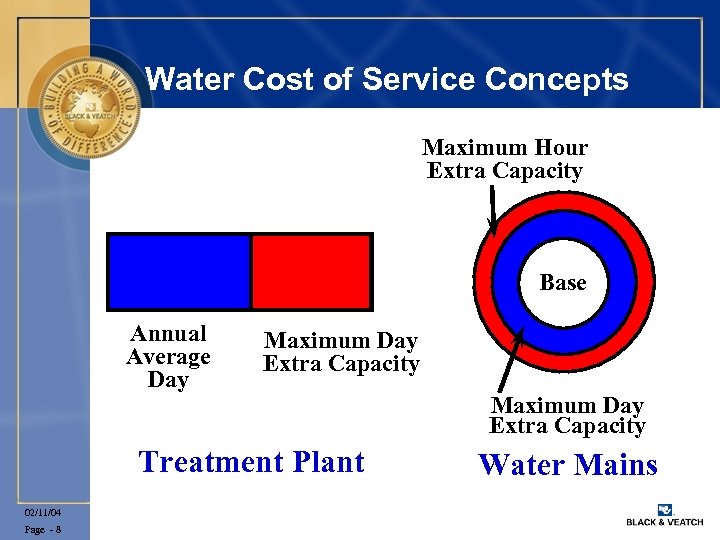
Water Cost of Service Concepts Maximum Hour Extra Capacity Base Annual Average Day Maximum Day Extra Capacity Treatment Plant 02/11/04 Page - 8 Maximum Day Extra Capacity Water Mains
Project Approach - Wastewater l l Excess Strength Surcharges l Page - 9 Cost Allocations – Cost Causative l 02/11/04 Utility Basis of Rate Design Septage Charges – Based on Same Volume and Excess Strength Charges Applied to Other Customers
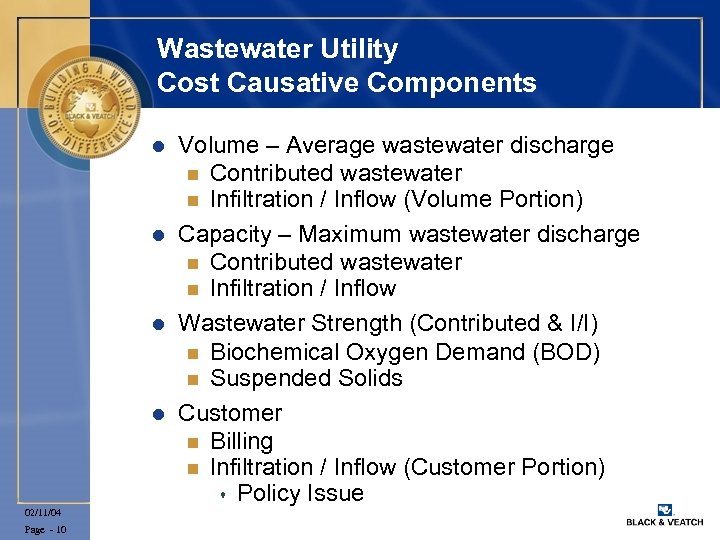
Wastewater Utility Cost Causative Components Volume – Average wastewater discharge n Contributed wastewater n Infiltration / Inflow (Volume Portion) l Capacity – Maximum wastewater discharge n Contributed wastewater n Infiltration / Inflow l Wastewater Strength (Contributed & I/I) n Biochemical Oxygen Demand (BOD) n Suspended Solids l Customer n Billing n Infiltration / Inflow (Customer Portion) s Policy Issue l 02/11/04 Page - 10
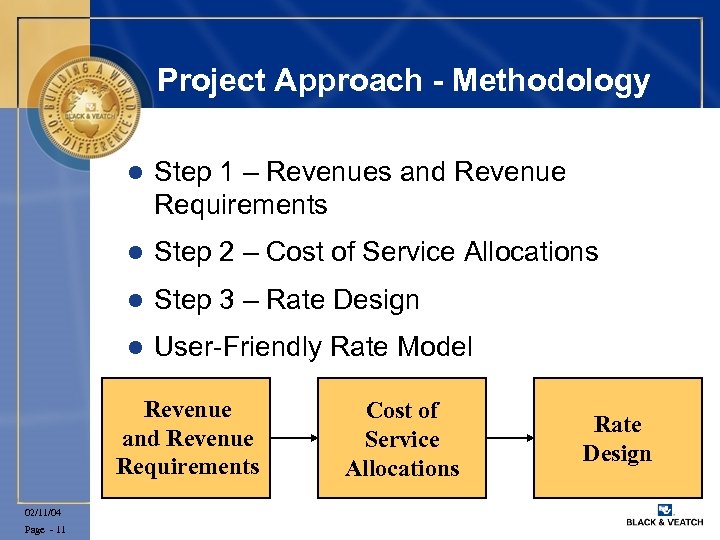
Project Approach - Methodology l Step 1 – Revenues and Revenue Requirements l Step 2 – Cost of Service Allocations l Step 3 – Rate Design l User-Friendly Rate Model Revenue and Revenue Requirements 02/11/04 Page - 11 Cost of Service Allocations Rate Design
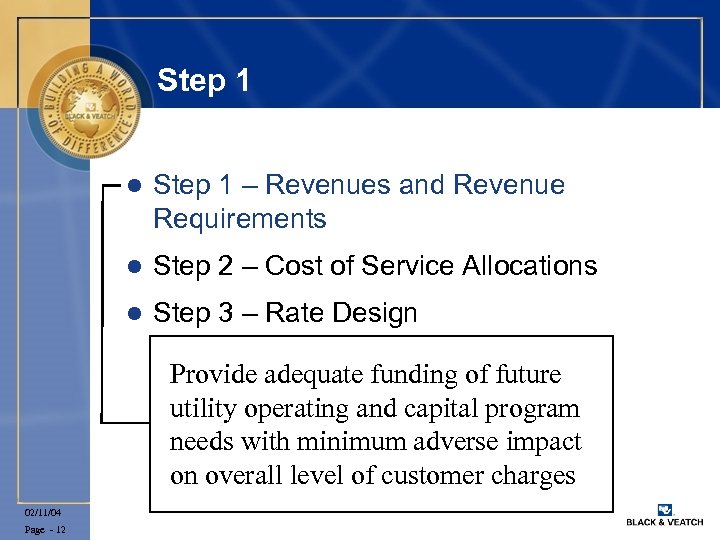
Step 1 l Step 1 – Revenues and Revenue Requirements l Step 2 – Cost of Service Allocations l Step 3 – Rate Design Provide adequate funding of future utility operating and capital program needs with minimum adverse impact on overall level of customer charges 02/11/04 Page - 12
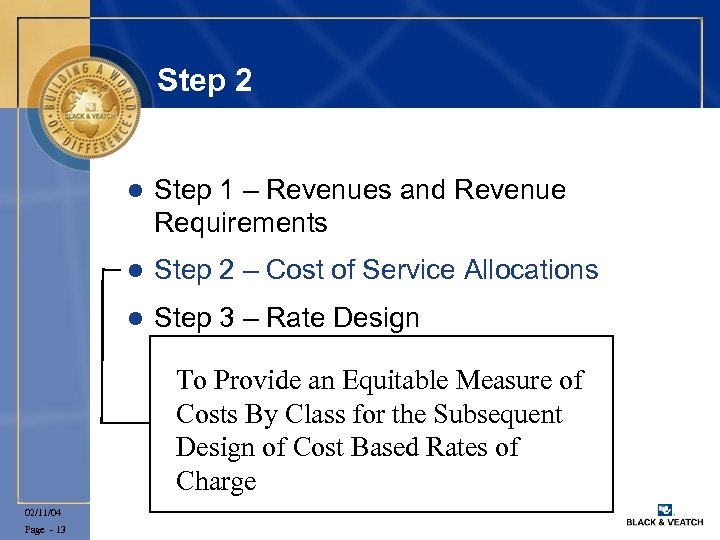
Step 2 l Step 1 – Revenues and Revenue Requirements l Step 2 – Cost of Service Allocations l Step 3 – Rate Design To Provide an Equitable Measure of Costs By Class for the Subsequent Design of Cost Based Rates of Charge 02/11/04 Page - 13
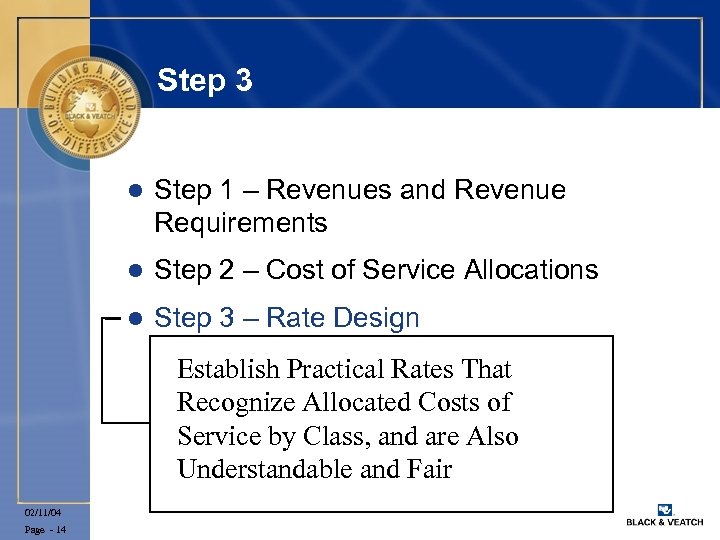
Step 3 l Step 1 – Revenues and Revenue Requirements l Step 2 – Cost of Service Allocations l Step 3 – Rate Design Establish Practical Rates That Recognize Allocated Costs of Service by Class, and are Also Understandable and Fair 02/11/04 Page - 14
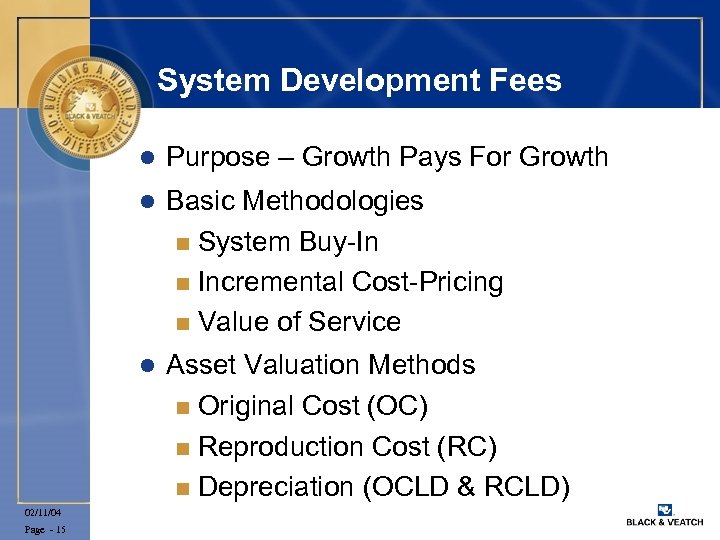
System Development Fees l l Page - 15 Basic Methodologies n System Buy-In n Incremental Cost-Pricing n Value of Service l 02/11/04 Purpose – Growth Pays For Growth Asset Valuation Methods n Original Cost (OC) n Reproduction Cost (RC) n Depreciation (OCLD & RCLD)
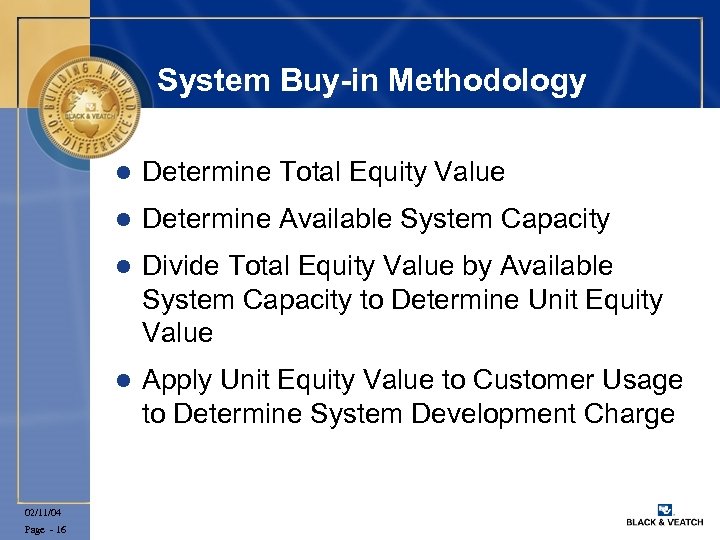
System Buy-in Methodology l l Divide Total Equity Value by Available System Capacity to Determine Unit Equity Value l Page - 16 Determine Available System Capacity l 02/11/04 Determine Total Equity Value Apply Unit Equity Value to Customer Usage to Determine System Development Charge
Policy Issues 1. Capital Financing 2. Debt Service Coverage 3. Fire Protection 4. Water Rate Structure 5. System Development Charges 6. I/I Cost Recovery 02/11/04 Page - 17
Issue 1 Capital Financing l Capital Financing Mix? n Cash – Pay-As-You-Go n Debt s s n 02/11/04 Page - 18 Traditional SRF Loan Program System Development Charges
Issue 2 Debt Service Coverage l Based on Combined Utility Approach l Large Coverage Ratio – 140% l Lower Debt Service Coverage Requirement? n n l 02/11/04 Page - 19 Refinance Existing Debt Reduce Required Coverage to 125%? Rate Design Target Level – 130%?
Issue 3 Private Fire Protection Charges l l 02/11/04 Page - 20 It is common utility practice to charge commercial customers a private fire protection charge for private fire connections serving their properties Should a private fire protection charge be imposed by the City of Lawrence?
Issue 4 Water Rate Structure l General l Customer Charges l Volume Charges n n Page - 21 Inverted Block n 02/11/04 Declining Block n l Uniform Seasonal (Conservation) Alternative Pricing Options
Rate Structure - General A rate structure normally consists of various elements: l l 02/11/04 Page - 22 A fixed or minimum rate for the lowest consumption levels and to recover fixed, customer related costs. A charge that generally varies with the volume consumed.
Rate Structure - General A properly structured rate should recognize the following rules: l l Page - 23 Minimize unexpected changes to customer’s bills. l 02/11/04 Yield total required revenue in a stable and predictable manner. Discourage wasteful use.
Rate Structure - General l l Maintain simplicity, certainty, convenience, and feasibility. l Page - 24 Avoid discrimination. l 02/11/04 Promote fairness and equity among classes of customers. Comply with all applicable laws.
Customer Charges 1. Service Charge: s Recovers customer related costs: s Meter costs l Meter reading l Billing and collecting l Customer service l Varies by size of meter s No volume allowance or costs included 02/11/04 Page - 25
Customer Charges 2. Minimum Bill Charge: s Recovers same costs as in Service Charge s Varies by meter size s Includes small volume allowance and associated cost 02/11/04 Page - 26
Monthly Service Charge The monthly service charge should be determined based on the cost to read the meter, prepare the bill, and provide other customer related services. Monthly rate = 02/11/04 Page - 27 Total customer service costs Total number of bills
Monthly Service Charge Check to ensure that this minimum or fixed monthly rate is affordable for your community. 02/11/04 Page - 28
Volume Charges 1. Uniform Volume Rate 2. Declining Block Rates (Lawrence) 3. Inverted Block Rates 4. Seasonal (Conservation) Rates 02/11/04 Page - 29
Volume Charges - Uniform 1. Uniform Volume Rate l All consumption billed at same unit rate: n All customers n Separate by class l Simplicity/customer understanding are highly valued l Customer classes have similar usage characteristics/demand 02/11/04 Page - 30
Volume Charges - Uniform l l Provides revenue stability l Page - 31 Easy to implement l 02/11/04 Customer consumption data is limited Sends conservation signal relative to Flat Rates or Declining Block Rates
Volume Charges – Declining Block 2. Declining Block Rates l l Page - 32 A single rate schedule applicable to all classes l 02/11/04 Varied demands by customer class System costs decline with increasing usage (economies of scale)
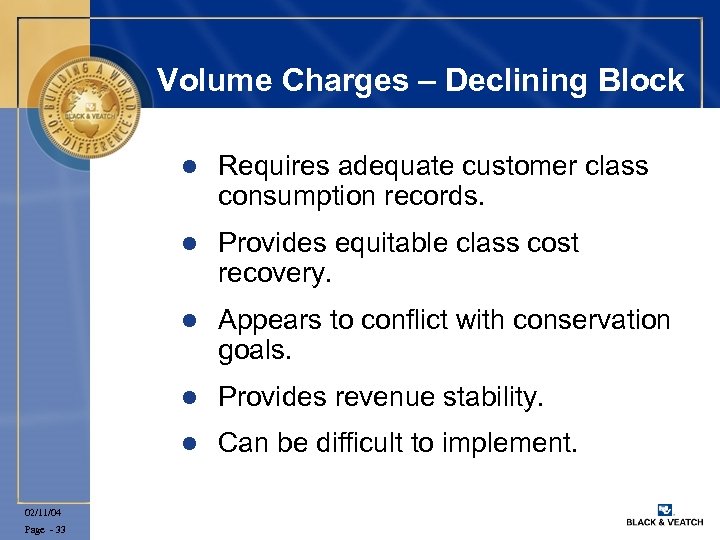
Volume Charges – Declining Block l l Appears to conflict with conservation goals. l Provides revenue stability. l Page - 33 Provides equitable class cost recovery. l 02/11/04 Requires adequate customer class consumption records. Can be difficult to implement.
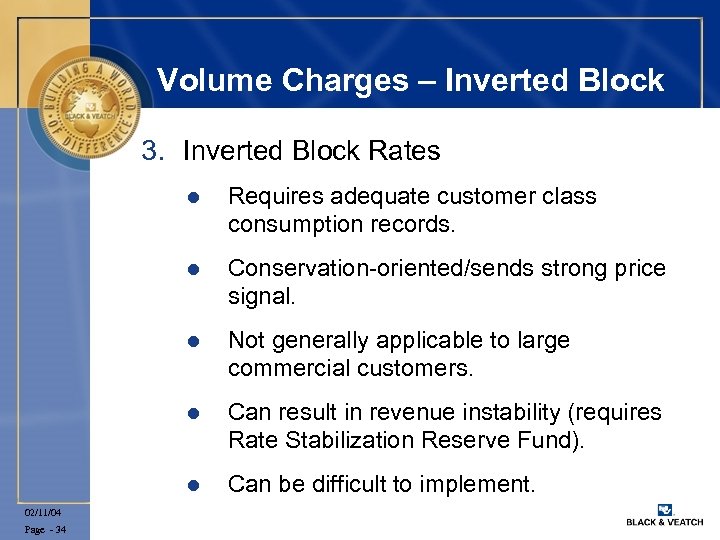
Volume Charges – Inverted Block 3. Inverted Block Rates l l Not generally applicable to large commercial customers. l Can result in revenue instability (requires Rate Stabilization Reserve Fund). l Page - 34 Conservation-oriented/sends strong price signal. l 02/11/04 Requires adequate customer class consumption records. Can be difficult to implement.
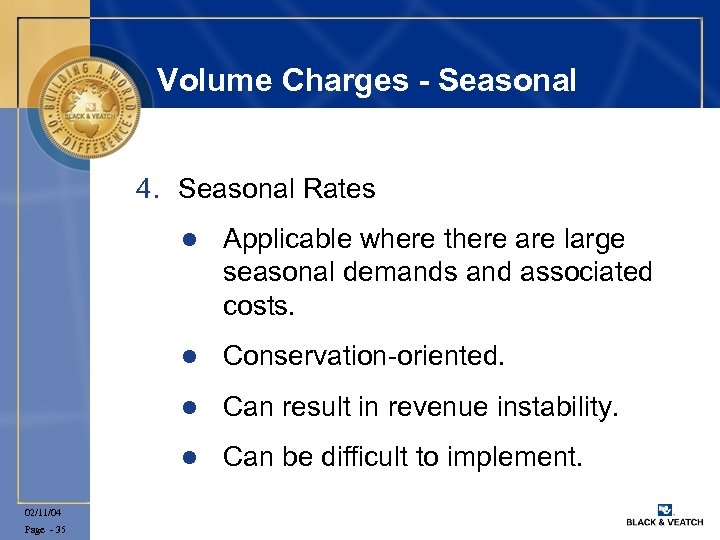
Volume Charges - Seasonal 4. Seasonal Rates l l Can result in revenue instability. l Page - 35 Conservation-oriented. l 02/11/04 Applicable where there are large seasonal demands and associated costs. Can be difficult to implement.
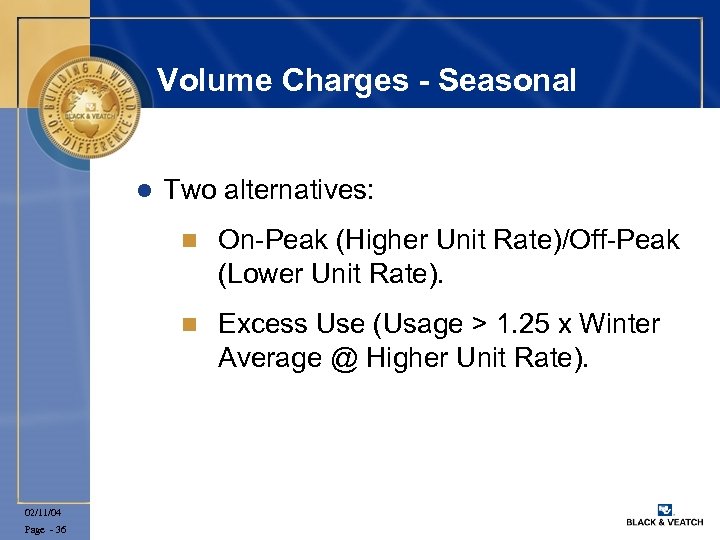
Volume Charges - Seasonal l Two alternatives: n n 02/11/04 Page - 36 On-Peak (Higher Unit Rate)/Off-Peak (Lower Unit Rate). Excess Use (Usage > 1. 25 x Winter Average @ Higher Unit Rate).
Issue 5 System Development Charges l Growth Pays for Growth n System Buy-In Methodology s s n l 02/11/04 Page - 37 Current Charges Have Not Been Updated Since They Were Enacted In 1999 Large Increases May Be Required Incremental Cost Pricing Dedicated Capacity Charges?
Issue 6 - Infiltration / Inflow (I/I) Cost Recovery l I/I Costs Must Be Recovered from Customers l Currently Recovered: n n l 02/11/04 Page - 38 2/3 on Customer Basis 1/3 on Volume Basis Should this allocation basis be changed to lower minimum charges?

Questions / Answers 02/11/04 Page - 39
Скачать презентацию Cost of Service Based Water and Wastewater Rates
27ed58c325b275c9aacf0d6df743ead5.ppt