


 Скачать презентацию Cost Forecasting and Analysis for the Un-Initiated Part
e9c40453106545ee79938ebd2b81d1f2.ppt
- Количество слайдов: 33
 “Cost Forecasting and Analysis for the Un-Initiated” (Part 1) Arthur Griffiths Chairman, SCAF 23 rd February 2005
 Contents Requirements for project success l Cost estimating basics l – Purpose, Applications, Skills, Benefits, Qualities, Limitations, Concerns l l l Principles of Cost Analysis Elements of Life Cycle Costing Influences of Costs Illustrations and issues Some myths of project management and costs February 2005
 Requirements for Project Success February 2005
 To bring a project in to Time and Cost requires that: l Targets are realistic – Targets can be challenging but they must be attainable or else the programme is doomed to failure from the start l The project is well managed – The possibility for expenditure and delay are unbounded l The requirement remains stable – To get anywhere one must know where one is going – Navigation is hindered if the customer tears up the map February 2005
 Causes of Failure l Causes of delay to in-service date – Technical difficulties – Need to redefine a project – Deferring projects to match overall funding l Causes of cost variance – Programme changes – Inflation adjustments – Specification changes Source: NAO Mo. D Major Projects Report February 2005
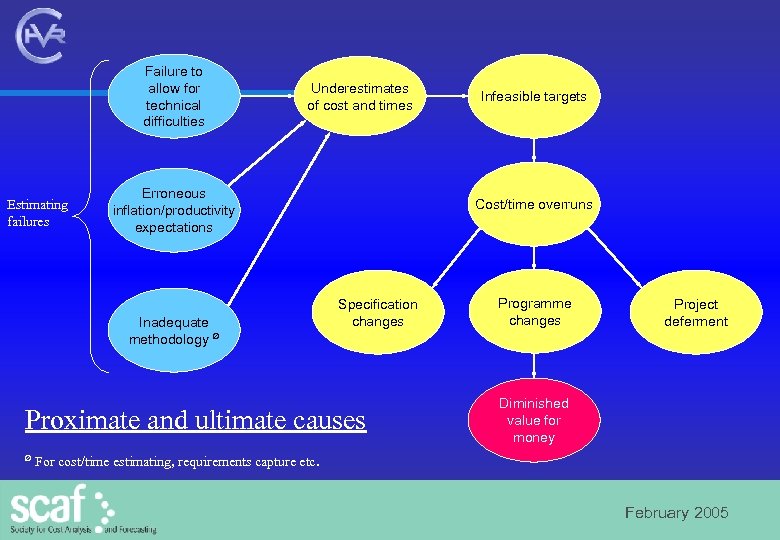 Failure to allow for technical difficulties Estimating failures Underestimates of cost and times Erroneous inflation/productivity expectations Inadequate methodology Ø Cost/time overruns Specification changes Proximate and ultimate causes Ø Infeasible targets Programme changes Project deferment Diminished value for money For cost/time estimating, requirements capture etc. February 2005
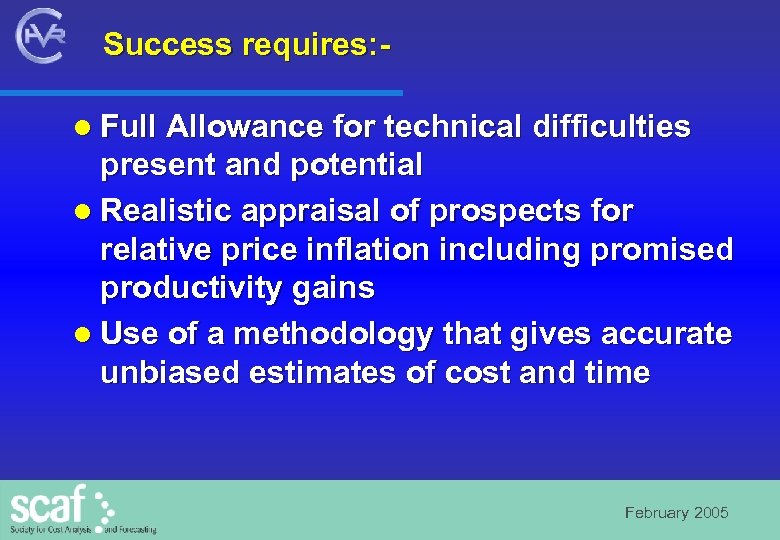 Success requires: l Full Allowance for technical difficulties present and potential l Realistic appraisal of prospects for relative price inflation including promised productivity gains l Use of a methodology that gives accurate unbiased estimates of cost and time February 2005
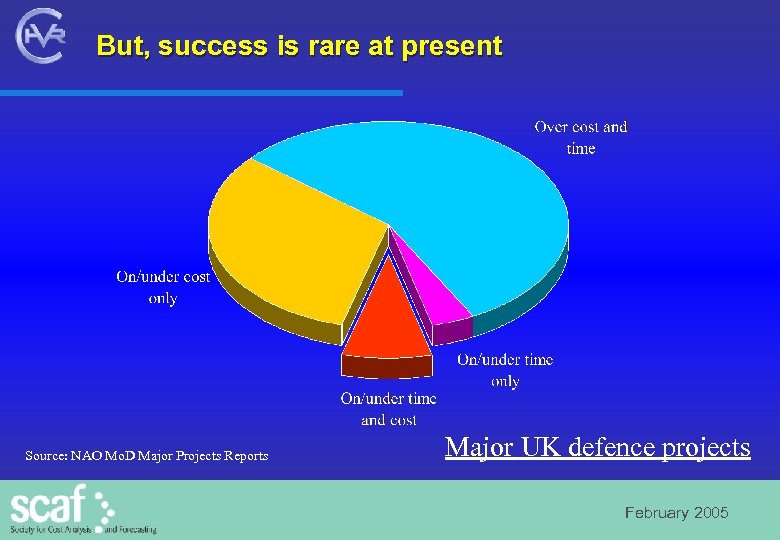 But, success is rare at present Source: NAO Mo. D Major Projects Reports Major UK defence projects February 2005
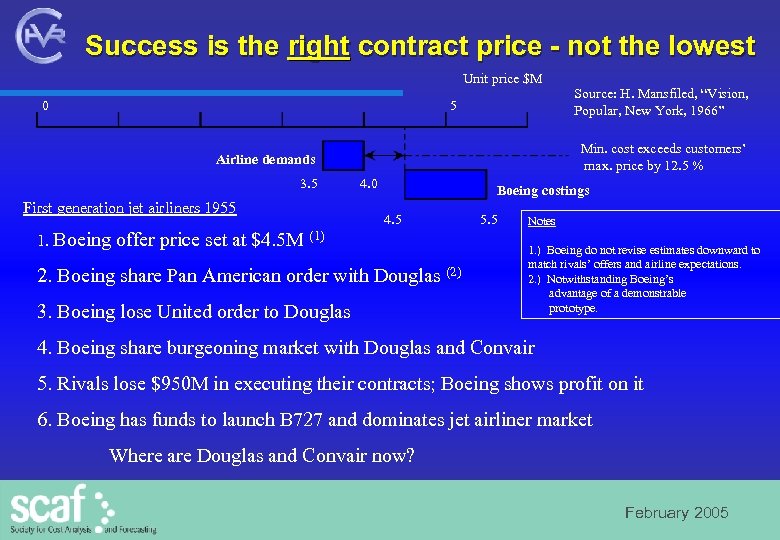 Success is the right contract price - not the lowest Unit price $M 0 5 Min. cost exceeds customers’ max. price by 12. 5 % Airline demands 3. 5 First generation jet airliners 1955 1. Boeing offer price set at $4. 5 M Source: H. Mansfiled, “Vision, Popular, New York, 1966” 4. 0 Boeing costings 4. 5 5. 5 Notes (1) 2. Boeing share Pan American order with Douglas (2) 3. Boeing lose United order to Douglas 1. ) Boeing do not revise estimates downward to match rivals’ offers and airline expectations. 2. ) Notwithstanding Boeing’s advantage of a demonstrable prototype. 4. Boeing share burgeoning market with Douglas and Convair 5. Rivals lose $950 M in executing their contracts; Boeing shows profit on it 6. Boeing has funds to launch B 727 and dominates jet airliner market Where are Douglas and Convair now? February 2005
 Cost Estimating Basics February 2005
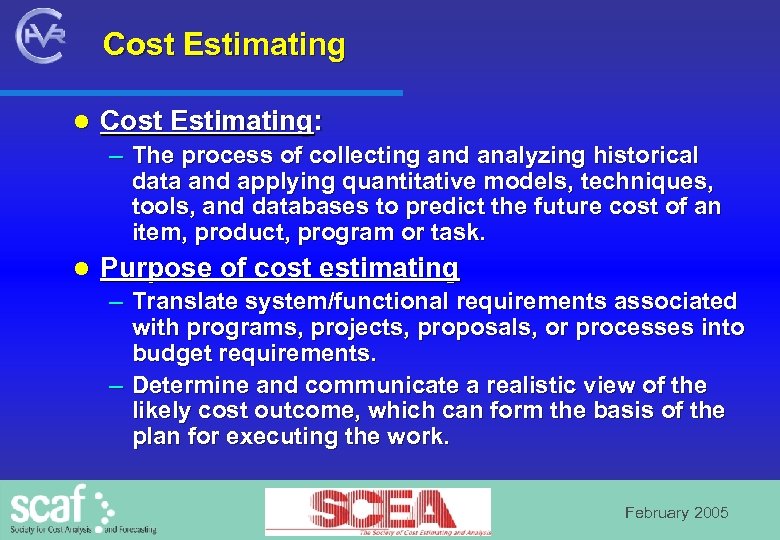 Cost Estimating l Cost Estimating: – The process of collecting and analyzing historical data and applying quantitative models, techniques, tools, and databases to predict the future cost of an item, product, program or task. l Purpose of cost estimating – Translate system/functional requirements associated with programs, projects, proposals, or processes into budget requirements. – Determine and communicate a realistic view of the likely cost outcome, which can form the basis of the plan for executing the work. February 2005
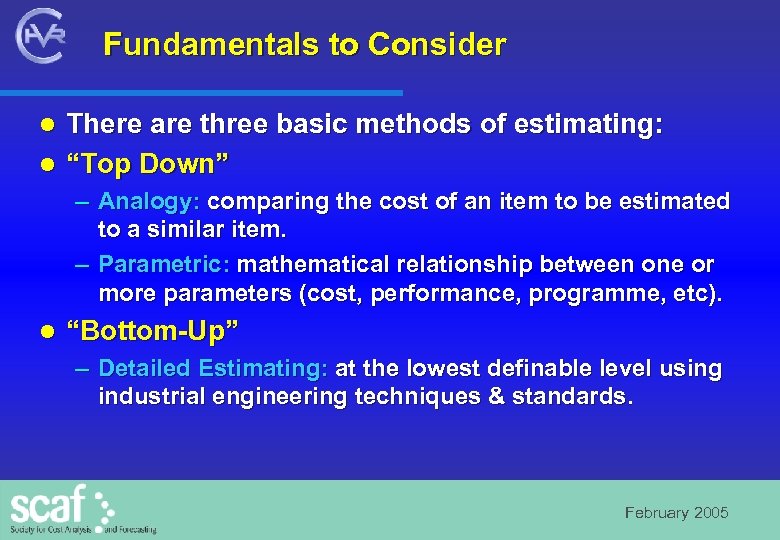 Fundamentals to Consider There are three basic methods of estimating: l “Top Down” l – Analogy: comparing the cost of an item to be estimated to a similar item. – Parametric: mathematical relationship between one or more parameters (cost, performance, programme, etc). l “Bottom-Up” – Detailed Estimating: at the lowest definable level using industrial engineering techniques & standards. February 2005
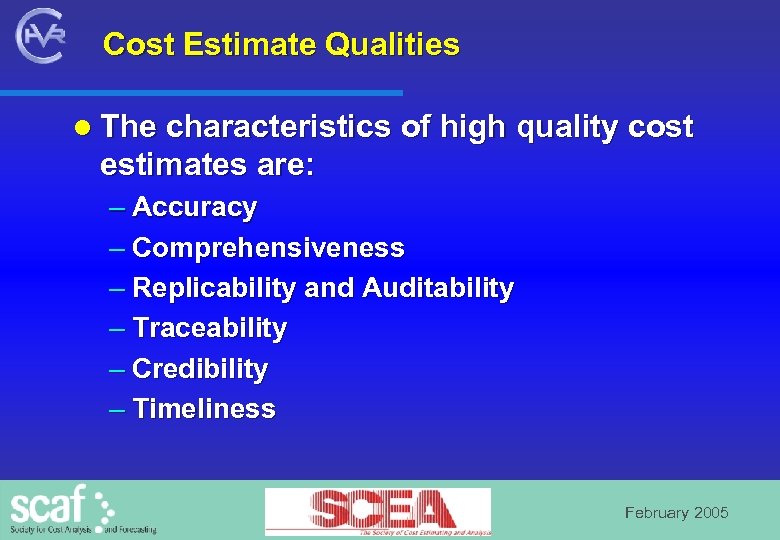 Cost Estimate Qualities l The characteristics of high quality cost estimates are: – Accuracy – Comprehensiveness – Replicability and Auditability – Traceability – Credibility – Timeliness February 2005
 Limitations of Cost Estimating l Cost estimating cannot: - – Be applied with cookbook precision – Produce results that are better than the input data – Predict political impacts – No substitute for sound judgment, management, or control – Make final decisions February 2005
 A Few - Cost Estimating Concerns l Consistency – Estimates must track over time – Estimates developed by other organisations must be based on same content and assumptions – Historical data is not consistent between differing cost element or work breakdown structures l Security/access – – – Company-proprietary data Data classification/security Possible misuse of data February 2005
 Basic principles of cost analysis February 2005
 General introduction to some concept and current issues • Some definitions and distinctions • Elements of Life-Cycle cost • Influences on cost • Illustrations and issues • Economics of scale February 2005
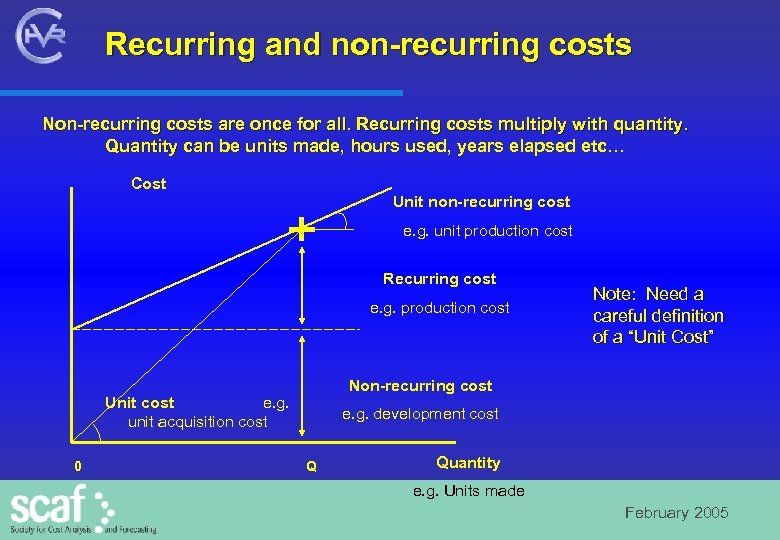 Recurring and non-recurring costs Non-recurring costs are once for all. Recurring costs multiply with quantity. Quantity can be units made, hours used, years elapsed etc… Cost Unit non-recurring cost e. g. unit production cost Recurring cost e. g. production cost Non-recurring cost Unit cost e. g. unit acquisition cost 0 Note: Need a careful definition of a “Unit Cost” e. g. development cost Q Quantity e. g. Units made February 2005
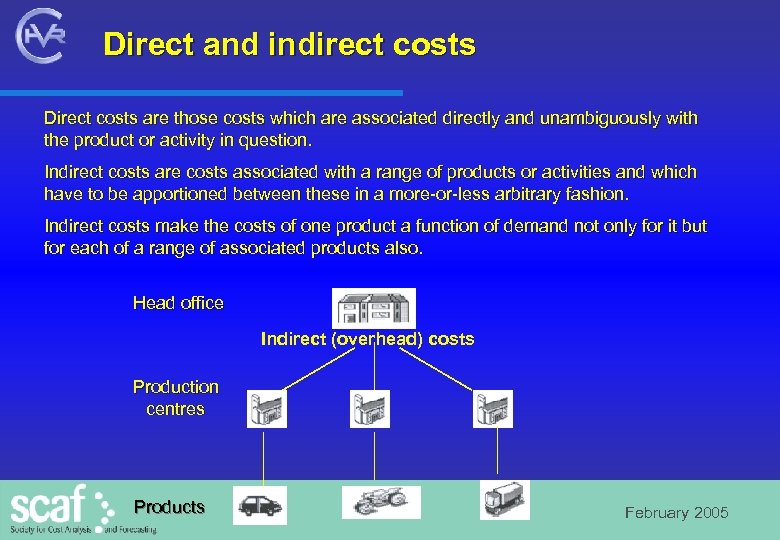 Direct and indirect costs Direct costs are those costs which are associated directly and unambiguously with the product or activity in question. Indirect costs are costs associated with a range of products or activities and which have to be apportioned between these in a more-or-less arbitrary fashion. Indirect costs make the costs of one product a function of demand not only for it but for each of a range of associated products also. Head office Indirect (overhead) costs Production centres Products February 2005
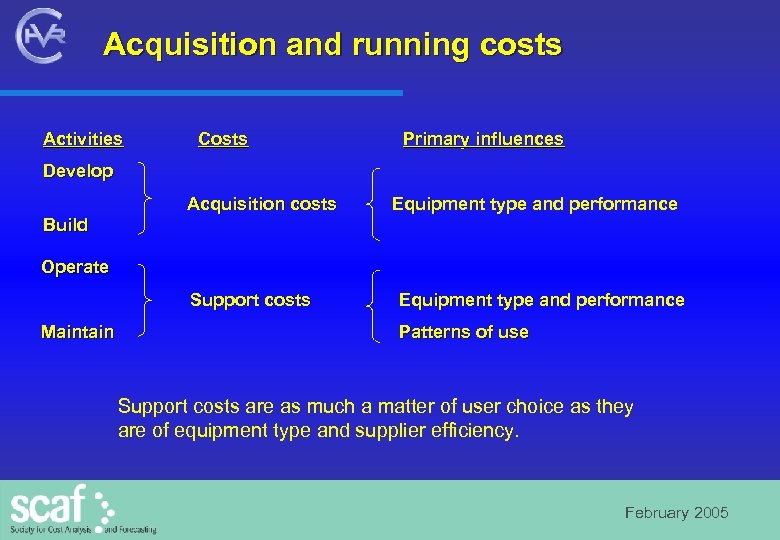 Acquisition and running costs Activities Costs Primary influences Develop Acquisition costs Equipment type and performance Build Operate Support costs Maintain Equipment type and performance Patterns of use Support costs are as much a matter of user choice as they are of equipment type and supplier efficiency. February 2005
 Elements of Life Cycle Cost February 2005
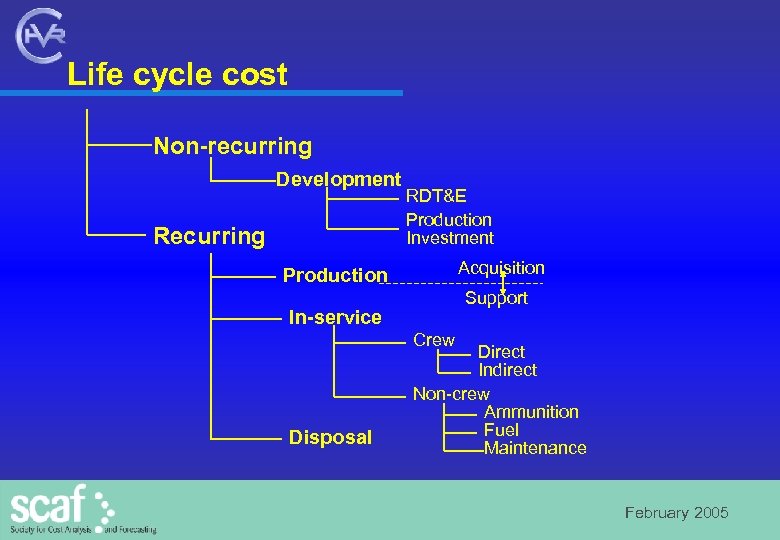 Life cycle cost Non-recurring Development Recurring RDT&E Production Investment Acquisition Production Support In-service Crew Disposal Direct Indirect Non-crew Ammunition Fuel Maintenance February 2005
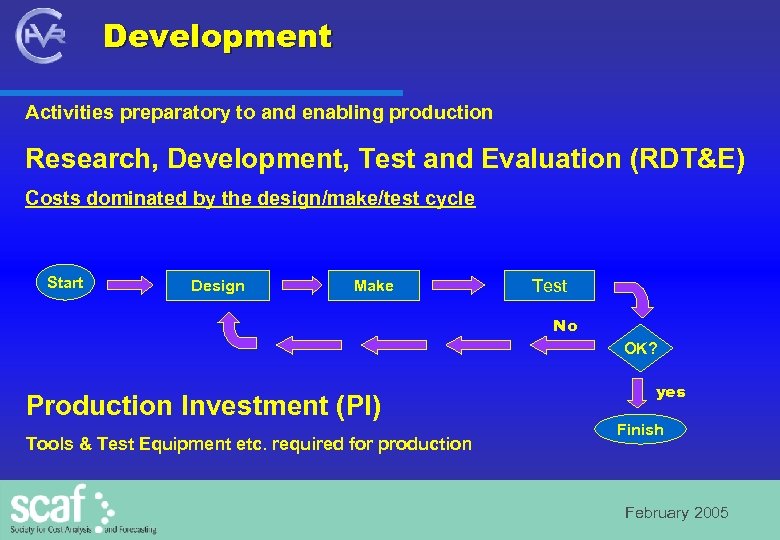 Development Activities preparatory to and enabling production Research, Development, Test and Evaluation (RDT&E) Costs dominated by the design/make/test cycle Start Design Make Test No OK? Production Investment (PI) Tools & Test Equipment etc. required for production yes Finish February 2005
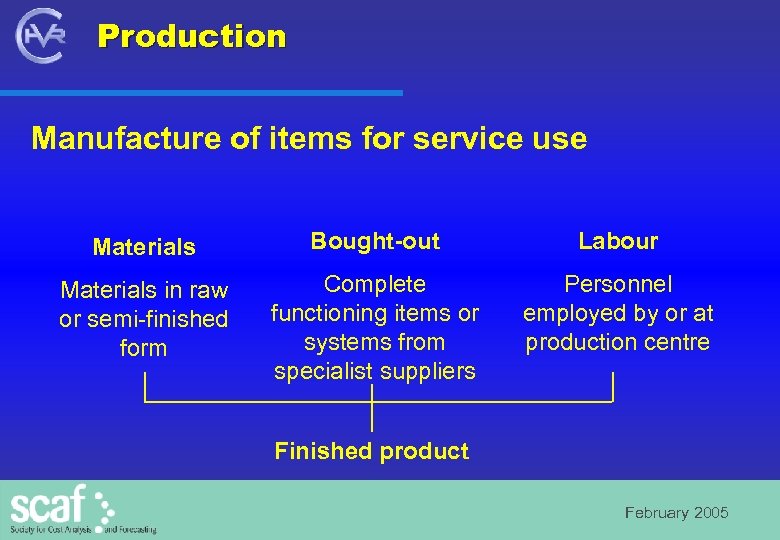 Production Manufacture of items for service use Materials Bought-out Labour Materials in raw or semi-finished form Complete functioning items or systems from specialist suppliers Personnel employed by or at production centre Finished product February 2005
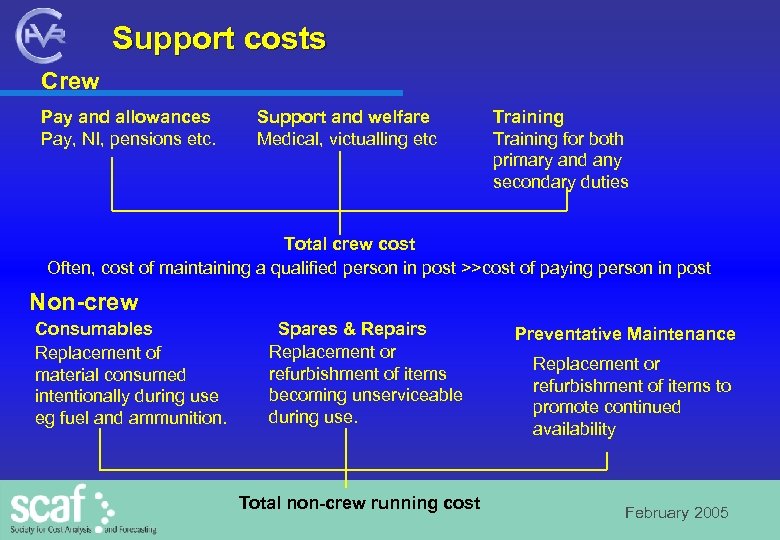 Support costs Crew Pay and allowances Pay, NI, pensions etc. Support and welfare Medical, victualling etc Training for both primary and any secondary duties Total crew cost Often, cost of maintaining a qualified person in post >>cost of paying person in post Non-crew Consumables Replacement of material consumed intentionally during use eg fuel and ammunition. Spares & Repairs Replacement or refurbishment of items becoming unserviceable during use. Total non-crew running cost Preventative Maintenance Replacement or refurbishment of items to promote continued availability February 2005
 Disposal There are different costs for disposal by: • Sale for reuse • Sale for scrap • Destruction/ incineration • Terminal use • Indefinite storage • Land fill/ dump at sea Employment of environmentally damaging materials can impose high disposal costs. May invoke wider legal and ecological issues. February 2005
 Influences on cost (Other than technical characteristics of the equipment in question) February 2005
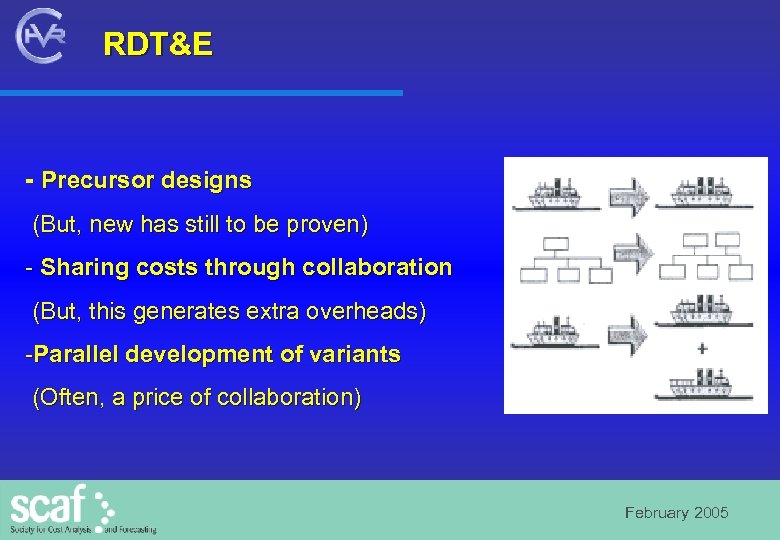 RDT&E - Precursor designs (But, new has still to be proven) - Sharing costs through collaboration (But, this generates extra overheads) -Parallel development of variants (Often, a price of collaboration) February 2005
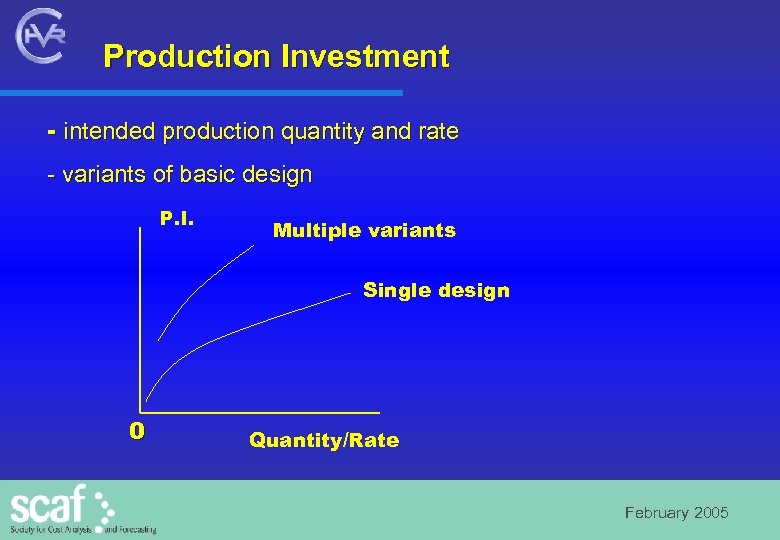 Production Investment - intended production quantity and rate - variants of basic design P. I. Multiple variants Single design 0 Quantity/Rate February 2005
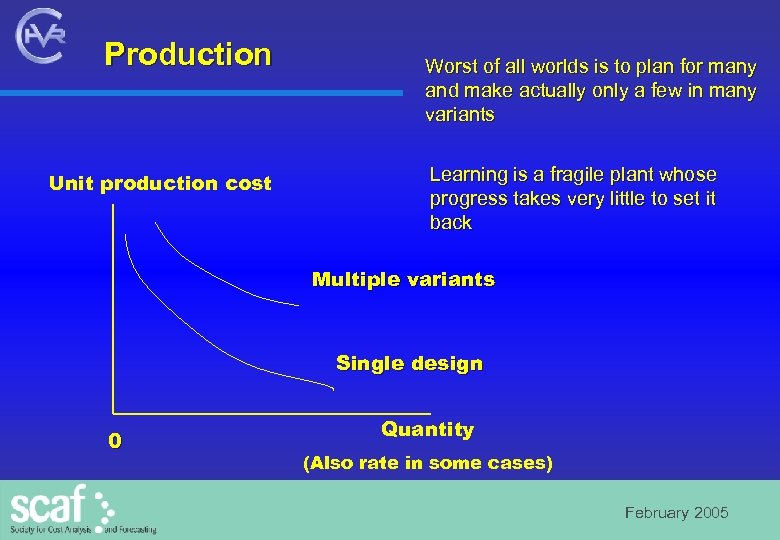 Production Unit production cost Worst of all worlds is to plan for many and make actually only a few in many variants Learning is a fragile plant whose progress takes very little to set it back Multiple variants Single design 0 Quantity (Also rate in some cases) February 2005
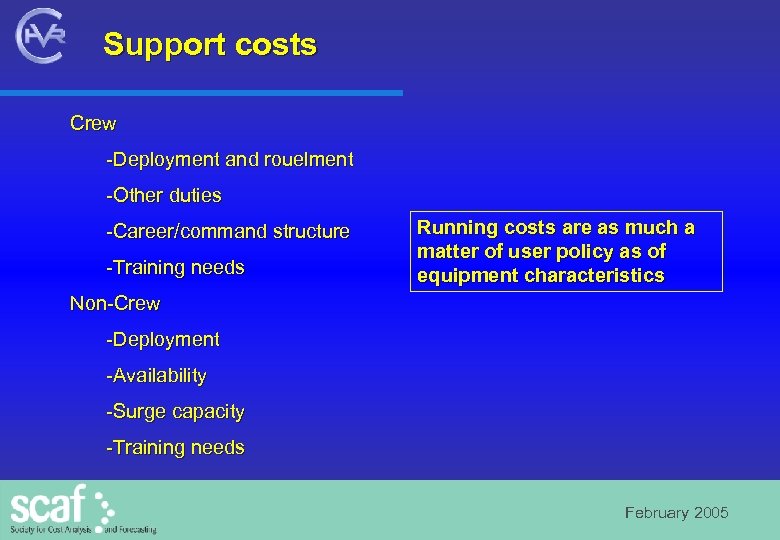 Support costs Crew -Deployment and rouelment -Other duties -Career/command structure -Training needs Running costs are as much a matter of user policy as of equipment characteristics Non-Crew -Deployment -Availability -Surge capacity -Training needs February 2005
 Disposal • Can be a negative cost if the equipment is sold on. • Can be sensitive to use of hazardous materials. • Disposal (or, even, non-disposal) of nuclear materials is a special problem. February 2005
 Questions & Contact Details Arthur Griffiths HVR Consulting Services Ltd Selborne House Mill Lane Alton Hants GU 34 2 QJ Tel: 01420 -87977 Email: arthur. griffiths@hvr-csl. co. uk February 2005