


 Скачать презентацию Cost Effectiveness Incremental Cost Analyses Applications to
0b1eebcd582edbc1c5d6101242014684.ppt
- Количество слайдов: 125
 Cost Effectiveness/ Incremental Cost Analyses & Applications to Indian River Lagoon Ecosystem Restoration Project Leigh Skaggs, HQUSACE Planners’ Core Curriculum: Economic Analysis March 2009
 Objectives • What are Cost Effectiveness & Incremental Cost Analyses (CE/ICA) ? • Why are CE/ICA conducted in evaluating ecosystem restoration alternatives? • How is CE/ICA performed & how was it done for Indian River Lagoon, FL Project? • What are some of the Nuances/ Issues/ Lessons from this project related to CE/ICA?
 References • ER 1105 -2 -100 • IWR Report 95 -R-1 • IWR Report 94 -PS-2 • IWR Report 02 -R-5 • Central & Southern Florida Project: Indian River Lago South, Project Implementation Report (2004) “IWR Planning Suite User’s Guide” • – Chapters 2 & 3, Appendix E – “Procedures Manual: Cost Effectiveness and Incremental Cost Cos Analyses” – “Cost Effectiveness Analysis for Environmental Planning: Nine EASY Steps” – “Lessons Learned from CE/ICA” – Draft IWR Report, Nov 2006 (www. iwr. usace. army. mil/)
 What are CEA/ICA? Why do CEA/ICA?
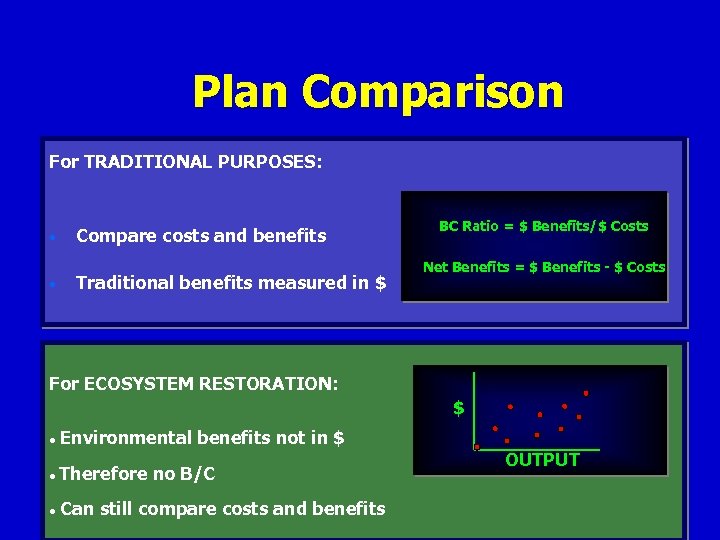 Plan Comparison For TRADITIONAL PURPOSES: • • Compare costs and benefits Traditional benefits measured in $ BC Ratio = $ Benefits/$ Costs Net Benefits = $ Benefits - $ Costs For ECOSYSTEM RESTORATION: $ • Environmental benefits not in $ • Therefore no B/C • Can still compare costs and benefits OUTPUT
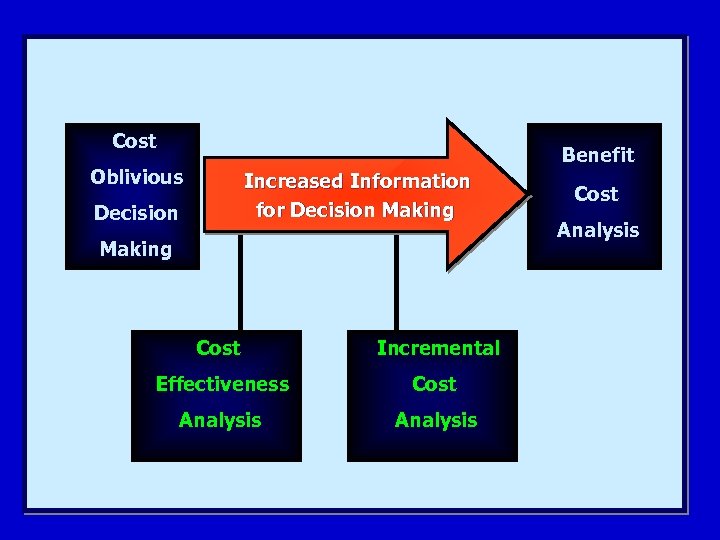 Cost Benefit Oblivious Increased Information for Decision Making Cost Incremental Effectiveness Cost Analysis
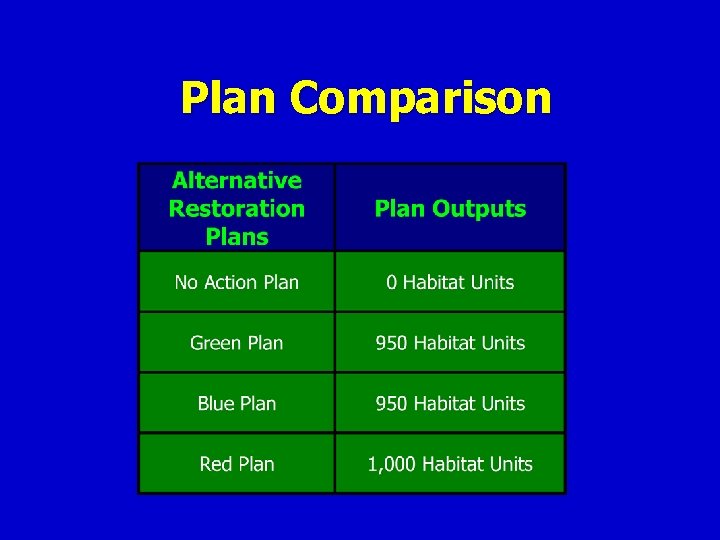 Plan Comparison
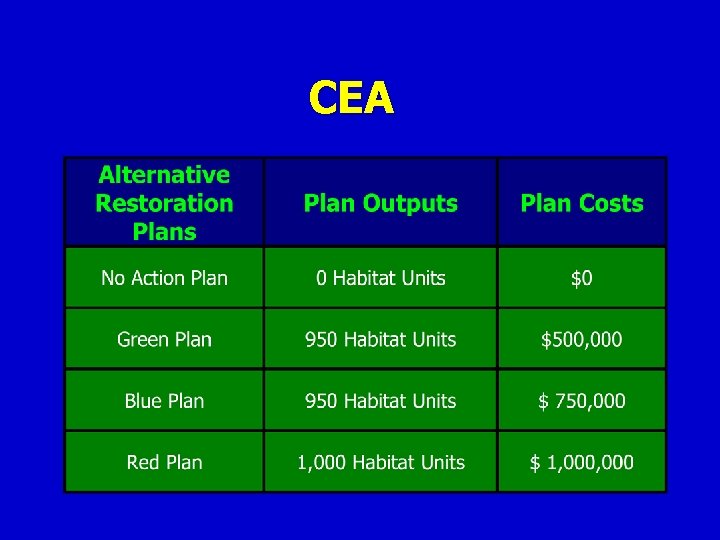 CEA
CEA
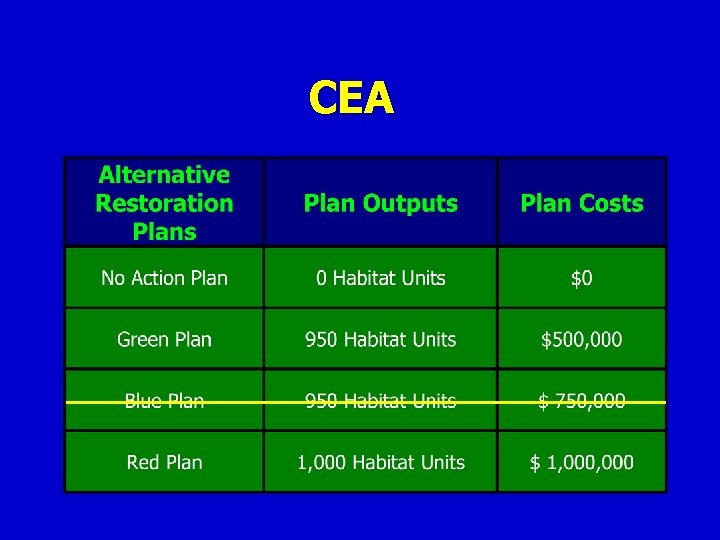 CEA
CEA
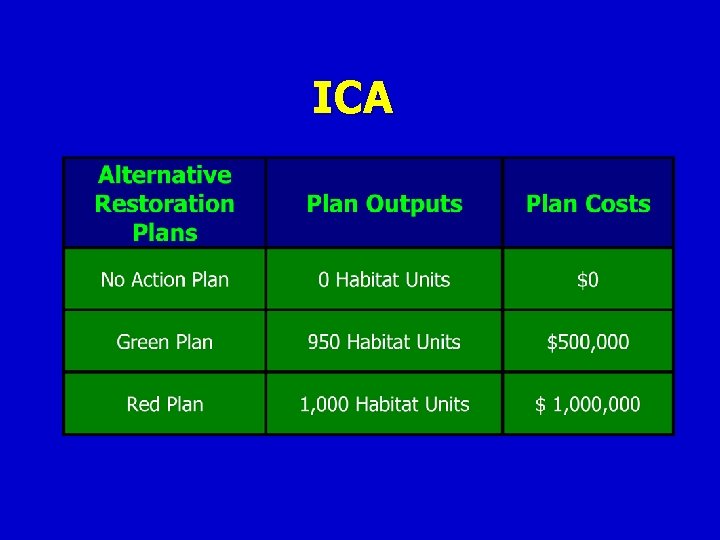 ICA
ICA
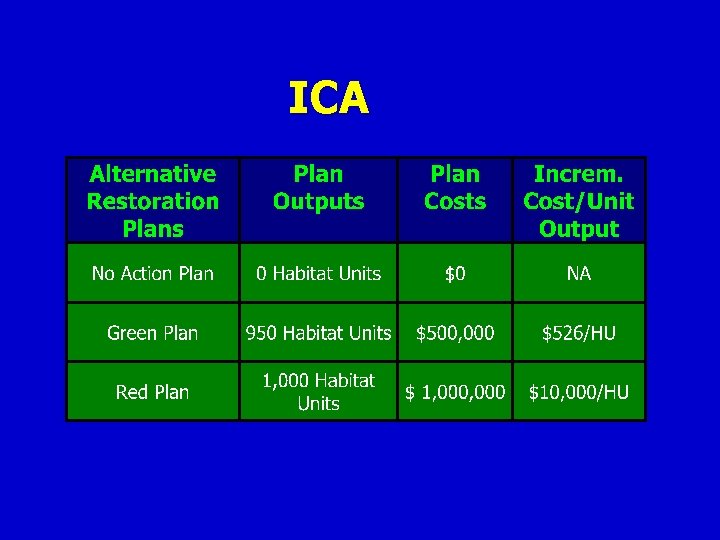 ICA
ICA
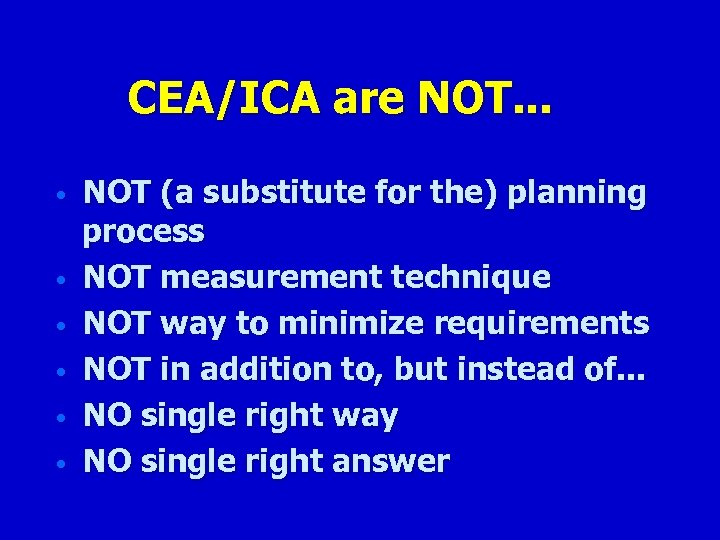 CEA/ICA are NOT. . . • • • NOT (a substitute for the) planning process NOT measurement technique NOT way to minimize requirements NOT in addition to, but instead of. . . NO single right way NO single right answer
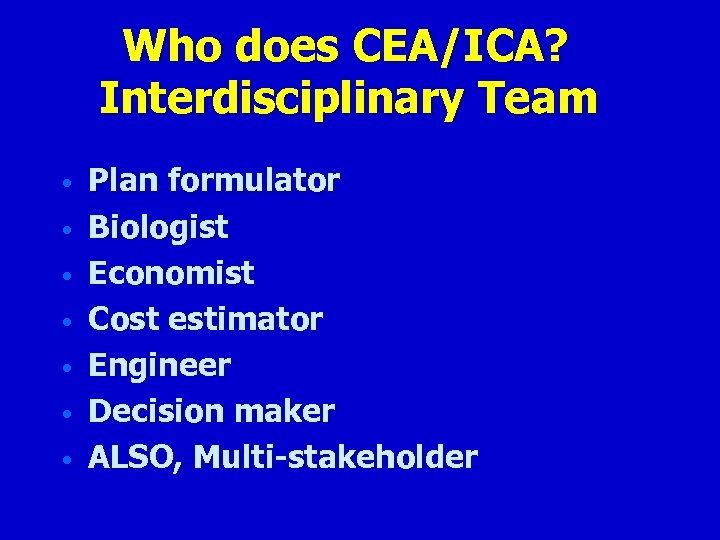 Who does CEA/ICA? Interdisciplinary Team • • Plan formulator Biologist Economist Cost estimator Engineer Decision maker ALSO, Multi-stakeholder
 How do you do CEA/ICA? Before you start, you need: • Solutions • Costs • Outputs
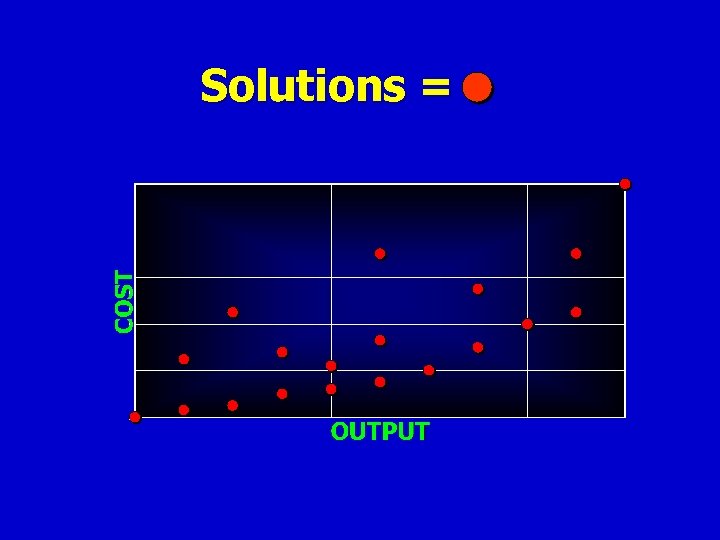 Solutions =
 Solutions • Management measures – Examples: dredging, planting, reservoirs, stormwater treatment areas, water diversions, substrate improvement, fencing, exotic removal • Alternative plans – Fully-formulated alternatives • Different sites
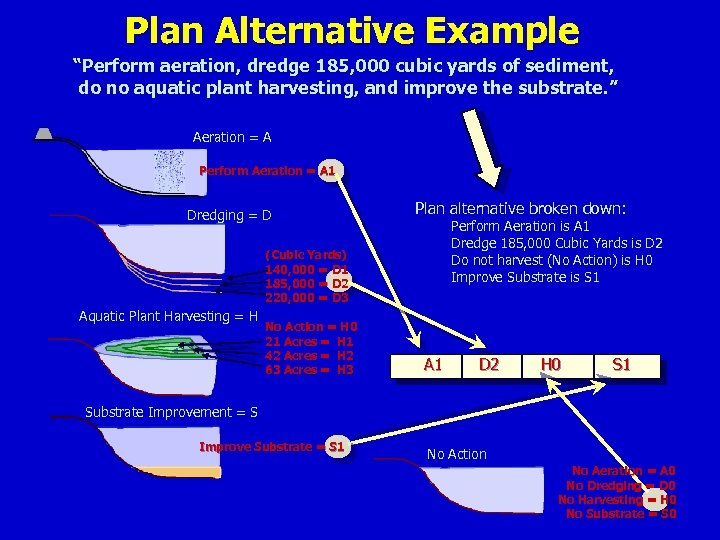 Plan Alternative Example “Perform aeration, dredge 185, 000 cubic yards of sediment, do no aquatic plant harvesting, and improve the substrate. ” Aeration = A Perform Aeration = A 1 Dredging = D Plan alternative broken down: Perform Aeration is A 1 Dredge 185, 000 Cubic Yards is D 2 Do not harvest (No Action) is H 0 Improve Substrate is S 1 (Cubic Yards) 140, 000 = D 1 185, 000 = D 2 220, 000 = D 3 Aquatic Plant Harvesting = H No Action = H 0 21 Acres = H 1 42 Acres = H 2 63 Acres = H 3 A 1 D 2 H 0 S 1 Substrate Improvement = S Improve Substrate = S 1 No Action No Aeration = A 0 No Dredging = D 0 No Harvesting = H 0 No Substrate = S 0
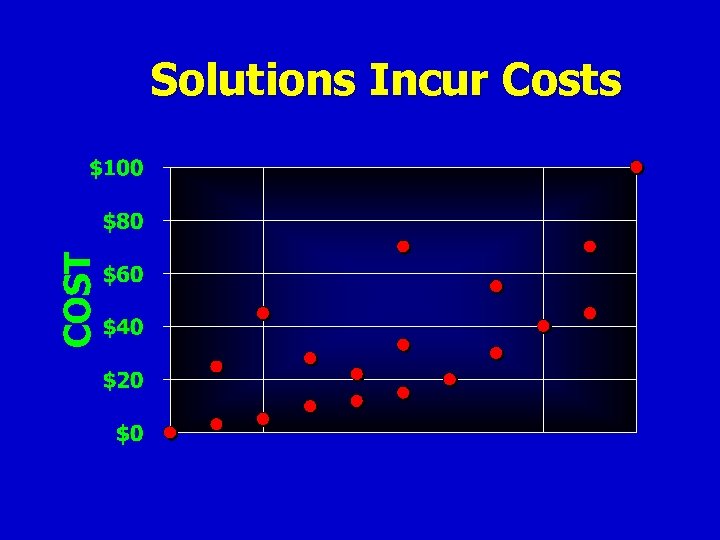 Solutions Incur Costs
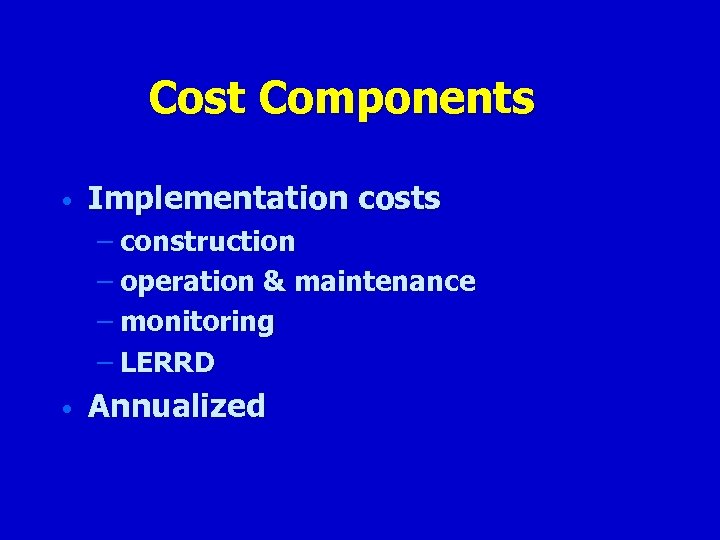 Cost Components • Implementation costs – construction – operation & maintenance – monitoring – LERRD • Annualized
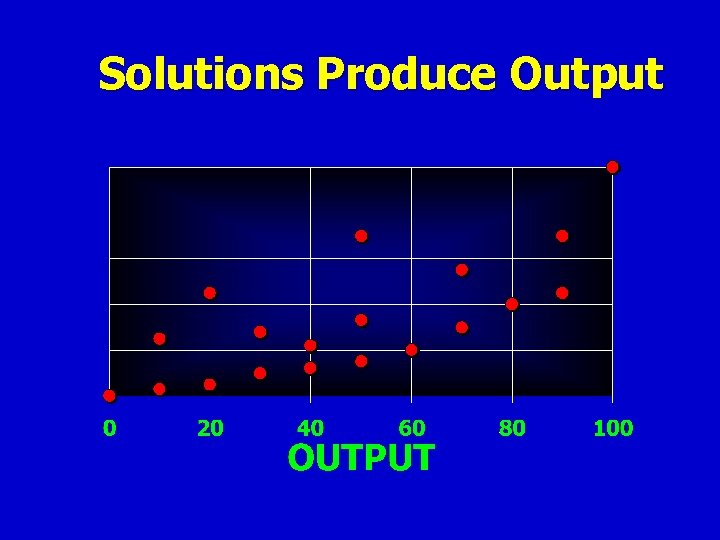 Solutions Produce Output
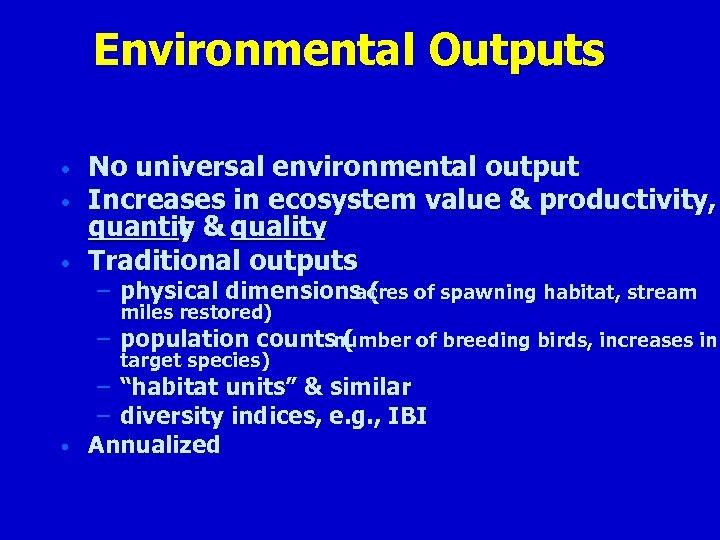 Environmental Outputs • • • No universal environmental output Increases in ecosystem value & productivity, quantit & quality y Traditional outputs – physical dimensions ( of spawning habitat, stream acres miles restored) – population countsnumber of breeding birds, increases in ( target species) • – “habitat units” & similar – diversity indices, e. g. , IBI Annualized
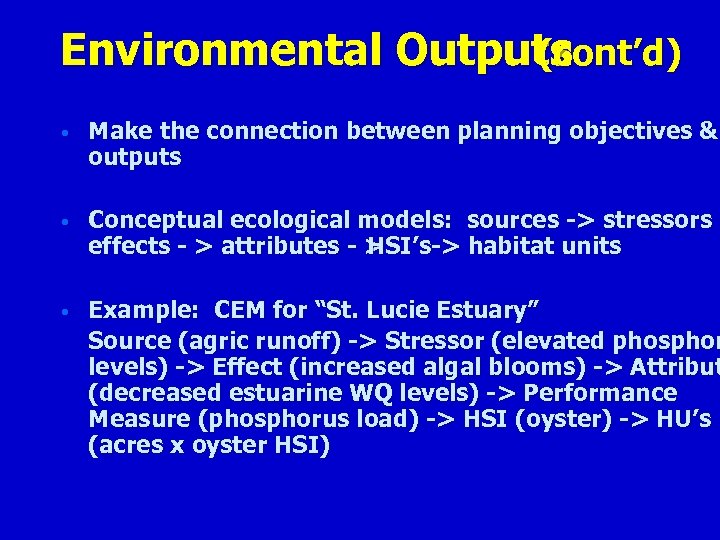 Environmental Outputs (cont’d) • Make the connection between planning objectives & outputs • Conceptual ecological models: sources -> stressors effects - > attributes - > HSI’s-> habitat units • Example: CEM for “St. Lucie Estuary” Source (agric runoff) -> Stressor (elevated phosphor levels) -> Effect (increased algal blooms) -> Attribut (decreased estuarine WQ levels) -> Performance Measure (phosphorus load) -> HSI (oyster) -> HU’s (acres x oyster HSI)
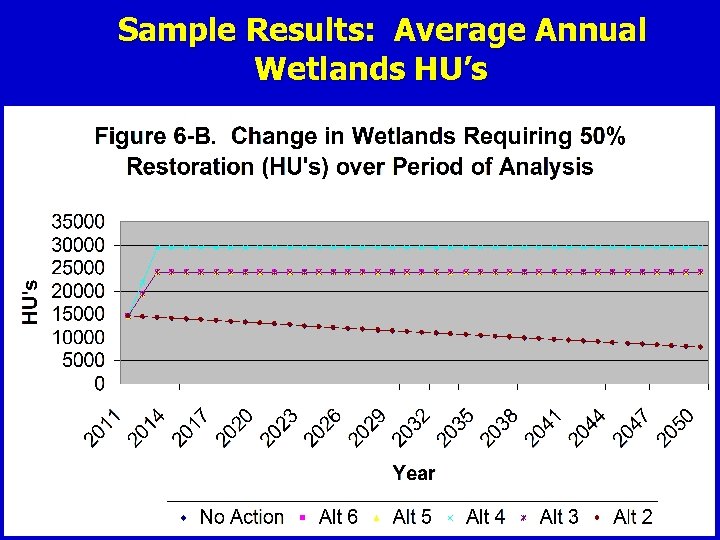 Sample Results: Average Annual Wetlands HU’s
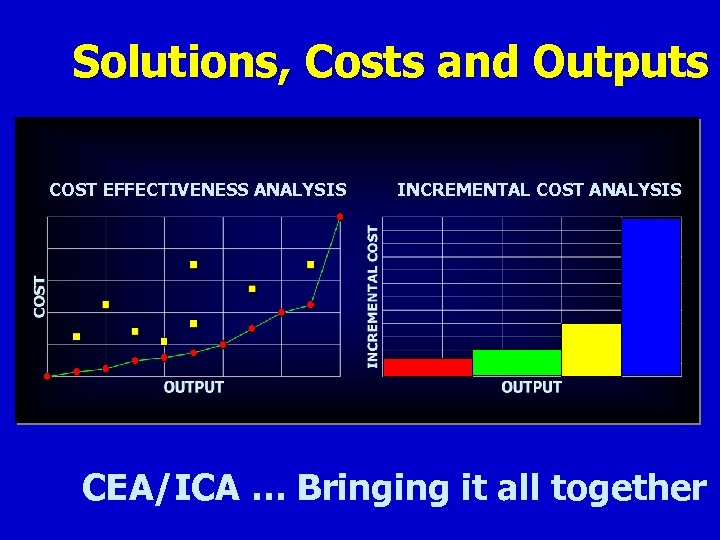 Solutions, Costs and Outputs COST EFFECTIVENESS ANALYSIS INCREMENTAL COST ANALYSIS CEA/ICA … Bringing it all together
 Step-by-step process: • Plan formulation • • Cost effectiveness analysis Incremental cost analysis • Decision making
 Cost Effectiveness Student Exercise Part 1
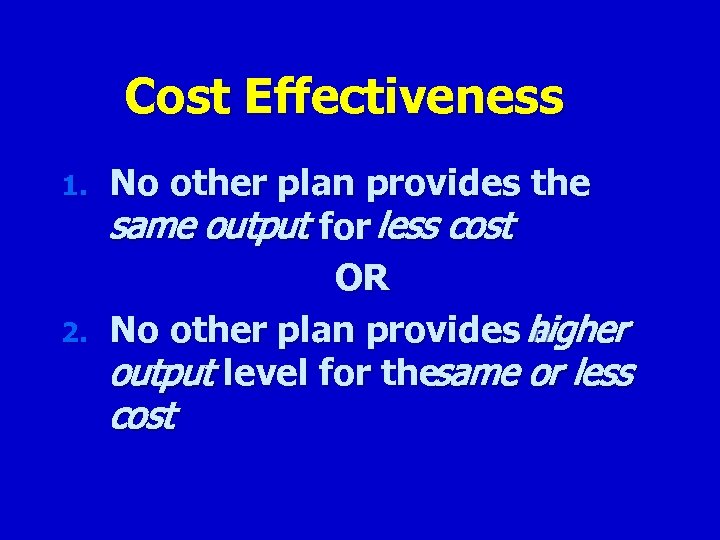 Cost Effectiveness 1. 2. No other plan provides the same output for less cost OR No other plan provides higher a output level for thesame or less cost
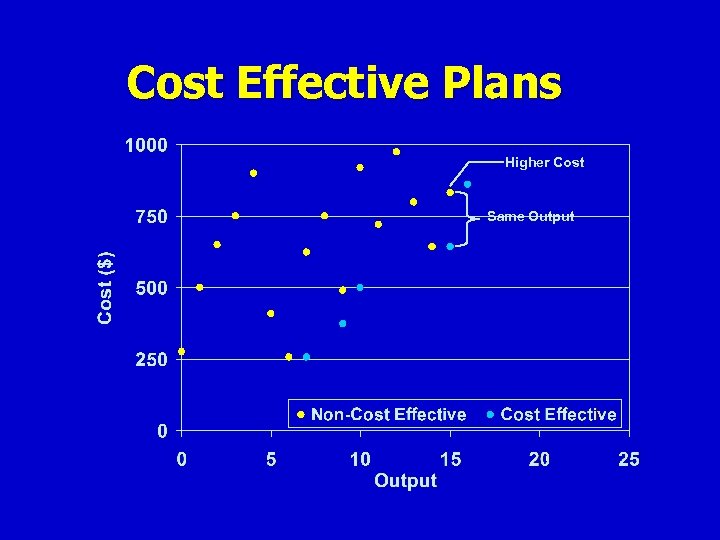 Cost Effective Plans Higher Cost Same Output
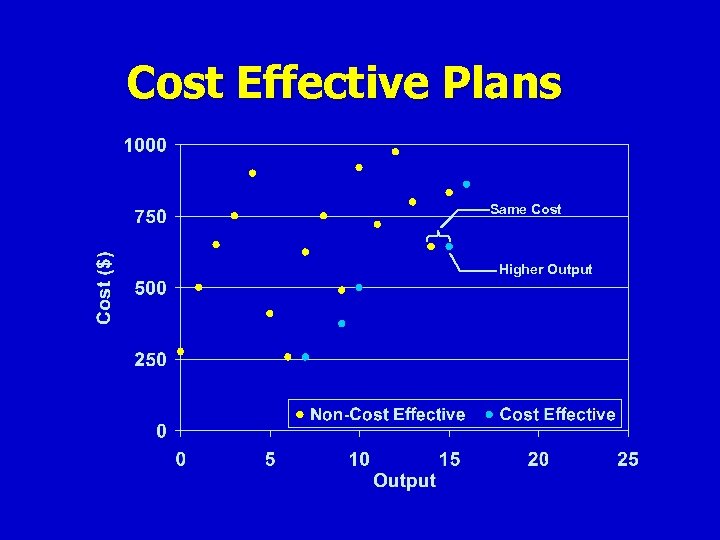 Cost Effective Plans Same Cost Higher Output
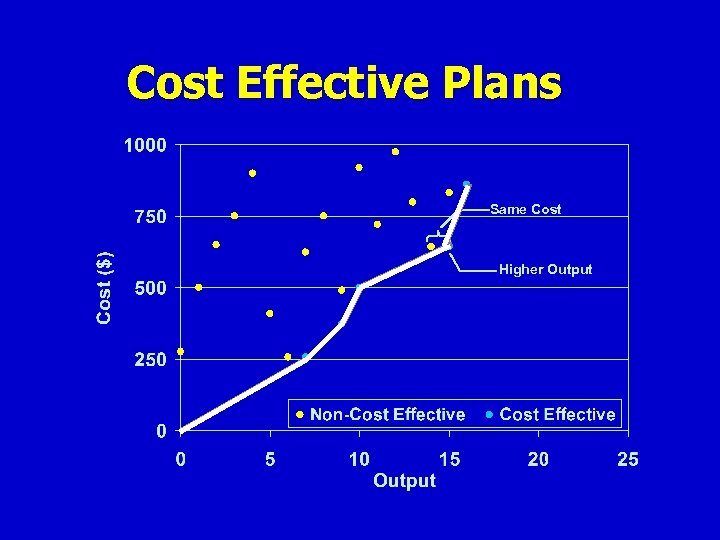 Cost Effective Plans Same Cost Higher Output
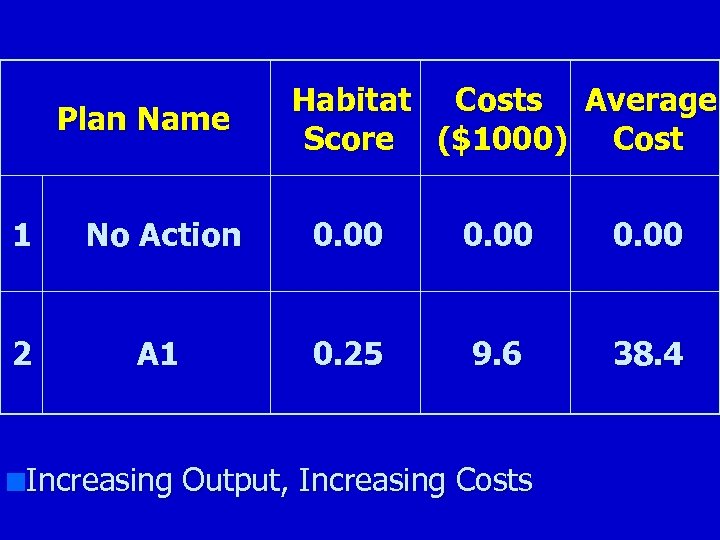 Plan Name Habitat Costs Average Score ($1000) Cost 1 No Action 0. 00 2 A 1 0. 25 9. 6 38. 4 n. Increasing Output, Increasing Costs
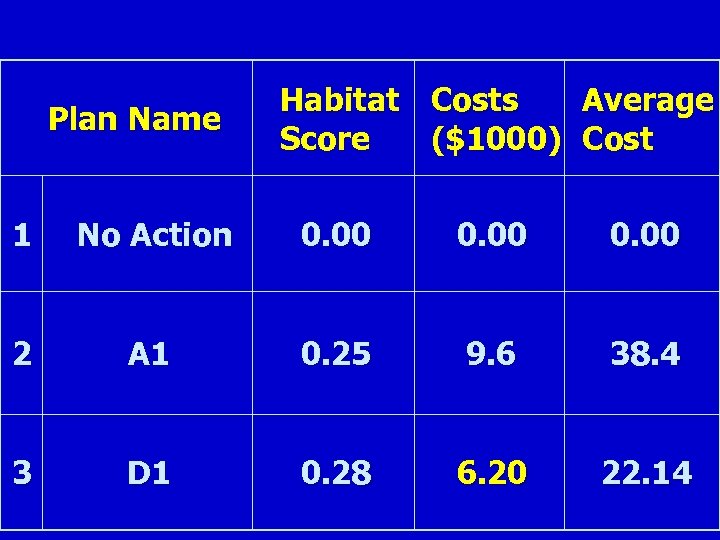 Plan Name Habitat Costs Average Score ($1000) Cost 1 No Action 0. 00 2 A 1 0. 25 9. 6 38. 4 3 D 1 0. 28 6. 20 22. 14
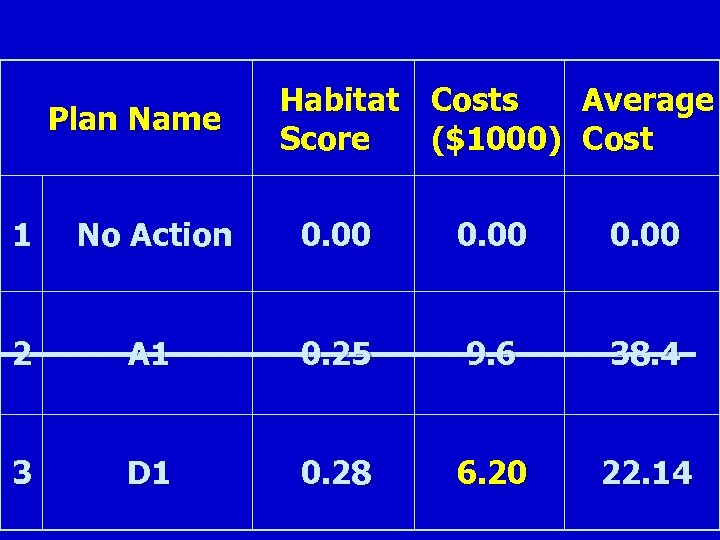 Plan Name Habitat Costs Average Score ($1000) Cost 1 No Action 0. 00 2 A 1 0. 25 9. 6 38. 4 3 D 1 0. 28 6. 20 22. 14
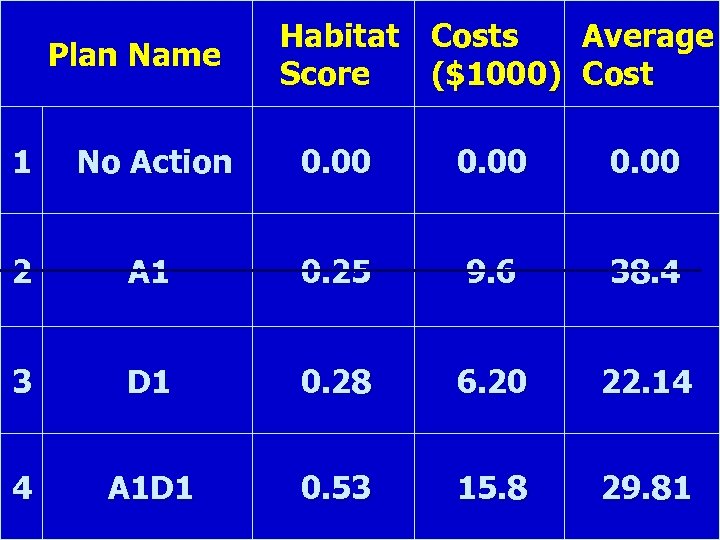 Plan Name Habitat Costs Average Score ($1000) Cost 1 No Action 0. 00 2 A 1 0. 25 9. 6 38. 4 3 D 1 0. 28 6. 20 22. 14 4 A 1 D 1 0. 53 15. 8 29. 81
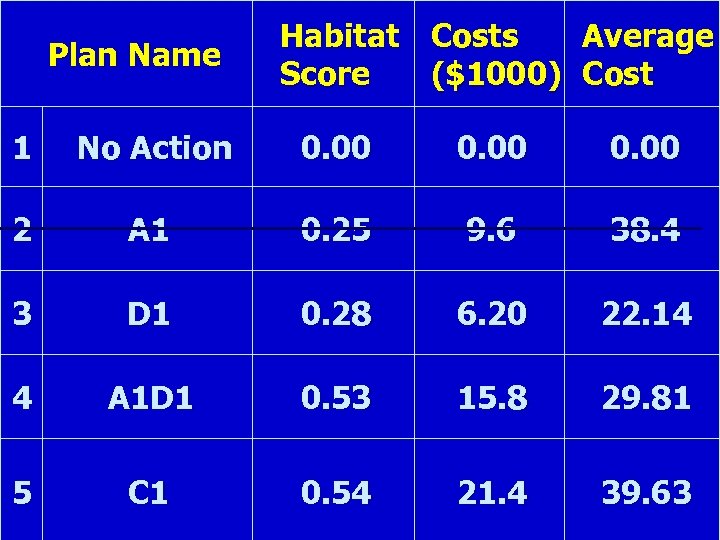 Plan Name Habitat Costs Average Score ($1000) Cost 1 No Action 0. 00 2 A 1 0. 25 9. 6 38. 4 3 D 1 0. 28 6. 20 22. 14 4 A 1 D 1 0. 53 15. 8 29. 81 5 C 1 0. 54 21. 4 39. 63
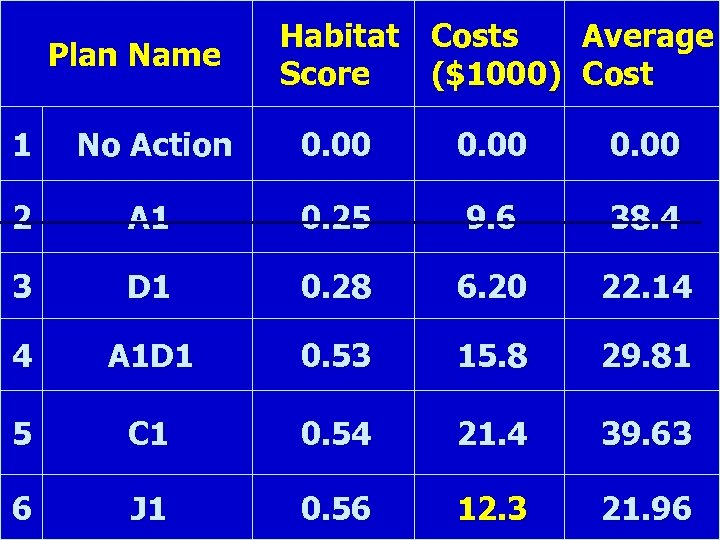 Plan Name Habitat Costs Average Score ($1000) Cost 1 No Action 0. 00 2 A 1 0. 25 9. 6 38. 4 3 D 1 0. 28 6. 20 22. 14 4 A 1 D 1 0. 53 15. 8 29. 81 5 C 1 0. 54 21. 4 39. 63 6 J 1 0. 56 12. 3 21. 96
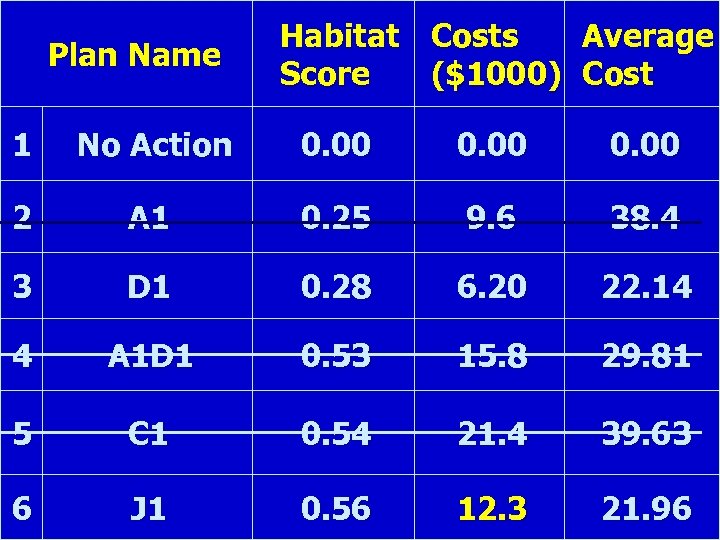 Plan Name Habitat Costs Average Score ($1000) Cost 1 No Action 0. 00 2 A 1 0. 25 9. 6 38. 4 3 D 1 0. 28 6. 20 22. 14 4 A 1 D 1 0. 53 15. 8 29. 81 5 C 1 0. 54 21. 4 39. 63 6 J 1 0. 56 12. 3 21. 96
 Answers
 Incremental Cost Analysis Student Exercise Part 2
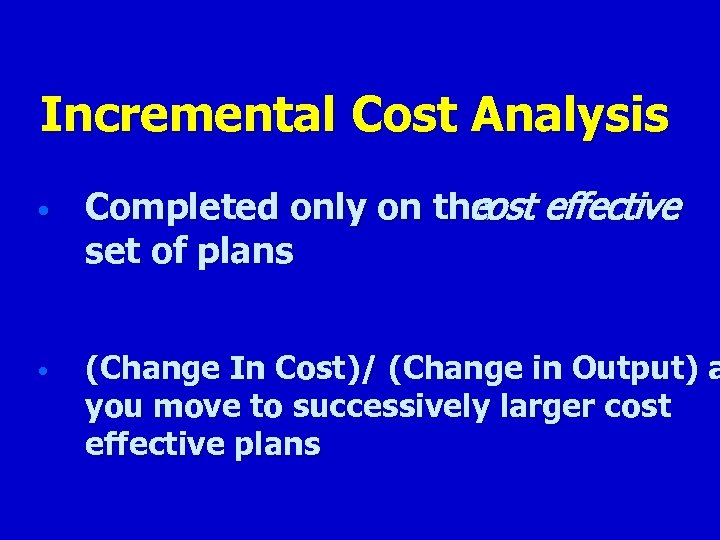 Incremental Cost Analysis • Completed only on the effective cost set of plans • (Change In Cost)/ (Change in Output) a you move to successively larger cost effective plans
 Cost-Effectiveness/Incremental Cost Analysis Definitions • Cost-Effectiveness – Conducted to ensure that the least cost alternative is identified for each possible level of output • Incremental Cost Analysis – Reveals changes in costs as output levels increase – Allows an assessment of whether the increase in output is worth the additional cost
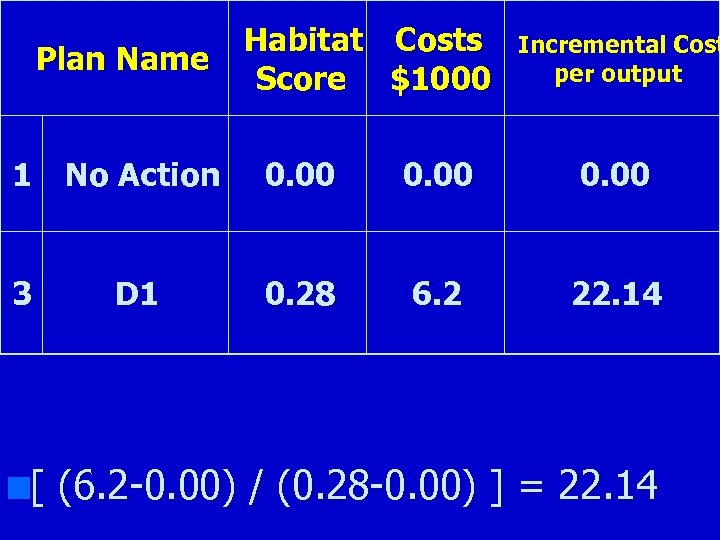
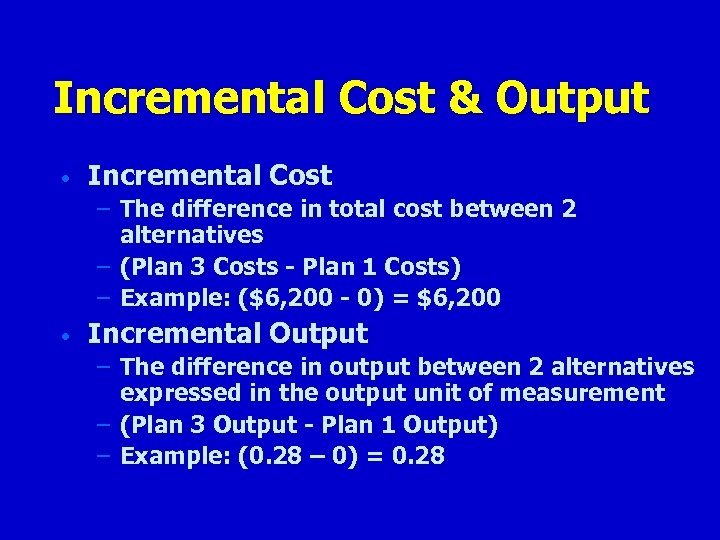 Incremental Cost & Output • Incremental Cost – The difference in total cost between 2 alternatives – (Plan 3 Costs - Plan 1 Costs) – Example: ($6, 200 - 0) = $6, 200 • Incremental Output – The difference in output between 2 alternatives expressed in the output unit of measurement – (Plan 3 Output - Plan 1 Output) – Example: (0. 28 – 0) = 0. 28
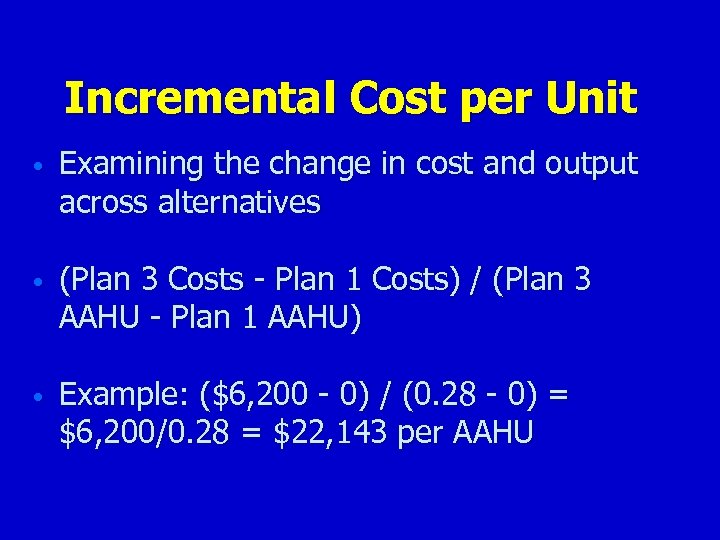 Incremental Cost per Unit • Examining the change in cost and output across alternatives • (Plan 3 Costs - Plan 1 Costs) / (Plan 3 AAHU - Plan 1 AAHU) • Example: ($6, 200 - 0) / (0. 28 - 0) = $6, 200/0. 28 = $22, 143 per AAHU
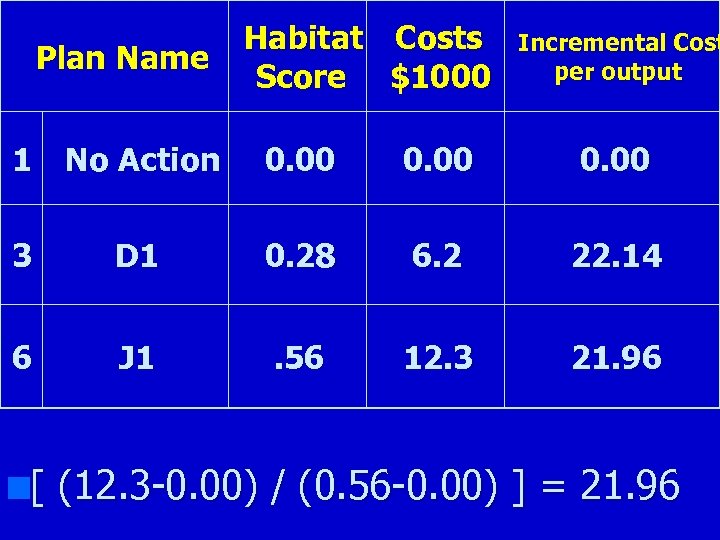
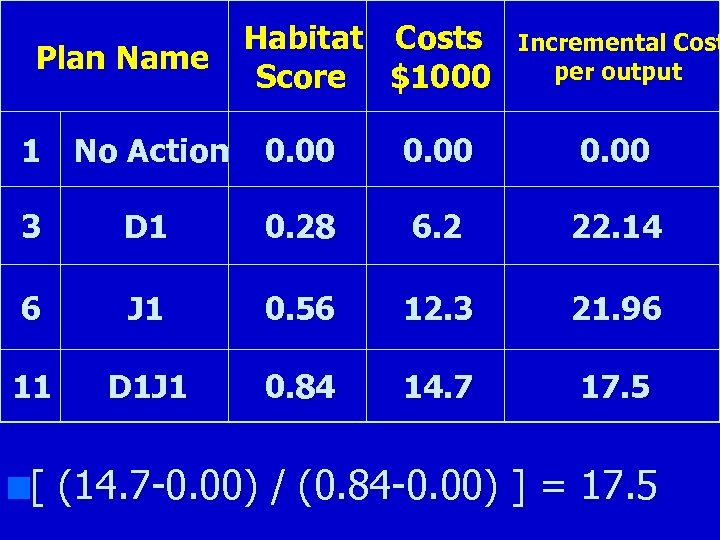
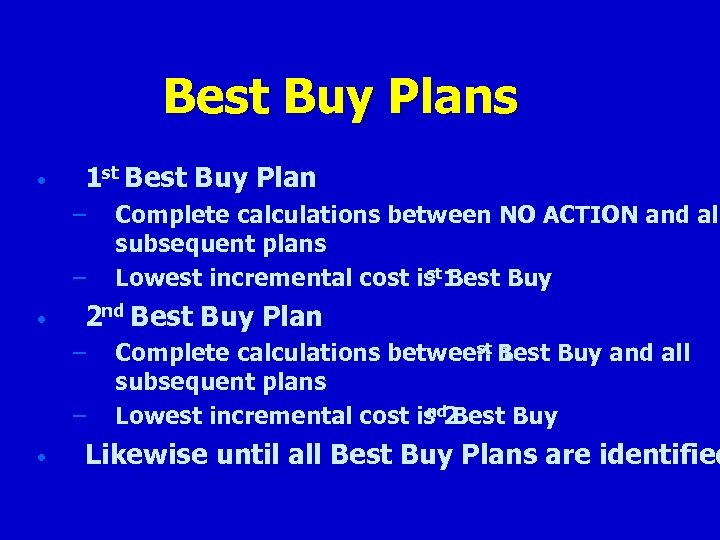
 Best Buy Plans: • • Subset of cost effective plans Most efficient in production Greatest increase in output for least increase in cost Lowest incremental costs per unit of output
 Plan Name Habitat Costs Score $1000 Incremental Cost per output 1 No Action 0. 00 3 0. 28 6. 2 22. 14 n[ D 1 (6. 2 -0. 00) / (0. 28 -0. 00) ] = 22. 14
 Plan Name Habitat Costs Score $1000 Incremental Cost per output 1 No Action 0. 00 3 D 1 0. 28 6. 2 22. 14 6 J 1 . 56 12. 3 21. 96 n[ (12. 3 -0. 00) / (0. 56 -0. 00) ] = 21. 96
 Plan Name Habitat Costs Score $1000 Incremental Cost per output 1 No Action 0. 00 3 D 1 0. 28 6. 2 22. 14 6 J 1 0. 56 12. 3 21. 96 11 D 1 J 1 0. 84 14. 7 17. 5 n[ (14. 7 -0. 00) / (0. 84 -0. 00) ] = 17. 5
 Best Buy Plans • 1 st Best Buy Plan – – • 2 nd Best Buy Plan – – • Complete calculations between NO ACTION and all subsequent plans st Best Buy Lowest incremental cost is 1 st 1 Complete calculations between Best Buy and all subsequent plans nd Best Buy Lowest incremental cost is 2 Likewise until all Best Buy Plans are identified
 Answers
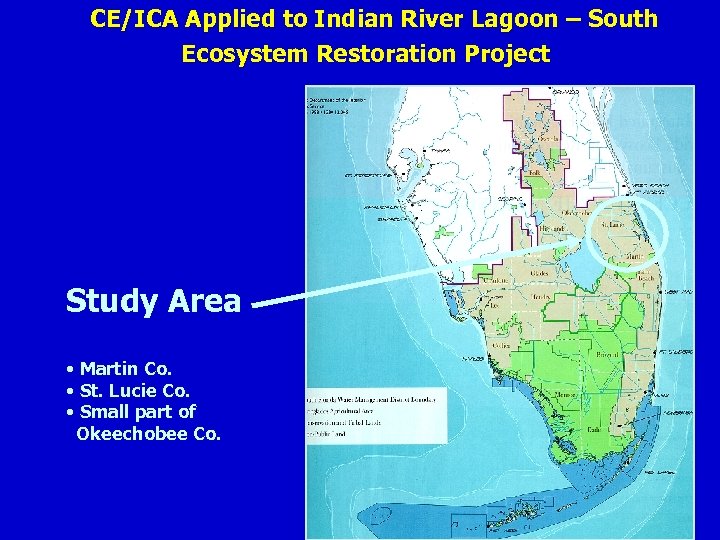 CE/ICA Applied to Indian River Lagoon – South Ecosystem Restoration Project Study Area • Martin Co. • St. Lucie Co. • Small part of Okeechobee Co.
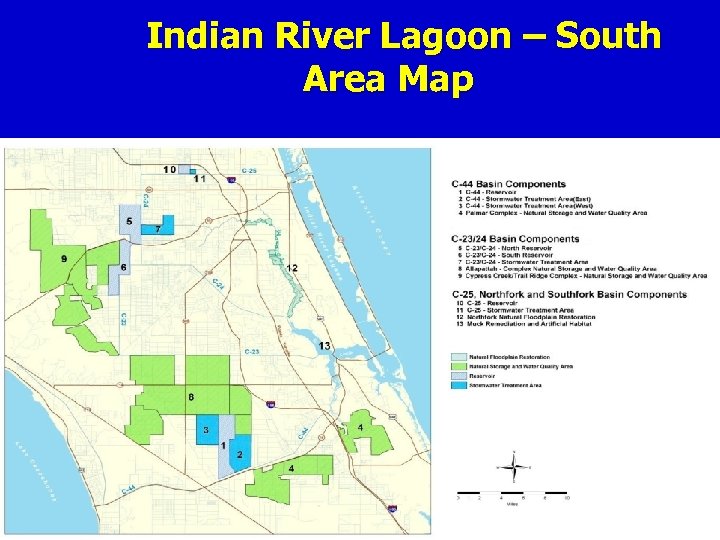 Indian River Lagoon – South Area Map
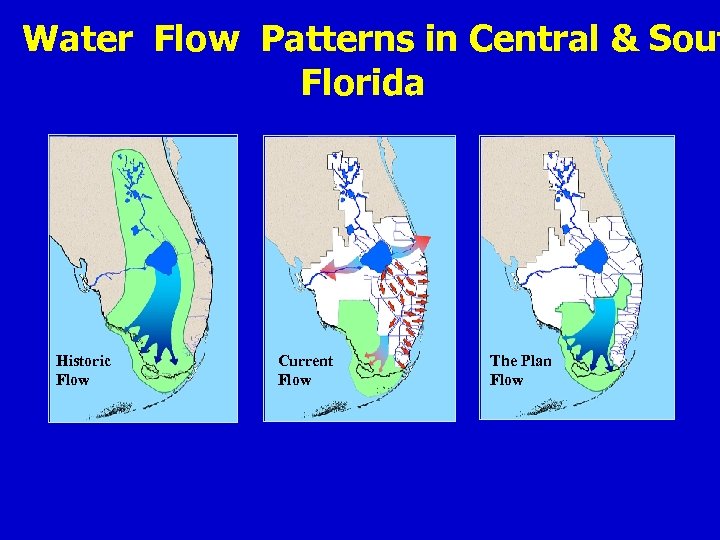 Water Flow Patterns in Central & Sout Florida Historic Flow Current Flow The Plan Flow
 IRL-S Problems & Opportunities • Ecological: • Declining fisheries resources, fish kills & lesions Accumulation of unconsolidated sediments (muck) Extensive & frequent algae blooms Decline of submerged aquatic (SAV), oyster reefs veg Decline in spatial extent & functional quality of watershe wetlands & native upland/wetland mosaic • • • Water Quality: • • High freshwater discharges disrupting salinity regime Pattern/location of freshwater discharges Eutrophication (excessive P & inorganic N) • Economic & Social Well-Being: • Irrigation demand Resource-based recreation & tourism Commercial & recreational fisheries • • •
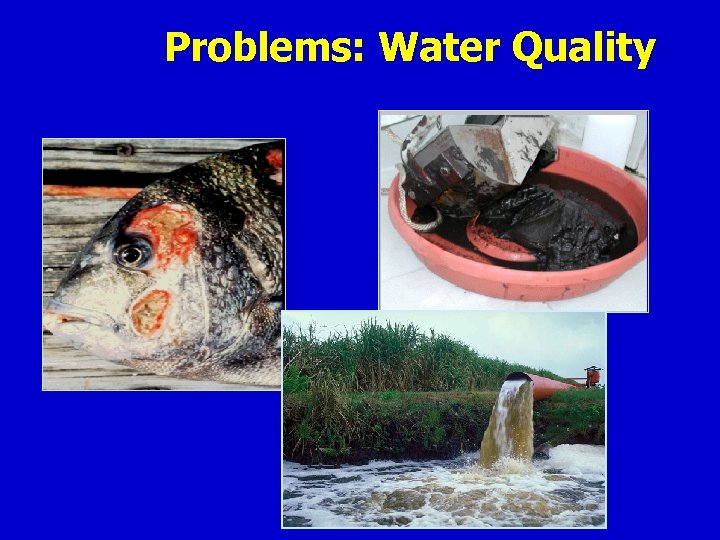 Problems: Water Quality
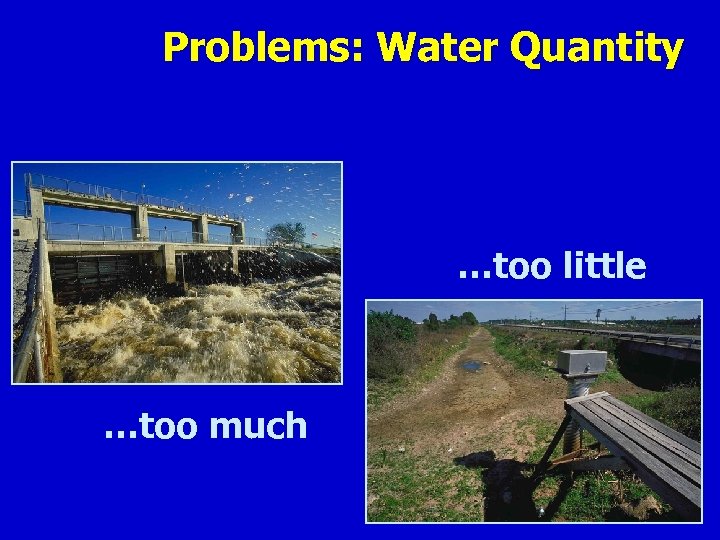 Problems: Water Quantity …too little …too much
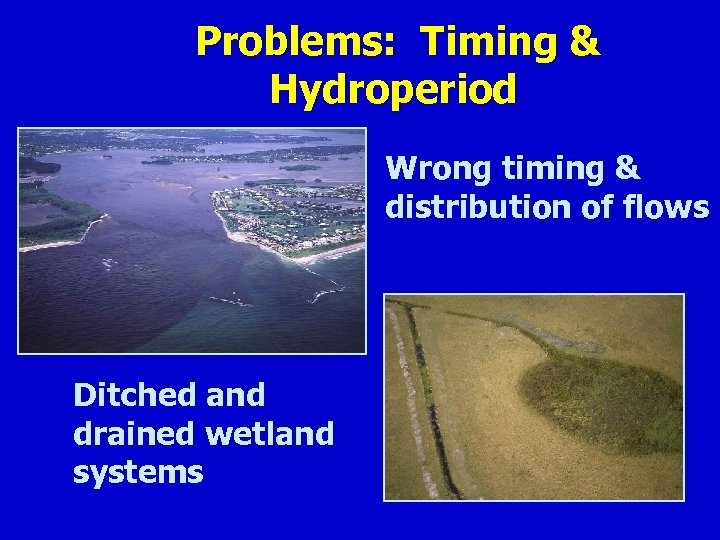 Problems: Timing & Hydroperiod Wrong timing & distribution of flows Ditched and drained wetland systems
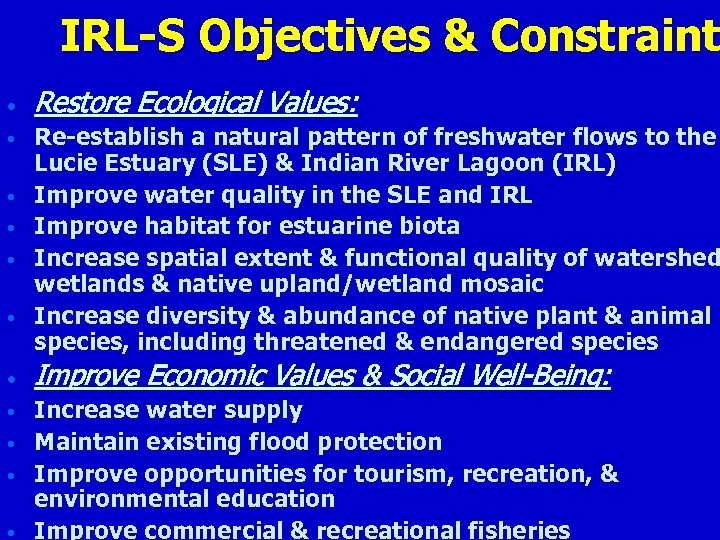 IRL-S Objectives & Constraint • Restore Ecological Values: • Re-establish a natural pattern of freshwater flows to the Lucie Estuary (SLE) & Indian River Lagoon (IRL) Improve water quality in the SLE and IRL Improve habitat for estuarine biota Increase spatial extent & functional quality of watershed wetlands & native upland/wetland mosaic Increase diversity & abundance of native plant & animal species, including threatened & endangered species • • • Improve Economic Values & Social Well-Being: • Increase water supply Maintain existing flood protection Improve opportunities for tourism, recreation, & environmental education Improve commercial & recreational fisheries • • •
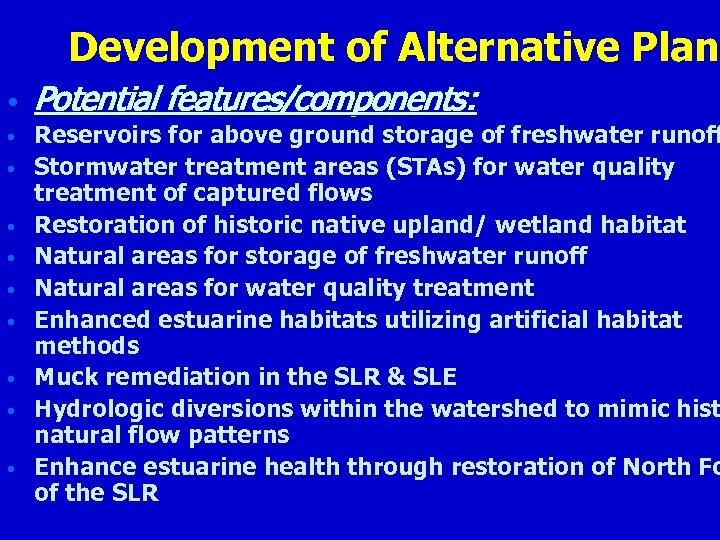 Development of Alternative Plans Plan • • • Potential features/components: Reservoirs for above ground storage of freshwater runoff Stormwater treatment areas (STAs) for water quality treatment of captured flows Restoration of historic native upland/ wetland habitat Natural areas for storage of freshwater runoff Natural areas for water quality treatment Enhanced estuarine habitats utilizing artificial habitat methods Muck remediation in the SLR & SLE Hydrologic diversions within the watershed to mimic hist natural flow patterns Enhance estuarine health through restoration of North Fo of the SLR
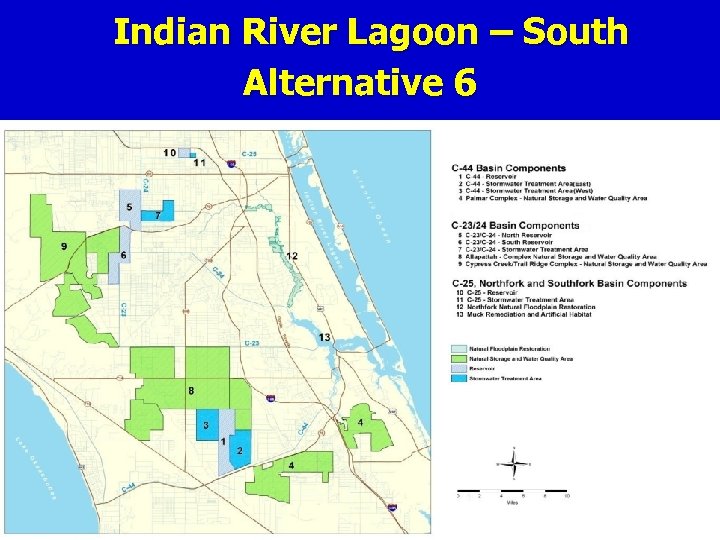 Indian River Lagoon – South Alternative 6
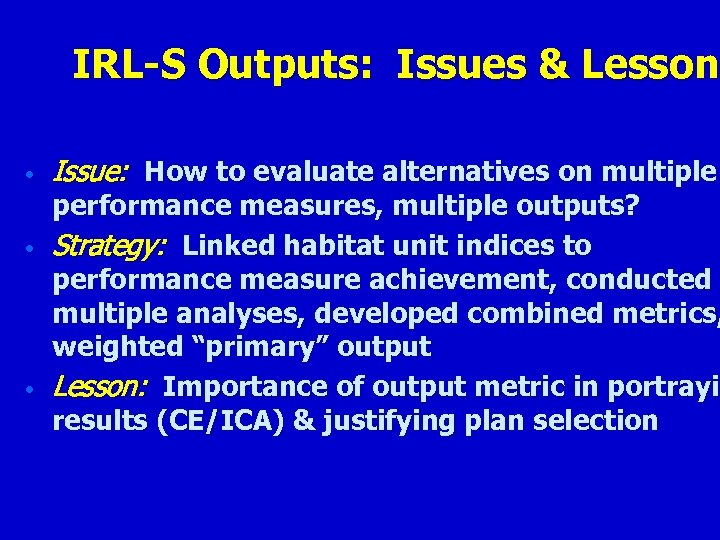 IRL-S Outputs: Issues & Lessons Lesson • • • Issue: How to evaluate alternatives on multiple performance measures, multiple outputs? Strategy: Linked habitat unit indices to performance measure achievement, conducted multiple analyses, developed combined metrics, weighted “primary” output Lesson: Importance of output metric in portrayi results (CE/ICA) & justifying plan selection
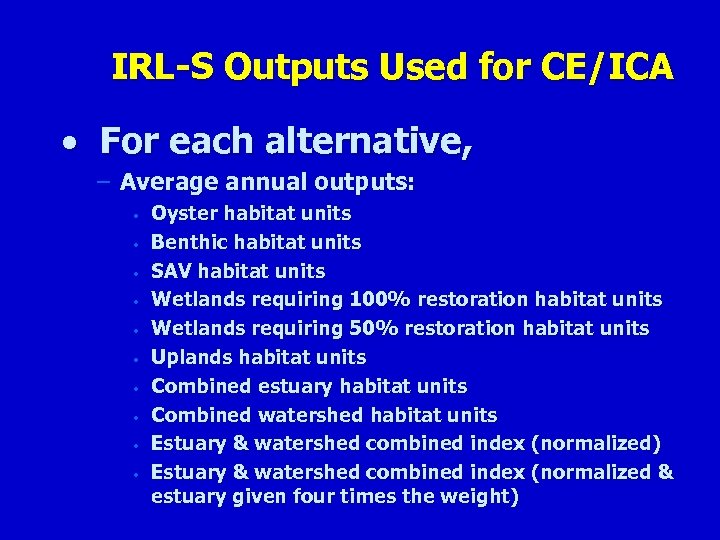 IRL-S Outputs Used for CE/ICA · For each alternative, – Average annual outputs: • • • Oyster habitat units Benthic habitat units SAV habitat units Wetlands requiring 100% restoration habitat units Wetlands requiring 50% restoration habitat units Uplands habitat units Combined estuary habitat units Combined watershed habitat units Estuary & watershed combined index (normalized) Estuary & watershed combined index (normalized & estuary given four times the weight)
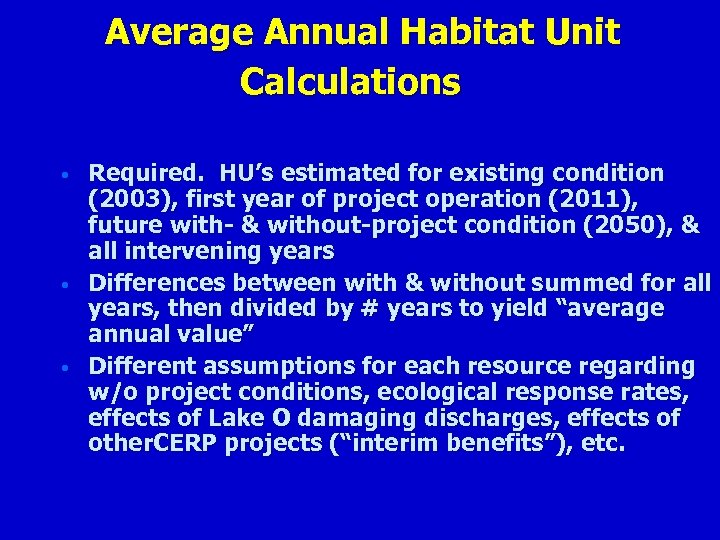 Average Annual Habitat Unit Calculations • • • Required. HU’s estimated for existing condition (2003), first year of project operation (2011), future with- & without-project condition (2050), & all intervening years Differences between with & without summed for all years, then divided by # years to yield “average annual value” Different assumptions for each resource regarding w/o project conditions, ecological response rates, effects of Lake O damaging discharges, effects of other. CERP projects (“interim benefits”), etc.
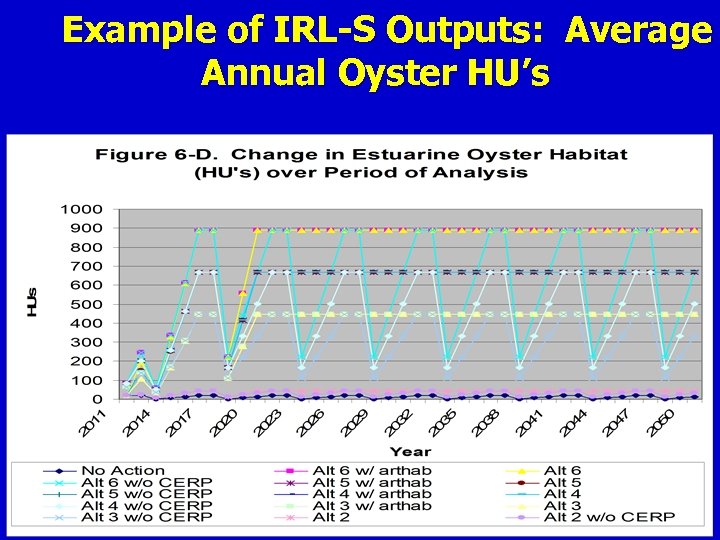 Example of IRL-S Outputs: Average Annual Oyster HU’s
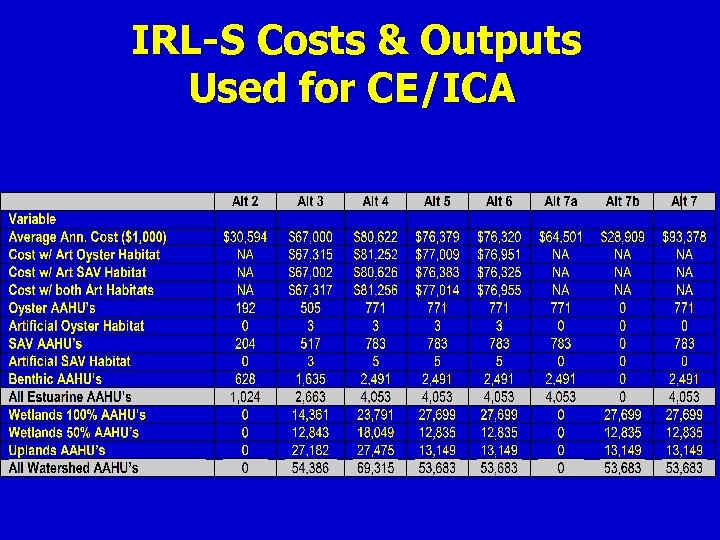 IRL-S Costs & Outputs Used for CE/ICA
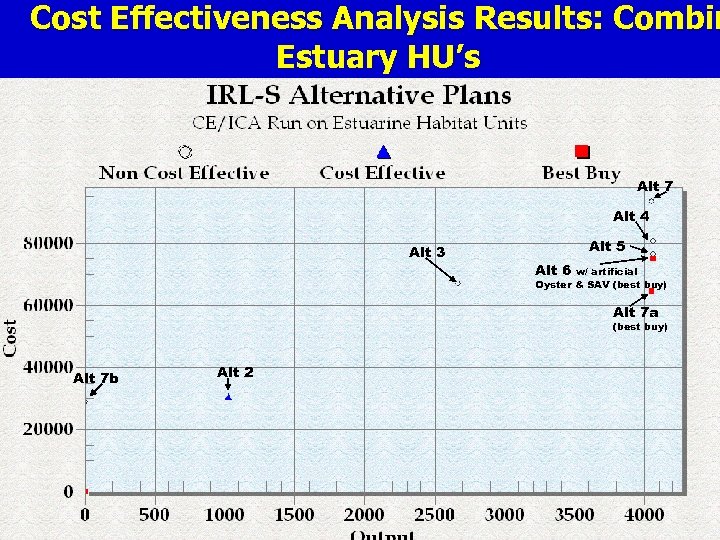 Cost Effectiveness Analysis Results: Combin Estuary HU’s Alt 7 Alt 4 Alt 3 Alt 5 Alt 6 w/ artificial Oyster & SAV (best buy) Alt 7 a (best buy) Alt 7 b Alt 2
 CEA: All Plans Arrayed by Increasing Output Total Estuary Habitat Units
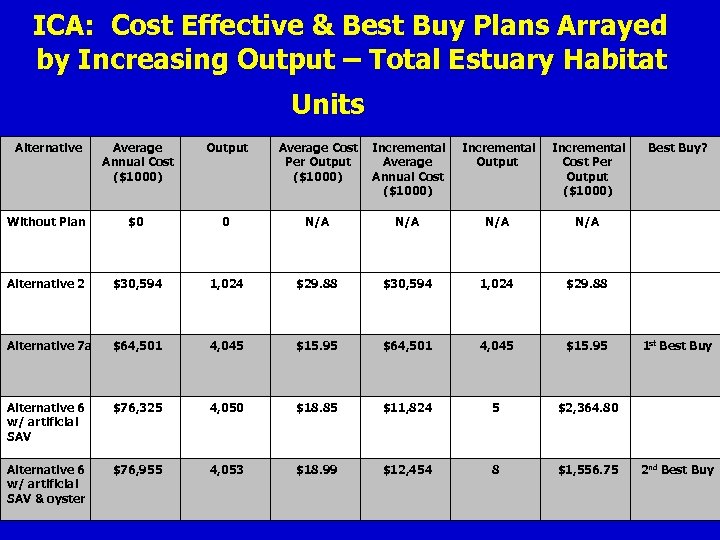 ICA: Cost Effective & Best Buy Plans Arrayed by Increasing Output – Total Estuary Habitat Units Alternative Average Annual Cost ($1000) Output Average Cost Per Output ($1000) Incremental Average Annual Cost ($1000) Incremental Output Incremental Cost Per Output ($1000) Without Plan $0 0 N/A N/A Alternative 2 $30, 594 1, 024 $29. 88 Alternative 7 a $64, 501 4, 045 $15. 95 Alternative 6 w/ artificial SAV $76, 325 4, 050 $18. 85 $11, 824 5 $2, 364. 80 Alternative 6 w/ artificial SAV & oyster $76, 955 4, 053 $18. 99 $12, 454 8 $1, 556. 75 Best Buy? 1 st Best Buy 2 nd Best Buy
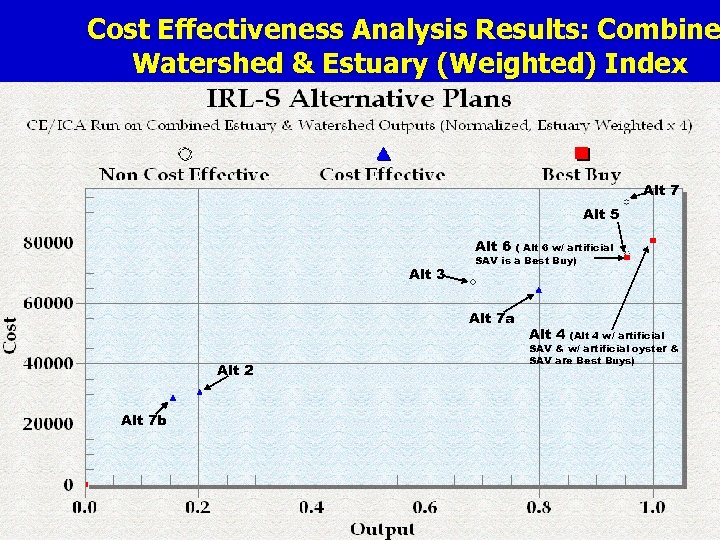 Cost Effectiveness Analysis Results: Combine Watershed & Estuary (Weighted) Index Alt 7 Alt 5 Alt 6 Alt 3 ( Alt 6 w/ artificial SAV is a Best Buy) Alt 7 a Alt 2 Alt 7 b Alt 4 (Alt 4 w/ artificial SAV & w/ artificial oyster & SAV are Best Buys)
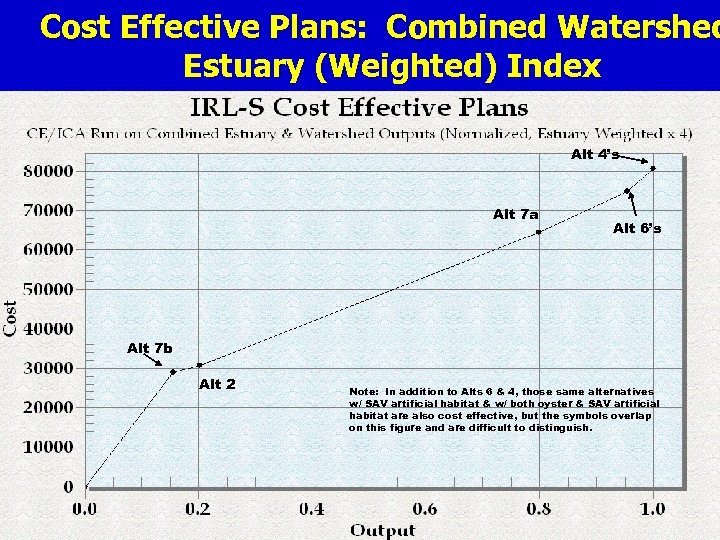 Cost Effective Plans: Combined Watershed Estuary (Weighted) Index Alt 4’s Alt 7 a Alt 6’s Alt 7 b Alt 2 Note: In addition to Alts 6 & 4, those same alternatives w/ SAV artificial habitat & w/ both oyster & SAV artificial habitat are also cost effective, but the symbols overlap on this figure and are difficult to distinguish.
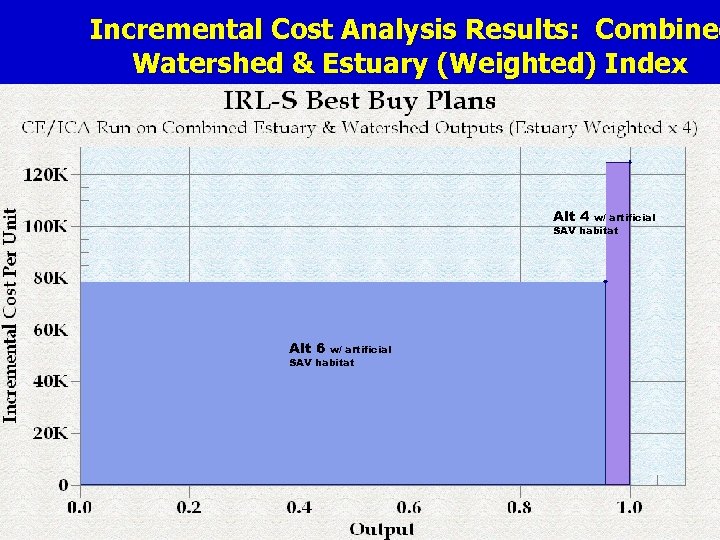 Incremental Cost Analysis Results: Combined Watershed & Estuary (Weighted) Index Alt 4 w/ artificial SAV habitat Alt 6 w/ artificial SAV habitat
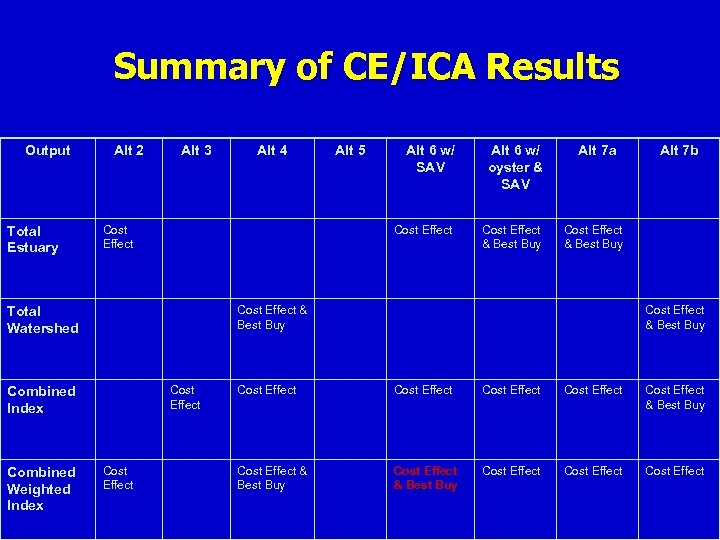 Summary of CE/ICA Results Output Total Estuary Alt 2 Alt 3 Alt 5 Alt 6 w/ SAV Alt 6 w/ oyster & SAV Cost Effect & Best Buy Alt 7 a Cost Effect Combined Index Cost Effect Alt 7 b Cost Effect & Best Buy Total Watershed Combined Weighted Index Alt 4 Cost Effect & Best Buy Cost Effect Cost Effect & Best Buy Cost Effect
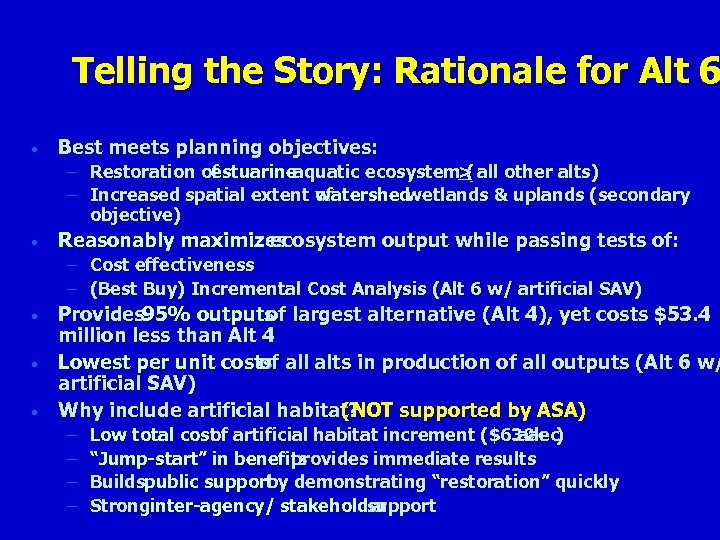 Telling the Story: Rationale for Alt 6 • Best meets planning objectives: – Restoration of estuarineaquatic ecosystem> all other alts) ( – Increased spatial extent of watershed wetlands & uplands (secondary objective) • Reasonably maximizes ecosystem output while passing tests of: – Cost effectiveness – (Best Buy) Incremental Cost Analysis (Alt 6 w/ artificial SAV) • • • Provides 95% outputs largest alternative (Alt 4), yet costs $53. 4 of million less than Alt 4 Lowest per unit costs all alts in production of all outputs (Alt 6 w/ of artificial SAV) Why include artificial habitat? (NOT supported by ASA) – – Low total cost artificial habitat increment ($630 k ) of aaec “Jump-start” in benefits provides immediate results Buildspublic support demonstrating “restoration” quickly by Stronginter-agency/ stakeholder support
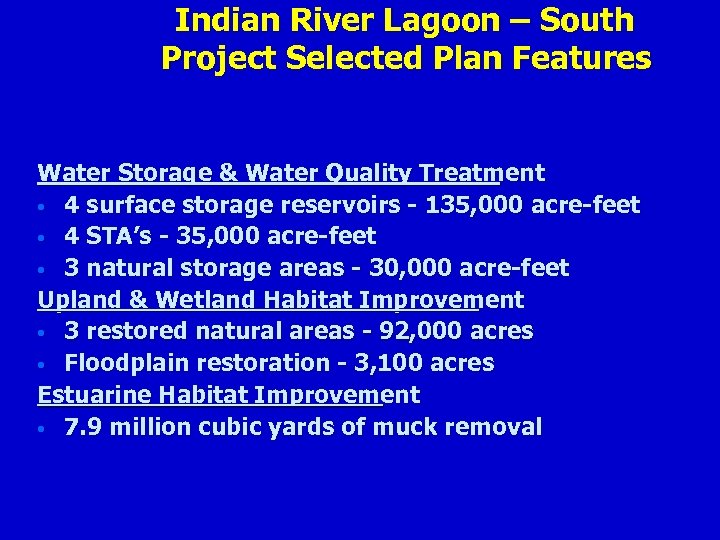 Indian River Lagoon – South Project Selected Plan Features Water Storage & Water Quality Treatment • 4 surface storage reservoirs - 135, 000 acre-feet • 4 STA’s - 35, 000 acre-feet • 3 natural storage areas - 30, 000 acre-feet Upland & Wetland Habitat Improvement • 3 restored natural areas - 92, 000 acres • Floodplain restoration - 3, 100 acres Estuarine Habitat Improvement • 7. 9 million cubic yards of muck removal
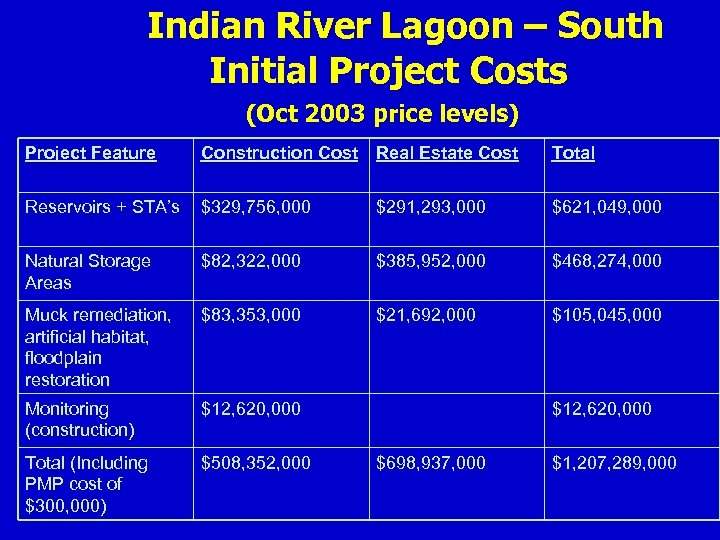 Indian River Lagoon – South Initial Project Costs (Oct 2003 price levels) Project Feature Construction Cost Real Estate Cost Total Reservoirs + STA’s $329, 756, 000 $291, 293, 000 $621, 049, 000 Natural Storage Areas $82, 322, 000 $385, 952, 000 $468, 274, 000 Muck remediation, artificial habitat, floodplain restoration $83, 353, 000 $21, 692, 000 $105, 045, 000 Monitoring (construction) $12, 620, 000 Total (Including PMP cost of $300, 000) $508, 352, 000 $12, 620, 000 $698, 937, 000 $1, 207, 289, 000
 VERSION 3. 33
 IWR-Planning Suite • Software version of CE/ICA procedures • Automates tedious math – Allows you to do more complicated analyses • Tables & graphs as record of analyses
 IWR-Planning Suite • Available on web • Website: www. pmcl. com/iwrplan – Instructions – Student tutorial – User’s Guide • For on-line help, click on “? ”
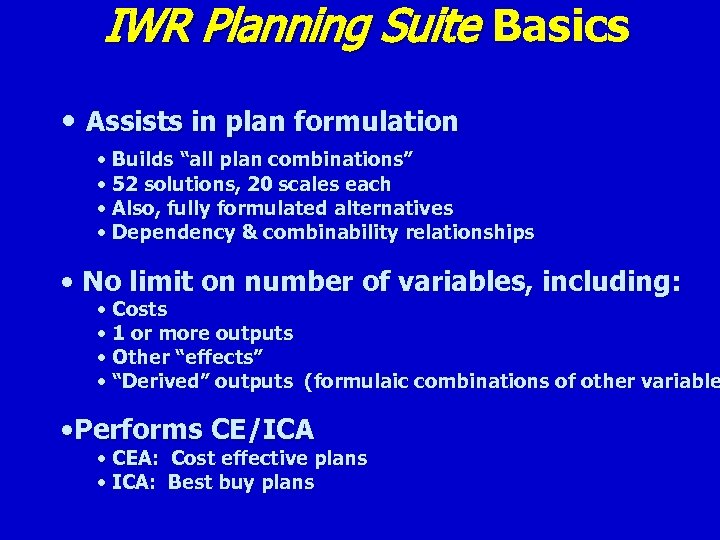 IWR Planning Suite Basics • Assists in plan formulation • Builds “all plan combinations” • 52 solutions, 20 scales each • Also, fully formulated alternatives • Dependency & combinability relationships • No limit on number of variables, including: • Costs • 1 or more outputs • Other “effects” • “Derived” outputs (formulaic combinations of other variable • Performs CE/ICA • CEA: Cost effective plans • ICA: Best buy plans
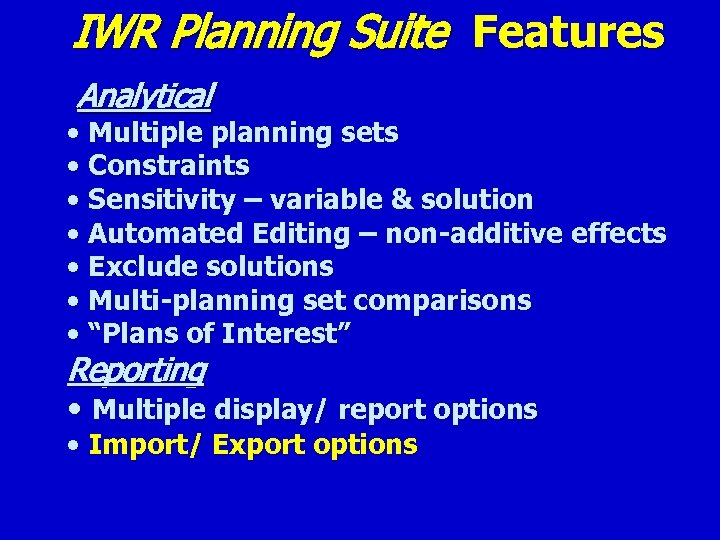 IWR Planning Suite Features Analytical • Multiple planning sets • Constraints • Sensitivity – variable & solution • Automated Editing – non-additive effects • Exclude solutions • Multi-planning set comparisons • “Plans of Interest” Reporting • Multiple display/ report options • Import/ Export options
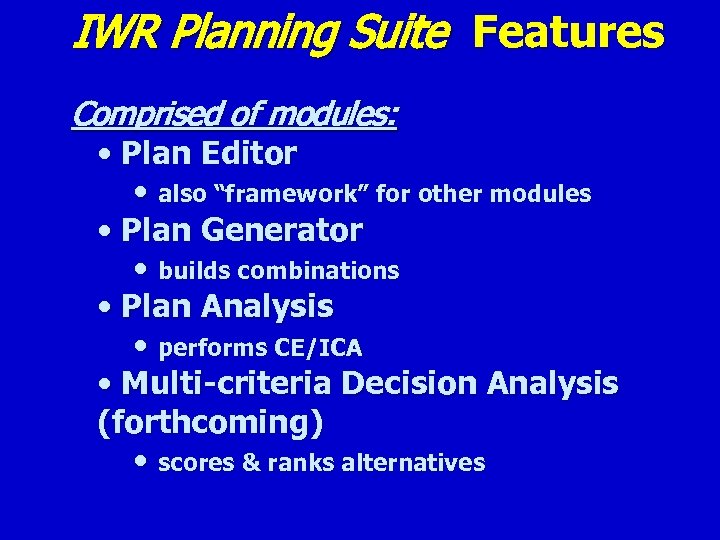 IWR Planning Suite Features Comprised of modules: • Plan Editor • also “framework” for other modules • Plan Generator • builds combinations • Plan Analysis • performs CE/ICA • Multi-criteria Decision Analysis (forthcoming) • scores & ranks alternatives
 ER 1105 -2 -100 (22 April 2000) • • • Recommend the NER Plan “… justified alternative & scale having the maximum excess of monetary & nonmonetary beneficial effects over monetary & non-monetary costs. ” “. . . occurs where the incremental beneficial effects just equal the incremental costs, or alternatively stated, where the extra environmental value is just worth the extra costs. ” (App. E-28. e(1))
 Is it worth it?
 Significance of Ecosystem Outputs • • Qualitative info critical to determining “worth” of outputs Who or what says the resource is significant? – – – • Institutional Public Technical Important info in “telling your story”
 More on Technical Recognition of Significance • Describe in terms of scientific knowledg judgment regarding: – – – Scarcity- relative abundance, rareness Representativenessexemplifies natural, undisturbe habitat Status & trends occurrence & extent over time, how & why changed Connectivity habitat corridors, fragmentation, barriers Limiting Habitat essential to species survival Biodiversity species richness, genetic variability -
 FY 2008 Budgetary Significance Criteria • • • Scarcity Connectivity Special Status Species – Provides significant contribution to key life requisite of special status species • Plan Recognition – Contributes to watershed or basin plans as emphasized in “CW Strategic Plan” • Self-sustaining – Ideal goal is self-sustaining ecosystem consisting of natural processes
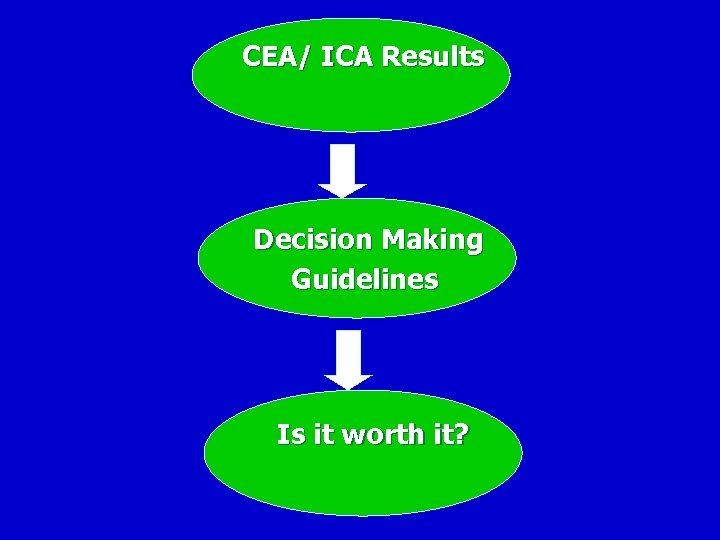 CEA/ ICA Results Decision Making Guidelines Is it worth it?
 Is it worth it? Decision making guidelines: • output target • output thresholds • cost limit • breakpoints • unintended effects • does it make sense?
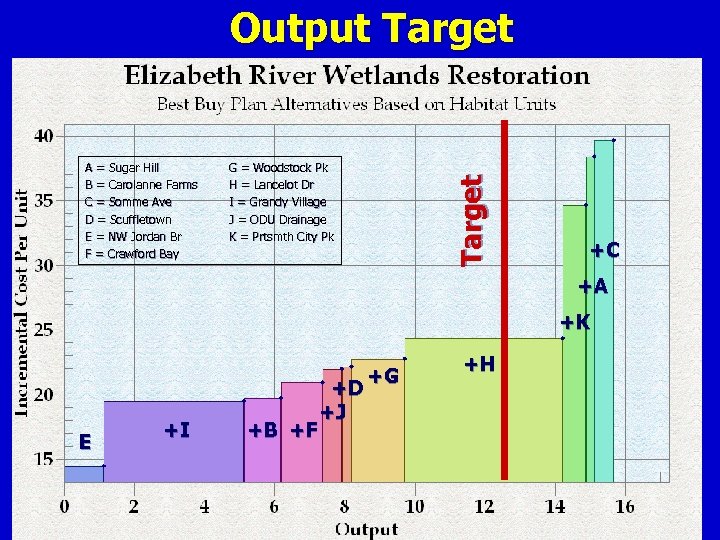 Output Target G = Woodstock Pk H = Lancelot Dr I = Grandy Village J = ODU Drainage K = Prtsmth City Pk Target A = Sugar Hill B = Carolanne Farms C = Somme Ave D = Scuffletown E = NW Jordan Br F = Crawford Bay +C +A +K E +I +B +F +D +J +G +H
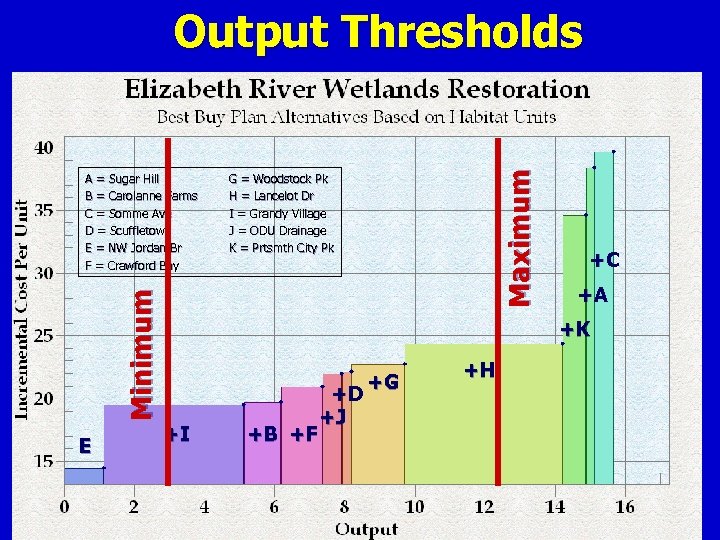 G = Woodstock Pk H = Lancelot Dr I = Grandy Village J = ODU Drainage K = Prtsmth City Pk Minimum A = Sugar Hill B = Carolanne Farms C = Somme Ave D = Scuffletown E = NW Jordan Br F = Crawford Bay E Maximum Output Thresholds +C +A +K +I +B +F +D +J +G +H
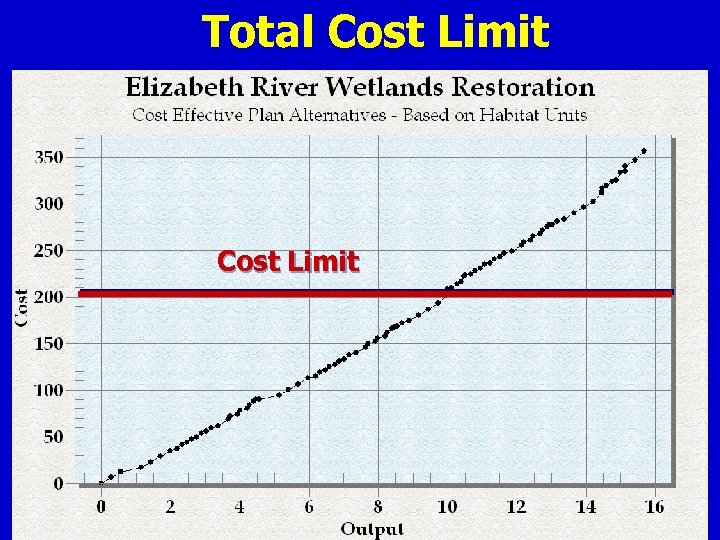 Total Cost Limit
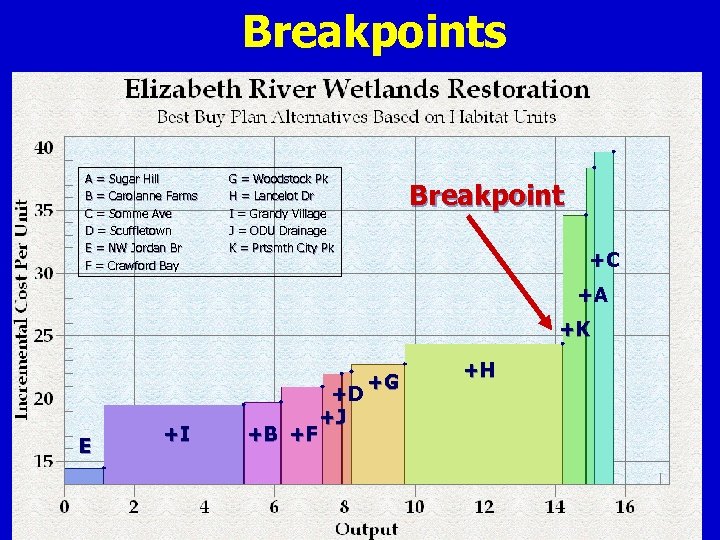 Breakpoints A = Sugar Hill B = Carolanne Farms C = Somme Ave D = Scuffletown E = NW Jordan Br F = Crawford Bay G = Woodstock Pk H = Lancelot Dr I = Grandy Village J = ODU Drainage K = Prtsmth City Pk Breakpoint +C +A +K E +I +B +F +D +J +G +H
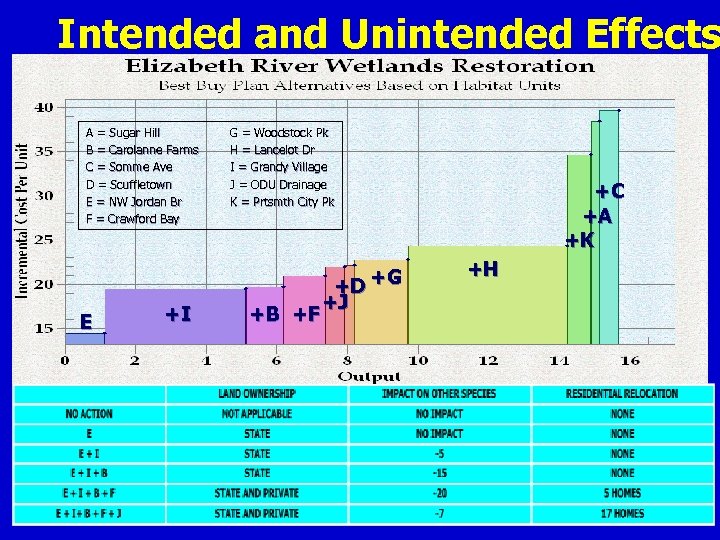 Intended and Unintended Effects A = Sugar Hill B = Carolanne Farms C = Somme Ave D = Scuffletown E = NW Jordan Br F = Crawford Bay E +I G = Woodstock Pk H = Lancelot Dr I = Grandy Village J = ODU Drainage K = Prtsmth City Pk +B +F +D +G +J +C +A +K +H
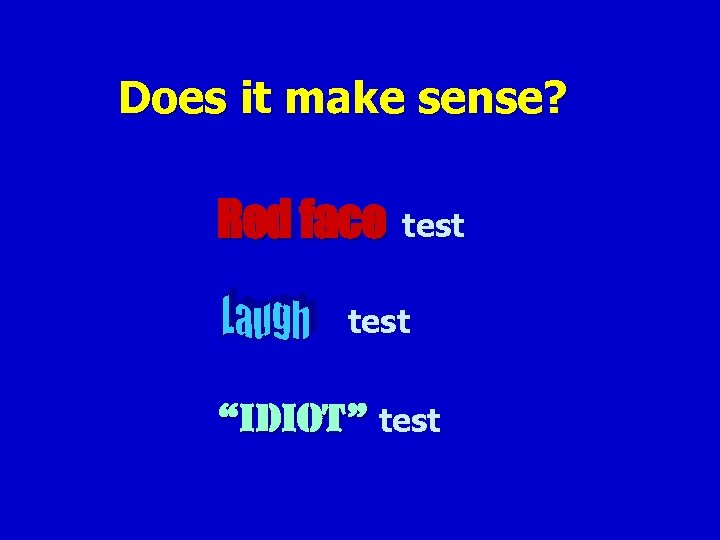 Does it make sense? Red face test “idiot” test
 ER 1105 -2 -100 (22 April 2000) • “Selecting the NER plan requires careful consideration of the plan that meets planning objectives and constraints and reasonably maximizes environmental benefits while passing tests cost of effectiveness and incremental cost analyses , significance outputs, acceptability of , completenessefficiency and , , effectiveness (Appendix E, E-41). ”. ”
 ER 1105 -2 -100 (22 April 2000) • Additional factors to consider: – Partnership context • higher priority to those projects planned in cooperation with other Federal resource agencies & regional & national interagency programs – Reasonableness of costs • decision-maker ascertains that the benefits are really worth the costs – Rarely will the NER plan not be among the best buy plans(App. E, E-41)
 Applicability • • • Restoration and mitigation All scopes of problems All types of resources – HU’s, acres, river miles, IBI, water quality parameters • All scales of projects • All phases of work • Many agencies and interests
 Challenges • • • K. I. S. S. - don’t go too fast too soon Set-up - getting started Commensuration – Multiple metrics
 Benefits • Flexibility - Handles various resources & approaches - From simple to complex • Rational, equitable approach • Saves time • Saves costs - Greatest “bang for the buck” • Allows you to focus on what’s important • It’s easy • More informed decisions!
 Visit IWR’s Homepage www. iwr. usace. army. mil
 Visit the. IWR-PLAN Homepage www. pmcl/com/iwrplan
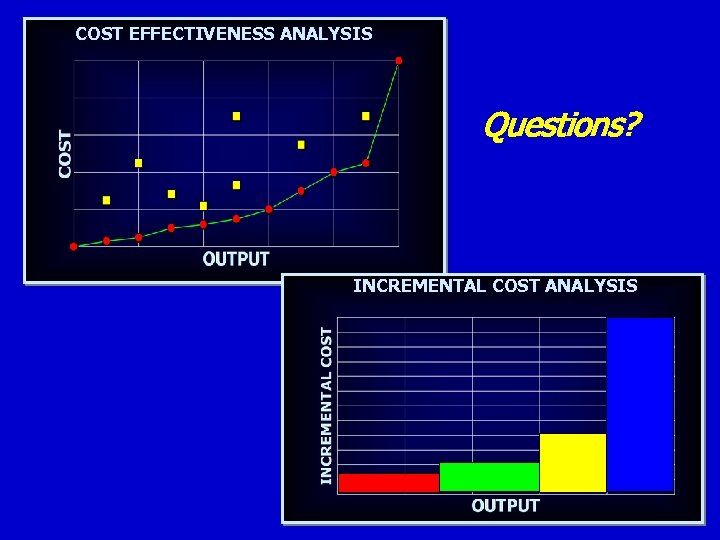 COST EFFECTIVENESS ANALYSIS Questions? INCREMENTAL COST ANALYSIS
 Truckee Meadows Flood Control Project, NV CE/ICA Applied to Fish Passage Component Leigh Skaggs, CEIWR-GW
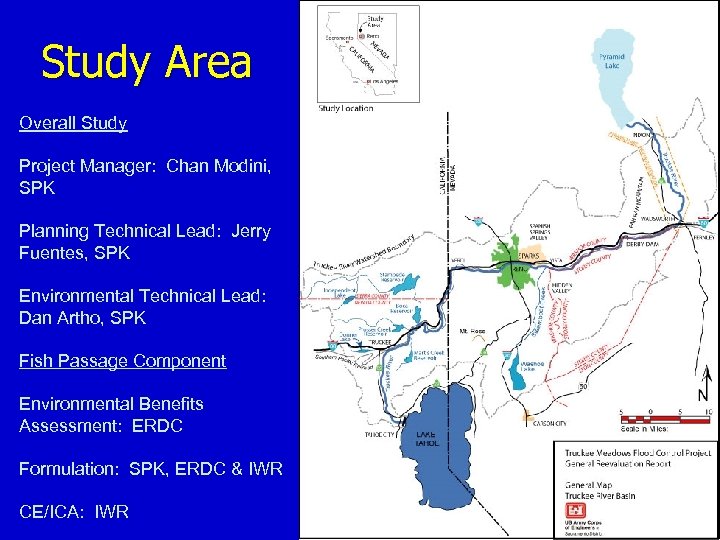 Study Area Overall Study Project Manager: Chan Modini, SPK Planning Technical Lead: Jerry Fuentes, SPK Environmental Technical Lead: Dan Artho, SPK Fish Passage Component Environmental Benefits Assessment: ERDC Formulation: SPK, ERDC & IWR CE/ICA: IWR
 Truckee Fish Passage Component • • • Latecomer to project Pyramid Lake Paiute Tribe approached ASA(CW): “We don’t want additional flood flows on our lands. ” 1990 Corps study investigated improving fish passage on Truckee River – but Tribe could not afford to cost-share Now opportunity to pressure Washoe County to cost-share Tribe a big player in watershed & has good case against BOR & cities – BOR Newlands project (1903, BOR’s first!) diverted up to ½ Truckee flow to Carson River; Pyramid Lake dropped 80’ by 1960; results: head-cutting, channel incision, disconnected river from floodplain, riparian vegetation disappeared – Effluent from Reno/Sparks wastewater treatment degrades WQ – Lake has a great fishery (historically) –threatened by declining WQ – Pyramid Lake is greatest source of income for Tribe – economically dependent on Lake resource • OASA(CW): Examine fish passage opportunities in FCP
 Truckee Fish Passage Plan Formulation • • • Collaboration between SPK, ERDC & IWR For Upstream Alternatives considered, see Excel file “Results_SKM_02 -27 -08 v. SKM 2”, tab “Upstream” For Downstream Alternatives considered, see Excel file “Results_SKM_02 -27 -08 v. SKM 2”, tab “Downstream” For Combinations of Upstream & Downstream Alternatives, see next slide Note: IWR Planning Suite was not used formulation. Although it can handle dependencies between sites, it could not handle the calculation of benefits for > 200, 000 combinations (because benefits at each site dependent on whether or not other sites implemented). Rational combinations of upstream & downstream sites were formulated
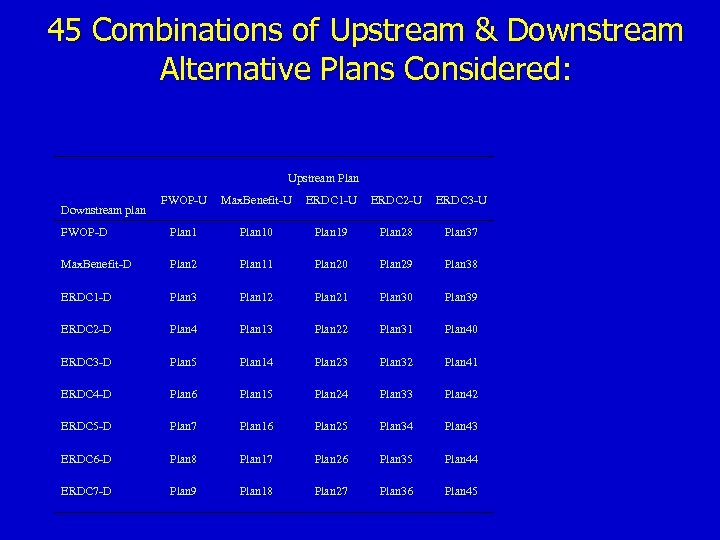 45 Combinations of Upstream & Downstream Alternative Plans Considered: Upstream Plan FWOP-U Max. Benefit-U ERDC 1 -U ERDC 2 -U ERDC 3 -U FWOP-D Plan 10 Plan 19 Plan 28 Plan 37 Max. Benefit-D Plan 2 Plan 11 Plan 20 Plan 29 Plan 38 ERDC 1 -D Plan 3 Plan 12 Plan 21 Plan 30 Plan 39 ERDC 2 -D Plan 4 Plan 13 Plan 22 Plan 31 Plan 40 ERDC 3 -D Plan 5 Plan 14 Plan 23 Plan 32 Plan 41 ERDC 4 -D Plan 6 Plan 15 Plan 24 Plan 33 Plan 42 ERDC 5 -D Plan 7 Plan 16 Plan 25 Plan 34 Plan 43 ERDC 6 -D Plan 8 Plan 17 Plan 26 Plan 35 Plan 44 ERDC 7 -D Plan 9 Plan 18 Plan 27 Plan 36 Plan 45 Downstream plan
 Benefits/Outputs • For explanation of how upstream & downstream benefits were calculated, see Conyngham et al. 2008, “Truckee River Fish Passage: Environmental Benefits Analysis” – Upstream & downstream benefits/outputs were calculated differently & used different metrics; therefore could not be combined to assess “total benefits” without normalizing each category • For CE/ICA analysis, both upstream & downstream benefits were normalized on a percent of maximum basis, 0 -1 scale (0=no output, 1=maximum output of any alternative) – Therefore, max output possible for any alternative for both upstream & downstream output = 2 • 3 scenarios/predictions of outputs estimated: average (expected outcome), minimum (worst case) & maximum (best case) – Reason for 3 scenarios is to conduct sensitivity analysis & address uncertainties regarding output predictions
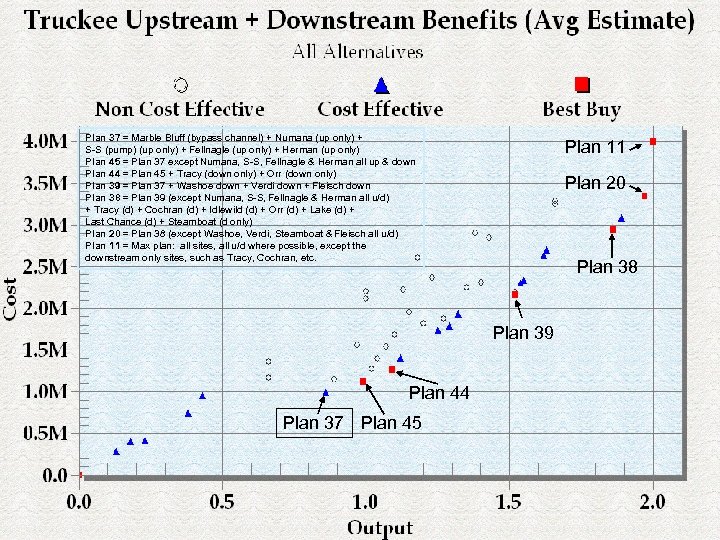 Plan 37 = Marble Bluff (bypass channel) + Numana (up only) + S-S (pump) (up only) + Fellnagle (up only) + Herman (up only) Plan 45 = Plan 37 except Numana, S-S, Fellnagle & Herman all up & down Plan 44 = Plan 45 + Tracy (down only) + Orr (down only) Plan 39 = Plan 37 + Washoe down + Verdi down + Fleisch down Plan 38 = Plan 39 (except Numana, S-S, Fellnagle & Herman all u/d) + Tracy (d) + Cochran (d) + Idlewild (d) + Orr (d) + Lake (d) + Last Chance (d) + Steamboat (d only) Plan 20 = Plan 38 (except Washoe, Verdi, Steamboat & Fleisch all u/d) Plan 11 = Max plan: all sites, all u/d where possible, except the downstream only sites, such as Tracy, Cochran, etc. Plan 11 Plan 20 Plan 38 Plan 39 Plan 44 Plan 37 Plan 45
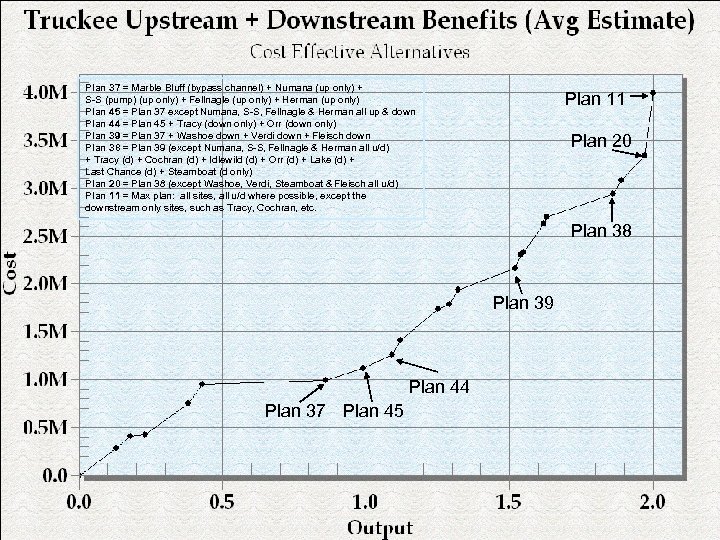 Plan 37 = Marble Bluff (bypass channel) + Numana (up only) + S-S (pump) (up only) + Fellnagle (up only) + Herman (up only) Plan 45 = Plan 37 except Numana, S-S, Fellnagle & Herman all up & down Plan 44 = Plan 45 + Tracy (down only) + Orr (down only) Plan 39 = Plan 37 + Washoe down + Verdi down + Fleisch down Plan 38 = Plan 39 (except Numana, S-S, Fellnagle & Herman all u/d) + Tracy (d) + Cochran (d) + Idlewild (d) + Orr (d) + Lake (d) + Last Chance (d) + Steamboat (d only) Plan 20 = Plan 38 (except Washoe, Verdi, Steamboat & Fleisch all u/d) Plan 11 = Max plan: all sites, all u/d where possible, except the downstream only sites, such as Tracy, Cochran, etc. Plan 11 Plan 20 Plan 38 Plan 39 Plan 44 Plan 37 Plan 45
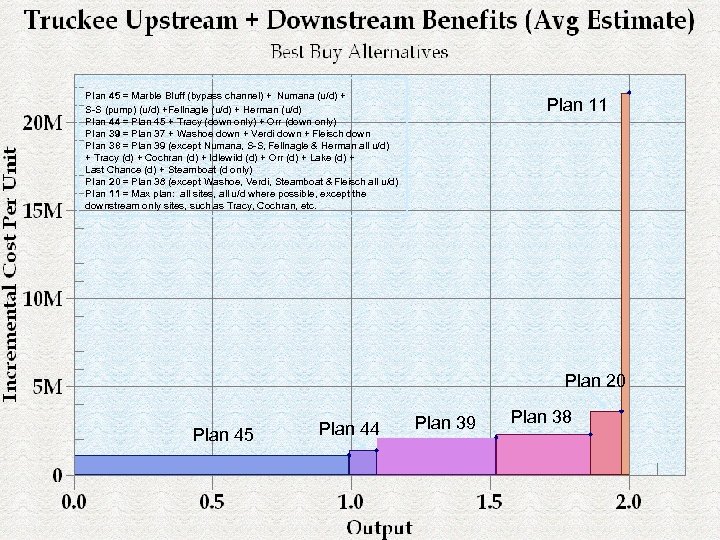 Plan 45 = Marble Bluff (bypass channel) + Numana (u/d) + S-S (pump) (u/d) +Fellnagle (u/d) + Herman (u/d) Plan 44 = Plan 45 + Tracy (down only) + Orr (down only) Plan 39 = Plan 37 + Washoe down + Verdi down + Fleisch down Plan 38 = Plan 39 (except Numana, S-S, Fellnagle & Herman all u/d) + Tracy (d) + Cochran (d) + Idlewild (d) + Orr (d) + Lake (d) + Last Chance (d) + Steamboat (d only) Plan 20 = Plan 38 (except Washoe, Verdi, Steamboat & Fleisch all u/d) Plan 11 = Max plan: all sites, all u/d where possible, except the downstream only sites, such as Tracy, Cochran, etc. Plan 11 Plan 20 Plan 45 Plan 44 Plan 39 Plan 38
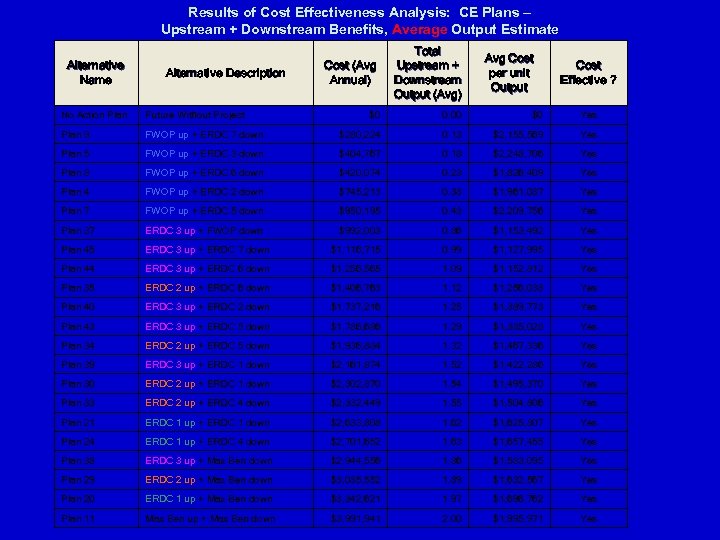 Results of Cost Effectiveness Analysis: CE Plans – Upstream + Downstream Benefits, Average Output Estimate Alternative Name Alternative Description No Action Plan Future Without Project Plan 9 Cost (Avg Annual) Total Upstream + Downstream Output (Avg) Avg Cost per unit Output Cost Effective ? $0 0. 00 $0 Yes FWOP up + ERDC 7 down $280, 224 0. 13 $2, 155, 569 Yes Plan 5 FWOP up + ERDC 3 down $404, 767 0. 18 $2, 248, 706 Yes Plan 8 FWOP up + ERDC 6 down $420, 074 0. 23 $1, 826, 409 Yes Plan 4 FWOP up + ERDC 2 down $745, 213 0. 38 $1, 961, 087 Yes Plan 7 FWOP up + ERDC 5 down $950, 195 0. 43 $2, 209, 756 Yes Plan 37 ERDC 3 up + FWOP down $992, 003 0. 86 $1, 153, 492 Yes Plan 45 ERDC 3 up + ERDC 7 down $1, 116, 715 0. 99 $1, 127, 995 Yes Plan 44 ERDC 3 up + ERDC 6 down $1, 256, 565 1. 09 $1, 152, 812 Yes Plan 35 ERDC 2 up + ERDC 6 down $1, 406, 763 1. 12 $1, 256, 038 Yes Plan 40 ERDC 3 up + ERDC 2 down $1, 737, 216 1. 25 $1, 389, 773 Yes Plan 43 ERDC 3 up + ERDC 5 down $1, 786, 686 1. 29 $1, 385, 028 Yes Plan 34 ERDC 2 up + ERDC 5 down $1, 936, 884 1. 32 $1, 467, 336 Yes Plan 39 ERDC 3 up + ERDC 1 down $2, 161, 874 1. 52 $1, 422, 286 Yes Plan 30 ERDC 2 up + ERDC 1 down $2, 302, 870 1. 54 $1, 495, 370 Yes Plan 33 ERDC 2 up + ERDC 4 down $2, 332, 449 1. 55 $1, 504, 806 Yes Plan 21 ERDC 1 up + ERDC 1 down $2, 633, 808 1. 62 $1, 625, 807 Yes Plan 24 ERDC 1 up + ERDC 4 down $2, 701, 652 1. 63 $1, 657, 455 Yes Plan 38 ERDC 3 up + Max Ben down $2, 944, 556 1. 86 $1, 583, 095 Yes Plan 29 ERDC 2 up + Max Ben down $3, 085, 552 1. 89 $1, 632, 567 Yes Plan 20 ERDC 1 up + Max Ben down $3, 342, 621 1. 97 $1, 696, 762 Yes Plan 11 Max Ben up + Max Ben down $3, 991, 941 2. 00 $1, 995, 971 Yes
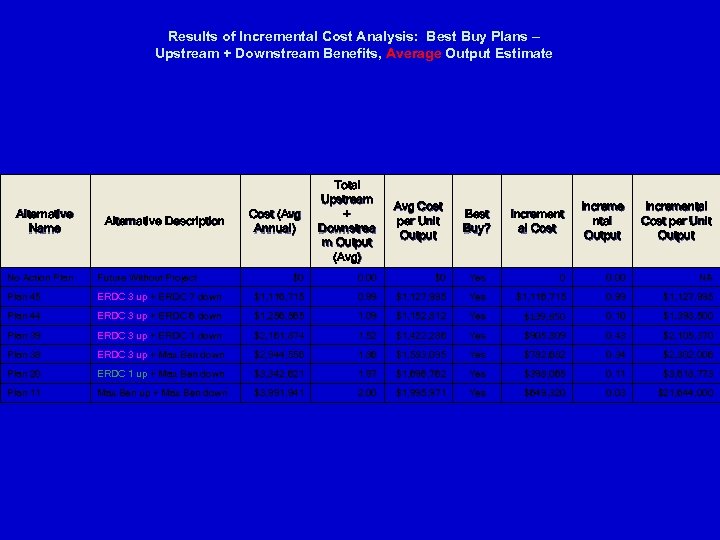 Results of Incremental Cost Analysis: Best Buy Plans – Upstream + Downstream Benefits, Average Output Estimate Alternative Name Alternative Description Cost (Avg Annual) Total Upstream + Downstrea m Output (Avg) Avg Cost per Unit Output $0 0. 00 $0 Increment al Cost Increme ntal Output Incremental Cost per Unit Output Yes 0 0. 00 NA Best Buy? No Action Plan Future Without Project Plan 45 ERDC 3 up + ERDC 7 down $1, 116, 715 0. 99 $1, 127, 995 Yes $1, 116, 715 0. 99 $1, 127, 995 Plan 44 ERDC 3 up + ERDC 6 down $1, 256, 565 1. 09 $1, 152, 812 Yes $139, 850 0. 10 $1, 398, 500 Plan 39 ERDC 3 up + ERDC 1 down $2, 161, 874 1. 52 $1, 422, 286 Yes $905, 309 0. 43 $2, 105, 370 Plan 38 ERDC 3 up + Max Ben down $2, 944, 556 1. 86 $1, 583, 095 Yes $782, 682 0. 34 $2, 302, 006 Plan 20 ERDC 1 up + Max Ben down $3, 342, 621 1. 97 $1, 696, 762 Yes $398, 065 0. 11 $3, 618, 773 Plan 11 Max Ben up + Max Ben down $3, 991, 941 2. 00 $1, 995, 971 Yes $649, 320 0. 03 $21, 644, 000
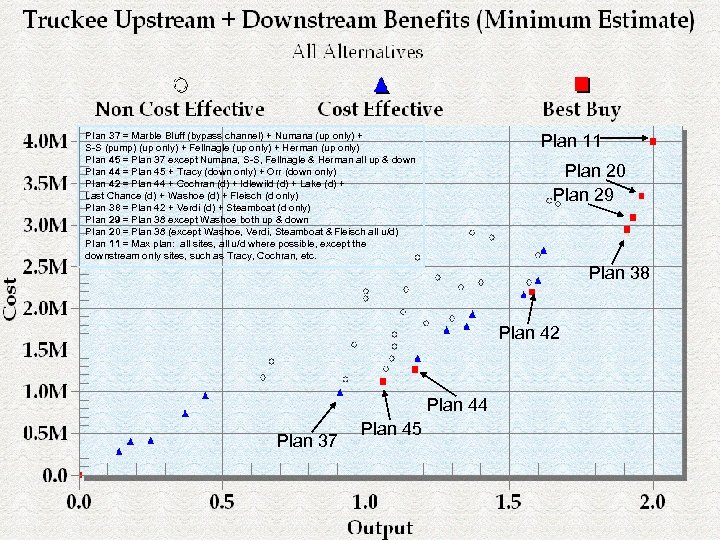 Plan 37 = Marble Bluff (bypass channel) + Numana (up only) + S-S (pump) (up only) + Fellnagle (up only) + Herman (up only) Plan 45 = Plan 37 except Numana, S-S, Fellnagle & Herman all up & down Plan 44 = Plan 45 + Tracy (down only) + Orr (down only) Plan 42 = Plan 44 + Cochran (d) + Idlewild (d) + Lake (d) + Last Chance (d) + Washoe (d) + Fleisch (d only) Plan 38 = Plan 42 + Verdi (d) + Steamboat (d only) Plan 29 = Plan 38 except Washoe both up & down Plan 20 = Plan 38 (except Washoe, Verdi, Steamboat & Fleisch all u/d) Plan 11 = Max plan: all sites, all u/d where possible, except the downstream only sites, such as Tracy, Cochran, etc. Plan 11 Plan 20 Plan 29 Plan 38 Plan 42 Plan 44 Plan 37 Plan 45
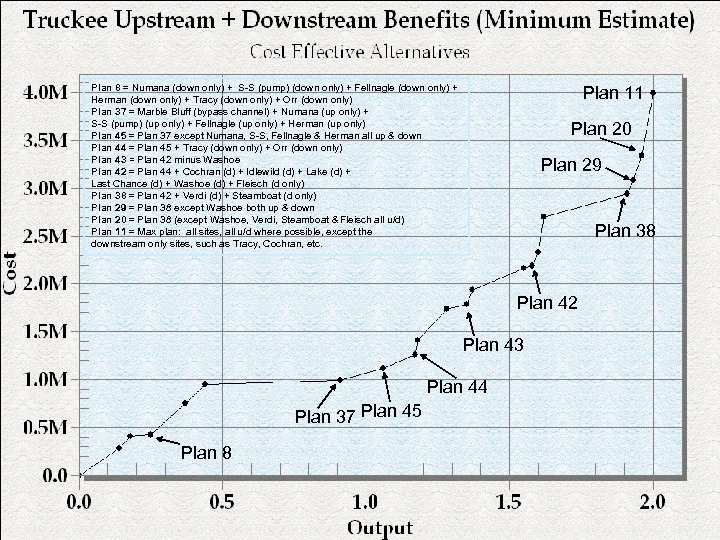 Plan 8 = Numana (down only) + S-S (pump) (down only) + Fellnagle (down only) + Herman (down only) + Tracy (down only) + Orr (down only) Plan 37 = Marble Bluff (bypass channel) + Numana (up only) + S-S (pump) (up only) + Fellnagle (up only) + Herman (up only) Plan 45 = Plan 37 except Numana, S-S, Fellnagle & Herman all up & down Plan 44 = Plan 45 + Tracy (down only) + Orr (down only) Plan 43 = Plan 42 minus Washoe Plan 42 = Plan 44 + Cochran (d) + Idlewild (d) + Lake (d) + Last Chance (d) + Washoe (d) + Fleisch (d only) Plan 38 = Plan 42 + Verdi (d) + Steamboat (d only) Plan 29 = Plan 38 except Washoe both up & down Plan 20 = Plan 38 (except Washoe, Verdi, Steamboat & Fleisch all u/d) Plan 11 = Max plan: all sites, all u/d where possible, except the downstream only sites, such as Tracy, Cochran, etc. Plan 11 Plan 20 Plan 29 Plan 38 Plan 42 Plan 43 Plan 44 Plan 37 Plan 45 Plan 8
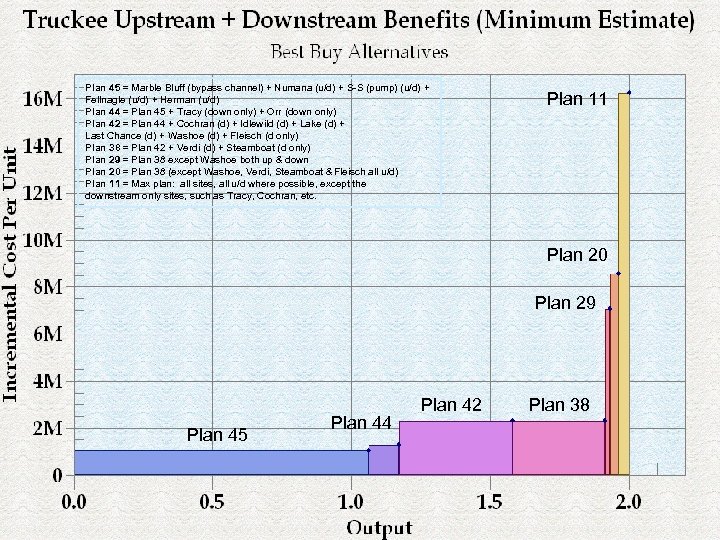 Plan 45 = Marble Bluff (bypass channel) + Numana (u/d) + S-S (pump) (u/d) + Fellnagle (u/d) + Herman (u/d) Plan 44 = Plan 45 + Tracy (down only) + Orr (down only) Plan 42 = Plan 44 + Cochran (d) + Idlewild (d) + Lake (d) + Last Chance (d) + Washoe (d) + Fleisch (d only) Plan 38 = Plan 42 + Verdi (d) + Steamboat (d only) Plan 29 = Plan 38 except Washoe both up & down Plan 20 = Plan 38 (except Washoe, Verdi, Steamboat & Fleisch all u/d) Plan 11 = Max plan: all sites, all u/d where possible, except the downstream only sites, such as Tracy, Cochran, etc. Plan 11 Plan 20 Plan 29 Plan 45 Plan 44 Plan 42 Plan 38
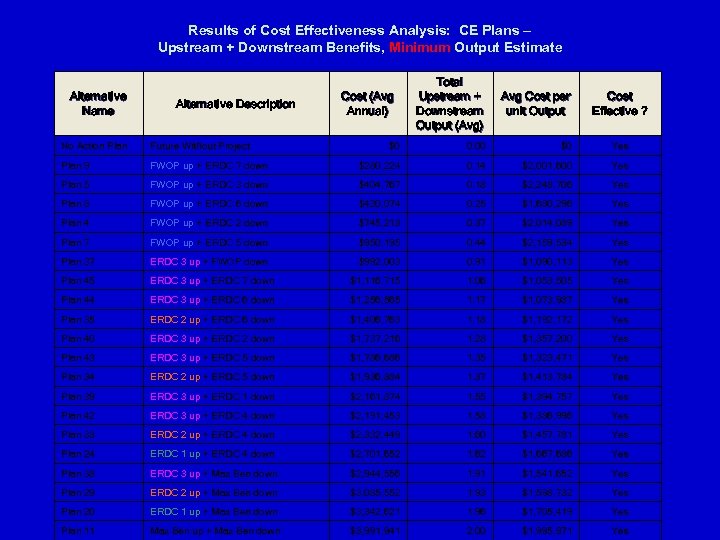 Results of Cost Effectiveness Analysis: CE Plans – Upstream + Downstream Benefits, Minimum Output Estimate Alternative Name Alternative Description Total Upstream + Downstream Output (Avg) Avg Cost per unit Output $0 0. 00 $0 Yes Cost (Avg Annual) Cost Effective ? No Action Plan Future Without Project Plan 9 FWOP up + ERDC 7 down $280, 224 0. 14 $2, 001, 600 Yes Plan 5 FWOP up + ERDC 3 down $404, 767 0. 18 $2, 248, 706 Yes Plan 8 FWOP up + ERDC 6 down $420, 074 0. 25 $1, 680, 296 Yes Plan 4 FWOP up + ERDC 2 down $745, 213 0. 37 $2, 014, 089 Yes Plan 7 FWOP up + ERDC 5 down $950, 195 0. 44 $2, 159, 534 Yes Plan 37 ERDC 3 up + FWOP down $992, 003 0. 91 $1, 090, 113 Yes Plan 45 ERDC 3 up + ERDC 7 down $1, 116, 715 1. 06 $1, 053, 505 Yes Plan 44 ERDC 3 up + ERDC 6 down $1, 256, 565 1. 17 $1, 073, 987 Yes Plan 35 ERDC 2 up + ERDC 6 down $1, 406, 763 1. 18 $1, 192, 172 Yes Plan 40 ERDC 3 up + ERDC 2 down $1, 737, 216 1. 28 $1, 357, 200 Yes Plan 43 ERDC 3 up + ERDC 5 down $1, 786, 686 1. 35 $1, 323, 471 Yes Plan 34 ERDC 2 up + ERDC 5 down $1, 936, 884 1. 37 $1, 413, 784 Yes Plan 39 ERDC 3 up + ERDC 1 down $2, 161, 874 1. 55 $1, 394, 757 Yes Plan 42 ERDC 3 up + ERDC 4 down $2, 191, 453 1. 58 $1, 386, 996 Yes Plan 33 ERDC 2 up + ERDC 4 down $2, 332, 449 1. 60 $1, 457, 781 Yes Plan 24 ERDC 1 up + ERDC 4 down $2, 701, 652 1. 62 $1, 667, 686 Yes Plan 38 ERDC 3 up + Max Ben down $2, 944, 556 1. 91 $1, 541, 652 Yes Plan 29 ERDC 2 up + Max Ben down $3, 085, 552 1. 93 $1, 598, 732 Yes Plan 20 ERDC 1 up + Max Ben down $3, 342, 621 1. 96 $1, 705, 419 Yes Plan 11 Max Ben up + Max Ben down $3, 991, 941 2. 00 $1, 995, 971 Yes
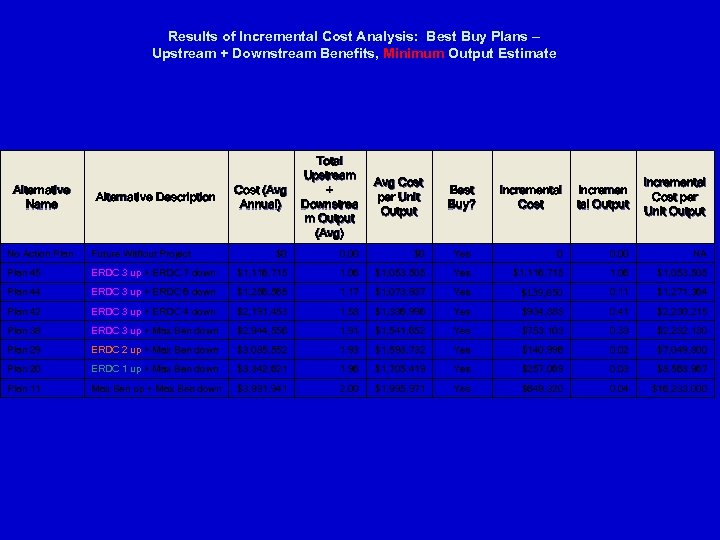 Results of Incremental Cost Analysis: Best Buy Plans – Upstream + Downstream Benefits, Minimum Output Estimate Alternative Name Alternative Description Cost (Avg Annual) Total Upstream + Downstrea m Output (Avg) Avg Cost per Unit Output $0 0. 00 $0 Incremental Cost Incremen tal Output Incremental Cost per Unit Output Yes 0 0. 00 NA Best Buy? No Action Plan Future Without Project Plan 45 ERDC 3 up + ERDC 7 down $1, 116, 715 1. 06 $1, 053, 505 Yes $1, 116, 715 1. 06 $1, 053, 505 Plan 44 ERDC 3 up + ERDC 6 down $1, 256, 565 1. 17 $1, 073, 987 Yes $139, 850 0. 11 $1, 271, 364 Plan 42 ERDC 3 up + ERDC 4 down $2, 191, 453 1. 58 $1, 386, 996 Yes $934, 888 0. 41 $2, 280, 215 Plan 38 ERDC 3 up + Max Ben down $2, 944, 556 1. 91 $1, 541, 652 Yes $753, 103 0. 33 $2, 282, 130 Plan 29 ERDC 2 up + Max Ben down $3, 085, 552 1. 93 $1, 598, 732 Yes $140, 996 0. 02 $7, 049, 800 Plan 20 ERDC 1 up + Max Ben down $3, 342, 621 1. 96 $1, 705, 419 Yes $257, 069 0. 03 $8, 568, 967 Plan 11 Max Ben up + Max Ben down $3, 991, 941 2. 00 $1, 995, 971 Yes $649, 320 0. 04 $16, 233, 000
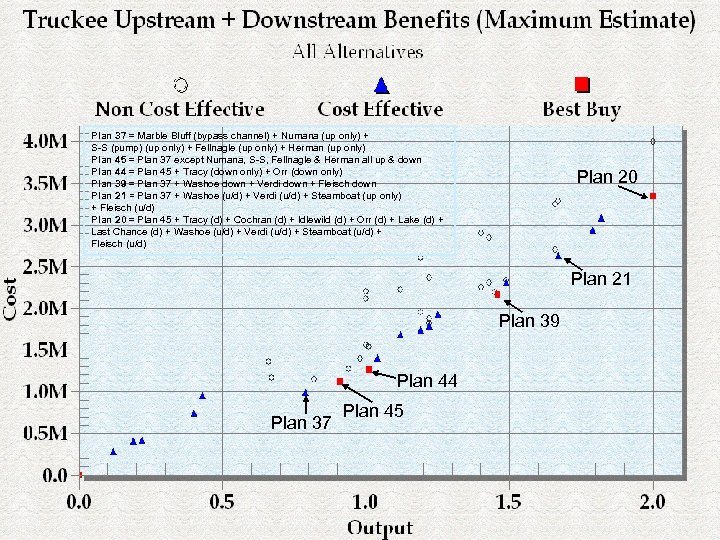 Plan 37 = Marble Bluff (bypass channel) + Numana (up only) + S-S (pump) (up only) + Fellnagle (up only) + Herman (up only) Plan 45 = Plan 37 except Numana, S-S, Fellnagle & Herman all up & down Plan 44 = Plan 45 + Tracy (down only) + Orr (down only) Plan 39 = Plan 37 + Washoe down + Verdi down + Fleisch down Plan 21 = Plan 37 + Washoe (u/d) + Verdi (u/d) + Steamboat (up only) + Fleisch (u/d) Plan 20 = Plan 45 + Tracy (d) + Cochran (d) + Idlewild (d) + Orr (d) + Lake (d) + Last Chance (d) + Washoe (u/d) + Verdi (u/d) + Steamboat (u/d) + Fleisch (u/d) Plan 20 Plan 21 Plan 39 Plan 44 Plan 37 Plan 45
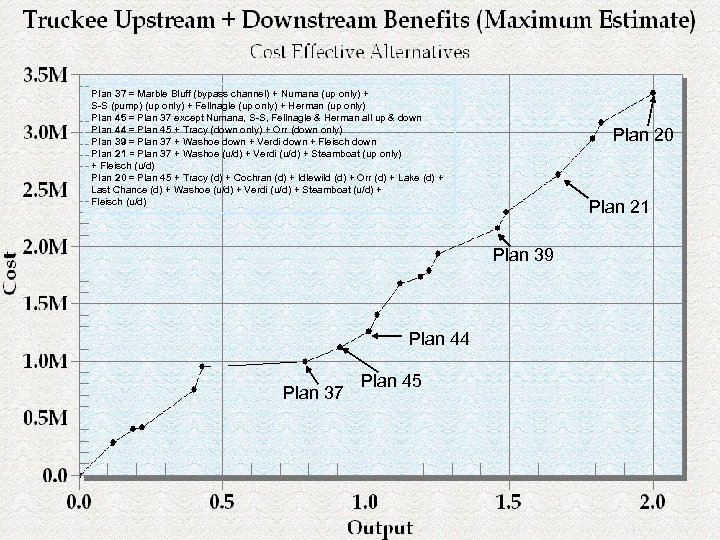 Plan 37 = Marble Bluff (bypass channel) + Numana (up only) + S-S (pump) (up only) + Fellnagle (up only) + Herman (up only) Plan 45 = Plan 37 except Numana, S-S, Fellnagle & Herman all up & down Plan 44 = Plan 45 + Tracy (down only) + Orr (down only) Plan 39 = Plan 37 + Washoe down + Verdi down + Fleisch down Plan 21 = Plan 37 + Washoe (u/d) + Verdi (u/d) + Steamboat (up only) + Fleisch (u/d) Plan 20 = Plan 45 + Tracy (d) + Cochran (d) + Idlewild (d) + Orr (d) + Lake (d) + Last Chance (d) + Washoe (u/d) + Verdi (u/d) + Steamboat (u/d) + Fleisch (u/d) Plan 20 Plan 21 Plan 39 Plan 44 Plan 37 Plan 45
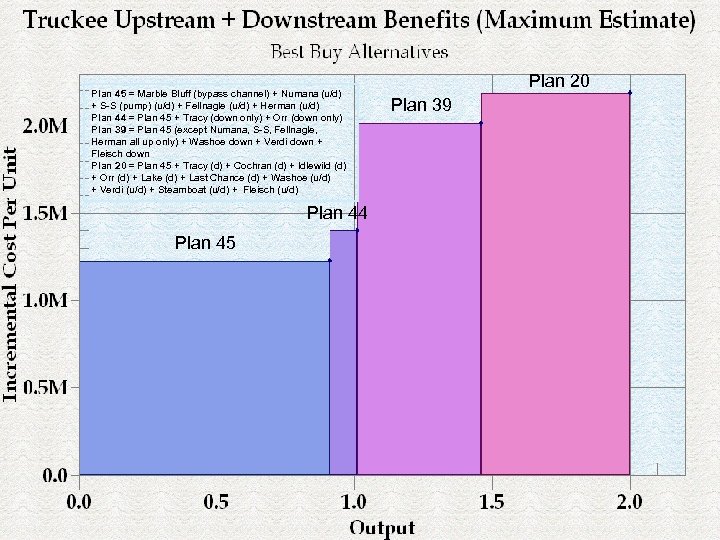 Plan 45 = Marble Bluff (bypass channel) + Numana (u/d) + S-S (pump) (u/d) + Fellnagle (u/d) + Herman (u/d) Plan 44 = Plan 45 + Tracy (down only) + Orr (down only) Plan 39 = Plan 45 (except Numana, S-S, Fellnagle, Herman all up only) + Washoe down + Verdi down + Fleisch down Plan 20 = Plan 45 + Tracy (d) + Cochran (d) + Idlewild (d) + Orr (d) + Lake (d) + Last Chance (d) + Washoe (u/d) + Verdi (u/d) + Steamboat (u/d) + Fleisch (u/d) Plan 44 Plan 45 Plan 20 Plan 39
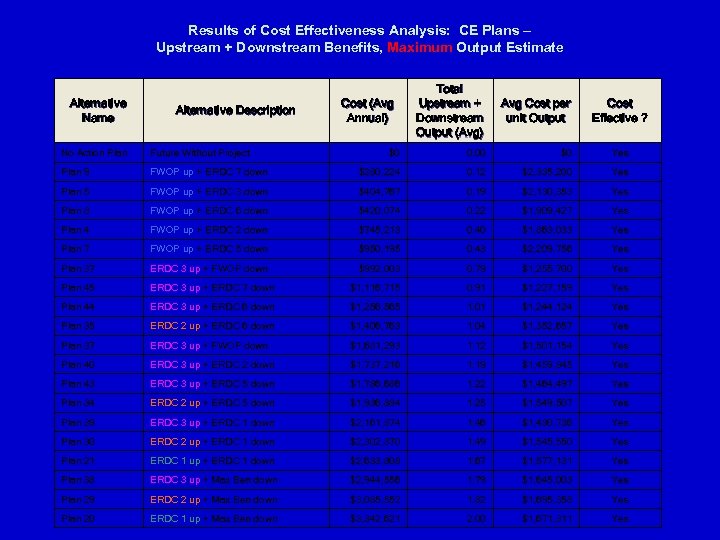 Results of Cost Effectiveness Analysis: CE Plans – Upstream + Downstream Benefits, Maximum Output Estimate Alternative Name Alternative Description Total Upstream + Downstream Output (Avg) Avg Cost per unit Output $0 0. 00 $0 Yes Cost (Avg Annual) Cost Effective ? No Action Plan Future Without Project Plan 9 FWOP up + ERDC 7 down $280, 224 0. 12 $2, 335, 200 Yes Plan 5 FWOP up + ERDC 3 down $404, 767 0. 19 $2, 130, 353 Yes Plan 8 FWOP up + ERDC 6 down $420, 074 0. 22 $1, 909, 427 Yes Plan 4 FWOP up + ERDC 2 down $745, 213 0. 40 $1, 863, 033 Yes Plan 7 FWOP up + ERDC 5 down $950, 195 0. 43 $2, 209, 756 Yes Plan 37 ERDC 3 up + FWOP down $992, 003 0. 79 $1, 255, 700 Yes Plan 45 ERDC 3 up + ERDC 7 down $1, 116, 715 0. 91 $1, 227, 159 Yes Plan 44 ERDC 3 up + ERDC 6 down $1, 256, 565 1. 01 $1, 244, 124 Yes Plan 35 ERDC 2 up + ERDC 6 down $1, 406, 763 1. 04 $1, 352, 657 Yes Plan 37 ERDC 3 up + FWOP down $1, 681, 293 1. 12 $1, 501, 154 Yes Plan 40 ERDC 3 up + ERDC 2 down $1, 737, 216 1. 19 $1, 459, 845 Yes Plan 43 ERDC 3 up + ERDC 5 down $1, 786, 686 1. 22 $1, 464, 497 Yes Plan 34 ERDC 2 up + ERDC 5 down $1, 936, 884 1. 25 $1, 549, 507 Yes Plan 39 ERDC 3 up + ERDC 1 down $2, 161, 874 1. 46 $1, 480, 736 Yes Plan 30 ERDC 2 up + ERDC 1 down $2, 302, 870 1. 49 $1, 545, 550 Yes Plan 21 ERDC 1 up + ERDC 1 down $2, 633, 808 1. 67 $1, 577, 131 Yes Plan 38 ERDC 3 up + Max Ben down $2, 944, 556 1. 79 $1, 645, 003 Yes Plan 29 ERDC 2 up + Max Ben down $3, 085, 552 1. 82 $1, 695, 358 Yes Plan 20 ERDC 1 up + Max Ben down $3, 342, 621 2. 00 $1, 671, 311 Yes
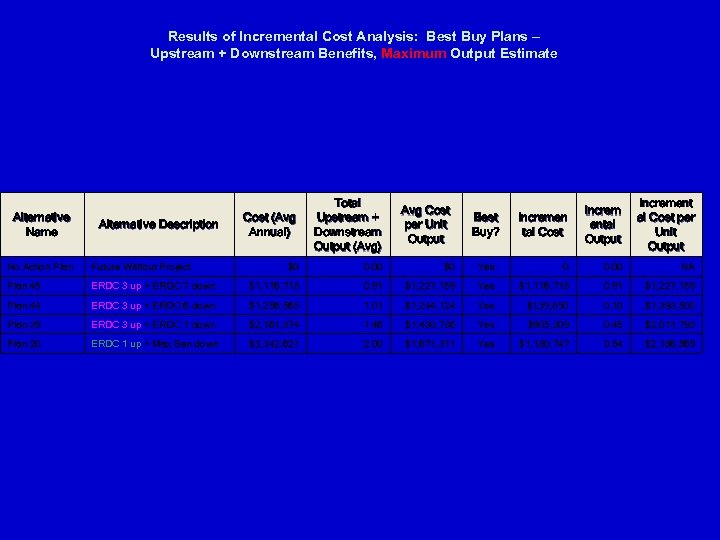 Results of Incremental Cost Analysis: Best Buy Plans – Upstream + Downstream Benefits, Maximum Output Estimate Alternative Name Alternative Description Cost (Avg Annual) Total Upstream + Downstream Output (Avg) $0 0. 00 $0 Yes 0 0. 00 NA Avg Cost per Unit Output Best Buy? Incremen tal Cost Increm ental Output Increment al Cost per Unit Output No Action Plan Future Without Project Plan 45 ERDC 3 up + ERDC 7 down $1, 116, 715 0. 91 $1, 227, 159 Yes $1, 116, 715 0. 91 $1, 227, 159 Plan 44 ERDC 3 up + ERDC 6 down $1, 256, 565 1. 01 $1, 244, 124 Yes $139, 850 0. 10 $1, 398, 500 Plan 39 ERDC 3 up + ERDC 1 down $2, 161, 874 1. 46 $1, 480, 736 Yes $905, 309 0. 45 $2, 011, 798 Plan 20 ERDC 1 up + Max Ben down $3, 342, 621 2. 00 $1, 671, 311 Yes $1, 180, 747 0. 54 $2, 186, 569
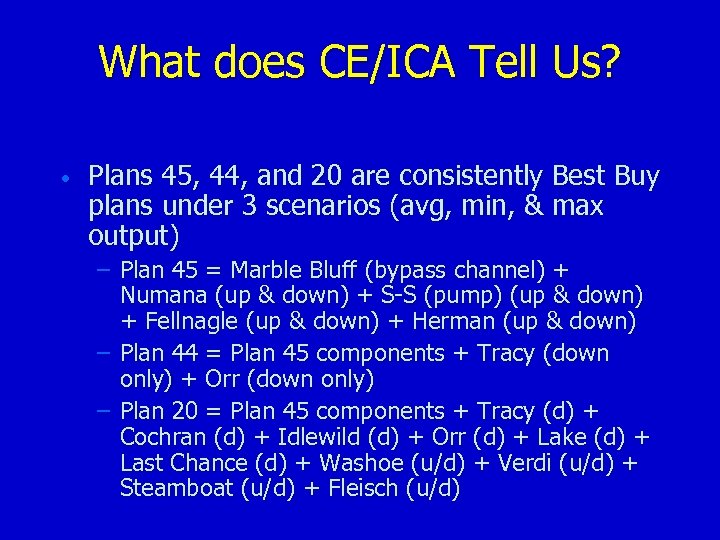 What does CE/ICA Tell Us? • Plans 45, 44, and 20 are consistently Best Buy plans under 3 scenarios (avg, min, & max output) – Plan 45 = Marble Bluff (bypass channel) + Numana (up & down) + S-S (pump) (up & down) + Fellnagle (up & down) + Herman (up & down) – Plan 44 = Plan 45 components + Tracy (down only) + Orr (down only) – Plan 20 = Plan 45 components + Tracy (d) + Cochran (d) + Idlewild (d) + Orr (d) + Lake (d) + Last Chance (d) + Washoe (u/d) + Verdi (u/d) + Steamboat (u/d) + Fleisch (u/d)
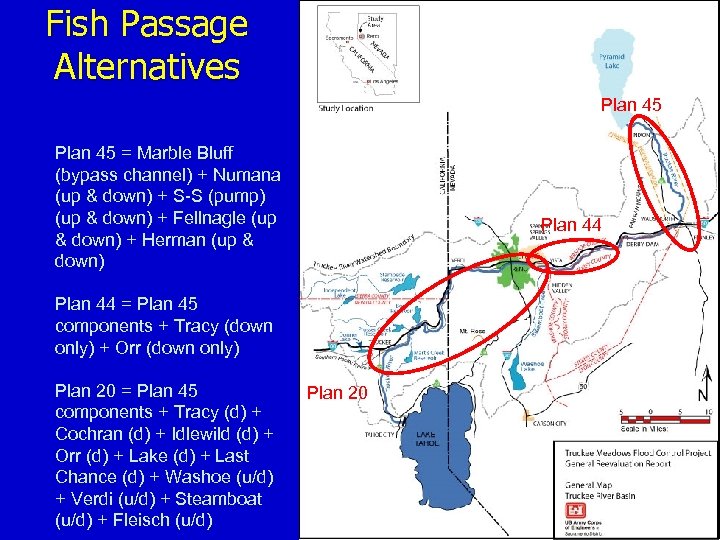 Fish Passage Alternatives Plan 45 = Marble Bluff (bypass channel) + Numana (up & down) + S-S (pump) (up & down) + Fellnagle (up & down) + Herman (up & down) Plan 44 = Plan 45 components + Tracy (down only) + Orr (down only) Plan 20 = Plan 45 components + Tracy (d) + Cochran (d) + Idlewild (d) + Orr (d) + Lake (d) + Last Chance (d) + Washoe (u/d) + Verdi (u/d) + Steamboat (u/d) + Fleisch (u/d) Plan 20
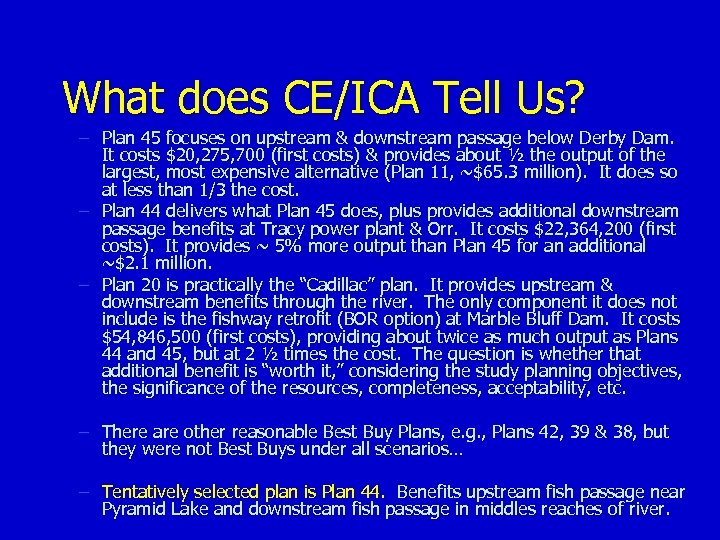 What does CE/ICA Tell Us? – Plan 45 focuses on upstream & downstream passage below Derby Dam. It costs $20, 275, 700 (first costs) & provides about ½ the output of the largest, most expensive alternative (Plan 11, ~$65. 3 million). It does so at less than 1/3 the cost. – Plan 44 delivers what Plan 45 does, plus provides additional downstream passage benefits at Tracy power plant & Orr. It costs $22, 364, 200 (first costs). It provides ~ 5% more output than Plan 45 for an additional ~$2. 1 million. – Plan 20 is practically the “Cadillac” plan. It provides upstream & downstream benefits through the river. The only component it does not include is the fishway retrofit (BOR option) at Marble Bluff Dam. It costs $54, 846, 500 (first costs), providing about twice as much output as Plans 44 and 45, but at 2 ½ times the cost. The question is whether that additional benefit is “worth it, ” considering the study planning objectives, the significance of the resources, completeness, acceptability, etc. – There are other reasonable Best Buy Plans, e. g. , Plans 42, 39 & 38, but they were not Best Buys under all scenarios… – Tentatively selected plan is Plan 44. Benefits upstream fish passage near Pyramid Lake and downstream fish passage in middles reaches of river.