 Скачать презентацию Cost Benefit Analysis overview Outline
d56f74e31e467ea6396f6893040d62ba.ppt
- Количество слайдов: 25



Cost Benefit Analysis – overview
Outline • Background • Overview of methodology • Some examples
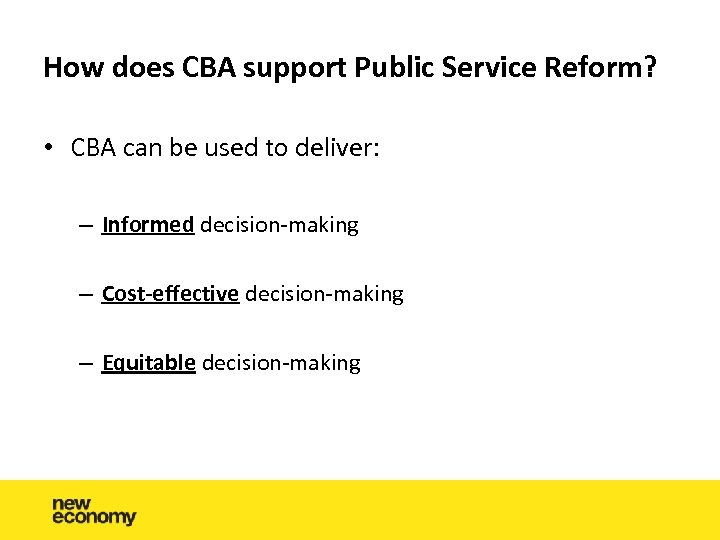
How does CBA support Public Service Reform? • CBA can be used to deliver: – Informed decision-making – Cost-effective decision-making – Equitable decision-making
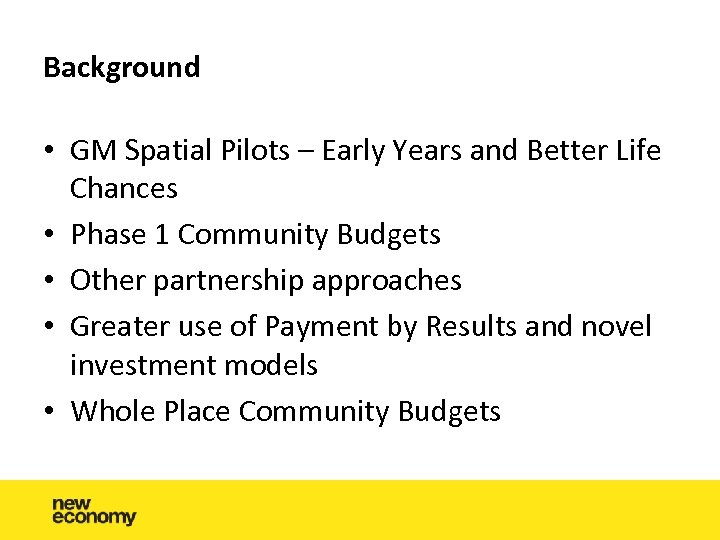
Background • GM Spatial Pilots – Early Years and Better Life Chances • Phase 1 Community Budgets • Other partnership approaches • Greater use of Payment by Results and novel investment models • Whole Place Community Budgets
Greater Manchester CBA methodology
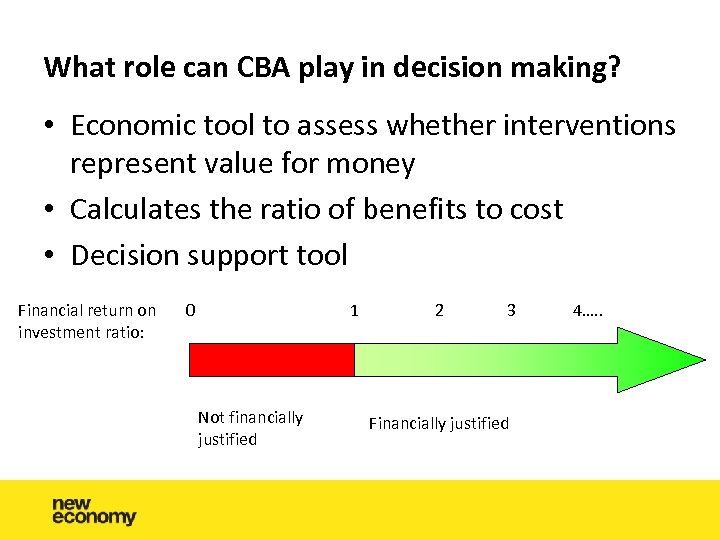
What role can CBA play in decision making? • Economic tool to assess whether interventions represent value for money • Calculates the ratio of benefits to cost • Decision support tool Financial return on investment ratio: 0 1 Not financially justified 2 3 Financially justified 4…. .
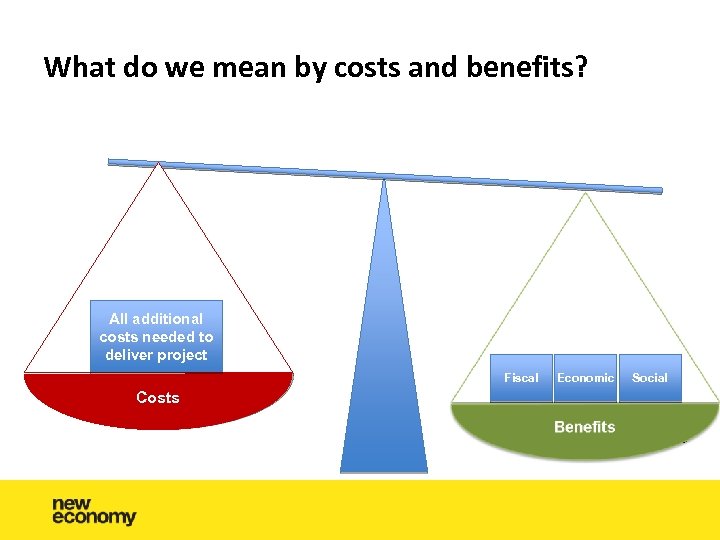
What do we mean by costs and benefits? All additional costs needed to deliver project • Fiscal • Social • Economic Fiscal Costs Economic Social
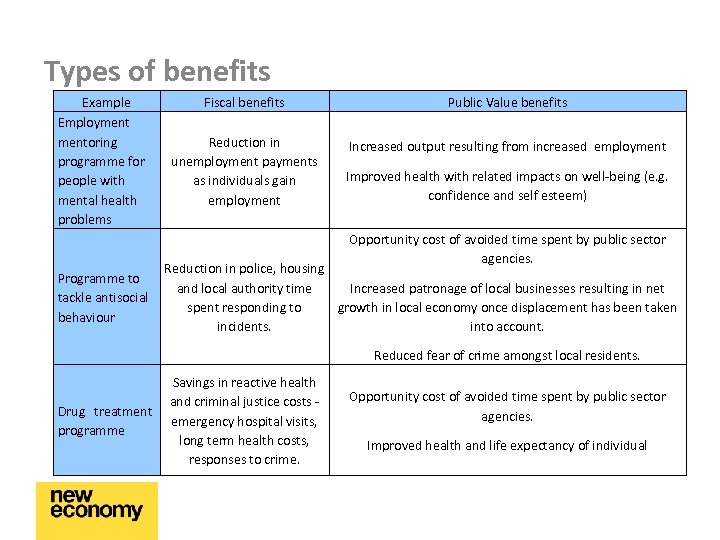
Types of benefits Example Employmentoring programme for people with mental health problems Fiscal benefits Public Value benefits Reduction in unemployment payments as individuals gain employment Increased output resulting from increased employment Improved health with related impacts on well-being (e. g. confidence and self esteem) Opportunity cost of avoided time spent by public sector agencies. Programme to tackle antisocial behaviour Reduction in police, housing Increased patronage of local businesses resulting in net and local authority time spent responding to growth in local economy once displacement has been taken incidents. into account. Reduced fear of crime amongst local residents. Drug treatment programme Savings in reactive health and criminal justice costs emergency hospital visits, long term health costs, responses to crime. Opportunity cost of avoided time spent by public sector agencies. Improved health and life expectancy of individual
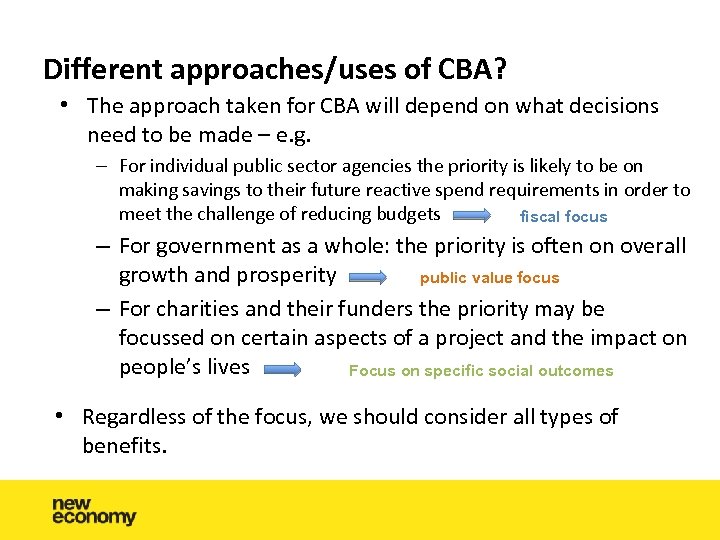
Different approaches/uses of CBA? • The approach taken for CBA will depend on what decisions need to be made – e. g. – For individual public sector agencies the priority is likely to be on making savings to their future reactive spend requirements in order to meet the challenge of reducing budgets fiscal focus – For government as a whole: the priority is often on overall growth and prosperity public value focus – For charities and their funders the priority may be focussed on certain aspects of a project and the impact on people’s lives Focus on specific social outcomes • Regardless of the focus, we should consider all types of benefits.
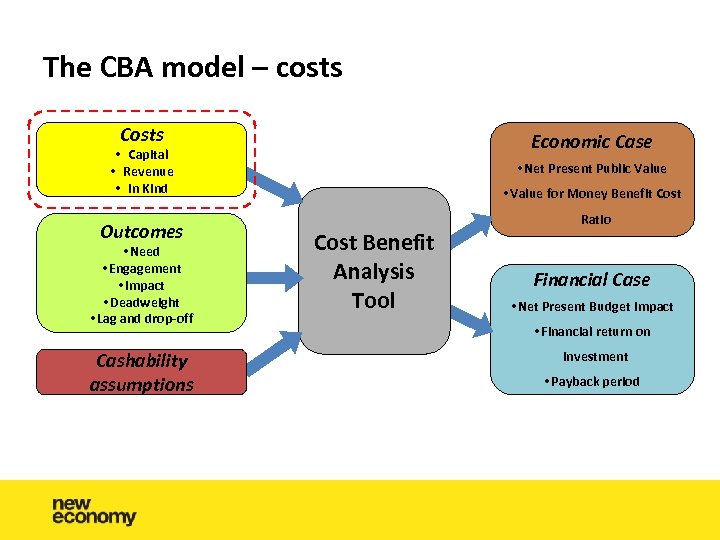
The CBA model – costs Costs Economic Case • Capital • Revenue • In Kind Outcomes • Need • Engagement • Impact • Deadweight • Lag and drop-off Cashability assumptions • Net Present Public Value • Value for Money Benefit Cost Benefit Analysis Tool Ratio Financial Case • Net Present Budget Impact • Financial return on investment • Payback period
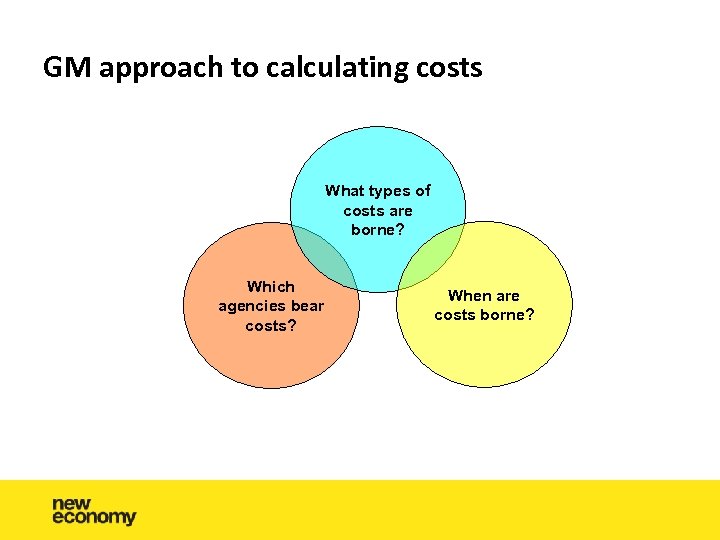
GM approach to calculating costs What types of costs are borne? Which agencies bear costs? When are costs borne?
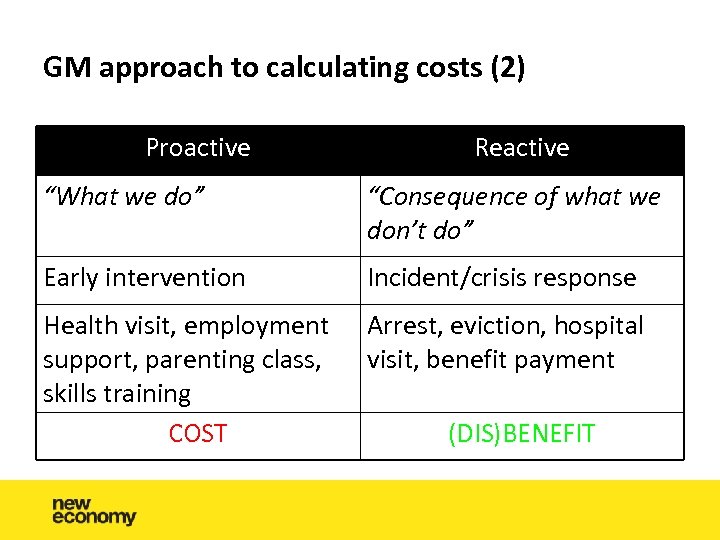
GM approach to calculating costs (2) Proactive Reactive “What we do” “Consequence of what we don’t do” Early intervention Incident/crisis response Health visit, employment support, parenting class, skills training COST Arrest, eviction, hospital visit, benefit payment (DIS)BENEFIT
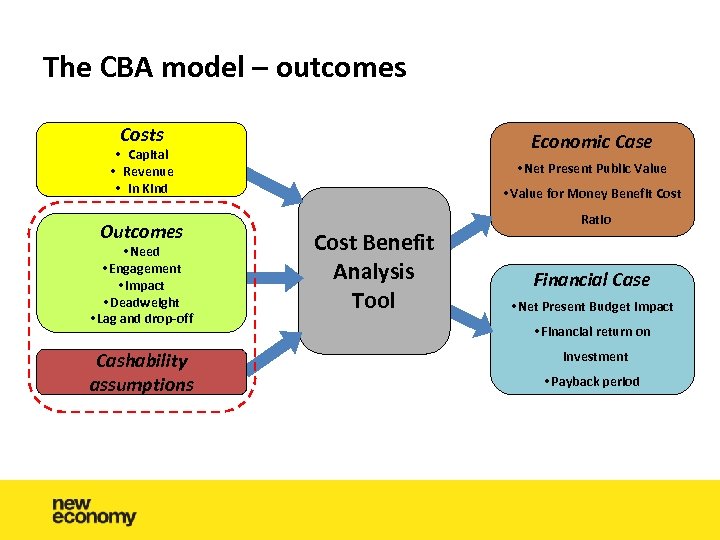
The CBA model – outcomes Costs Economic Case • Capital • Revenue • In Kind Outcomes • Need • Engagement • Impact • Deadweight • Lag and drop-off Cashability assumptions • Net Present Public Value • Value for Money Benefit Cost Benefit Analysis Tool Ratio Financial Case • Net Present Budget Impact • Financial return on investment • Payback period
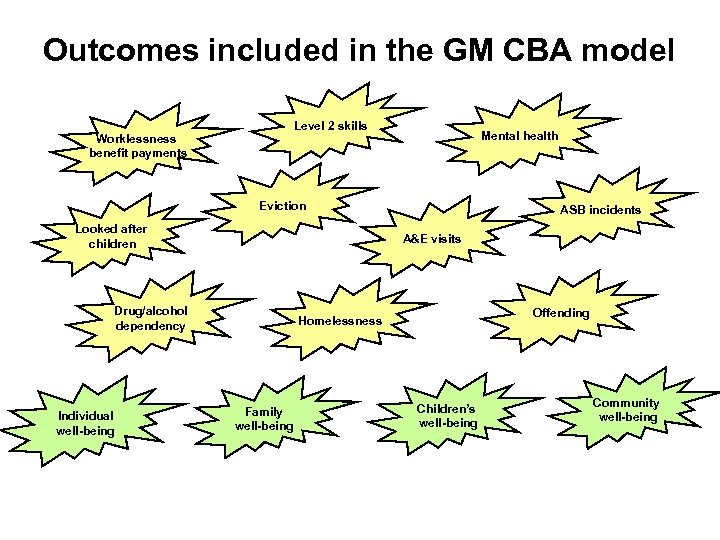
Outcomes included in the GM CBA model Level 2 skills Mental health Worklessness benefit payments Eviction Looked after children A&E visits Drug/alcohol dependency Individual well-being ASB incidents Offending Homelessness Family well-being Children’s well-being Community well-being
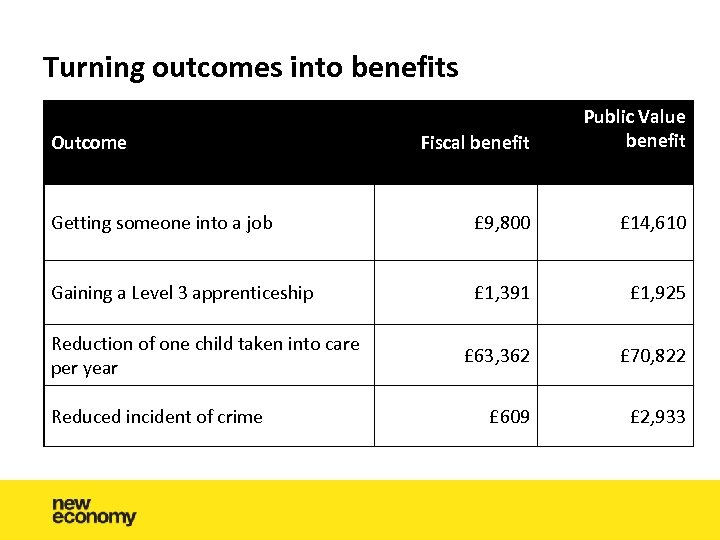
Turning outcomes into benefits Fiscal benefit Public Value benefit Getting someone into a job £ 9, 800 £ 14, 610 Gaining a Level 3 apprenticeship £ 1, 391 £ 1, 925 £ 63, 362 £ 70, 822 £ 609 £ 2, 933 Outcome Reduction of one child taken into care per year Reduced incident of crime
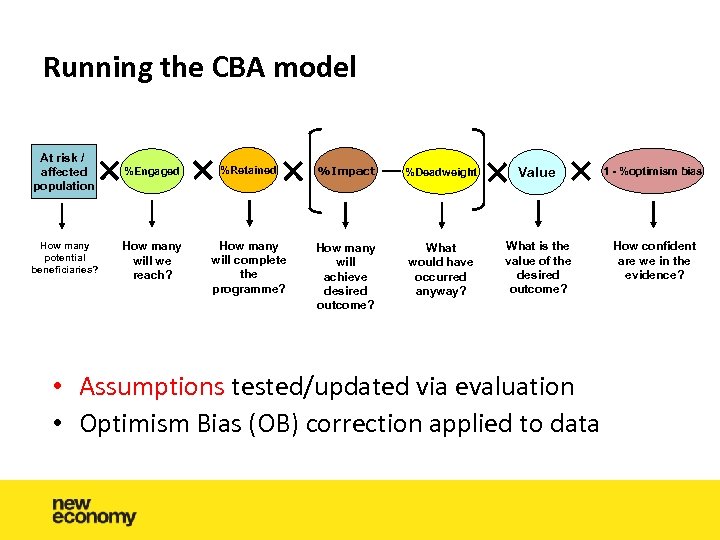
Running the CBA model At risk / affected population %Engaged %Retained %Impact %Deadweight Value 1 - %optimism bias How many potential beneficiaries? How many will we reach? How many will complete the programme? How many will achieve desired outcome? What would have occurred anyway? What is the value of the desired outcome? How confident are we in the evidence? • Assumptions tested/updated via evaluation • Optimism Bias (OB) correction applied to data
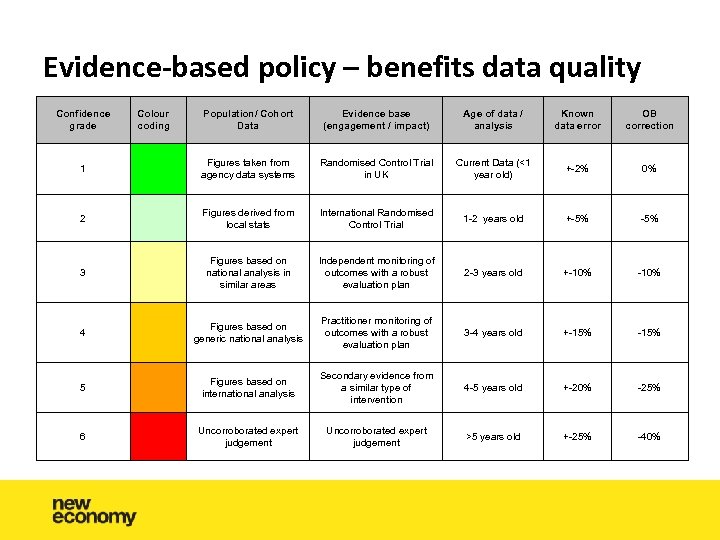
Evidence-based policy – benefits data quality Confidence grade Colour coding 1 Population/ Cohort Data Evidence base (engagement / impact) Age of data / analysis Known data error OB correction Figures taken from agency data systems Randomised Control Trial in UK Current Data (<1 year old) +-2% 0% 2 Figures derived from local stats International Randomised Control Trial 1 -2 years old +-5% 3 Figures based on national analysis in similar areas Independent monitoring of outcomes with a robust evaluation plan 2 -3 years old +-10% 4 Figures based on generic national analysis Practitioner monitoring of outcomes with a robust evaluation plan 3 -4 years old +-15% 5 Figures based on international analysis Secondary evidence from a similar type of intervention 4 -5 years old +-20% -25% 6 Uncorroborated expert judgement >5 years old +-25% -40%
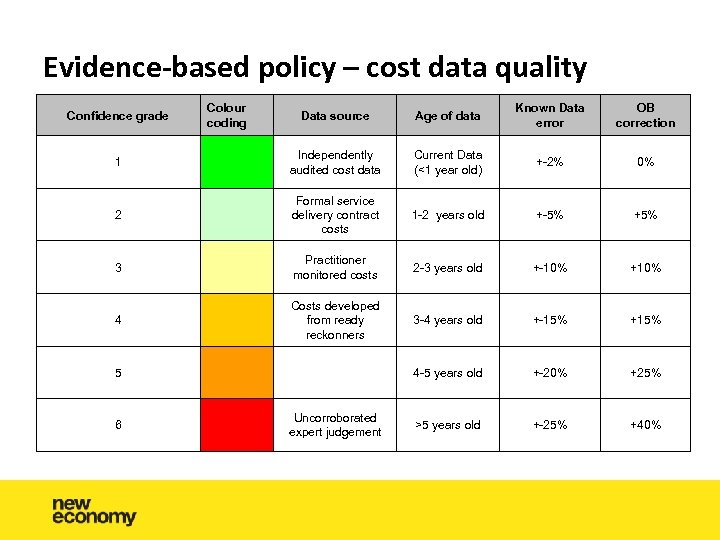
Evidence-based policy – cost data quality Confidence grade Colour coding 1 Data source Age of data Known Data error OB correction Independently audited cost data Current Data (<1 year old) +-2% 0% 2 Formal service delivery contract costs 1 -2 years old +-5% +5% 3 Practitioner monitored costs 2 -3 years old +-10% +10% 4 Costs developed from ready reckonners 3 -4 years old +-15% +15% 5 4 -5 years old +-20% +25% 6 Uncorroborated expert judgement >5 years old +-25% +40%
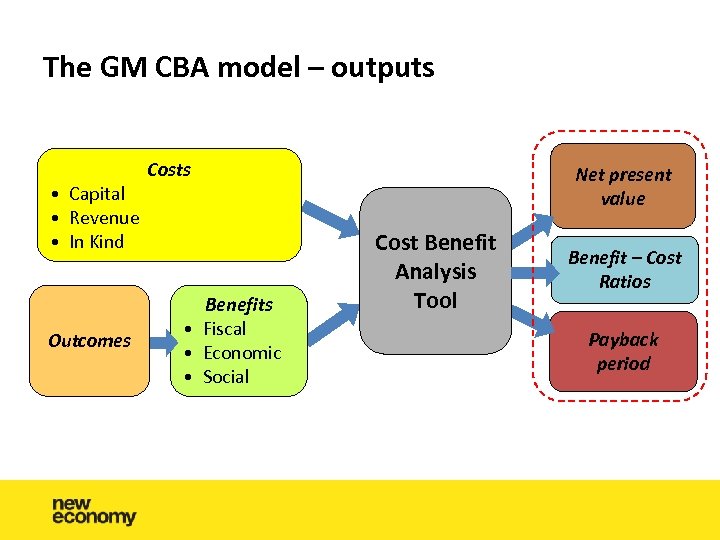
The GM CBA model – outputs • Capital • Revenue • In Kind Outcomes Costs Benefits • Fiscal • Economic • Social Net present value Cost Benefit Analysis Tool Benefit – Cost Ratios Payback period
Example outputs
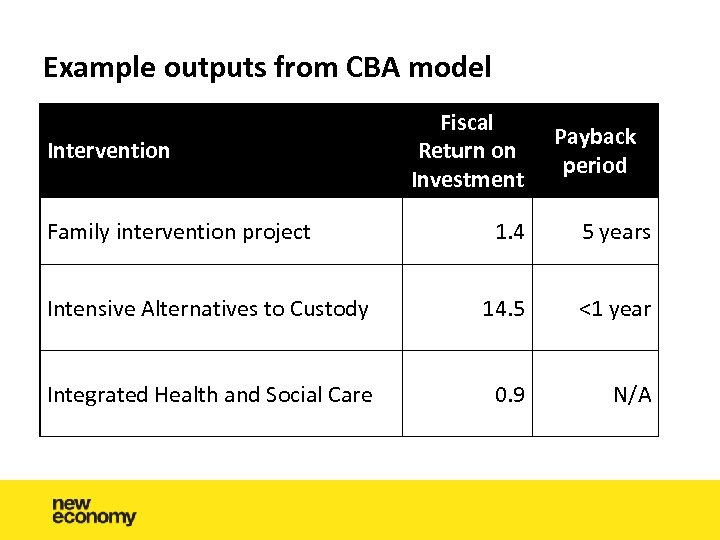
Example outputs from CBA model Intervention Family intervention project Fiscal Return on Investment Payback period 1. 4 5 years Intensive Alternatives to Custody 14. 5 <1 year Integrated Health and Social Care 0. 9 N/A
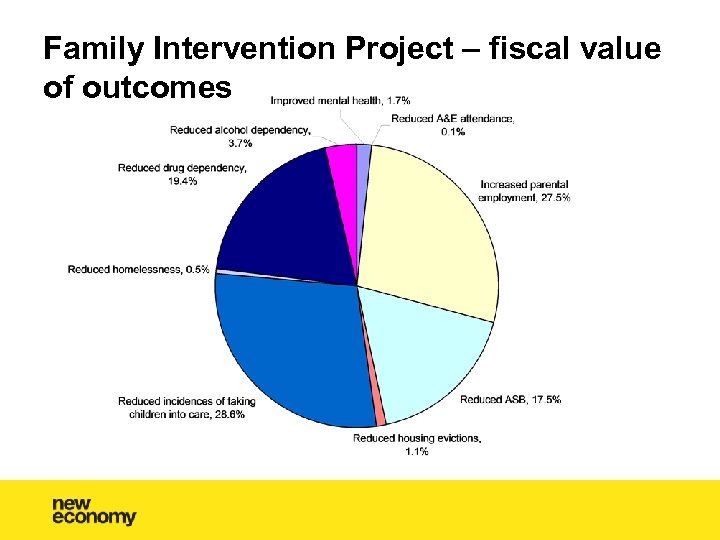
Family Intervention Project – fiscal value of outcomes
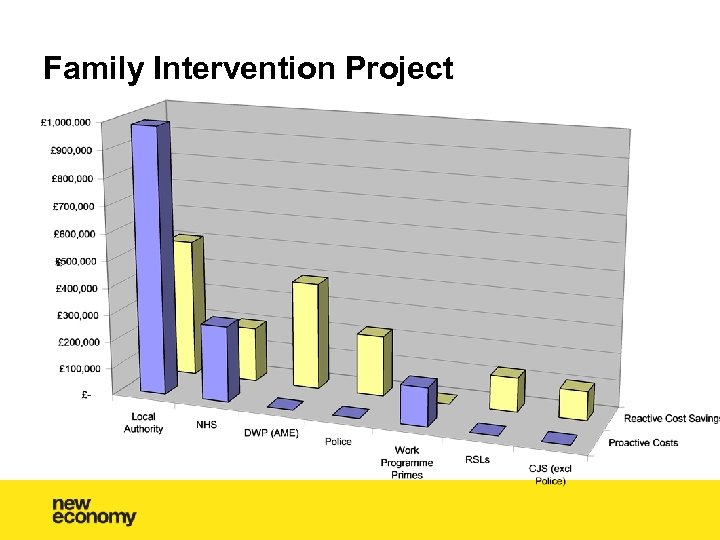
Family Intervention Project
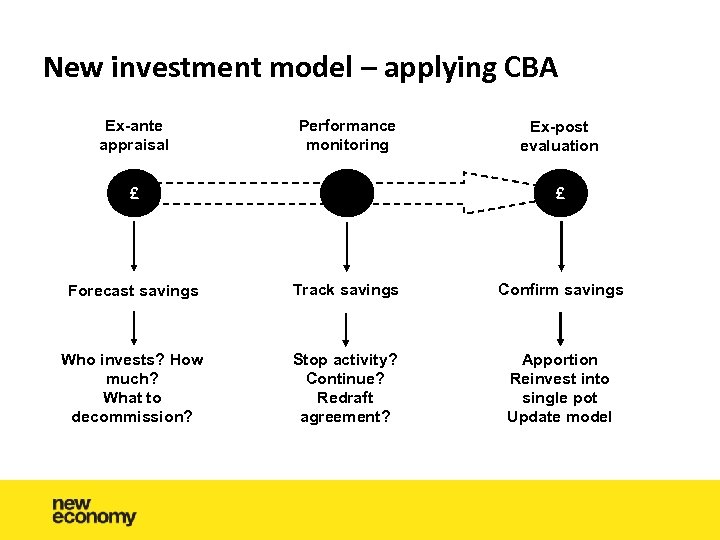
New investment model – applying CBA Ex-ante appraisal Performance monitoring £ Ex-post evaluation £ Forecast savings Track savings Confirm savings Who invests? How much? What to decommission? Stop activity? Continue? Redraft agreement? Apportion Reinvest into single pot Update model

Any questions? cba@neweconomymanchester. com
Скачать презентацию Cost Benefit Analysis overview Outline
d56f74e31e467ea6396f6893040d62ba.ppt