


 Скачать презентацию Cost and Regulatory Challenges to U S Short
2fadd0ee8d3a080b4ed14dbc2aad060b.ppt
- Количество слайдов: 14
 Cost and Regulatory Challenges to U. S. Short Sea Shipping Transportation Research Board Alternative Freight Capacity: Opportunities and Challenges January 11 th 2004 Washington, DC 1 PFRA Paul F. Richardson Associates, Inc.
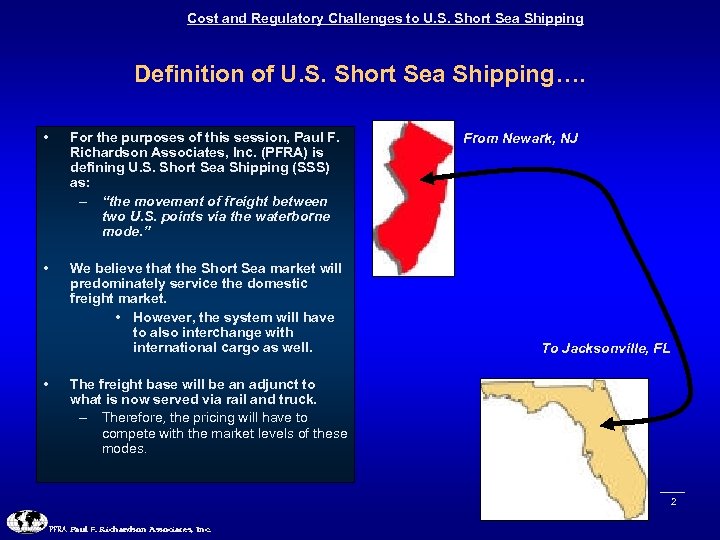 Cost and Regulatory Challenges to U. S. Short Sea Shipping Definition of U. S. Short Sea Shipping…. • For the purposes of this session, Paul F. Richardson Associates, Inc. (PFRA) is defining U. S. Short Sea Shipping (SSS) as: – “the movement of freight between two U. S. points via the waterborne mode. ” • We believe that the Short Sea market will predominately service the domestic freight market. • However, the system will have to also interchange with international cargo as well. • From Newark, NJ To Jacksonville, FL The freight base will be an adjunct to what is now served via rail and truck. – Therefore, the pricing will have to compete with the market levels of these modes. 2 PFRA Paul F. Richardson Associates, Inc.
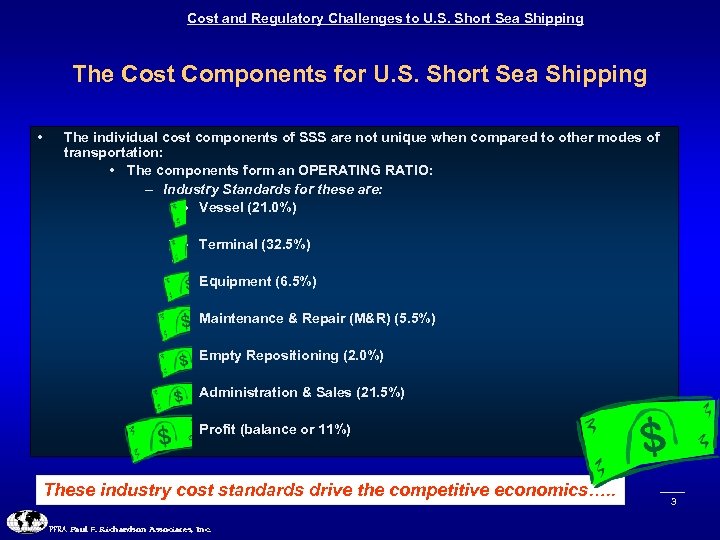 Cost and Regulatory Challenges to U. S. Short Sea Shipping The Cost Components for U. S. Short Sea Shipping • The individual cost components of SSS are not unique when compared to other modes of transportation: • The components form an OPERATING RATIO: – Industry Standards for these are: » Vessel (21. 0%) » Terminal (32. 5%) » Equipment (6. 5%) » Maintenance & Repair (M&R) (5. 5%) » Empty Repositioning (2. 0%) » Administration & Sales (21. 5%) » Profit (balance or 11%) These industry cost standards drive the competitive economics…. . PFRA Paul F. Richardson Associates, Inc. 3
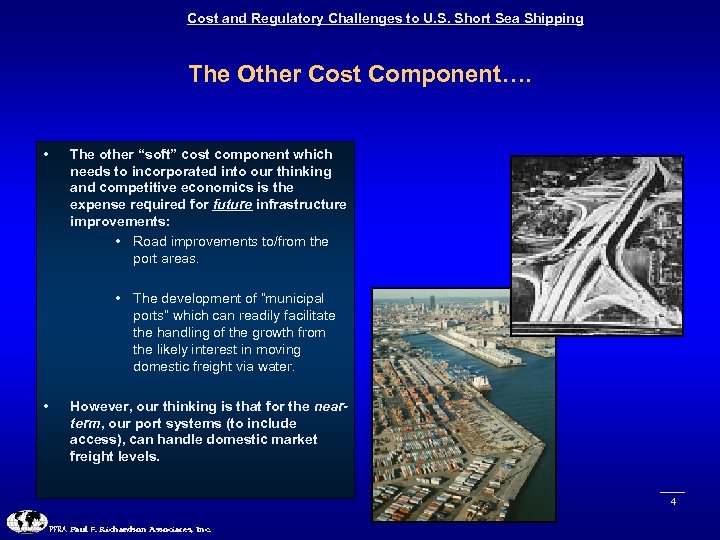 Cost and Regulatory Challenges to U. S. Short Sea Shipping The Other Cost Component…. • The other “soft” cost component which needs to incorporated into our thinking and competitive economics is the expense required for future infrastructure improvements: • Road improvements to/from the port areas. • The development of “municipal ports” which can readily facilitate the handling of the growth from the likely interest in moving domestic freight via water. • However, our thinking is that for the nearterm, our port systems (to include access), can handle domestic market freight levels. 4 PFRA Paul F. Richardson Associates, Inc.
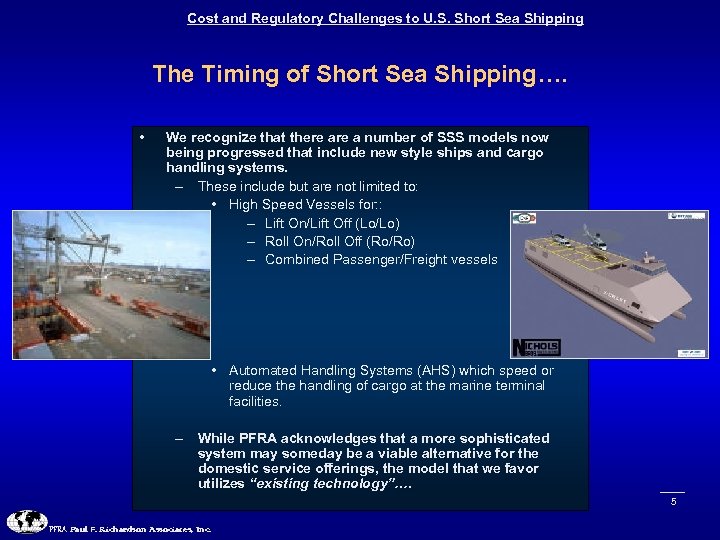 Cost and Regulatory Challenges to U. S. Short Sea Shipping The Timing of Short Sea Shipping…. • We recognize that there a number of SSS models now being progressed that include new style ships and cargo handling systems. – These include but are not limited to: • High Speed Vessels for: : – Lift On/Lift Off (Lo/Lo) – Roll On/Roll Off (Ro/Ro) – Combined Passenger/Freight vessels • Automated Handling Systems (AHS) which speed or reduce the handling of cargo at the marine terminal facilities. – While PFRA acknowledges that a more sophisticated system may someday be a viable alternative for the domestic service offerings, the model that we favor utilizes “existing technology”…. 5 PFRA Paul F. Richardson Associates, Inc.
 Cost and Regulatory Challenges to U. S. Short Sea Shipping The Market Requirements…. • This “existing technology” meets current market requirements: – While “high-speed” ships and “automated” handling will some day address an expanded market, a vast segment of today’s domestic freight can go waterborne. • This translates to an alternative to the rail and truck markets…. • Given market size, we believe that with the right competitive economics, a domestic Short Sea System could be implemented in short order. • Previous analysis has confirmed that with “existing technology”, that the market/customer requirements could bear an approximate 10% rate differential from current rail/truck rates. – Waterborne cost-per-mile economics are superior. • An example is for a move from New Jersey to Florida (the largest available domestic market), which is currently over 75% a truck market. 6 PFRA Paul F. Richardson Associates, Inc.
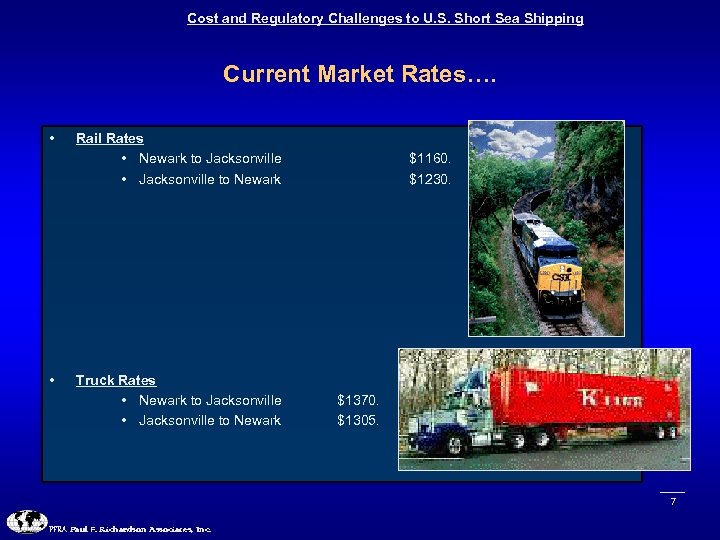 Cost and Regulatory Challenges to U. S. Short Sea Shipping Current Market Rates…. • • Rail Rates • Newark to Jacksonville • Jacksonville to Newark Truck Rates • Newark to Jacksonville • Jacksonville to Newark $1160. $1230. $1370. $1305. 7 PFRA Paul F. Richardson Associates, Inc.
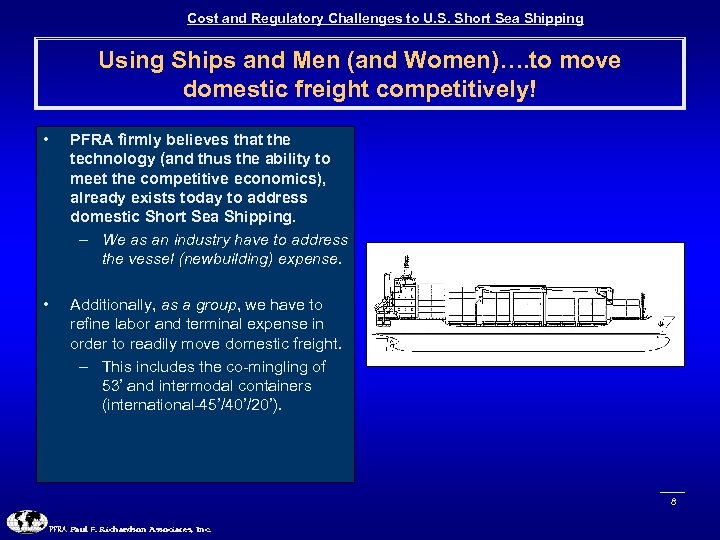 Cost and Regulatory Challenges to U. S. Short Sea Shipping Using Ships and Men (and Women)…. to move domestic freight competitively! • PFRA firmly believes that the technology (and thus the ability to meet the competitive economics), already exists today to address domestic Short Sea Shipping. – We as an industry have to address the vessel (newbuilding) expense. • Additionally, as a group, we have to refine labor and terminal expense in order to readily move domestic freight. – This includes the co-mingling of 53’ and intermodal containers (international-45’/40’/20’). 8 PFRA Paul F. Richardson Associates, Inc.
 Cost and Regulatory Challenges to U. S. Short Sea Shipping The Individual Cost Components…. Vessel • At the Spring Transportation Research Board (TRB) session, I mentioned that certain challenges do exist…. » Newbuilding Vessel Technologies » Vessel Operating Costs » Infrastructure • We also stated that we believe existing vessel technology could immediately be adapted to meet the market requirements of domestic short sea shipping. – Our feeling is that the latest generation of anchor-handling, towing and supply vessels (AHTS) could be converted to market-focused “container vessels”. – Vessel operating costs still need to be addressed, however, it is our understanding that the various sea-going unions are engaged in dialogue to review the required competitive economics for this new market opportunity. 9 PFRA Paul F. Richardson Associates, Inc.
 Cost and Regulatory Challenges to U. S. Short Sea Shipping Cost Components of the Operating Ratio…. Vessel • We believe that a standard containership design has to be set that allows the builders of these “AHTS-type” vessels (or the “smaller tier” of U. S. shipbuilding companies), to join together to immediately address this available market segment. – This vessel ideally would be between 400 and 600 TEU. – Assuming that the U. S. sea-going unions can make the required concessions from today’s domestic offshore or international U. S. flag manning requirements, the vessel construction cost becomes the most critical cost component for the success of the short sea shipping market. – Ship Construction Costs drive this cost component of the Operating Ratio: • A $20 M vessel/Total Cost per day: $16, 400 or 17. 6% • A $40 M vessel/Total Operating Cost per day: $20, 700 or 22. 3% • A $80 M vessel/Total Cost per day: $29, 300 or 31. 5% 10 PFRA Paul F. Richardson Associates, Inc.
 Cost and Regulatory Challenges to U. S. Short Sea Shipping Cost Components…. Terminal • The International Longshoremen’s Association (ILA) has already stated and addressed in a similar forum their desire to meet the market demands for a competitive terminal cost component. – As a reference only, current costs for loading/discharging a container in the industry standard cost model (between New Jersey and Florida ) are: • Newark-$300 per move • Jacksonville-$172 per move – That “percent of revenue” for the stevedoring segment only of the total terminal cost component in the Operating Ratio would be 63. 0% – Reducing the lift charges, which we believe to be realistic, to: • Newark-$150 • Jacksonville-$100 would translate to a stevedoring segment of this Operating Ratio component to be 33. 3% of revenue 11 PFRA Paul F. Richardson Associates, Inc.
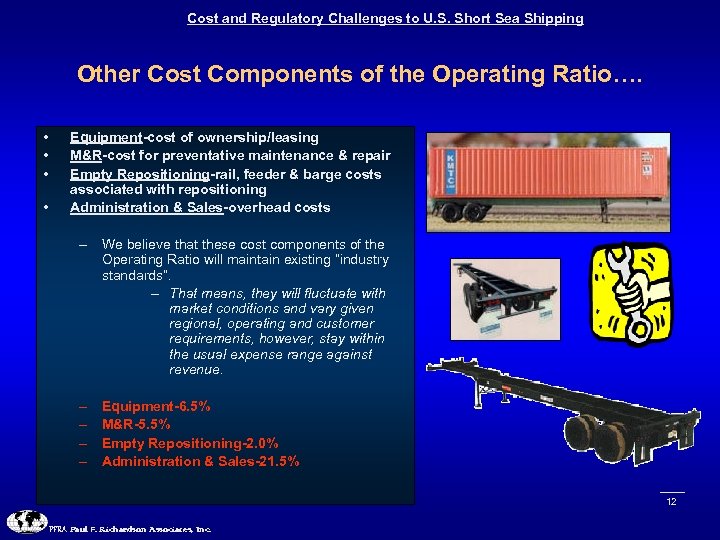 Cost and Regulatory Challenges to U. S. Short Sea Shipping Other Cost Components of the Operating Ratio…. • • Equipment-cost of ownership/leasing M&R-cost for preventative maintenance & repair Empty Repositioning-rail, feeder & barge costs associated with repositioning Administration & Sales-overhead costs – We believe that these cost components of the Operating Ratio will maintain existing “industry standards”. – That means, they will fluctuate with market conditions and vary given regional, operating and customer requirements, however, stay within the usual expense range against revenue. – – Equipment-6. 5% M&R-5. 5% Empty Repositioning-2. 0% Administration & Sales-21. 5% 12 PFRA Paul F. Richardson Associates, Inc.
 Cost and Regulatory Challenges to U. S. Short Sea Shipping The Required Competitive Economics…. • In summary, given current market pricing and the assumed differential, we need to work together to achieve the following competitive economics, and thus operating ratio for domestic short sea shipping: – Vessel – Terminal – Equipment – M&R – Empty Repositioning – Administration & Sales We look forward to working with each the stakeholders to progress this concept…. 13 PFRA Paul F. Richardson Associates, Inc.
 Cost and Regulatory Challenges to U. S. Short Sea Shipping Regulatory Issues…. • There also exists some regulatory hurdles that should be addressed as an industry, they include: – These regulatory issues impact the competitive economics and thus operating ratio for a domestic short sea shipping operation. • Equipment Regulations • Taxes for U. S. Vessels • Duties on U. S. Flag Vessels • Harbor Maintenance Tax 14 PFRA Paul F. Richardson Associates, Inc.