


 Скачать презентацию Cost Analysis WSARA and the Road Ahead Ms
e8bdb55277c71018c18c54d3f6cb2595.ppt
- Количество слайдов: 33
 Cost Analysis, WSARA, and the Road Ahead Ms. Wendy Kunc Deputy Assistant Secretary of the Navy (Cost & Economics) Executive Director, Naval Center for Cost Analysis 2 June 2010
 Agenda • Public perceptions on cost growth and what Congress did about it • Impacts of Recent Policy Changes on DON Cost Community • Improvement Initiatives – DON Cost Estimating Best Practices and Standards – Probability of Program Success Cost Estimating Metrics – Technical/Programmatic Baseline Policy for NAVAIR Estimates – Navy-Industry Cost IPT – NATO / Partnership for Peace Joint Costing Efforts – Training • Challenges for the Road Ahead Changing the Culture to Win the War on Cost -2 -
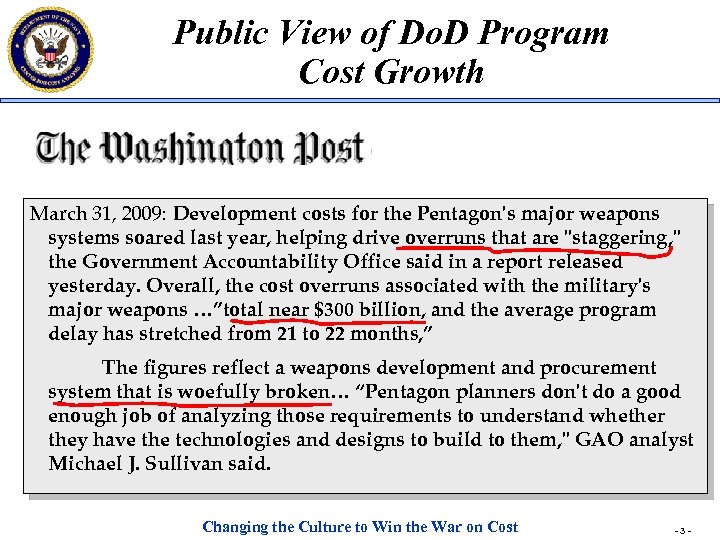 Public View of Do. D Program Cost Growth March 31, 2009: Development costs for the Pentagon's major weapons systems soared last year, helping drive overruns that are "staggering, " the Government Accountability Office said in a report released yesterday. Overall, the cost overruns associated with the military's major weapons …”total near $300 billion, and the average program delay has stretched from 21 to 22 months, ” The figures reflect a weapons development and procurement system that is woefully broken… “Pentagon planners don't do a good enough job of analyzing those requirements to understand whether they have the technologies and designs to build to them, " GAO analyst Michael J. Sullivan said. Changing the Culture to Win the War on Cost -3 -
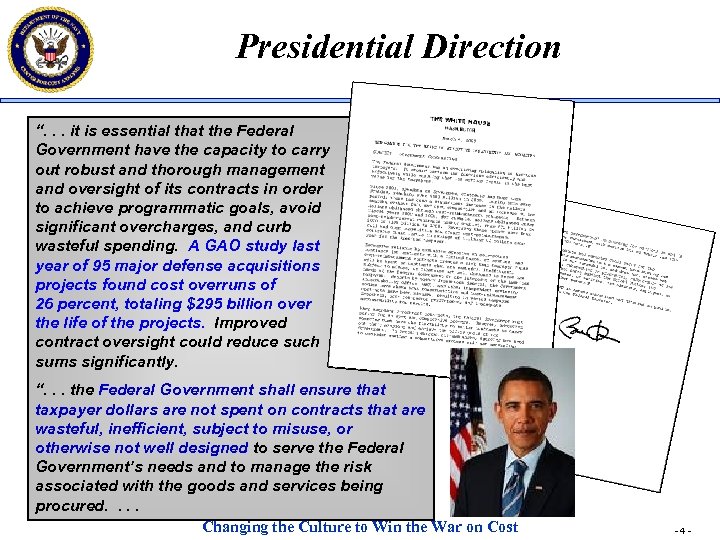 Presidential Direction “. . . it is essential that the Federal Government have the capacity to carry out robust and thorough management and oversight of its contracts in order to achieve programmatic goals, avoid significant overcharges, and curb wasteful spending. A GAO study last year of 95 major defense acquisitions projects found cost overruns of 26 percent, totaling $295 billion over the life of the projects. Improved contract oversight could reduce such sums significantly. “. . . the Federal Government shall ensure that taxpayer dollars are not spent on contracts that are wasteful, inefficient, subject to misuse, or otherwise not well designed to serve the Federal Government’s needs and to manage the risk associated with the goods and services being procured. . Changing the Culture to Win the War on Cost -4 -
 SECDEF Mandate for Reform “Fully reforming defense acquisition also requires recognizing the challenges of today’s battlefield and constantly changing adversary. This requires an acquisition system that can perform with greater urgency and agility. We need greater funding flexibility and the ability to streamline our requirements and acquisition execution procedures. The perennial procurement and contracting cycle – going back many decades – of adding layer upon layer of cost and complexity onto fewer and fewer platforms that take longer and longer to build must come to an end. There is broad agreement on the need for acquisition and contracting reform in the Department of Defense. There have been enough studies. Enough handwringing. Enough rhetoric. Now is the time for action. ” Robert Gates, Secretary of Defense, Defense Budget Recommendation Statement, April 6, 2009 Changing the Culture to Win the War on Cost -5 -
 View from the Congress • Congress’s Perception: – Nunn Mc. Curdy law in place since 1982, but: • Not that many consequences over time • Cost growth continued • Perception of “Rubber Baselines” & lack of discipline • Reaction: Mandatory Discipline – FY 06 NDAA • Tightened Nunn Mc. Curdy rules and measurements • Section 2366, Title 10, required certification of MDAPs at MS B – FY 07 NDAA • Added three more criteria for MS B certification – FY 08 NDAA • Required certification at MS A (costs understood, non-duplicative, valid requirement) – FY 09 NDAA • Updated section 2366 for technical corrections Changing the Culture to Win the War on Cost -6 -
 Weapon Systems Acquisition Reform Act (WSARA) of 2009 “The key to successful acquisition programs is getting things right from the start with sound systems engineering, cost estimating, and developmental testing early in the program cycle. The bill that we are introducing today will require the Department of Defense to take the steps needed to put major defense acquisition programs on a sound footing from the outset. If these changes are successfully implemented, they should help our acquisition programs avoid future cost overruns, schedule delays, and performance problems. ” –Senator Carl Levin, Chairman, Senate Armed Services Committee “The Weapon System Acquisition Reform Act of 2009 is an important step in efforts to reform the defense acquisition progress. This legislation is needed to focus acquisition and procurement on emphasizing systems engineering; more effective upfront planning and management of technology risk; and growing the acquisition workforce to meet program objectives. ” –Senator John Mc. Cain, Ranking Member, Senate Armed Services Committee Changing the Culture to Win the War on Cost -7 -
 Weapon Systems Acquisition Reform Act of 2009 “The purpose of this law will be to limit cost overruns before they spiral out of control. It will strengthen oversight and accountability by appointing officials who will be charged with closely monitoring the weapons systems we're purchasing to ensure that costs are controlled. If the cost of certain defense projects continue to grow year after year, those projects will be closely reviewed, and if they don't provide the value we need, they will be terminated. This law will also enhance competition and end conflicts of interest in the weapons acquisitions process so that American taxpayers and the American military can get the best weapons at the lowest cost. ” Signing Statement May 22, 2009 BARACK OBAMA Changing the Culture to Win the War on Cost -8 -
 Introduction to WSARA 2009 • Weapon Systems Acquisition Reform Act of 2009 signed into law May 22 – Passed in Senate 93 - 0, passed in House 411 - 0 – Law took effect immediately – Covers MDAP and MAIS programs • Key Elements of WSARA – Changes to Acquisition Procedures • Expansion of Milestone certifications, review of MDAP/MAIS cost estimates, critical cost growth breach requirements – Directed Action • Catch-up certifications, reports to Congress – Chartering Direction • Cost Analysis and Program Evaluation; Director of Systems Engineering; Performance Assessment and Root Cause Analysis Changing the Culture to Win the War on Cost -9 -
 Director, Cost Assessment and Program Evaluation (CAPE) • Appointed by the President, with advice and consent of Senate • Two Deputy Directors – Cost Assessment – Program Evaluation – No restrictions: Political, career, military • Responsible for – Cost estimation and analysis for acquisition programs – The planning and programming phases of PPBES – Resource analysis of JROC requirements – Analysis of Alternatives study guidance – Review, analysis and evaluation of programs – Assessments of intelligence programs – Assessments of alternatives for acquisition programs – Leading the development of the CAPE workforce of the department – Leading the development of improved tools and data Changing the Culture to Win the War on Cost - 10 -
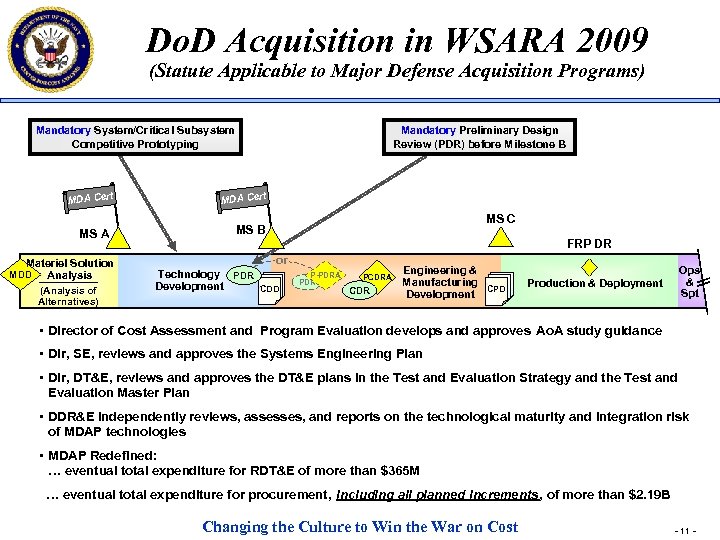 Do. D Acquisition in WSARA 2009 (Statute Applicable to Major Defense Acquisition Programs) Mandatory System/Critical Subsystem Competitive Prototyping MDA Cert MS A Materiel Solution Analysis MDD (Analysis of Alternatives) Mandatory Preliminary Design Review (PDR) before Milestone B MDA Cert MS C MS B FRP DR or Technology PDR Development CDD P-PDRA PDR PCDRA CDR Engineering & Manufacturing CPD Development Ops & Spt Production & Deployment • Director of Cost Assessment and Program Evaluation develops and approves Ao. A study guidance • Dir, SE, reviews and approves the Systems Engineering Plan • Dir, DT&E, reviews and approves the DT&E plans in the Test and Evaluation Strategy and the Test and Evaluation Master Plan • DDR&E independently reviews, assesses, and reports on the technological maturity and integration risk of MDAP technologies • MDAP Redefined: … eventual total expenditure for RDT&E of more than $365 M … eventual total expenditure for procurement, including all planned increments, of more than $2. 19 B Changing the Culture to Win the War on Cost - 11 -
 MS Certifications in WSARA 2009 • Amends MS A (section 2366 a) Certification Process – Invokes Nunn-Mc. Curdy “like” process for pre-MS B pre-MDAPs – Retroactively applies certification criteria to post-MS A programs that began prior to enactment of the 2366 a certification requirements, but have not yet received MS B approval. • Amends MS B (section 2366 b) Certification Process – Retroactively applies certification criteria to post-MS B programs that began prior to enactment of the 2366 b certification requirements, but have not yet received MS C approval. • Creates SEC-DEF designated official for Program Assessment and Root Cause Analysis • Strengthens Nunn Mc. Curdy Process Changing the Culture to Win the War on Cost - 12 -
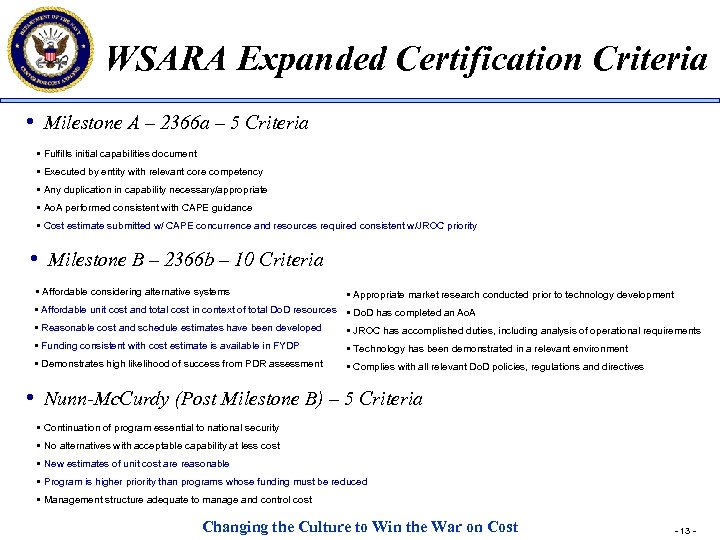 WSARA Expanded Certification Criteria • Milestone A – 2366 a – 5 Criteria • Fulfills initial capabilities document • Executed by entity with relevant core competency • Any duplication in capability necessary/appropriate • Ao. A performed consistent with CAPE guidance • Cost estimate submitted w/ CAPE concurrence and resources required consistent w/JROC priority • Milestone B – 2366 b – 10 Criteria § Affordable considering alternative systems • Appropriate market research conducted prior to technology development • Affordable unit cost and total cost in context of total Do. D resources • Do. D has completed an Ao. A • Reasonable cost and schedule estimates have been developed • JROC has accomplished duties, including analysis of operational requirements • Funding consistent with cost estimate is available in FYDP • Technology has been demonstrated in a relevant environment • Demonstrates high likelihood of success from PDR assessment • Complies with all relevant Do. D policies, regulations and directives • Nunn-Mc. Curdy (Post Milestone B) – 5 Criteria § Continuation of program essential to national security § No alternatives with acceptable capability at less cost § New estimates of unit cost are reasonable § Program is higher priority than programs whose funding must be reduced § Management structure adequate to manage and control cost Changing the Culture to Win the War on Cost - 13 -
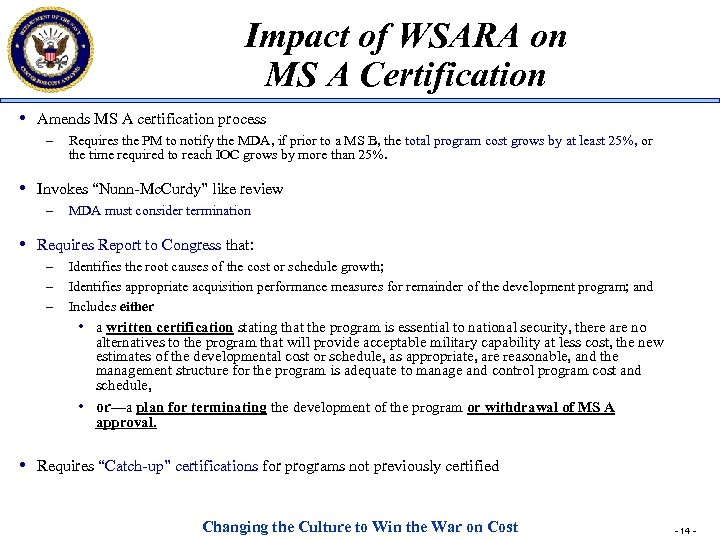 Impact of WSARA on MS A Certification • Amends MS A certification process – Requires the PM to notify the MDA, if prior to a MS B, the total program cost grows by at least 25%, or the time required to reach IOC grows by more than 25%. • Invokes “Nunn-Mc. Curdy” like review – MDA must consider termination • Requires Report to Congress that: – – – Identifies the root causes of the cost or schedule growth; Identifies appropriate acquisition performance measures for remainder of the development program; and Includes either • a written certification stating that the program is essential to national security, there are no alternatives to the program that will provide acceptable military capability at less cost, the new estimates of the developmental cost or schedule, as appropriate, are reasonable, and the management structure for the program is adequate to manage and control program cost and schedule, • or—a plan for terminating the development of the program or withdrawal of MS A approval. • Requires “Catch-up” certifications for programs not previously certified Changing the Culture to Win the War on Cost - 14 -
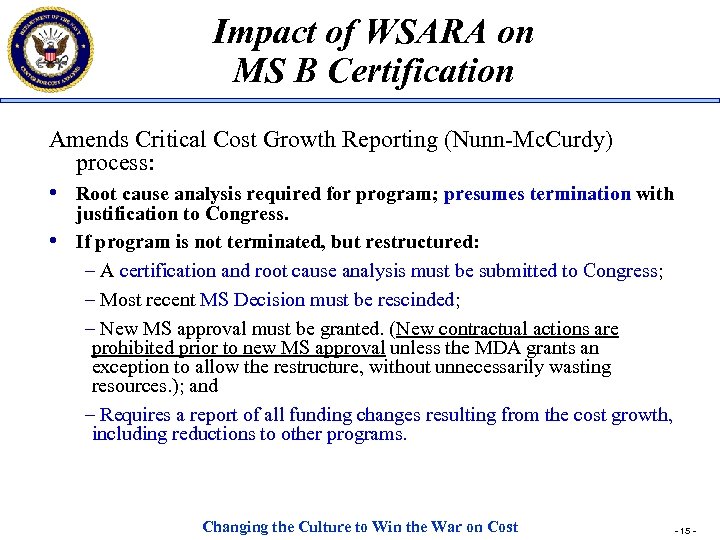 Impact of WSARA on MS B Certification Amends Critical Cost Growth Reporting (Nunn-Mc. Curdy) process: • Root cause analysis required for program; presumes termination with • justification to Congress. If program is not terminated, but restructured: – A certification and root cause analysis must be submitted to Congress; – Most recent MS Decision must be rescinded; – New MS approval must be granted. (New contractual actions are prohibited prior to new MS approval unless the MDA grants an exception to allow the restructure, without unnecessarily wasting resources. ); and – Requires a report of all funding changes resulting from the cost growth, including reductions to other programs. Changing the Culture to Win the War on Cost - 15 -
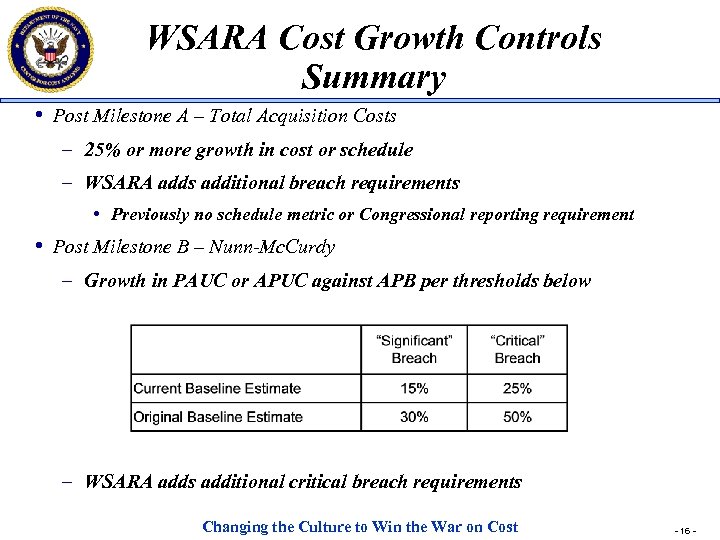 WSARA Cost Growth Controls Summary • Post Milestone A – Total Acquisition Costs – 25% or more growth in cost or schedule – WSARA adds additional breach requirements • Previously no schedule metric or Congressional reporting requirement • Post Milestone B – Nunn-Mc. Curdy – Growth in PAUC or APUC against APB per thresholds below – WSARA adds additional critical breach requirements Changing the Culture to Win the War on Cost - 16 -
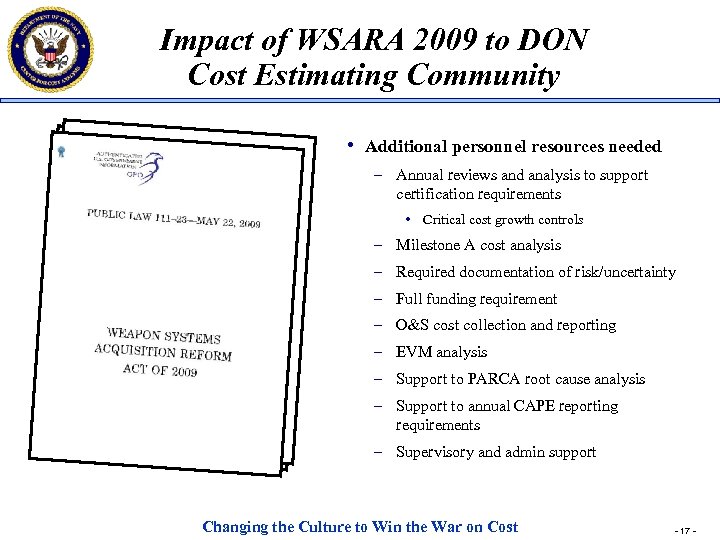 Impact of WSARA 2009 to DON Cost Estimating Community • Additional personnel resources needed – Annual reviews and analysis to support certification requirements • Critical cost growth controls – Milestone A cost analysis – Required documentation of risk/uncertainty – Full funding requirement – O&S cost collection and reporting – EVM analysis – Support to PARCA root cause analysis – Support to annual CAPE reporting requirements – Supervisory and admin support Changing the Culture to Win the War on Cost - 17 -
 DON Cost Analysis Policy: Increase Robustness, Inject Realism • SECNAVINST 5223. 2, signed Dec 08 – SYSCOMs provide • Comprehensive coverage – All programs – Estimates, O&S, EVM support – NCCA • • • – Advise at Acquisition Gate Reviews Develop independent estimates for ACAT IC/IAs Assess SYSCOM estimates for ACAT ID programs Provide independent risk assessment for IDs Chair Cost Estimating Stakeholders Group Program Managers • Use cost info; document differences • Obtain approval before outsourcing cost support • Obtain technical review of CARD – Senior Leadership • Use cost info • Adequately resource cost organizations Changing the Culture to Win the War on Cost - 18 -
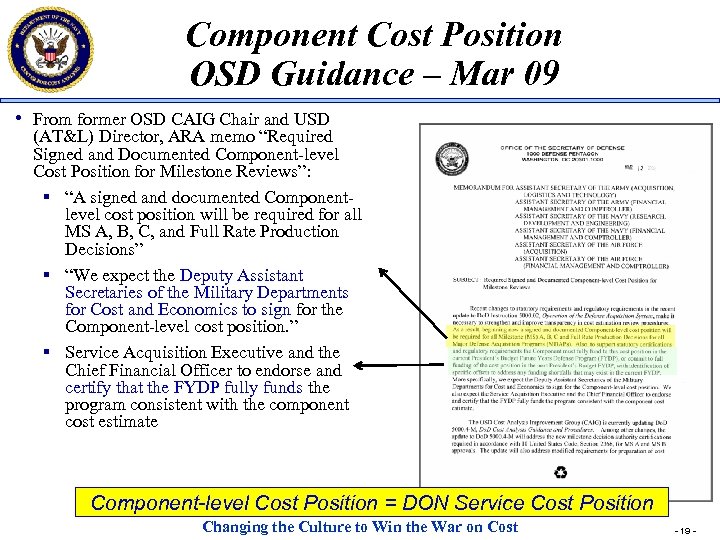 Component Cost Position OSD Guidance – Mar 09 • From former OSD CAIG Chair and USD (AT&L) Director, ARA memo “Required Signed and Documented Component-level Cost Position for Milestone Reviews”: § “A signed and documented Componentlevel cost position will be required for all MS A, B, C, and Full Rate Production Decisions” § “We expect the Deputy Assistant Secretaries of the Military Departments for Cost and Economics to sign for the Component-level cost position. ” § Service Acquisition Executive and the Chief Financial Officer to endorse and certify that the FYDP fully funds the program consistent with the component cost estimate Component-level Cost Position = DON Service Cost Position Changing the Culture to Win the War on Cost - 19 -
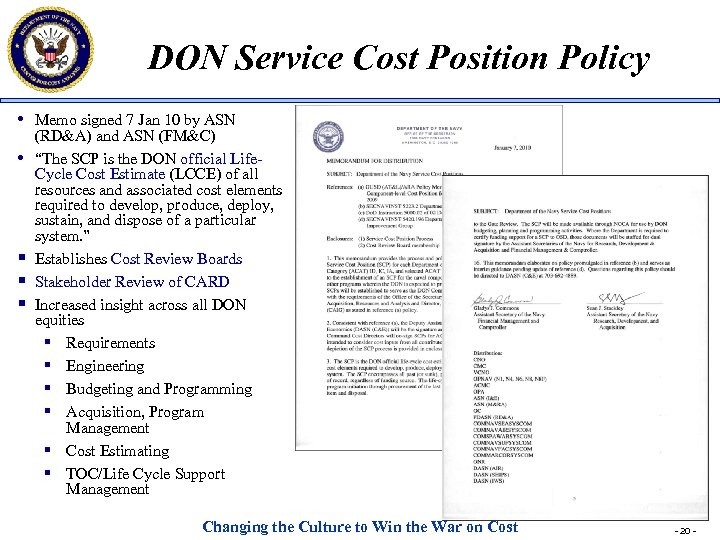 DON Service Cost Position Policy • Memo signed 7 Jan 10 by ASN • § § § (RD&A) and ASN (FM&C) “The SCP is the DON official Life. Cycle Cost Estimate (LCCE) of all resources and associated cost elements required to develop, produce, deploy, sustain, and dispose of a particular system. ” Establishes Cost Review Boards Stakeholder Review of CARD Increased insight across all DON equities § Requirements § Engineering § Budgeting and Programming § Acquisition, Program Management § Cost Estimating § TOC/Life Cycle Support Management Changing the Culture to Win the War on Cost - 20 -
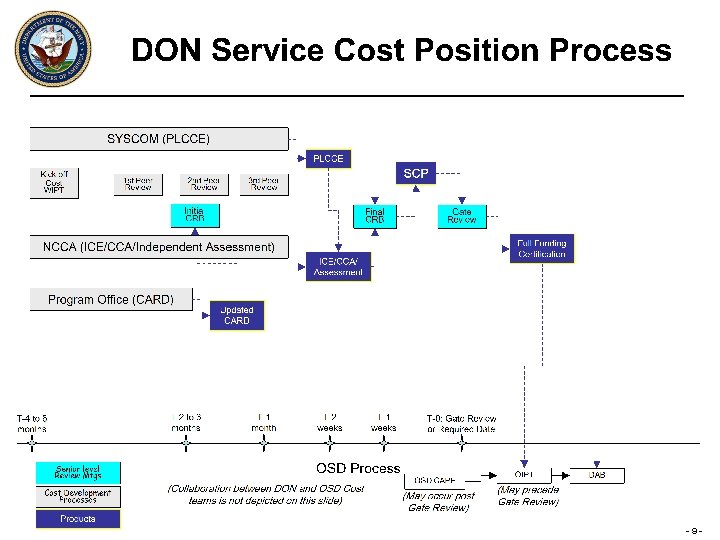 Changing the Culture to Win the War on Cost - 21 9 - -
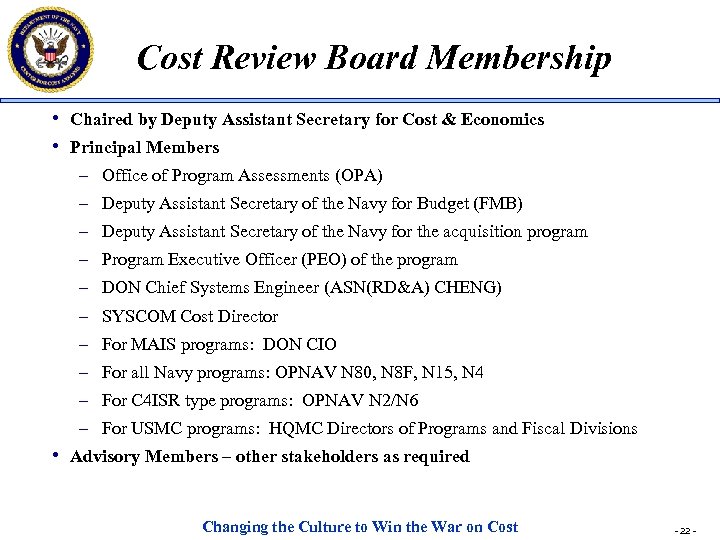 Cost Review Board Membership • Chaired by Deputy Assistant Secretary for Cost & Economics • Principal Members – Office of Program Assessments (OPA) – Deputy Assistant Secretary of the Navy for Budget (FMB) – Deputy Assistant Secretary of the Navy for the acquisition program – Program Executive Officer (PEO) of the program – DON Chief Systems Engineer (ASN(RD&A) CHENG) – SYSCOM Cost Director – For MAIS programs: DON CIO – For all Navy programs: OPNAV N 80, N 8 F, N 15, N 4 – For C 4 ISR type programs: OPNAV N 2/N 6 – For USMC programs: HQMC Directors of Programs and Fiscal Divisions • Advisory Members – other stakeholders as required Changing the Culture to Win the War on Cost - 22 -
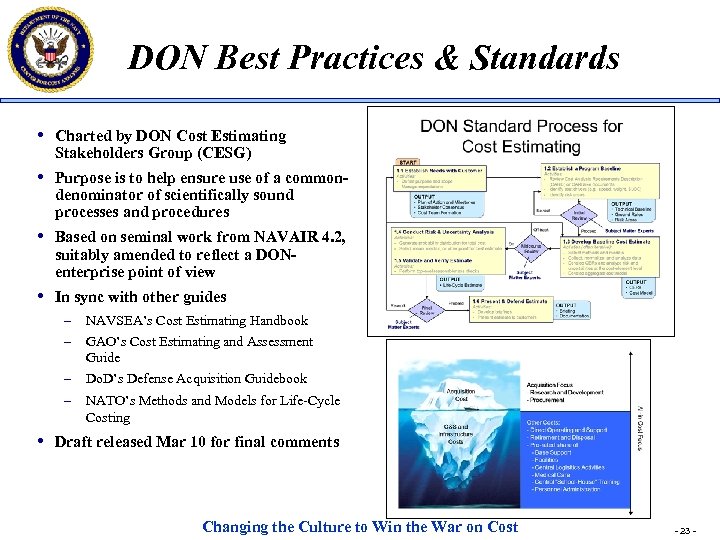 DON Best Practices & Standards • Charted by DON Cost Estimating Stakeholders Group (CESG) • Purpose is to help ensure use of a commondenominator of scientifically sound processes and procedures • Based on seminal work from NAVAIR 4. 2, suitably amended to reflect a DONenterprise point of view • In sync with other guides – NAVSEA’s Cost Estimating Handbook – GAO’s Cost Estimating and Assessment Guide – Do. D’s Defense Acquisition Guidebook – NATO’s Methods and Models for Life-Cycle Costing • Draft released Mar 10 for final comments Changing the Culture to Win the War on Cost - 23 -
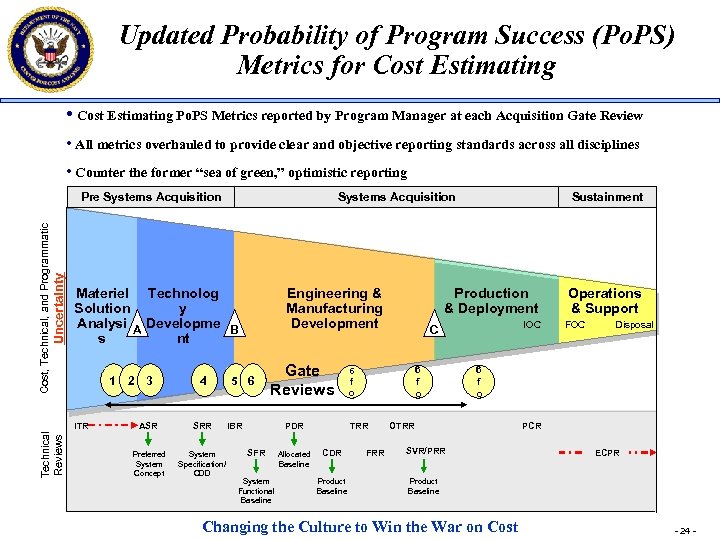 Updated Probability of Program Success (Po. PS) Metrics for Cost Estimating • Cost Estimating Po. PS Metrics reported by Program Manager at each Acquisition Gate Review • All metrics overhauled to provide clear and objective reporting standards across all disciplines • Counter the former “sea of green, ” optimistic reporting Uncertainty Cost, Technical, and Programmatic Pre Systems Acquisition Materiel Technolog Solution y Analysi A Developme B s nt 1 ITR Technical Reviews Systems Acquisition 2 3 4 ASR SRR Preferred System Concept System Specification/ CDD Engineering & Manufacturing Development 5 6 Gate Reviews IBR PDR SFR System Functional Baseline Allocated Baseline CDR Product Baseline Production & Deployment 6 f o FRR IOC C 6 f o TRR Sustainment Operations & Support FOC Disposal 6 f o OTRR SVR/PRR PCR ECPR Product Baseline Changing the Culture to Win the War on Cost - 24 -
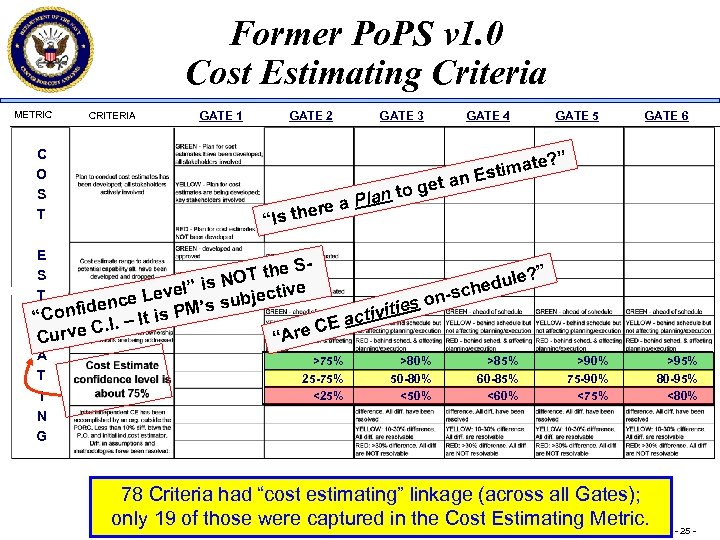 Former Po. PS v 1. 0 Cost Estimating Criteria METRIC C O S T CRITERIA GATE 1 GATE 2 GATE 3 GATE 4 GATE 5 GATE 6 ? ” ere “Is th to a Plan get te stima an E E SS ? ” T the is NO edule el” ive ch T on-s ce Lev M’s subject ies iden “IConf. I. – It is P ctivit a re CE rve C Mu “A C A >75% >80% >85% T 25 -75% 50 -80% 60 -85% <25% <50% <60% I N G >90% 75 -90% <75% 78 Criteria had “cost estimating” linkage (across all Gates); only 19 of Changing the Culture to Win the War on Cost those were captured in the Cost Estimating Metric. >95% 80 -95% <80% - 25 -
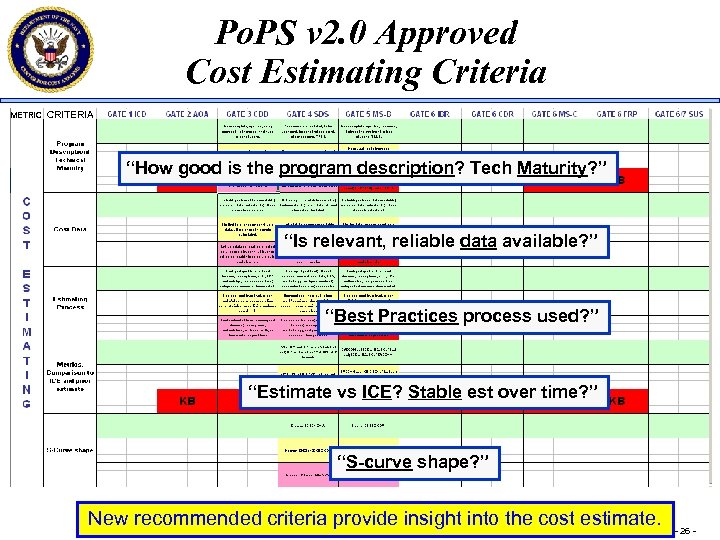 Po. PS v 2. 0 Approved Cost Estimating Criteria METRIC CRITERIA “How good is the program description? Tech Maturity? ” “Is relevant, reliable data available? ” “Best Practices process used? ” “Estimate vs ICE? Stable est over time? ” “S-curve shape? ” New recommended criteria provide insight on Cost cost estimate. Changing the Culture to Win the War into the - 26 -
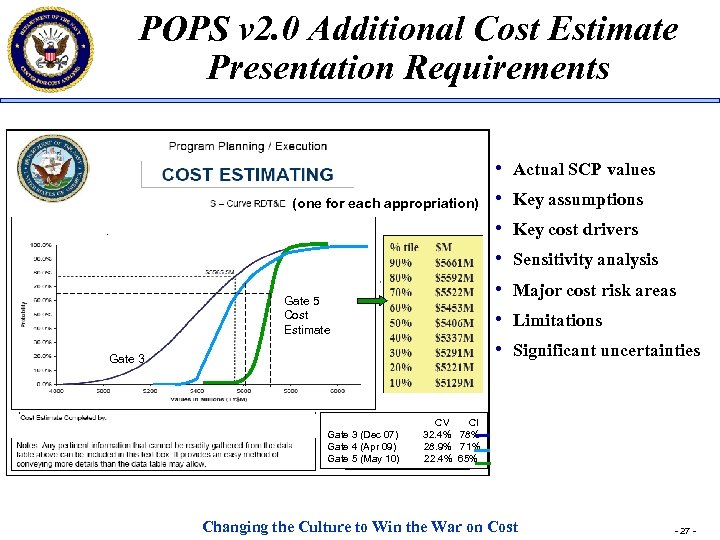 POPS v 2. 0 Additional Cost Estimate Presentation Requirements (one for each appropriation). Gate 5 Cost Estimate ove m Re Gate 3 (Dec 07) Gate 4 (Apr 09) Gate 5 (May 10) • • Actual SCP values Key assumptions Key cost drivers Sensitivity analysis Major cost risk areas Limitations Significant uncertainties CV CI 32. 4% 78% 28. 9% 71% 22. 4% 65% Changing the Culture to Win the War on Cost - 27 -
 Naval Cost Integrated Process Team Mission Statement: Host a government/industry forum to gain an understanding of each parties’ perspectives on cost -- with the objective of improving estimates • Cost IPT Goals: • Create lines of communication to help with data collection, estimating methods development, understanding technical requirements • Address common costing issues and challenges • • • Inflation Software development Impact of Pension Protection Act New Mil-Std-881 and CCDR reporting requirements Contractor Logistics Support • Foster mutual trust and respect • Protection of proprietary methods and data Changing the Culture to Win the War on Cost - 28 -
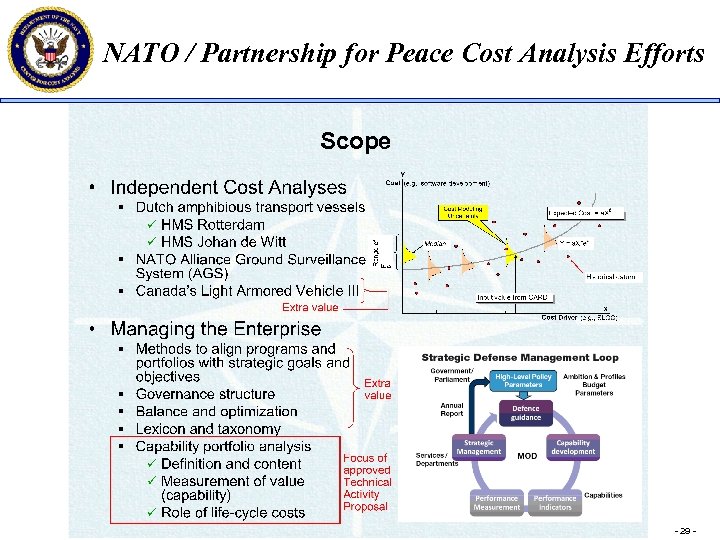 NATO / Partnership for Peace Cost Analysis Efforts Scope Changing the Culture to Win the War on Cost - 29 -
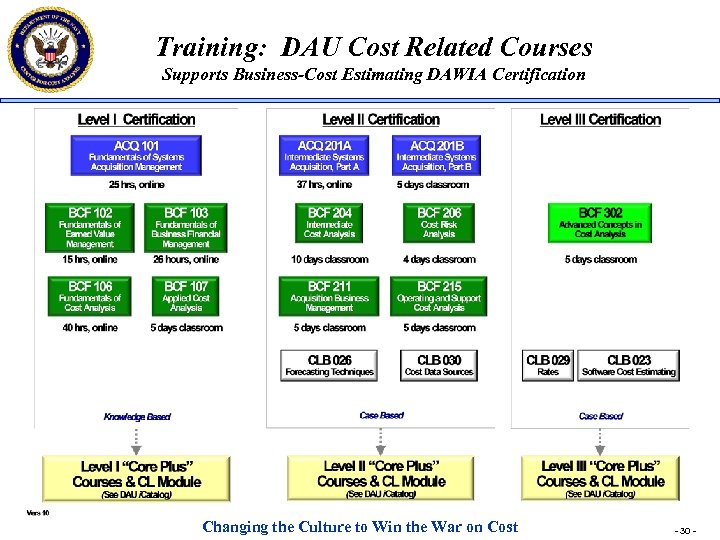 Training: DAU Cost Related Courses Supports Business-Cost Estimating DAWIA Certification Changing the Culture to Win the War on Cost - 30 -
 Training: Masters Distance Learning Program • Proposed effort to jointly develop a distance learning Master’s program in Cost Engineering/Analysis – NAVSEA 05 C, NCCA, Naval Postgraduate School (NPS), and the Air Force Institute of Technology (AFIT) • Will leverage the AFIT in-residence course material as well as NPS content to provide efficiencies related to curriculum development – Demand outweighs supply – only known Master’s program in cost analysis is offered by AFIT, in residence – Distance learning mode enables greater flexibility for workforce to obtain advanced degree Changing the Culture to Win the War on Cost - 31 -
 NCCA’s Reinvigorated use of Intern and Associate Programs • Naval Acquisition Development Program (NADP) administered by the Naval Acquisition Career Center (NACC) – Naval Acquisition Intern Program (NAIP) • Two to three-year program for entry level candidates – Naval Acquisition Associates Program (NAAP) • Two-year program for journeymen level candidates • Navy Career Intern Program (NCIP) – Localized, flexible – Tailorable to NCCA’s needs Changing the Culture to Win the War on Cost - 32 -
 Current Challenges • Increased Workload Requirements for Cost Community – SECNAV Policy adds additional responsibilities – Total impacts of WSARA not yet certain for the military components’ cost groups • Organizational/Personnel Issues – Current on-board strengths inadequate to execute increased workload in specified timeframes – Lead time for identifying “right skill set” candidates and completing hiring activities is problematic – Shortage of available trained cost analysts -- must “grow our own” • Major culture change requires openness, communication, and data sharing between all stakeholders Changing the Culture to Win the War on Cost - 33 -