 Скачать презентацию Cost Allocations EMBA 5412 Fall 2007 What
2cf15888df64f2165b8f5bb2ac6cd745.ppt
- Количество слайдов: 45



Cost Allocations EMBA 5412 Fall 2007
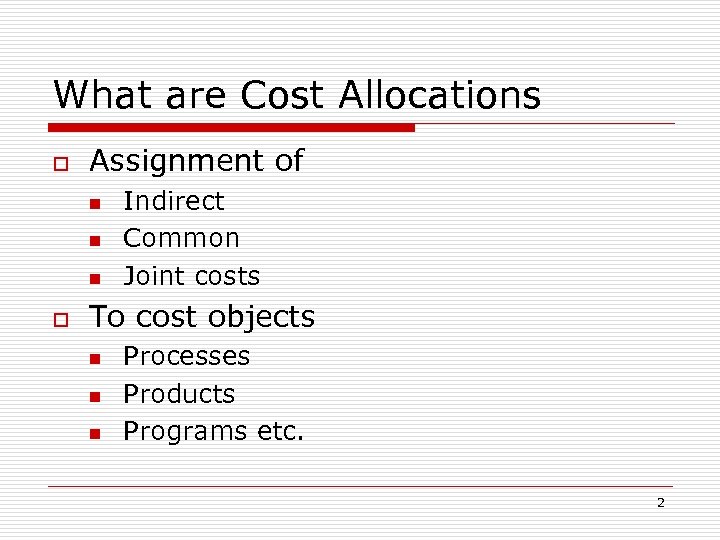
What are Cost Allocations o Assignment of n n n o Indirect Common Joint costs To cost objects n n n Processes Products Programs etc. 2
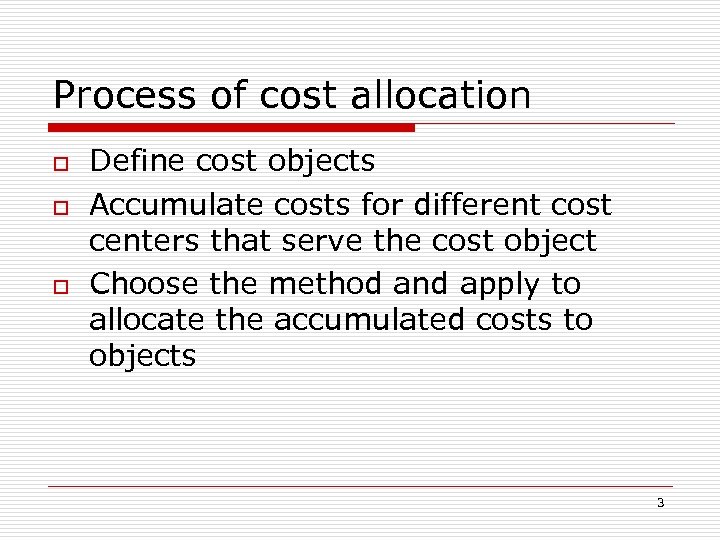
Process of cost allocation o o o Define cost objects Accumulate costs for different cost centers that serve the cost object Choose the method and apply to allocate the accumulated costs to objects 3
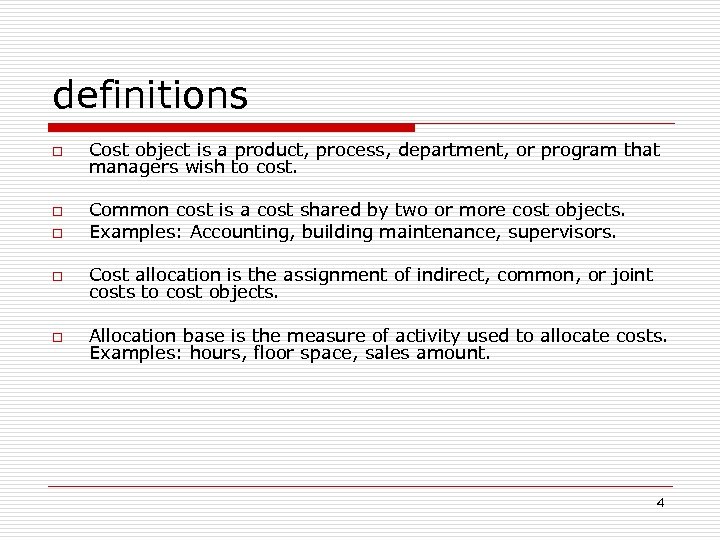
definitions o o o Cost object is a product, process, department, or program that managers wish to cost. Common cost is a cost shared by two or more cost objects. Examples: Accounting, building maintenance, supervisors. o Cost allocation is the assignment of indirect, common, or joint costs to cost objects. o Allocation base is the measure of activity used to allocate costs. Examples: hours, floor space, sales amount. 4
Surveys of Cost Allocation Practices by Large Corporations o o o o What corporate-level costs are allocated to profit centers? Most often: selling and distribution expenses Least often: income taxes What allocation bases are used? Meter: measure actual use Negotiate: estimate usage Prorate: based on relative proportions of sales, profits, or assets 5
why Control and behavioral uses 42% o Signaling resource allocation 32% o Cost determination 19% o Overhead allocation 5% o Fairness 2 % (source: Zimmerman, 2003, p 338) o 6
What costs are allocated Income taxes 44% o Interest expenses and capital charges 62% o Research and development 72% o Finance and accounting 73% o Selling costs 91% o Distribution costs 100% (source: Zimmerman, 2003, p. 338 o 7
Types of cost allocations o o Service department cost allocations Allocations to products 8
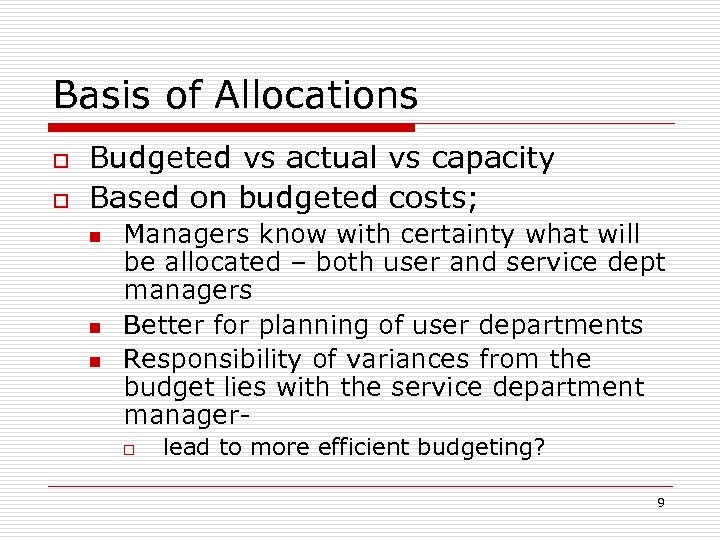
Basis of Allocations o o Budgeted vs actual vs capacity Based on budgeted costs; n n n Managers know with certainty what will be allocated – both user and service dept managers Better for planning of user departments Responsibility of variances from the budget lies with the service department managero lead to more efficient budgeting? 9
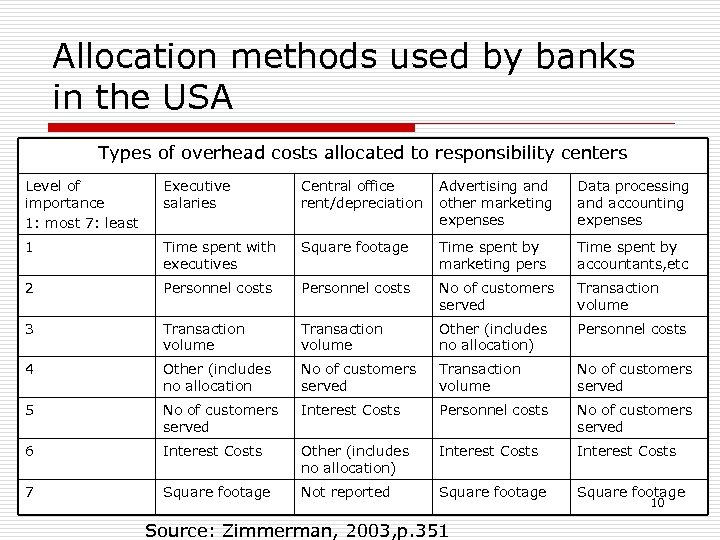
Allocation methods used by banks in the USA Types of overhead costs allocated to responsibility centers Level of importance 1: most 7: least Executive salaries Central office rent/depreciation Advertising and other marketing expenses Data processing and accounting expenses 1 Time spent with executives Square footage Time spent by marketing pers Time spent by accountants, etc 2 Personnel costs No of customers served Transaction volume 3 Transaction volume Other (includes no allocation) Personnel costs 4 Other (includes no allocation No of customers served Transaction volume No of customers served 5 No of customers served Interest Costs Personnel costs No of customers served 6 Interest Costs Other (includes no allocation) Interest Costs 7 Square footage Not reported Square footage Source: Zimmerman, 2003, p. 351 10
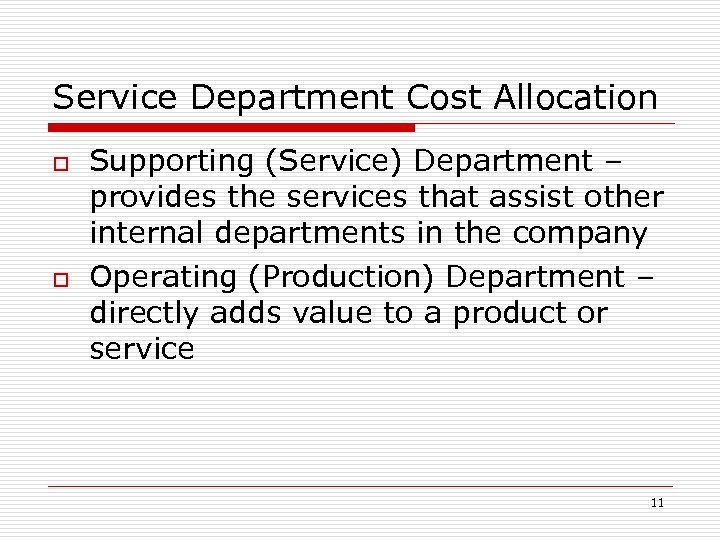
Service Department Cost Allocation o o Supporting (Service) Department – provides the services that assist other internal departments in the company Operating (Production) Department – directly adds value to a product or service 11
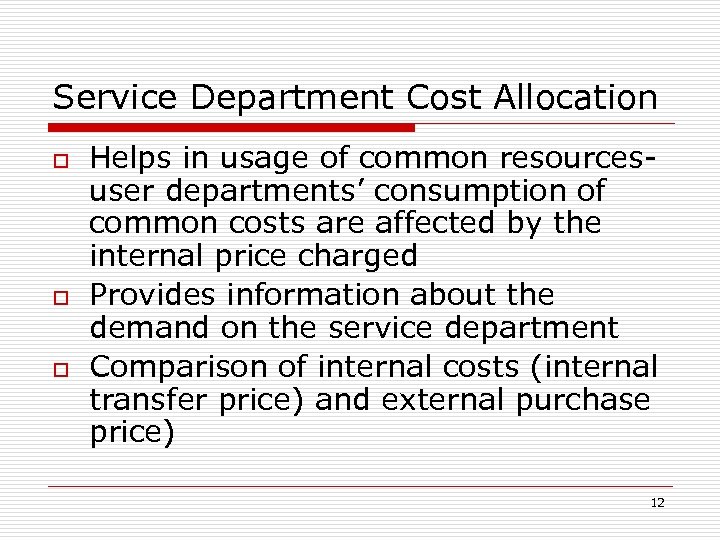
Service Department Cost Allocation o o o Helps in usage of common resourcesuser departments’ consumption of common costs are affected by the internal price charged Provides information about the demand on the service department Comparison of internal costs (internal transfer price) and external purchase price) 12
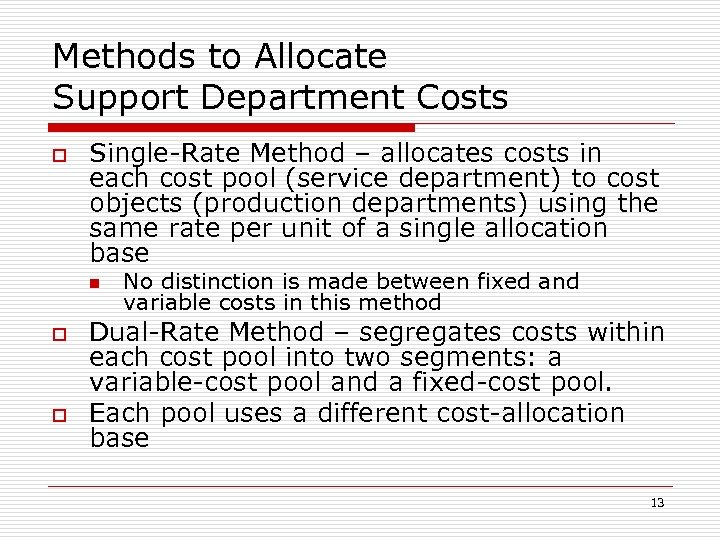
Methods to Allocate Support Department Costs o Single-Rate Method – allocates costs in each cost pool (service department) to cost objects (production departments) using the same rate per unit of a single allocation base n o o No distinction is made between fixed and variable costs in this method Dual-Rate Method – segregates costs within each cost pool into two segments: a variable-cost pool and a fixed-cost pool. Each pool uses a different cost-allocation base 13
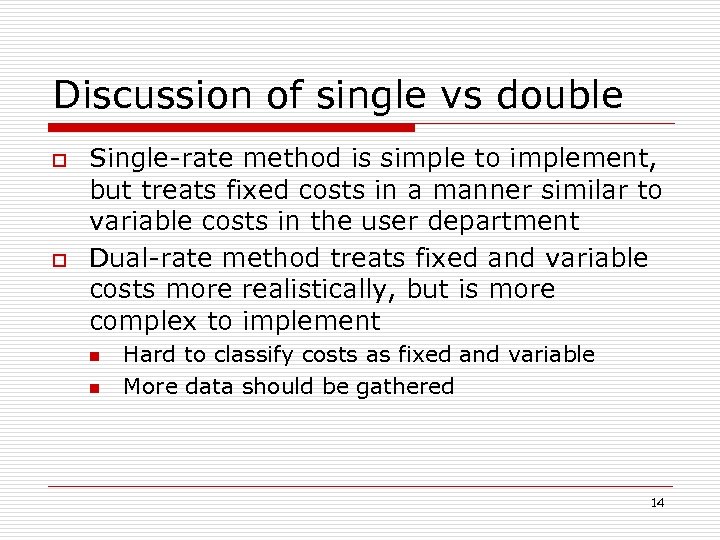
Discussion of single vs double o o Single-rate method is simple to implement, but treats fixed costs in a manner similar to variable costs in the user department Dual-rate method treats fixed and variable costs more realistically, but is more complex to implement n n Hard to classify costs as fixed and variable More data should be gathered 14
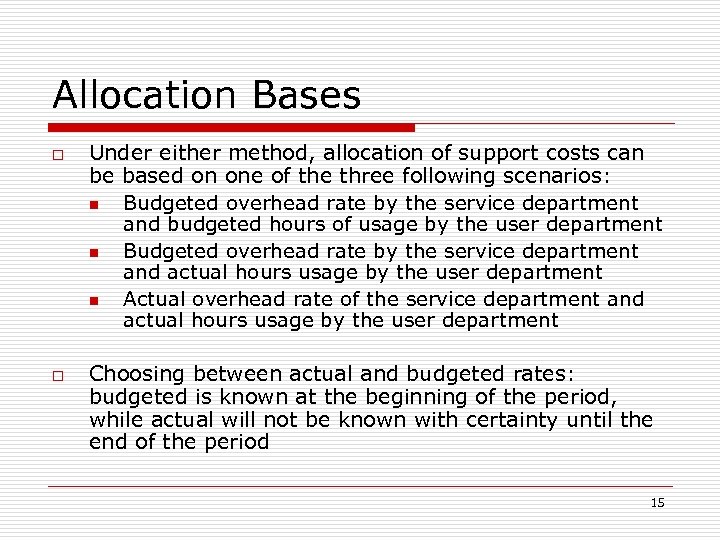
Allocation Bases o o Under either method, allocation of support costs can be based on one of the three following scenarios: n Budgeted overhead rate by the service department and budgeted hours of usage by the user department n Budgeted overhead rate by the service department and actual hours usage by the user department n Actual overhead rate of the service department and actual hours usage by the user department Choosing between actual and budgeted rates: budgeted is known at the beginning of the period, while actual will not be known with certainty until the end of the period 15
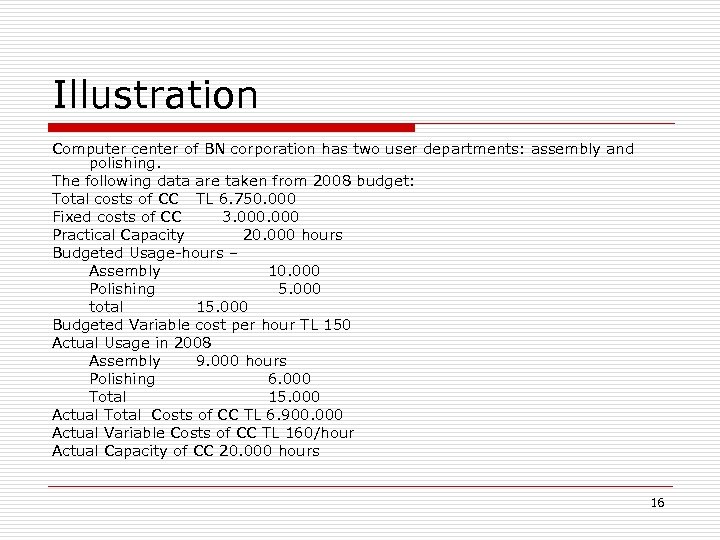
Illustration Computer center of BN corporation has two user departments: assembly and polishing. The following data are taken from 2008 budget: Total costs of CC TL 6. 750. 000 Fixed costs of CC 3. 000 Practical Capacity 20. 000 hours Budgeted Usage-hours – Assembly 10. 000 Polishing 5. 000 total 15. 000 Budgeted Variable cost per hour TL 150 Actual Usage in 2008 Assembly 9. 000 hours Polishing 6. 000 Total 15. 000 Actual Total Costs of CC TL 6. 900. 000 Actual Variable Costs of CC TL 160/hour Actual Capacity of CC 20. 000 hours 16
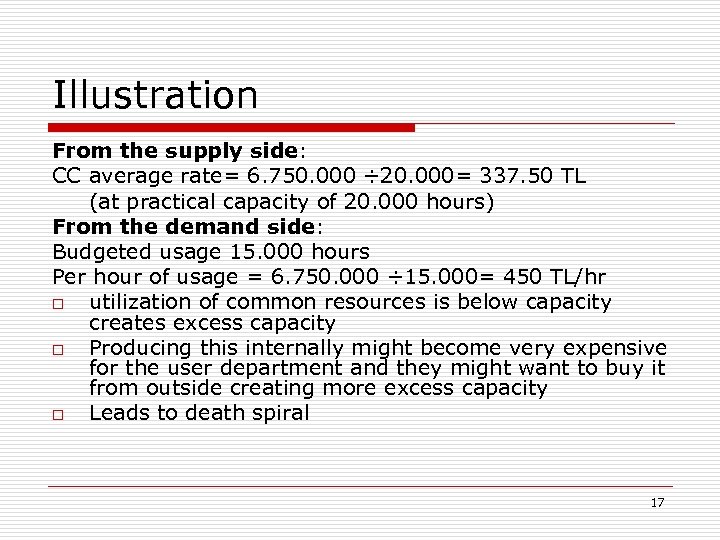
Illustration From the supply side: CC average rate= 6. 750. 000 ÷ 20. 000= 337. 50 TL (at practical capacity of 20. 000 hours) From the demand side: Budgeted usage 15. 000 hours Per hour of usage = 6. 750. 000 ÷ 15. 000= 450 TL/hr o utilization of common resources is below capacity creates excess capacity o Producing this internally might become very expensive for the user department and they might want to buy it from outside creating more excess capacity o Leads to death spiral 17
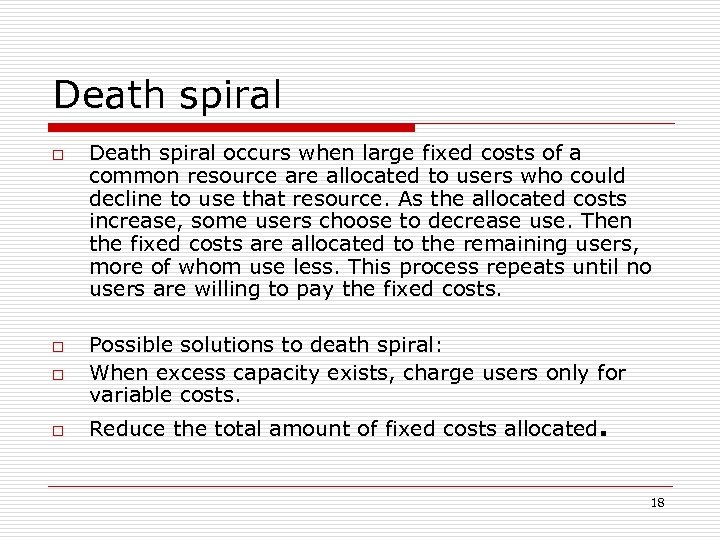
Death spiral occurs when large fixed costs of a common resource are allocated to users who could decline to use that resource. As the allocated costs increase, some users choose to decrease use. Then the fixed costs are allocated to the remaining users, more of whom use less. This process repeats until no users are willing to pay the fixed costs. o Possible solutions to death spiral: When excess capacity exists, charge users only for variable costs. o Reduce the total amount of fixed costs allocated. o 18
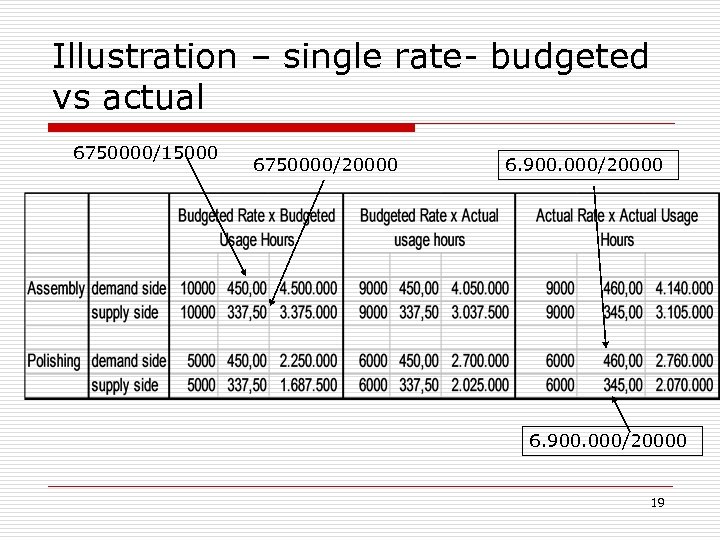
Illustration – single rate- budgeted vs actual 6750000/15000 6750000/20000 6. 900. 000/20000 19
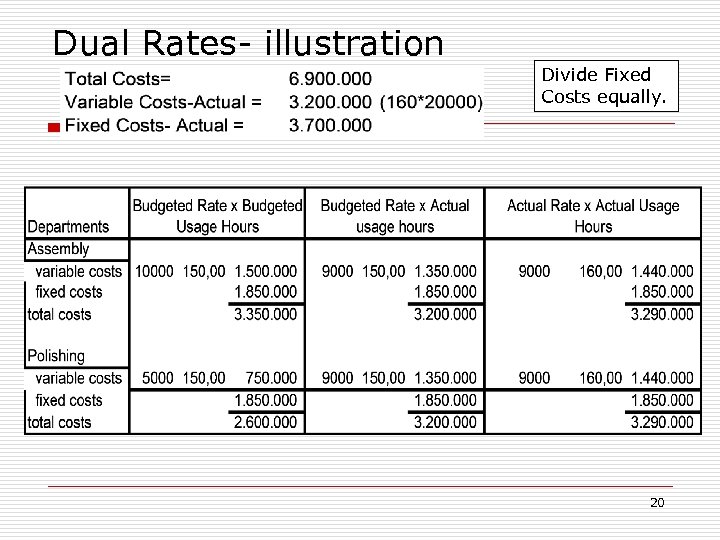
Dual Rates- illustration Divide Fixed Costs equally. 20
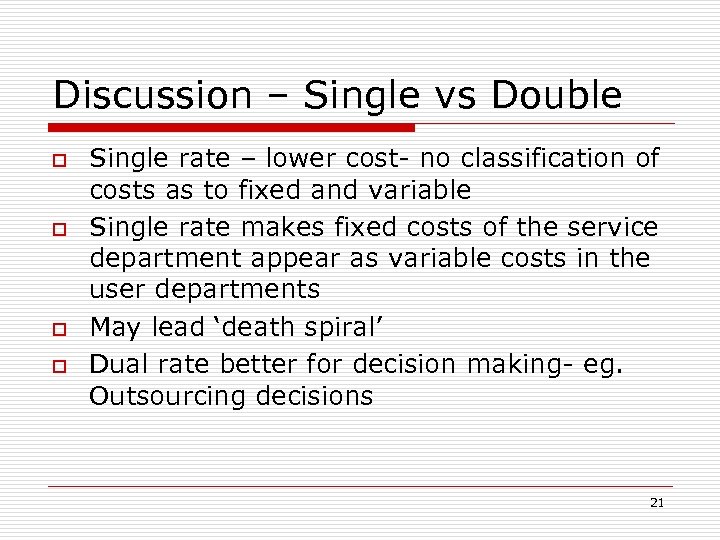
Discussion – Single vs Double o o Single rate – lower cost- no classification of costs as to fixed and variable Single rate makes fixed costs of the service department appear as variable costs in the user departments May lead ‘death spiral’ Dual rate better for decision making- eg. Outsourcing decisions 21
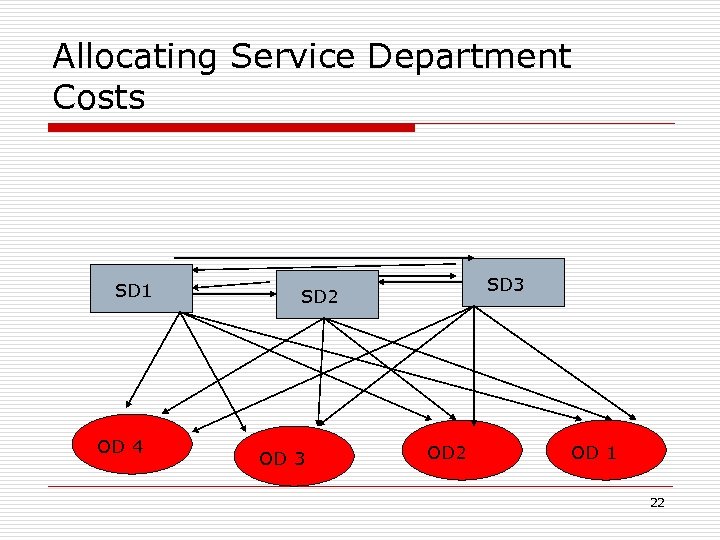
Allocating Service Department Costs SD 1 OD 4 SD 3 SD 2 OD 3 OD 2 OD 1 22
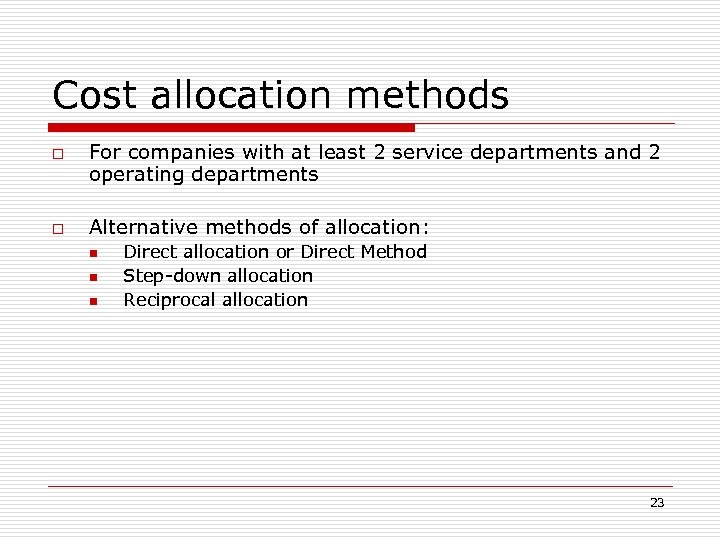
Cost allocation methods o o For companies with at least 2 service departments and 2 operating departments Alternative methods of allocation: n n n Direct allocation or Direct Method Step-down allocation Reciprocal allocation 23
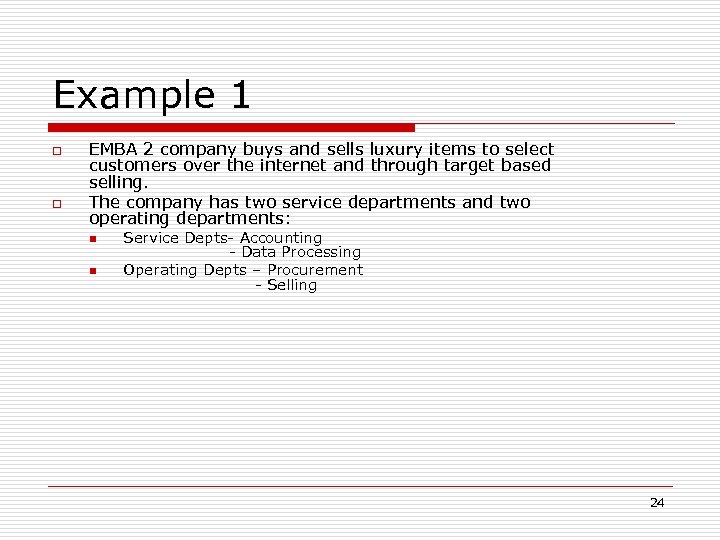
Example 1 o o EMBA 2 company buys and sells luxury items to select customers over the internet and through target based selling. The company has two service departments and two operating departments: n n Service Depts- Accounting - Data Processing Operating Depts – Procurement - Selling 24
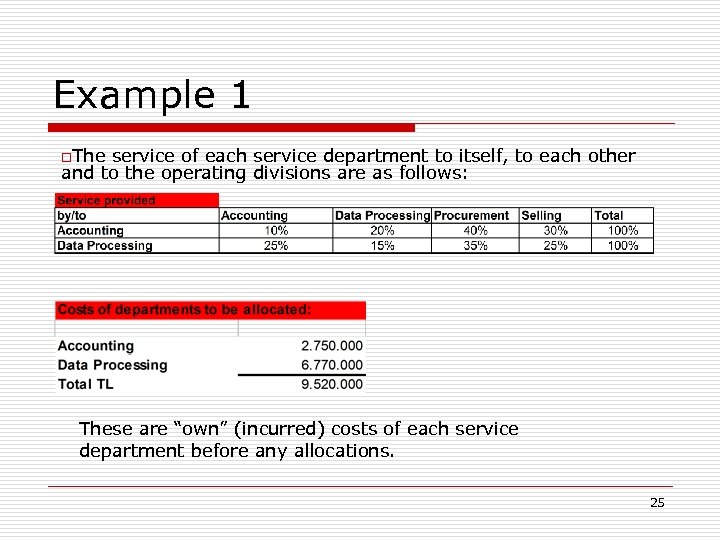
Example 1 o. The service of each service department to itself, to each other and to the operating divisions are as follows: These are “own” (incurred) costs of each service department before any allocations. 25
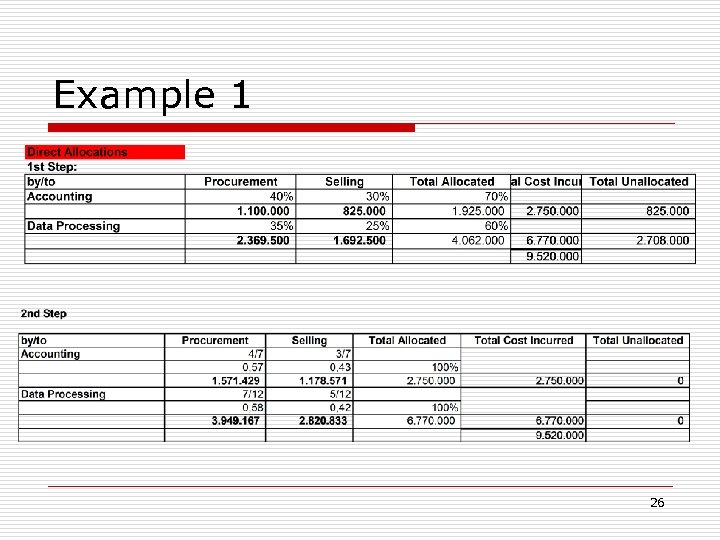
Example 1 26
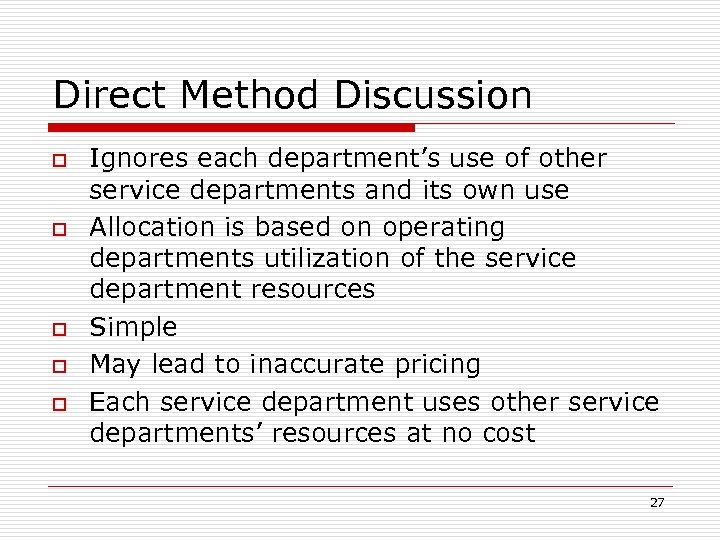
Direct Method Discussion o o o Ignores each department’s use of other service departments and its own use Allocation is based on operating departments utilization of the service department resources Simple May lead to inaccurate pricing Each service department uses other service departments’ resources at no cost 27
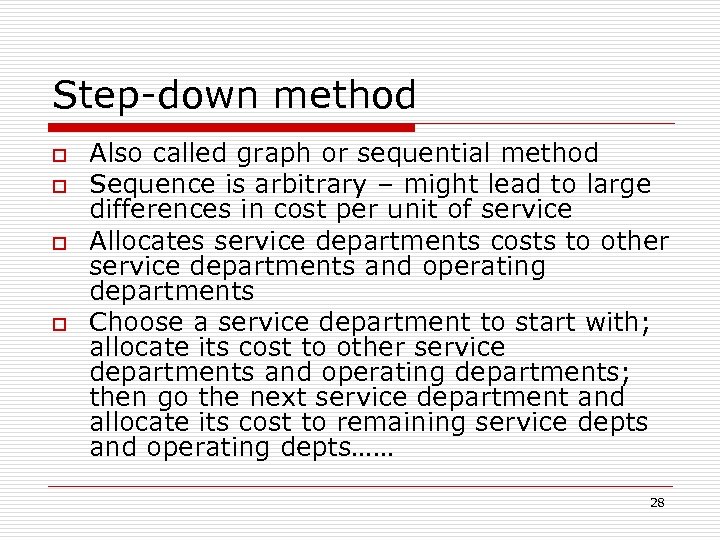
Step-down method o o Also called graph or sequential method Sequence is arbitrary – might lead to large differences in cost per unit of service Allocates service departments costs to other service departments and operating departments Choose a service department to start with; allocate its cost to other service departments and operating departments; then go the next service department and allocate its cost to remaining service depts and operating depts…… 28
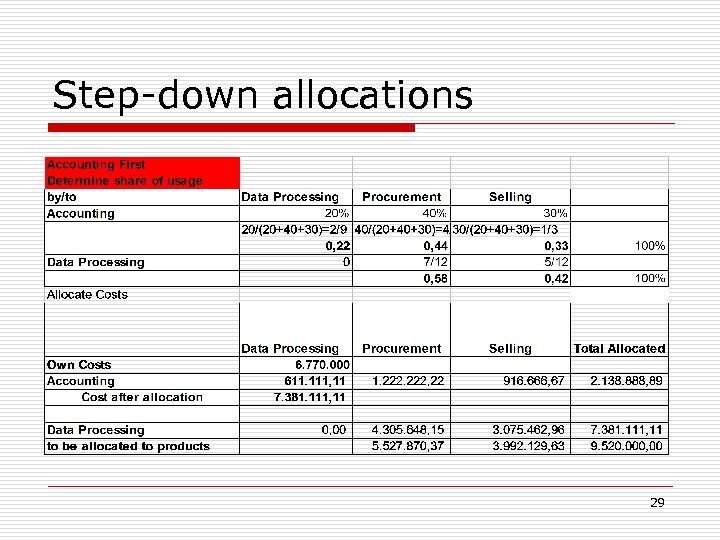
Step-down allocations 29
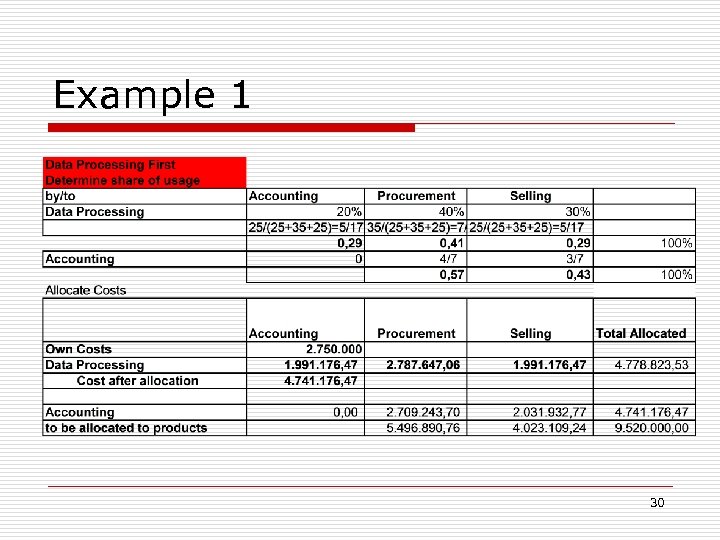
Example 1 30
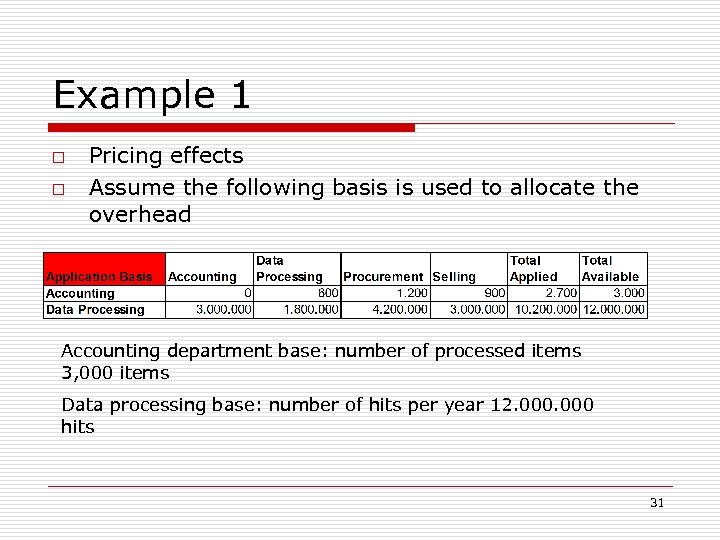
Example 1 o o Pricing effects Assume the following basis is used to allocate the overhead Accounting department base: number of processed items 3, 000 items Data processing base: number of hits per year 12. 000 hits 31
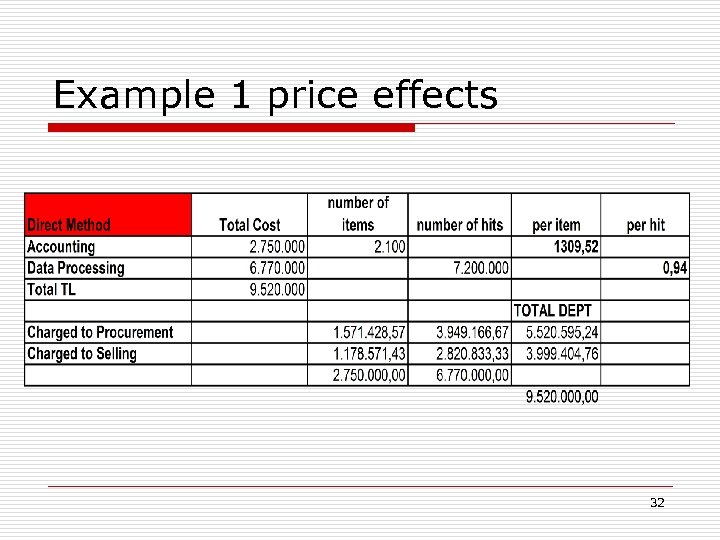
Example 1 price effects 32
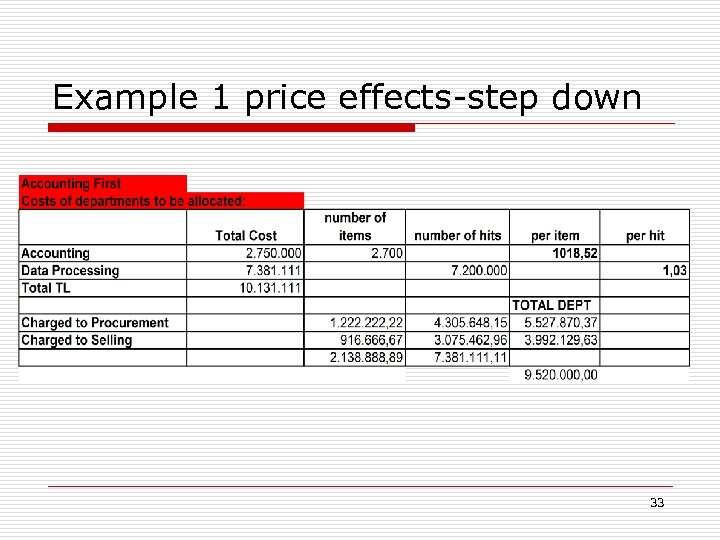
Example 1 price effects-step down 33
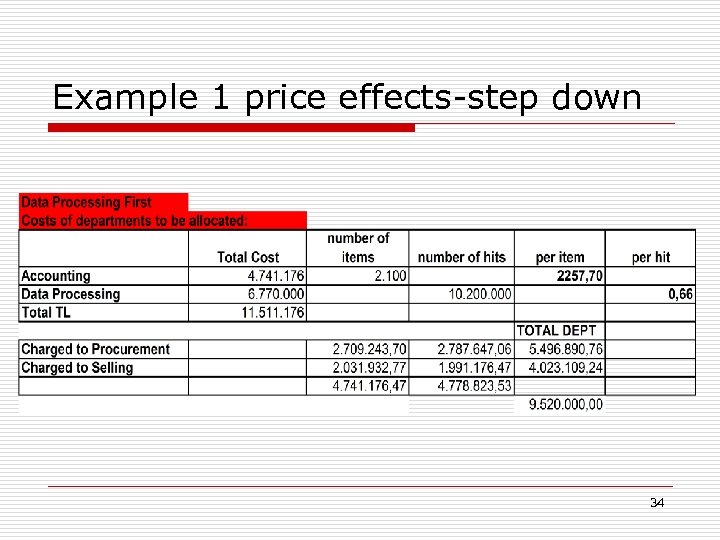
Example 1 price effects-step down 34
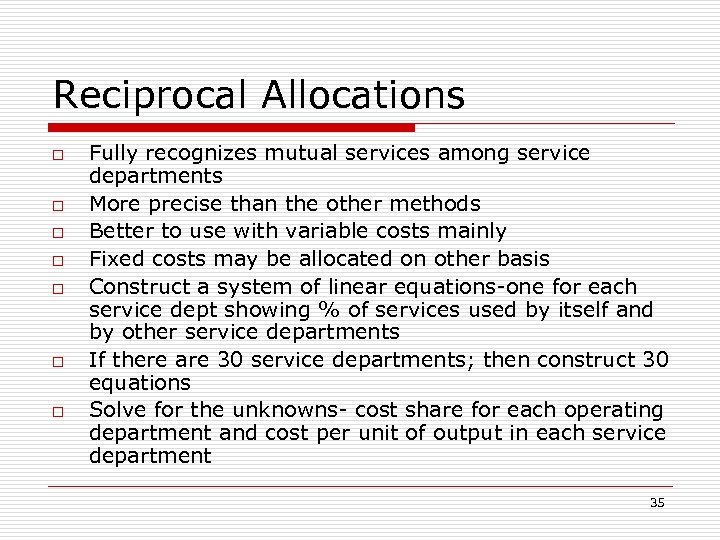
Reciprocal Allocations o o o o Fully recognizes mutual services among service departments More precise than the other methods Better to use with variable costs mainly Fixed costs may be allocated on other basis Construct a system of linear equations-one for each service dept showing % of services used by itself and by other service departments If there are 30 service departments; then construct 30 equations Solve for the unknowns- cost share for each operating department and cost per unit of output in each service department 35
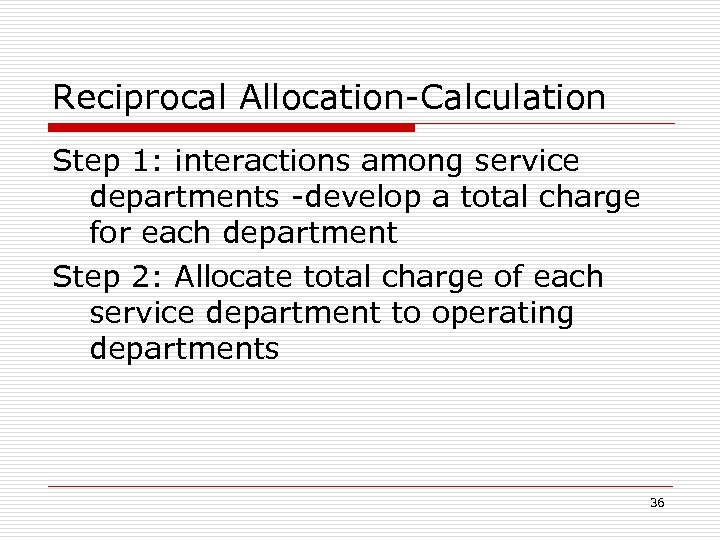
Reciprocal Allocation-Calculation Step 1: interactions among service departments -develop a total charge for each department Step 2: Allocate total charge of each service department to operating departments 36
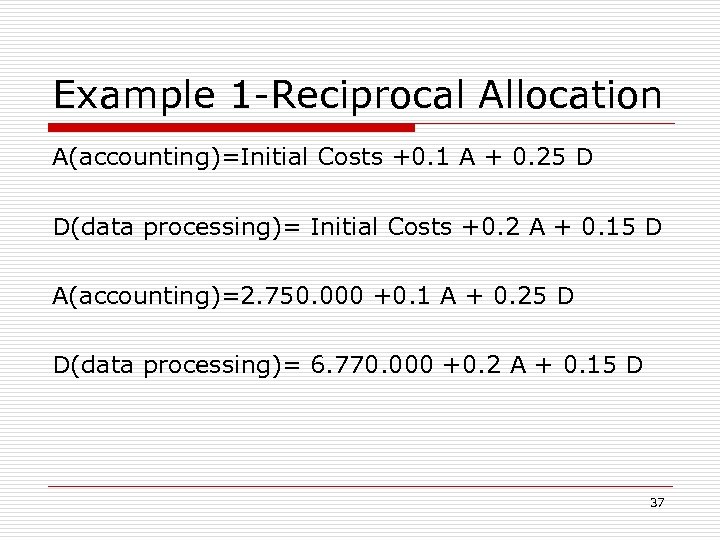
Example 1 -Reciprocal Allocation A(accounting)=Initial Costs +0. 1 A + 0. 25 D D(data processing)= Initial Costs +0. 2 A + 0. 15 D A(accounting)=2. 750. 000 +0. 1 A + 0. 25 D D(data processing)= 6. 770. 000 +0. 2 A + 0. 15 D 37
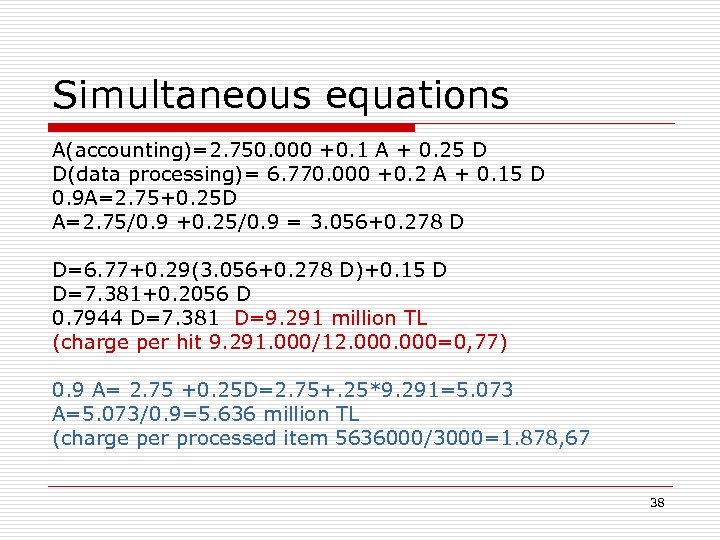
Simultaneous equations A(accounting)=2. 750. 000 +0. 1 A + 0. 25 D D(data processing)= 6. 770. 000 +0. 2 A + 0. 15 D 0. 9 A=2. 75+0. 25 D A=2. 75/0. 9 +0. 25/0. 9 = 3. 056+0. 278 D D=6. 77+0. 29(3. 056+0. 278 D)+0. 15 D D=7. 381+0. 2056 D 0. 7944 D=7. 381 D=9. 291 million TL (charge per hit 9. 291. 000/12. 000=0, 77) 0. 9 A= 2. 75 +0. 25 D=2. 75+. 25*9. 291=5. 073 A=5. 073/0. 9=5. 636 million TL (charge per processed item 5636000/3000=1. 878, 67 38
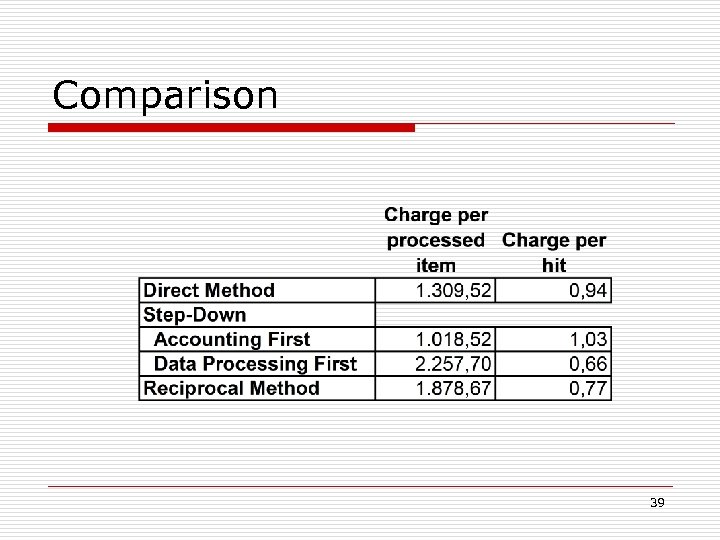
Comparison 39
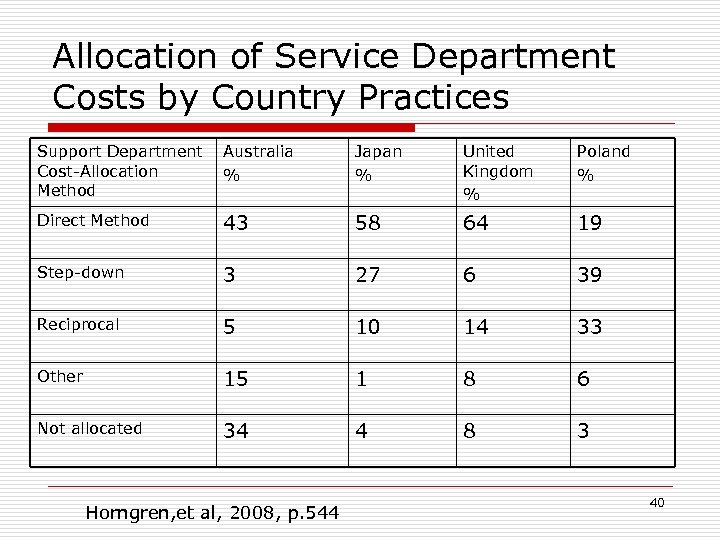
Allocation of Service Department Costs by Country Practices Support Department Cost-Allocation Method Australia % Japan % United Kingdom % Poland % Direct Method 43 58 64 19 Step-down 3 27 6 39 Reciprocal 5 10 14 33 Other 15 1 8 6 Not allocated 34 4 8 3 Horngren, et al, 2008, p. 544 40
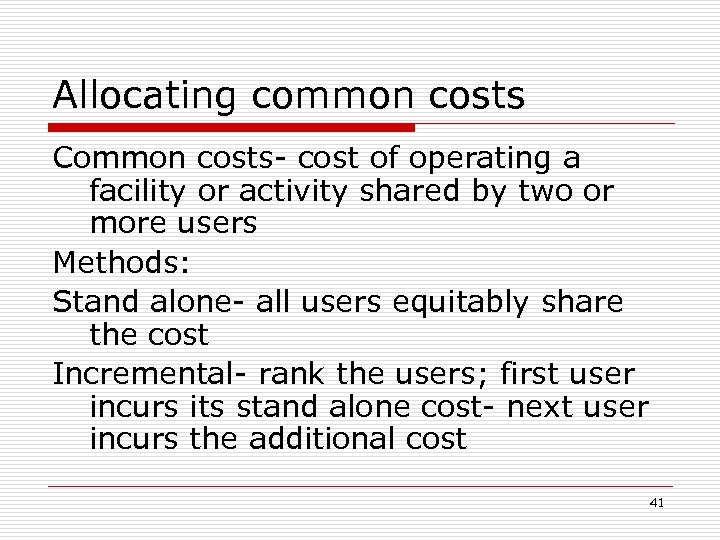
Allocating common costs Common costs- cost of operating a facility or activity shared by two or more users Methods: Stand alone- all users equitably share the cost Incremental- rank the users; first user incurs its stand alone cost- next user incurs the additional cost 41
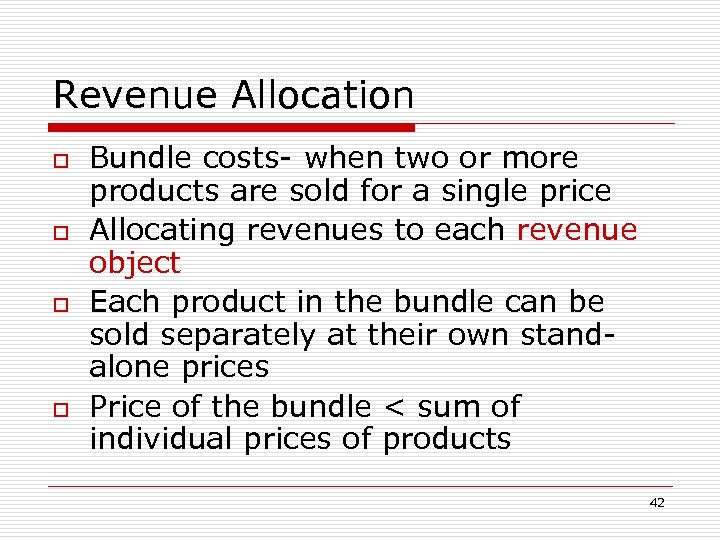
Revenue Allocation o o Bundle costs- when two or more products are sold for a single price Allocating revenues to each revenue object Each product in the bundle can be sold separately at their own standalone prices Price of the bundle < sum of individual prices of products 42
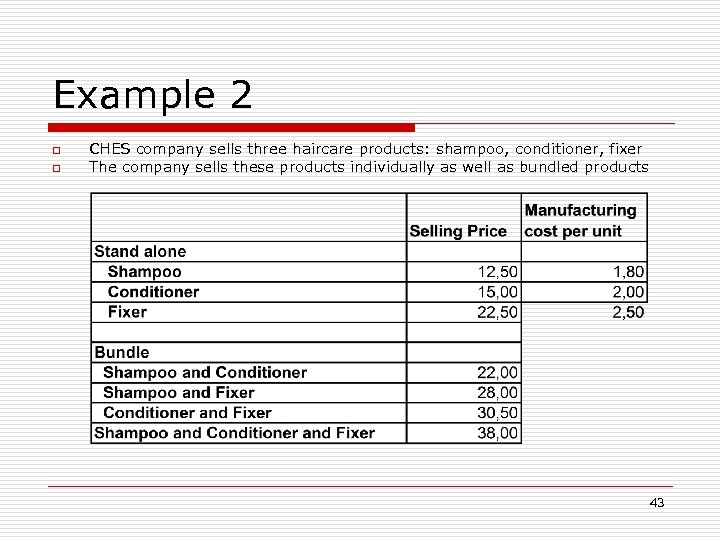
Example 2 o o CHES company sells three haircare products: shampoo, conditioner, fixer The company sells these products individually as well as bundled products 43
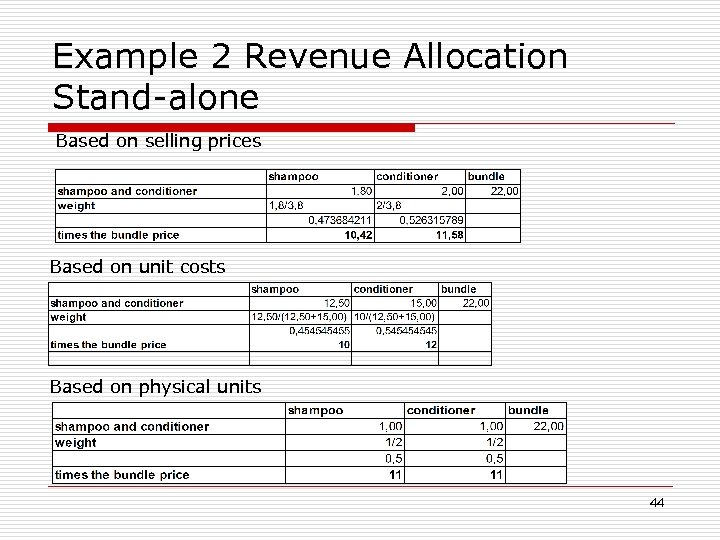
Example 2 Revenue Allocation Stand-alone Based on selling prices Based on unit costs Based on physical units 44
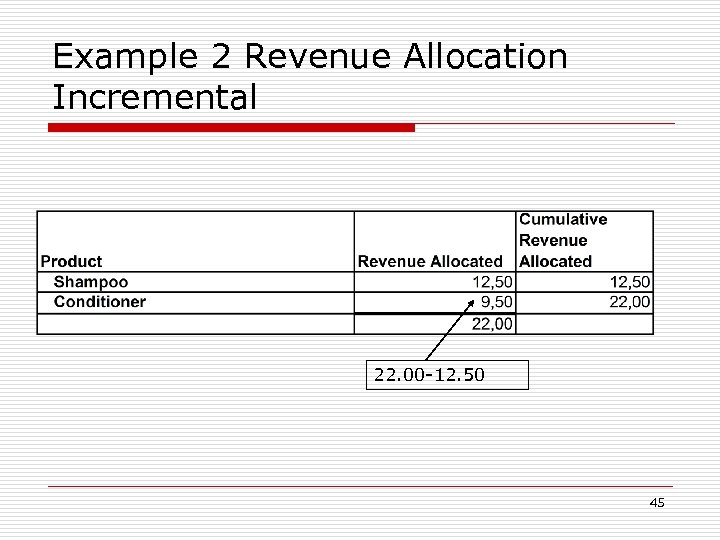
Example 2 Revenue Allocation Incremental 22. 00 -12. 50 45
Скачать презентацию Cost Allocations EMBA 5412 Fall 2007 What
2cf15888df64f2165b8f5bb2ac6cd745.ppt