 Скачать презентацию Cosmic Holography Bin Wang 王 斌 Wang Department of
f277e9251a9d66de494e48f45d682b8d.ppt
- Количество слайдов: 64




Cosmic Holography Bin Wang(王 斌) Wang( Department of Physics, Fudan University
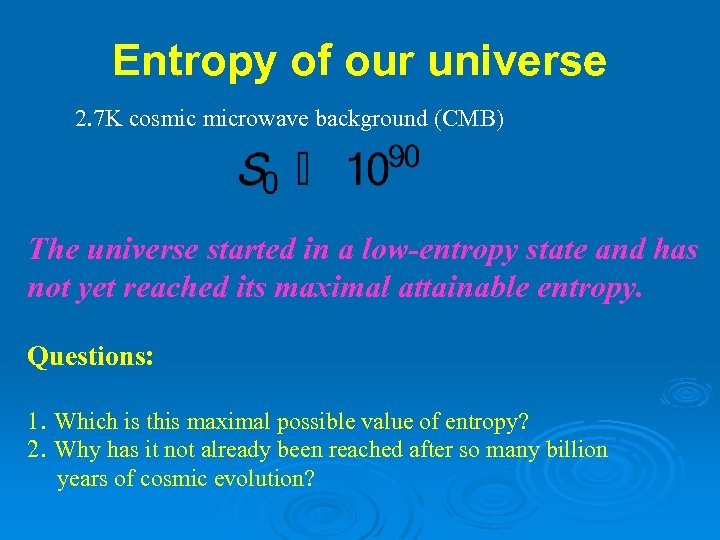
Entropy of our universe 2. 7 K cosmic microwave background (CMB) The universe started in a low-entropy state and has not yet reached its maximal attainable entropy. Questions: 1. Which is this maximal possible value of entropy? 2. Why has it not already been reached after so many billion years of cosmic evolution?
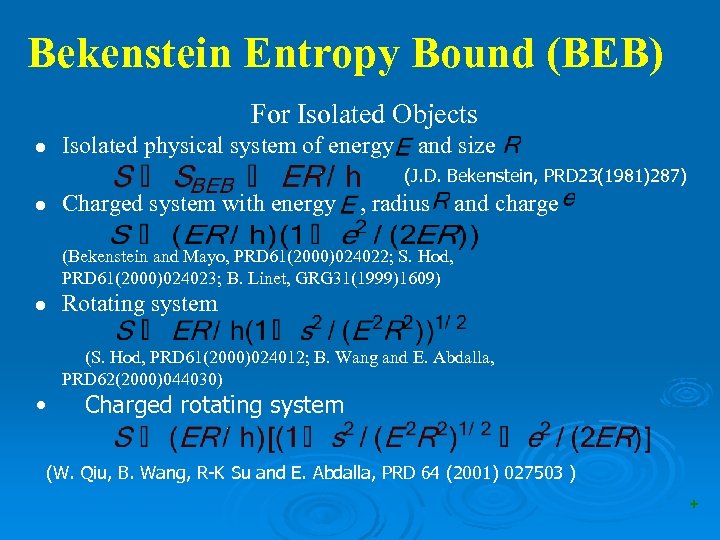
Bekenstein Entropy Bound (BEB) For Isolated Objects l Isolated physical system of energy and size (J. D. Bekenstein, PRD 23(1981)287) l Charged system with energy , radius and charge (Bekenstein and Mayo, PRD 61(2000)024022; S. Hod, PRD 61(2000)024023; B. Linet, GRG 31(1999)1609) l • Rotating system (S. Hod, PRD 61(2000)024012; B. Wang and E. Abdalla, PRD 62(2000)044030) Charged rotating system (W. Qiu, B. Wang, R-K Su and E. Abdalla, PRD 64 (2001) 027503 ) +

“Entropy bounds for isolated system depend neither On background spacetime nor on spacetime dimensions. ” Universal
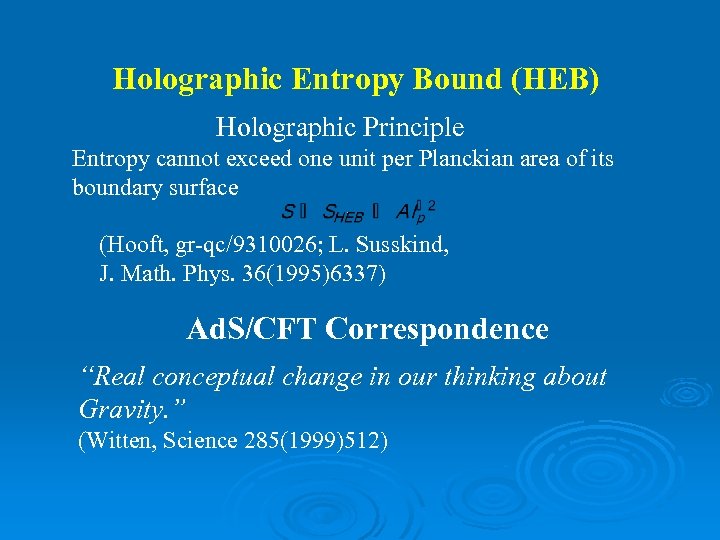
Holographic Entropy Bound (HEB) Holographic Principle Entropy cannot exceed one unit per Planckian area of its boundary surface (Hooft, gr-qc/9310026; L. Susskind, J. Math. Phys. 36(1995)6337) Ad. S/CFT Correspondence “Real conceptual change in our thinking about Gravity. ” (Witten, Science 285(1999)512)
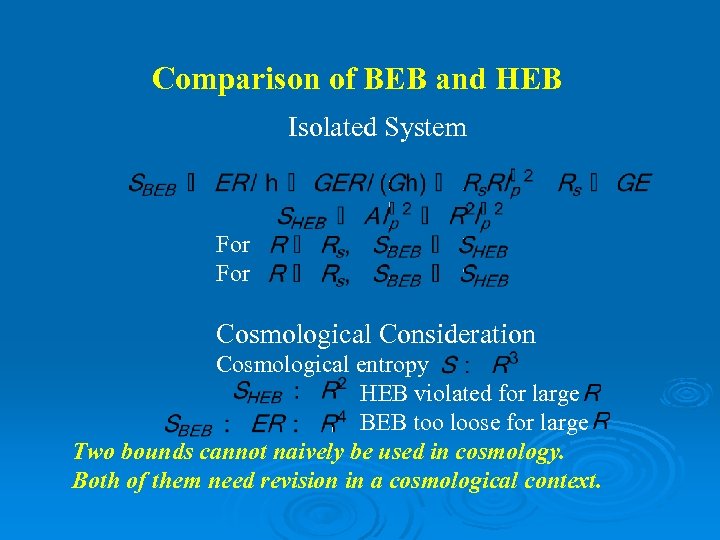
Comparison of BEB and HEB Isolated System For Cosmological Consideration Cosmological entropy HEB violated for large BEB too loose for large Two bounds cannot naively be used in cosmology. Both of them need revision in a cosmological context.
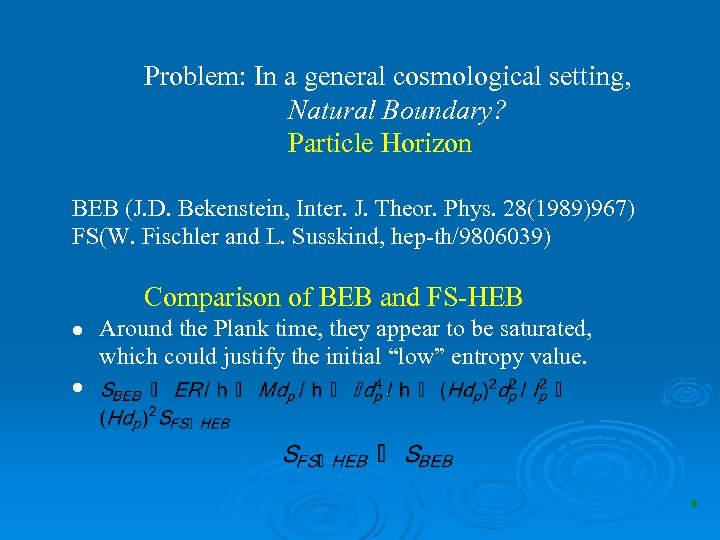
Problem: In a general cosmological setting, Natural Boundary? Particle Horizon BEB (J. D. Bekenstein, Inter. J. Theor. Phys. 28(1989)967) FS(W. Fischler and L. Susskind, hep-th/9806039) Comparison of BEB and FS-HEB l Around the Plank time, they appear to be saturated, which could justify the initial “low” entropy value. l +
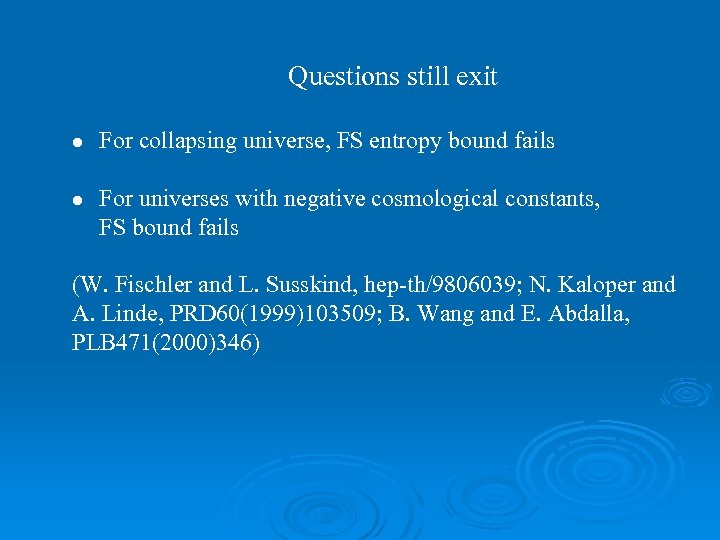
Questions still exit l l For collapsing universe, FS entropy bound fails For universes with negative cosmological constants, FS bound fails (W. Fischler and L. Susskind, hep-th/9806039; N. Kaloper and A. Linde, PRD 60(1999)103509; B. Wang and E. Abdalla, PLB 471(2000)346)
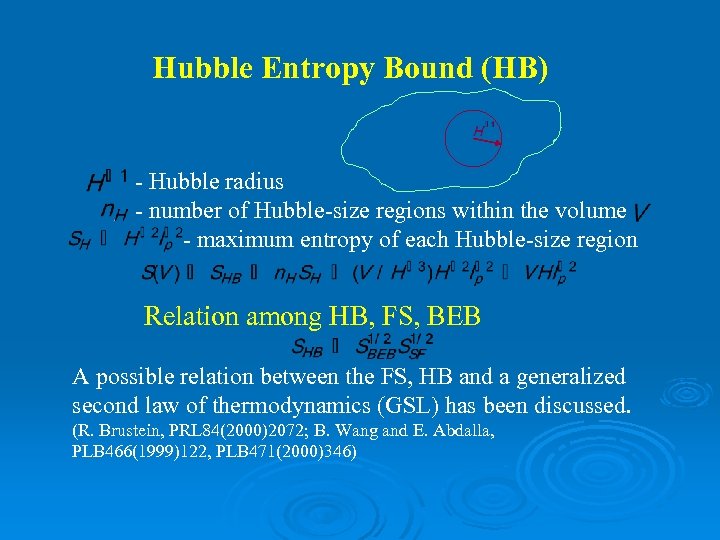
Hubble Entropy Bound (HB) - Hubble radius - number of Hubble-size regions within the volume - maximum entropy of each Hubble-size region Relation among HB, FS, BEB A possible relation between the FS, HB and a generalized second law of thermodynamics (GSL) has been discussed. (R. Brustein, PRL 84(2000)2072; B. Wang and E. Abdalla, PLB 466(1999)122, PLB 471(2000)346)
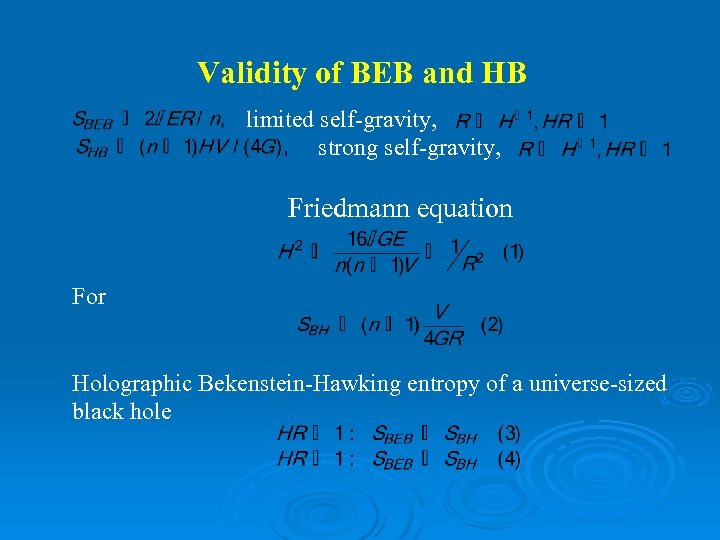
Validity of BEB and HB limited self-gravity, strong self-gravity, Friedmann equation For Holographic Bekenstein-Hawking entropy of a universe-sized black hole
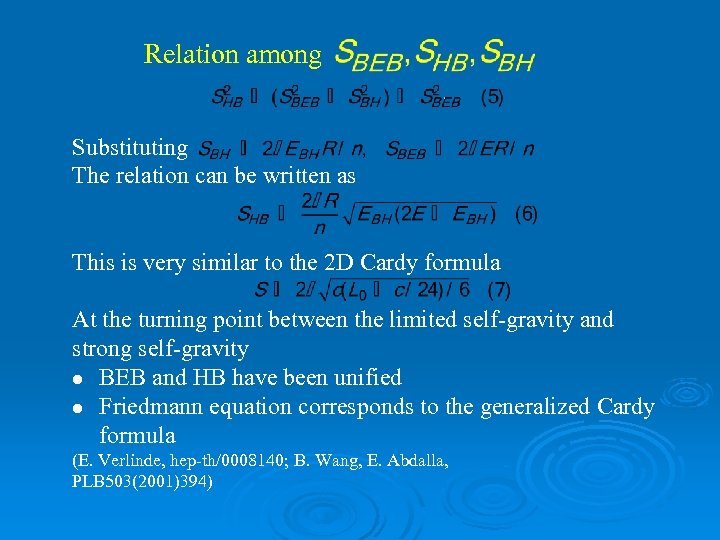
Relation among Substituting The relation can be written as This is very similar to the 2 D Cardy formula At the turning point between the limited self-gravity and strong self-gravity l BEB and HB have been unified l Friedmann equation corresponds to the generalized Cardy formula (E. Verlinde, hep-th/0008140; B. Wang, E. Abdalla, PLB 503(2001)394)
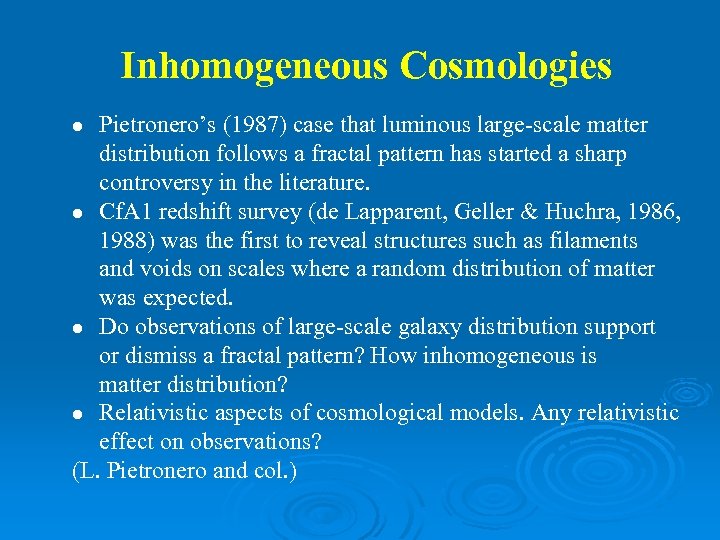
Inhomogeneous Cosmologies Pietronero’s (1987) case that luminous large-scale matter distribution follows a fractal pattern has started a sharp controversy in the literature. l Cf. A 1 redshift survey (de Lapparent, Geller & Huchra, 1986, 1988) was the first to reveal structures such as filaments and voids on scales where a random distribution of matter was expected. l Do observations of large-scale galaxy distribution support or dismiss a fractal pattern? How inhomogeneous is matter distribution? l Relativistic aspects of cosmological models. Any relativistic effect on observations? (L. Pietronero and col. ) l
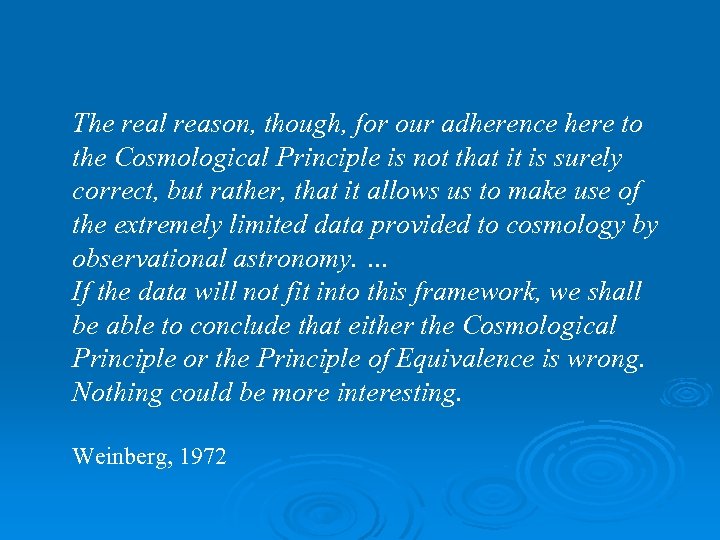
The real reason, though, for our adherence here to the Cosmological Principle is not that it is surely correct, but rather, that it allows us to make use of the extremely limited data provided to cosmology by observational astronomy. … If the data will not fit into this framework, we shall be able to conclude that either the Cosmological Principle or the Principle of Equivalence is wrong. Nothing could be more interesting. Weinberg, 1972
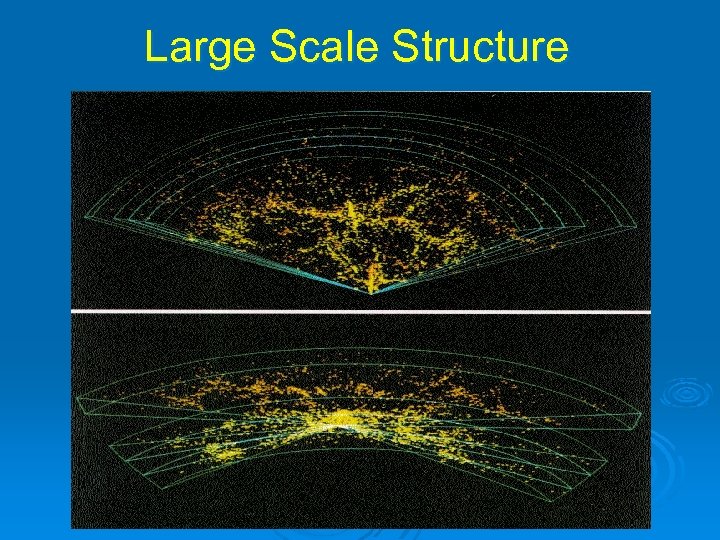
Large Scale Structure
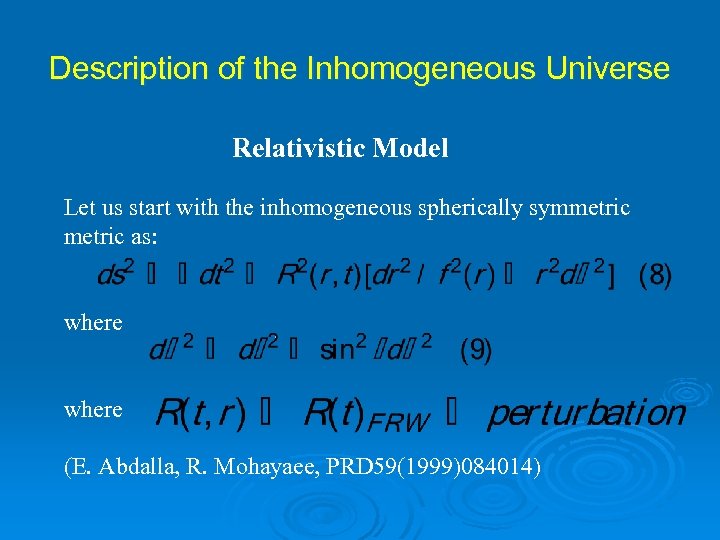
Description of the Inhomogeneous Universe Relativistic Model Let us start with the inhomogeneous spherically symmetric as: where (E. Abdalla, R. Mohayaee, PRD 59(1999)084014)
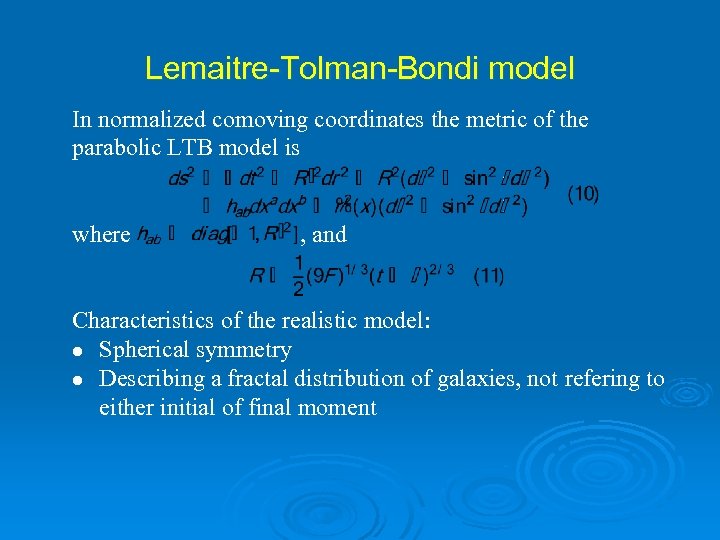
Lemaitre-Tolman-Bondi model In normalized comoving coordinates the metric of the parabolic LTB model is where , and Characteristics of the realistic model: l Spherical symmetry l Describing a fractal distribution of galaxies, not refering to either initial of final moment
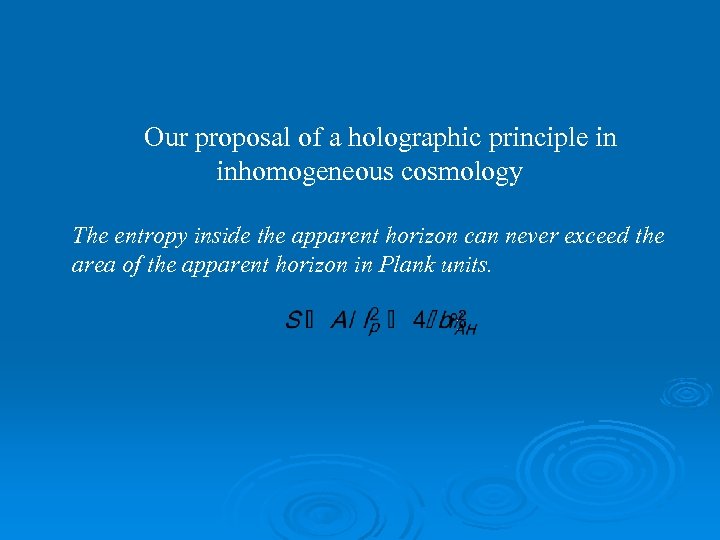
Our proposal of a holographic principle in inhomogeneous cosmology The entropy inside the apparent horizon can never exceed the area of the apparent horizon in Plank units.
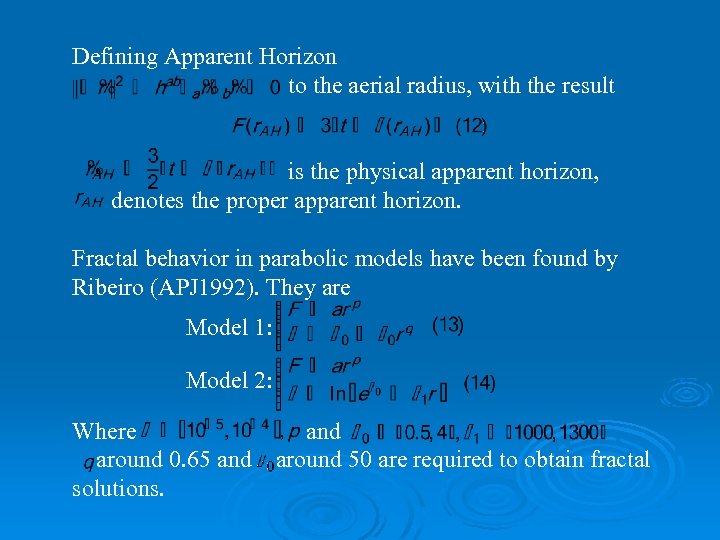
Defining Apparent Horizon to the aerial radius, with the result is the physical apparent horizon, denotes the proper apparent horizon. Fractal behavior in parabolic models have been found by Ribeiro (APJ 1992). They are Model 1: Model 2: Where around 0. 65 and solutions. and around 50 are required to obtain fractal

Define the local entropy density Standard big-bang cosmology: When a particle becomes nonrelativistic and disappears, its entropy is transferred to other relativistic particle species still present in thermal plasma. Photons and neutrinos share the entropy of the universe. Reasonable suppose: Entropy of the universe is mainly produced before the dust-filled era. +
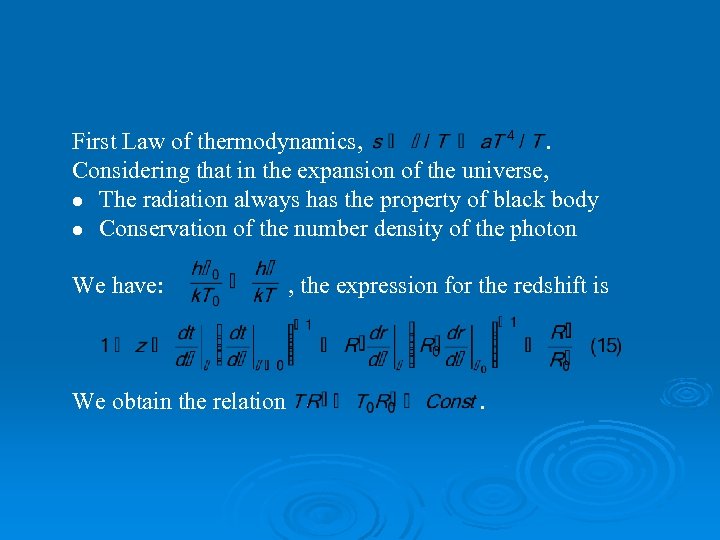
First Law of thermodynamics, . Considering that in the expansion of the universe, l The radiation always has the property of black body l Conservation of the number density of the photon We have: We obtain the relation , the expression for the redshift is .
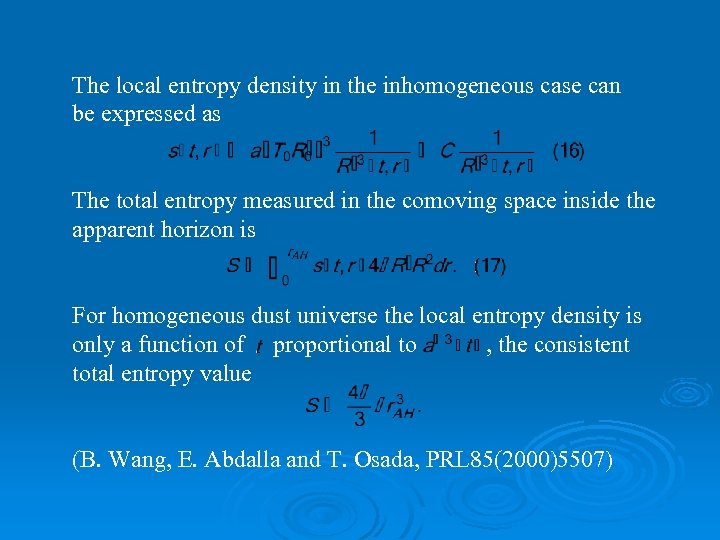
The local entropy density in the inhomogeneous case can be expressed as The total entropy measured in the comoving space inside the apparent horizon is For homogeneous dust universe the local entropy density is only a function of proportional to , the consistent total entropy value (B. Wang, E. Abdalla and T. Osada, PRL 85(2000)5507)
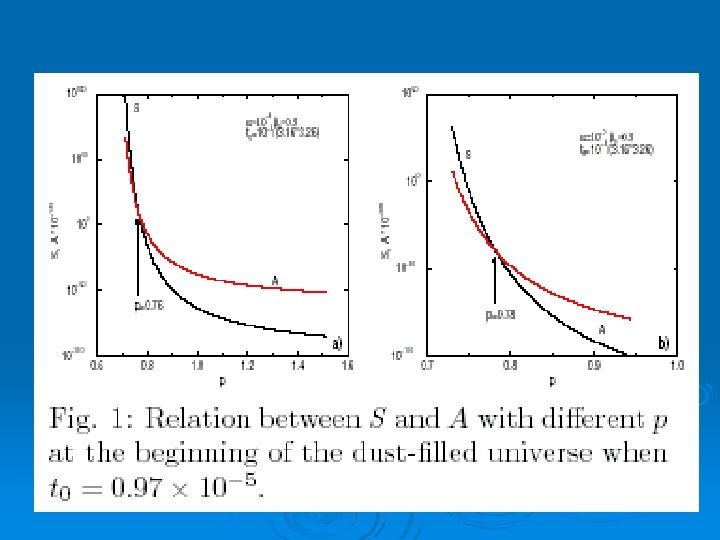
Fig. 1: Relation between and with different beginning of the dust-filled universe when at the.

We now face the question: l l the holographic principle has to be challenged it can be used to select a physically acceptable model We prefer the second, more constructive, alternative.
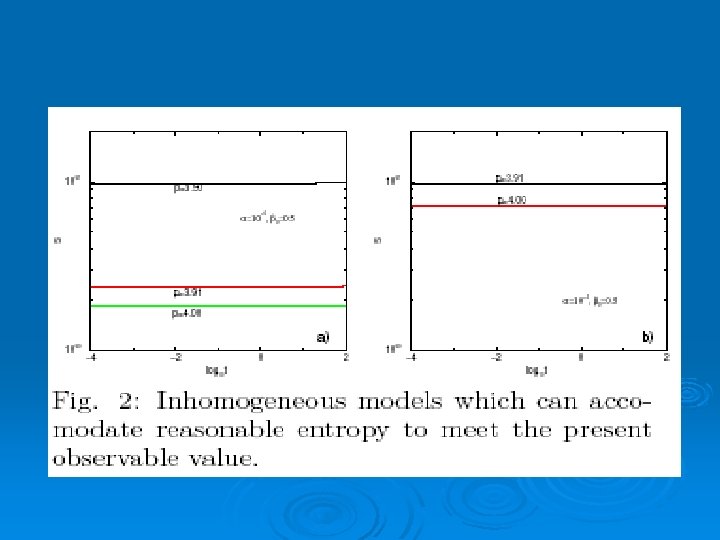
Fig. 2: Inhomogeneous models which can accommodate reasonable entropy to meet the present observable value.
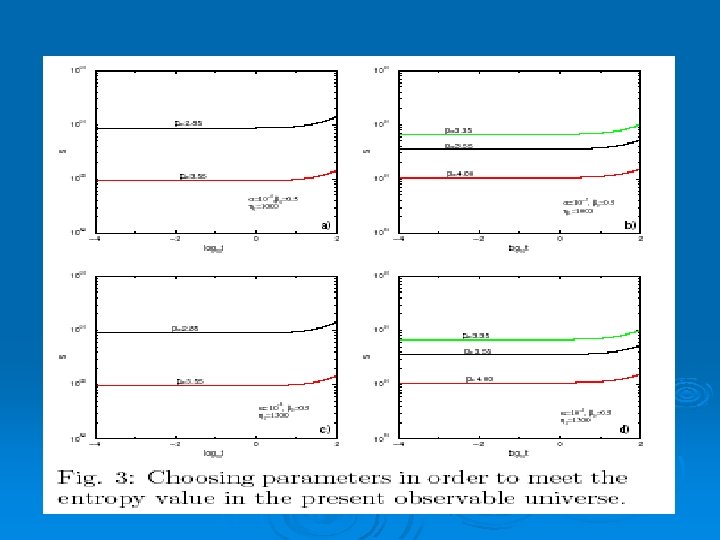
Fig. 3: Choosing parameters in order to meet the entropy value in the present observable universe.
Conclusions l l Possible to modelize highly inhomogeneous structures Entropy constraints can give valuable information through the holographic principle

I. Upper bound on the number of e-foldings from holography
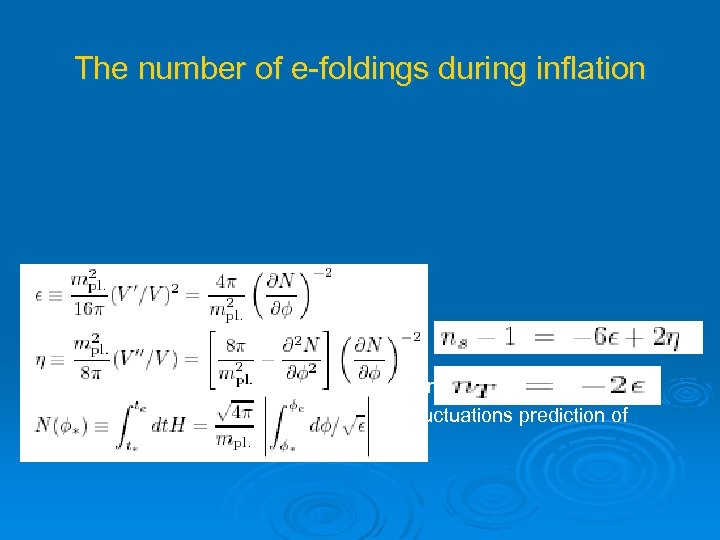
The number of e-foldings during inflation Number of e-folds: Horizon problem, flatness problem & entropy problem Ø Relate to the slow roll parameters and fluctuations prediction of inflation Ø
The number of e-foldings during inflation The existence of an upper bound for the number of efoldings has been discussed. In general it is model dependent. The bound has been obtained in some very simple cosmological settings, while it is still difficult to be obtained in nonstandard models. Using the holographic principle, the consideration of physical details connected to the universe evolution can be avoided. We have obtained the upper bound for the number of e-foldings for a standard FRW universe as well as non-standard cosmology based on the brane inspired idea of Randall and Sundrum models.
Holographic Principle Motivated by the well-known example of black hole entropy, an influential holographic principle has put forward, suggesting that microscopic degrees of freedom that build up the gravitational dynamics actually reside on the boundary of space-time. This principle developed to the Maldacena's conjecture on Ad. S/CFT correspondence and further very important consequences, such as Witten's identification of the entropy, energy and temperature of CFT at high temperatures with the entropy, mass and Hawking temperature of the Ad. S black hole.
Cosmic Holography We thus seek at a description of the powerful holographic principle in cosmological settings, where its testing is subtle. The question of holography therein: for flat and open FLRW universes the area of the particle horizon should bound the entropy on the backward-looking light cone.
Verlinde-Cardy formula FLRW universe filled with CFT with a dual Ad. S description has been done by Verlinde, revealing that when a universe-sized black hole can be formed, an interesting and surprising correspondence appears between entropy of CFT and Friedmann equation governing the radiation dominated closed FLRW universes. Generalizing Verlinde's discussion to a broader class of universes including a cosmological constant: matching of Friedmann equation to Cardy formula holds for de Sitter closed and Ad. S flat universes. However for the remaining de Sitter and Ad. S universes, the argument fails due to breaking down of the general philosophy of the holographic principle. In high dimensions, various other aspects of Verlinde's proposal have also been investigated in a number of works.
Verlinde-Cardy formula in Brane Cosmology Further light on the correspondence between Friedmann equation and Cardy formula has been shed from a Randall-Sundrum. CFT dominated universe as a co-dimension one brane with finetuned tension in a background of an Ad. S black hole, Savonije and Verlinde found the correspondence between Friedmann equation and Cardy formula for the entropy of CFT when the brane crosses the black hole horizon. Confirmed by studying a brane-universe filled with radiation and stiffmatter, quantum-induced brane worlds and radially infalling brane. The discovered relation between Friedmann equation and Cardy formula for the entropy shed significant light on the meaning of the holographic principle in a cosmological setting. The general proof for this correspondence for all CFTs is still difficult at the moment.
The number of e-foldings from holography Our motivation here is the use of the correspondence between the CFT gas and the Friedmann equation establishing an upper bound for the number of e-foldings during inflation. Recently, Banks and Fischler have considered the problem of the number of e-foldings in a universe displaying an asymptotic de Sitter phase, as our own. As a result the number of efoldings is not larger than 65/85 depending on the type of matter considered.
The number of e-foldings from holography Here we reconsider the problem from the point of view of the entropy content of the Universe, and considering the correspondence between the Friedmann equation and Cardy formula in Brane Universes.
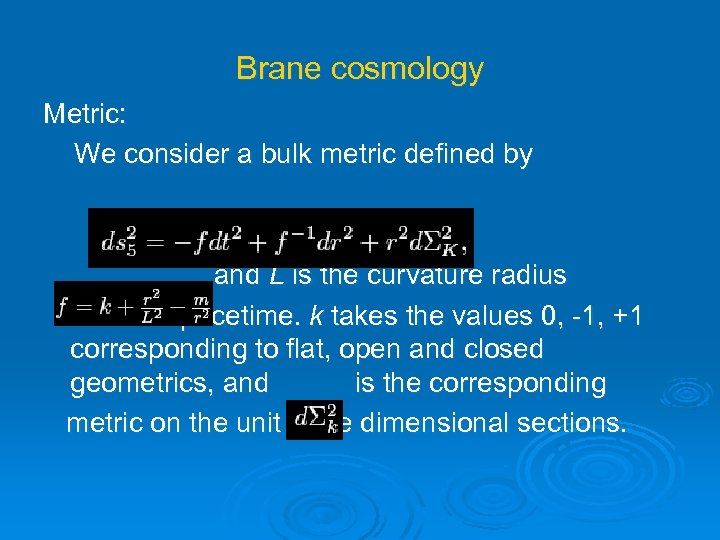
Brane cosmology Metric: We consider a bulk metric defined by and L is the curvature radius of Ad. S spacetime. k takes the values 0, -1, +1 corresponding to flat, open and closed geometrics, and is the corresponding metric on the unit three dimensional sections.
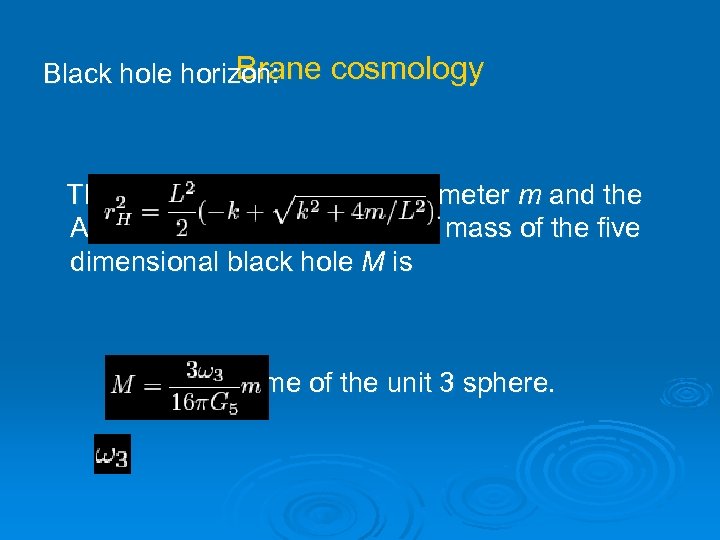
Brane cosmology Black hole horizon: The relation between the parameter m and the Arnowitt-Deser-Misner (ADM) mass of the five dimensional black hole M is is the volume of the unit 3 sphere.
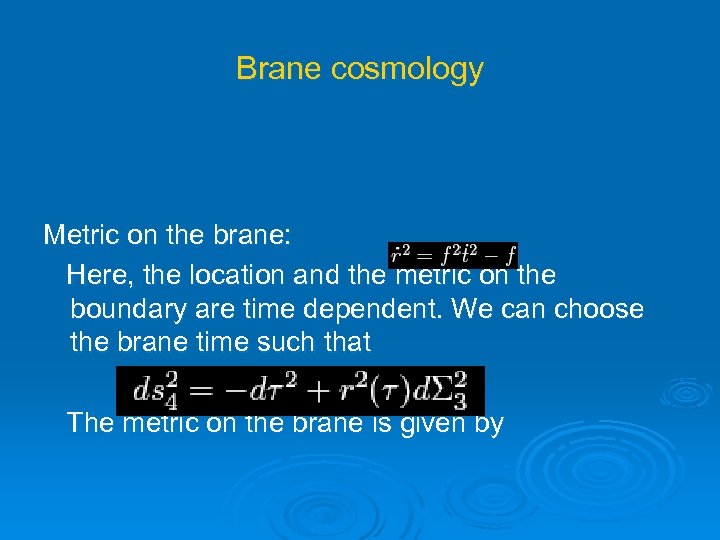
Brane cosmology Metric on the brane: Here, the location and the metric on the boundary are time dependent. We can choose the brane time such that The metric on the brane is given by
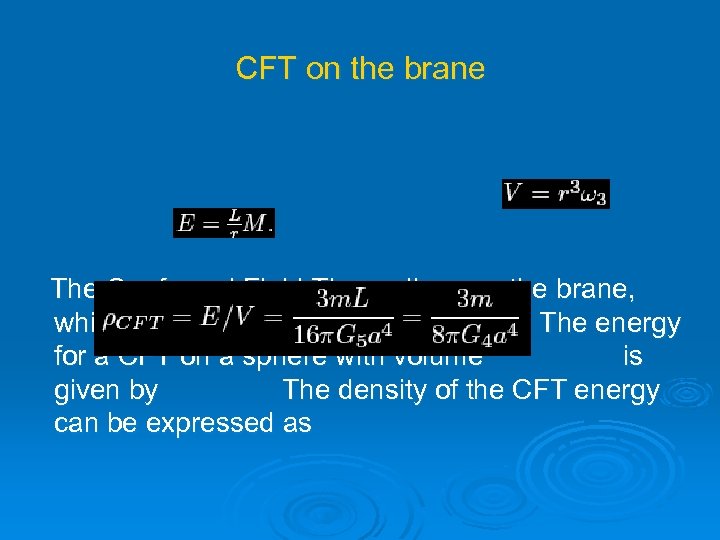
CFT on the brane The Conformal Field Theory lives on the brane, which is the boundary of the Ad. S hole. The energy for a CFT on a sphere with volume is given by The density of the CFT energy can be expressed as
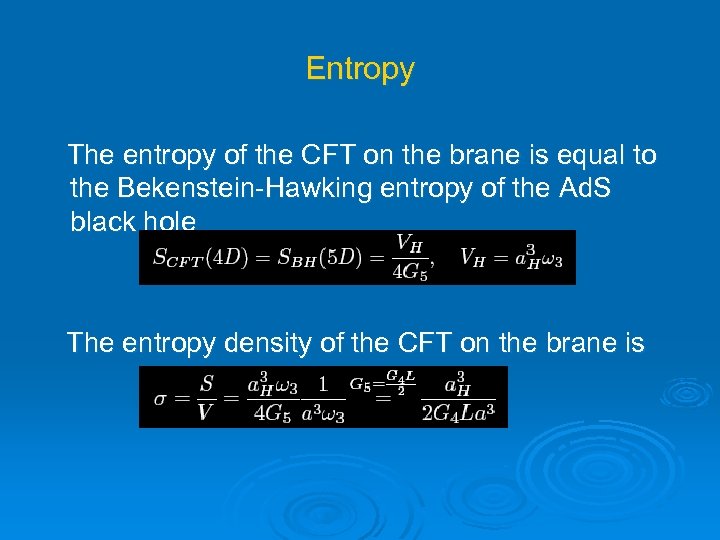
Entropy The entropy of the CFT on the brane is equal to the Bekenstein-Hawking entropy of the Ad. S black hole The entropy density of the CFT on the brane is
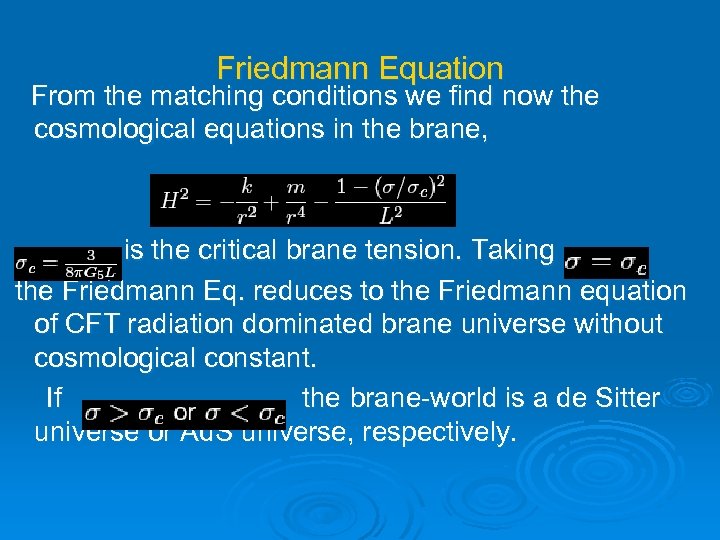
Friedmann Equation From the matching conditions we find now the cosmological equations in the brane, is the critical brane tension. Taking the Friedmann Eq. reduces to the Friedmann equation of CFT radiation dominated brane universe without cosmological constant. If the brane-world is a de Sitter universe or Ad. S universe, respectively.
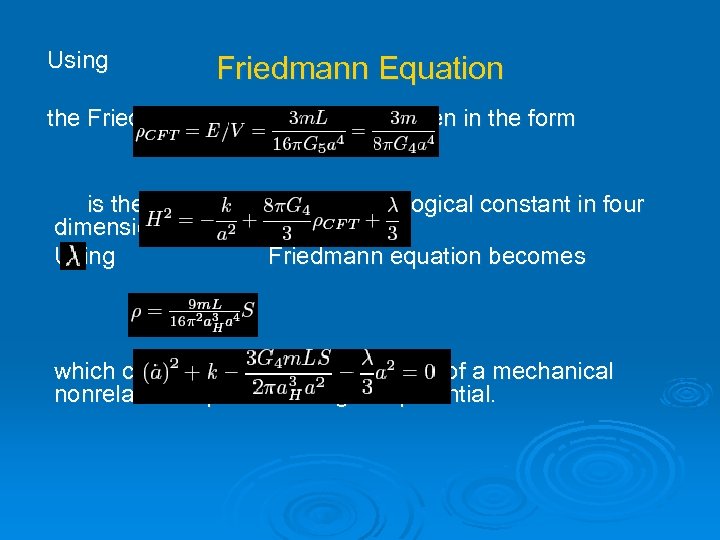
Using Friedmann Equation the Friedmann equation can be written in the form is the effective positive cosmological constant in four dimensions. Using Friedmann equation becomes which corresponds to the movement of a mechanical nonrelativistic particle in a given potential.
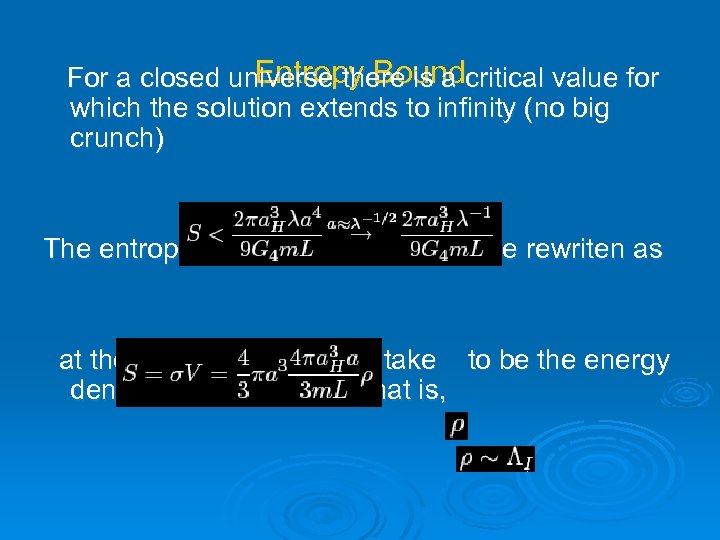
Entropy Bound For a closed universe there is a critical value for which the solution extends to infinity (no big crunch) The entropy in such a universe can be rewriten as at the end of inflation. We take to be the energy density during inflation, that is,
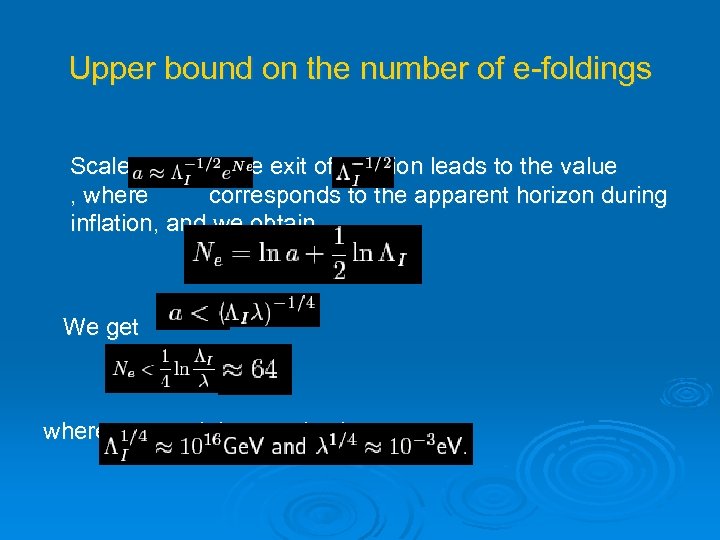
Upper bound on the number of e-foldings Scale factor at the exit of inflation leads to the value , where corresponds to the apparent horizon during inflation, and we obtain We get where we used the usual values
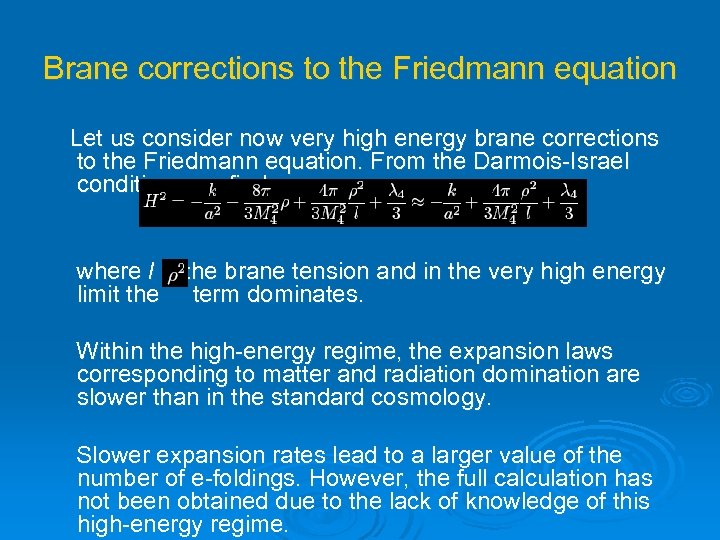
Brane corrections to the Friedmann equation Let us consider now very high energy brane corrections to the Friedmann equation. From the Darmois-Israel conditions we find where l is the brane tension and in the very high energy limit the term dominates. Within the high-energy regime, the expansion laws corresponding to matter and radiation domination are slower than in the standard cosmology. Slower expansion rates lead to a larger value of the number of e-foldings. However, the full calculation has not been obtained due to the lack of knowledge of this high-energy regime.
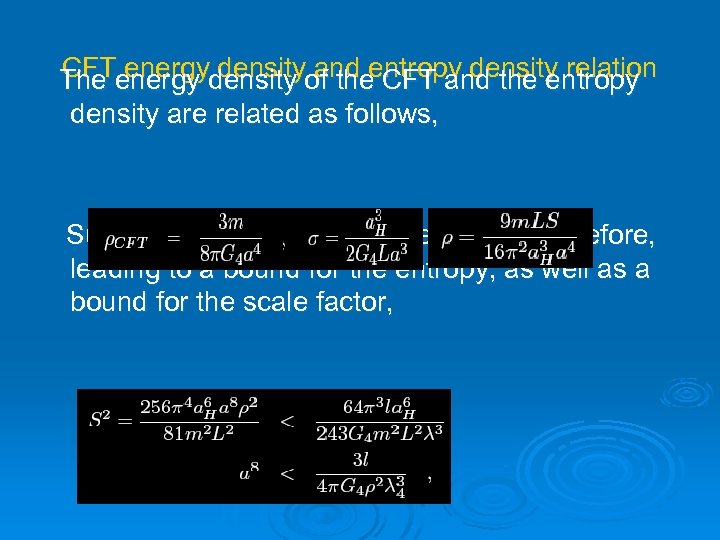
CFT energy density and entropy density relation The energy density of the CFT and the entropy density are related as follows, Substitute in the Friedmann equation as before, leading to a bound for the entropy, as well as a bound for the scale factor,
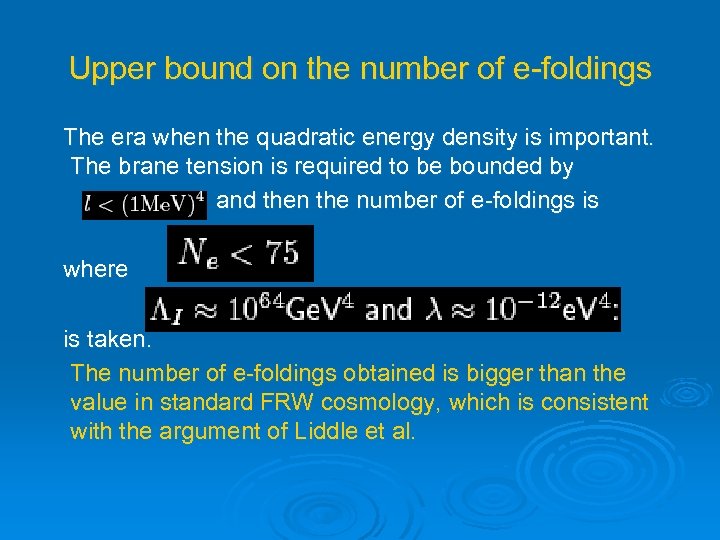
Upper bound on the number of e-foldings The era when the quadratic energy density is important. The brane tension is required to be bounded by and then the number of e-foldings is where is taken. The number of e-foldings obtained is bigger than the value in standard FRW cosmology, which is consistent with the argument of Liddle et al.
Upper bound on the number of e-foldings In summary: Ø we have derived the upper limit for the number of e-foldings based upon the arguments relating Friedmann equation and Cardy formula. Ø For the standard FRW universe our result is in good agreement with Literatures. Ø For the brane inspired cosmology in four dimensions we obtained a larger bound. Considering such a high energy context, the expansion laws are slower than in the standard cosmology, and our result can again be considered to be consistent with the known argument. Ø The interesting point here is that using the holographic point of view, we can avoid a complicated physics during the universe evolution and give a reasonable value for the upper bound of the number of efoldings.
II. WMAP constraint on P-term inflationary model
Supersymmetric inflationary model Besides the standard model, supersymmetry has been considered both as a blessing and as a curse for inflationary model building. Ø It is a blessing, primarily because it allows one to have very flat potential, as well as to fine-tune any parameters at the tree level. Moreover it seems more natural than the non-symmetric theories. Ø It is a curse, because during inflation one needs to consider supergravity, where usually all scalar fields have too big masses to support inflation. Ø Exceptions: The N=1 generic D-term inflation The N=1 supersymmetric F-term inflation avoids the general problem of inflation in supergravity.
P-term inflationary model A new version of hybrid inflation, the ``P-term inflation'' has been introduced in the context of N=2 supersymmetry. [Kallosh & Linde] It is intriguing that once one breaks N=2 supersymmetry and implements the P-term inflation in N=1 supergravity, this scenario simultaneously leads to a new class of inflationary models, which interpolates between D-term and F-term models.
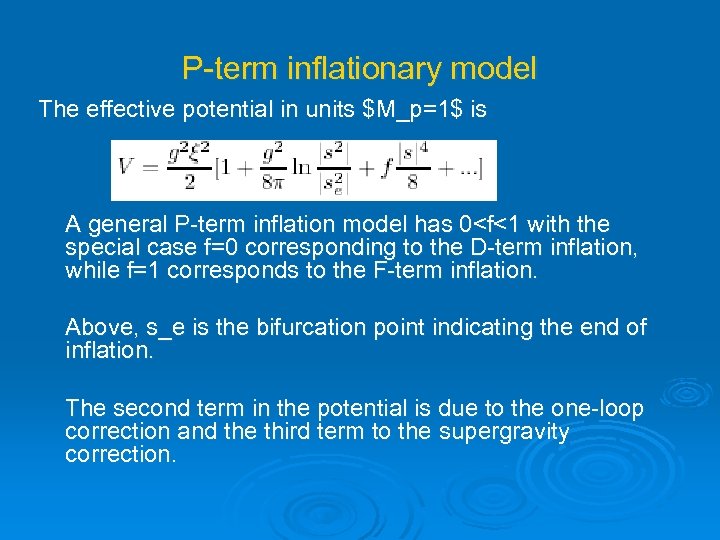
P-term inflationary model The effective potential in units $M_p=1$ is A general P-term inflation model has 0<f<1 with the special case f=0 corresponding to the D-term inflation, while f=1 corresponds to the F-term inflation. Above, s_e is the bifurcation point indicating the end of inflation. The second term in the potential is due to the one-loop correction and the third term to the supergravity correction.
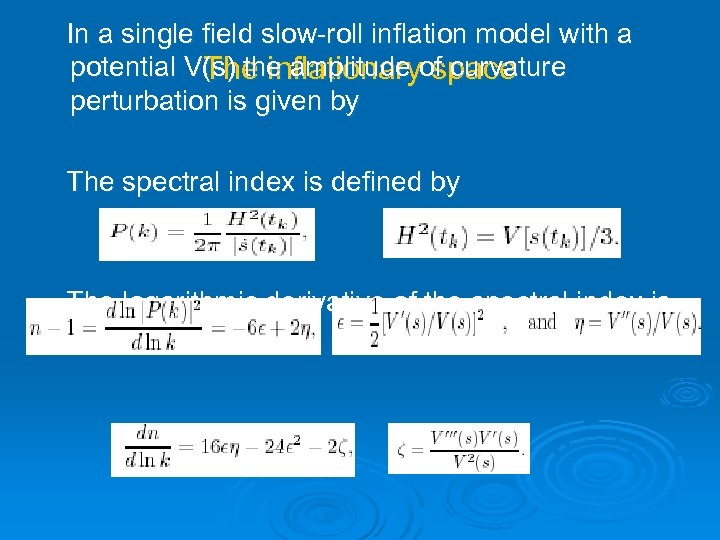
In a single field slow-roll inflation model with a potential V(s) the amplitude of curvature The inflationary space perturbation is given by The spectral index is defined by The logarithmic derivative of the spectral index is
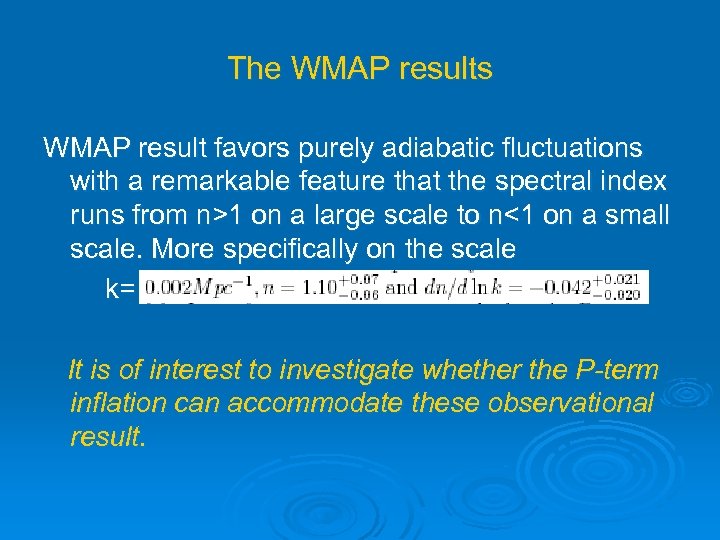
The WMAP results WMAP result favors purely adiabatic fluctuations with a remarkable feature that the spectral index runs from n>1 on a large scale to n<1 on a small scale. More specifically on the scale k= It is of interest to investigate whether the P-term inflation can accommodate these observational result.
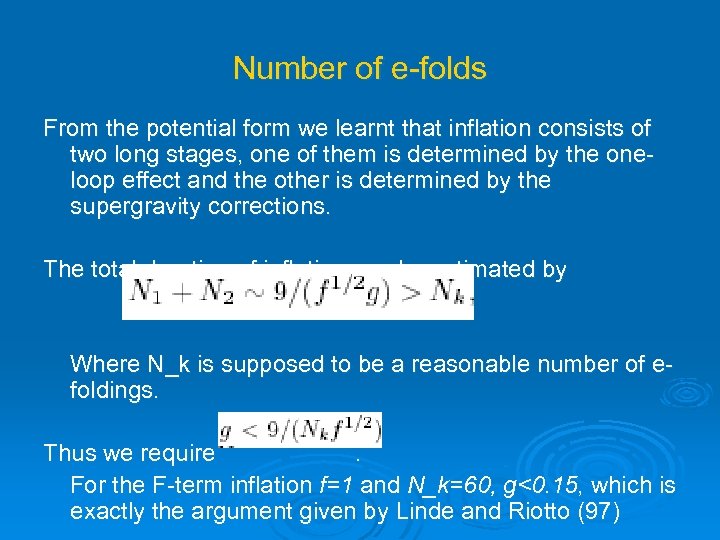
Number of e-folds From the potential form we learnt that inflation consists of two long stages, one of them is determined by the oneloop effect and the other is determined by the supergravity corrections. The total duration of inflation can be estimated by Where N_k is supposed to be a reasonable number of efoldings. Thus we require. For the F-term inflation f=1 and N_k=60, g<0. 15, which is exactly the argument given by Linde and Riotto (97)
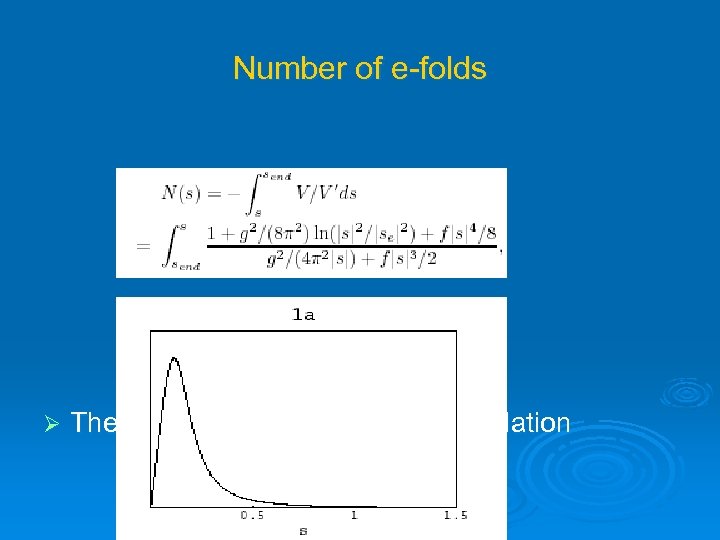
Number of e-folds Ø The number of e-foldings during inflation
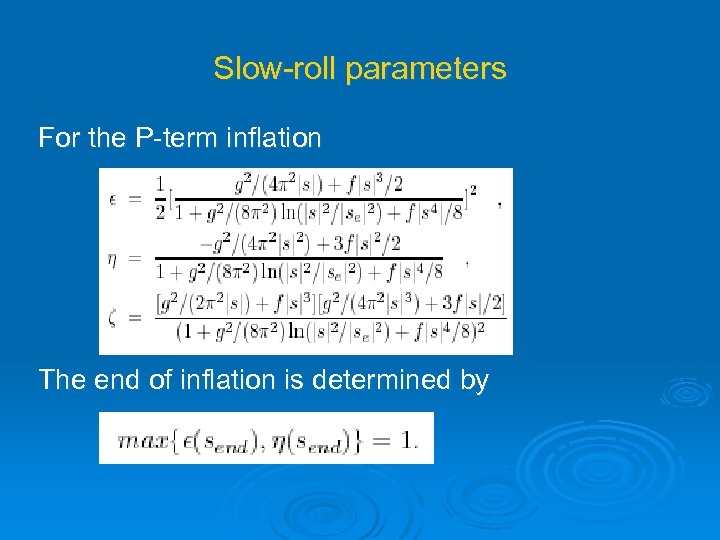
Slow-roll parameters For the P-term inflation The end of inflation is determined by
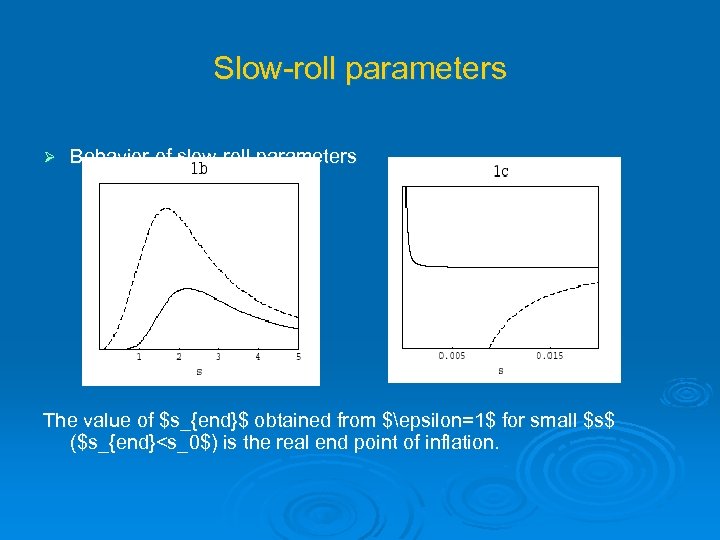
Slow-roll parameters Ø Behavior of slow-roll parameters The value of $s_{end}$ obtained from $epsilon=1$ for small $s$ ($s_{end}<s_0$) is the real end point of inflation.
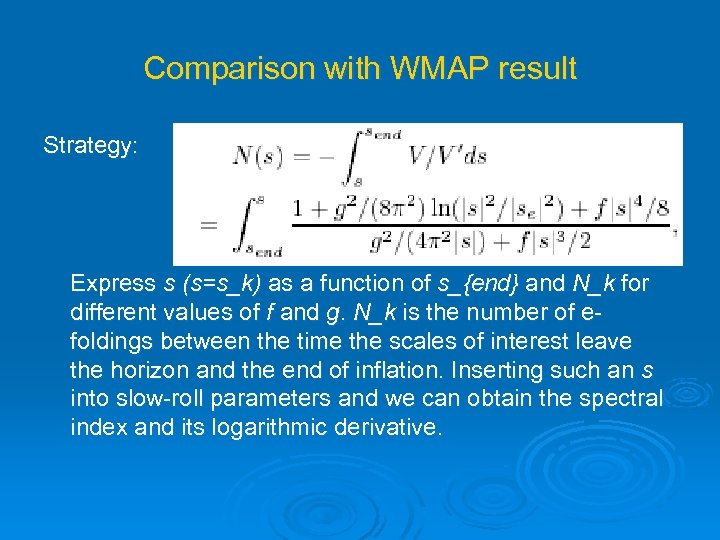
Comparison with WMAP result Strategy: Express s (s=s_k) as a function of s_{end} and N_k for different values of f and g. N_k is the number of efoldings between the time the scales of interest leave the horizon and the end of inflation. Inserting such an s into slow-roll parameters and we can obtain the spectral index and its logarithmic derivative.
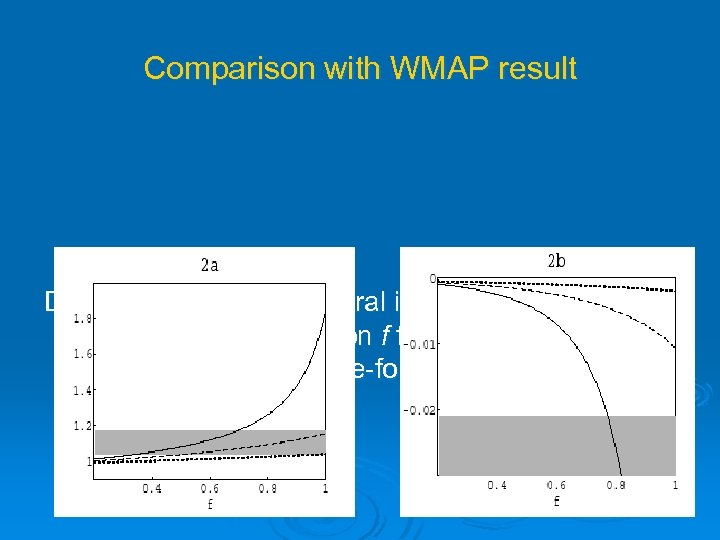
Comparison with WMAP result Dependence of the spectral index and its logarithmic derivative on f for different values of g when the number of e-foldings are 60 and 70, respectively.
Comparison with WMAP result Ø There is a threshold value of g(min) to force the spectral index n to meet the minimum observational result 1. 04. Ø With the increase of N, the threshold value g(min) can be smaller. However due to the existence of the upper bound of the number of e-foldings, this threshold value cannot be reduced arbitrarily. Ø For fixed f, both the values of the spectral index and its logarithmic derivative increase with the increase of g. For fixed g, they increase with f as well. Ø We cannot enforce both spectral index and its running to meet the WMAP observational result at the same time for the common range of f and g.
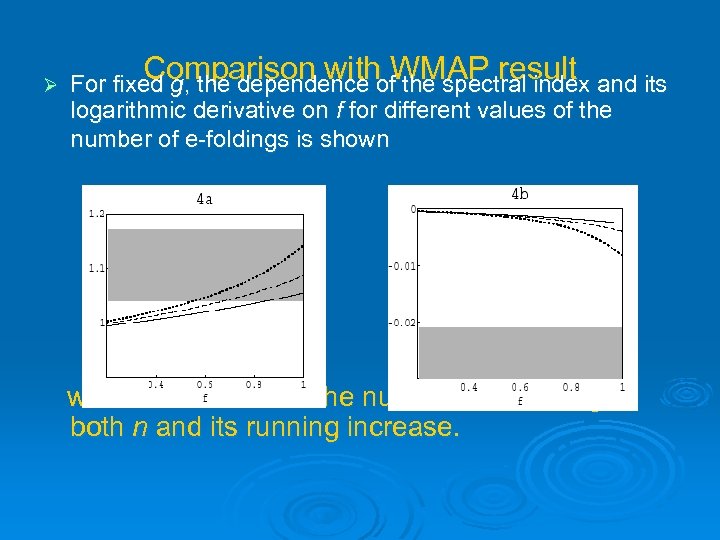
Ø Comparison withof. WMAP result and its For fixed g, the dependence the spectral index logarithmic derivative on f for different values of the number of e-foldings is shown with the increase of the number of e-foldings both n and its running increase.
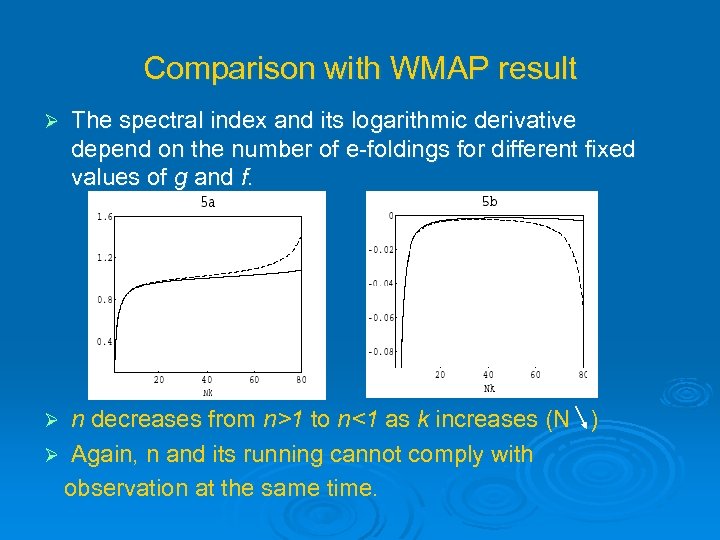
Comparison with WMAP result Ø The spectral index and its logarithmic derivative depend on the number of e-foldings for different fixed values of g and f. n decreases from n>1 to n<1 as k increases (N ) Ø Again, n and its running cannot comply with observation at the same time. Ø
WMAP constraint on P-term inflationary model In summary: Ø The P-term inflation model with a running parameter 0<f<1 displays a richer physics. Ø In addition to the upper bound on g determined by a reasonable number of e-foldings to solve the horizon problem as required by the inflation, the observational data of the spectral index together with the upper limit of the number of e-foldings puts the lower bound on the choice of g. Ø Obtaining a logarithmic derivative spectral index such that n>1 on large scales while n<1 on small scale for P-term inflation. (Not for D -, F-term inflations) Ø It is not possible to accommodate both observational ranges of n and its running at the same time. Ø The larger values of the logarithmic derivative of the spectral index can be around -0. 011 for values of f and g keeping the spectral index within the WMAP range.
Скачать презентацию Cosmic Holography Bin Wang 王 斌 Wang Department of
f277e9251a9d66de494e48f45d682b8d.ppt