


 Скачать презентацию Cos PA 2015 and the Standard Model W-Y
ea36a6768969df41d12118598516d045.ppt
- Количество слайдов: 34
 Cos. PA 2015 and the Standard Model W-Y. Pauchy Hwang Y. T. Lee Outstanding-Scholar Chair Professor Institute of Astrophysics National Taiwan University
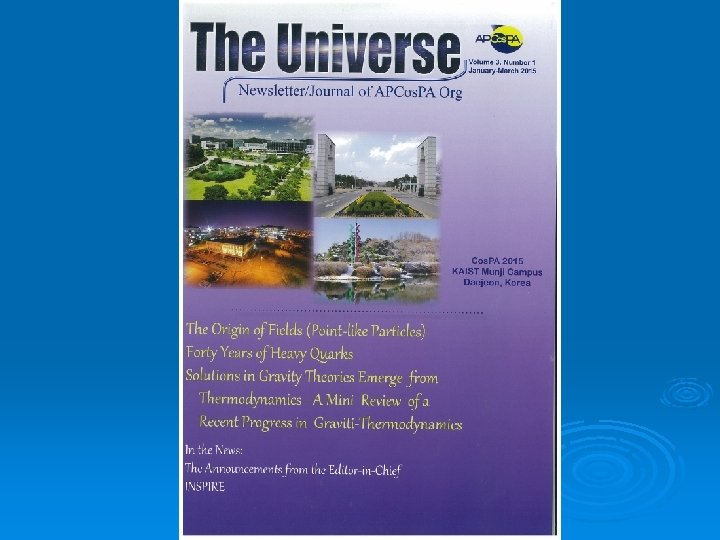
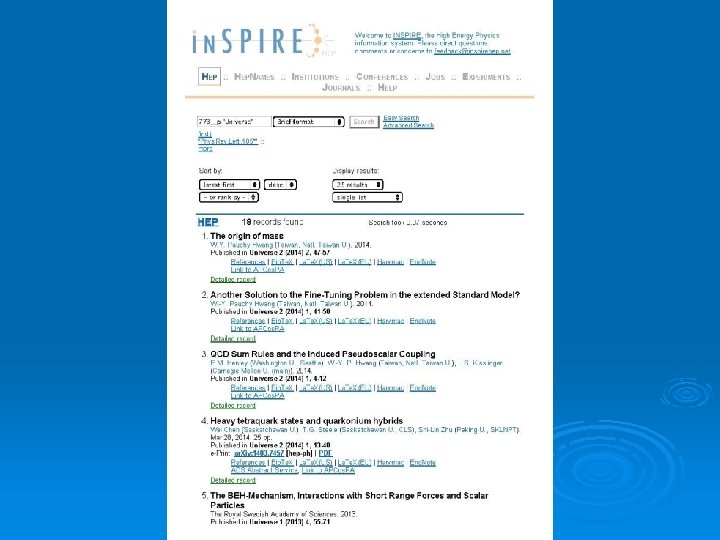
 My first encounter with Inspire I usually don’t play with the Web’s, feeling that it wastes my time that way. Ø Now I feel that it is occupying my time for thinkings. Ø Ø My advice to a young physics student would be: Try to save time for thinkings; no alternative for thinkings, otherwise, the other smart people would think on your behalf.
 My Search & Research with the Standard Model Our universe – 5% (visible) ordinary matter; Ø 25% dark matter; Ø 70% dark energy. Ø Since 2000 when I led the research excellence project on Cosmology and Particle Astrophysics (for a period of about 10 years). Ø Ø To understand the dark matter part, it is the most nontrivial. I think some generalized Standard Model would do the job.
 My early struggles with the Standard Model Why do we need Higgs mechanism in SU_L(2) x U(1) electroweak theory but not in SU_c(3) [QCD]? Ø The toilets in a house – Glashow’s remark at Indiana University (1982 -1983? ). Ø A useless paper and rejected (Phys. Lett. B) by H. Georgi: W-Y. P. Hwang, Phys. Rev. D 32, 824 (1985). Ø Ø The idea of “colored Higgs mechanism”.
 What is the final Standard Model? Ø Why do we have three generations ? It cannot be “final” without understanding it. Ø Neutrino oscillations – from one family into another. “Not final” if without understanding it. Ø Very excited when I conceived (2008 summer night, at U. Penn) why I can’t use the colored Higgs mechanism as the family one.
 I believe that the God wouldn’t create a particle that is so boring in just knowing only weak interactions. Ø Neutrinos now have tiny masses these days. So, they, naturally, have 4 -components in the Dirac space. Note that in the (old) minimal Standard Model their masses were suspected to vanish. Ø There is so much dark matter (25 % of the Universe), compared to so little “visible” ordinary matter (5 % of the Universe), the latter as described by the minimal Standard Model. Ø My remark at 2012 Cos. PA Symposium.
 As time goes by, the strange role of neutrinos has become clearer and clearer. Ø Note that right-handed neutrinos never appear in the construction of the Minimal Standard Model, as though they are unwanted. Ø The mystery may lie with the neutrinos. There is nothing called “neutrino flavor eigen-states”, some ill-defined concept.
 Eleven Science Questions for the New Century: The First Four Questions U. S. Science Academy Report, 4/17/2002 Ø Q 1: What is the dark matter? Our Universe has 25% in Dark Matter while only 5% in ordinary matter. It clusters. Ø Q 2: What is the nature of the dark energy? Ø Ø Q 3: How did the universe begin? Q 4: Did Einstein have the last word on gravity?
 In view of the minimal Standard Model, we could write down two working “rules”: Ø Dirac similarity principle – our struggle of eighty years to describe the point-like Dirac particle such as the electron. Ø The “minimum Higgs hypothesis” is the other mysterious conjecture – after forty years we finally get glimpse over the SM Higgs particle, and nothing more. Ø By “induction”, we may write down these two working rules for the much “larger” dark matter world.
 At the beginning of 2010, I realized that we’d better begin with the two working “rules”. Ø Dirac similarity principle – We put (nu_{e, L}, e_L) as an SU_L(2) doublet; it implies that two members would have the same characteristics. Similarly for the SU_f(3) triplet members, such as ((nu_tau, tau)_L, (nu_mu, mu)_L, (nu_e, e)_L) (column), as in Hwang/Yan. Ø The “minimum Higgs hypothesis” – Why is it so difficult in finding any of them?
 Dirac may be the first “physicist” to formulate some equation for “point-like” particles. Ø Dirac didn’t know that the electrons are point-like particles, the size certainly less than 10**(-20) cm in length, these days. Ø It turns out that, for over eighty years, we recognize only a few point-like particles, those building blocks of the Standard Model. Ø Neutrino oscillations: How does a “point-like” Dirac particle change itself into the other “pointlike” Dirac particle? We miss an “interaction”.
 The point is: Without the two working rules, we have too many choices on the extended SM. Ø Maybe our space-time only allows for “point-like” Dirac particles, those can be created and can communicate among them. Ø Besides, we use the complex scalar fields to “modulate” quite a number of things, SSB (the Higgs mechanisms), etc. Their existences appear to be “minimal”. Ø Starting at 2010 – two working rules.
 Ø Now, “What is the dark matter? ” Could we describe it or them? If yes, what would be the language? The first guess would be to use the language which we set up for the Standard Model – a gauge theory with/without Higgs Mechanism. If not, what else? Ø In what follows, we wish to present that, in the 4 -dimensional Minkowski space-time with the SU_c(3) x SU(2) x U(1) x SU_f(3) gauge-group structure built-in from the outset, there is the Standard Model, with (123) the quark world and with another (123) the lepton world.
 My Struggles with the Standard Model: Part No. 1 Ø How to add a Z’ but with a minimum number of Higgs fields? W-Y. P. Hwang, Phys. Rev. D 36, 261 (1987). Ø When we go beyond the Standard Model, the Higgs sector depends on the sector of gauge bosons – extra Z, then extra Higgs.
 My Struggles with the Standard Model: Part No. 2 Ø Why should we have the standard case, i. e. , Higgs in the electroweak sector but not in the strong QCD case. W-Y. P. Hwang, Phys. Rev. D 32, 824 (1985). Ø The idea of “colored Higgs mechanism”.
 No. 3: I started thinking that my miserable life has some meaning. Ø In 2008 (four years after I was struck by cerebral haemorrhage), I went to U. Penn (my Alma Mater) to attend some high energy Conference. I woke up one night to ask why the idea of colored Higgs mechanism be “copied” as the family SU(3) gauge theory. Ø That sets off a series of talks and papers – maybe nobody appreciate the idea.
 My Struggles with the Standard Model: Part No. 3 Ø W-Y. Pauchy Hwang, Nucl. Phys. A 844, 40 c (2012); W-Y. Pauchy Hwang, International J. Mod. Phys. A 24, 3366 (2009); W-Y. Pauchy Hwang, Intern. J. Mod. Phys. Conf. Series 1, 5 (2011); W-Y. Pauchy Hwang, AIP 978 -0 -73540687 -2/09, pp. 25 -30 (2009). Ø In fact, the evolution of the idea culminates in rewriting of the Standard Model.
 My Struggles with the Standard Model: Part No. 4 Last June (2012) I went to Groningen to attend SSP 2012 and suddenly realized the role of neutrino oscillations in all these. W-Y. Pauchy Hwang, ar. Xiv: 1207. 6837 v 1 [hepph] 30 Jul 2012; Ø W-Y. Pauchy Hwang, ar. Xiv: 1207. 6443 v 1 [hepph] 27 Jul 2012; Ø W-Y. Pauchy Hwang, ar. Xiv: 1209. 5488 v 1 [hepph] 25 Sep 2012. Ø
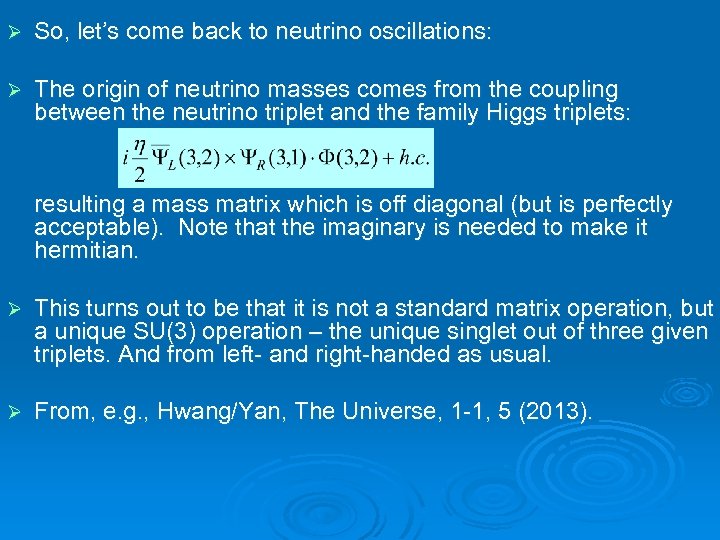 Ø So, let’s come back to neutrino oscillations: Ø The origin of neutrino masses comes from the coupling between the neutrino triplet and the family Higgs triplets: resulting a mass matrix which is off diagonal (but is perfectly acceptable). Note that the imaginary is needed to make it hermitian. Ø This turns out to be that it is not a standard matrix operation, but a unique SU(3) operation – the unique singlet out of three given triplets. And from left- and right-handed as usual. Ø From, e. g. , Hwang/Yan, The Universe, 1 -1, 5 (2013).
 My Struggles with the Standard Model: Part No. 5 Ø Nevertheless, we ventured to put the three generation of leptons together, as the triplets under SU_f(3). Ø W-Y. Pauchy Hwang and Tung-Mow Yan, ar. Xiv: 1212. 4944 [hep-ph] 20 December 2012; The Universe, 1 -1, 5 (2013).
 My Struggles with the Standard Model: Part No. 6 Finally, I worked on the “combined” Higgs mechanisms – using the scalar/Higgs fields Phi(3, 2), Phi(3, 1), and the standard Phi(1, 2) – from the renormalizability. Ø Everything still quite complicated !! Ø Ø W-Y. Pauchy Hwang, ar. Xiv: 1304. 4705 v 1 [hepph] 17 April 2013.
 I realized that what “the Origin of Mass” is !! No. 7 & more !! Ø The masses as the result of the family SSB, but not neccessary of EW SSB. Ø W-Y. Pauchy Hwang, The Universe, 2 -2, 47 (2014). Ø Maybe this brings “Universe” to the attention of Inspire (inspirehep. net).
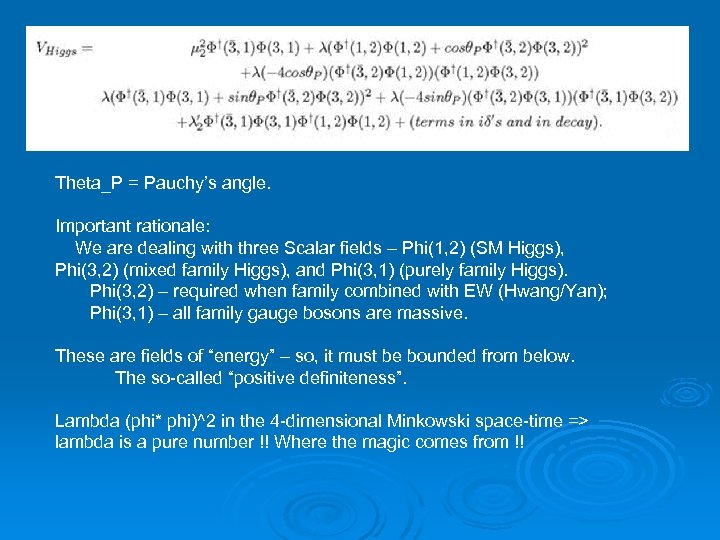 Theta_P = Pauchy’s angle. Important rationale: We are dealing with three Scalar fields – Phi(1, 2) (SM Higgs), Phi(3, 2) (mixed family Higgs), and Phi(3, 1) (purely family Higgs). Phi(3, 2) – required when family combined with EW (Hwang/Yan); Phi(3, 1) – all family gauge bosons are massive. These are fields of “energy” – so, it must be bounded from below. The so-called “positive definiteness”. Lambda (phi* phi)^2 in the 4 -dimensional Minkowski space-time => lambda is a pure number !! Where the magic comes from !!
 Many interesting stories followed, afterward: I started to think what the SU_f(3) really is, a ten’s Ge. V or sub-Fermi family gauge theory!! In our case, SU_f(3) is meant to protect the lepton world from the QED Landau ghost and it is asymptotically free. g-2 would be a testing ground. Ø So, this Standard Model has SU(3) everywhere. Indeed, it works like a magic. Ø Ø W-Y. Pauchy Hwang, ar. Xiv: 1301. 6464 v 5 [hepph] 29 April 2014.
 The Origin of Mass We may turn off all the “mass” terms (such as high enough temperature) except the family SSB driving term – keeping all interaction terms among the various Higgs. The masses arise naturally out of family SSB – a big surprise!! Remember that all fermion masses, including neutrino oscillations, also come out in one way or the other. Ø So, this Standard Model is everybody’s Standard Model. Ø Ø W-Y. Pauchy Hwang, The Universe, 2 -2, 47 (2014).
 The origin of fields (point-like particles) The complex scalar field phi(x): Ø m^2 phi* phi + lambda (phi*phi)^2 Ø m^2 =0 if T from above; lambda is dimensionless, we find lambda=1/8 as determined by the 4 -dimensional Minkowski space-time (not by the field itself). Ø Ø 4 -dimension means so many things, even the origin of our world. Ø W-Y. Pauchy Hwang, The Universe, 3 -1, 3 (2015).
 The origin of fields We live in the (quantum) 4 -dimensional Minkowski space-time with the force-fields gauge group SU_c(3) x SU_L(2) x U(1) x SU_f(3) builtin from the outset. That sets the “background”. Ø The quark world is accepted because of the (123) symmetry while the lepton world is also accepted for another (123) symmetry. Ø Ø W-Y. Pauchy Hwang, The Universe, 3 -1, 3 (2015).
 This is supposed be a “complete” theory!! All those divergences would canceled out by our belief (or, by my conjecture). The system of all point-like Dirac particles appears to be such remarkable physical system in Nature. Ø At first, dimensional regularization and the adoption of U-gauge seems to work. But it is incorrect in view of the lack of the causality requirement. Ø I started with the wave-function renormalization. Ø Ø W-Y. Pauchy Hwang, ar. Xiv: 1301. 6464 v 5 [hepph] 29 April 2014.
 Lambda=1/8 and non-renormalization Ø We note that the lambda value is determined by the 4 -dimension Minkowski space-time – so the non-renormalization theorem should apply in some way. Ø We have to admit that, even if QFT appears to be the right language, the details are quite complicated to be worked out.
 A precise definition of the Standard Model Ø Maybe it should be like this: Ø We live in the 4 -dimensional Minkowski space-time with the force-fields gauge group SU_c(3) x SU_L(2) x U(1) x SU_f(3) built-in from the outset. It supports the lepton world and it also supports the quark world. Ø It is a force-field, or a gauge-field, Minkowski space-time.
 Conclusion Ø These stories sort of tell you that the physics all comes from the Standard Model (of particle physics). And the Standard model is extremely simple. Ø We live in the (quantum) 4 -dimensional Minkowski space-time with the group SU_c(3) x SU_L(2) x U(1) x SU_f(3), force -fields gauge-group structure built-in from the outset. This is the “background” of everything. So, the dark matter !!