


 Скачать презентацию Corruption in Croatia A Short Guide for Visitors
21422f52d71dcd833299085a3221a483.ppt
- Количество слайдов: 33
 Corruption in Croatia: A Short Guide for Visitors 4/11/2017
 Un presidente de Mexico entro cantando la letra de la anti-corrupcion y salio con las maletas llenas cantando la misma cancion A president of mexico/began singing the verse of anti-corruption and left with full suitcases/singing the same song. Corruption in Croatia, especially at high levels of government, is endemic¸and systemic. Officials typically excuse Croatia with the empty phrase “corruption is a problem in all transition countries”. The too frail international strategy emphasises “process” and “capacity building” – the passing of laws and the training of officials to, as one official says, “reduce the opportunities for corruption”. It is both naïve and negligent to rely on weak indigenous watchdogs like the USKOK, the Anti-Corruption Council, or the media and civil society, to stand up alone to the corrupt elite. A dramatically different mind-set is needed. Croatia is not “just another transition country” but an inherently weak state with external and internal challenges to its very existence.
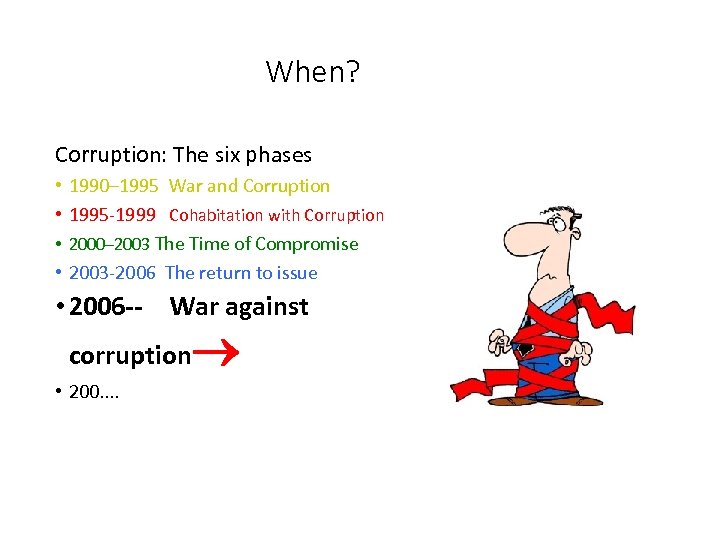 When? Corruption: The six phases • 1990– 1995 War and Corruption • 1995 -1999 Cohabitation with Corruption • 2000– 2003 The Time of Compromise • 2003 -2006 The return to issue • 2006 -- War against corruption • 200. .
 How much corruption? 1. 2. 3. 4. 5. CPI index Corruption barometar Public opinion Public Scandals Economic indicators
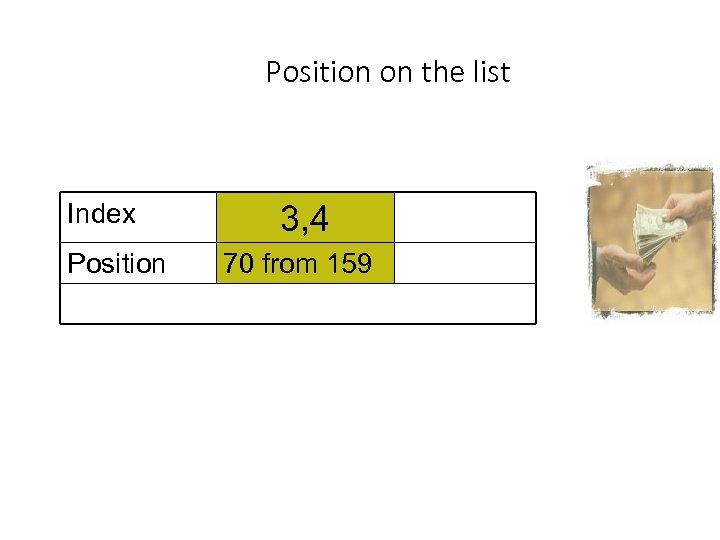 Position on the list Index Position 3, 4 70 from 159
 Corruption in Croatia: Beyond the facts • CPI contribute to a knowledge map on which policy action can be taken. • No single index contains the concept in its entirety. • To provide a cardinal or ordinal index as a basis for comparison. • Common units does not imply comparability of meaning.
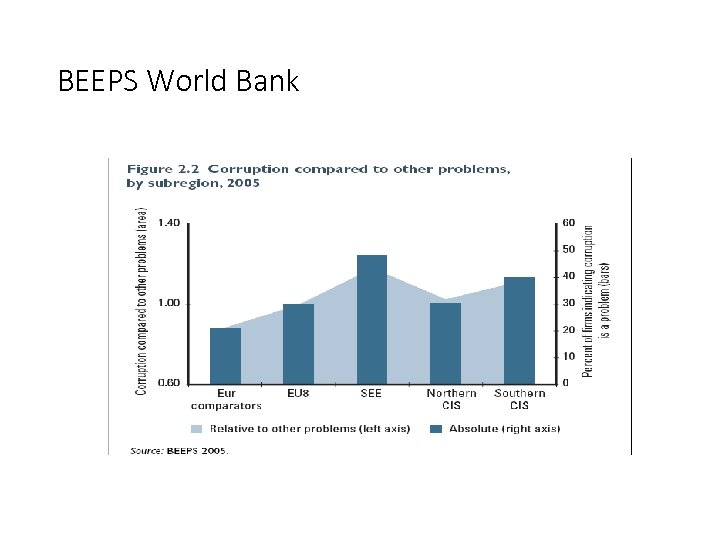 BEEPS World Bank
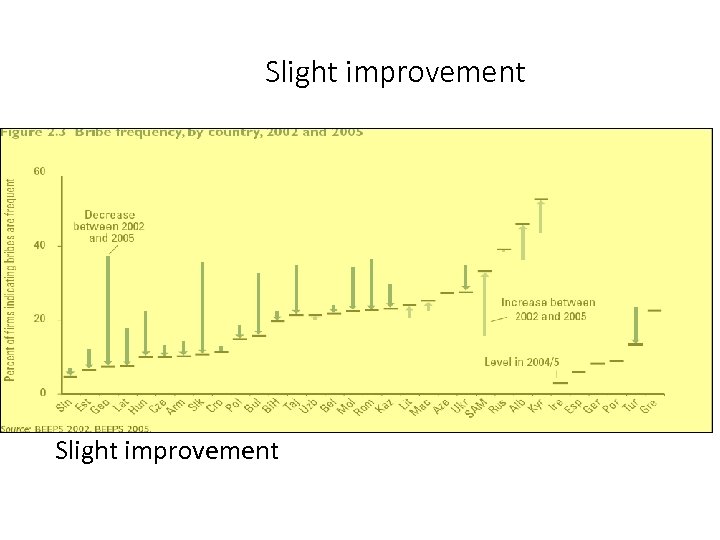 Slight improvement
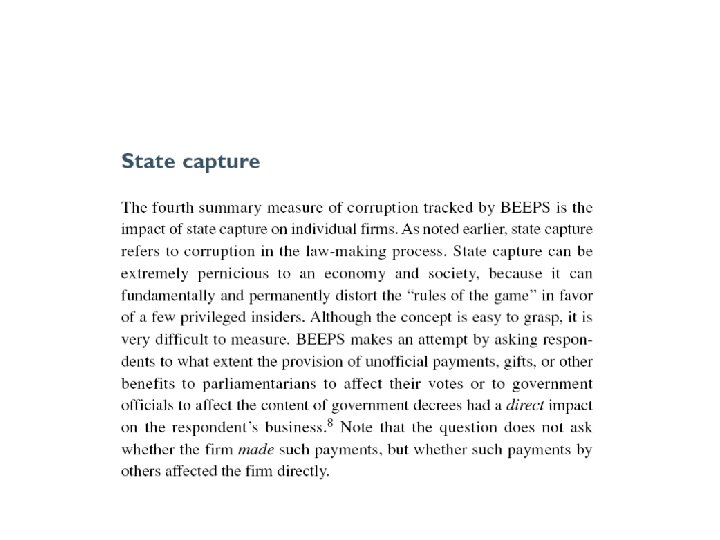
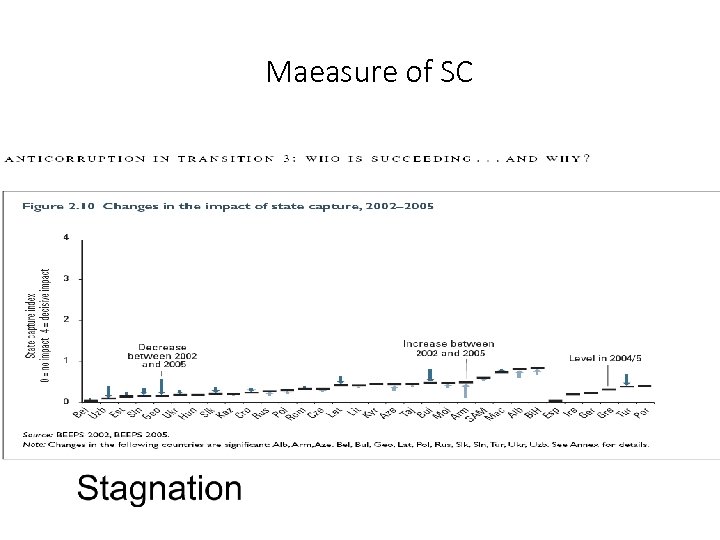 Maeasure of SC
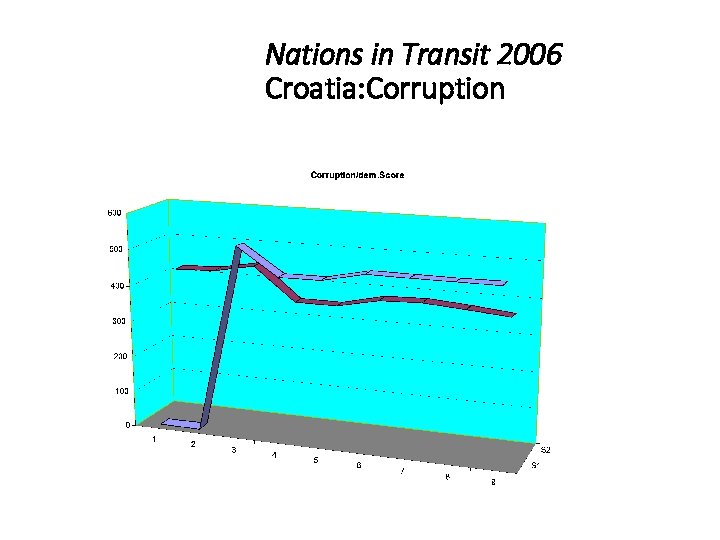 Nations in Transit 2006 Croatia: Corruption
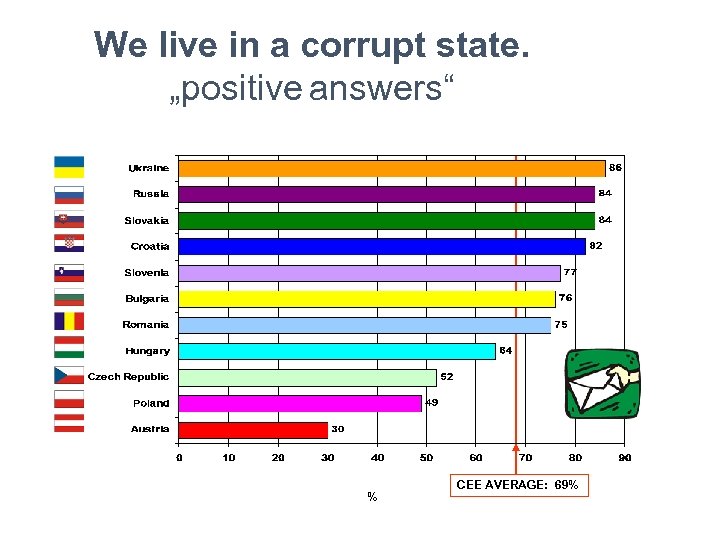 We live in a corrupt state. „positive answers“ % CEE AVERAGE: 69%
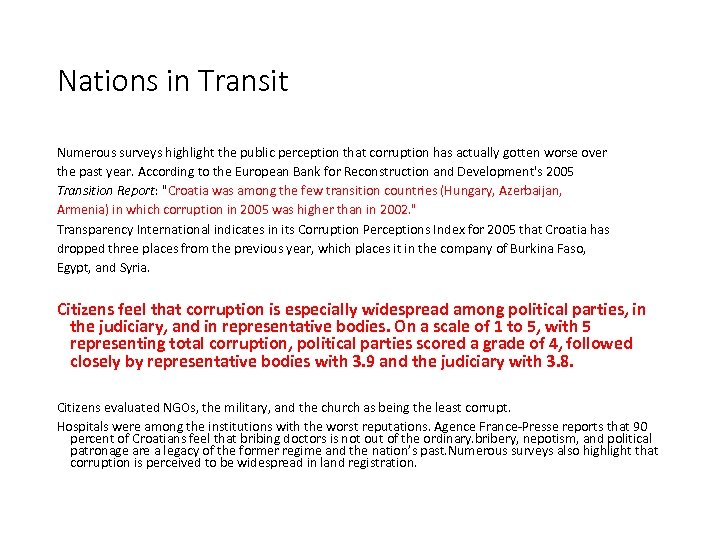 Nations in Transit Numerous surveys highlight the public perception that corruption has actually gotten worse over the past year. According to the European Bank for Reconstruction and Development's 2005 Transition Report: "Croatia was among the few transition countries (Hungary, Azerbaijan, Armenia) in which corruption in 2005 was higher than in 2002. " Transparency International indicates in its Corruption Perceptions Index for 2005 that Croatia has dropped three places from the previous year, which places it in the company of Burkina Faso, Egypt, and Syria. Citizens feel that corruption is especially widespread among political parties, in the judiciary, and in representative bodies. On a scale of 1 to 5, with 5 representing total corruption, political parties scored a grade of 4, followed closely by representative bodies with 3. 9 and the judiciary with 3. 8. Citizens evaluated NGOs, the military, and the church as being the least corrupt. Hospitals were among the institutions with the worst reputations. Agence France-Presse reports that 90 percent of Croatians feel that bribing doctors is not out of the ordinary. bribery, nepotism, and political patronage are a legacy of the former regime and the nation’s past. Numerous surveys also highlight that corruption is perceived to be widespread in land registration.
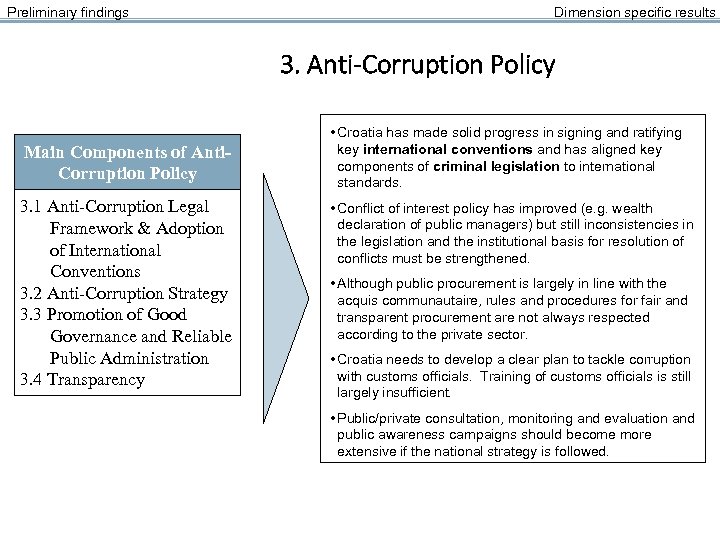 Preliminary findings Dimension specific results 3. Anti-Corruption Policy Main Components of Anti. Corruption Policy 3. 1 Anti-Corruption Legal Framework & Adoption of International Conventions 3. 2 Anti-Corruption Strategy 3. 3 Promotion of Good Governance and Reliable Public Administration 3. 4 Transparency • Croatia has made solid progress in signing and ratifying key international conventions and has aligned key components of criminal legislation to international standards. • Conflict of interest policy has improved (e. g. wealth declaration of public managers) but still inconsistencies in the legislation and the institutional basis for resolution of conflicts must be strengthened. • Although public procurement is largely in line with the acquis communautaire, rules and procedures for fair and transparent procurement are not always respected according to the private sector. • Croatia needs to develop a clear plan to tackle corruption with customs officials. Training of customs officials is still largely insufficient. • Public/private consultation, monitoring and evaluation and public awareness campaigns should become more extensive if the national strategy is followed.
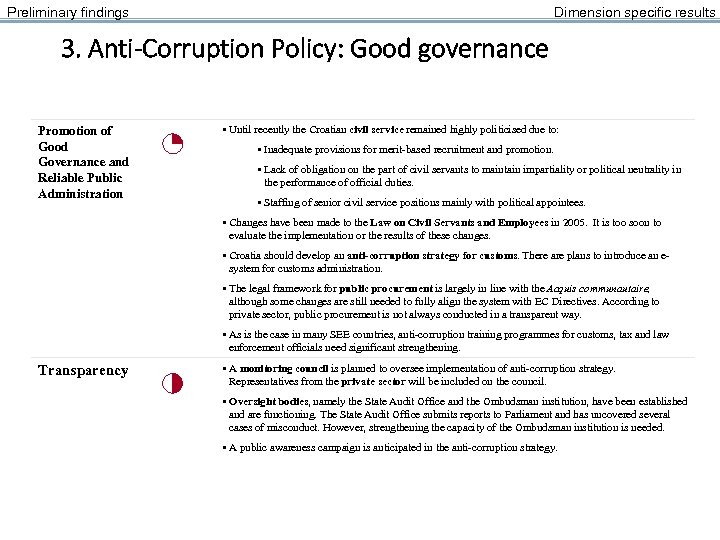 Preliminary findings Dimension specific results 3. Anti-Corruption Policy: Good governance Promotion of Good Governance and Reliable Public Administration • Until recently the Croatian civil service remained highly politicised due to: • Inadequate provisions for merit-based recruitment and promotion. • Lack of obligation on the part of civil servants to maintain impartiality or political neutrality in the performance of official duties. • Staffing of senior civil service positions mainly with political appointees. • Changes have been made to the Law on Civil Servants and Employees in 2005. It is too soon to evaluate the implementation or the results of these changes. • Croatia should develop an anti-corruption strategy for customs. There are plans to introduce an esystem for customs administration. • The legal framework for public procurement is largely in line with the Acquis communautaire, although some changes are still needed to fully align the system with EC Directives. According to private sector, public procurement is not always conducted in a transparent way. • As is the case in many SEE countries, anti-corruption training programmes for customs, tax and law enforcement officials need significant strengthening. Transparency • A monitoring council is planned to oversee implementation of anti-corruption strategy. Representatives from the private sector will be included on the council. • Oversight bodies, namely the State Audit Office and the Ombudsman institution, have been established and are functioning. The State Audit Office submits reports to Parliament and has uncovered several cases of misconduct. However, strengthening the capacity of the Ombudsman institution is needed. • A public awareness campaign is anticipated in the anti-corruption strategy.
 National Strategy • Second Strategy • Political Will • Operationalization • Credible leadership • Entry point • Diagnosis • Assessment of the political culture • Sequencing
 Who: Actors in Corruption • Political parties • Health • Judiciary • Local Government
 Money and Politics “There are two things important in politics. The first is money and I can’t remember what the second one is”. • Mark Hanna, 1904
 Learning or tricks/lerning tricks The party finance reform and regulation of electoral campaigns, beside the manifest goals have effects in development of participative political culture. It is a learning and constructive process and not a set of tricks to make politics a vocation for the honest people
 The changing nature of political campaignes • Increase of costs • Professionalism • Public relations • Electronic media • Trading of influence • Lobbyng costs • Oligarhisation
 Inside the parties: soft money • Oligarhization and concentration of power and knowledge on finances • Records and secrecy, books and soft money, audit • Connections and influence of donors (“no free lunch”)
 Croatian legislation • Law on Political Parties (LPP: Zakon o političkim strankama OG 164/98, 111/96, 76/93) • Law on Elections in Sabor (LES: Zakon o izborima zastupnika u Hrvatski drzavni Sabor, OG 116/99) • Law on Presidential Elections (LPE: Zakon o izboru predsjednika Republike Hrvatske , OG 22/92). • Law on financing of Campaign for Election of the President (Zakon o financiranju izborne promidžbe za izbor predsjednika RH OG 22/94). 21. July 2004
 Elements Of The Party System: Croatia • Non for profit entities • Financed by membership fee and state budget (0, 056%) • 20% equally + 80% mandates • etc.
 Croatia -Campaign Finance • The right for compensation of costs from budget if the have representative elected • Limit of 5% of votes • Obligation to disclose the estimation of costs • Minorities
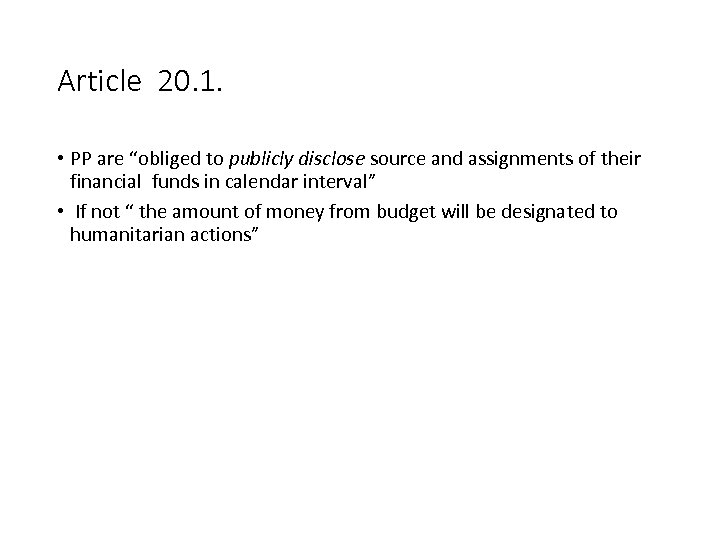 Article 20. 1. • PP are “obliged to publicly disclose source and assignments of their financial funds in calendar interval” • If not “ the amount of money from budget will be designated to humanitarian actions”
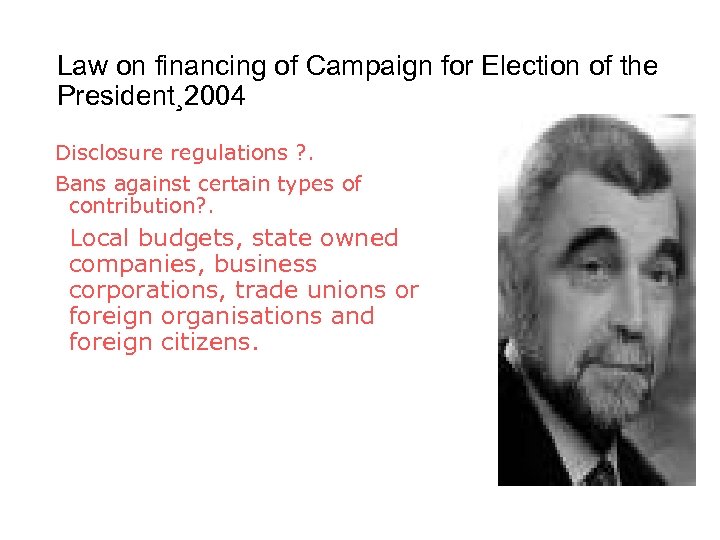 Law on financing of Campaign for Election of the President¸ 2004 Disclosure regulations ? . Bans against certain types of contribution? . Local budgets, state owned companies, business corporations, trade unions or foreign organisations and foreign citizens.
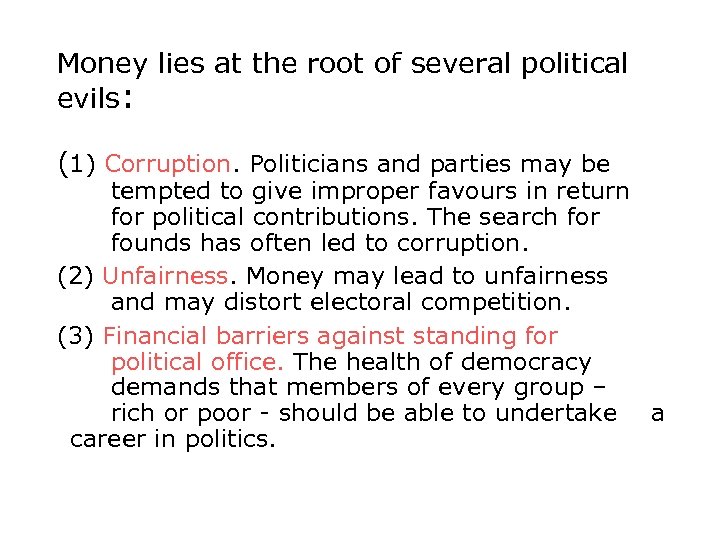 Money lies at the root of several political evils: (1) Corruption. Politicians and parties may be tempted to give improper favours in return for political contributions. The search for founds has often led to corruption. (2) Unfairness. Money may lead to unfairness and may distort electoral competition. (3) Financial barriers against standing for political office. The health of democracy demands that members of every group – rich or poor - should be able to undertake a career in politics.
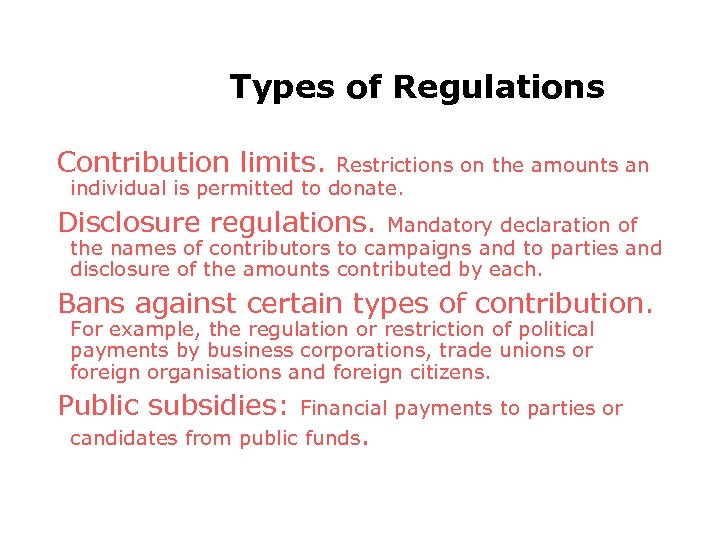 Types of Regulations Contribution limits. Restrictions on the amounts an individual is permitted to donate. Disclosure regulations. Mandatory declaration of the names of contributors to campaigns and to parties and disclosure of the amounts contributed by each. Bans against certain types of contribution. For example, the regulation or restriction of political payments by business corporations, trade unions or foreign organisations and foreign citizens. Public subsidies: Financial payments to parties or candidates from public funds.
 Rational balance of financing (public and private) • Fair criteria for distribution • Strict rules and limits of private donations • Limits to overall costs of campaigns • Full transparency of accounts • Independent auditing body • Sanctions
 Why are Political Financing Regulations Often Evaded ? (1) Loopholes. Although contributions to political parties and to election campaigns are two of the most important and most direct channels through which money may be use to influence politics, they are not the only ones. Restrictions on the financing of parties and elections are likely to prove ineffective if other forms of 'politically relevant' financing remain unchecked. (2) Inadequate enforcement. In a field as controversial and complex as the funding of parties and campaigns, laws require effective supervision and implementation. Election law has been a burgeoning field of activity - and of profit - for the legal profession.
 Emphasis and Highlights • Financing of political parties is priority in anti corruption • Standards and principles of regulation are developed, in spite of loopholes and abuses • Respect for local circumstances • The Role of Civil Society • Internal organizational issues of political parties
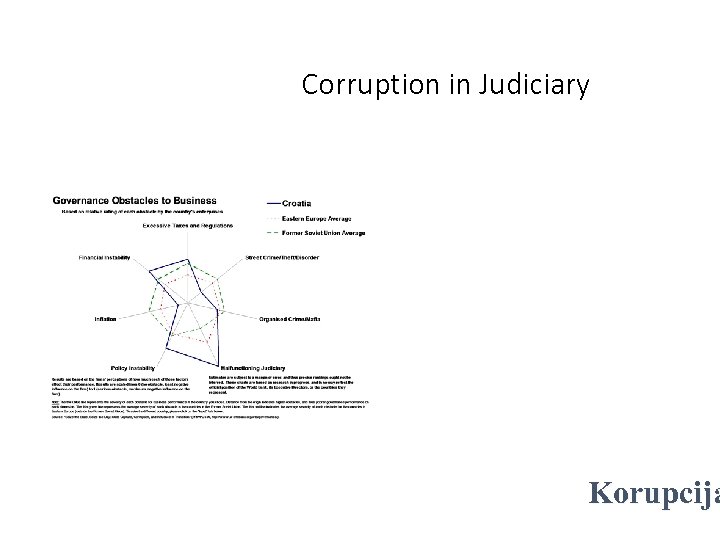 Corruption in Judiciary Korupcija
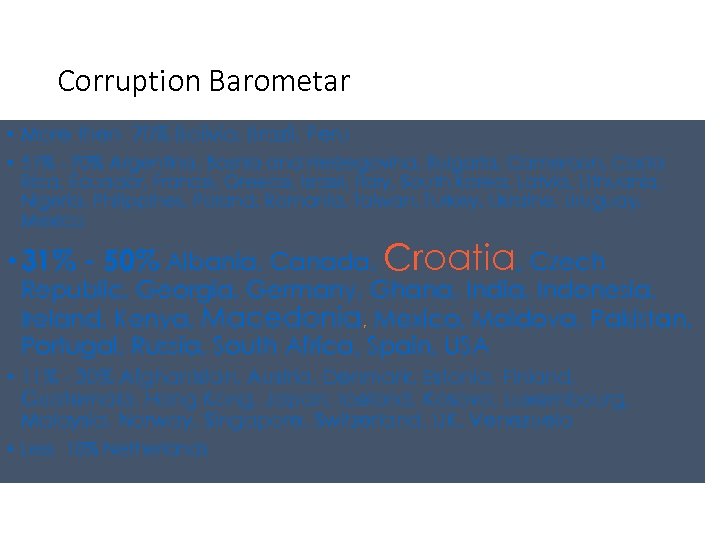 Corruption Barometar • More then 70% Bolivia, Brazil, Peru • 51% - 70% Argentina, Bosnia and Herzegovina, Bulgaria, Cameroon, Costa Rica, Ecuador, France, Greece, Israel, Italy, South Korea, Latvia, Lithuania, Nigeria, Philippines, Poland, Romania, Taiwan, Turkey, Ukraine, Uruguay, Mexico • 31% - 50% Albania, Canada, Croatia, Czech Republic, Georgia, Germany, Ghana, India, Indonesia, Ireland, Kenya, Macedonia, Mexico, Moldova, Pakistan, Portugal, Russia, South Africa, Spain, USA • 11% - 30% Afghanistan, Austria, Denmark, Estonia, Finland, Guatemala, Hong Kong, Japan, Iceland, Kosovo, Luxembourg, Malaysia, Norway, Singapore, Switzerland, UK, Venezuela • Less 10% Netherlands