 Скачать презентацию Correlations Introduction Learning Objectives Identify the
ea9e4020ce1923e65bf7489708045a81.ppt
- Количество слайдов: 33



Correlations Introduction
Learning Objectives • Identify the features of correlations. • Outline differences between positive and negative correlations and no correlations. • Outline features of a correlation coefficient.
Key terms • Correlation • Positive correlation • Negative correlation • No correlation • Correlation coefficient
Correlations • Correlation: a measure of how strongly two or more variables are related to each other: • Height is positively correlated to shoe size • The taller someone is, the larger their shoe size tends to be. • Like Self Report and Observation, there is no manipulation of data, conditions or groups in correlations. • No IV or DV, just to co-occurring variables (co-variables). Stretch & Challenge: If there is no IV, what can’t we establish?
Correlations • Still use the sampling methods: – Volunteer, self selected, random, snowball • Still consider the same ethical issues: – How many of the ethical issues can you identify? Give an example of how each ethical issue may need to be considered in a correlation.
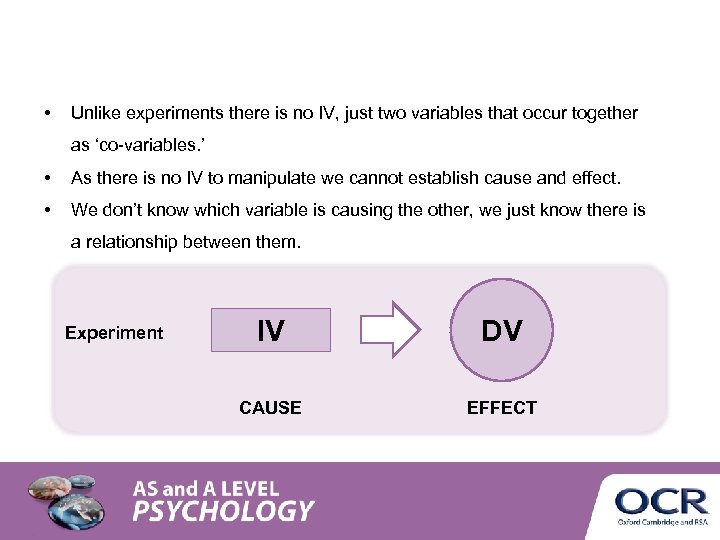
• Unlike experiments there is no IV, just two variables that occur together as ‘co-variables. ’ • As there is no IV to manipulate we cannot establish cause and effect. • We don’t know which variable is causing the other, we just know there is a relationship between them. Experiment IV DV CAUSE EFFECT
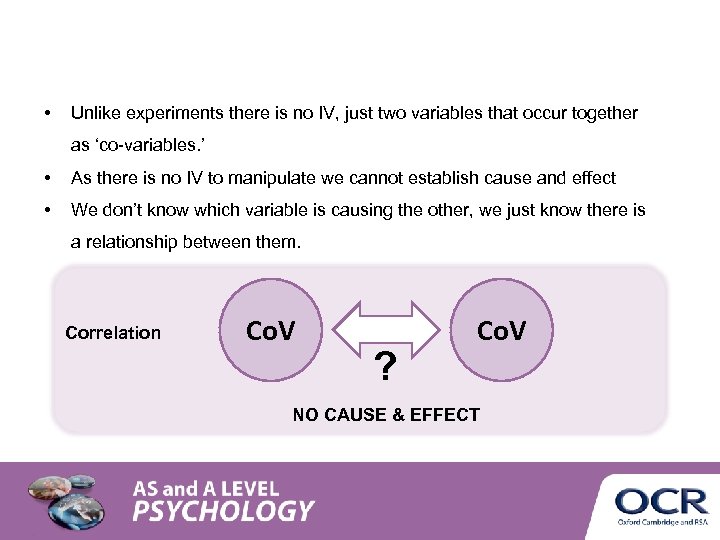
• Unlike experiments there is no IV, just two variables that occur together as ‘co-variables. ’ • As there is no IV to manipulate we cannot establish cause and effect • We don’t know which variable is causing the other, we just know there is a relationship between them. Correlation Co. V ? Co. V NO CAUSE & EFFECT
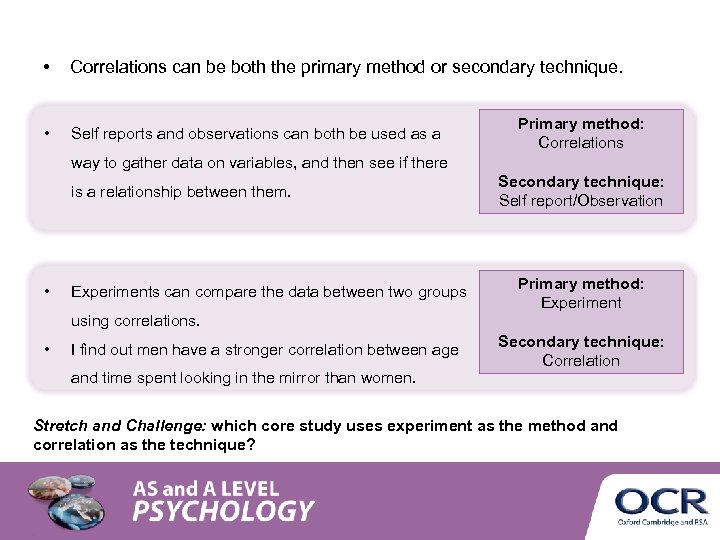
• Correlations can be both the primary method or secondary technique. • Self reports and observations can both be used as a Primary method: Correlations way to gather data on variables, and then see if there is a relationship between them. • Experiments can compare the data between two groups using correlations. • I find out men have a stronger correlation between age and time spent looking in the mirror than women. Secondary technique: Self report/Observation Primary method: Experiment Secondary technique: Correlation Stretch and Challenge: which core study uses experiment as the method and correlation as the technique?
Task • Activity 1: Identify other possible correlations we could investigate for age and sleep. • Extension: Identify any two variables you would find interesting to investigate (you will be expected to conduct your own investigation at a later stage).
Positive and negative correlations • Positive Correlation: as one variable increases, so does the other. • Negative Correlation: as one variable increases, the other decreases. • No Correlation: there is no relationship between the variables. Stretch and Challenge: The more revision is done, the higher the final grade is. Is this a positive or negative correlation?
Positive, negative and no correlations – Activity 2 • Perfect Positive Relationship • No relationship • Perfect Negative Relationship
Correlation Co-efficient • We can measure the strength of the relationship, by using inferential statistics. • Which statistical test would we need to use? Why? • Being wealthy is correlated with living longer, BUT eating healthily and exercising has a stronger relationship with living longer. • Correlation Coefficient: a number between -1 and 1 that tells us how strong the relationship is.
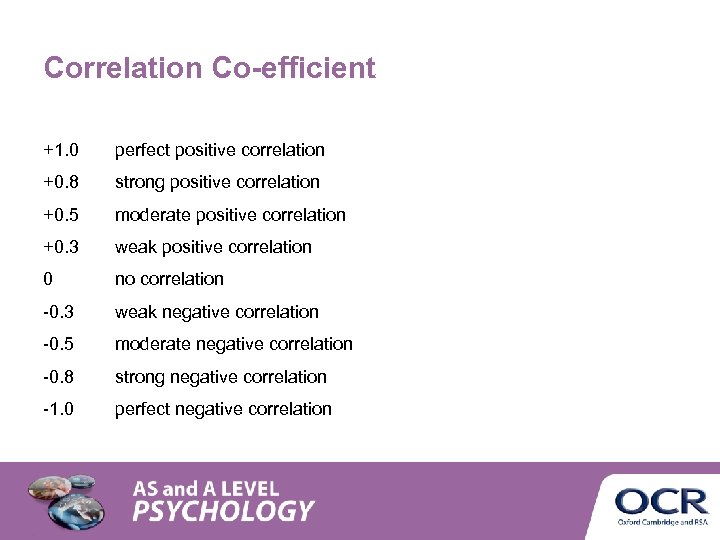
Correlation Co-efficient +1. 0 perfect positive correlation +0. 8 strong positive correlation +0. 5 moderate positive correlation +0. 3 weak positive correlation 0 no correlation -0. 3 weak negative correlation -0. 5 moderate negative correlation -0. 8 strong negative correlation -1. 0 perfect negative correlation
Task • Complete Activity 3 in the workbook. • Calculate the co-efficient for the data sets given. • What can we conclude from the correlation co-efficient from this data?
Correlations Scatter diagrams and Evaluations
Learning Objectives • Identify the features of scatter diagrams. • Outline the different correlation hypotheses. • Evaluate the strengths and weaknesses of correlations.
Scatter diagrams • We can display correlation data in scatter diagrams. • One variable (amount of revision done) along one axis and another variable (final grade) along the other. • Each ‘point’ on the scatter diagram represents one participant: how much revision they put in and what their final grade was.
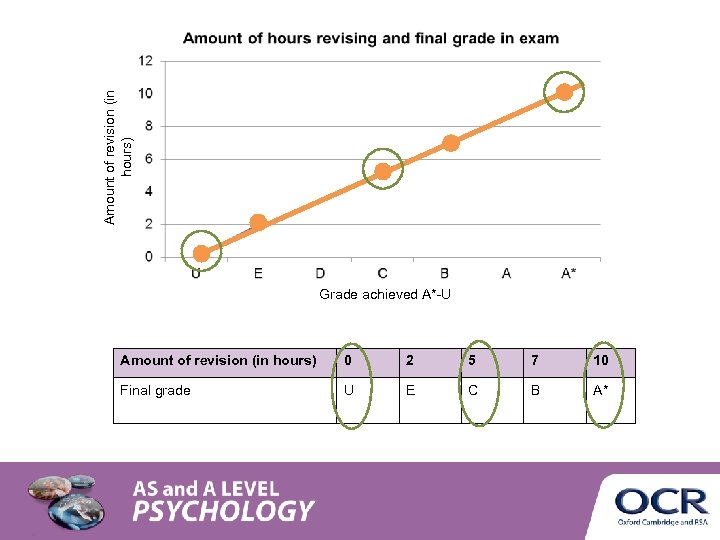
Amount of revision (in hours) Grade achieved A*-U Amount of revision (in hours) 0 2 5 7 10 Final grade U E C B A*
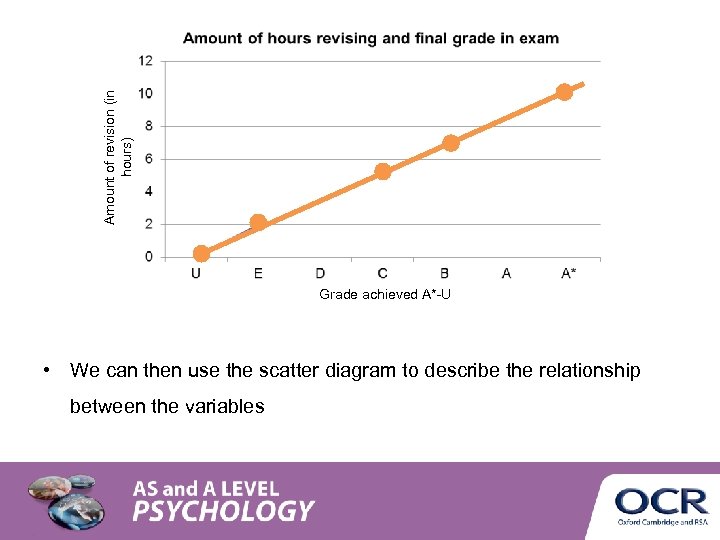
Amount of revision (in hours) Grade achieved A*-U • We can then use the scatter diagram to describe the relationship between the variables
Task • Complete Activity 4 in the workbook. • Plot one variable on the x axis and one on the y axis. • Plot using dots or crosses. • Remember to include: Title Clearly labelled both axes (including measurements when possible).
Hypotheses • Unlike Observation and Self Report we can generate hypotheses for Correlation Research. • Recap: Null Hypothesis Alternate hypothesis (one tailed or two tailed). What is the difference between a one tailed and a two tailed hypothesis?
Hypotheses • Correlations can’t show cause and effect • Can’t mention the effect one variable will have on the other so we talk about the ‘relationship’ between two variables • Still using the term significant • Still must clearly state the variables and how they have been operationalised • NEVER using the words cause, effect or difference.
Hypotheses • Null hypothesis: there will be no relationship • There will be no significant relationship between V 1 and V 2. Alternate hypothesis: One tailed: There will be a significant positive/negative relationship between V 1 and V 2 Two tailed: there will be a significant relationship between V 1 and V 2. Which word(s) must you NEVER use in a correlational hypothesis?
Assessment Tasks • Activity 5 - Complete the hypotheses questions in the workbook. • Activity 6 - Answer the sample exam questions relating to correlations.
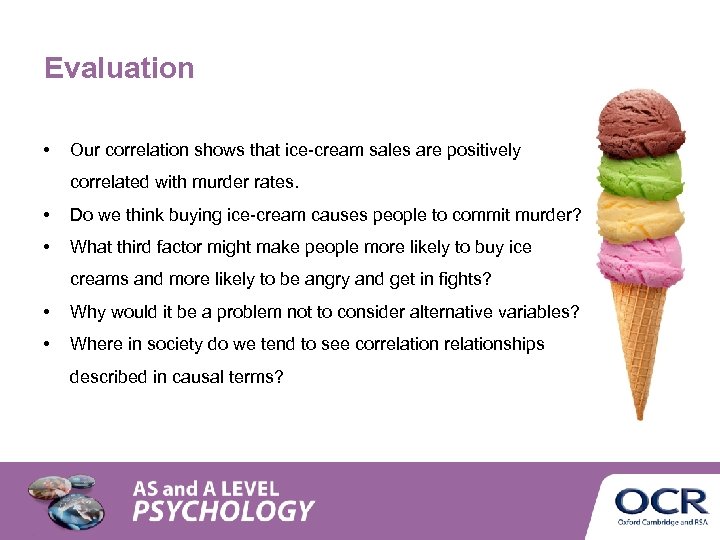
Evaluation • Our correlation shows that ice-cream sales are positively correlated with murder rates. • Do we think buying ice-cream causes people to commit murder? • What third factor might make people more likely to buy ice creams and more likely to be angry and get in fights? • Why would it be a problem not to consider alternative variables? • Where in society do we tend to see correlationships described in causal terms?
Task • Complete Activity 7. • Mexican lemon imports prevent highway deaths • Eating organic food causes autism • From the buzzfeed article explain the correlations such as those above.
Strengths of Correlations Makes a good pilot study to generate a hypothesis for an experiment. ü Can research variables that would be unethical to manipulate. ü Can understand the relationship between two variables (positive/negative, weak/strong).
Weaknesses of Correlations do not show causation. They have the same weakness as whatever method was used to gather the data (observation/self report). Tell us nothing about other variables that may be the real cause Often correlations are misleading: NEVER USE DIFFERENCE, EFFECT OR CAUSE when describing a correlation.
Correlations Practical Activity
Learning Objectives • Carry out a practical activity on a correlation. • Write a report for correlational research.
Report Writing • You must complete a report for the correlation you have conducted • Remember the procedure must be replicable.
Task • You will now be carrying out your own correlational research. • Follow the instructions from Activity 8 in the workook. • You need to decide if you are using self report or observation to gather your data. • Make sure your data can be plotted on a scale, not qualitative or nominal.
Thank you for using this OCR resource Other OCR resources are available at www. ocr. org. uk To give us feedback on, or ideas about, the OCR resources you have used email resourcesfeedback@ocr. org. uk If you do not currently offer this OCR qualification but would like to do so, please complete the Expression of Interest Form which can be found here: www. ocr. org. uk/expression-of-interest OCR Resources: the small print OCR’s resources are provided to support the teaching of OCR specifications, but in no way constitute an endorsed teaching method that is required by the Board, and the decision to use them lies with the individual teacher. Whilst every effort is made to ensure the accuracy of the content, OCR cannot be held responsible for any errors or omissions within these resources. © OCR 2015 - This resource may be freely copied and distributed, as long as the OCR logo and this message remain intact and OCR is acknowledged as the originator of this work. OCR acknowledges use of the following content: Ice cream: M. Unal Ozmen Please get in touch if you want to discuss the accessibility of resources we offer to support delivery of our qualifications: resources. feedback@ocr. org. uk
Скачать презентацию Correlations Introduction Learning Objectives Identify the
ea9e4020ce1923e65bf7489708045a81.ppt