 Скачать презентацию Corpus Delicti Elements Objective Side Subjective
Corpus delicti.ppt
- Количество слайдов: 10




Corpus Delicti Elements: ► Objective Side ► Subjective Side
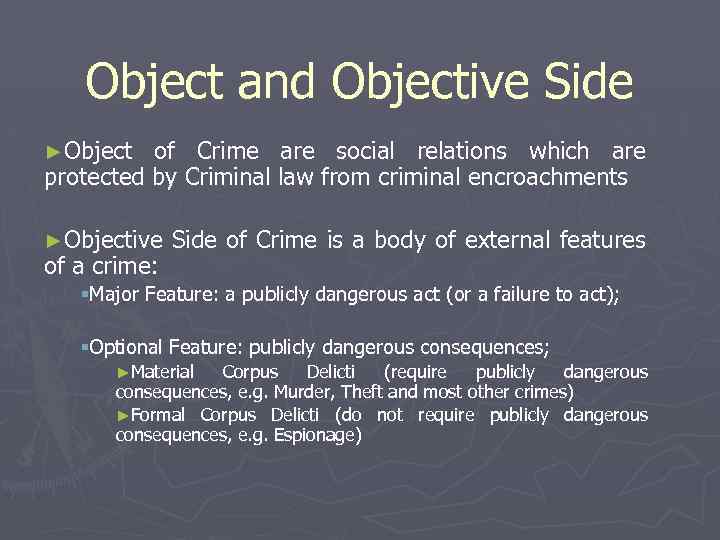
Object and Objective Side ►Object of Crime are social relations which are protected by Criminal law from criminal encroachments ►Objective of a crime: Side of Crime is a body of external features §Major Feature: a publicly dangerous act (or a failure to act); §Optional Feature: publicly dangerous consequences; ►Material Corpus Delicti (require publicly dangerous consequences, e. g. Murder, Theft and most other crimes) ►Formal Corpus Delicti (do not require publicly dangerous consequences, e. g. Espionage)
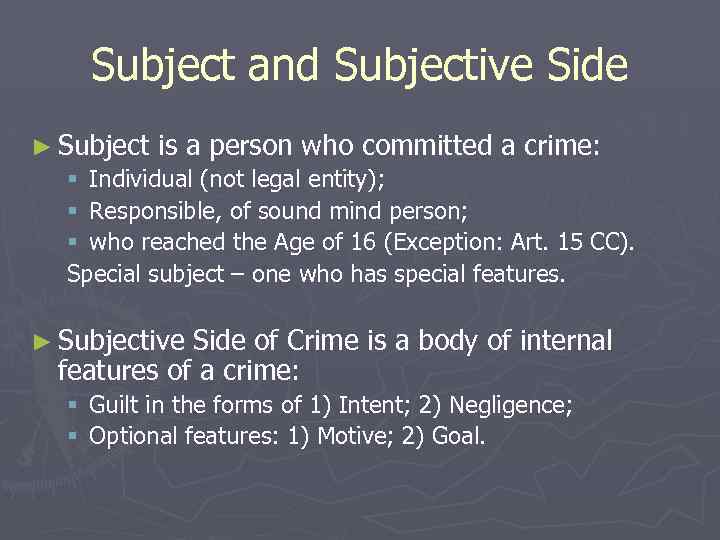
Subject and Subjective Side ► Subject is a person who committed a crime: § Individual (not legal entity); § Responsible, of sound mind person; § who reached the Age of 16 (Exception: Art. 15 CC). Special subject – one who has special features. ► Subjective Side of Crime is a body of internal features of a crime: § Guilt in the forms of 1) Intent; 2) Negligence; § Optional features: 1) Motive; 2) Goal.
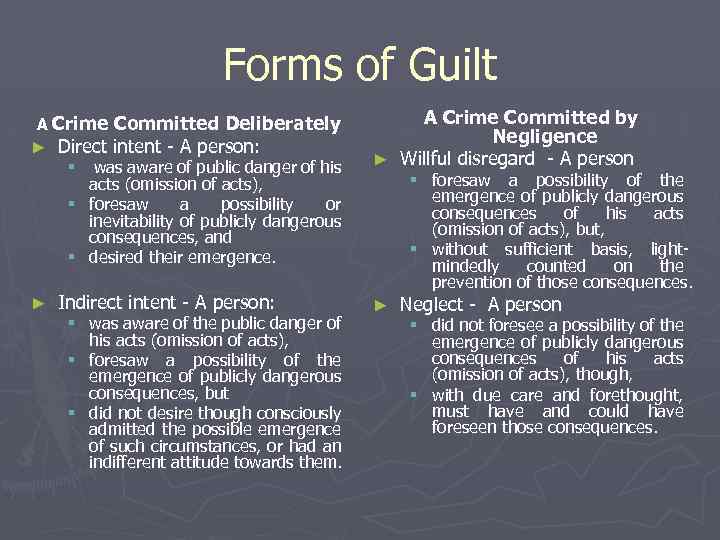
Forms of Guilt A Crime Committed Deliberately ► Direct intent - A person: was aware of public danger of his acts (omission of acts), § foresaw a possibility or inevitability of publicly dangerous consequences, and § desired their emergence. § ► Indirect intent - A person: § was aware of the public danger of his acts (omission of acts), § foresaw a possibility of the emergence of publicly dangerous consequences, but § did not desire though consciously admitted the possible emergence of such circumstances, or had an indifferent attitude towards them. A Crime Committed by Negligence ► Willful disregard - A person § foresaw a possibility of the emergence of publicly dangerous consequences of his acts (omission of acts), but, § without sufficient basis, lightmindedly counted on the prevention of those consequences. ► Neglect - A person § did not foresee a possibility of the emergence of publicly dangerous consequences of his acts (omission of acts), though, § with due care and forethought, must have and could have foreseen those consequences.
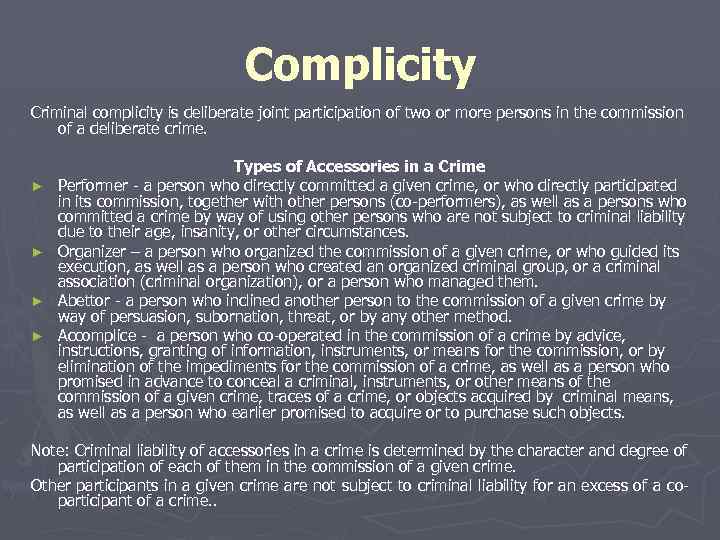
Complicity Criminal complicity is deliberate joint participation of two or more persons in the commission of a deliberate crime. ► ► Types of Accessories in a Crime Performer - a person who directly committed a given crime, or who directly participated in its commission, together with other persons (co-performers), as well as a persons who committed a crime by way of using other persons who are not subject to criminal liability due to their age, insanity, or other circumstances. Organizer – a person who organized the commission of a given crime, or who guided its execution, as well as a person who created an organized criminal group, or a criminal association (criminal organization), or a person who managed them. Abettor - a person who inclined another person to the commission of a given crime by way of persuasion, subornation, threat, or by any other method. Accomplice - a person who co-operated in the commission of a crime by advice, instructions, granting of information, instruments, or means for the commission, or by elimination of the impediments for the commission of a crime, as well as a person who promised in advance to conceal a criminal, instruments, or other means of the commission of a given crime, traces of a crime, or objects acquired by criminal means, as well as a person who earlier promised to acquire or to purchase such objects. Note: Criminal liability of accessories in a crime is determined by the character and degree of participation of each of them in the commission of a given crime. Other participants in a given crime are not subject to criminal liability for an excess of a coparticipant of a crime. .
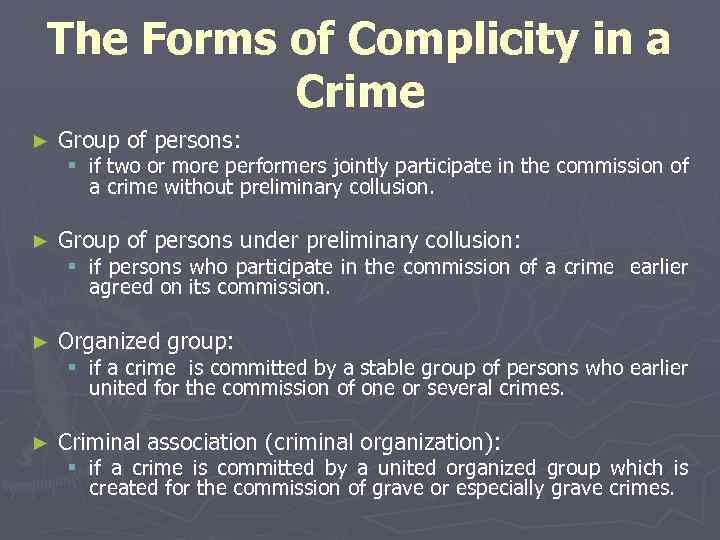
The Forms of Complicity in a Crime ► Group of persons: ► Group of persons under preliminary collusion: ► Organized group: ► Criminal association (criminal organization): § if two or more performers jointly participate in the commission of a crime without preliminary collusion. § if persons who participate in the commission of a crime earlier agreed on its commission. § if a crime is committed by a stable group of persons who earlier united for the commission of one or several crimes. § if a crime is committed by a united organized group which is created for the commission of grave or especially grave crimes.
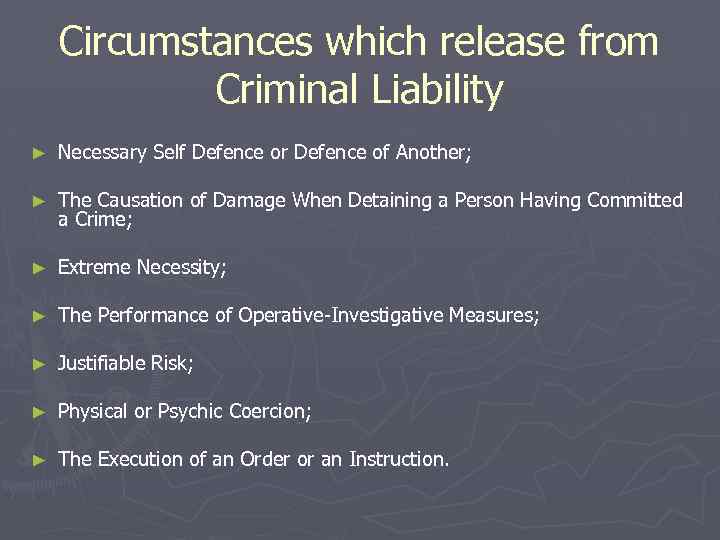
Circumstances which release from Criminal Liability ► Necessary Self Defence or Defence of Another; ► The Causation of Damage When Detaining a Person Having Committed a Crime; ► Extreme Necessity; ► The Performance of Operative-Investigative Measures; ► Justifiable Risk; ► Physical or Psychic Coercion; ► The Execution of an Order or an Instruction.
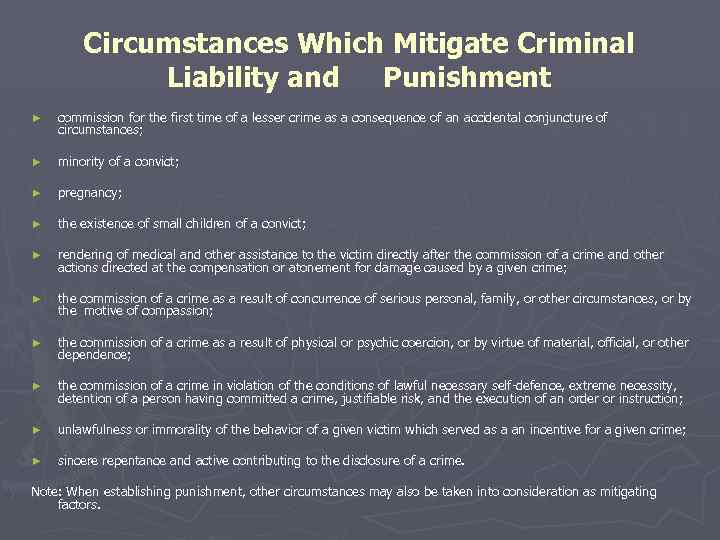
Circumstances Which Mitigate Criminal Liability and Punishment ► commission for the first time of a lesser crime as a consequence of an accidental conjuncture of circumstances; ► minority of a convict; ► pregnancy; ► the existence of small children of a convict; ► rendering of medical and other assistance to the victim directly after the commission of a crime and other actions directed at the compensation or atonement for damage caused by a given crime; ► the commission of a crime as a result of concurrence of serious personal, family, or other circumstances, or by the motive of compassion; ► the commission of a crime as a result of physical or psychic coercion, or by virtue of material, official, or other dependence; ► the commission of a crime in violation of the conditions of lawful necessary self-defence, extreme necessity, detention of a person having committed a crime, justifiable risk, and the execution of an order or instruction; ► unlawfulness or immorality of the behavior of a given victim which served as a an incentive for a given crime; ► sincere repentance and active contributing to the disclosure of a crime. Note: When establishing punishment, other circumstances may also be taken into consideration as mitigating factors.
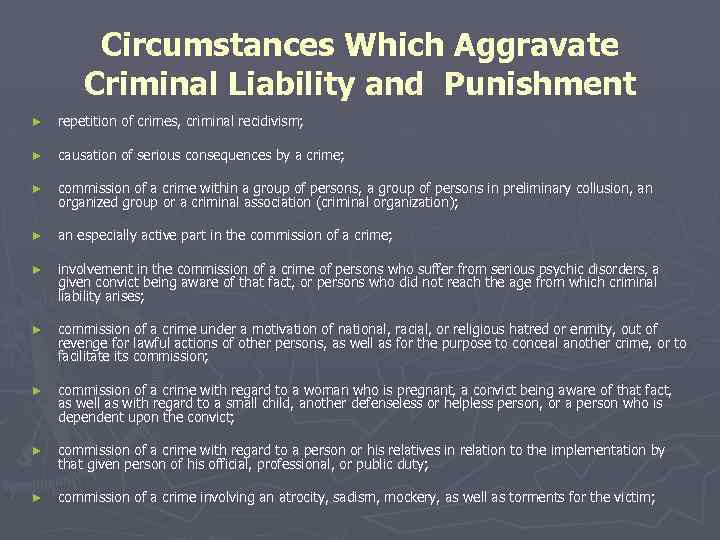
Circumstances Which Aggravate Criminal Liability and Punishment ► repetition of crimes, criminal recidivism; ► causation of serious consequences by a crime; ► commission of a crime within a group of persons, a group of persons in preliminary collusion, an organized group or a criminal association (criminal organization); ► an especially active part in the commission of a crime; ► involvement in the commission of a crime of persons who suffer from serious psychic disorders, a given convict being aware of that fact, or persons who did not reach the age from which criminal liability arises; ► commission of a crime under a motivation of national, racial, or religious hatred or enmity, out of revenge for lawful actions of other persons, as well as for the purpose to conceal another crime, or to facilitate its commission; ► commission of a crime with regard to a woman who is pregnant, a convict being aware of that fact, as well as with regard to a small child, another defenseless or helpless person, or a person who is dependent upon the convict; ► commission of a crime with regard to a person or his relatives in relation to the implementation by that given person of his official, professional, or public duty; ► commission of a crime involving an atrocity, sadism, mockery, as well as torments for the victim;

Circumstances Which Aggravate Criminal Liability and Punishment ► commission of a crime with the use of arms, ammunition, explosive substances, an explosive or other devices imitating them, specially made technical instruments, combustible and inflammable liquids, poisonous and radioactive materials, medicinal and other chemico-pharmacological substances, as well as with the application of physical or psychic coercion, or by generally dangerous methods; ► commission of a crime with the use of conditions of an extraordinary situation, natural or other social disaster, as well as in cases of mass unrest; ► commission of a crime in a condition of alcoholic, narcotic, or toxicomanic inebriation. A court shall have the right, depending on the character of a given crime, not to recognise this circumstance as aggravating; ► commission of a crime by a person who violated by that a military oath or a professional vow; ► commission of a crime with the use of trust rendered to a convict by virtue of his service position or a certain contract; ► commission of a crime with the use of a uniform or documents of a representative of authority. Note: When establishing punishment, a court may not recognise as aggravating any other circumstances.
Скачать презентацию Corpus Delicti Elements Objective Side Subjective
Corpus delicti.ppt