


 Скачать презентацию Corpus Approach vs Generative Approach and Movement vs
7104da2ac241aca6f94640f4a4ef6d01.ppt
- Количество слайдов: 96
 Corpus Approach vs. Generative Approach and Movement vs. Grammatical Functions One-Soon Her 何萬順
 OUTLINE 1) Contrasting GA and CA 2) Contrasting LFG and TG 3) Conclusion
 1) Contrasting GA and CA What is the ultimate goal of a generative syntactic theory?
 To account for the universal properties and variations in the syntactic phenomena in all languages, in the simplest way.
 A. 2 What is the ultimate goal of a corpus-based syntactic theory?
 To discover generalizations and variations in the syntactic phenomena from the corpus materials at hand.
 Let’s see a simple non-linguistic demonstration of CA vs. GA
 Driving on Planet Earth Research Goal: to come up with a description of the side of the road to drive on, on Planet Earth
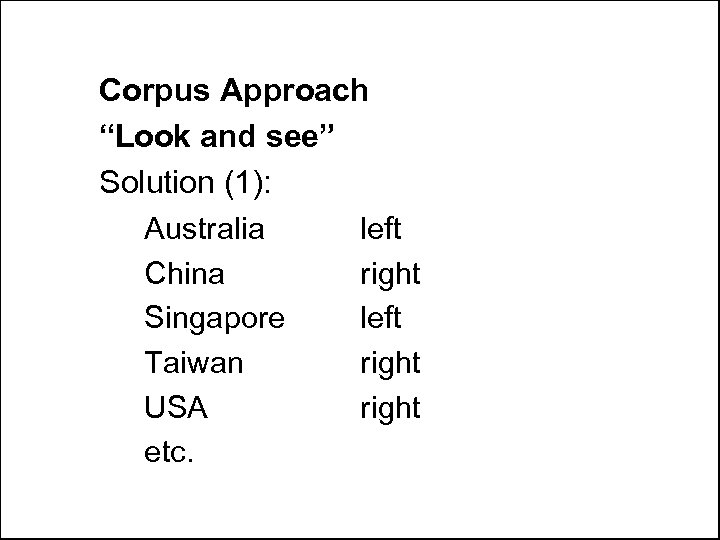 Corpus Approach “Look and see” Solution (1): Australia left China right Singapore left Taiwan right USA right etc.
 Evaluating Corpus Solution (1) Not happy Must make generalizations
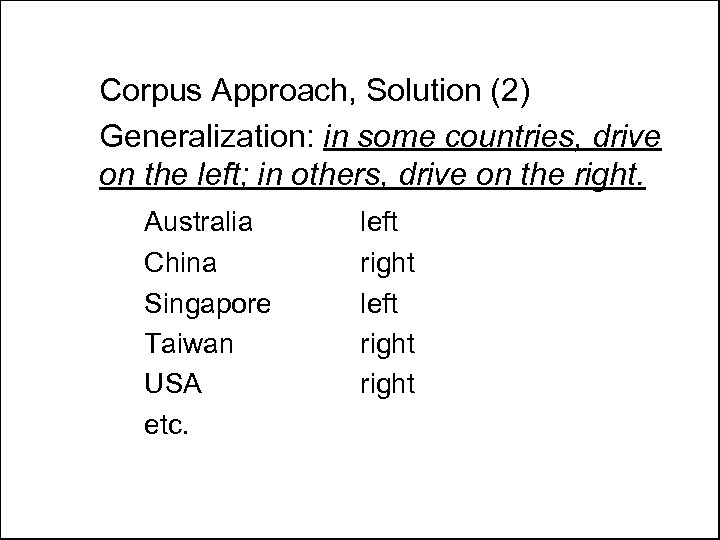 Corpus Approach, Solution (2) Generalization: in some countries, drive on the left; in others, drive on the right. Australia China Singapore Taiwan USA etc. left right
 How about the generative approach?
 The generative approach assumes: 1) there are universal principles 2) variation is due to parameters
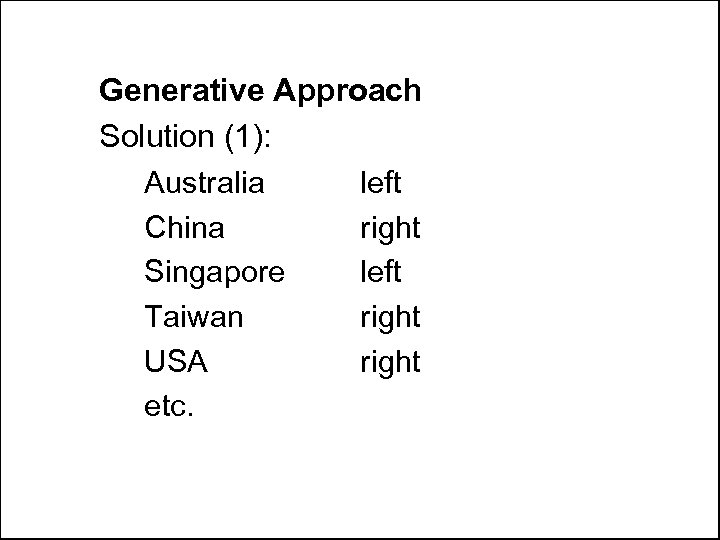 Generative Approach Solution (1): Australia left China right Singapore left Taiwan right USA right etc.
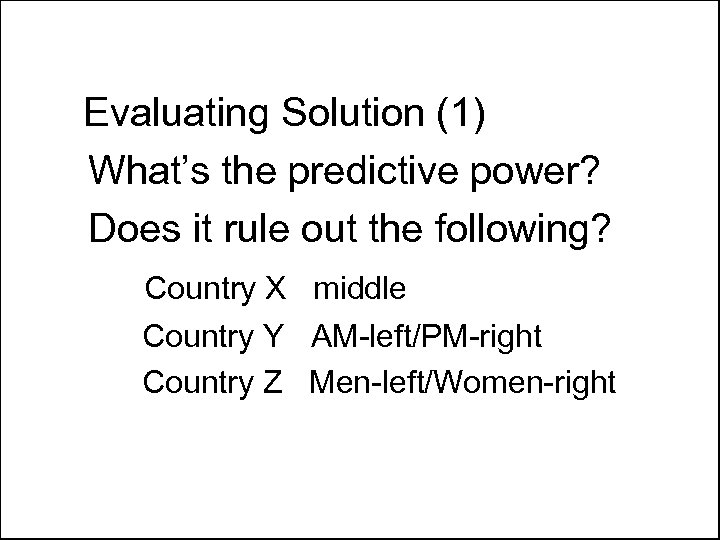 Evaluating Solution (1) What’s the predictive power? Does it rule out the following? Country X middle Country Y AM-left/PM-right Country Z Men-left/Women-right
 Evaluating Solution (1) Each listing is a stipulation, thus no predictive power. Must generalize and make predictions!
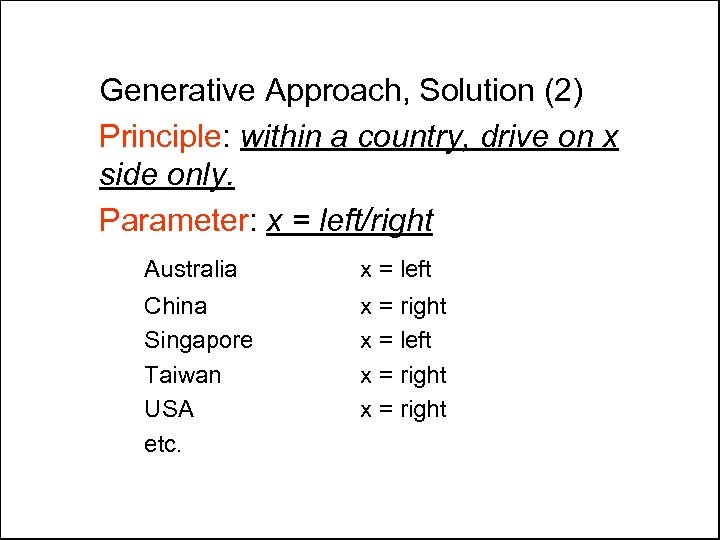 Generative Approach, Solution (2) Principle: within a country, drive on x side only. Parameter: x = left/right Australia x = left China Singapore Taiwan USA etc. x = right x = left x = right
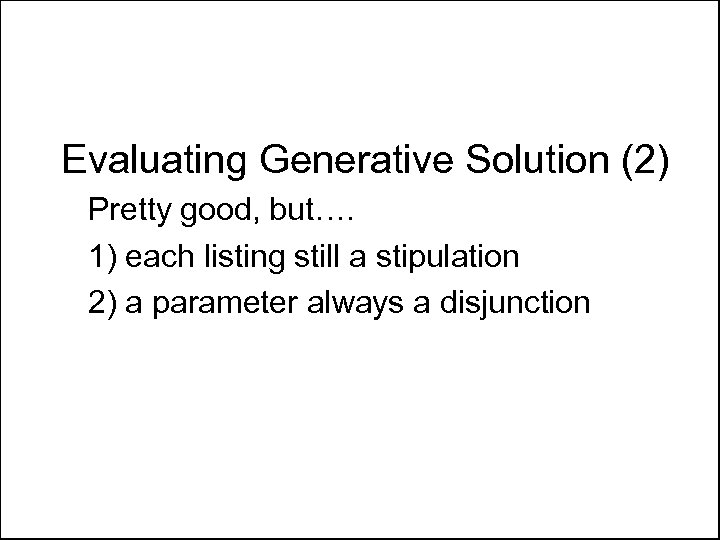 Evaluating Generative Solution (2) Pretty good, but…. 1) each listing still a stipulation 2) a parameter always a disjunction
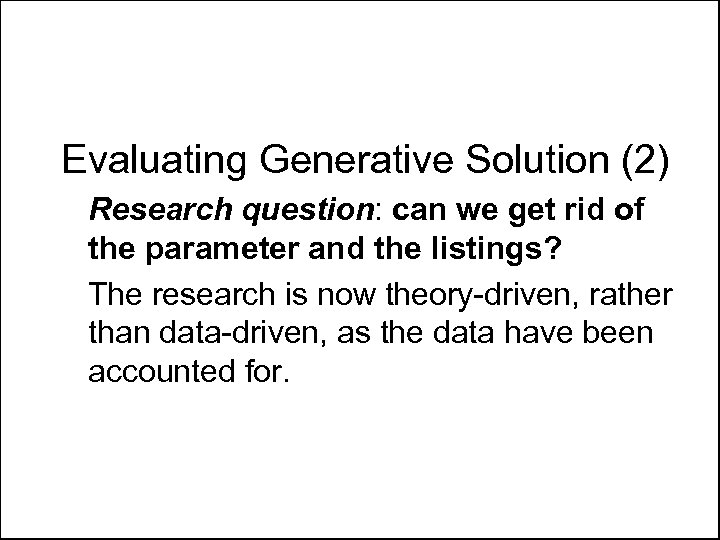 Evaluating Generative Solution (2) Research question: can we get rid of the parameter and the listings? The research is now theory-driven, rather than data-driven, as the data have been accounted for.
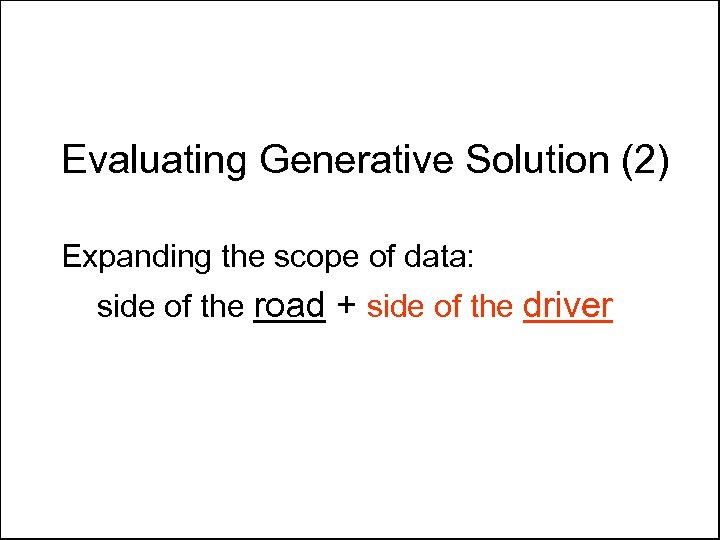 Evaluating Generative Solution (2) Expanding the scope of data: side of the road + side of the driver
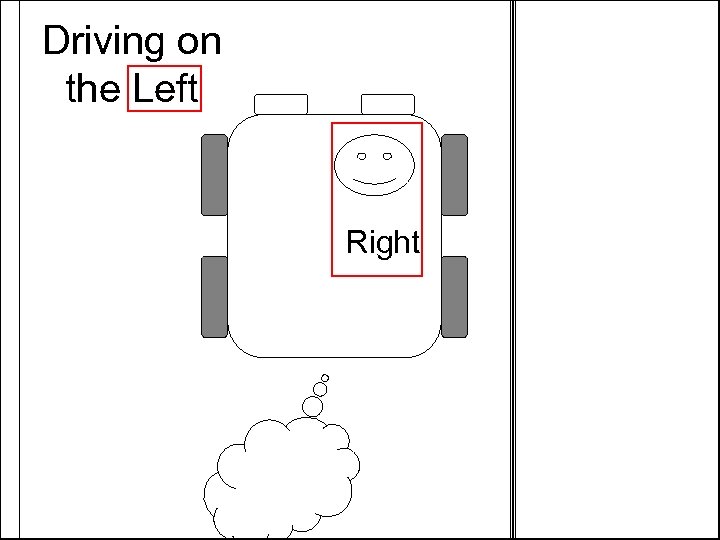 Driving on the Left Right
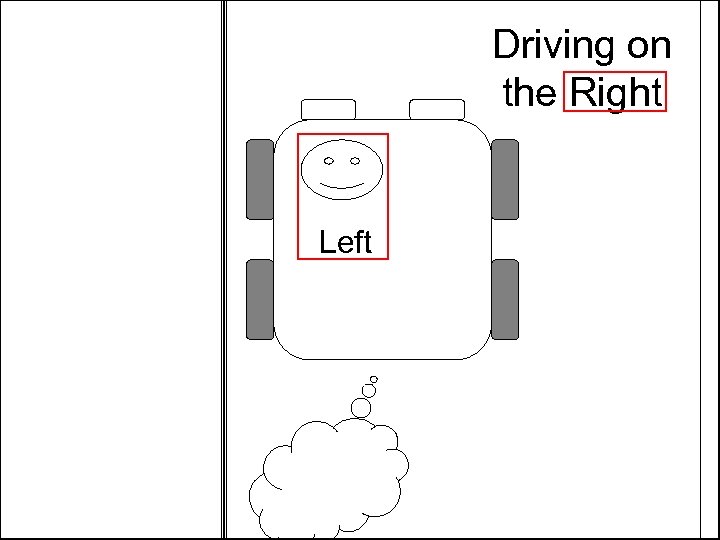 Driving on the Right Left
 The driving side is always the opposite of the driver side!!
 Generative Approach, Solution (3) Principle: on Planet Earth, drive on the left, if the driver seat is on the right; otherwise, drive on the right.
 Evaluating Generative Solution (3) Wow, no listings and no parameters!! But, wait! There’s still a disjunction.
 Evaluating Generative Solution (3) Principle: on Planet Earth, if the driver seat is on the right, then drive on the left; otherwise, drive on the right.
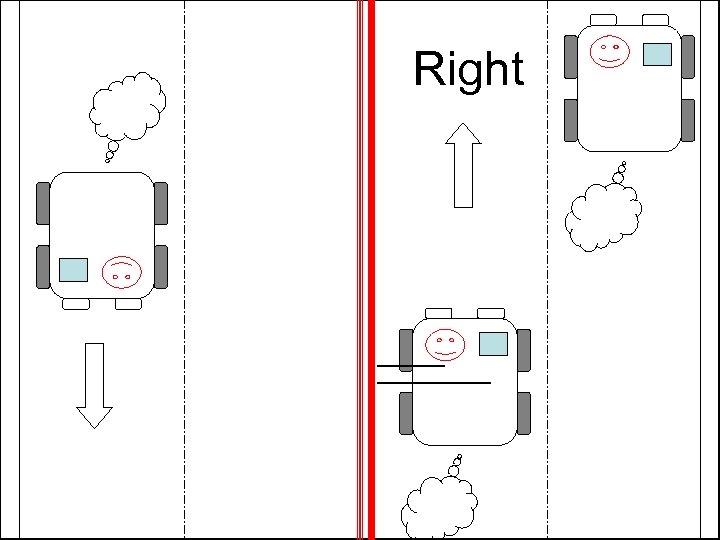
 Evaluating Generative Solution (3) Let’s again expand the scope of data: driver + passenger + center of the road
 Right
Right
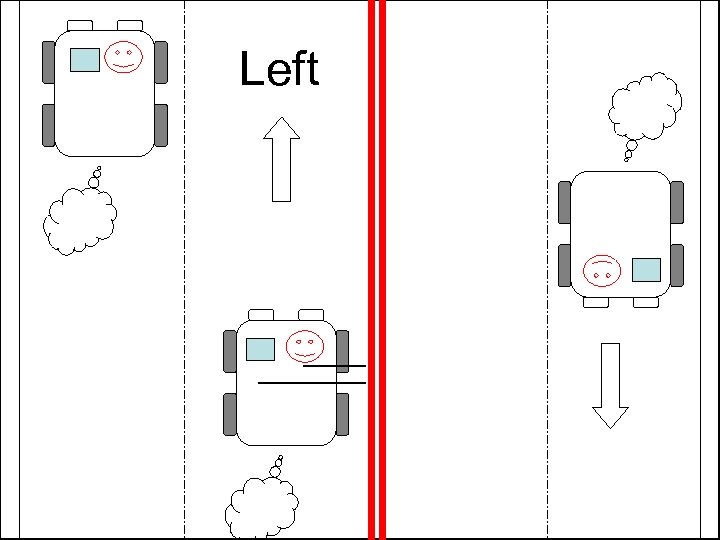 Left
Left
 The driver is always closer to the center of the road!!
 Generative Approach, Solution Ultimate Principle: when driving on Planet Earth, stay closer to the center of the road in relation to the front seat passenger.
 Evaluating GG Solution Ultimate Does it allow a functional explanation? Yes, it does! Being closer to the center of the road affords the driver the best range of vision with the least physical strain
 Evaluating GA Solution Ultimate It’s simple and elegant, but is it complete?
 Evaluating GG Solution Ultimate Consider 建國高架橋下迴轉道 US Postman’s jeep And, of course, Myanmar!
 Evaluating GG Solution Ultimate …the two kinds of linguists need each other. Or better, that the two kinds of linguists, wherever possible, should exist in the same body. (Fillmore 1992: 35)
 Evaluating GG Solution Ultimate Lessons from Myanmar and Pirahã.
 Evaluating GG Solution Ultimate It’s simple and elegant, but how many countries do you really need to observe to derive it?
 2) Contrasting LFG and TG 1. 2. 3. 4. 5. Motivation Phrase structures Grammatical features Theta roles & linking Summary & examples
 1. Motivation
 Under the Generative Grammar, there are many competing frameworks: TG (incl. GB, MP…) LFG HPSG etc.
 They share the same goal, but differ in: 1) what is “simple” exactly? 2) the right balance between descriptive adequacy and theoretical elegance Consequence: somewhat different architectures some different primitive notions
 2. Phrase Structures a. k. a. c(onstituent)-structures
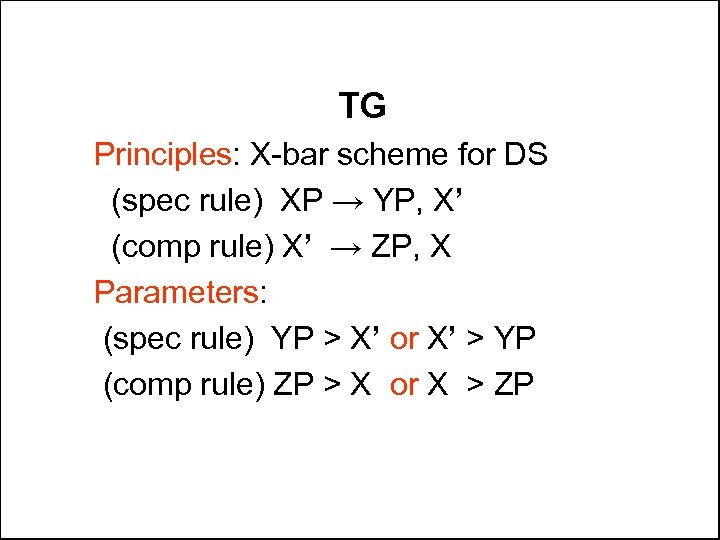 TG Principles: X-bar scheme for DS (spec rule) XP → YP, X’ (comp rule) X’ → ZP, X Parameters: (spec rule) YP > X’ or X’ > YP (comp rule) ZP > X or X > ZP
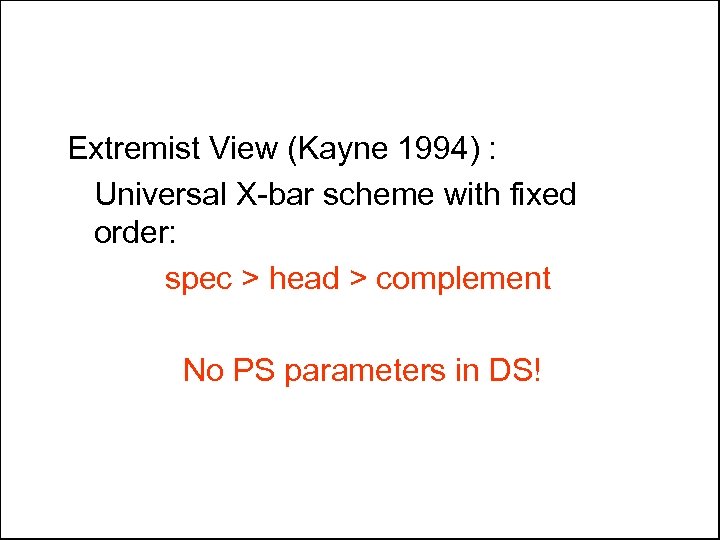 Extremist View (Kayne 1994) : Universal X-bar scheme with fixed order: spec > head > complement No PS parameters in DS!
 TG DS → movements → SS
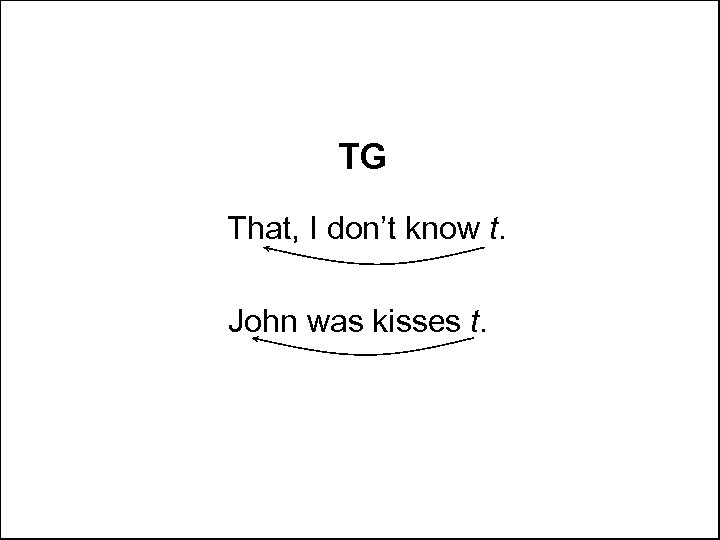 TG That, I don’t know t. John was kisses t.
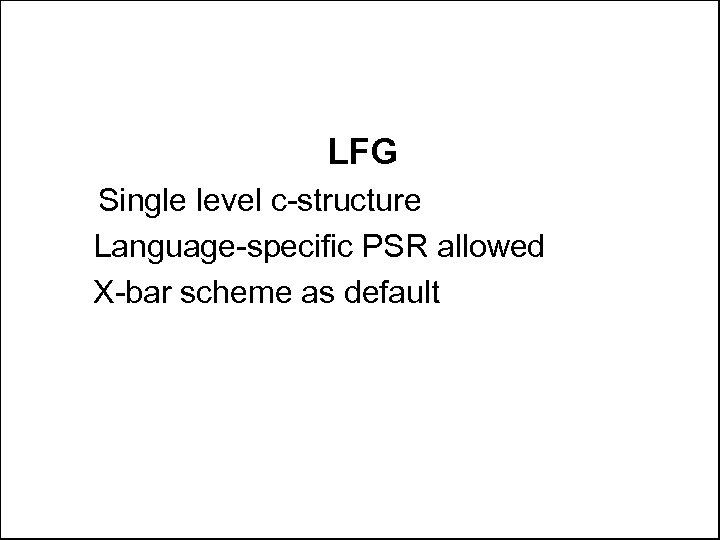 LFG Single level c-structure Language-specific PSR allowed X-bar scheme as default
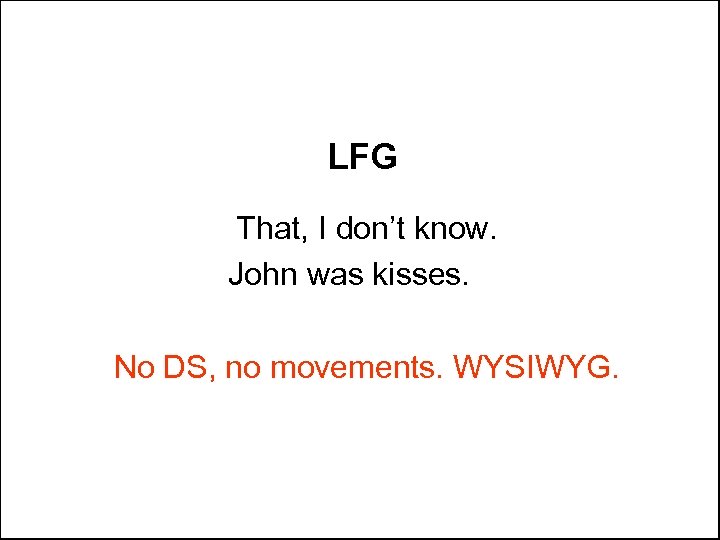 LFG That, I don’t know. John was kisses. No DS, no movements. WYSIWYG.
 3. Grammatical Features e. g. , case, number, person, etc.
![TG Features grow on trees. Mary has [3/sg/nom] kissed John …. .](https://present5.com/presentation/7104da2ac241aca6f94640f4a4ef6d01/image-50.jpg "TG Features grow on trees. Mary has [3/sg/nom] kissed John …. .") TG Features grow on trees. Mary has [3/sg/nom] kissed John …. .
TG Features grow on trees. Mary has [3/sg/nom] kissed John …. .
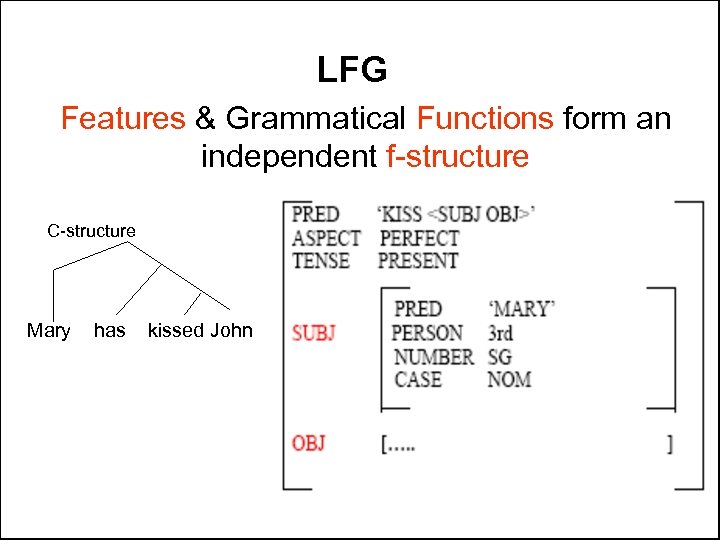 LFG Features & Grammatical Functions form an independent f-structure C-structure Mary has kissed John
 4. Theta roles & linking
![TG Theta roles are assigned to tree positions. kiss [x y] Mary has kissed](https://present5.com/presentation/7104da2ac241aca6f94640f4a4ef6d01/image-53.jpg "TG Theta roles are assigned to tree positions. kiss [x y] Mary has kissed") TG Theta roles are assigned to tree positions. kiss [x y] Mary has kissed John
TG Theta roles are assigned to tree positions. kiss [x y] Mary has kissed John
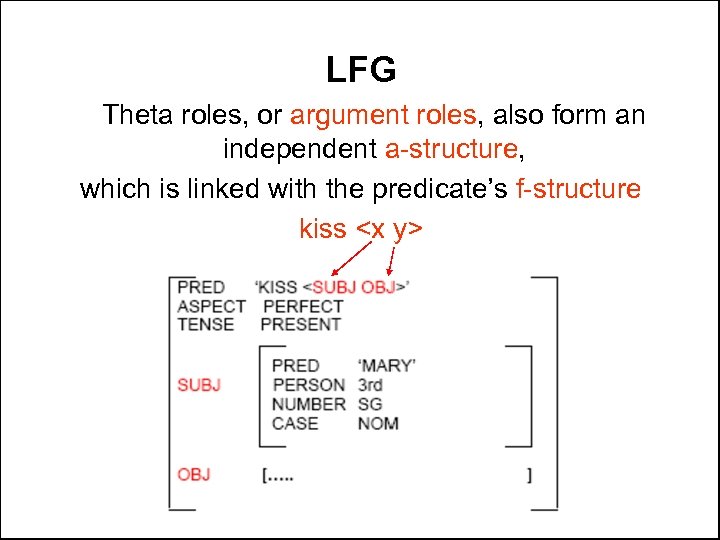 LFG Theta roles, or argument roles, also form an independent a-structure, which is linked with the predicate’s f-structure kiss
 5. Summary & examples
![TG (1) John, Mary has kissed. kiss [x y] DS Mary has 3/sg/nom kissed](https://present5.com/presentation/7104da2ac241aca6f94640f4a4ef6d01/image-56.jpg "TG (1) John, Mary has kissed. kiss [x y] DS Mary has 3/sg/nom kissed") TG (1) John, Mary has kissed. kiss [x y] DS Mary has 3/sg/nom kissed John …. .
TG (1) John, Mary has kissed. kiss [x y] DS Mary has 3/sg/nom kissed John …. .
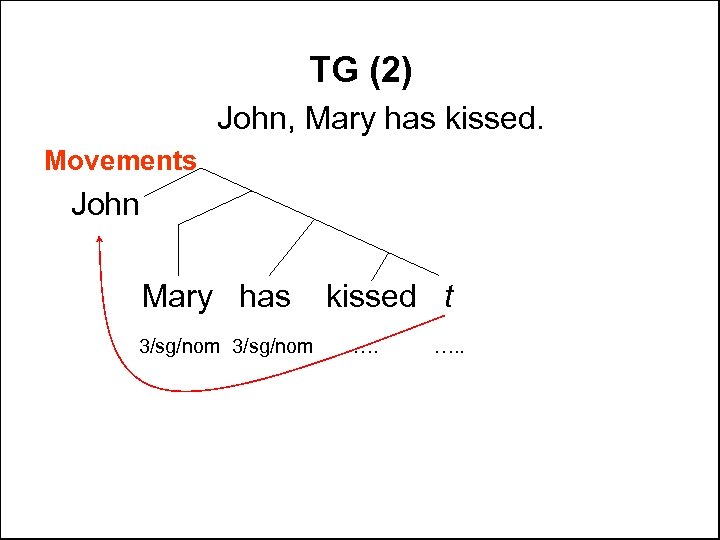 TG (2) John, Mary has kissed. Movements John Mary has 3/sg/nom kissed t …. .
![TG (3) John, Mary has kissed. John Mary has [3/sg/nom] kissed t …. Feature](https://present5.com/presentation/7104da2ac241aca6f94640f4a4ef6d01/image-58.jpg "TG (3) John, Mary has kissed. John Mary has [3/sg/nom] kissed t …. Feature") TG (3) John, Mary has kissed. John Mary has [3/sg/nom] kissed t …. Feature checking …. .
TG (3) John, Mary has kissed. John Mary has [3/sg/nom] kissed t …. Feature checking …. .
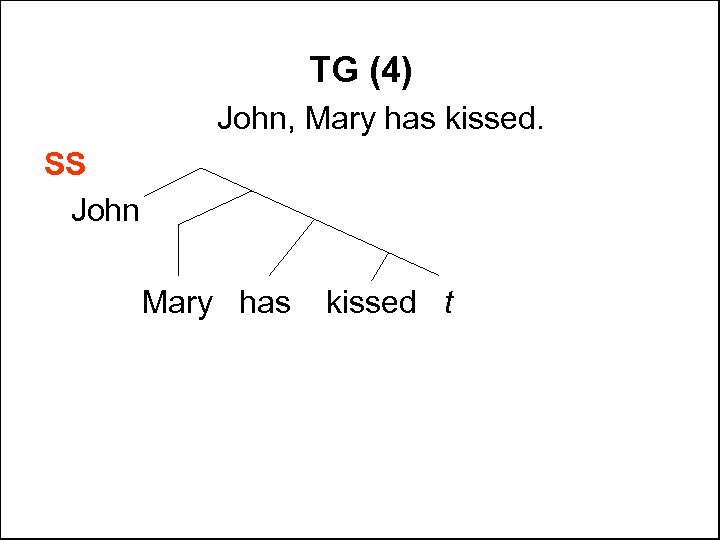 TG (4) John, Mary has kissed. SS John Mary has kissed t
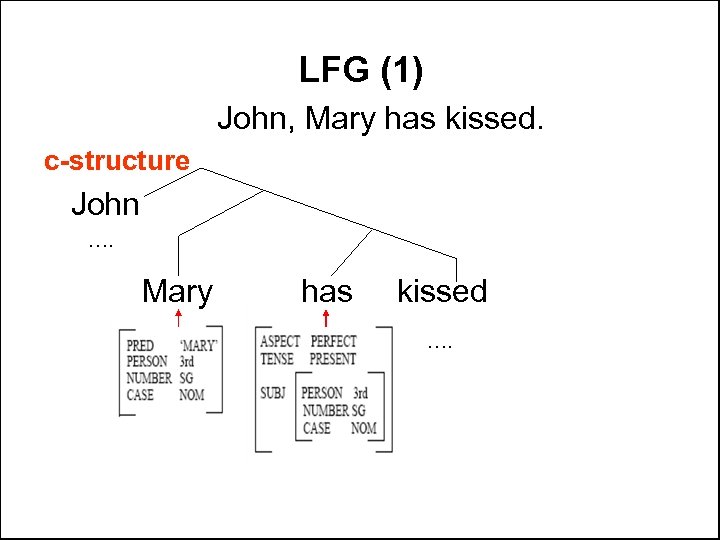 LFG (1) John, Mary has kissed. c-structure John …. Mary has kissed ….
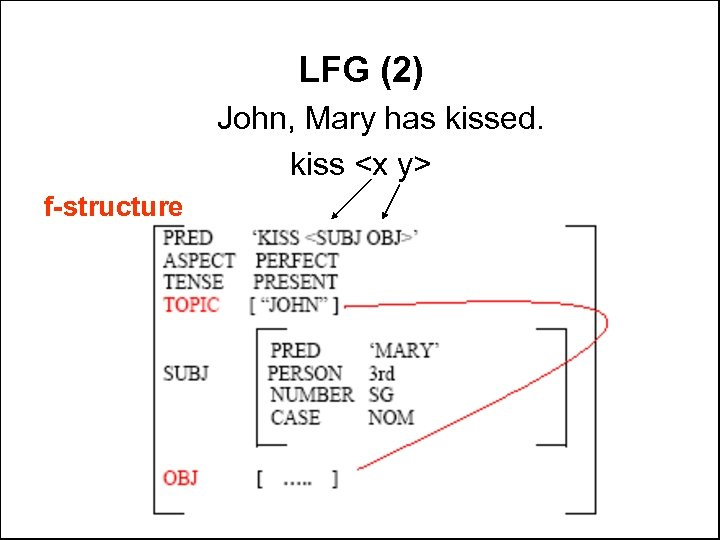 LFG (2) John, Mary has kissed. kiss
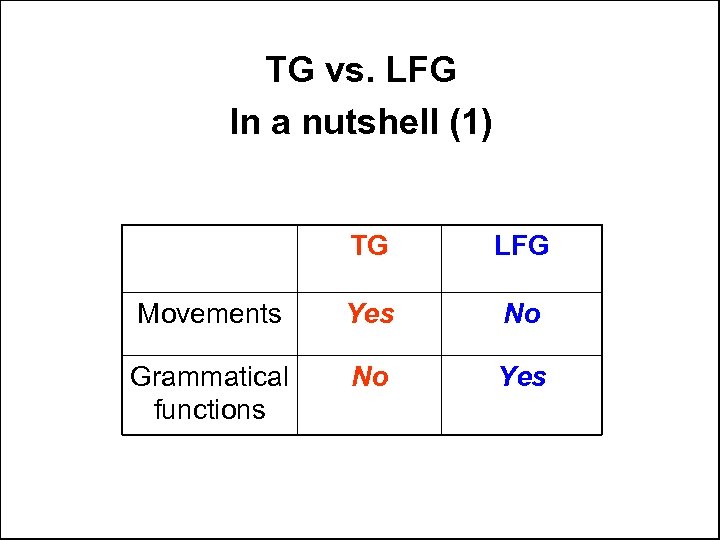 TG vs. LFG In a nutshell (1) TG LFG Movements Yes No Grammatical functions No Yes
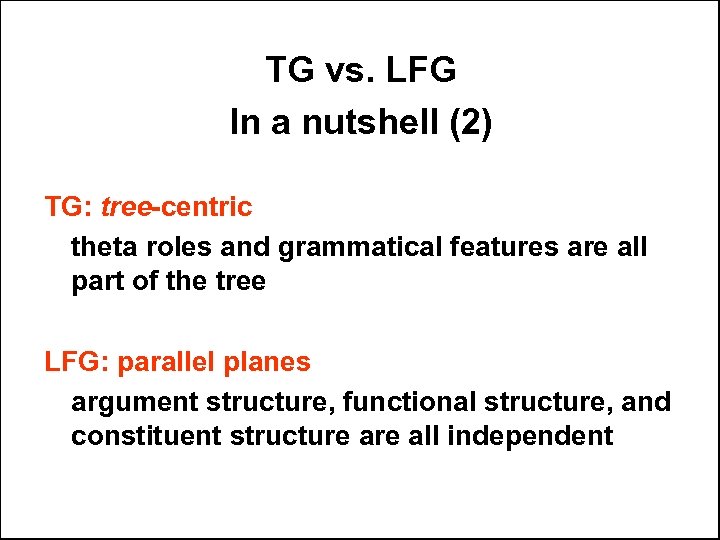 TG vs. LFG In a nutshell (2) TG: tree-centric theta roles and grammatical features are all part of the tree LFG: parallel planes argument structure, functional structure, and constituent structure all independent
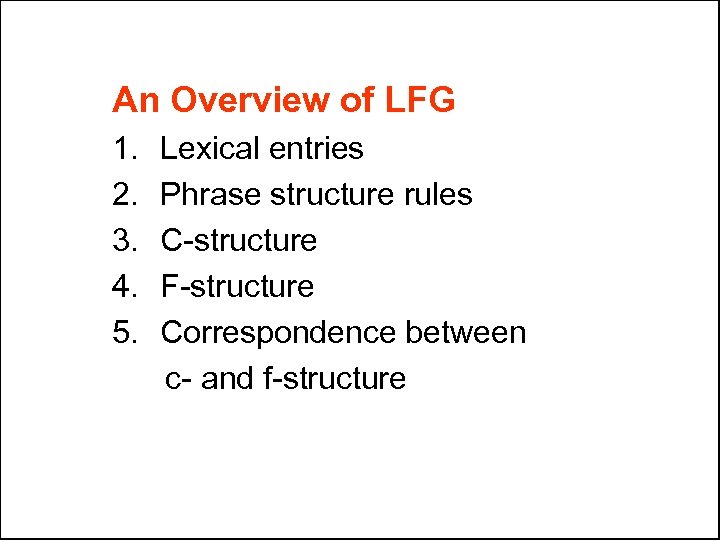 An Overview of LFG 1. 2. 3. 4. 5. Lexical entries Phrase structure rules C-structure F-structure Correspondence between c- and f-structure
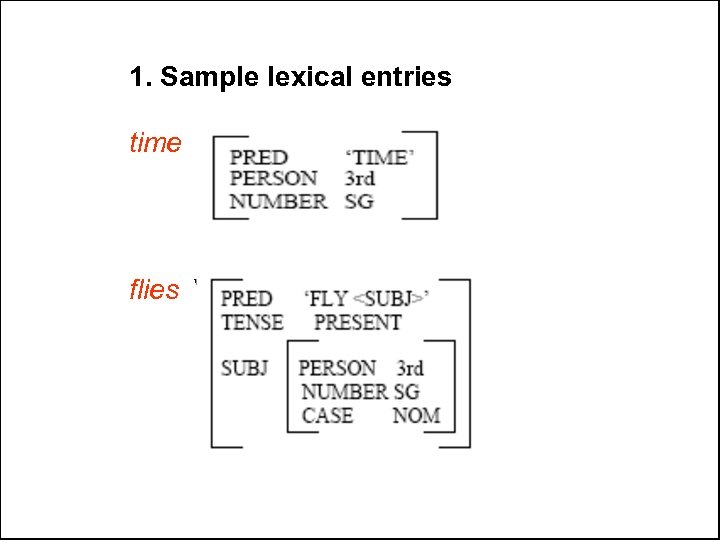 1. Sample lexical entries time N flies V
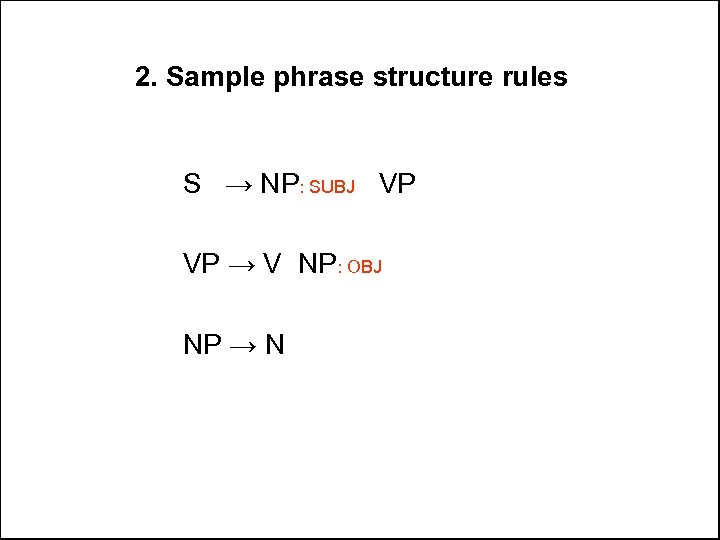 2. Sample phrase structure rules S → NP: SUBJ VP VP → V NP: OBJ NP → N
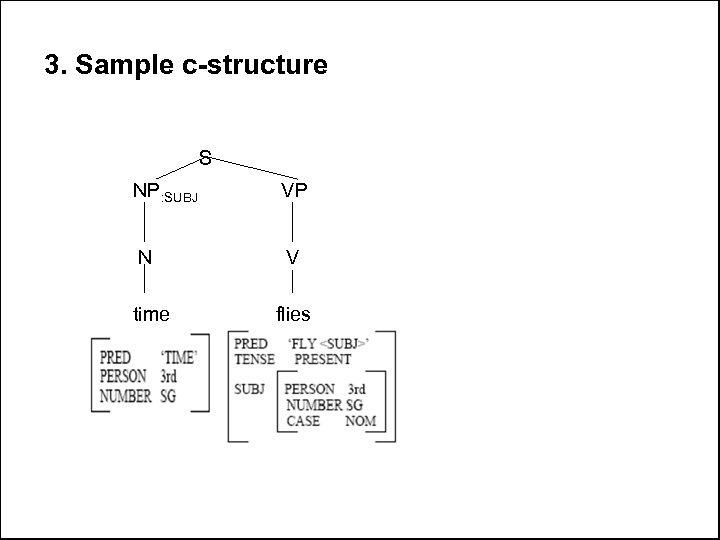 3. Sample c-structure S NP: SUBJ VP N V time flies
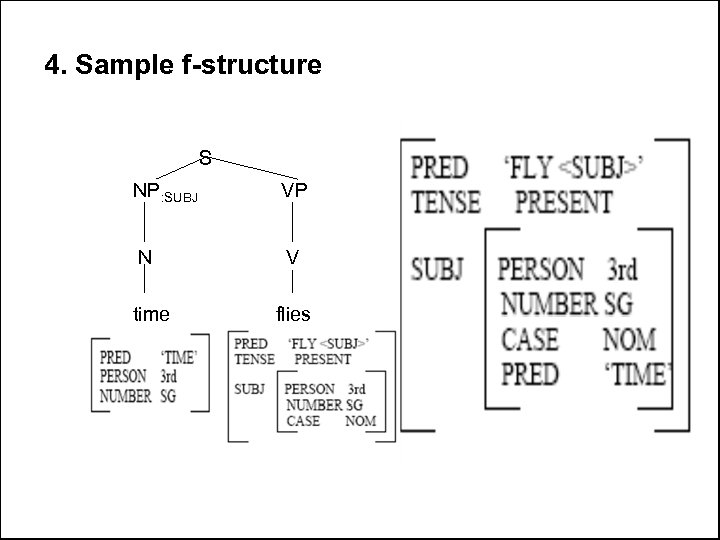 4. Sample f-structure S NP: SUBJ VP N V time flies
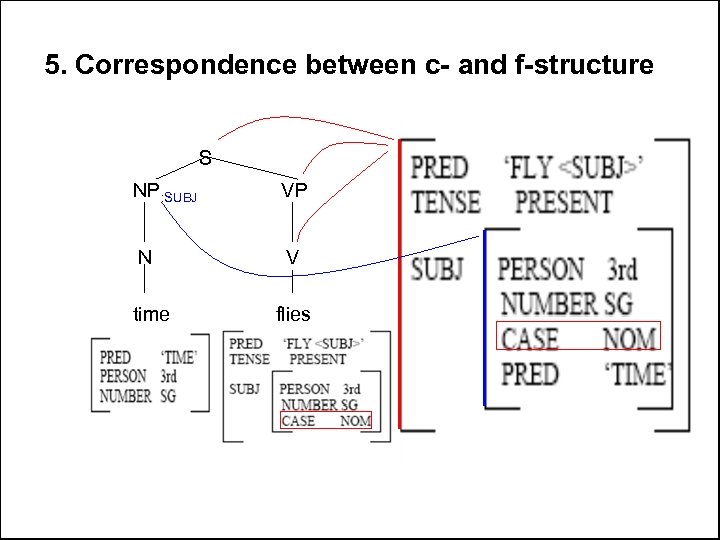 5. Correspondence between c- and f-structure S NP: SUBJ VP N V time flies
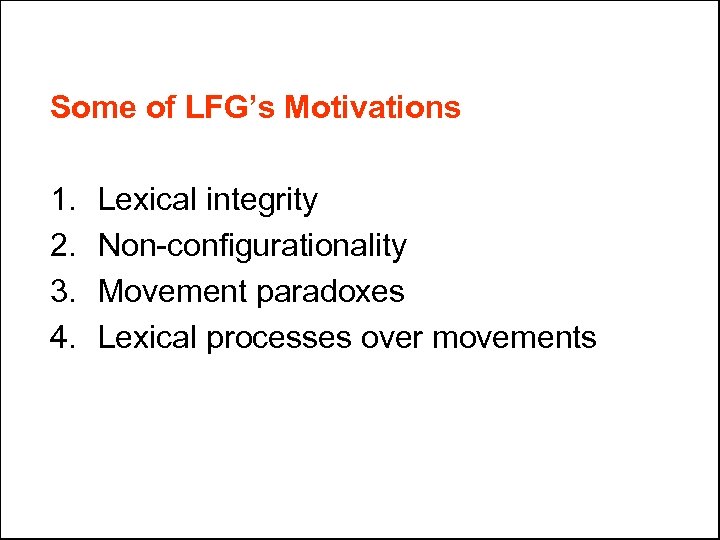 Some of LFG’s Motivations 1. 2. 3. 4. Lexical integrity Non-configurationality Movement paradoxes Lexical processes over movements
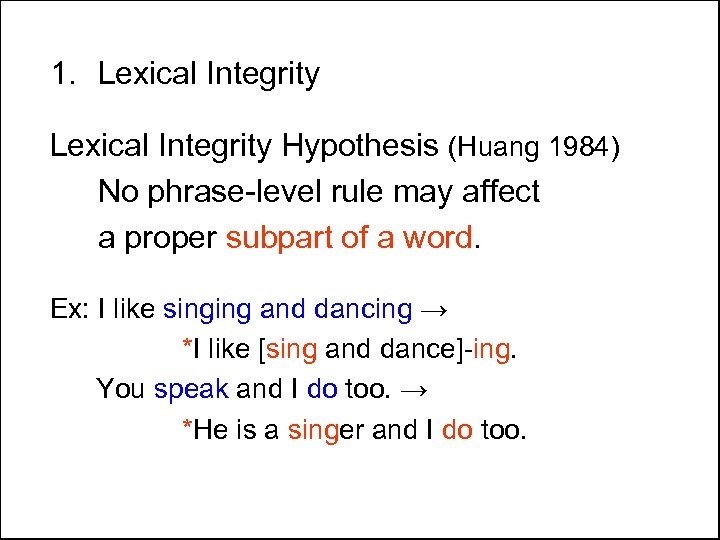 1. Lexical Integrity Hypothesis (Huang 1984) No phrase-level rule may affect a proper subpart of a word. Ex: I like singing and dancing → *I like [sing and dance]-ing. You speak and I do too. → *He is a singer and I do too.
 TG Mary went. Mary /ed/ go Affix Hopping Violating lexical integrity.
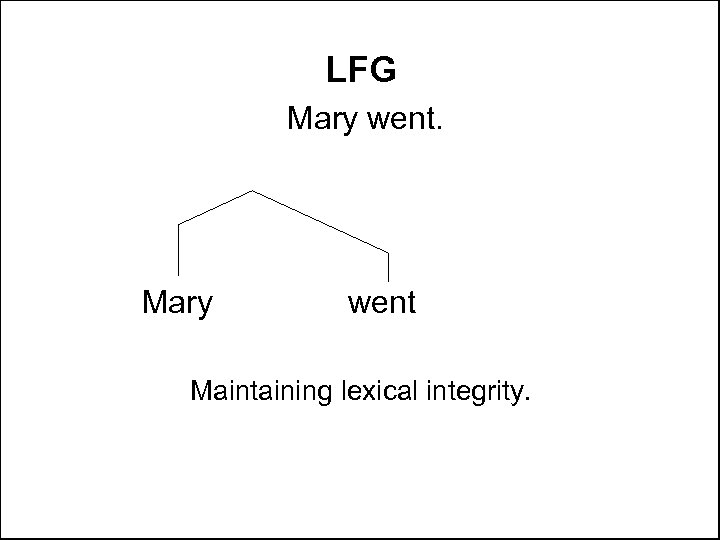 LFG Mary went Maintaining lexical integrity.
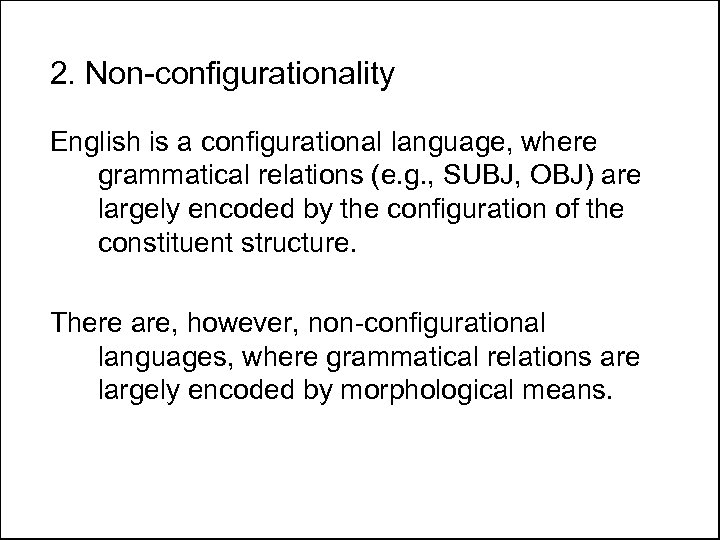 2. Non-configurationality English is a configurational language, where grammatical relations (e. g. , SUBJ, OBJ) are largely encoded by the configuration of the constituent structure. There are, however, non-configurational languages, where grammatical relations are largely encoded by morphological means.
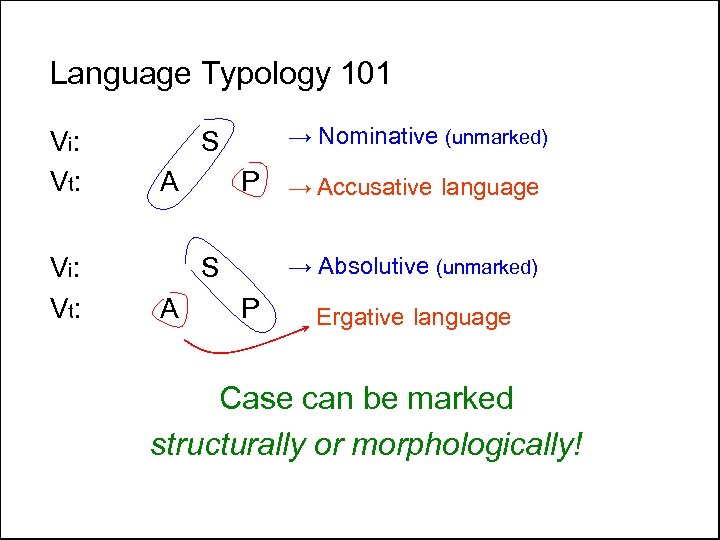 Language Typology 101 V i: V t: → Nominative (unmarked) S A P S A → Accusative language → Absolutive (unmarked) P Ergative language Case can be marked structurally or morphologically!
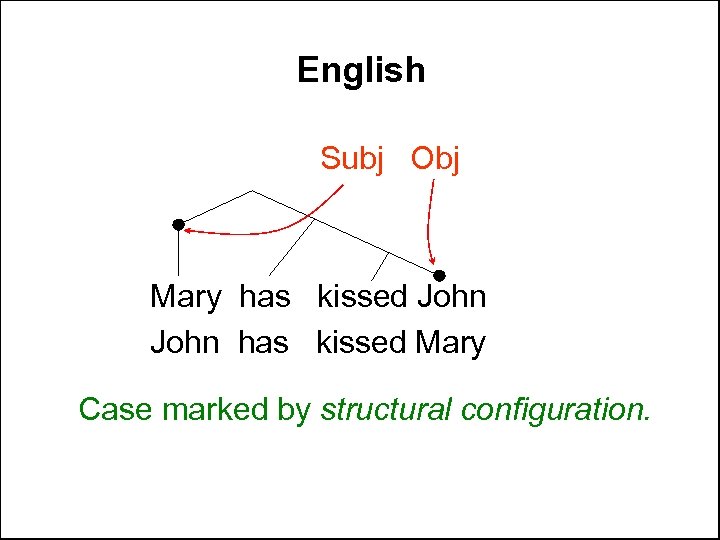 English Subj Obj Mary has kissed John has kissed Mary Case marked by structural configuration.
 Yes, I speak Malayalam Case marked by affixes.
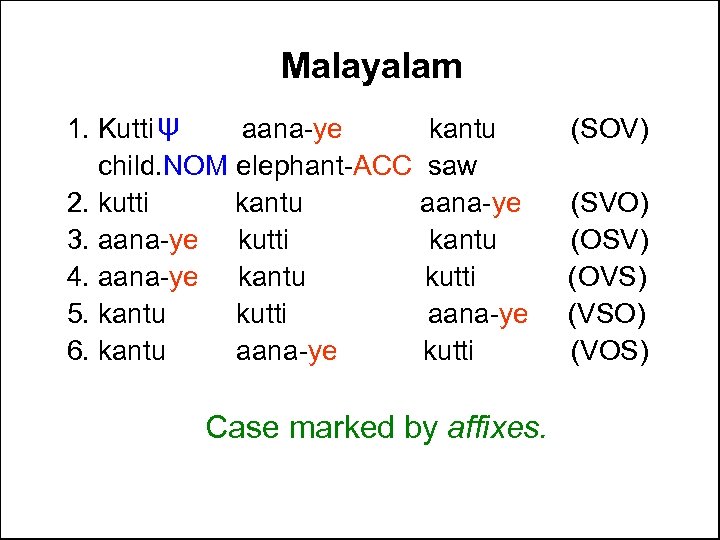 Malayalam 1. Kutti ψ aana-ye kantu child. NOM elephant-ACC saw 2. kutti kantu aana-ye 3. aana-ye kutti kantu 4. aana-ye kantu kutti 5. kantu kutti aana-ye 6. kantu aana-ye kutti Case marked by affixes. (SOV) (SVO) (OSV) (OVS) (VSO) (VOS)
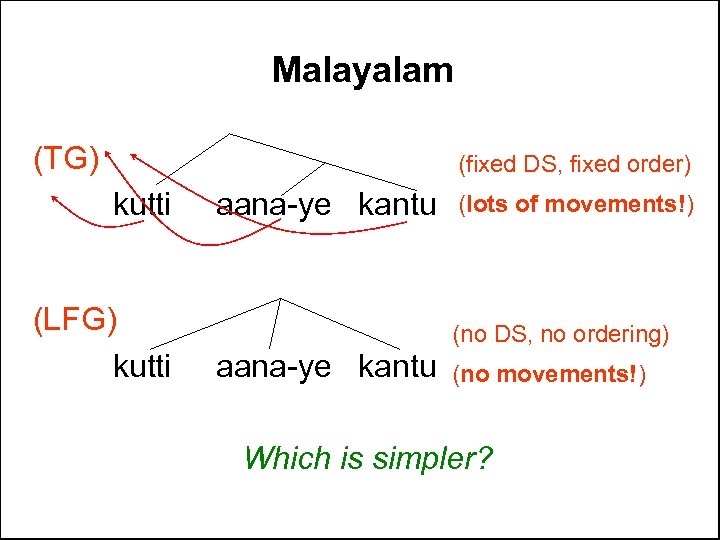 Malayalam (TG) (fixed DS, fixed order) kutti (LFG) kutti aana-ye kantu (lots of movements!) (no DS, no ordering) aana-ye kantu (no movements!) Which is simpler?
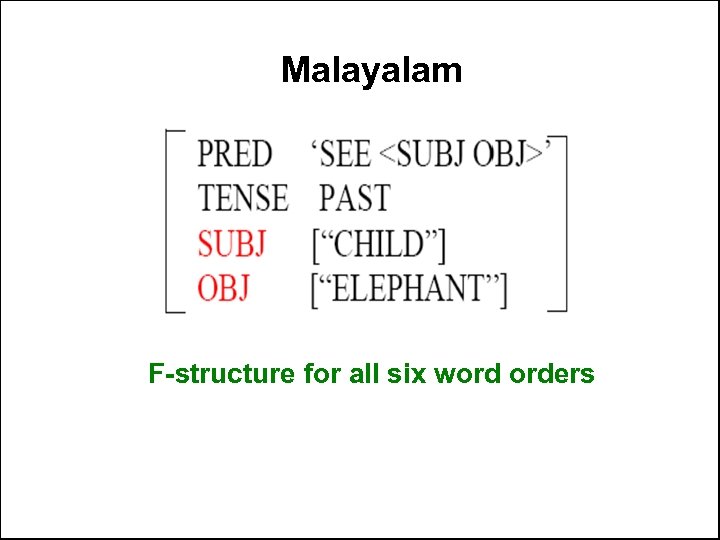 Malayalam F-structure for all six word orders
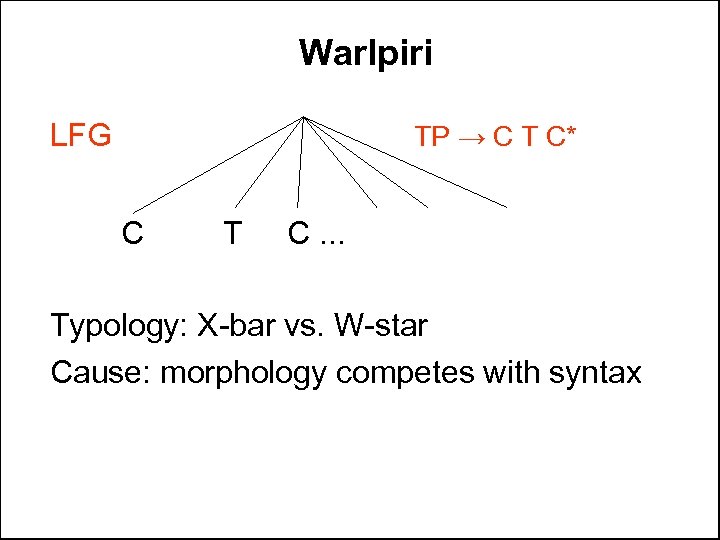
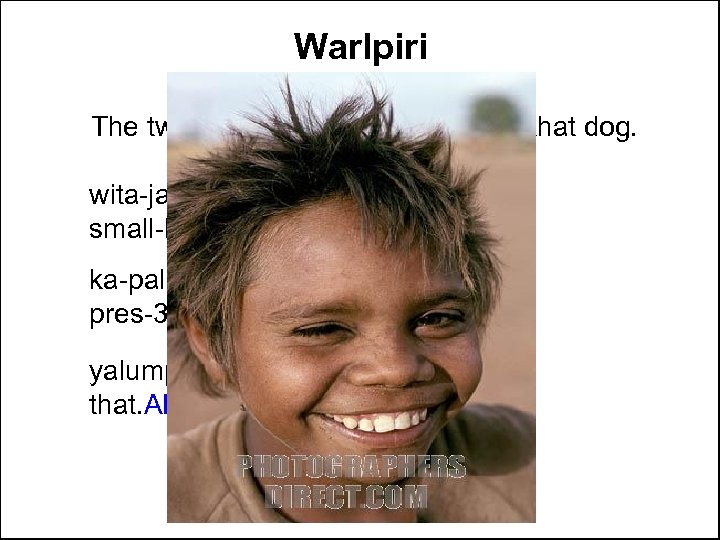 Warlpiri The two small children are chasing that dog. wita-jarra-rlu kurdu-jarra- rlu small-DUAL-ERG child-DUAL-ERG ka-pala pres-3 du. SUBJ wajili-pi-nyi chase-NPAST yalumpuψ that. ABS malikiψ dog. ABS
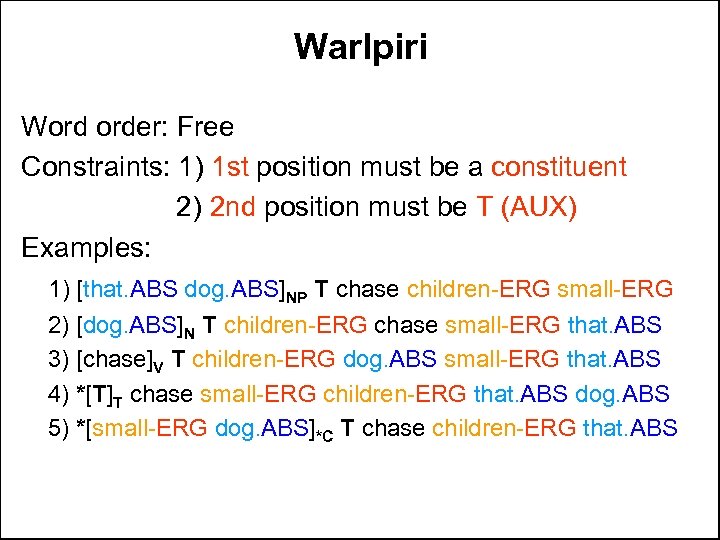 Warlpiri Word order: Free Constraints: 1) 1 st position must be a constituent 2) 2 nd position must be T (AUX) Examples: 1) [that. ABS dog. ABS]NP T chase children-ERG small-ERG 2) [dog. ABS]N T children-ERG chase small-ERG that. ABS 3) [chase]V T children-ERG dog. ABS small-ERG that. ABS 4) *[T]T chase small-ERG children-ERG that. ABS dog. ABS 5) *[small-ERG dog. ABS]*C T chase children-ERG that. ABS
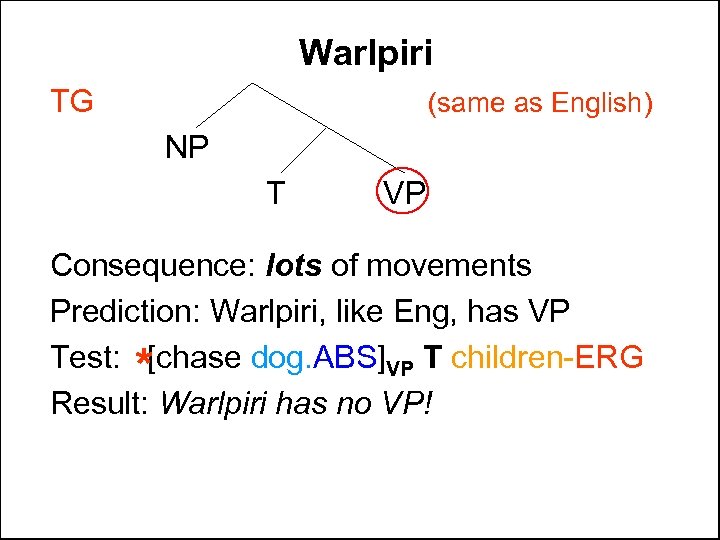 Warlpiri TG (same as English) NP T VP Consequence: lots of movements Prediction: Warlpiri, like Eng, has VP Test: *[chase dog. ABS]VP T children-ERG Result: Warlpiri has no VP!
 Warlpiri LFG TP → C T C* C T C. . . Typology: X-bar vs. W-star Cause: morphology competes with syntax
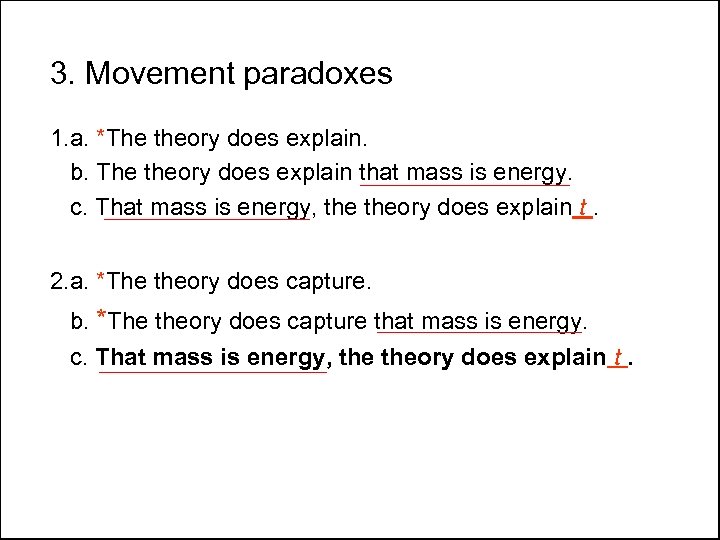 3. Movement paradoxes 1. a. *The theory does explain. b. The theory does explain that mass is energy. c. That mass is energy, theory does explain t. 2. a. *The theory does capture. b. *The theory does capture that mass is energy. c. That mass is energy, theory does explain t.
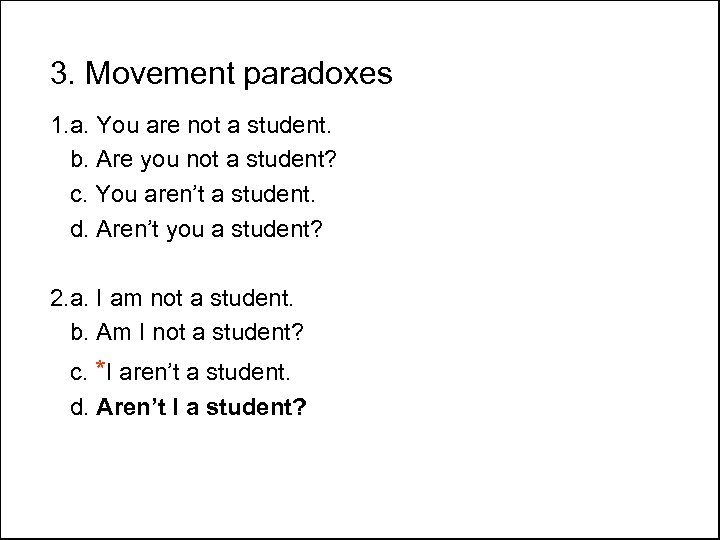 3. Movement paradoxes 1. a. You are not a student. b. Are you not a student? c. You aren’t a student. d. Aren’t you a student? 2. a. I am not a student. b. Am I not a student? c. *I aren’t a student. d. Aren’t I a student?
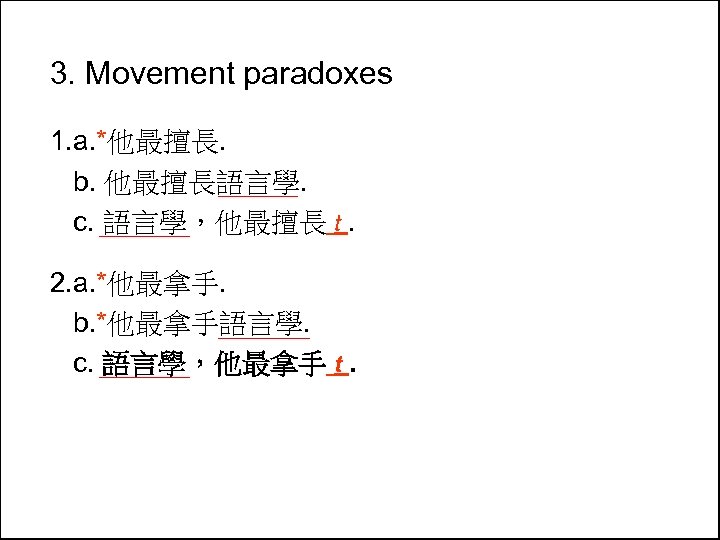 3. Movement paradoxes 1. a. *他最擅長. b. 他最擅長語言學. c. 語言學,他最擅長 t. 2. a. *他最拿手. b. *他最拿手語言學. c. 語言學,他最拿手 t.
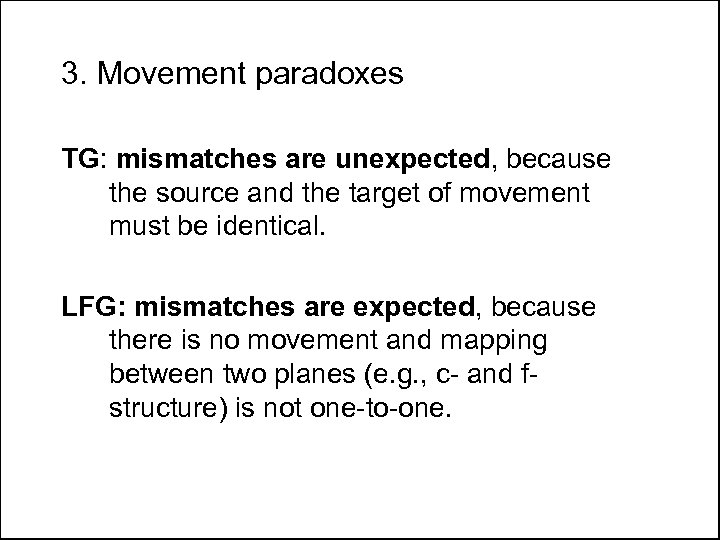 3. Movement paradoxes TG: mismatches are unexpected, because the source and the target of movement must be identical. LFG: mismatches are expected, because there is no movement and mapping between two planes (e. g. , c- and fstructure) is not one-to-one.
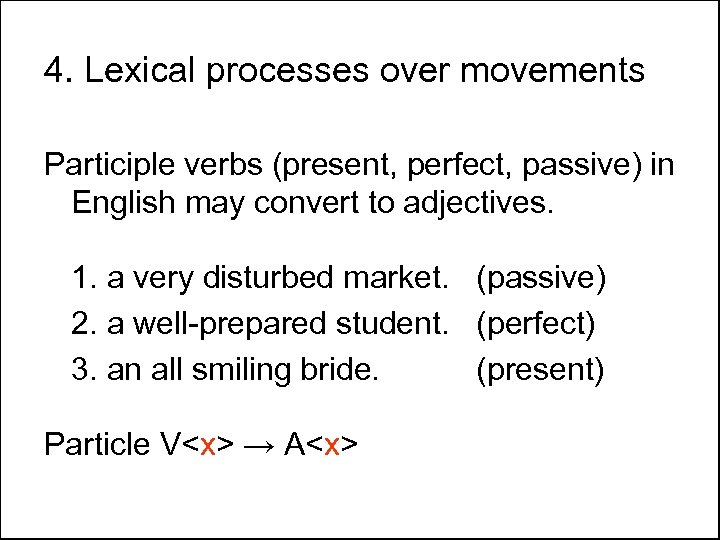 4. Lexical processes over movements Participle verbs (present, perfect, passive) in English may convert to adjectives. 1. a very disturbed market. (passive) 2. a well-prepared student. (perfect) 3. an all smiling bride. (present) Particle V
![4. Lexical processes over movements happy [x] TG was happy John Prediction: V[x] →](https://present5.com/presentation/7104da2ac241aca6f94640f4a4ef6d01/image-90.jpg "4. Lexical processes over movements happy [x] TG was happy John Prediction: V[x] →") 4. Lexical processes over movements happy [x] TG was happy John Prediction: V[x] → A[x], x undergoes movement
4. Lexical processes over movements happy [x] TG was happy John Prediction: V[x] → A[x], x undergoes movement
![4. Lexical processes over movements True for passive and unaccusative verbs disturbed [x y]](https://present5.com/presentation/7104da2ac241aca6f94640f4a4ef6d01/image-91.jpg "4. Lexical processes over movements True for passive and unaccusative verbs disturbed [x y]") 4. Lexical processes over movements True for passive and unaccusative verbs disturbed [x y] TG was disturbed the market
4. Lexical processes over movements True for passive and unaccusative verbs disturbed [x y] TG was disturbed the market
![4. Lexical processes over movements Not true for unergative verbs prepared [x] TG John](https://present5.com/presentation/7104da2ac241aca6f94640f4a4ef6d01/image-92.jpg "4. Lexical processes over movements Not true for unergative verbs prepared [x] TG John") 4. Lexical processes over movements Not true for unergative verbs prepared [x] TG John has prepared well V[x] → A[x], x undergoes no movement
4. Lexical processes over movements Not true for unergative verbs prepared [x] TG John has prepared well V[x] → A[x], x undergoes no movement
![4. Lexical processes over movements happy <x> LFG <SUBJ> John was happy Prediction: V[x]](https://present5.com/presentation/7104da2ac241aca6f94640f4a4ef6d01/image-93.jpg "4. Lexical processes over movements happy <x> LFG <SUBJ> John was happy Prediction: V[x]") 4. Lexical processes over movements happy
4. Lexical processes over movements happy
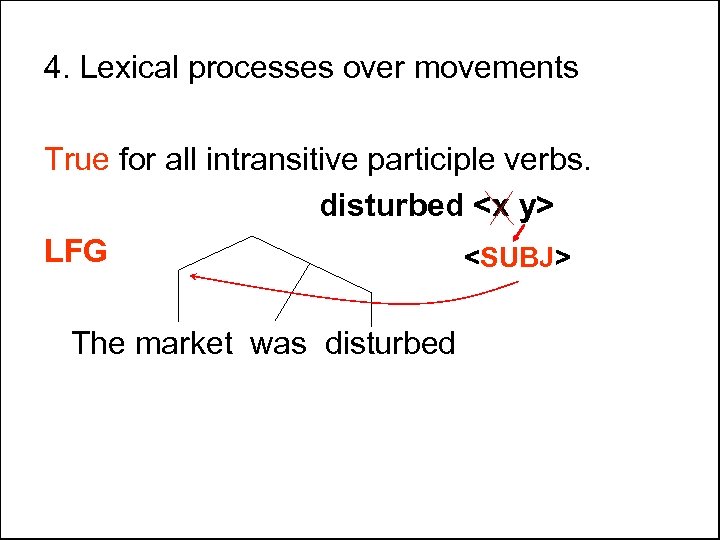 4. Lexical processes over movements True for all intransitive participle verbs. disturbed
 3) CONCLUSION The air-mattress metaphor
 Corpus Approach vs. Generative Approach and Movement vs. Grammatical Functions One-Soon Her 何萬順