 Скачать презентацию Corporate Social Responsibility The Concept Sandro Baričević President
f5a799de6593a4af12be02da7cb35a37.ppt
- Количество слайдов: 17



Corporate Social Responsibility The Concept Sandro Baričević President CPRA Communications & Public Affairs Manager Coca-Cola Adria d. o. o.
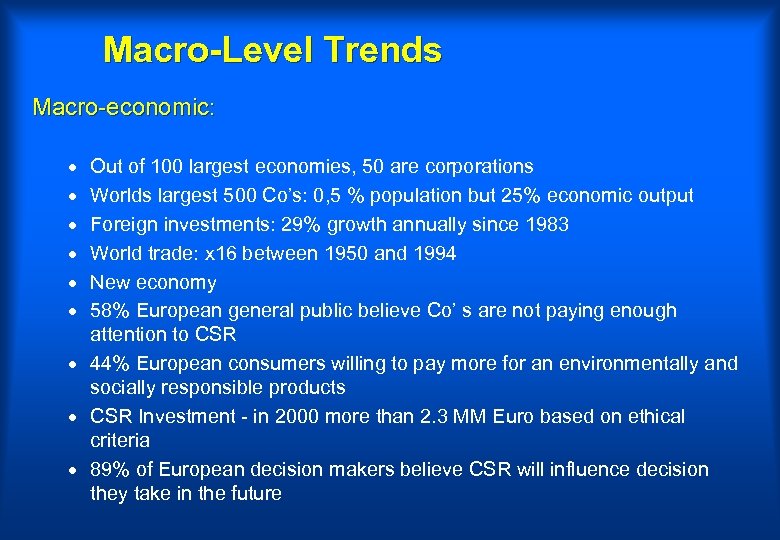
Macro-Level Trends Macro-economic: · · · Out of 100 largest economies, 50 are corporations Worlds largest 500 Co’s: 0, 5 % population but 25% economic output Foreign investments: 29% growth annually since 1983 World trade: x 16 between 1950 and 1994 New economy 58% European general public believe Co’ s are not paying enough attention to CSR · 44% European consumers willing to pay more for an environmentally and socially responsible products · CSR Investment - in 2000 more than 2. 3 MM Euro based on ethical criteria · 89% of European decision makers believe CSR will influence decision they take in the future
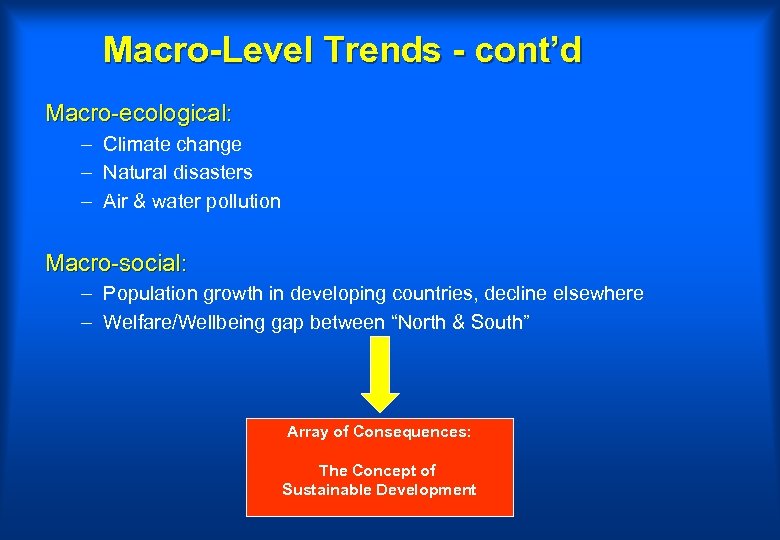
Macro-Level Trends - cont’d Macro-ecological: – Climate change – Natural disasters – Air & water pollution Macro-social: – Population growth in developing countries, decline elsewhere – Welfare/Wellbeing gap between “North & South” Array of Consequences: The Concept of Sustainable Development
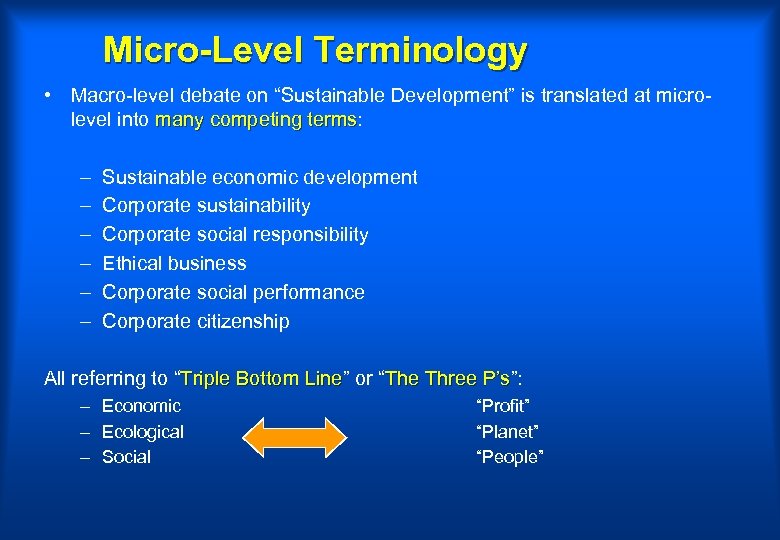
Micro-Level Terminology • Macro-level debate on “Sustainable Development” is translated at microlevel into many competing terms: terms – – – Sustainable economic development Corporate sustainability Corporate social responsibility Ethical business Corporate social performance Corporate citizenship All referring to “Triple Bottom Line” or “The Three P’s”: Line P’s – Economic – Ecological – Social “Profit” “Planet” “People”
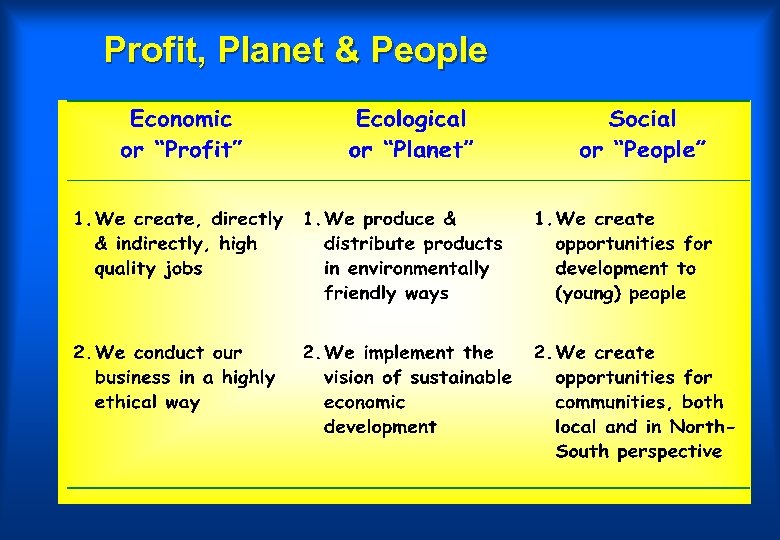
Profit, Planet & People
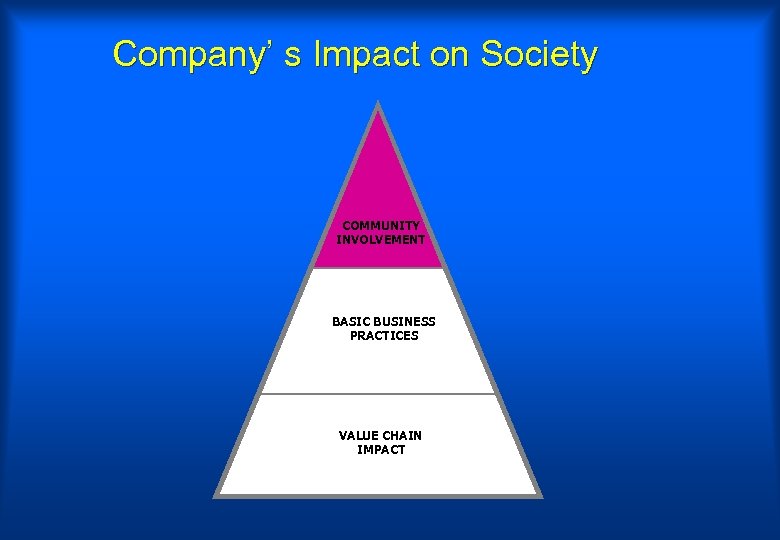
Company’ s Impact on Society COMMUNITY INVOLVEMENT BASIC BUSINESS PRACTICES VALUE CHAIN IMPACT
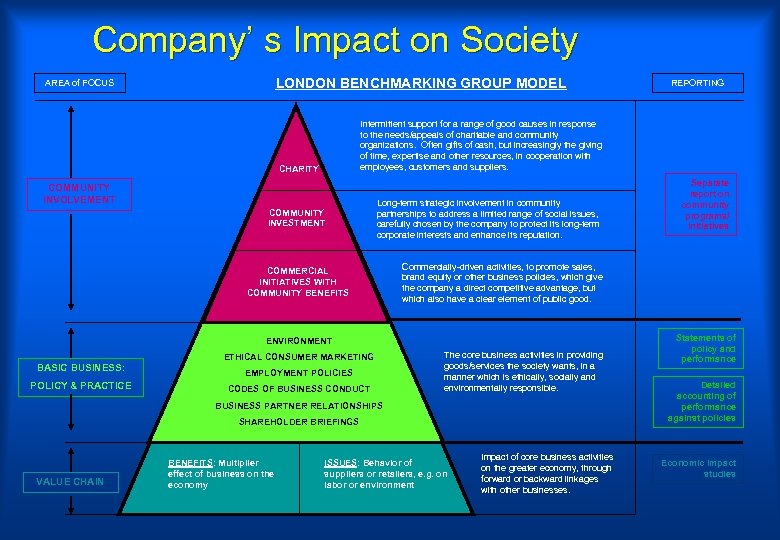
Company’ s Impact on Society LONDON BENCHMARKING GROUP MODEL AREA of FOCUS Intermittent support for a range of good causes in response to the needs/appeals of charitable and community organizations. Often gifts of cash, but increasingly the giving of time, expertise and other resources, in cooperation with employees, customers and suppliers. CHARITY COMMUNITY INVOLVEMENT COMMUNITY INVESTMENT Long-term strategic involvement in community partnerships to address a limited range of social issues, carefully chosen by the company to protect its long-term corporate interests and enhance its reputation. COMMERCIAL INITIATIVES WITH COMMUNITY BENEFITS ETHICAL CONSUMER MARKETING POLICY & PRACTICE EMPLOYMENT POLICIES CODES OF BUSINESS CONDUCT The core business activities in providing goods/services the society wants, in a manner which is ethically, socially and environmentally responsible. BUSINESS PARTNER RELATIONSHIPS SHAREHOLDER BRIEFINGS VALUE CHAIN BENEFITS: Multiplier effect of business on the economy Separate report on community programs/ initiatives Commercially-driven activities, to promote sales, brand equity or other business policies, which give the company a direct competitive advantage, but which also have a clear element of public good. ENVIRONMENT BASIC BUSINESS: REPORTING ISSUES: Behavior of suppliers or retailers, e. g. on labor or environment Impact of core business activities on the greater economy, through forward or backward linkages with other businesses. Statements of policy and performance Detailed accounting of performance against policies Economic impact studies
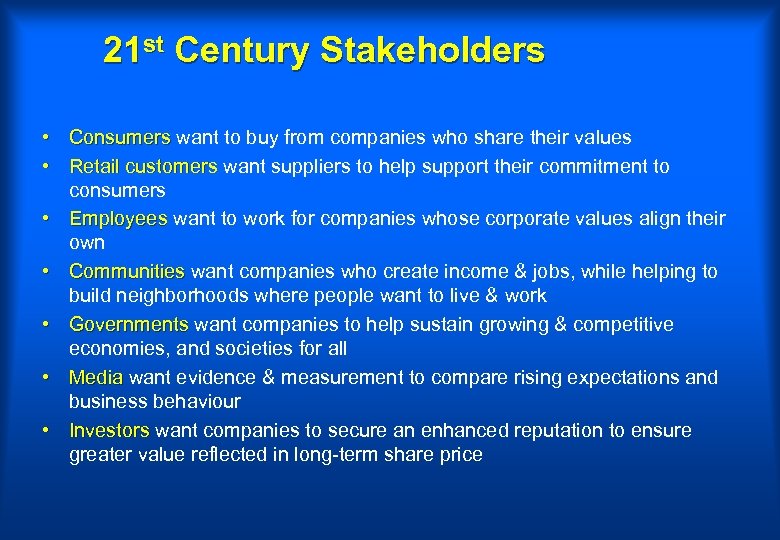
21 st Century Stakeholders • Consumers want to buy from companies who share their values • Retail customers want suppliers to help support their commitment to consumers • Employees want to work for companies whose corporate values align their own • Communities want companies who create income & jobs, while helping to build neighborhoods where people want to live & work • Governments want companies to help sustain growing & competitive economies, and societies for all • Media want evidence & measurement to compare rising expectations and business behaviour • Investors want companies to secure an enhanced reputation to ensure greater value reflected in long-term share price
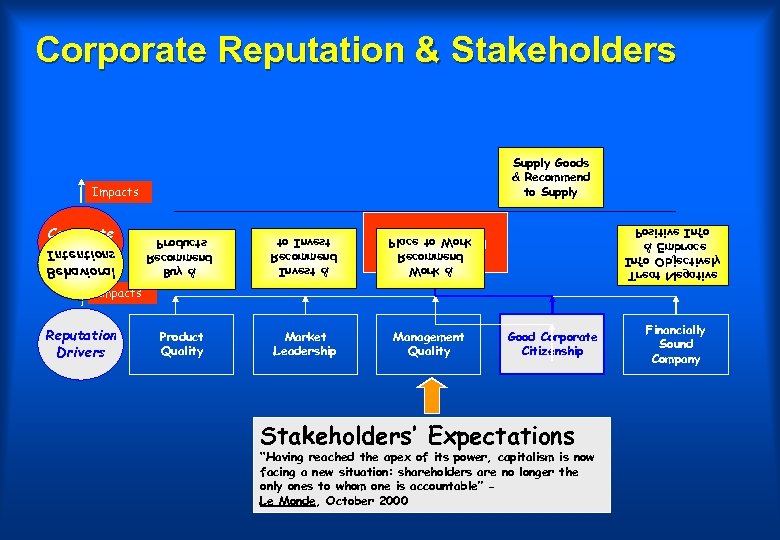
Corporate Reputation & Stakeholders Supply Goods & Recommend to Supply & yu. B dnemmoce. R stcudor. P & tsevn. I dnemmoce. R tsevn. I ot Product Quality Market Leadership Reputation & kro. W dnemmoce. R kro. W ot ecal. P Corporate Reputation evitage. N taer. T ylevitcejb. O ofn. I ecarbm. E & ofn. I evitiso. P Impacts laroivahe. B snoitnetn. I Impacts Reputation Drivers Management Quality Good Corporate Citizenship Stakeholders’ Expectations “Having reached the apex of its power, capitalism is now facing a new situation: shareholders are no longer the only ones to whom one is accountable” Le Monde, October 2000 Financially Sound Company
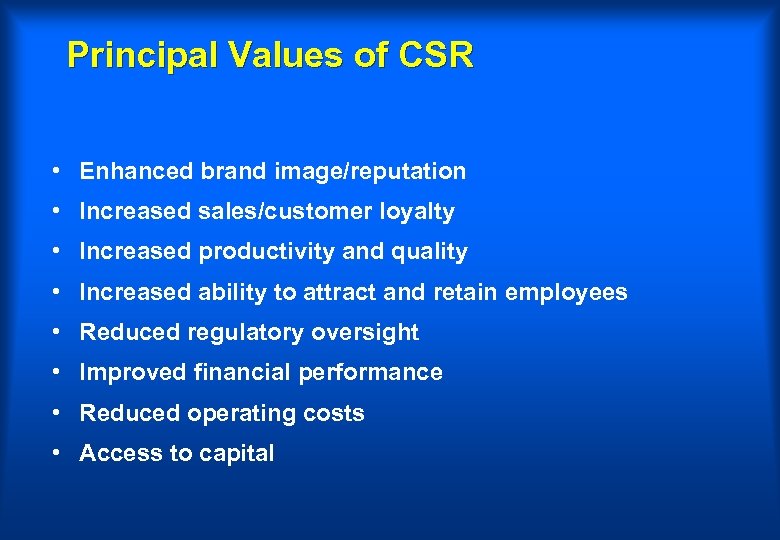
Principal Values of CSR • Enhanced brand image/reputation • Increased sales/customer loyalty • Increased productivity and quality • Increased ability to attract and retain employees • Reduced regulatory oversight • Improved financial performance • Reduced operating costs • Access to capital
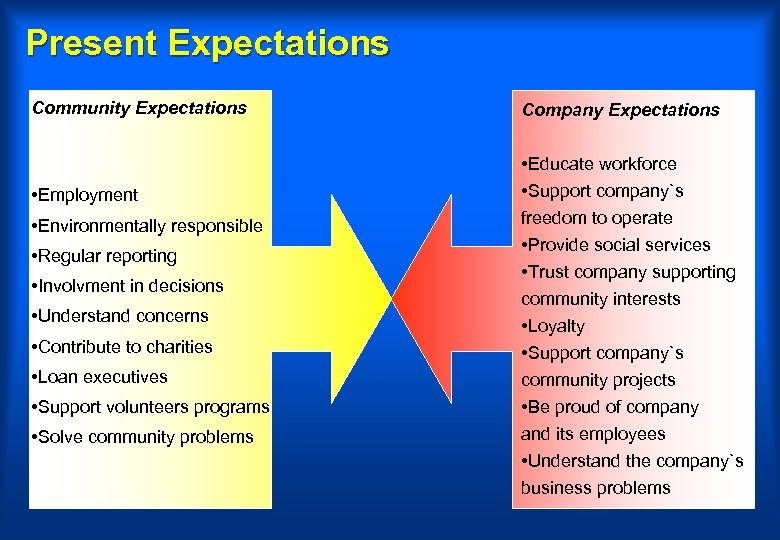
Present Expectations Community Expectations • Employment • Environmentally responsible • Regular reporting • Involvment in decisions • Understand concerns • Contribute to charities • Loan executives • Support volunteers programs • Solve community problems Company Expectations • Educate workforce • Support company`s freedom to operate • Provide social services • Trust company supporting community interests • Loyalty • Support company`s community projects • Be proud of company and its employees • Understand the company`s business problems
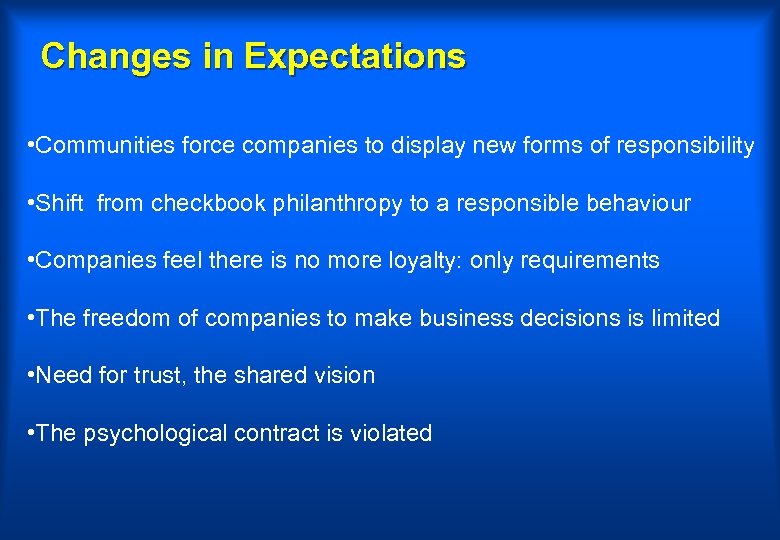
Changes in Expectations • Communities force companies to display new forms of responsibility • Shift from checkbook philanthropy to a responsible behaviour • Companies feel there is no more loyalty: only requirements • The freedom of companies to make business decisions is limited • Need for trust, the shared vision • The psychological contract is violated
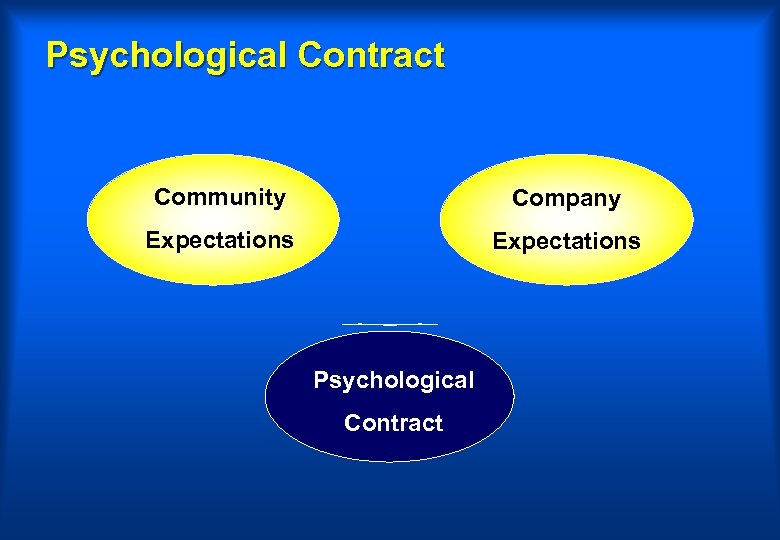
Psychological Contract Community Company Expectations Psychological Contract
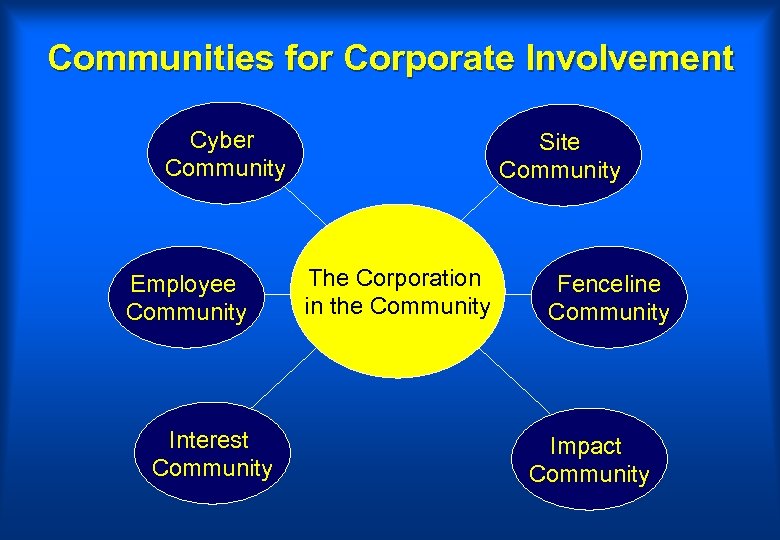
Communities for Corporate Involvement Cyber Community Employee Community Interest Community Site Community The Corporation in the Community Fenceline Community Impact Community
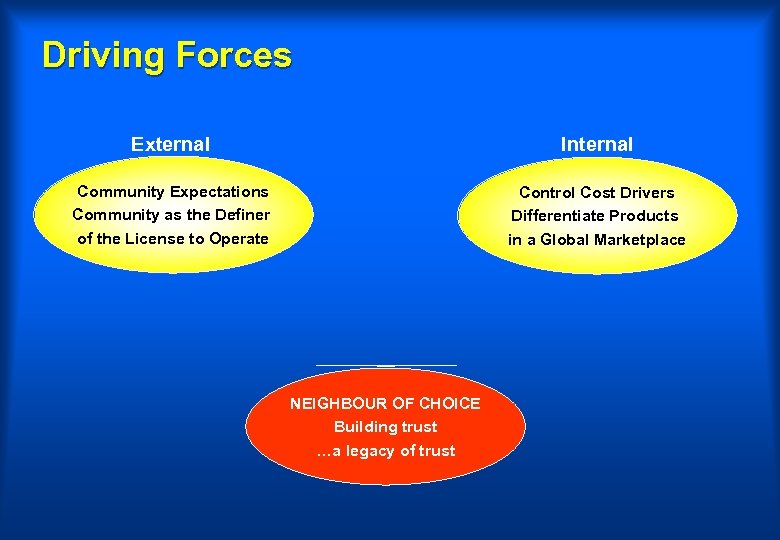
Driving Forces External Internal Community Expectations Community as the Definer of the License to Operate Control Cost Drivers Differentiate Products in a Global Marketplace NEIGHBOUR OF CHOICE Building trust …a legacy of trust
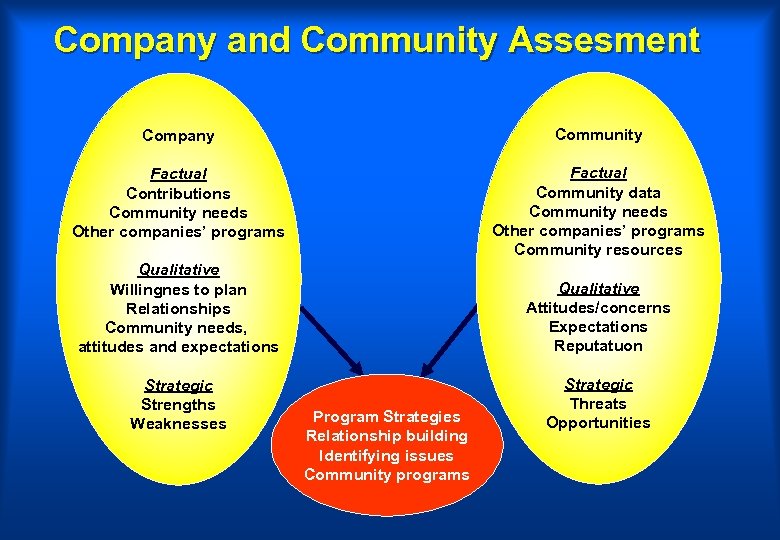
Company and Community Assesment Company Community Factual Contributions Community needs Other companies’ programs Factual Community data Community needs Other companies’ programs Community resources Qualitative Willingnes to plan Relationships Community needs, attitudes and expectations Qualitative Attitudes/concerns Expectations Reputatuon Strategic Strengths Weaknesses Strategic Threats Opportunities Program Strategies Relationship building Identifying issues Community programs
Considering Community Needs • Permanent and sustainable relations with key individuals, groups and organizations • Institutionalised procedures which anticipate the expectations of the community • Focus on problems and quality of life of social community
Скачать презентацию Corporate Social Responsibility The Concept Sandro Baričević President
f5a799de6593a4af12be02da7cb35a37.ppt