


 Скачать презентацию Corporate Law and Economics 3 Does law matter
Corporate Law and Economics 3.pptx
- Количество слайдов: 43
 Corporate Law and Economics 3: Does law matter for finance? Simon Deakin University of Cambridge Lectures at Moscow State University, September 2013
 New institutional economics • institutions, understood as rules, practices and routines of varying degrees of formality and embeddedness, matter to economic performance (North, Aoki) • legal rules affect economic growth according to how far they support market access, contract enforcement and the protection of property rights (La Porta et al. )
 ‘Law matters’ • A higher degree of shareholder protection through law encourages stock market development and dispersed share ownership (La Porta et al. 1998) • Rules protecting creditor rights promote banking development and the growth of private credit (Djankov et al, 2008) • Labour protection, by contrast, is mostly driven by rent-seeking (the protection of vested interests) and results in inefficiencies (higher unemployment and lower productivity, as well as a larger informal economy) (Botero et al. , 2004)
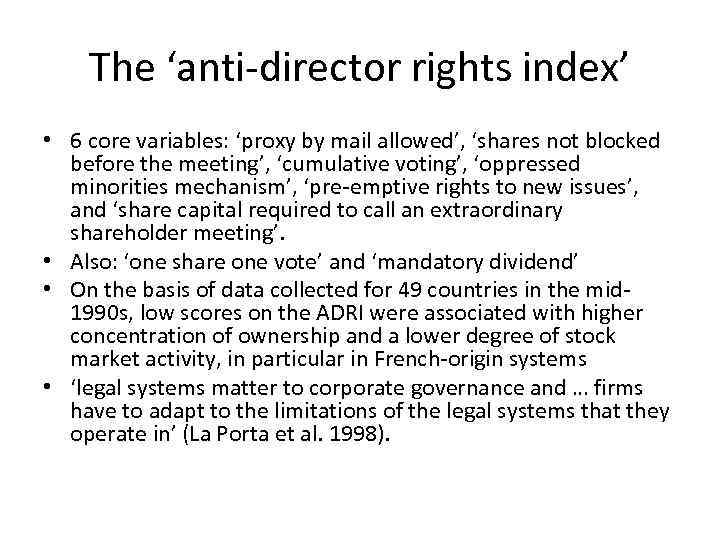 The ‘anti-director rights index’ • 6 core variables: ‘proxy by mail allowed’, ‘shares not blocked before the meeting’, ‘cumulative voting’, ‘oppressed minorities mechanism’, ‘pre-emptive rights to new issues’, and ‘share capital required to call an extraordinary shareholder meeting’. • Also: ‘one share one vote’ and ‘mandatory dividend’ • On the basis of data collected for 49 countries in the mid 1990 s, low scores on the ADRI were associated with higher concentration of ownership and a lower degree of stock market activity, in particular in French-origin systems • ‘legal systems matter to corporate governance and … firms have to adapt to the limitations of the legal systems that they operate in’ (La Porta et al. 1998).
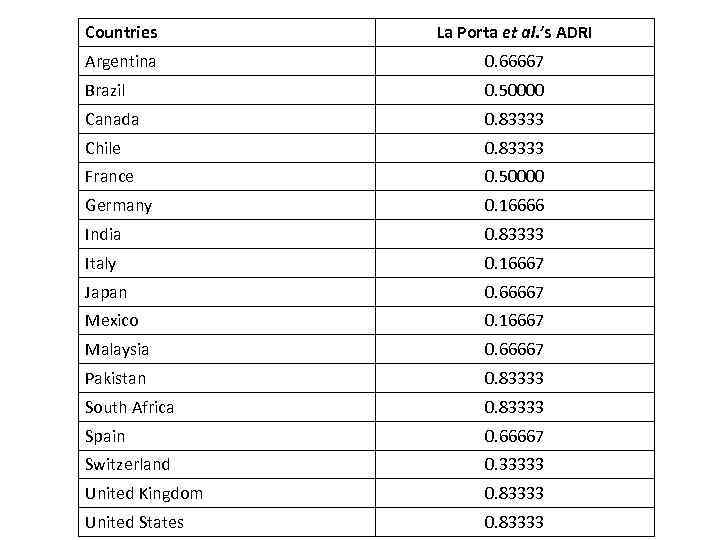 Countries La Porta et al. ’s ADRI Argentina 0. 66667 Brazil 0. 50000 Canada 0. 83333 Chile 0. 83333 France 0. 50000 Germany 0. 16666 India 0. 83333 Italy 0. 16667 Japan 0. 66667 Mexico 0. 16667 Malaysia 0. 66667 Pakistan 0. 83333 South Africa 0. 83333 Spain 0. 66667 Switzerland 0. 33333 United Kingdom 0. 83333 United States 0. 83333
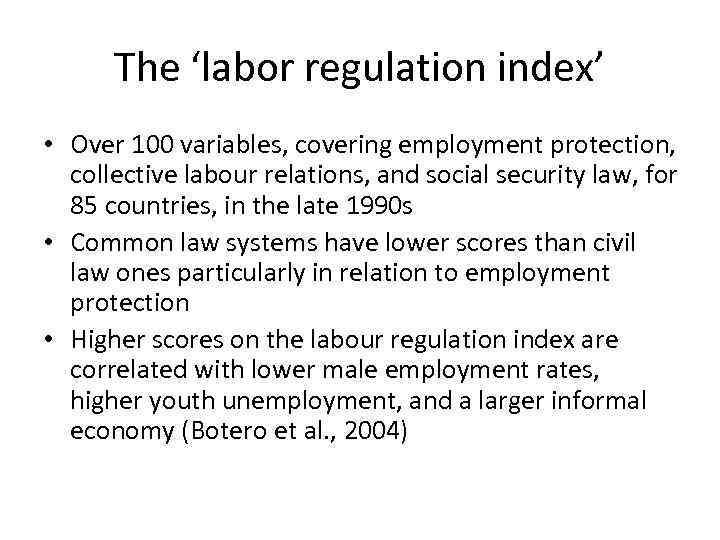 The ‘labor regulation index’ • Over 100 variables, covering employment protection, collective labour relations, and social security law, for 85 countries, in the late 1990 s • Common law systems have lower scores than civil law ones particularly in relation to employment protection • Higher scores on the labour regulation index are correlated with lower male employment rates, higher youth unemployment, and a larger informal economy (Botero et al. , 2004)
 Updated measures (mid-2000 s): anti selfdealing index, prospectus index, creditor rights index • Higher scores on the anti-self dealing index are correlated with increases in the stock-market/GDP ratio, the number of listed firms, and in ownership dispersion • The prospectus index scores are linked to lower control premia • Higher scores on the creditor rights index are correlated with an increase in the private credit/GDP ratio
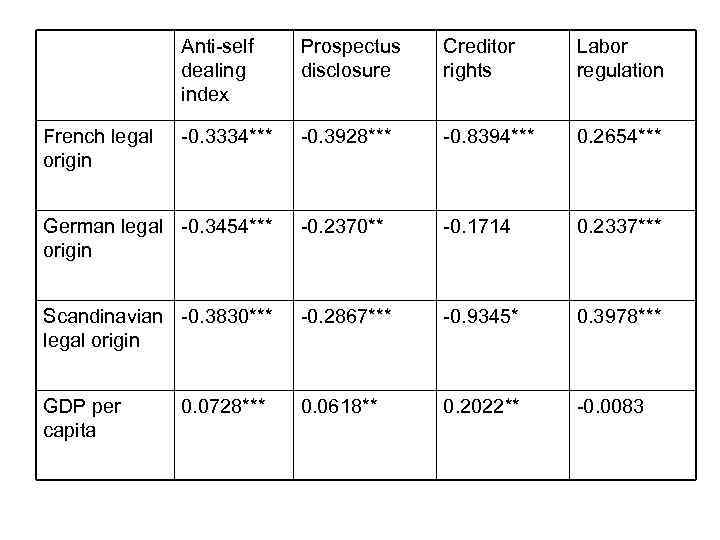 Anti-self dealing index Prospectus disclosure Creditor rights Labor regulation -0. 3334*** -0. 3928*** -0. 8394*** 0. 2654*** German legal -0. 3454*** origin -0. 2370** -0. 1714 0. 2337*** Scandinavian -0. 3830*** legal origin -0. 2867*** -0. 9345* 0. 3978*** GDP per capita 0. 0618** 0. 2022** -0. 0083 French legal origin 0. 0728***
 The ‘new comparative economics’ • There are significant variations across national regimes in all the areas of law which have been examined using the coding methods developed by LLSV, and these differences map on to the divide between common law and civil law legal families • Systems of common law origin provide higher levels of shareholder and creditor protection than those of the civil law and regulate the labour market less intensively
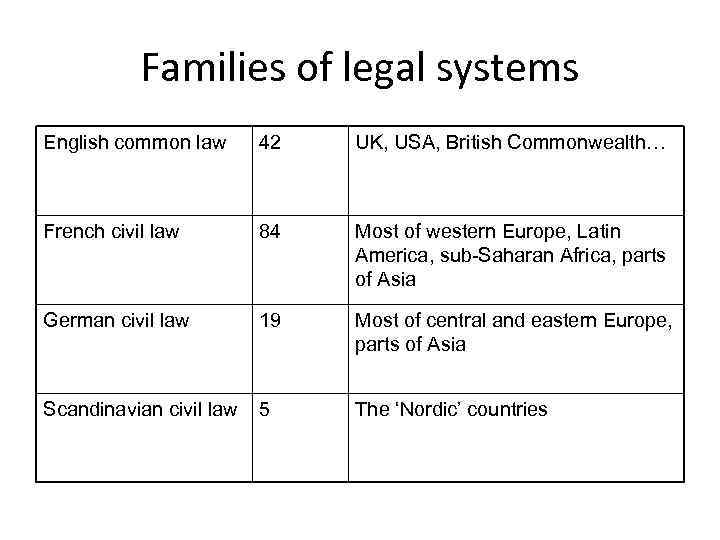 Families of legal systems English common law 42 UK, USA, British Commonwealth… French civil law 84 Most of western Europe, Latin America, sub-Saharan Africa, parts of Asia German civil law 19 Most of central and eastern Europe, parts of Asia Scandinavian civil law 5 The ‘Nordic’ countries
 The legal origin hypothesis • The content of legal rules is influenced by the infrastructure of the legal system, i. e. , the way that disputes are resolved, the relationship between the courts and the legislature, and the capacity of legal rules for adaptation. The nature of this ‘legal infrastructure’ varies across national systems, with the principal point of difference being the divide between the common law and civil law legal families (La Porta et al. 1997 -2007).
 Different approaches to market regulation • ‘We adopt a broad conception of legal origin as a style of social control economic life… Civil law is associated with a heavier hand of government ownership and regulation than common law…[and with] greater corruption, higher unemployment and larger informal economy… common law is associated with lower formalism of judicial procedures and greater judicial independence than civil law…[and] with greater contract enforcement and greater security of property rights’ (La Porta et al. , 2008: 286).
 Aggregate economic outcomes • Mahoney: faster GDP growth in common law countries than civilian ones post-1945 • But, German-origin systems grew faster than common law ones (with French-origin ones growing most slowly) • And Mahoney’s result largely disappears when standard controls (e. g. years of schooling) are put in (LLS, 2008) • Moreover, the result doesn’t hold for developed systems up to 1980 (Hall and Soskice) • Although common law systems have enjoyed faster growth than civil law ones since 1980, overall growth rates in 19802000 period are half those in the period 1960 -1980 (Blankenburg and Plesch) • ‘The Legal Origins Theory does not say that common law always works better for the economy (LLS, 2008: 309)
 Criticisms of the methods used to generate the empirical findings • Some values were incorrect and the approach to coding inconsistent (Cools, Braendle, Spamann) • Implicit weightings in the LLSV indices were not explained (Ahlering and Deakin) (cf, LLS, 2008: 291: ‘an important feature of [the cross-country] studies is that all countries received the same weight’) • Selection bias in the definition of the core variables (Siems) • Original results disappeared with more consistent coding (Spamann)… new approaches were tried including use of questionnaire evidence, apparently restoring the findings (Djankov et al. , 2008; La Porta et al. , 2008)… but these new data sources are also open to question • Over-reliance on cross-sectional data (but see LLS 2008: 299, reviewing some recent longitudinal studies)
 Criticisms of the explanations given for the observed effects • The description of the difference between the civil law and common law systems given in the new comparative economics is a caricature: ‘a superficial and outdated image of the differences between the common law and the civil law’ (Mattei) • Legislation is highly significant as a source of norms for the common law systems in the area of economic regulation (Ahlering and Deakin; but see above, response of LLS). • Civil law judges arguably have greater power to control outcomes than their common law counterparts, through the use of general clauses and similar interpretive devices (Pistor)
 Tentative conclusions • Legal systems are autonomous institutional phenomena with the potential to influence long-run patterns of economic development • But, the conventional distinction between the common law and the civil law is too crude to bear the weight being placed on it • The strong-form legal origin hypothesis seems hard to support because of legal variation over time and the lack of a consistently clear link between law and economic outcome variables • There is no straightforward relationship between the degree of regulation and whether a country has a common law or civil law origin; much depends on the legal context (contrasting results for shareholder and worker protection) • A weak-form version of the legal origin hypothesis may be plausible: the origins of legal infrastructure in a given system may make a difference to the substance of rules and to economic outcomes, but legal systems are likely to be endogenous, to some extent, to the political and economic contexts within which they operate, and the implications of origin for efficiency are unclear a priori
 Some questions • Can we adequately quantify differences in the content of legal rules? • What conclusions can be drawn from econometric analysis of correlations between legal change and economic outcomes? • What are the normative implications of the legal origin hypothesis?
 Empirical case study: does company law influence economic growth? • What is the contribution of financial markets to economic growth in developed and developing countries? • What is the contribution of the legal system in general, and of corporate law/governance in particular, to financial development and economic growth?
 Governance, finance and growth: the critical questions • What is the contribution of financial markets to economic growth in developed and developing countries? • What is the contribution of the legal system in general, and of corporate law/governance in particular, to financial development and economic growth?
 Legal origin and growth • Firms grow faster where they can access external finance (Levine, 1997) • Thus legal origin theory supports the claims that (1) legal reform is a means of promoting financial and economic development, and that (2) common law systems are better placed than civil law ones to generate market-driven growth, underpinned by law
 How law influences finance • A higher level of shareholder protection in a given country is correlated with more dispersed share ownership, a larger listed company sector, and a higher ratio of stock market values to GDP (La Porta et al. 1998) • ‘Legal systems matter to corporate governance and… firms have to adapt to the limitations of the legal systems that they operate in’ (ibid. ) • High scores on creditor protection index linked to growth of private (bank-based) credit: Djankov et al. , 2007 • But, these findings mostly based on cross-sectional data and inadequate coding of laws
 Three hypotheses • Convergence hypothesis: systems are converging at the level of formal law (formal convergence) and in terms of effects of law on financial development (functional convergence) • Complementarity hypothesis: legal and financial institutions co-evolved in a complementary way, reflecting local diversity • Transplant hypothesis: transfer of legal models from common law world to civil law world likely to encounter resistance
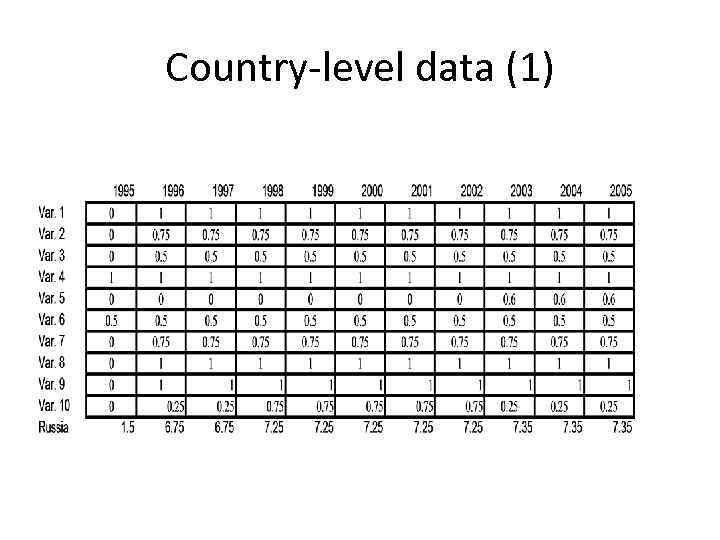
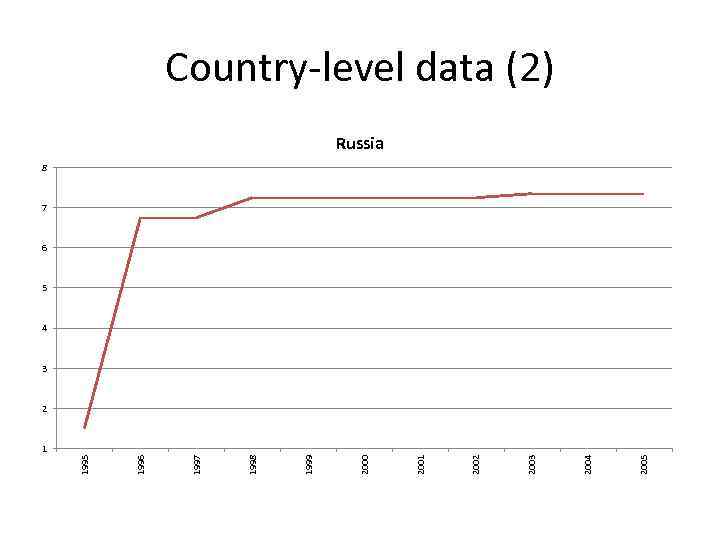
 New evidence on law and financial development • The datasets constructed by LLSV are deficient in presenting only a cross-sectional view of differences in the law across countries, as well as suffering from some coding errors • The development of more recent, longitudinal datasets by the CBR (Cambridge Centre for Business Research) makes it possible to introduce time-series element into the analysis of law and financial development: http: //www. cbr. cam. ac. uk/research/programme 2/proj ect 2 -20 output. htm • SPI and CPI, 25 countries, 1995 -2005
 The business judgment rule • In the United States, the courts have articulated the ‘business judgment’ rule, according to which the courts will not, in general, review decisions of the board taken in good faith in the interests of the company, with adequate information, and according to normal standards of prudence (similar conventions operate in the UK). • But the rule will not apply where there is selfdealing; and takeover bids may be special cases.
 Shareholder protection index 1. Powers of shareholder meeting 2. Agenda setting power 3. Proxy voting facilitated 4. One share one vote 5. Independent directors 6. Director dismissal 7. Derivative action 8. Action against majority shareholder 9. Mandatory bid 10. Block disclosure
 Country-level data (1)
 2005 2004 2003 2002 2001 2000 1999 1998 1997 1996 1995 Country-level data (2) Russia 8 7 6 5 4 3 2 1
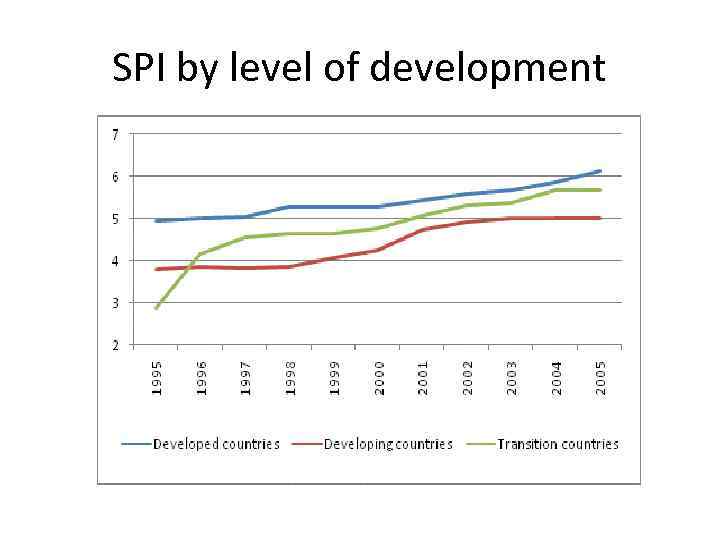 SPI by level of development
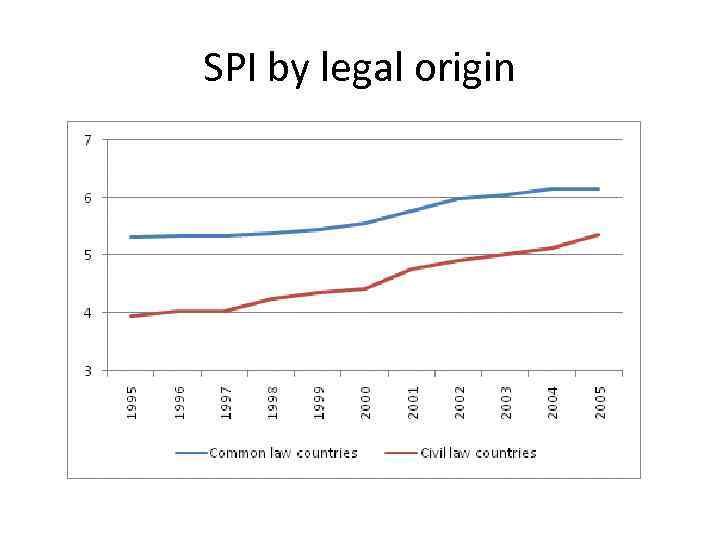 SPI by legal origin
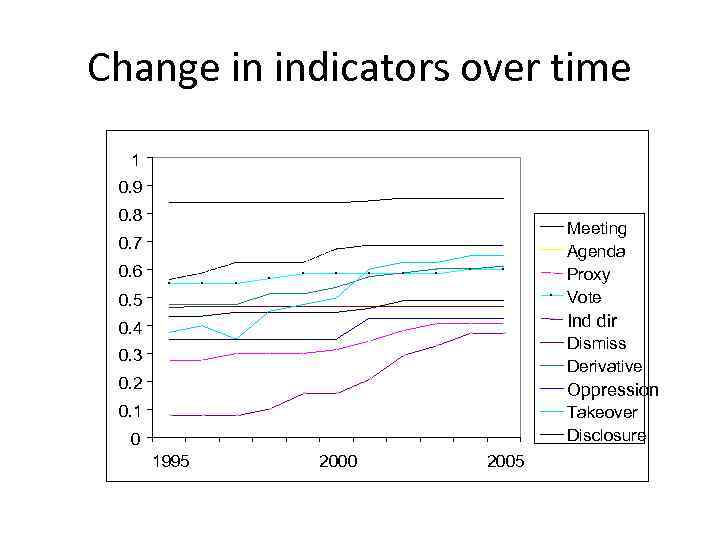 Change in indicators over time 1 0. 9 0. 8 0. 5 Meeting Agenda Proxy Vote 0. 4 Ind dir 0. 7 0. 6 Dismiss Derivative 0. 3 0. 2 Oppression 0. 1 Takeover Disclosure 0 1995 2000 2005
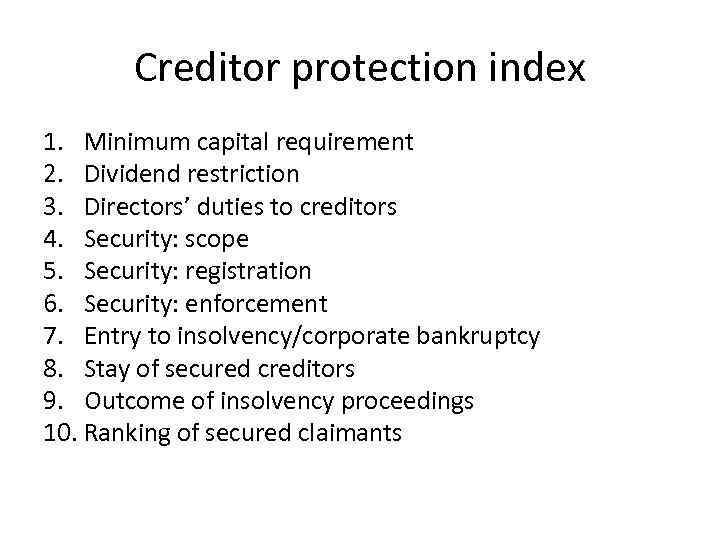 Creditor protection index 1. Minimum capital requirement 2. Dividend restriction 3. Directors’ duties to creditors 4. Security: scope 5. Security: registration 6. Security: enforcement 7. Entry to insolvency/corporate bankruptcy 8. Stay of secured creditors 9. Outcome of insolvency proceedings 10. Ranking of secured claimants
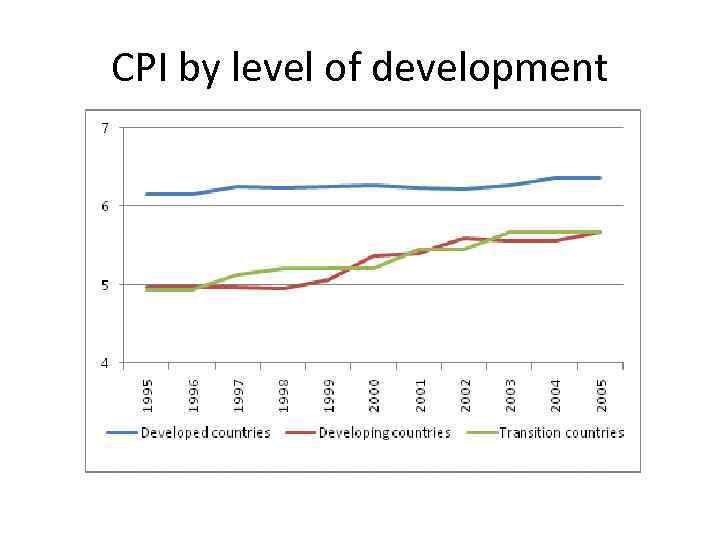 CPI by level of development
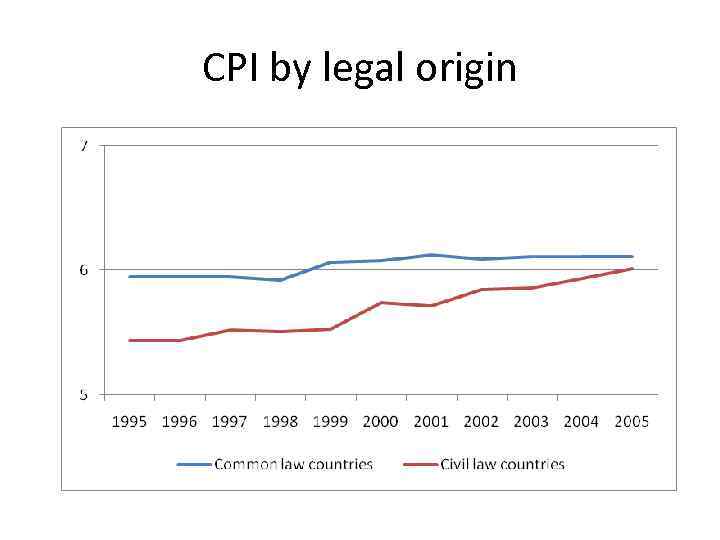 CPI by legal origin
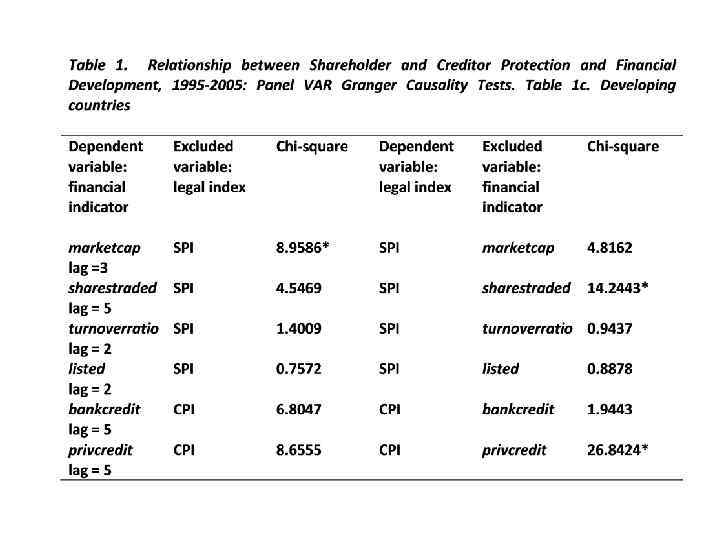
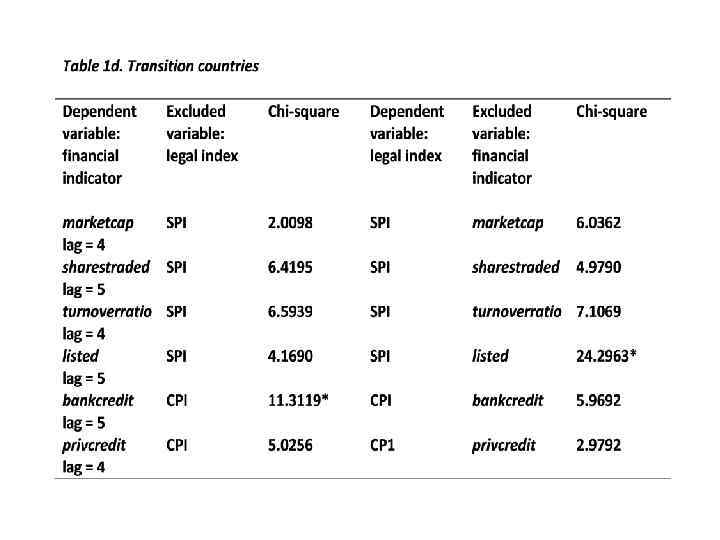
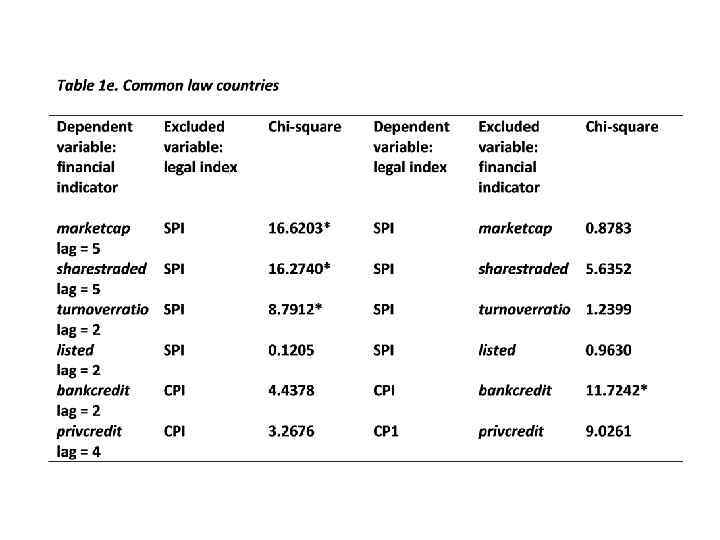
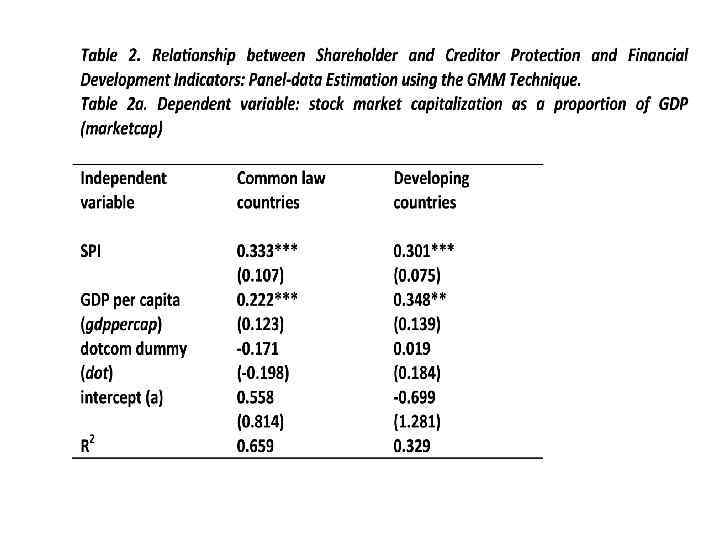
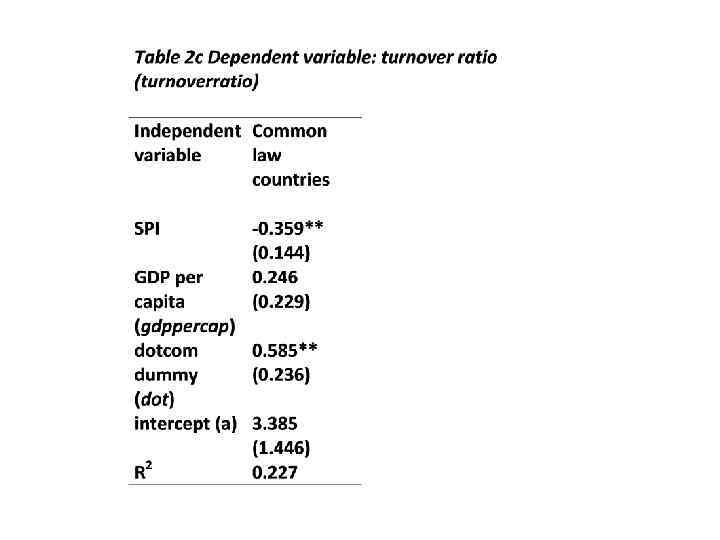
 Econometric analysis • Panel VAR Granger causality tests carried out to see whether changes in the SPI or CPI cause or are caused by financial development (as measured by stock market capitalisation/turnover and bank credit respectively), after controlling for rule of law, GDP level • Panel data estimation (GMM) technique used to clarify the nature of impacts (positive or negative)
 Model where Y is GDP per capita (in natural log), LPCY, RULE is the rule of law index, DOT is a dummy for dotcom bubble which takes the value zero for 1995 -2000 and 1 for the period, 2001 -2005, a is the fixed effect common across the panels and eit is the error term varying across time and panels. To choose the lags (p, q and r in the regression model) which indicate how many past years are to be considered, a number of possible approaches available (such as the sequential modified LR test statistic (LRM), the final prediction error approach (FPE), the Akaike information criterion (AIC), the Schwarz information criterion (SC), and the Hannan-Quinn information criterion (HQ)). Different criteria often choose different lag lengths and we have considered the maximum lag length. Similarly, to test whether X causes Z we interchange the position of X and Z in the above equation.
 Main finding • No evidence of law influencing financial development (or vice versa) for sample as a whole, but there are impacts if the sample is split by reference to level of development and legal origin
 Effects by level of development and legal origin • Increased shareholder protection linked to stock market growth in developing countries • But, increased shareholder protection linked to stock market bubbles in developed, common law countries
 Conclusions • Indeterminacy of legal change in driving economic outcomes • Formal, but not functional convergence • Evidence of complementarity between legal and financial institutions • Failure of transplanted laws to bed down in the civil law • But, some evidence of beneficial impacts in the developing and transition countries • Time to reassess Washington consensus? Need for more nuanced, context-specific approach