 Скачать презентацию Corporate Law and Economics 2 Takeover bids and
Corporate Law and Economics 2.pptx
- Количество слайдов: 38




Corporate Law and Economics 2: Takeover bids and hedge fund activism Simon Deakin University of Cambridge Lectures at Moscow State University, September 2013
Takeover bids: legal and regulatory issues • Economic considerations affecting takeover bids: the ‘market for corporate control’ • Differences in the nature and extent of hostile takeover activity across countries • The regulatory framework in the UK, compared to that in the US, EU and Japan • Empirical research on takeover bids ‘from the inside’ • Hedge fund activism: substitute for or complement to for takeover bids?

Economic considerations affecting takeover bids • Agency cost considerations: the hostile bid as the ‘great white shark’ of the corporate world encouraging ‘all the fish in the ocean to swim a little more quickly’ (UK investment banker interviewed in mid-1990 s as part of Cambridge project) • Macroeconomic considerations: ‘[i]t was impatient, valuefocused shareholders who did America a great favour by forcing capital out of its traditional companies, and thereby making it available to fund the venture capitalists and the Ciscos and Microsofts that are now in a position to propel our economy very rapidly forward’ (Larry Summers, 2001)
What is the source of takeover premiums? • Premiums paid by hostile bidders are on average in excess of 30% of the pre-bid price • Is greater operating efficiency the source of the surplus? Merged firms resulting from hostile bids show small, positive gains over time to bidder shareholders (mergers from agreed bids show, on average, declining performance) • Or is the premium generated by wealth transfers from other stakeholders (breach of trust hypothesis)? Laid-off employees on average suffer significant losses of earning capacity over time: evidence of firm-specific human capital?
Differences across countries • Hostile takeovers are much more prevalent and are much more likely to succeed in the UK and US than in Japan, France, or Germany • In Japan, the number of tender offers has been increasing, but numbers of hostile takeovers remain very low • The percentage of targets targeted for underperformance has gone up over time in Japan (admittedly on very small numbers) but fallen in the UK and US
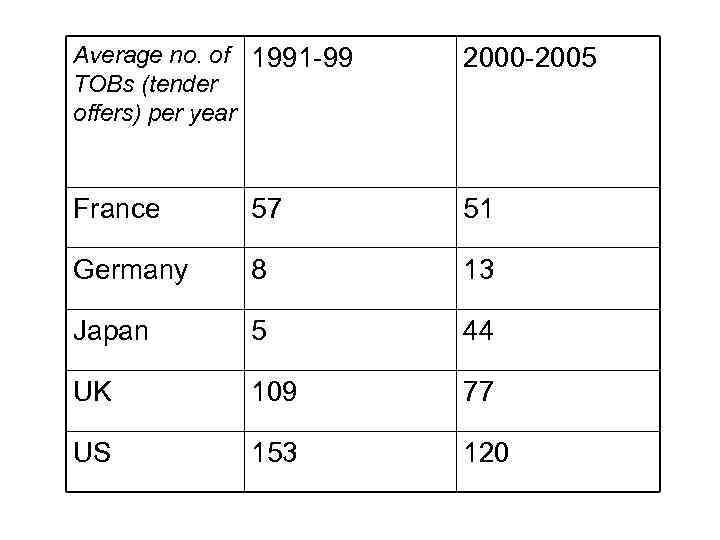
Average no. of 1991 -99 TOBs (tender offers) per year 2000 -2005 France 57 51 Germany 8 13 Japan 5 44 UK 109 77 US 153 120
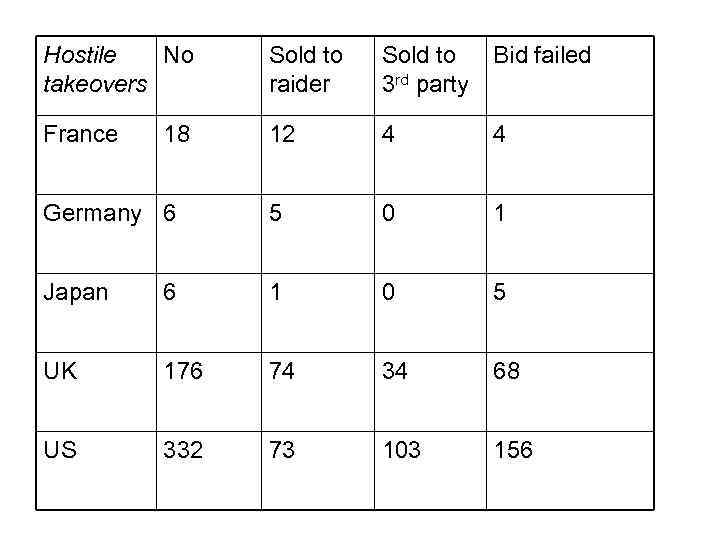
Hostile No takeovers Sold to raider Sold to 3 rd party Bid failed France 12 4 4 Germany 6 5 0 1 Japan 6 1 0 5 UK 176 74 34 68 US 332 73 103 156 18
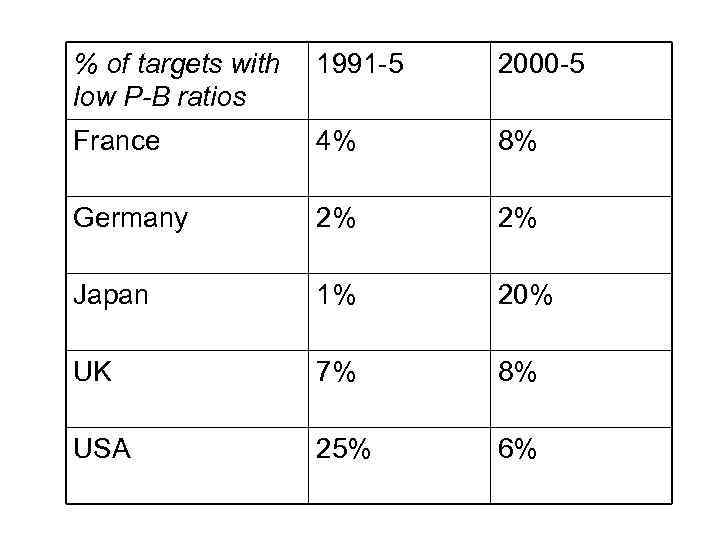
% of targets with low P-B ratios 1991 -5 2000 -5 France 4% 8% Germany 2% 2% Japan 1% 20% UK 7% 8% USA 25% 6%
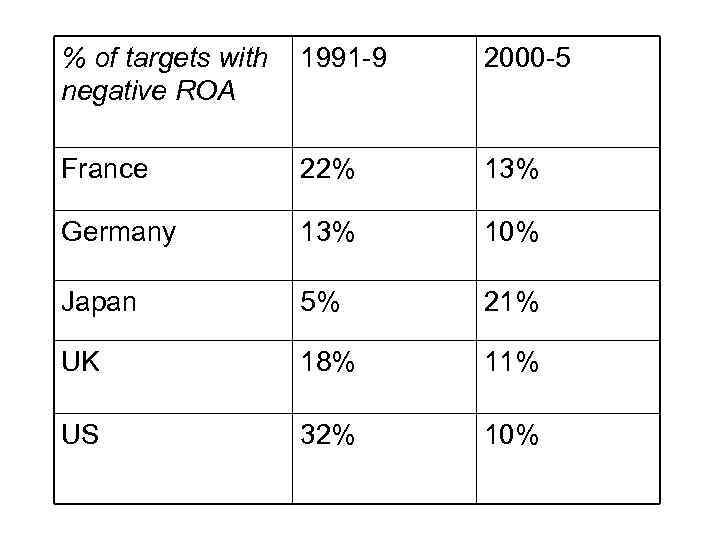
% of targets with negative ROA 1991 -9 2000 -5 France 22% 13% Germany 13% 10% Japan 5% 21% UK 18% 11% US 32% 10%
The regulatory framework • What should takeover regulation be trying to achieve? • How should boards respond to bids? • What are the main differences between countries?
Aims of takeover regulation • Protecting minority shareholders (cf. UK equal treatment rule; US rules on fiduciary duties) while also restricting the scope for shareholder ‘hold out’ (UK rules on squeeze outs) • Protecting companies from repeated bids (cf. UK bid timetable rules) • Ensuring transparency and a ‘level playing field’ in transnational capital markets (cf. ‘breakthrough rule’ in EC Takeover Directive) • Ensuring that managers of listed companies put shareholder interests first both before and during bids (UK ‘no frustration’ rule; EC board neutrality rule) • Protecting the autonomy of the board to respond to bids as it sees fit, if necessary by protecting ‘stakeholder’ interests (US position on ‘poison pills’)
How should boards respond to hostile takeovers? • Management passivity: duty of target board does not go beyond advising shareholders on the financial merits of the bid • Auction rule: poison pill permissible if it encourages a second bidder to enter the fray • ‘Breach of trust’: board has right to block bid if it is not in the company’s best long-term interests, given its impact on non-shareholder stakeholders; and/or, employees could be given veto or voice rights in relation to bids
The regulatory framework for takeover bids in the UK • Company law: directors owe duty to act in good faith in the interests of the company (not the shareholders: s. 172 CA 2006), but fiduciary duty law has limited significance in takeover bid context • Takeover Code: ‘soft law’ which imposes a bid timetable, a ‘no frustration’ rule (for post-bid defences), a ‘mandatory bid’ rule with 30% threshold, and a principle of ‘equal treatment’ of target shareholders • Other features of UK corporate governance practice are relevant in limiting pre-bid defences: pre-emption rules (in Listing Rules), widespread practice of one-share, one vote • Squeeze-out right for last 10% of shares: deals with danger of minority shareholder hold-out (CA 2006) • Statutory buy-out right for last 10% protects shareholders who failed to respond to tender offer (CA 2006)
Anti-poison pill rules: general prohibitions • ‘The board of an offeree company must act in the interests of the company as a whole and must not deny the holders of securities the opportunity to decide on the merits of the bid. ’ (General Principle 3) • ‘During the course of an offer, or even before the date of the offer if the board of the offeree company has reason to believe that a bona fide offer might be imminent, the board must not, without the approval of the shareholders in general meeting: — (a) take any action which may result in any offer or bona fide possible offer being frustrated or in shareholders being denied the opportunity to decide on its merits…’
Specific prohibitions • In addition, the Board must not: ‘(i) issue any shares or transfer or sell, or agree to transfer or sell, any shares out of treasury; (ii) issue or grant options in respect of any unissued shares; (iii) create or issue, or permit the creation or issue of, any securities carrying rights of conversion into or subscription for shares; (iv) sell, dispose of or acquire, or agree to sell, dispose of or acquire, assets of a material amount; or (v) enter into contracts otherwise than in the ordinary course of business’ (Rule 21. 1)
The regulatory framework for takeover bids in the US • Williams Act: imposes disclosure requirements and duty to make public tender offer under certain circumstances (not a mandatory bid rule, although tendering shareholders must be treated equally i. e. on a pro-rata basis) • A poison pill (shareholder rights plan) is permitted under Delaware law, but subject to general fiduciary duty law (board may have to redeem the pill under certain circumstances) • ‘Constituency’ statutes at state level: unclear how effective in practice
Directors’ duties in the US • Failure of board properly to evaluate a takeover bid can lead to a breach of the duty of care, actionable by the shareholders: Smith v. Van Gorkom (note also the aspect of self-dealing in this case) • During a takeover bid, the ‘business judgment rule’ is suspended in favour of an obligation to show ‘good faith and reasonable investigation’: Revlon. • The board may be under a duty to ‘redeem’ the poison pill if a high enough offer is made and a sale becomes inevitable: Revlon
Treatment of stakeholders under Delaware law • ‘A board may have regard for various constituencies in discharging its responsibilities, provided that there are rationally related benefits accruing to the stockholders… However, such concern for nonstockholder interests is inappropriate when an auction among active bidders is in process, and the object is no longer to maintain or protect the corporate enterprise but to sell it to the highest bidder’ (Revlon)
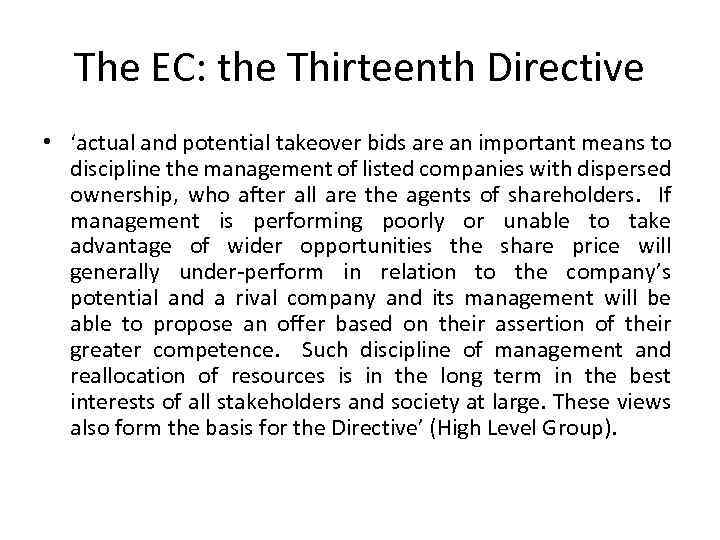
The EC: the Thirteenth Directive • ‘actual and potential takeover bids are an important means to discipline the management of listed companies with dispersed ownership, who after all are the agents of shareholders. If management is performing poorly or unable to take advantage of wider opportunities the share price will generally under-perform in relation to the company’s potential and a rival company and its management will be able to propose an offer based on their assertion of their greater competence. Such discipline of management and reallocation of resources is in the long term in the best interests of all stakeholders and society at large. These views also form the basis for the Directive’ (High Level Group).
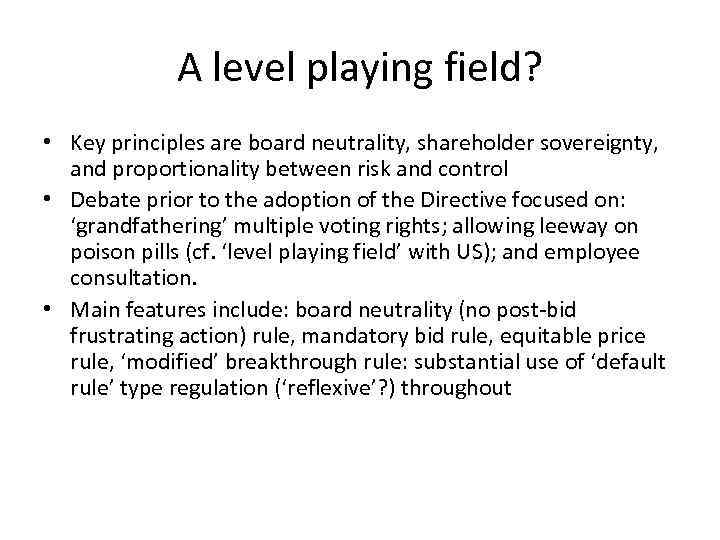
A level playing field? • Key principles are board neutrality, shareholder sovereignty, and proportionality between risk and control • Debate prior to the adoption of the Directive focused on: ‘grandfathering’ multiple voting rights; allowing leeway on poison pills (cf. ‘level playing field’ with US); and employee consultation. • Main features include: board neutrality (no post-bid frustrating action) rule, mandatory bid rule, equitable price rule, ‘modified’ breakthrough rule: substantial use of ‘default rule’ type regulation (‘reflexive’? ) throughout
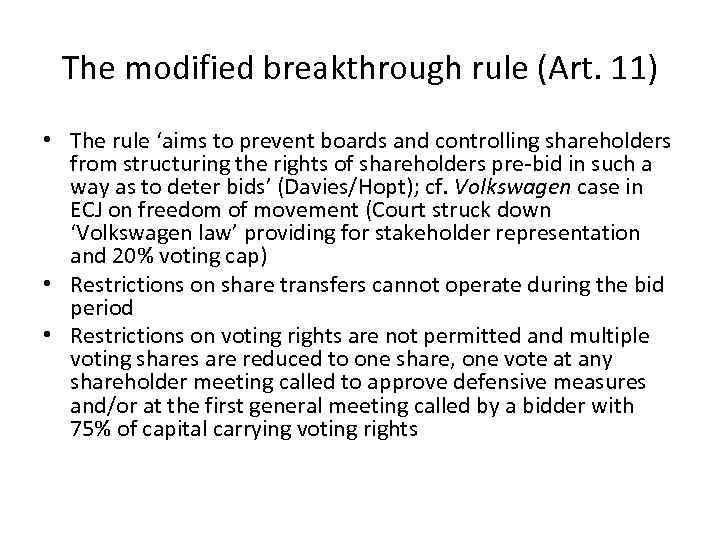
The modified breakthrough rule (Art. 11) • The rule ‘aims to prevent boards and controlling shareholders from structuring the rights of shareholders pre-bid in such a way as to deter bids’ (Davies/Hopt); cf. Volkswagen case in ECJ on freedom of movement (Court struck down ‘Volkswagen law’ providing for stakeholder representation and 20% voting cap) • Restrictions on share transfers cannot operate during the bid period • Restrictions on voting rights are not permitted and multiple voting shares are reduced to one share, one vote at any shareholder meeting called to approve defensive measures and/or at the first general meeting called by a bidder with 75% of capital carrying voting rights
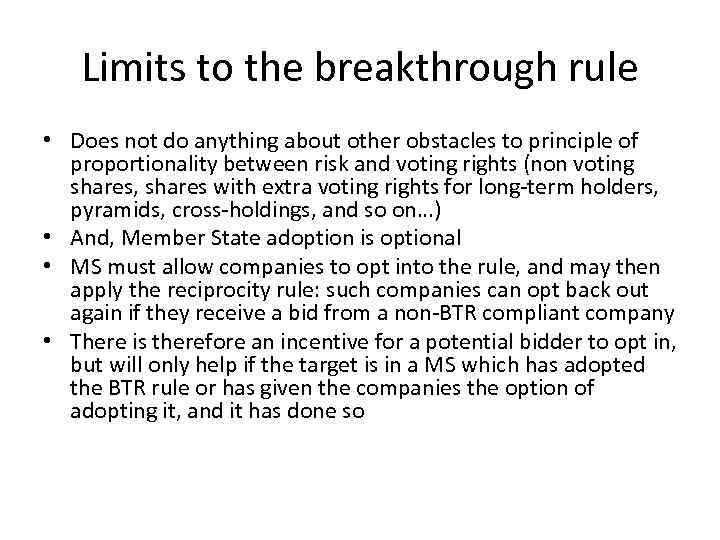
Limits to the breakthrough rule • Does not do anything about other obstacles to principle of proportionality between risk and voting rights (non voting shares, shares with extra voting rights for long-term holders, pyramids, cross-holdings, and so on…) • And, Member State adoption is optional • MS must allow companies to opt into the rule, and may then apply the reciprocity rule: such companies can opt back out again if they receive a bid from a non-BTR compliant company • There is therefore an incentive for a potential bidder to opt in, but will only help if the target is in a MS which has adopted the BTR rule or has given the companies the option of adopting it, and it has done so
Implementation • Board neutrality rule (control of post-bid defences): majority of MSs have made it mandatory (so there is a shareholder approval condition), but some of them have qualified it by allowing companies to opt out on the basis of reciprocity • BTR (control of pre-bid defences): only mandatory in Baltic states and Italy • Mandatory bid rule: subject to different thresholds and to exceptions in a number of MSs
Takeover bids in Japan • Tension between legal model (joint stock company), changing ownership structure, and concept of Japanese firm as ‘social institution’ (or ‘community firm’)? • Significance of court rulings in Livedoor and Bull-Dog Sauce cases • Concept of ‘corporate value’ not the same as ‘shareholder value’ • No equivalent to UK Takeover Code or board neutrality principle in EC Directive • Widespread adoption of poison pills by companies following the Livedoor ruling • Closer to US practice on poison pills, but is their function different in the two countries?
Tokyo High Court on Livedoor bid • ‘The issue of new shares, etc. , by the directors – who are appointed by the shareholders – for the primary purpose of changing the composition of those who appoint them clearly contravenes the intent of the Commercial Code and in principle should not be allowed. The issue of new shares for the entrenchment of management control cannot be countenanced because the authority of the directors derives from trust placed in them by the owners of the company, the shareholders. The only circumstances in which a new rights issue aimed primarily at protecting management control would not be unfair is when, under special circumstances, it aims to protect the interests of shareholders overall. ’ • But: defences permissible in the cases of greenmail, asset stripping, leveraged buy-out, share price manipulation

CVSG 2005 report on ‘corporate value’ and CV Guidelines • ‘The price of a company is its corporate value, and corporate value is based on the company’s ability to generate profits. The ability to generate profits is based not only on managers’ abilities, but is influenced by the quality of human resources of the employees, their commitment to the company, good relations with suppliers and creditors, trust of customers, relationships with the local community, etc. Shareholders select managers for their ability to generate high corporate value, and managers respond to their expectations by raising corporate value through creating good relations with various stakeholders. What issue in the case of a hostile takeover is which of the parties - the bidder or the incumbent management - can, through relations with stakeholders, generate higher corporate value. ’
Takeover defences • 2005 Company Law contained new powers to put in place takeover defences, including issuing of shares issued with special voting rights, poison pills (rights issues), golden shares • In 2005, 118 companies surveyed by Shoji homu (6. 0%) had adopted takeover defences in 2005 and 860 (44. 4%) were not considering them. In 2006 the proportions were 8. 8% and 44. 3% respectively, and in 2007 they were 14. 5% and 43. 3%. In 2008, 213 companies intended to introduce them in June shareholder meetings, one third of which required changes to articles through special resolution • CV Guidelines: defences permissible subject to (Delaware-like) ‘threat’ and proportionality’ principles
Bull-Dog Sauce Case • May 2007: having acquired a 10. 3% stake, Steel Partners launched an unsolicited tender offer for 100% of Bull-Dog’s shares. • Annual shareholders meeting passed a special resolution proposing the issue of warrants at a ratio of three per share, which could be exercised by all except Steel Partners, who would receive an equivalent amount in cash compensation, but would see its stake diluted to under 3%.
Tokyo District Court ruling • ‘Even if a particular shareholder suffers a decline in its shareholder ratio owing to discriminatory terms placed on the exercise or acquisition of stock warrants distributed to shareholders, when the decision to issue said stock warrants is made by special resolution at the general shareholders’ meeting, and shareholders are properly and equally compensated in proportion to the number of shares they own, said stock warrants do not violate the principle of equal treatment of shareholders’
Tokyo High Court ruling • ‘An “abusive” acquirer, with the intention of buying up shares for its own benefit as a majority shareholder, engages in abusive company management or control, without due regard to the sound management of the company. This leads to a damaging of said company’s enterprise value or a harming of the common interests of shareholders. That such an abusive acquirer would be subject to discriminatory treatment as a shareholder is unavoidable’
Supreme Court ruling • ‘To protect the interests of individual shareholders, the company is obligated to treat shareholders fairly based on the type and number of shares they hold, but since individual shareholders’ interests are normally inconceivable without an ongoing and thriving company, if there is a risk that the acquisition of management control by a particular shareholder would damage the company’s enterprise value, such as interfering with the company’s survival or growth, or would harm the company’s interests or the common interests of shareholders, discriminatory treatment of said shareholder aimed at preventing such acquisition cannot be immediately construed as a violation of the intent of said principle unless said treatment is unreasonable and contrary to the equal treatment principle’
J-Power • 2006 -2008 TCI intervened in J-Power • Large company: market cap exceeded net assets, net debt, low ratio of assets in cash or investments • 2007 AGM proposal: more than double dividend ~ defeated • 2008 AGM proposal: increased dividend, share buy-back, reduced corporate holdings, appointment of external directors ~ defeated • Request to exceed 10% limit on utility shares held by a nonresident rejected by authorities • TCI exited at a loss in October 2008 32
Reactions to hedge fund activism in Japan • Managers opposed concept of quest for higher returns: • “We realize that, obviously, they chose [us] as an investment target purely as a means to raise their own returns and that all this talk of ‘improving the company’ was just talk” • Managers opposed concept of shareholder priority: • “There’s not a single employee in our company who thinks he is working for the shareholders. The attitude is that this is hard work and we’re doing it for our customers. ” • Stable shareholders value relationships, not dividends: • “…since their shareholder value is being maximised they have no complaints and, in that sense, from the viewpoint of these shareholders, ‘maximising shareholder value’ is the wrong way to manage things” 33

The aftermath • TCI gone; Steel Partners retrenched from late 2008 • Other funds less obviously active, though still present • Financial crisis appears to vindicate cautious strategies; concept of stripping out “excess” value discredited. • But some issues remain: • How to regard portfolio investors? Fund partner: “To call the funds ‘short- • term’ is to have a massive neglect for why you have a stock market in the first place. The stock market is to trade, so if you push their logic to the very end, which is that everyone is ‘long-term’ – meaning they don’t sell their shares – then there is no stock market” Trend to higher distribution - Target CEO: “After all, there’s no such thing as an investor that says he does not want an increased dividend” • The external supervision debate has been revived - Press comment: “Equity investors and corporate management are at odds over the question of how to ensure an adequacy of external directors” 34
CVSG 2008 report • Role of takeover defences should be to protect shareholder interests • Board should take a view on the merits of the bid and not pass the buck to shareholders • Unsolicited bids can improve corporate value and governance • Corporate value should be defined with reference to cash flow and not be used to entrench management
Takeover bids from the inside: evidence for the UK and Japan • Inconclusiveness of econometric studies suggests role for qualitative research • Non-random sample of 15 bids mounted in period 1993 -96 (hostile and agreed; UK only, international; cash only, shares (and cash)) • Interviews with directors, bankers, lawyers, institutional investors, union representatives, aimed at understanding perceptions of bid process • Sample re-examined 5 years on to see how the merged firm was perceived to have performed
Attitudes to TOBs in Japan • ‘I’m not quite sure whether shutting out these sorts of opportunities [i. e. bid approaches] can really be called “corporate defence”. However - this is a Japanese sort of environment - the fact is that 6, 000 people are working in our group and hitherto they have always had a great feeling of confidence and attachment towards the management. Accordingly, with regard to philosophy, even if for the sake of argument someone were to appear with a philosophy that was even more elevated than ours, I would be very worried and doubtful as to whether these employees who are currently contributing their confidence and attachment to us would continue to do so in the same way for them’ (executive interviewed by Buchanan and Deakin) • ‘It is a mistake to think only of the interests of shareholders. Raising benefits to stakeholders such as employees, suppliers, customers and the local community accords with the overall interests of shareholders’ (Tokyo District Court judge in Livedoor case)
Evaluation • Negative distributional implications of hostile bids for producer interests create danger of zero-sum game • Lack of ‘credible commitment’ from shareholders to uphold ‘implicit contracts’ of employees and suppliers • More evidence needed on implications for human capital • Are TOBs in the long-run interests of shareholders? • Is hedge fund activism a viable alternative to TOBs?
Скачать презентацию Corporate Law and Economics 2 Takeover bids and
Corporate Law and Economics 2.pptx