 Скачать презентацию Corporate Governance Trends in OECD Countries OECD World Bank
c21a48df087d71162ede5da7dda60290.ppt
- Количество слайдов: 22



Corporate Governance Trends in OECD Countries OECD/World Bank Asian Roundtable on Corporate Governance Hong Kong, China 31 May-2 June 2000 Stephen Davis
Context of Change n Epic transition in OECD area as the state withdraws from economies n Who replaces the state? To whom are corporations or funds accountable? How can companies be best shaped to succeed?
Catalysts n Foreign Money: Transmission belt sending corporate governance values across borders n Failures & Scandals: Corporate collapses and misdeeds expose need for owner oversight n Stagnation: Unemployment, crony capitalism, under-performance turn focus to shareholder value
n Lowered Trade Barriers: To survive, firms need low-cost capital, forcing appeal to investors n Privatization: Sales of state-owned enterprises have handed institutional investors new powers n Pension Bomb: Demographic pressure on equitydriven pension funds to boost returns
Key Trends in OECD Corporate Governance n n n Benchmarks Convergence Disclosure Shareowner Intervention Fund Governance
Benchmarks: International n n G 7—Richest nations name corporate governance newest pillar of global economic architecture OECD developed first global standards, but noncompliance by members is found common World Bank/IMF/Financial Stability Forum— Good corporate governance part of emerging market recovery Asia-Pacific Economic Cooperation Forum, PECC, Asian Corporate Governance Assoc.
n n n n IOSCO IFAC International Corporate Governance Network Commonwealth Assoc for Corporate Gov. EBRD EASD Euroshareholders Guidelines Private sector: S&P, Déminor, ISS Australia, Governance. Metrics, State Street
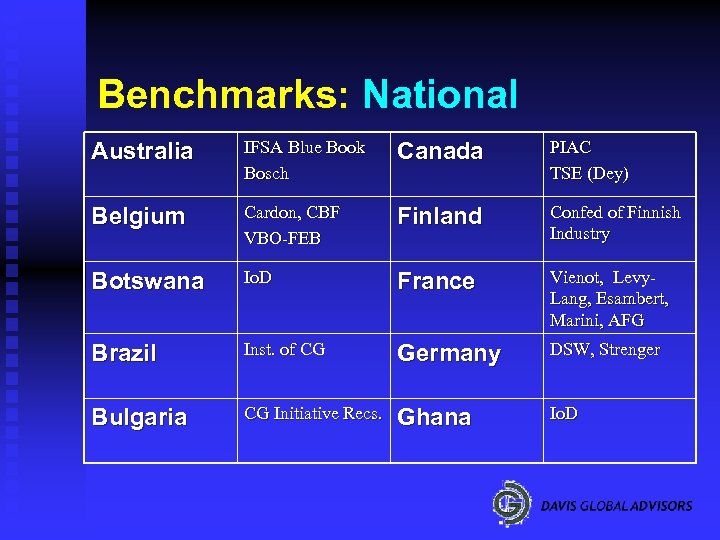
Benchmarks: National Australia IFSA Blue Book Bosch Canada PIAC TSE (Dey) Belgium Cardon, CBF VBO-FEB Finland Confed of Finnish Industry Botswana Io. D France Vienot, Levy. Lang, Esambert, Marini, AFG Brazil Inst. of CG Germany DSW, Strenger Bulgaria CG Initiative Recs. Ghana Io. D
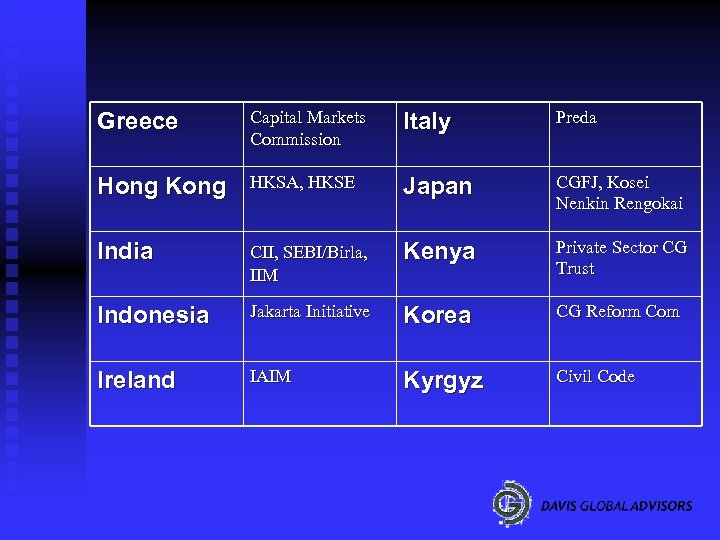
Greece Capital Markets Commission Italy Preda Hong Kong HKSA, HKSE Japan CGFJ, Kosei Nenkin Rengokai India CII, SEBI/Birla, IIM Kenya Private Sector CG Trust Indonesia Jakarta Initiative Korea CG Reform Com Ireland IAIM Kyrgyz Civil Code
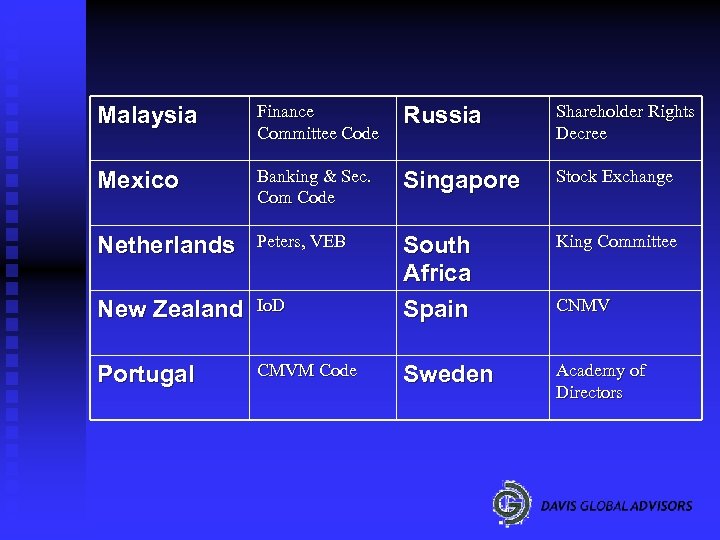
Malaysia Finance Committee Code Russia Shareholder Rights Decree Mexico Banking & Sec. Com Code Singapore Stock Exchange Netherlands Peters, VEB King Committee New Zealand Io. D South Africa Spain Portugal CMVM Code Sweden Academy of Directors CNMV
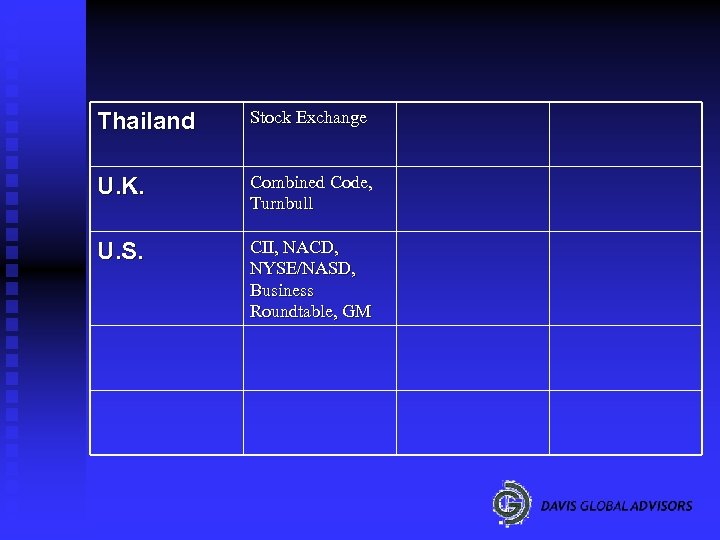
Thailand Stock Exchange U. K. Combined Code, Turnbull U. S. CII, NACD, NYSE/NASD, Business Roundtable, GM
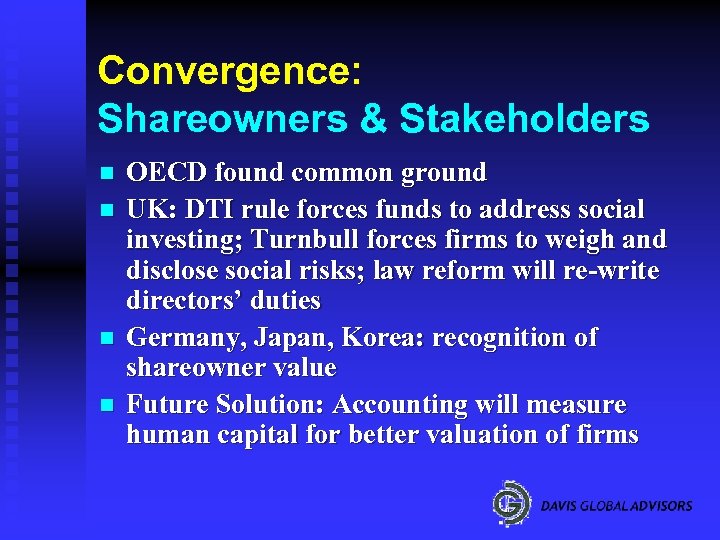
Convergence: Shareowners & Stakeholders n n OECD found common ground UK: DTI rule forces funds to address social investing; Turnbull forces firms to weigh and disclose social risks; law reform will re-write directors’ duties Germany, Japan, Korea: recognition of shareowner value Future Solution: Accounting will measure human capital for better valuation of firms
Disclosure Race to overhaul company law, listing rules n n Accounting Standards (Germany, Japan) Audit Oversight/Integrity (US, Canada, Japan, Italy, Korea) Executive Pay (UK, Ireland, Australia, France) Corporate Governance Statements
Shareholder Intervention n Consensus among investors: Activism pays n Emerging view among governments and corporate boards: More rights bring more capital, better performance
Recent Evidence n n n ANZ study: Poor governance cost NZ 7% Kang: Activist institutions associated with positive corporate performance Stiglitz/World Bank: Privatization only works in combination with good corporate governance Millstein/Mac. Avoy: Good boards=premium Mc. Kinsey: 11% premium on governance Wilshire: Cal. PERS reaped $609 m for $2. 5 m
Trends in Activism n Focus Funds: Target under-performing, undergoverned companies or tilt toward well-governed (AV, Hermes Lens, Relational Investors, ABF Euro VA, Russia fund) n n n Routine Voting: More monitoring, less expense Benchmarks: Pressure on indexers and analysts International Alliances—Cal. PERS/Hermes, ICGN, World Bank/OECD GCGF Investor Taskforce, ACGA n n Cross-Pollination of Tactics, Ideas—Web Stakeholder Issues, Unions—ICFTU, Rio Tinto
Expanding Rights n n n Company law reform: Expanding shareowner communication Greater ballot powers—Canada, UK (though Japan is debating limits) Electronic voting near: UK steps (NAPF panel, ecommerce bill, commercial ventures); laws in Australia, the Netherlands, France, Germany; pressure on EU
Fund Governance n n n How many fund managers would pass standards? Few fund governance rules: PIAC, U. S. CII, IFSA UK: Financial equivalent of a nutrition label. Theory: Accountable owners will be activist Kirby Canadian Senate report on accountability AFL-CIO tactics are a taste of the future
What Shareowners Expect of Public Policy n n n Local benchmarks reflecting global standards Disclosure rules to allow application of benchmarks and promote integrity Law & regulation empowering shareowners—easier voting and communication, protection of minorities n Tax and statutes to spur shareowner value—share options, end to cross-holdings, fair takeover rules
What Shareowners Expect of Company Practice n n Prepare a corporate governance balance sheet. Put R&D into governance. Incorporate the best new ideas and emerging standards. n n Overhaul voting agenda as a critical link to investors. Utilize the Internet. Collect information as much as disseminate it. Early intelligence of worldwide shareholder concerns allows management to anticipate criticism and best compete for international equity capital.
Conclusion n Assume there are no borders in corporate governance. Institutional investors from any part of the globe are monitoring markets and companies everywhere and basing decisions, in part, on how they rank with global competitors on governance criteria. .
Davis Global Advisors, Inc. 57 Hancock Street Newton MA 02466 -2308 USA T +1 617 630 8792 F +1 617 630 0398 E dga@davisglobal. com www. davisglobal. com
Скачать презентацию Corporate Governance Trends in OECD Countries OECD World Bank
c21a48df087d71162ede5da7dda60290.ppt