


 Скачать презентацию CORPORATE FINANCE Part II Gogolukhina Maria Ph D
Corporate finance Part II 2013-2014.ppt
- Количество слайдов: 18
 CORPORATE FINANCE Part II. Gogolukhina Maria, Ph. D
 FINANCIAL MARKETS AND INTEREST RATES
 Market Players o An investor / lender is an individual, company, government, or any entity that owns more funds than it can use. o An issuer / borrower is an entity that has a need for capital. o Brokers and dealers are financial intermediaries, who purchase securities from issuers and sell them to investors
 Securities o Debt security or bond – promises periodic payments of interest and/or principal from a claim on the issuer's earnings o Equity or stock – promises a share in the ownership and profits of the issuer
 Types of Financial Markets o Money markets trade short-term, marketable, liquid, low-risk debt securities - "cash equivalents“ o Capital markets trade in longerterm, more risky securities: n bond (or debt) markets, n equity markets, n derivative markets
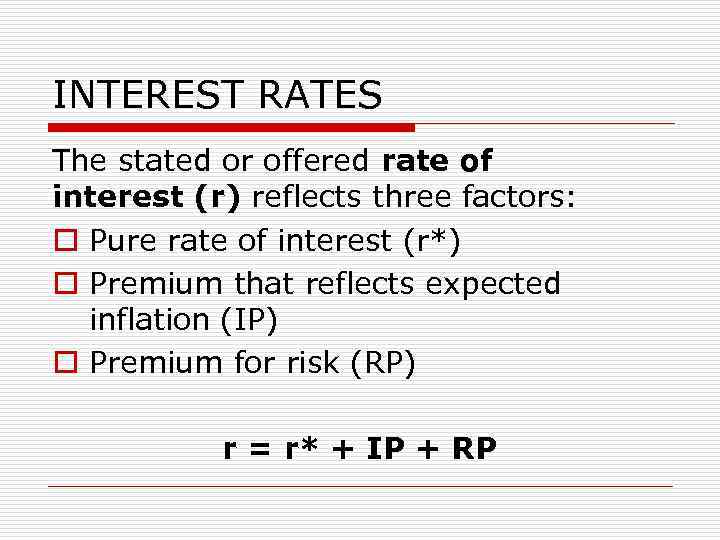 INTEREST RATES The stated or offered rate of interest (r) reflects three factors: o Pure rate of interest (r*) o Premium that reflects expected inflation (IP) o Premium for risk (RP) r = r* + IP + RP
 Pure Interest Rate o the rate for a risk-free security when no inflation is expected o constantly changes over time, depending on economic conditions
 Inflation o Investors build in an inflation premium to compensate for this loss of value o the inflation premium is not constant; it is always changing based on investors' expectations of the future level of inflation
 Risk o Counterparty (default) risk is the chance that the borrower will not be able to pay the interest or pay off the principal of a loan. o Ratings companies identify and classify the creditworthiness of corporations and governments to determine how large the risk premium should be (AAA – CCC)
 Risk o Liquidity risk – possible losses if there is no opportunity to buy or to sell assets at the proposed volume for the proposed price due to bad market conditions
 Risk o Interest rate risk - possible changes of asset value due to changes of the interest rate: n As interest rates increase, bond prices decrease. n As interest rates decrease, bond prices increase.
 Risk o Currency risk – possible changes of the assets value due to changes of the currency exchange rate. o Operational risk – possible losses due to possible technical mistakes. o Business-event risk – possible losses due to force-mageure events, changes in legislation, etc.
 Normal Yield Curve Theories o upward sloping yield curve is considered normal: n expectations theory, n the market segmentation theory, n the liquidity preference theory
 Expectations Theory o The yield curve reflects lenders' and borrowers' expectations of inflation o Changes in these expectations cause changes in the shape of the yield curve
 Market Segmentation Theory o The slope of the yield curve depends on supply / demand conditions in the shortterm and long-term markets o An upward sloping curve results from a large supply of funds in the short-term market relative to demand a shortage of long-term funds. o A downward sloping curve indicates strong demand in the short-term market relative to the long-term market
 Liquidity Preference Theory o long-term securities often yield more than short-term securities o Investors generally prefer shortterm securities, which are more liquid and less expensive to buy and sell. Investors require higher yield on long -term instruments to compensate for the higher cost
 Liquidity Preference Theory o Borrowers dislike short-term debt because it exposes them to the risk of having to roll over the debt or raise new principal under adverse conditions (such as a rise in rates). Borrowers will pay a higher rate for long-term debt than for short-term debt, all other factors being held constant.
 Effect on Stock Prices o The higher the level of interest rates, the lower the level of corporate profits o High bond yields induce investors to sell their stock holdings and invest in more bonds and vs.