


 Скачать презентацию Corporate Entrepreneurship Salvatore Sciascia 23 05 2003 1 Section
db3231c09a382f2f044c2c93103b9761.ppt
- Количество слайдов: 42
 Corporate Entrepreneurship Salvatore Sciascia 23/05/2003 1
 Section 1: The concept of Corporate Entrepreneurship 2
 C. E. as action: Entrepreneurship within existing organizations 3
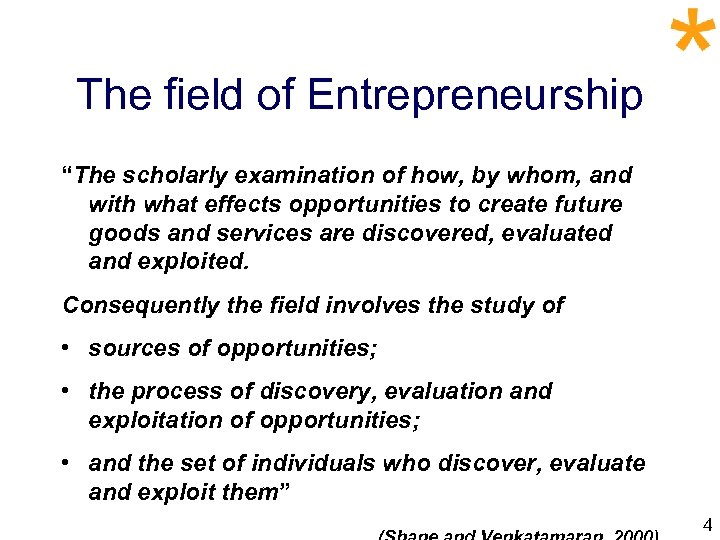 The field of Entrepreneurship “The scholarly examination of how, by whom, and with what effects opportunities to create future goods and services are discovered, evaluated and exploited. Consequently the field involves the study of • sources of opportunities; • the process of discovery, evaluation and exploitation of opportunities; • and the set of individuals who discover, evaluate and exploit them” 4
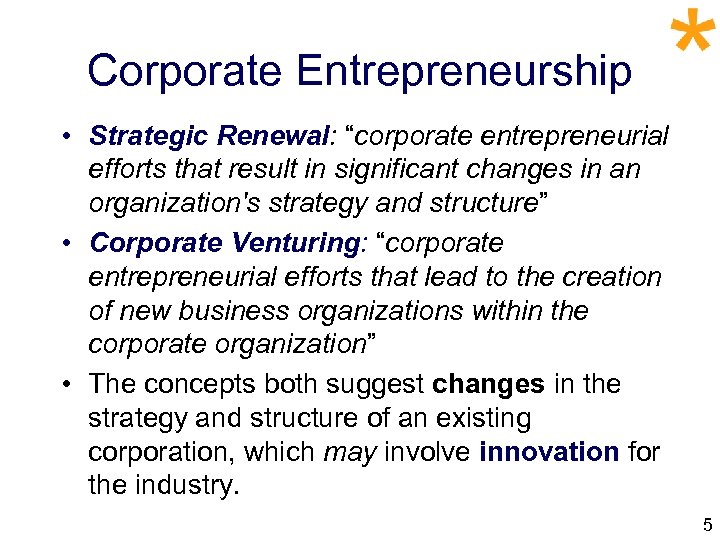 Corporate Entrepreneurship • Strategic Renewal: “corporate entrepreneurial efforts that result in significant changes in an organization's strategy and structure” • Corporate Venturing: “corporate entrepreneurial efforts that lead to the creation of new business organizations within the corporate organization” • The concepts both suggest changes in the strategy and structure of an existing corporation, which may involve innovation for the industry. 5
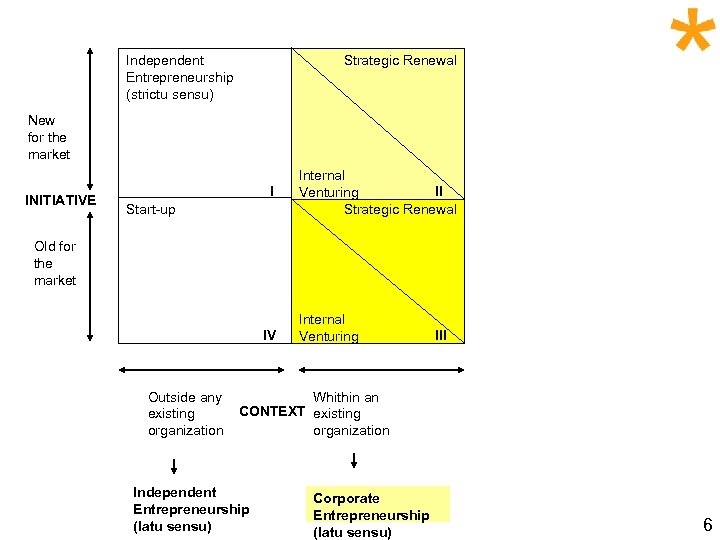 Independent Entrepreneurship (strictu sensu) Strategic Renewal New for the market INITIATIVE I Start-up Internal II Venturing Strategic Renewal Old for the market IV Outside any existing organization Internal Venturing III Whithin an CONTEXT existing organization Independent Entrepreneurship (latu sensu) Corporate Entrepreneurship (latu sensu) 6
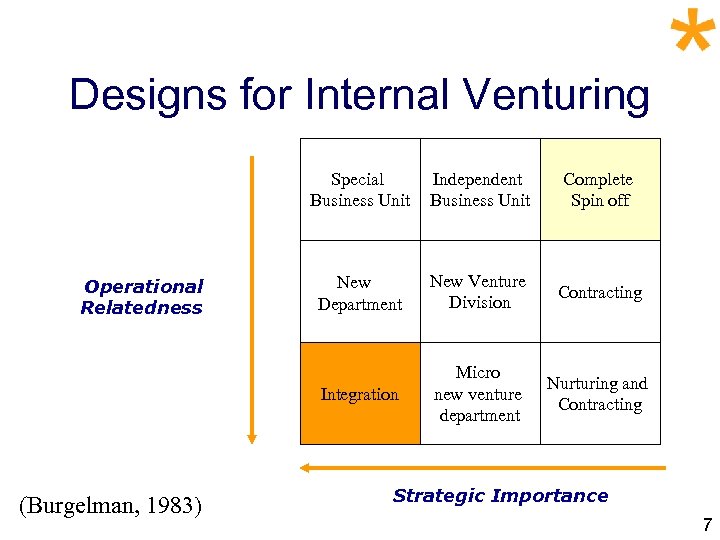 Designs for Internal Venturing Special Business Unit (Burgelman, 1983) Complete Spin off New Department New Venture Division Contracting Integration Operational Relatedness Independent Business Unit Micro new venture department Nurturing and Contracting Strategic Importance 7
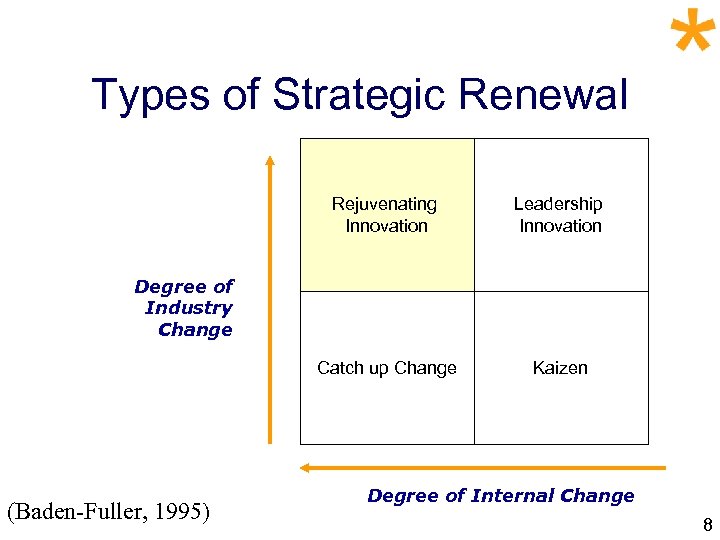 Types of Strategic Renewal Rejuvenating Innovation Leadership Innovation Catch up Change Kaizen Degree of Industry Change (Baden-Fuller, 1995) Degree of Internal Change 8
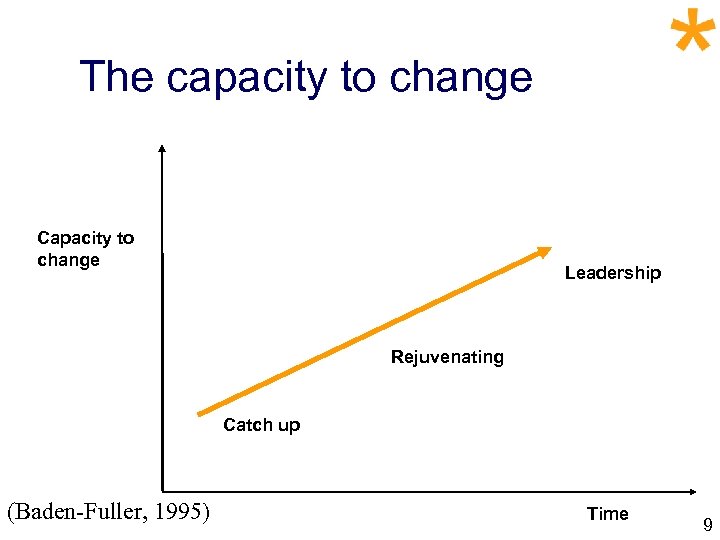 The capacity to change Capacity to change Leadership Rejuvenating Catch up (Baden-Fuller, 1995) Time 9
 C. E. as strategic management approach 10
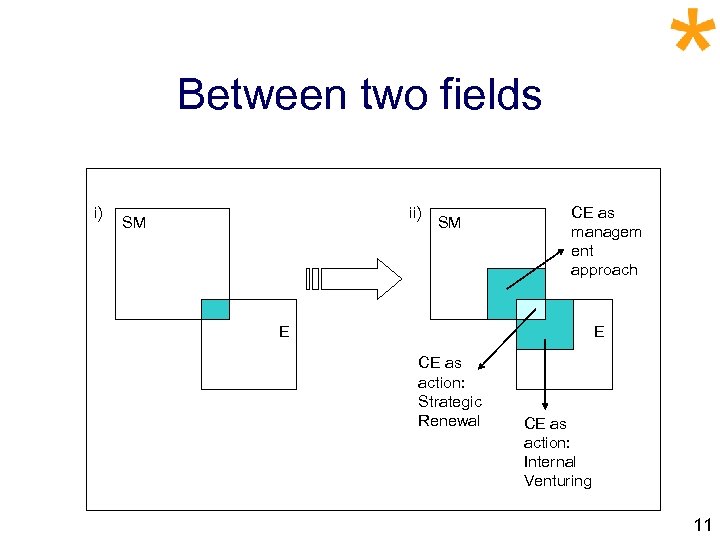 Between two fields i) ii) SM SM CE as managem ent approach E E CE as action: Strategic Renewal CE as action: Internal Venturing 11
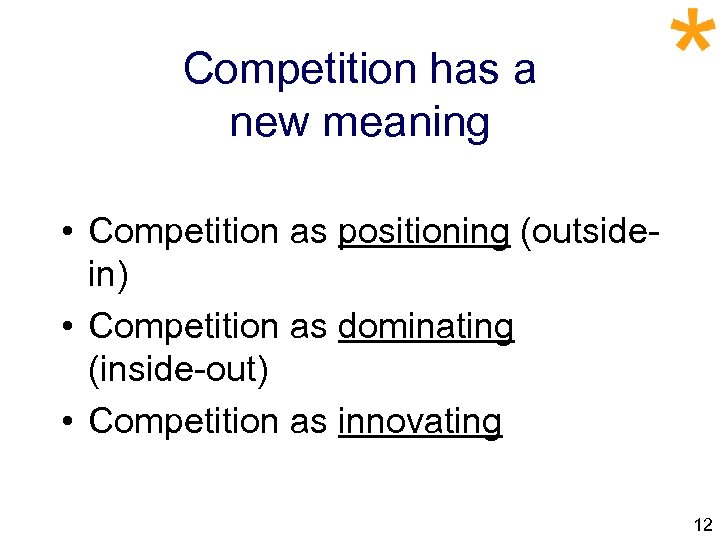 Competition has a new meaning • Competition as positioning (outsidein) • Competition as dominating (inside-out) • Competition as innovating 12
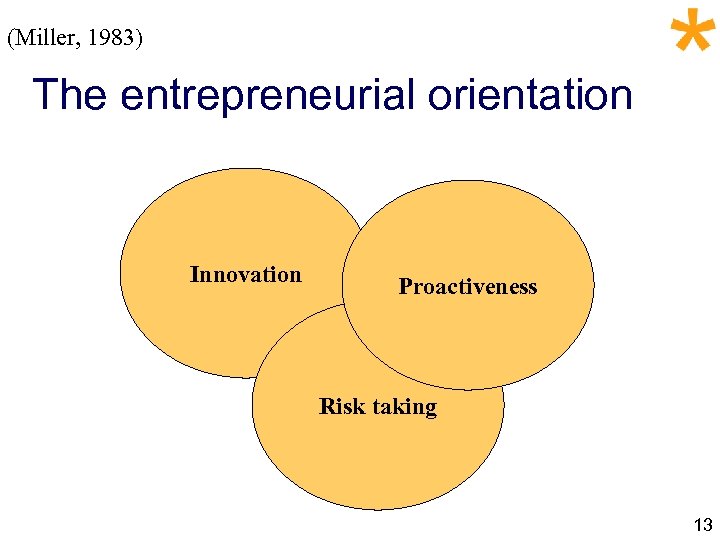 (Miller, 1983) The entrepreneurial orientation Innovation Proactiveness Risk taking 13
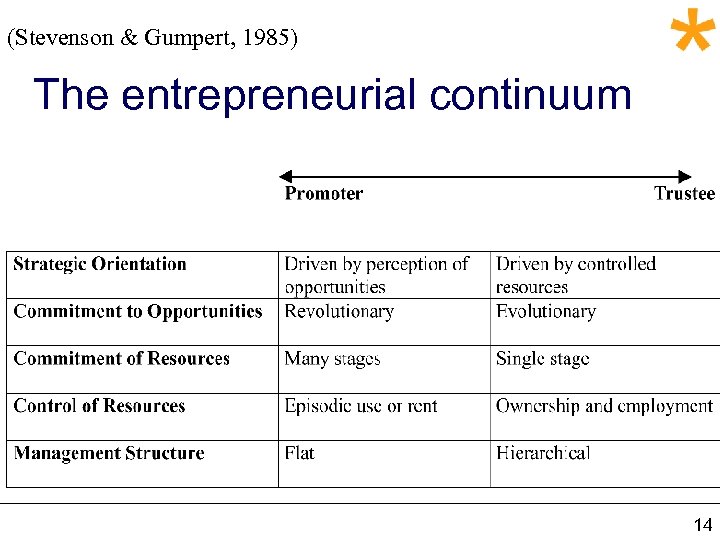 (Stevenson & Gumpert, 1985) The entrepreneurial continuum 14
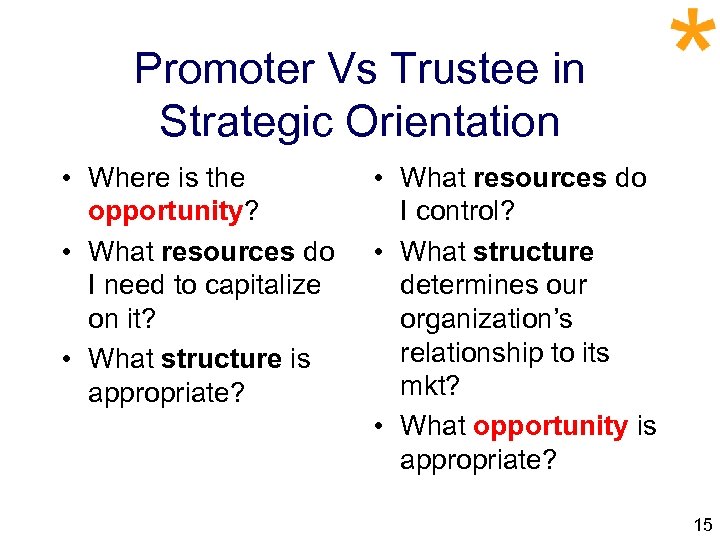 Promoter Vs Trustee in Strategic Orientation • Where is the opportunity? • What resources do I need to capitalize on it? • What structure is appropriate? • What resources do I control? • What structure determines our organization’s relationship to its mkt? • What opportunity is appropriate? 15
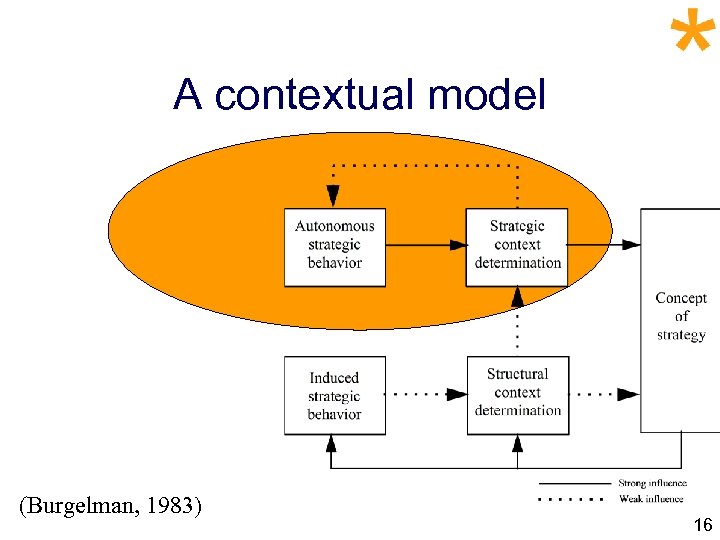 A contextual model (Burgelman, 1983) 16
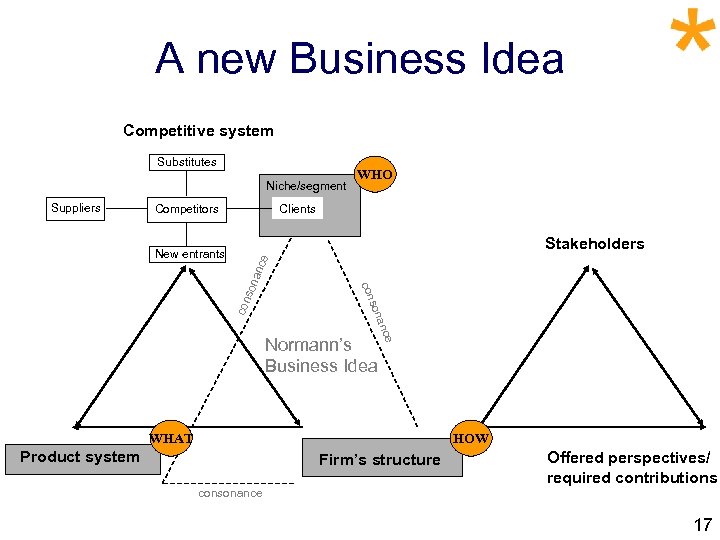 A new Business Idea Competitive system Substitutes Niche/segment Suppliers Competitors WHO Clients Stakeholders con nce ona s con son anc e New entrants Normann’s Business Idea WHAT HOW Product system Firm’s structure Offered perspectives/ required contributions consonance 17
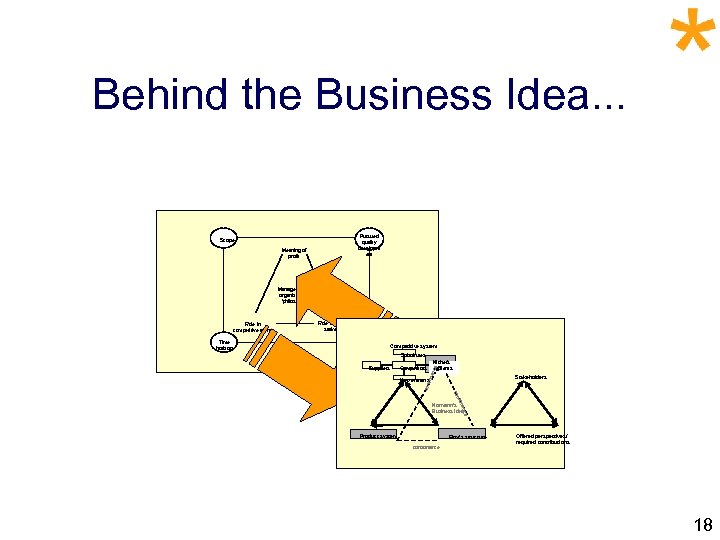 Behind the Business Idea. . . Scope Meaning of profit Pursued quality developm ent Managerial and organizational ‘philosophy’ Competitive system Substitutes Competitors Niche/s egment Clients e Suppliers anc Pursued dimensional growth Stakeholders son Time horizon Role towards main stakeholders New entrants con Role in competitive arena son con e anc Normann’s Business Idea Product system Firm’s structure consonance Offered perspectives/ required contributions 18
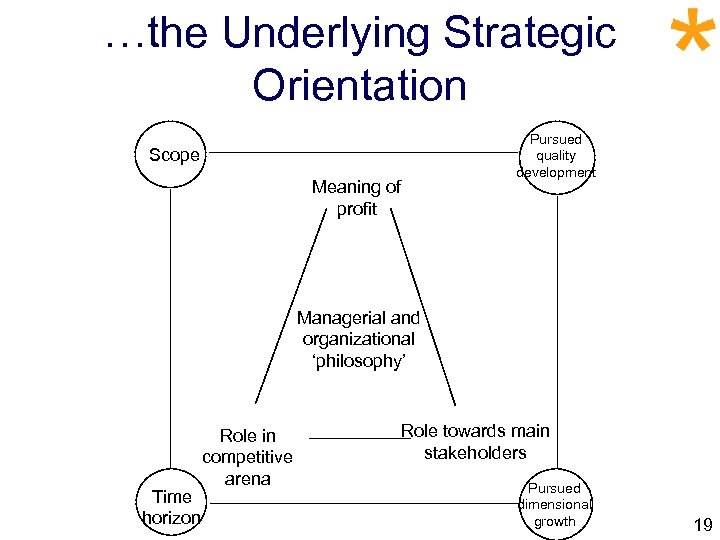 …the Underlying Strategic Orientation Scope Meaning of profit Pursued quality development Managerial and organizational ‘philosophy’ Time horizon Role in competitive arena Role towards main stakeholders Pursued dimensional growth 19
 Section 2: Cases 20
 Modafil - Bottega Verde 21
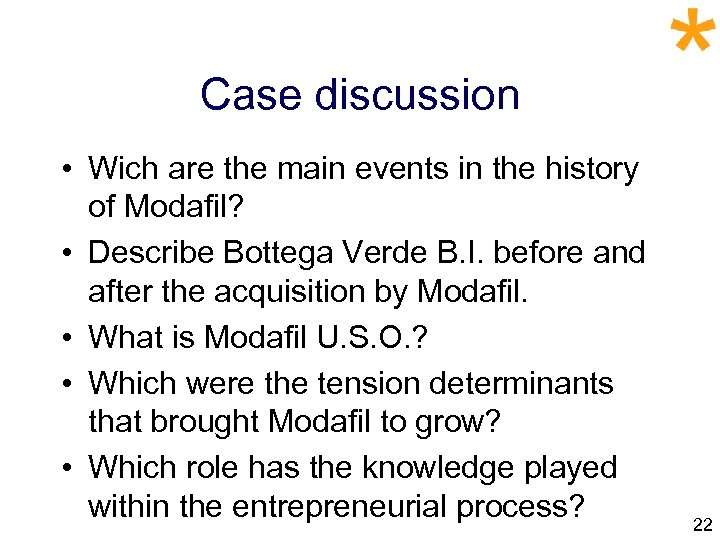 Case discussion • Wich are the main events in the history of Modafil? • Describe Bottega Verde B. I. before and after the acquisition by Modafil. • What is Modafil U. S. O. ? • Which were the tension determinants that brought Modafil to grow? • Which role has the knowledge played within the entrepreneurial process? 22
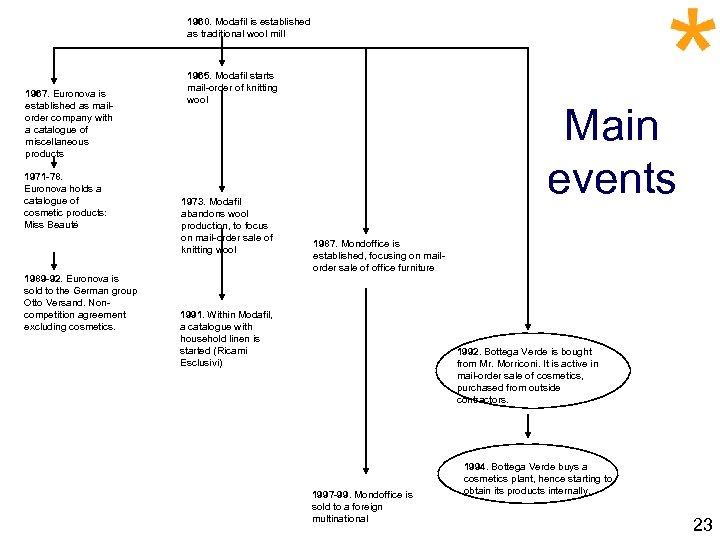 1960. Modafil is established as traditional wool mill 1967. Euronova is established as mailorder company with a catalogue of miscellaneous products 1971 -78. Euronova holds a catalogue of cosmetic products: Miss Beauté 1989 -92. Euronova is sold to the German group Otto Versand. Noncompetition agreement excluding cosmetics. 1965. Modafil starts mail-order of knitting wool 1973. Modafil abandons wool production, to focus on mail-order sale of knitting wool Main events 1987. Mondoffice is established, focusing on mailorder sale of office furniture 1991. Within Modafil, a catalogue with household linen is started (Ricami Esclusivi) 1992. Bottega Verde is bought from Mr. Morriconi. It is active in mail-order sale of cosmetics, purchased from outside contractors. 1997 -99. Mondoffice is sold to a foreign multinational 1994. Bottega Verde buys a cosmetics plant, hence starting to obtain its products internally. 23
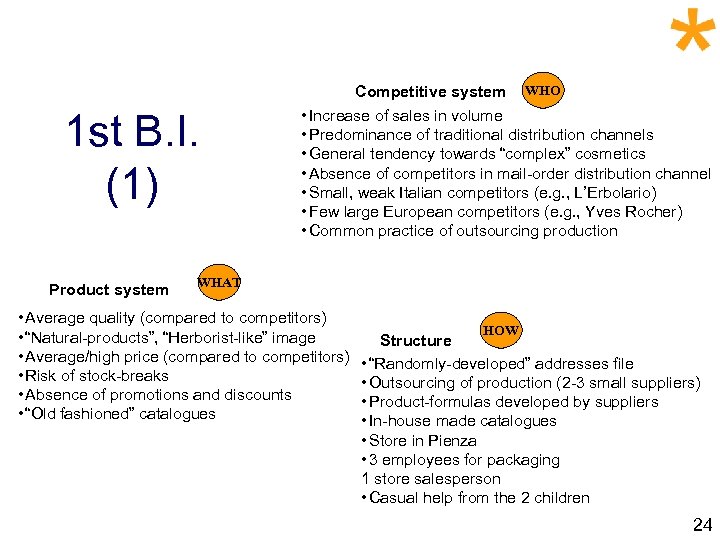 1 st B. I. (1) Product system Competitive system WHO • Increase of sales in volume • Predominance of traditional distribution channels • General tendency towards “complex” cosmetics • Absence of competitors in mail-order distribution channel • Small, weak Italian competitors (e. g. , L’Erbolario) • Few large European competitors (e. g. , Yves Rocher) • Common practice of outsourcing production WHAT • Average quality (compared to competitors) • “Natural-products”, “Herborist-like” image • Average/high price (compared to competitors) • Risk of stock-breaks • Absence of promotions and discounts • “Old fashioned” catalogues HOW Structure • “Randomly-developed” addresses file • Outsourcing of production (2 -3 small suppliers) • Product-formulas developed by suppliers • In-house made catalogues • Store in Pienza • 3 employees for packaging 1 store salesperson • Casual help from the 2 children 24
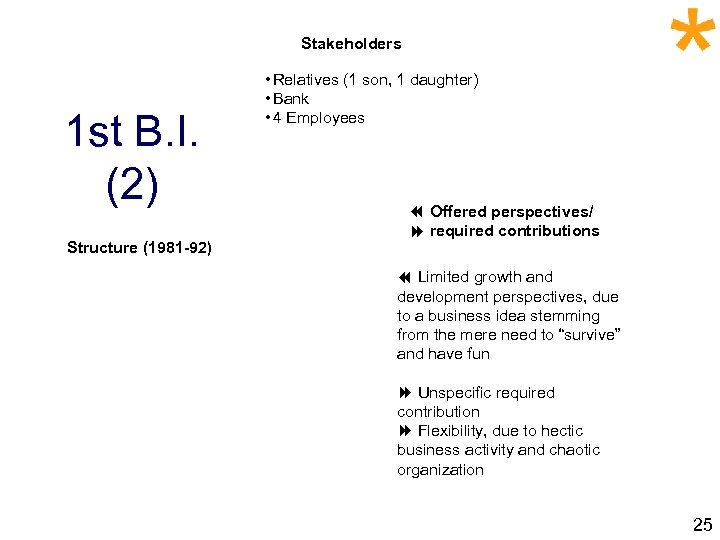 Stakeholders 1 st B. I. (2) Structure (1981 -92) • Relatives (1 son, 1 daughter) • Bank • 4 Employees Offered perspectives/ required contributions Limited growth and development perspectives, due to a business idea stemming from the mere need to “survive” and have fun Unspecific required contribution Flexibility, due to hectic business activity and chaotic organization 25
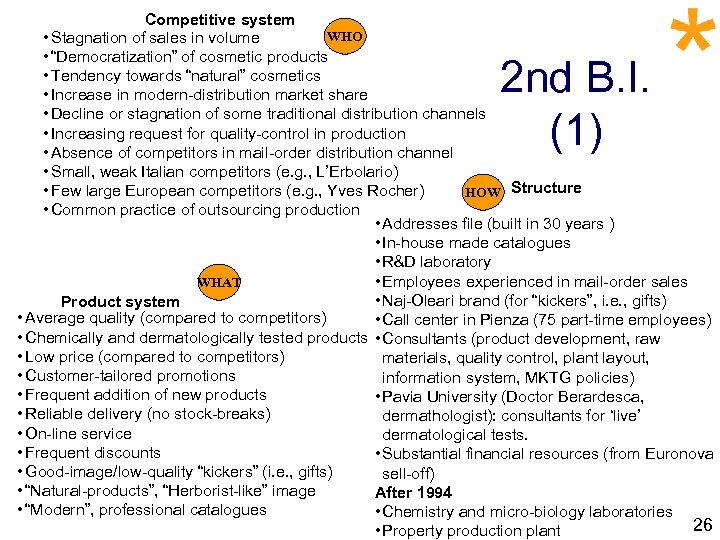 Competitive system WHO • Stagnation of sales in volume • “Democratization” of cosmetic products • Tendency towards “natural” cosmetics • Increase in modern-distribution market share • Decline or stagnation of some traditional distribution channels • Increasing request for quality-control in production • Absence of competitors in mail-order distribution channel • Small, weak Italian competitors (e. g. , L’Erbolario) • Few large European competitors (e. g. , Yves Rocher) HOW Structure • Common practice of outsourcing production • Addresses file (built in 30 years ) • In-house made catalogues • R&D laboratory • Employees experienced in mail-order sales WHAT • Naj-Oleari brand (for “kickers”, i. e. , gifts) Product system • Average quality (compared to competitors) • Call center in Pienza (75 part-time employees) • Chemically and dermatologically tested products • Consultants (product development, raw • Low price (compared to competitors) materials, quality control, plant layout, • Customer-tailored promotions information system, MKTG policies) • Frequent addition of new products • Pavia University (Doctor Berardesca, • Reliable delivery (no stock-breaks) dermathologist): consultants for ‘live’ • On-line service dermatological tests. • Frequent discounts • Substantial financial resources (from Euronova • Good-image/low-quality “kickers” (i. e. , gifts) sell-off) • “Natural-products”, “Herborist-like” image After 1994 • “Modern”, professional catalogues • Chemistry and micro-biology laboratories 26 • Property production plant 2 nd B. I. (1)
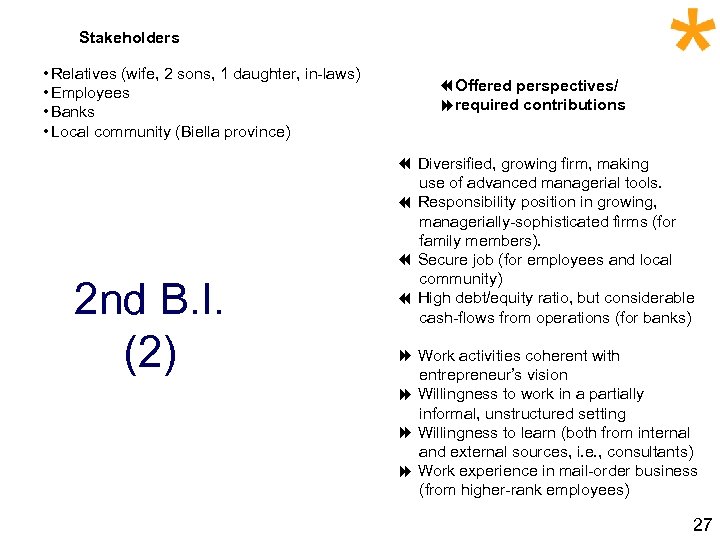 Stakeholders • Relatives (wife, 2 sons, 1 daughter, in-laws) • Employees • Banks • Local community (Biella province) 2 nd B. I. (2) Offered perspectives/ required contributions Diversified, growing firm, making use of advanced managerial tools. Responsibility position in growing, managerially-sophisticated firms (for family members). Secure job (for employees and local community) High debt/equity ratio, but considerable cash-flows from operations (for banks) Work activities coherent with entrepreneur’s vision Willingness to work in a partially informal, unstructured setting Willingness to learn (both from internal and external sources, i. e. , consultants) Work experience in mail-order business (from higher-rank employees) 27
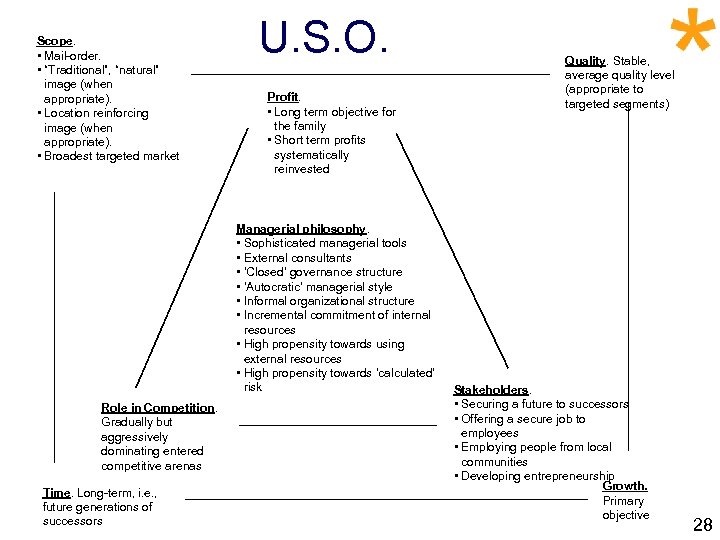 Scope. • Mail-order. • “Traditional”, “natural” image (when appropriate). • Location reinforcing image (when appropriate). • Broadest targeted market U. S. O. Profit. • Long term objective for the family • Short term profits systematically reinvested Managerial philosophy. • Sophisticated managerial tools • External consultants • ‘Closed’ governance structure • ‘Autocratic’ managerial style • Informal organizational structure • Incremental commitment of internal resources • High propensity towards using external resources • High propensity towards ‘calculated’ risk Role in Competition. Gradually but aggressively dominating entered competitive arenas Time. Long-term, i. e. , future generations of successors Quality. Stable, average quality level (appropriate to targeted segments) Stakeholders. • Securing a future to successors • Offering a secure job to employees • Employing people from local communities • Developing entrepreneurship Growth. Primary objective 28
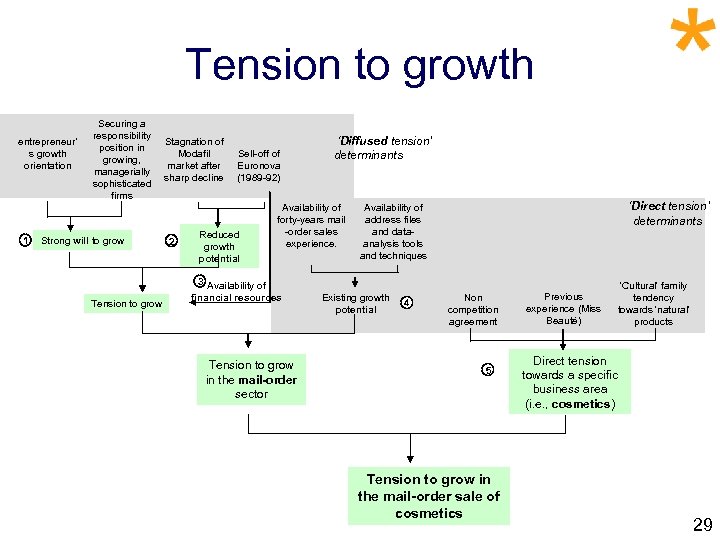 Tension to growth entrepreneur’ s growth orientation 1 Securing a responsibility position in growing, managerially sophisticated firms Strong will to grow Tension to grow Stagnation of Modafil market after sharp decline 2 Sell-off of Euronova (1989 -92) Reduced growth potential ‘Diffused tension’ determinants Availability of forty-years mail -order sales experience. 3 Availability of financial resources Tension to grow in the mail-order sector ‘Direct tension’ determinants Availability of address files and dataanalysis tools and techniques Existing growth potential 4 Non competition agreement 5 Tension to grow in the mail-order sale of cosmetics Previous experience (Miss Beauté) 'Cultural' family tendency towards 'natural' products Direct tension towards a specific business area (i. e. , cosmetics) 29
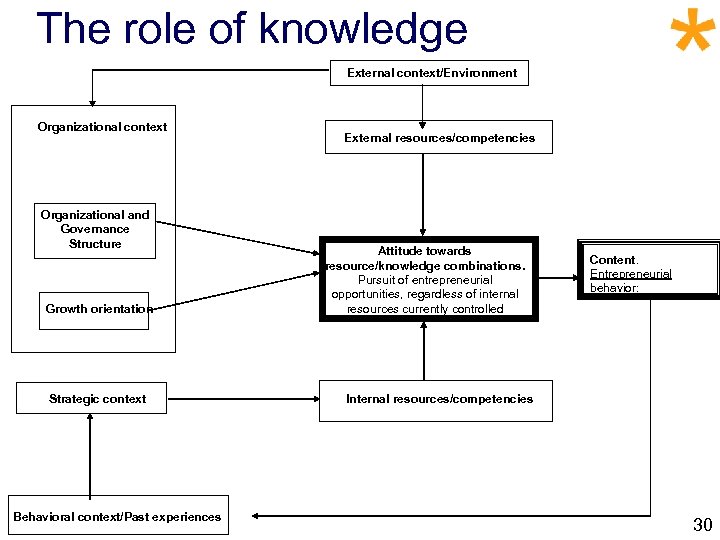 The role of knowledge External context/Environment Organizational context Organizational and Governance Structure Growth orientation Strategic context Behavioral context/Past experiences External resources/competencies Attitude towards resource/knowledge combinations. Pursuit of entrepreneurial opportunities, regardless of internal resources currently controlled Content. Entrepreneurial behavior: Internal resources/competencies 30
 Barilla - Mulino Bianco 31
 Barilla • It’s the largest pasta maker in Italy; it holds one of the most appealing brands for the Italian consumers. • This family-owned giant has revenues for 2 billions Euros, employs 8. 500 persons, produces in 25 different plants (5 of them are abroad) and exports in more then 100 countries. • Its Italian market share (in pasta) is 25% 32
 Mulino Bianco • Mulino Bianco is a line of products that Barilla funded 25 years ago: under this umbrellabrand we find biscuits, cakes, sweet snacks, crackers and bread (the so called “bakery products”). • In all these markets Mulino Bianco has a leading position in Italy. • The division is growing so fast that MB sales count for about 50% of the Barilla’s group turnover 33
 A growing and innovating company (1) • 1877 Pietro Barilla settles a pasta and bread shop in Parma: • 1910 he settles the first plant: 80 employees produce 8000 kilos of pasta daily • 1911 the famous corporate logo is created • 1936 the number of employees reaches 700 • 1950 the Barillas visit the States: they come back to Italy with new ideas to improve efficiency and customer satisfaction • 1955 Barilla is the first company selling pasta in packs 34
 A growing and innovating company (2) • 1960 The company become a PLC; it employees 1300 persons • 1970 they build a plant in Pedrignano (it’s still the largest pasta plant in the world) • 1971 W. R. Grace buys Barilla for over $70 million; they start diversification • 1975 they fund Mulino Bianco • 1979 W. R. Grace sells the company to the Barillas for $65 million; they build Barilla France, the first foreigner subsidiary 35
 A growing and innovating company (3) • 1987 they structure their internationalization process and start focused advertising campaign in several foreign countries • 1991 the Greek pasta leader Misko is taken over 1992 They take over Pavesi, well known biscuits producer • 1996 On average they reduce prices by 15% to face the strong competition of Hard Discount and own label products; fresh pasta production starts • 1999 They buy Wasa from Novartis • 2000 Barilla launchs the filled dried pasta • 2002 Barilla launchs the frozen pasta 36
 Tension to Corporate Entrepreneurship • Mature pasta market • Declining financial results • Mono-business company (high risk) 37
 In which industry to diversify? • • • growing market low competition good profitability possibility to innovate relatedness to pasta WHO Biscuits! 38
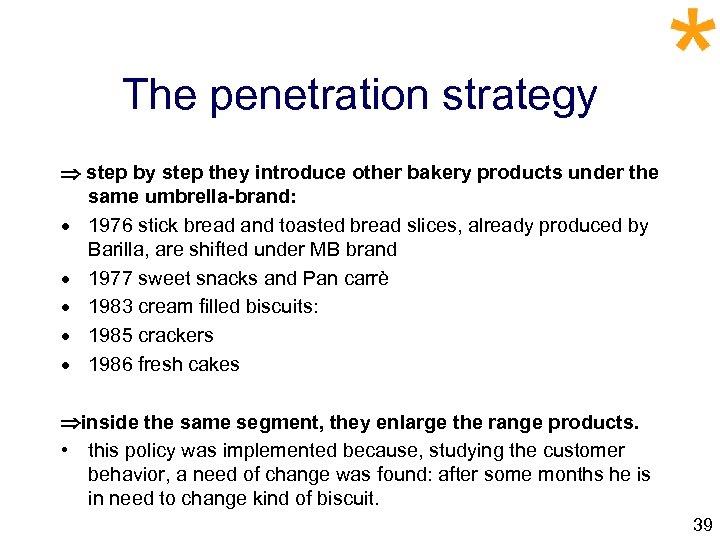 The penetration strategy step by step they introduce other bakery products under the same umbrella-brand: · 1976 stick bread and toasted bread slices, already produced by Barilla, are shifted under MB brand · 1977 sweet snacks and Pan carrè · 1983 cream filled biscuits: · 1985 crackers · 1986 fresh cakes inside the same segment, they enlarge the range products. • this policy was implemented because, studying the customer behavior, a need of change was found: after some months he is in need to change kind of biscuit. 39
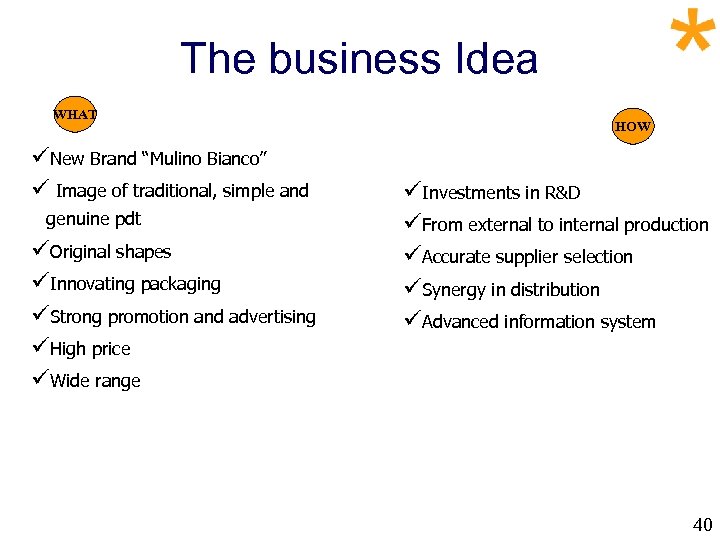 The business Idea WHAT üNew Brand “Mulino Bianco” ü Image of traditional, simple and genuine pdt üOriginal shapes üInnovating packaging üStrong promotion and advertising üHigh price üWide range HOW üInvestments in R&D üFrom external to internal production üAccurate supplier selection üSynergy in distribution üAdvanced information system 40
 Corporate Support • • • Financial Organizational Bargaining power Brand reputation Efficiency culture Approach to the customer 41
 Conclusions • Today competition means spotting entrepreneurial opportunities • Innovation can be pursued in different ways (SR vs IV), requiring different organizational levers • Corporate Entrepreneurship occurs with no regards to company size • Develop an entrepreneurial orientation • The success of entrepreneurial development is related mostly to immaterial factors 42