 Скачать презентацию Corporate Bonds Fixed Income Seminar Luxembourg 8 Feb
610e8d228297ddf914291ad235a4e5be.ppt
- Количество слайдов: 22



Corporate Bonds Fixed Income Seminar Luxembourg 8 Feb 2011 Return on Knowledge Division af Danske Bank A/S, CVR-nr. 61 12 62 28 - København
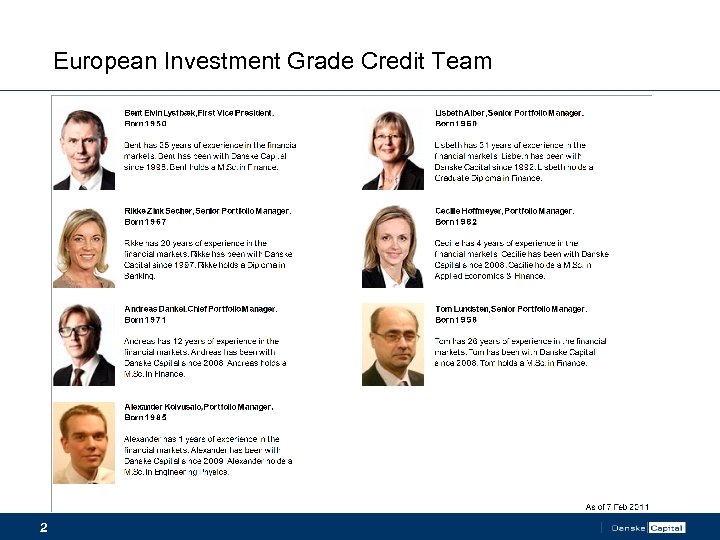
European Investment Grade Credit Team 2
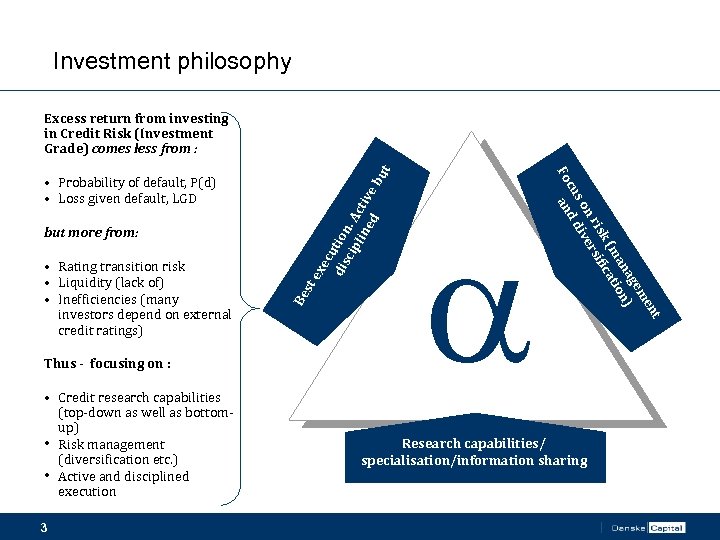
Investment philosophy Thus - focusing on : • Credit research capabilities (top-down as well as bottomup) • Risk management (diversification etc. ) • Active and disciplined execution 3 ec u dis tion cip. A lin cti ed ve b st Be • Rating transition risk • Liquidity (lack of) • Inefficiencies (many investors depend on external credit ratings) ex but more from: t en em ag ) an on (m cati isk sifi n r er s o iv cu nd d a • Probability of default, P(d) • Loss given default, LGD Fo ut Excess return from investing in Credit Risk (Investment Grade) comes less from : Research capabilities/ specialisation/information sharing
Credit research – general thoughts Important way to exploit market inefficiencies • • Typical bond: Limited upside + unlimited downside Less research coverage – compared to equity research coverage Strong equity case: not necessarily strong bond case and vice versa Crucial to identify potential falling angels (and other spread sensitive events) Requires skills • • • Thorough business/sector understanding through specialisation and experience Extensive knowledge through network (in house/in market) One issuer – many issues Efficiency and focus on value-adding research • 4 Non-descriptive research and documentation (Focus on potential spread drivers)
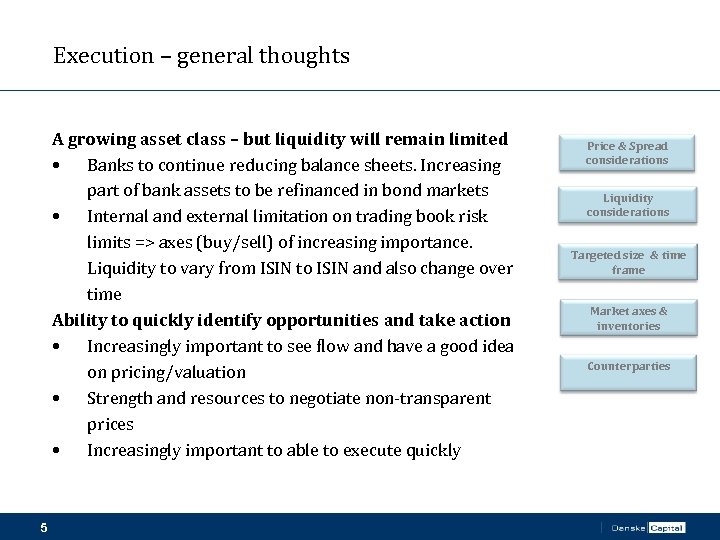
Execution – general thoughts A growing asset class – but liquidity will remain limited • Banks to continue reducing balance sheets. Increasing part of bank assets to be refinanced in bond markets • Internal and external limitation on trading book risk limits => axes (buy/sell) of increasing importance. Liquidity to vary from ISIN to ISIN and also change over time Ability to quickly identify opportunities and take action • Increasingly important to see flow and have a good idea on pricing/valuation • Strength and resources to negotiate non-transparent prices • Increasingly important to able to execute quickly 5 Price & Spread considerations Liquidity considerations Targeted size & time frame Market axes & inventories Counterparties
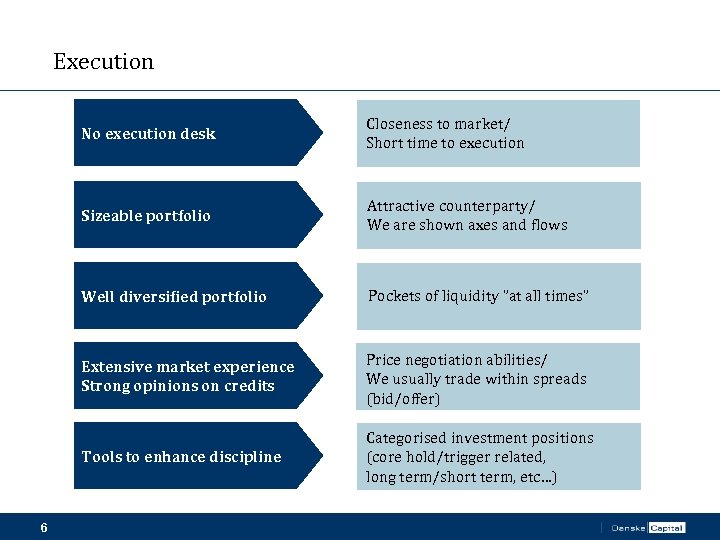
Execution No execution desk Sizeable portfolio Attractive counterparty/ We are shown axes and flows Well diversified portfolio Pockets of liquidity ”at all times” Extensive market experience Strong opinions on credits Price negotiation abilities/ We usually trade within spreads (bid/offer) Tools to enhance discipline 6 Closeness to market/ Short time to execution Categorised investment positions (core hold/trigger related, long term/short term, etc…)
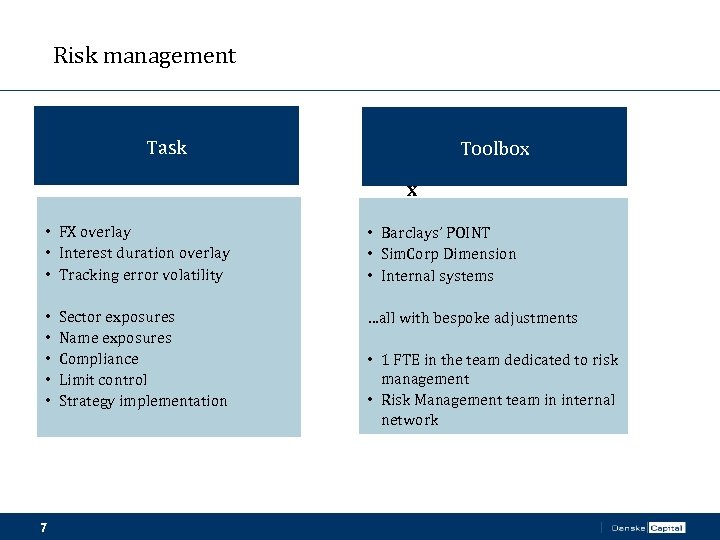
Risk management Task • FX overlay • Interest duration overlay • Tracking error volatility • • • 7 Sector exposures Name exposures Compliance Limit control Strategy implementation Toolbo x Toolbox • Barclays’ POINT • Sim. Corp Dimension • Internal systems …all with bespoke adjustments • 1 FTE in the team dedicated to risk management • Risk Management team in internal network
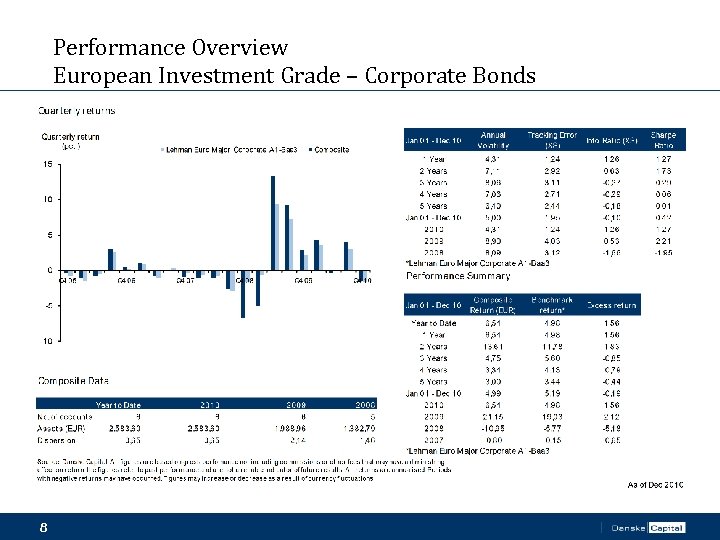
Performance Overview European Investment Grade – Corporate Bonds 8
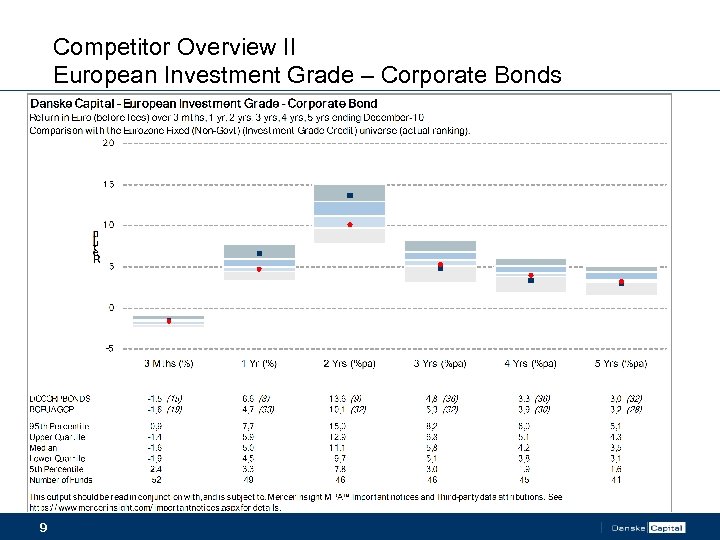
Competitor Overview II European Investment Grade – Corporate Bonds 9
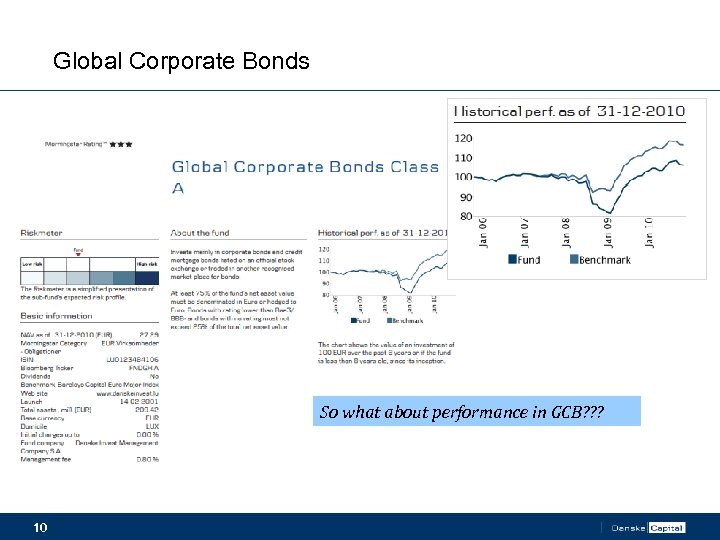
Global Corporate Bonds So what about performance in GCB? ? ? 10
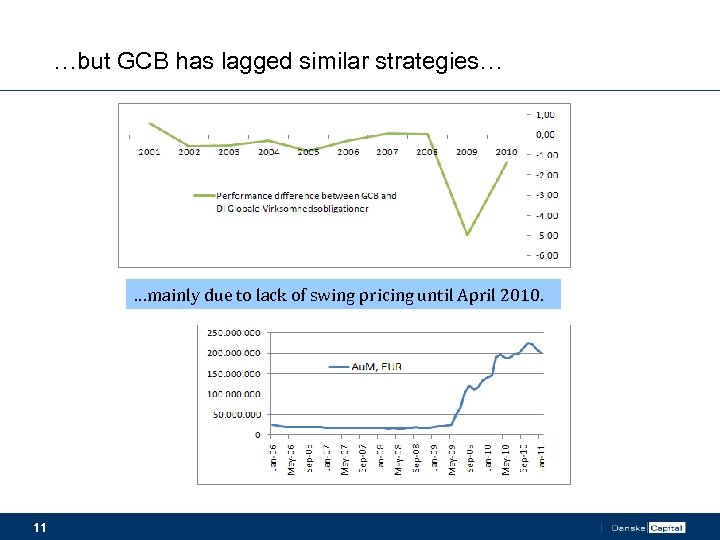
…but GCB has lagged similar strategies… …mainly due to lack of swing pricing until April 2010. 11
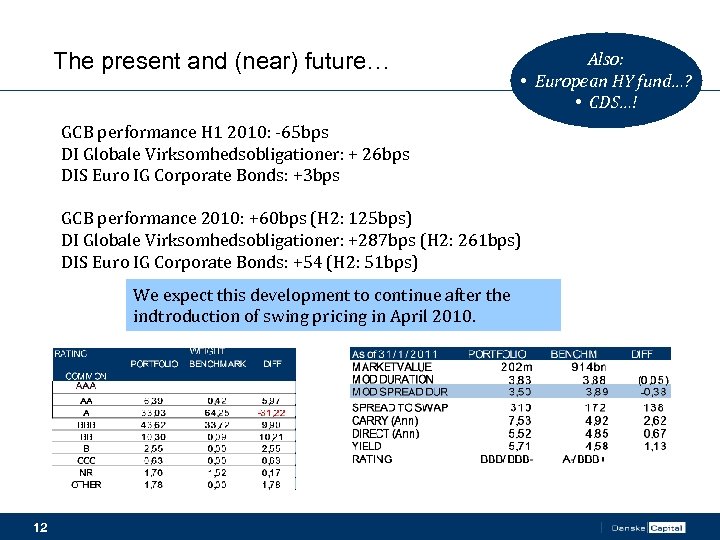
The present and (near) future… Also: • European HY fund…? • CDS…! GCB performance H 1 2010: -65 bps DI Globale Virksomhedsobligationer: + 26 bps DIS Euro IG Corporate Bonds: +3 bps GCB performance 2010: +60 bps (H 2: 125 bps) DI Globale Virksomhedsobligationer: +287 bps (H 2: 261 bps) DIS Euro IG Corporate Bonds: +54 (H 2: 51 bps) We expect this development to continue after the indtroduction of swing pricing in April 2010. 12
Appendix 13
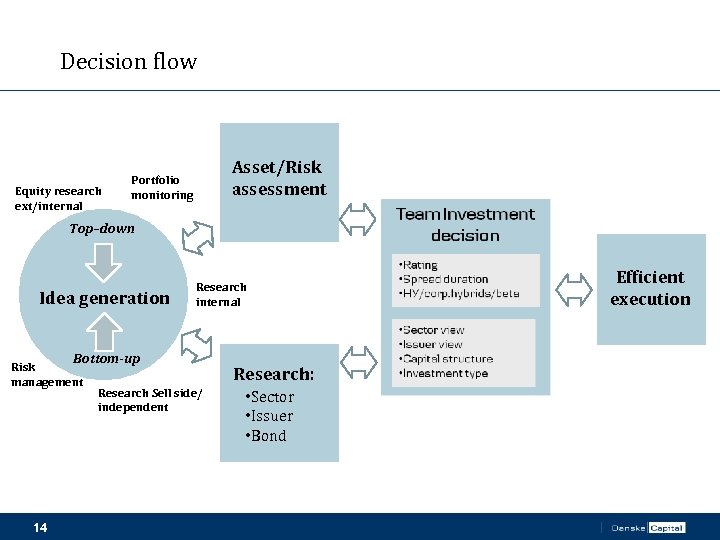
Decision flow Equity research ext/internal Asset/Risk assessment Portfolio monitoring Top–down Idea generation Research internal Bottom-up Risk management 14 Research Sell side/ independent Research: • Sector • Issuer • Bond Efficient execution
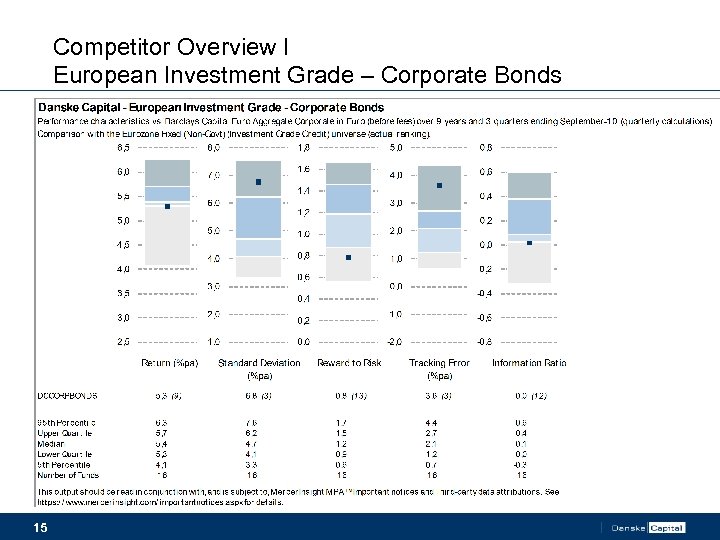
Competitor Overview I European Investment Grade – Corporate Bonds 15
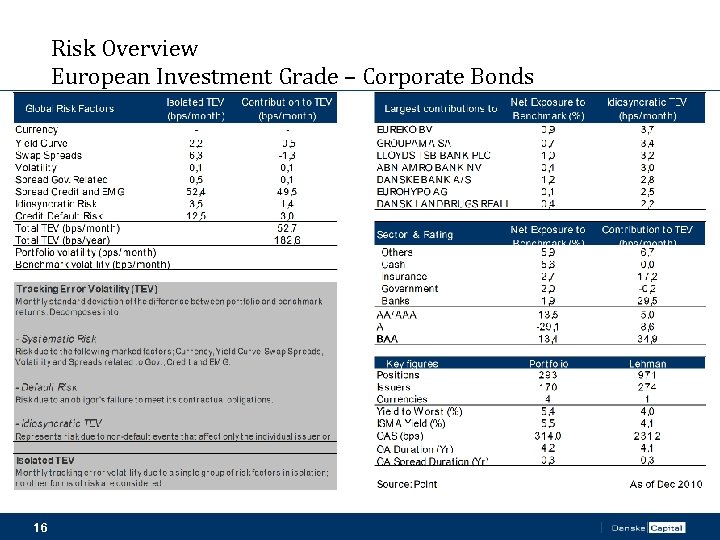
Risk Overview European Investment Grade – Corporate Bonds 16
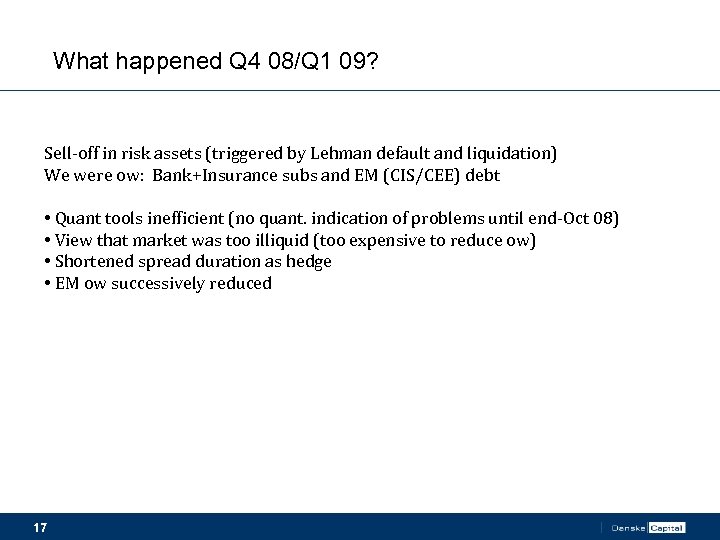
What happened Q 4 08/Q 1 09? Sell-off in risk assets (triggered by Lehman default and liquidation) We were ow: Bank+Insurance subs and EM (CIS/CEE) debt • Quant tools inefficient (no quant. indication of problems until end-Oct 08) • View that market was too illiquid (too expensive to reduce ow) • Shortened spread duration as hedge • EM ow successively reduced 17
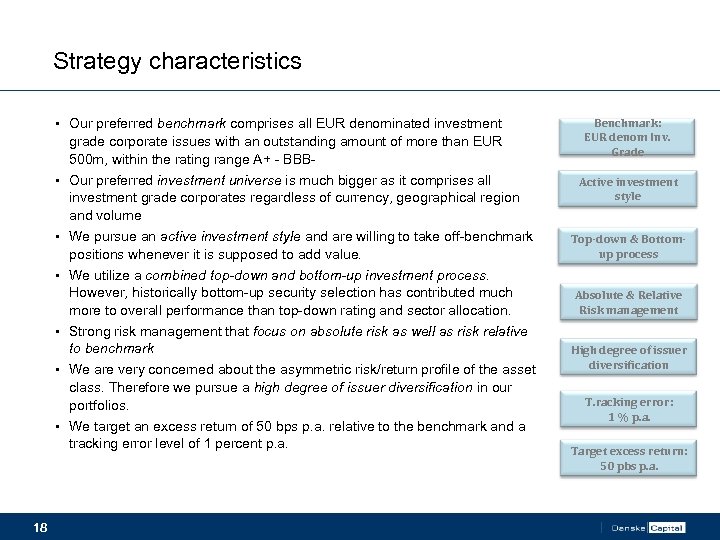
Strategy characteristics • Our preferred benchmark comprises all EUR denominated investment grade corporate issues with an outstanding amount of more than EUR 500 m, within the rating range A+ - BBB • Our preferred investment universe is much bigger as it comprises all • • • 18 investment grade corporates regardless of currency, geographical region and volume We pursue an active investment style and are willing to take off-benchmark positions whenever it is supposed to add value. We utilize a combined top-down and bottom-up investment process. However, historically bottom-up security selection has contributed much more to overall performance than top-down rating and sector allocation. Strong risk management that focus on absolute risk as well as risk relative to benchmark We are very concerned about the asymmetric risk/return profile of the asset class. Therefore we pursue a high degree of issuer diversification in our portfolios. We target an excess return of 50 bps p. a. relative to the benchmark and a tracking error level of 1 percent p. a. Benchmark: EUR denom Inv. Grade Active investment style Top-down & Bottomup process Absolute & Relative Risk management High degree of issuer diversification T. racking error: 1 % p. a. Target excess return: 50 pbs p. a.
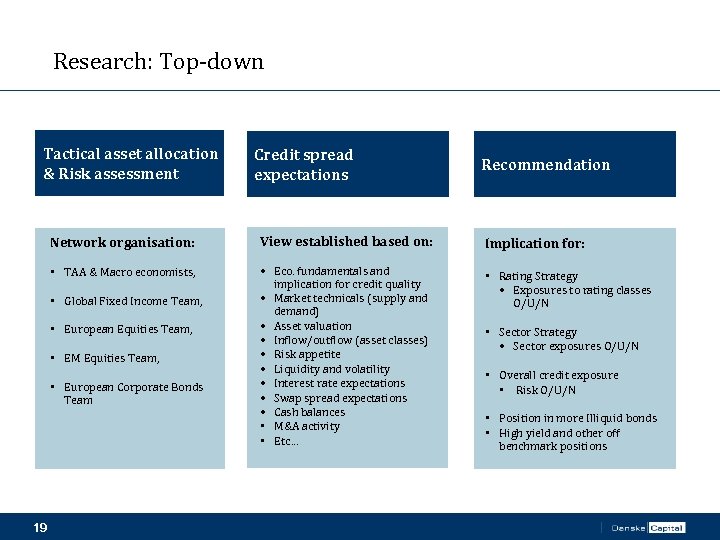
Research: Top-down Tactical asset allocation & Risk assessment Credit spread expectations Recommendation Network organisation: View established based on: Implication for: • TAA & Macro economists, • Eco. fundamentals and implication for credit quality • Market technicals (supply and demand) • Asset valuation • Inflow/outflow (asset classes) • Risk appetite • Liquidity and volatility • Interest rate expectations • Swap spread expectations • Cash balances • M&A activity • Etc… • Rating Strategy • Exposures to rating classes O/U/N • Global Fixed Income Team, • European Equities Team, • EM Equities Team, • European Corporate Bonds Team 19 • Sector Strategy • Sector exposures O/U/N • Overall credit exposure • Risk O/U/N • Position in more Illiquid bonds • High yield and other off benchmark positions
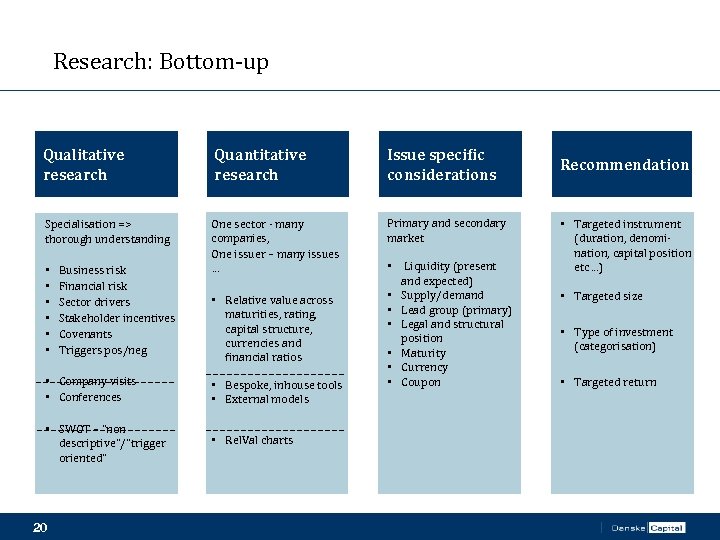
Research: Bottom-up Qualitative research Quantitative research Issue specific considerations Specialisation => thorough understanding One sector - many companies, One issuer – many issues … Primary and secondary market • • • Business risk Financial risk Sector drivers Stakeholder incentives Covenants Triggers pos/neg • Relative value across maturities, rating, capital structure, currencies and financial ratios • Company visits • Conferences • Bespoke, inhouse tools • External models • SWOT – ”non descriptive”/”trigger oriented” • Rel. Val charts 20 • Liquidity (present and expected) • Supply/demand • Lead group (primary) • Legal and structural position • Maturity • Currency • Coupon Recommendation • Targeted instrument (duration, denomination, capital position etc…) • Targeted size • Type of investment (categorisation) • Targeted return
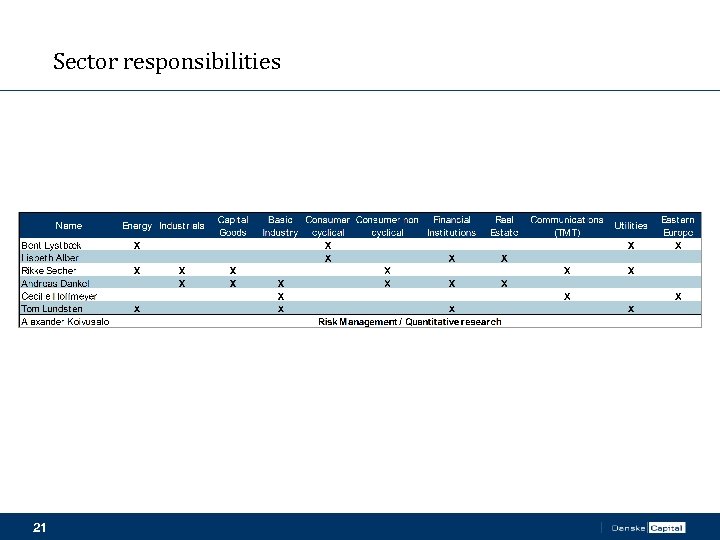
Sector responsibilities 21
Disclaimer & Contact information 22
Скачать презентацию Corporate Bonds Fixed Income Seminar Luxembourg 8 Feb
610e8d228297ddf914291ad235a4e5be.ppt