


 Скачать презентацию Cornwall Council Workshop for Councillors and Development
387cb331dd80a97df5597822a0acf738.ppt
- Количество слайдов: 36
 Cornwall Council – Workshop for Councillors and Development Industry HOUSING STRATEGIC VIABILITY APPRAISAL UPDATE – 27 January 2012 Jonathan Lee Kathleen Dunmore Lin Cousins Opinion Research Services Three Dragons
 Workshop - Three Parts • Why do we need the study and how has it been done? • What does the evidence tell us about Cornwall and its housing markets? • What are the options for taking policy forward?
 1 Why and how of the study • • • Context Viability and the Community Infrastructure Levy Principles behind the analysis Key assumptions – market values matter Role of land value comparators Short hand AH = affordable housing and CIL = Community Infrastructure Levy
 Context - What the study is for • For affordable housing – review targets (%) – review site size thresholds – test impact of different types of AH products • Test combined impact of AH and CIL • Assess if there should be different targets and/or different thresholds and/or different levy rates for different parts of Cornwall.
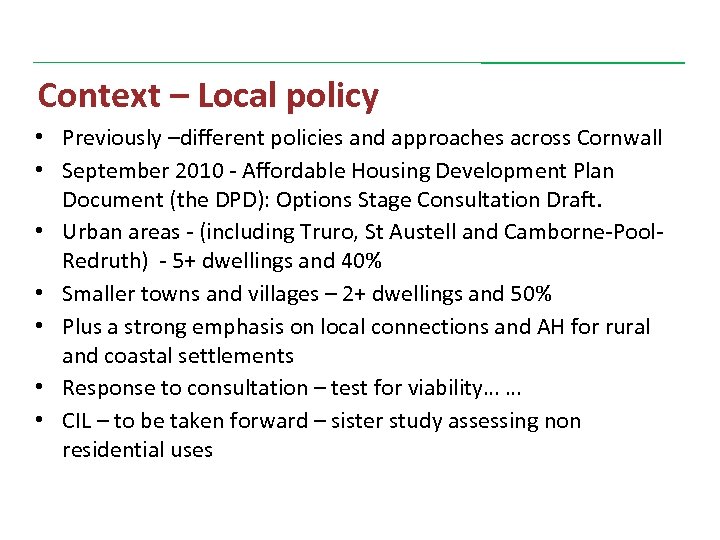 Context – Local policy • Previously –different policies and approaches across Cornwall • September 2010 - Affordable Housing Development Plan Document (the DPD): Options Stage Consultation Draft. • Urban areas - (including Truro, St Austell and Camborne-Pool. Redruth) - 5+ dwellings and 40% • Smaller towns and villages – 2+ dwellings and 50% • Plus a strong emphasis on local connections and AH for rural and coastal settlements • Response to consultation – test for viability… … • CIL – to be taken forward – sister study assessing non residential uses
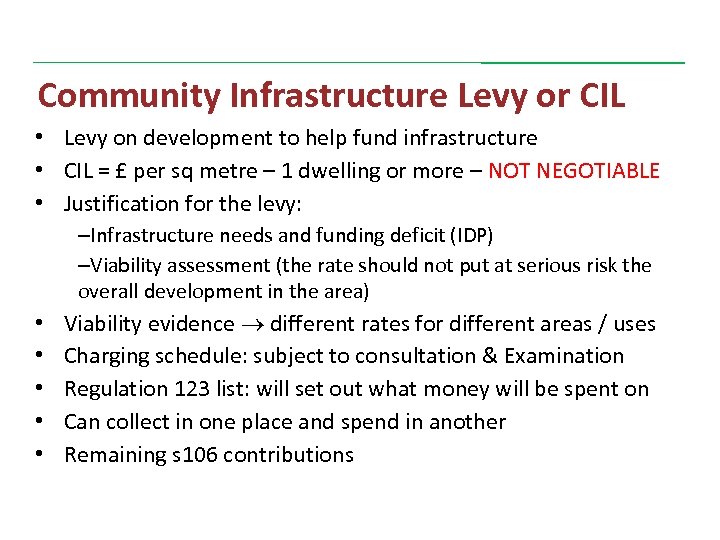 Community Infrastructure Levy or CIL • Levy on development to help fund infrastructure • CIL = £ per sq metre – 1 dwelling or more – NOT NEGOTIABLE • Justification for the levy: –Infrastructure needs and funding deficit (IDP) –Viability assessment (the rate should not put at serious risk the overall development in the area) • • • Viability evidence different rates for different areas / uses Charging schedule: subject to consultation & Examination Regulation 123 list: will set out what money will be spent on Can collect in one place and spend in another Remaining s 106 contributions
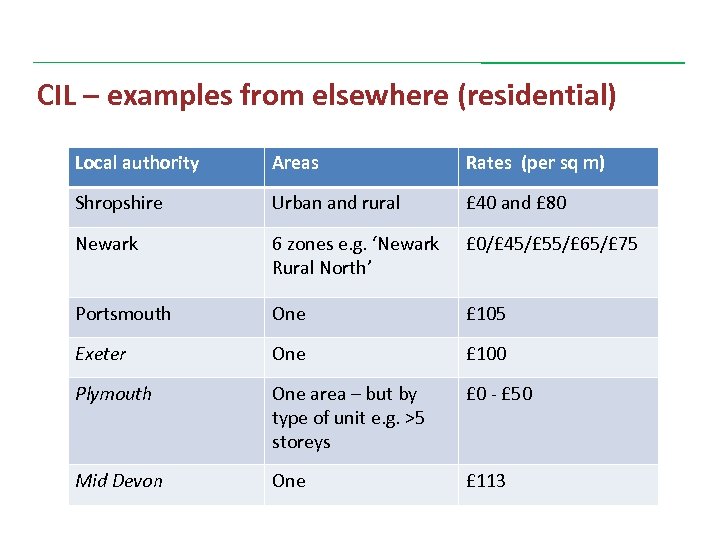 CIL – examples from elsewhere (residential) Local authority Areas Rates (per sq m) Shropshire Urban and rural £ 40 and £ 80 Newark 6 zones e. g. ‘Newark Rural North’ £ 0/£ 45/£ 55/£ 65/£ 75 Portsmouth One £ 105 Exeter One £ 100 Plymouth One area – but by type of unit e. g. >5 storeys £ 0 - £ 50 Mid Devon One £ 113
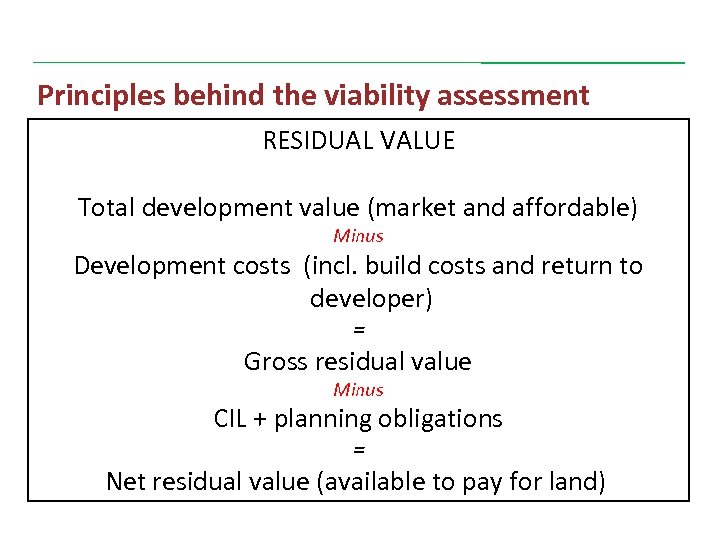 Principles behind the viability assessment RESIDUAL VALUE Total development value (market and affordable) Minus Development costs (incl. build costs and return to developer) = Gross residual value Minus CIL + planning obligations = Net residual value (available to pay for land)
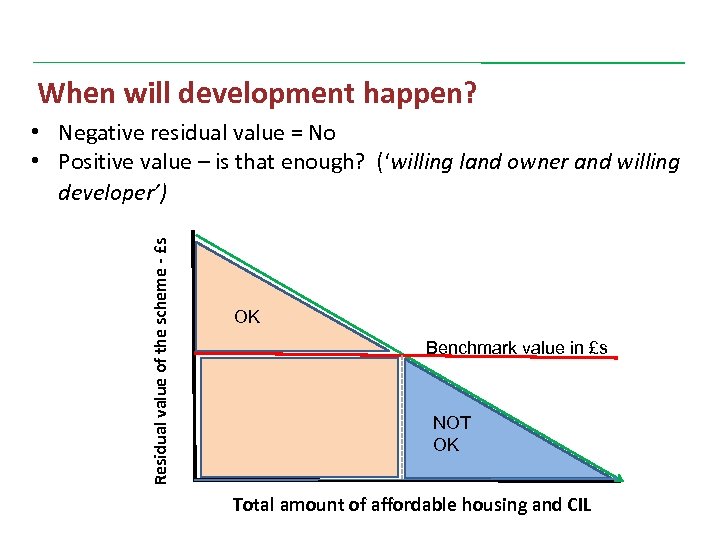 When will development happen? Residual value of the scheme - £s • Negative residual value = No • Positive value – is that enough? (‘willing land owner and willing developer’) OK Benchmark value in £s NOT OK Total amount of affordable housing and CIL
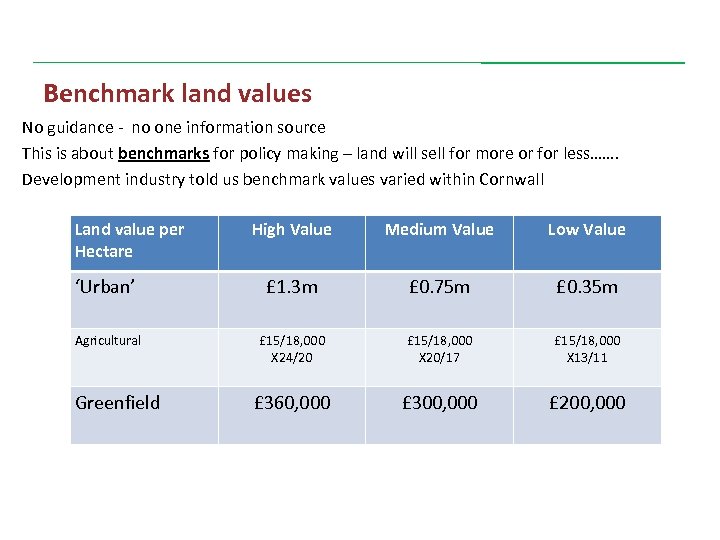 Benchmark land values No guidance - no one information source This is about benchmarks for policy making – land will sell for more or for less……. Development industry told us benchmark values varied within Cornwall Land value per Hectare High Value Medium Value Low Value ‘Urban’ £ 1. 3 m £ 0. 75 m £ 0. 35 m Agricultural £ 15/18, 000 X 24/20 £ 15/18, 000 X 20/17 £ 15/18, 000 X 13/11 £ 360, 000 £ 300, 000 £ 200, 000 Greenfield
 Assumptions used – market values • Based on HM Land Registry data over 10 years (actual selling prices) • Historic data uplifted to current new build prices (2010 - 2011) • Extreme transactions removed in each parish • Current average newbuild house price calculated for each parish • Each parish allocated to a Price Zone: Zone 1 -5 = most to least expensive
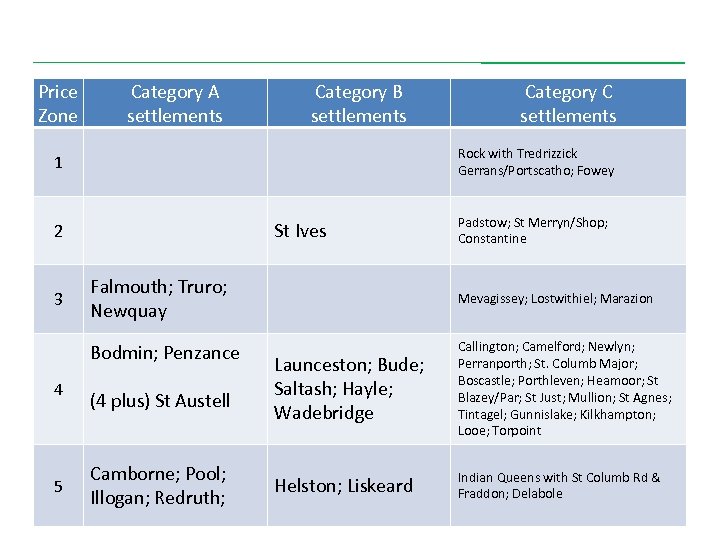 Price Zone Category A settlements Category B settlements Rock with Tredrizzick Gerrans/Portscatho; Fowey 1 St Ives 2 3 Falmouth; Truro; Newquay Bodmin; Penzance 4 5 Category C settlements (4 plus) St Austell Camborne; Pool; Illogan; Redruth; Padstow; St Merryn/Shop; Constantine Mevagissey; Lostwithiel; Marazion Launceston; Bude; Saltash; Hayle; Wadebridge Callington; Camelford; Newlyn; Perranporth; St. Columb Major; Boscastle; Porthleven; Heamoor; St Blazey/Par; St Just; Mullion; St Agnes; Tintagel; Gunnislake; Kilkhampton; Looe; Torpoint Helston; Liskeard Indian Queens with St Columb Rd & Fraddon; Delabole
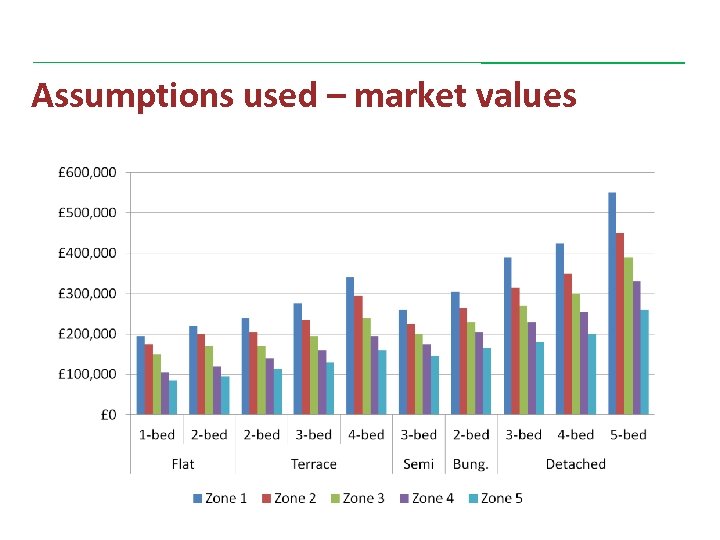 Assumptions used – market values
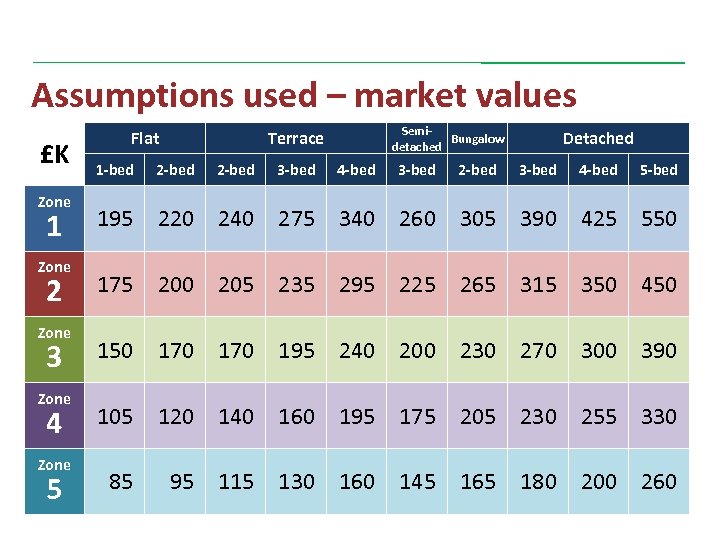 Assumptions used – market values £K Zone 1 Zone 2 Zone 3 Zone 4 Zone 5 Flat Semi. Bungalow detached Terrace 1 -bed 2 -bed 195 220 175 3 -bed 4 -bed Detached 3 -bed 2 -bed 3 -bed 4 -bed 5 -bed 240 275 340 260 305 390 425 550 205 235 295 225 265 315 350 450 170 195 240 200 230 270 300 390 105 120 140 160 195 175 205 230 255 330 85 95 115 130 160 145 165 180 200 260
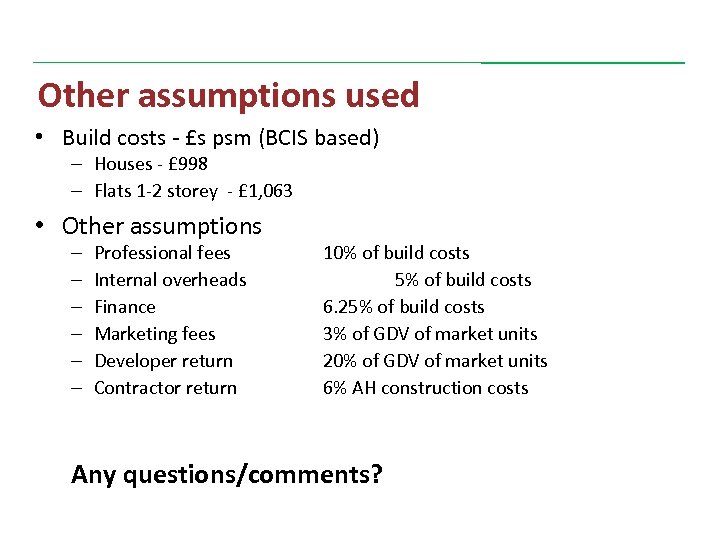 Other assumptions used • Build costs - £s psm (BCIS based) – Houses - £ 998 – Flats 1 -2 storey - £ 1, 063 • Other assumptions – – – Professional fees Internal overheads Finance Marketing fees Developer return Contractor return 10% of build costs 5% of build costs 6. 25% of build costs 3% of GDV of market units 20% of GDV of market units 6% AH construction costs Any questions/comments?
 2. What the evidence tells us about Cornwall The results • Notional 1 hectare site (at different densities) • (Over 40) case study sites (including large strategic sites) • Special case of rural developments
 What we tested • 20% to 50% AH (70% Affordable Rent/ 30% Shared Ownership) • CIL - £ 40, £ 70, £ 100 psm • Everything for each of the 5 price zones
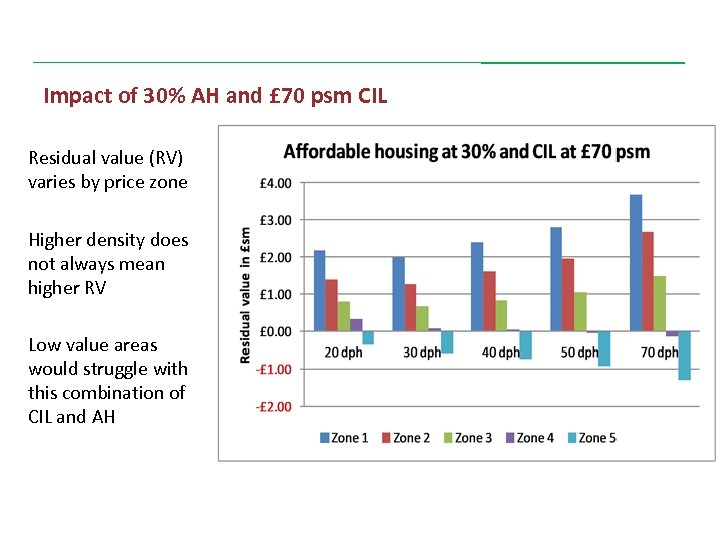 Impact of 30% AH and £ 70 psm CIL Residual value (RV) varies by price zone Higher density does not always mean higher RV Low value areas would struggle with this combination of CIL and AH
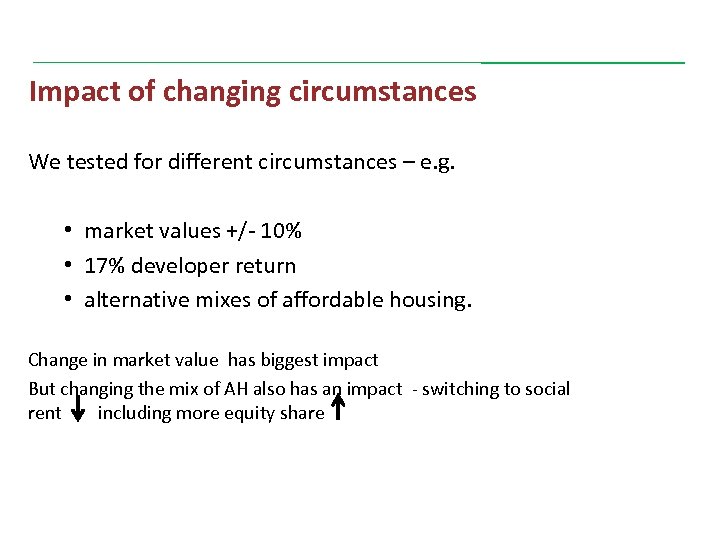 Impact of changing circumstances We tested for different circumstances – e. g. • market values +/- 10% • 17% developer return • alternative mixes of affordable housing. Change in market value has biggest impact But changing the mix of AH also has an impact - switching to social rent including more equity share
 ‘Rules of thumb’ about CIL rates • Amount will vary with dwelling – using averages from this study as a guide! With a CIL of £ 100 psm – levy for a market dwelling – 2 bed flat = – 3 bed terrace = – 4 bed detached = £ 5, 600 £ 8, 000 £ 12, 500 • Some very rough sums…. (CIL at £ 100 psm again) – 40 dph scheme with 25% AH = £ 240, 000 per hectare – For every 1, 000 dwellings, with 25% AH, total CIL = £ 6 m – For every 1, 000 dwellings, with 50% AH, total CIL = £ 4 m
 Taking each zone in turn • RV per hectare – combinations of CIL and AH • Compare with the relevant benchmark • Use 40 dph - not necessarily density producing greatest RV but reasonable for comparison.
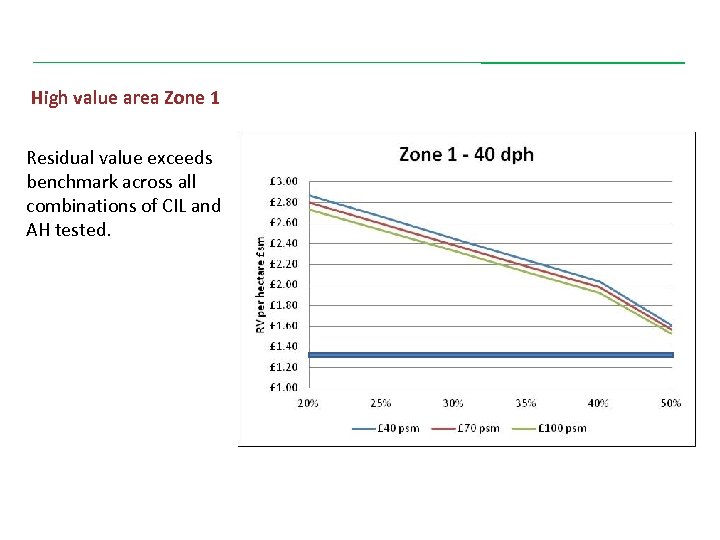 High value area Zone 1 Residual value exceeds benchmark across all combinations of CIL and AH tested.
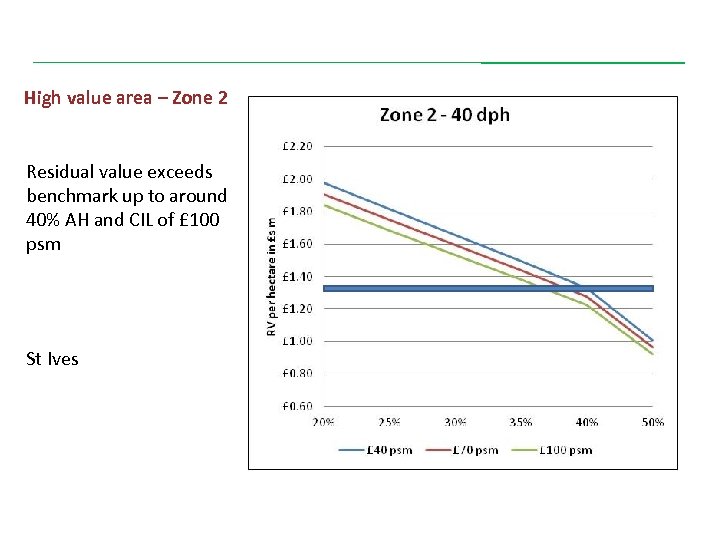 High value area – Zone 2 Residual value exceeds benchmark up to around 40% AH and CIL of £ 100 psm St Ives
 High value areas – Zones 1 and 2 – Case studies • 3 x case studies – 8, 15 and 20 dwellings (densities between 20 dph and 38 dph) • 2 out of 3 viable at £ 100 and 35%+ AH (lessons about type of dwelling mix) • Supports assessment that these high value Zones can support high % AH and CIL
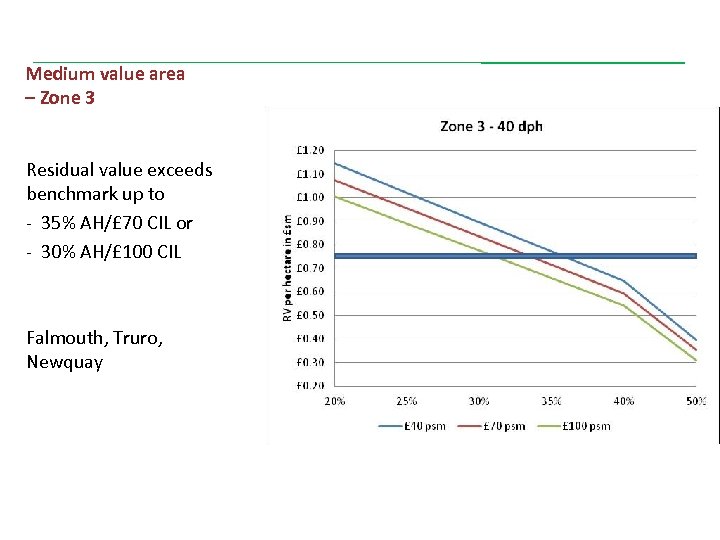 Medium value area – Zone 3 Residual value exceeds benchmark up to - 35% AH/£ 70 CIL or - 30% AH/£ 100 CIL Falmouth, Truro, Newquay
 Medium value areas – Zone 3 – Case studies • 13 Case studies for 3 main towns • 35% and £ 100 CIL above benchmark land value in most cases (but not all e. g. 5 dw scheme in Falmouth) • Large scale greenfield developments – have additional costs but can achieve 35%/£ 100 – deferring payment of CIL improves viability
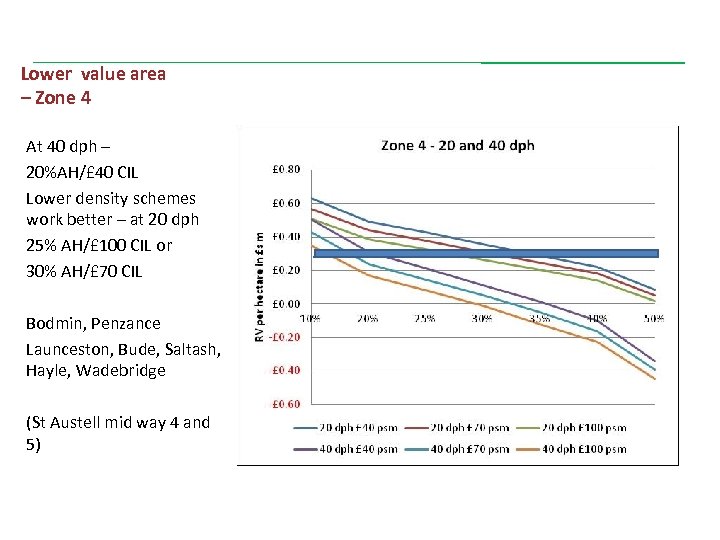 Lower value area – Zone 4 At 40 dph – 20%AH/£ 40 CIL Lower density schemes work better – at 20 dph 25% AH/£ 100 CIL or 30% AH/£ 70 CIL Bodmin, Penzance Launceston, Bude, Saltash, Hayle, Wadebridge (St Austell mid way 4 and 5)
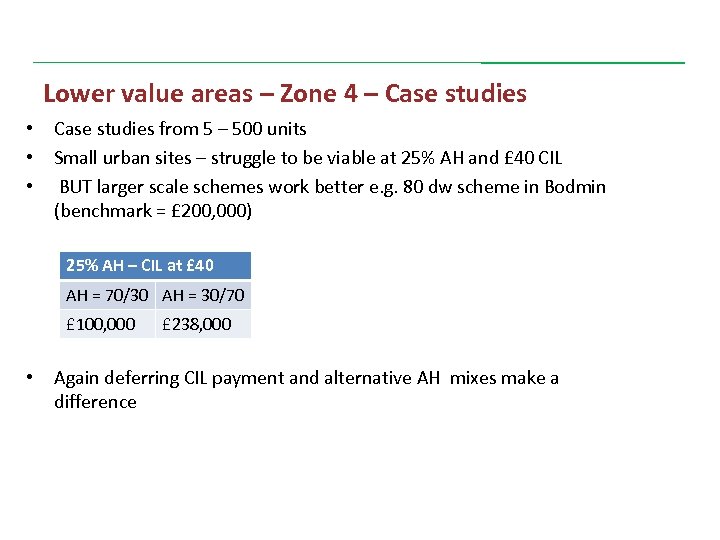 Lower value areas – Zone 4 – Case studies • • • Case studies from 5 – 500 units Small urban sites – struggle to be viable at 25% AH and £ 40 CIL BUT larger scale schemes work better e. g. 80 dw scheme in Bodmin (benchmark = £ 200, 000) 25% AH – CIL at £ 40 AH = 70/30 AH = 30/70 £ 100, 000 • £ 238, 000 Again deferring CIL payment and alternative AH mixes make a difference
 Zone 5 = Camborne/ Pool/Illogan/Redruth, / Helston, Liskeard • Circumstances in which viable development is achievable • Examples of small schemes in specific locations which respond to local market conditions • + Large scale development - market values are higher, creating their own environment
 Viability and rural areas Looked at in two ways…… • With alternative %AH and CIL levels as for larger sites • But focus on smaller sites – 1, 2, 4, 8, 15 and 20 dws • Viability will depend on mix of units and location (price zones) • But small sites (tested down to 1 dwelling) – can deliver viable development with AH and CIL
 Viability and rural areas Second type of testing – Rural exception schemes with (just) enough market housing to make viable (no subsidy, meets a local need, local support). Again viability will depend on i) type of units ii) location (price zones) iii) type of AH • In the high value areas – nil/limited requirement for market housing • But lower price zones, need more market housing (c 50%+) (More detailed analysis to follow…. . )
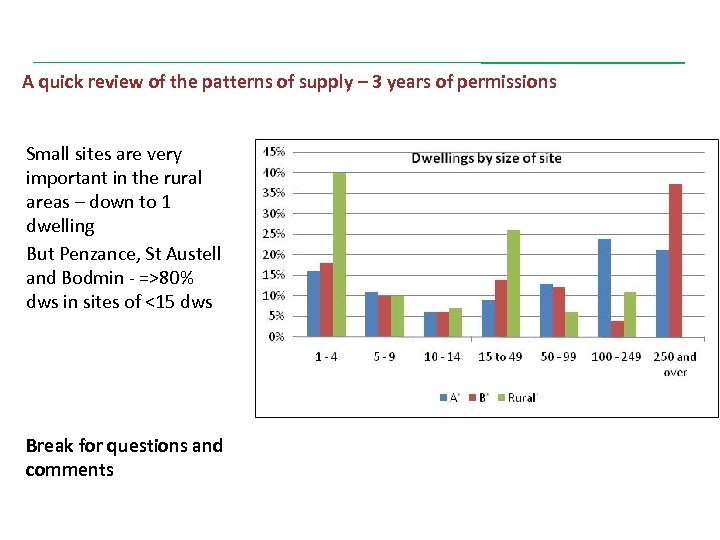 A quick review of the patterns of supply – 3 years of permissions Small sites are very important in the rural areas – down to 1 dwelling But Penzance, St Austell and Bodmin - =>80% dws in sites of <15 dws Break for questions and comments
 What are the options for taking policy forward?
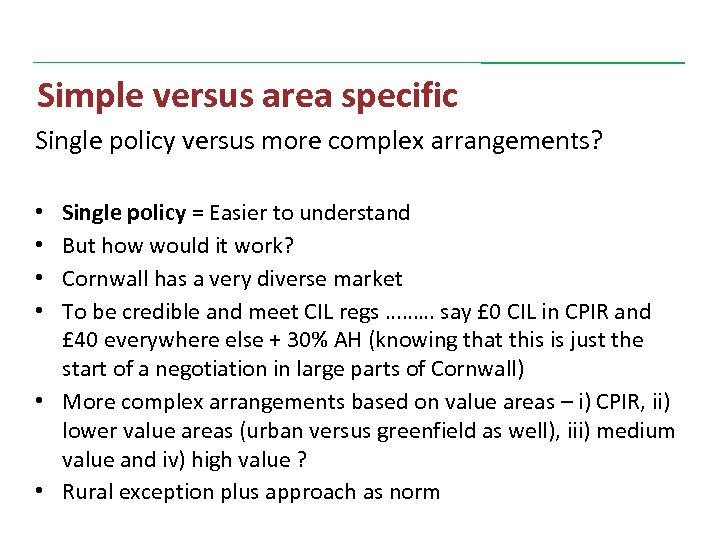 Simple versus area specific Single policy versus more complex arrangements? Single policy = Easier to understand But how would it work? Cornwall has a very diverse market To be credible and meet CIL regs ……… say £ 0 CIL in CPIR and £ 40 everywhere else + 30% AH (knowing that this is just the start of a negotiation in large parts of Cornwall) • More complex arrangements based on value areas – i) CPIR, ii) lower value areas (urban versus greenfield as well), iii) medium value and iv) high value ? • Rural exception plus approach as norm • •
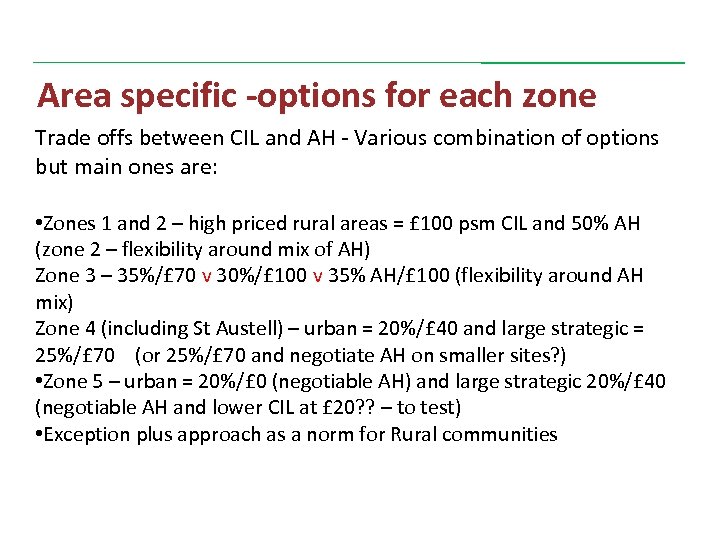 Area specific -options for each zone Trade offs between CIL and AH - Various combination of options but main ones are: • Zones 1 and 2 – high priced rural areas = £ 100 psm CIL and 50% AH (zone 2 – flexibility around mix of AH) Zone 3 – 35%/£ 70 v 30%/£ 100 v 35% AH/£ 100 (flexibility around AH mix) Zone 4 (including St Austell) – urban = 20%/£ 40 and large strategic = 25%/£ 70 (or 25%/£ 70 and negotiate AH on smaller sites? ) • Zone 5 – urban = 20%/£ 0 (negotiable AH) and large strategic 20%/£ 40 (negotiable AH and lower CIL at £ 20? ? – to test) • Exception plus approach as a norm for Rural communities
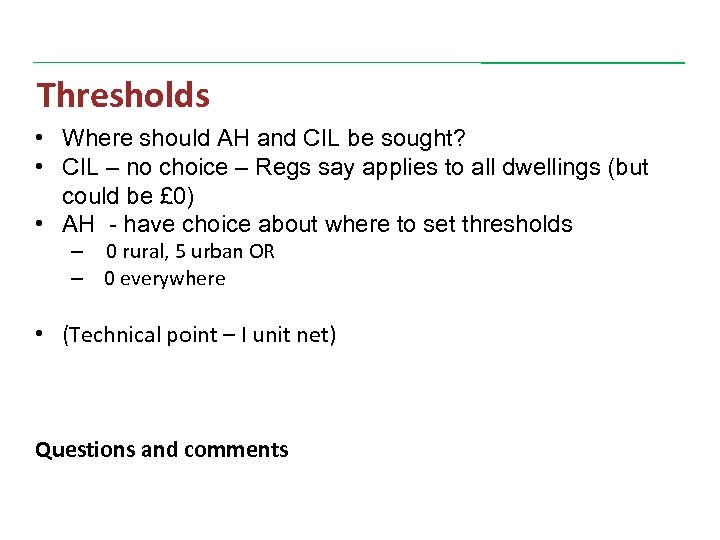 Thresholds • Where should AH and CIL be sought? • CIL – no choice – Regs say applies to all dwellings (but could be £ 0) • AH - have choice about where to set thresholds – 0 rural, 5 urban OR – 0 everywhere • (Technical point – I unit net) Questions and comments