


 Скачать презентацию Core Competencies and Skills in the Knowledge Economy
063d910fd380f041013b4474face379d.ppt
- Количество слайдов: 29
 Core Competencies and Skills in the Knowledge Economy - Implications for OECS Eduardo Velez May 16 -17, 2006 evelezbustillo@worldbank. org
 Presentation Structure Knowledge Revolution and Implications for Education and Training n Measuring Education and Training in a Knowledge Economy Perspective n Key Competencies in the KE n International Benchmarking n Towards a More Effective and Efficient System n
 Knowledge Revolution n Increased global knowledge and development of new technologies, rapid speed of innovation, shorter product life cycles, productivity and upskilling of labor force, as well as intensified globalization and competition have all characterized the “Knowledge Revolution”. n The workforce is “upgrading”, both in terms of the average educational level of workers and the types of job that they are performing. n The ability to create, access and apply knowledge is thus becoming fundamental determinant of global competitiveness.
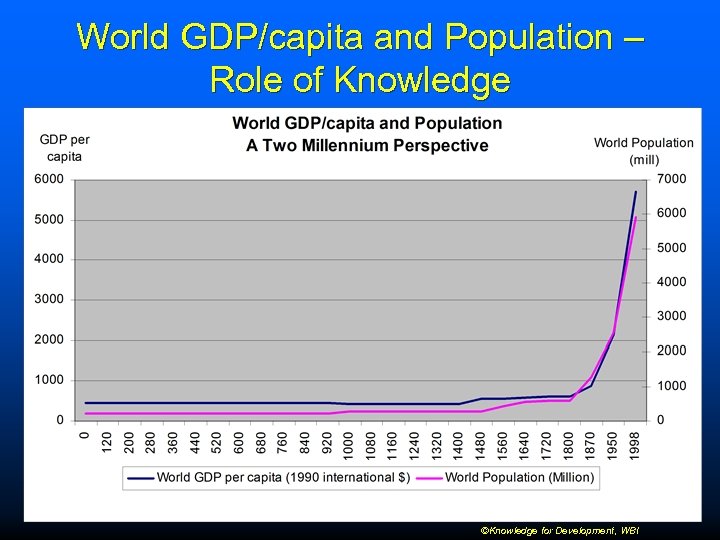 World GDP/capita and Population – Role of Knowledge ©Knowledge for Development, WBI
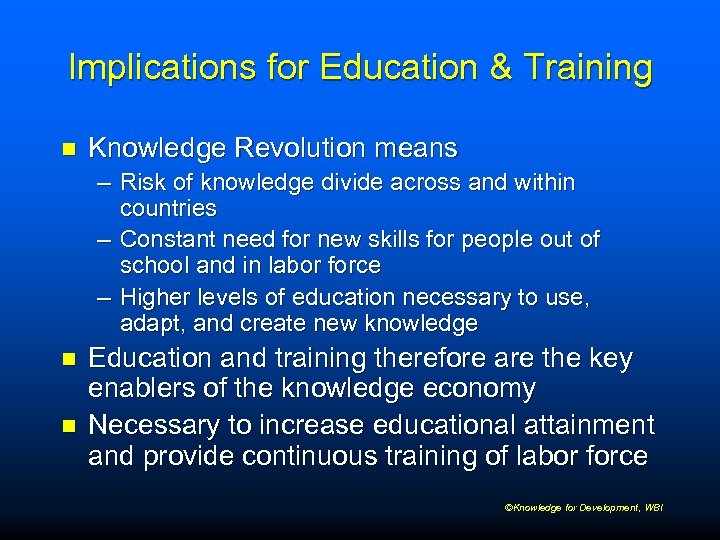 Implications for Education & Training n Knowledge Revolution means – Risk of knowledge divide across and within countries – Constant need for new skills for people out of school and in labor force – Higher levels of education necessary to use, adapt, and create new knowledge n n Education and training therefore are the key enablers of the knowledge economy Necessary to increase educational attainment and provide continuous training of labor force ©Knowledge for Development, WBI
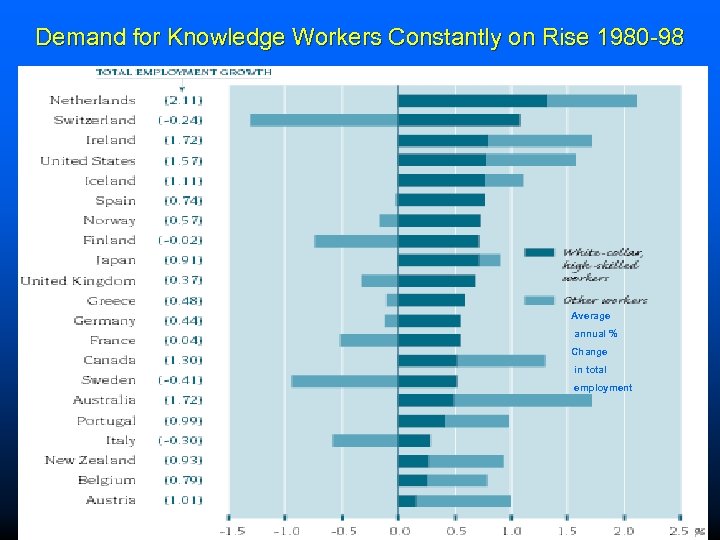 Demand for Knowledge Workers Constantly on Rise 1980 -98 Average annual % Change in total employment
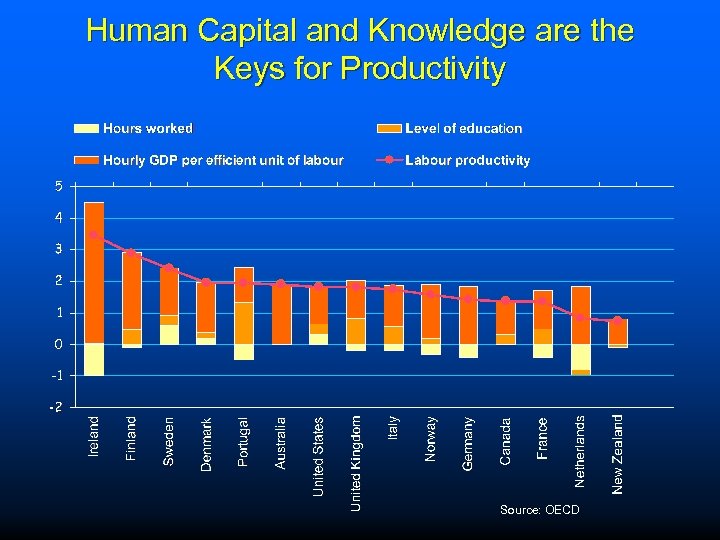 Human Capital and Knowledge are the Keys for Productivity Source: OECD
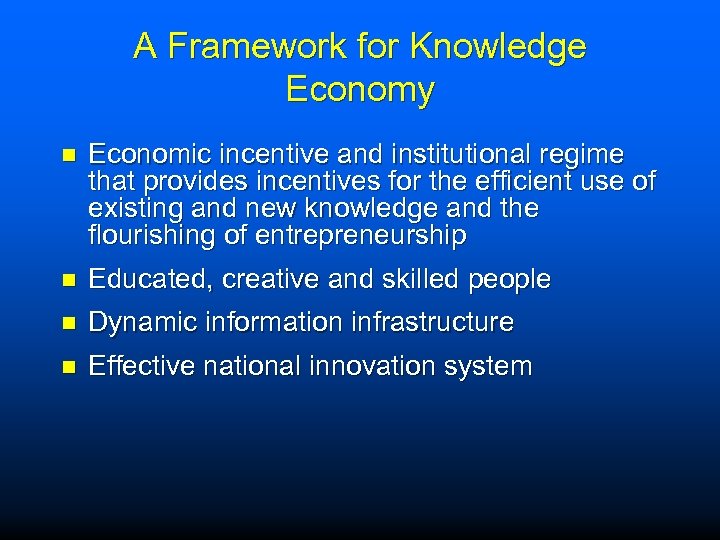 A Framework for Knowledge Economy n Economic incentive and institutional regime that provides incentives for the efficient use of existing and new knowledge and the flourishing of entrepreneurship n Educated, creative and skilled people n Dynamic information infrastructure n Effective national innovation system
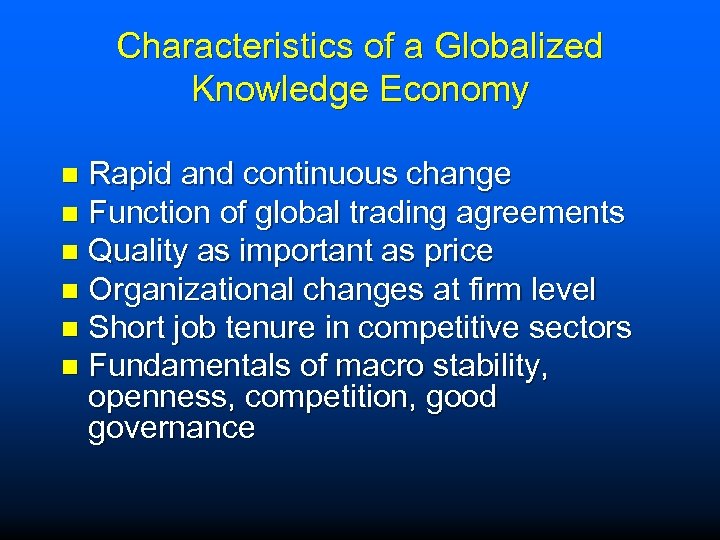 Characteristics of a Globalized Knowledge Economy Rapid and continuous change n Function of global trading agreements n Quality as important as price n Organizational changes at firm level n Short job tenure in competitive sectors n Fundamentals of macro stability, openness, competition, good governance n
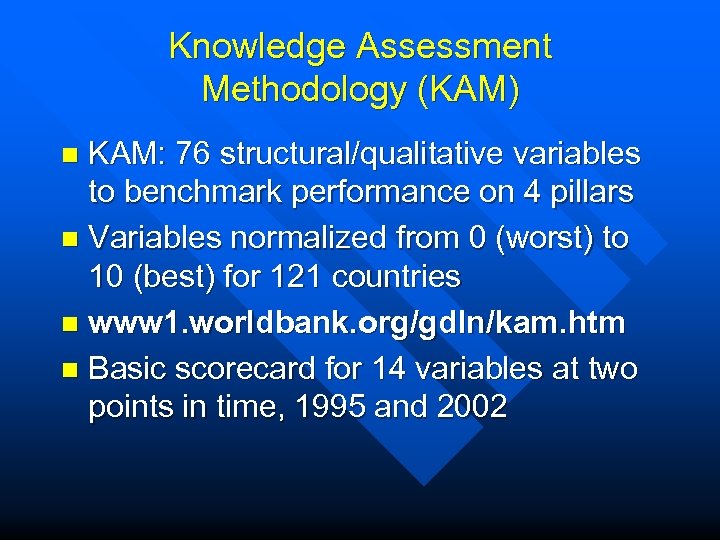 Knowledge Assessment Methodology (KAM) KAM: 76 structural/qualitative variables to benchmark performance on 4 pillars n Variables normalized from 0 (worst) to 10 (best) for 121 countries n www 1. worldbank. org/gdln/kam. htm n Basic scorecard for 14 variables at two points in time, 1995 and 2002 n
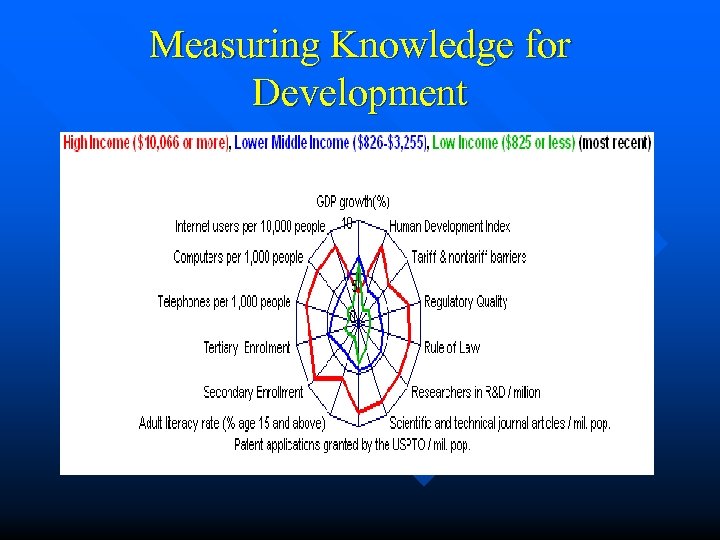 Measuring Knowledge for Development
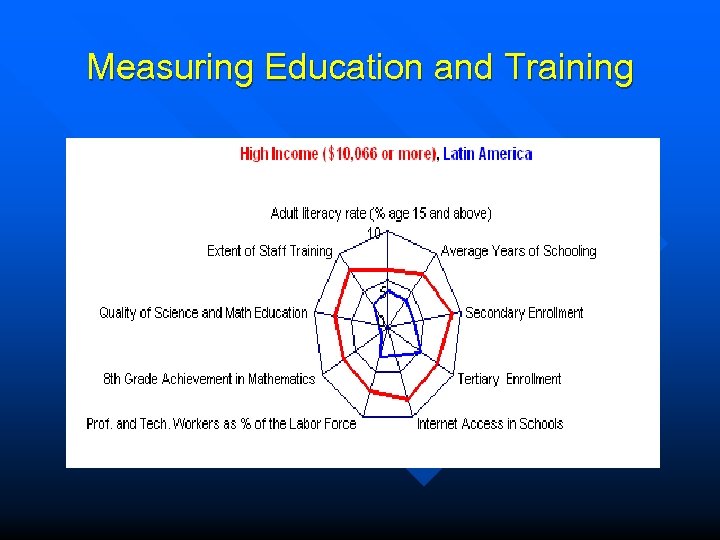 Measuring Education and Training
 Core Competencies in the KE There is no universal definition so far; n The Definition and Selection of Competencies (De. Se. Co) Project of the OECD reviewed 12 countries on competencies for a knowledge society; n Despite wide variations in definitions of competencies in the 12 countries, the De. Se. Co found some competencies appearing in most reports. n
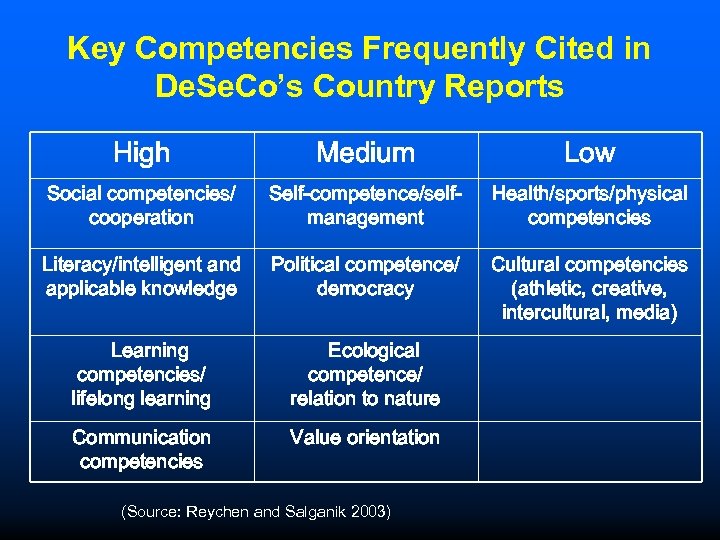 Key Competencies Frequently Cited in De. Se. Co’s Country Reports High Medium Low Social competencies/ cooperation Self-competence/selfmanagement Health/sports/physical competencies Literacy/intelligent and applicable knowledge Political competence/ democracy Cultural competencies (athletic, creative, intercultural, media) Learning competencies/ lifelong learning Ecological competence/ relation to nature Communication competencies Value orientation (Source: Reychen and Salganik 2003)
 Key Competencies Have Multiple Dimensions n n n Complexity and uncertainty of modern life requires people to apply more than one type of competency to tackle tasks and issues that they face. Given this background, the De. Se. Co sees that key competencies have many dimensions (for example: cognitive, motivational, ethical, and social components) and they are interrelated. Based on extensive research then, the De. Se. Co identified three groups of key competencies.
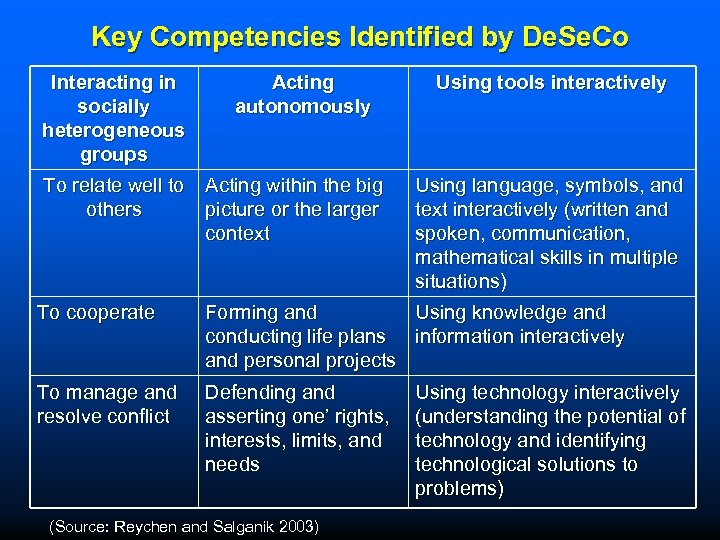 Key Competencies Identified by De. Se. Co Interacting in socially heterogeneous groups Acting autonomously To relate well to Acting within the big others picture or the larger context Using tools interactively Using language, symbols, and text interactively (written and spoken, communication, mathematical skills in multiple situations) To cooperate Forming and conducting life plans and personal projects Using knowledge and information interactively To manage and resolve conflict Defending and asserting one’ rights, interests, limits, and needs Using technology interactively (understanding the potential of technology and identifying technological solutions to problems) (Source: Reychen and Salganik 2003)
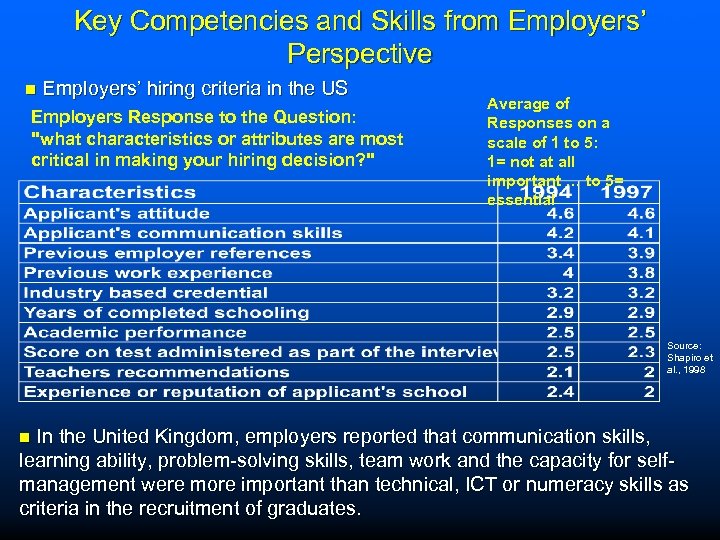 Source: Shapiro et al. , Key Competencies and Skills from Employers’ 1998 Perspective n Employers’ hiring criteria in the US Employers Response to the Question: "what characteristics or attributes are most critical in making your hiring decision? " Average of Responses on a scale of 1 to 5: 1= not at all important … to 5= essential Source: Shapiro et al. , 1998 In the United Kingdom, employers reported that communication skills, learning ability, problem-solving skills, team work and the capacity for selfmanagement were more important than technical, ICT or numeracy skills as criteria in the recruitment of graduates. n
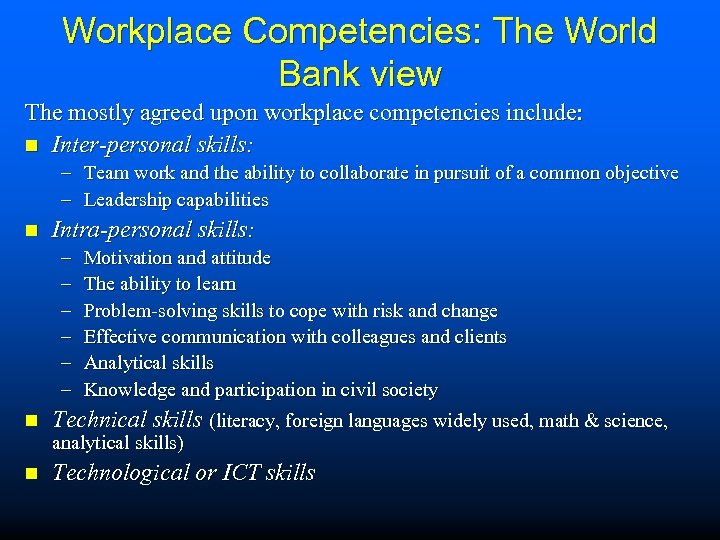 Workplace Competencies: The World Bank view The mostly agreed upon workplace competencies include: n Inter-personal skills: – Team work and the ability to collaborate in pursuit of a common objective – Leadership capabilities n Intra-personal skills: – – – Motivation and attitude The ability to learn Problem-solving skills to cope with risk and change Effective communication with colleagues and clients Analytical skills Knowledge and participation in civil society n Technical skills (literacy, foreign languages widely used, math & science, analytical skills) n Technological or ICT skills
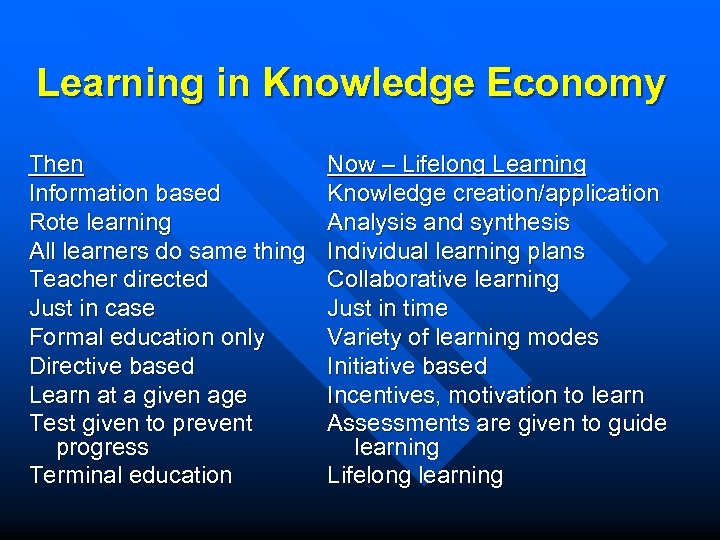 Learning in Knowledge Economy Then Information based Rote learning All learners do same thing Teacher directed Just in case Formal education only Directive based Learn at a given age Test given to prevent progress Terminal education Now – Lifelong Learning Knowledge creation/application Analysis and synthesis Individual learning plans Collaborative learning Just in time Variety of learning modes Initiative based Incentives, motivation to learn Assessments are given to guide learning Lifelong learning
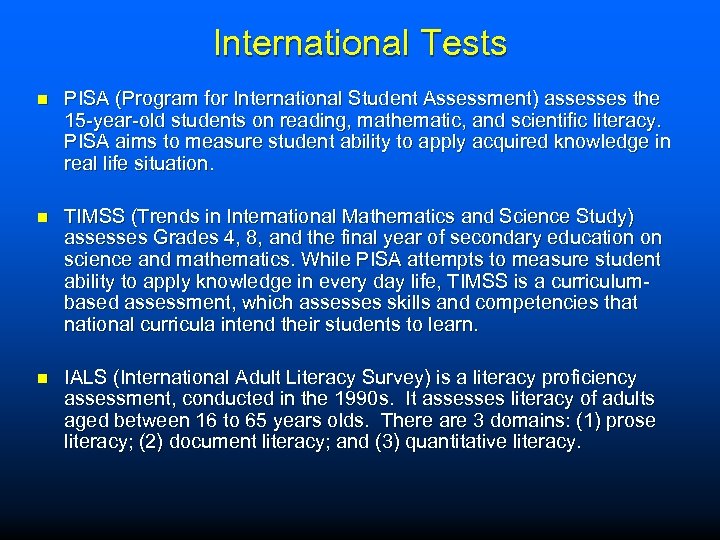 International Tests n PISA (Program for International Student Assessment) assesses the 15 -year-old students on reading, mathematic, and scientific literacy. PISA aims to measure student ability to apply acquired knowledge in real life situation. n TIMSS (Trends in International Mathematics and Science Study) assesses Grades 4, 8, and the final year of secondary education on science and mathematics. While PISA attempts to measure student ability to apply knowledge in every day life, TIMSS is a curriculumbased assessment, which assesses skills and competencies that national curricula intend their students to learn. n IALS (International Adult Literacy Survey) is a literacy proficiency assessment, conducted in the 1990 s. It assesses literacy of adults aged between 16 to 65 years olds. There are 3 domains: (1) prose literacy; (2) document literacy; and (3) quantitative literacy.
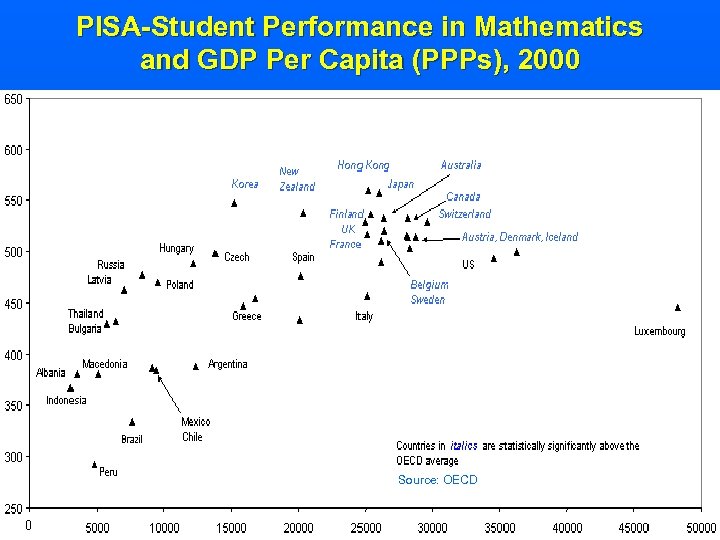 PISA-Student Performance in Mathematics and GDP Per Capita (PPPs), 2000 Source: OECD
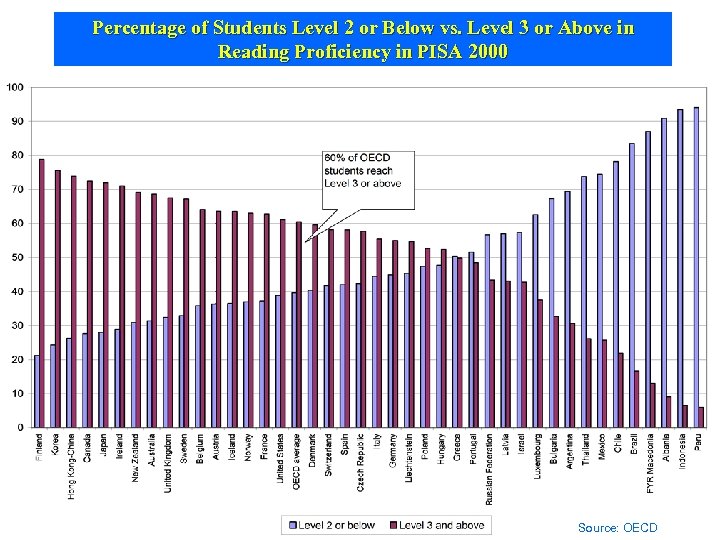 Percentage of Students Level 2 or Below vs. Level 3 or Above in Reading Proficiency in PISA 2000 Source: OECD
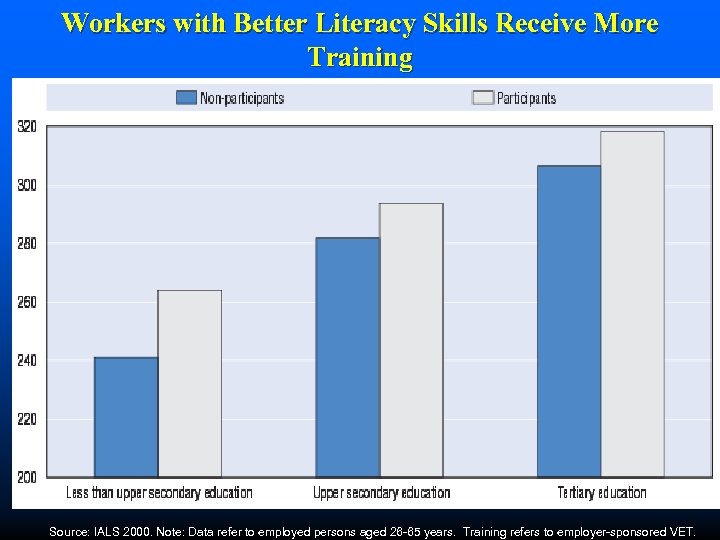 Workers with Better Literacy Skills Receive More Training Source: IALS 2000. Note: Data refer to employed persons aged 26 -65 years. Training refers to employer-sponsored VET.
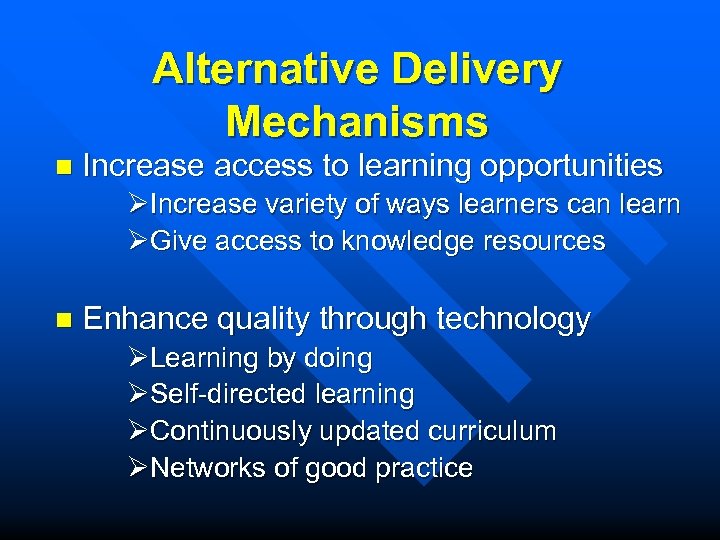 Alternative Delivery Mechanisms n Increase access to learning opportunities ØIncrease variety of ways learners can learn ØGive access to knowledge resources n Enhance quality through technology ØLearning by doing ØSelf-directed learning ØContinuously updated curriculum ØNetworks of good practice
 Governance for Lifelong Learning Requires multi-sectoral collaboration n Enabling environment for pluralistic approaches n Focus on equity n Demand-driven policy n
 OECS in Perspective Most Caribbean countries have made significant public investment in education over the last decades, averaging 6 -7 percent of GDP. n Considerable progress has been made in UPE and in secondary education. n However tertiary enrollments has slowly increased. n And there are still many challenges regarding quality of education as measured by the Caribbean Examination Council. n
 Major Challenges for OECS’s VET Low levels of training of the labor force. n Supply-driven programs, lacking flexibility and relevance to changing market needs. n Uneven quality of training programs, with no objective quality assessment and assurance mechanisms. n Lack of private participation in training design and provision. n
 Towards a More Productive VET System v v v v Strengthening the cross-sectoral coordination of relevant agencies. Increasing the role of the private sector in financing and provision of education and training, especially VET. Strengthening the linkages between training supply and the market through employers’ participation in course design and training activities. Implementing the occupational standards and qualification systems by which work skills and training programs can be tested and certified. Spurring VET by providing more incentives, such as tax credits, individual accounts, part-time study, etc. Enhancing the efficiency and quality through better evaluation, input-output analysis, and curricula. Further harnessing the power of distance learning, e. g. , . . .
 Thank You! Eduardo Velez evelezbustillo@worldbank. org