


 Скачать презентацию Core challenges facing social security in South Africa
a9200cef84deeda09d28b54652e93d00.ppt
- Количество слайдов: 19
 Core challenges facing social security in South Africa Parliamentary briefing Prof Marius Olivier, UJ Prof Evance Kalula, UCT 18 August 2006
 Introduction • Three areas for discussion: – Impact of constitutional framework – Coverage and exclusion – International and regional standards
 Impact of constitutional framework • Section 27(1)(c) – “Everyone“ – see Khosa case and constitutional emphasis on vulnerable people – “Access to“ – other elements ensuring dignity of people and quality of life must be in place too – Right to access to social assistance: • “Unable to support …. “ • “Dependants“ • “Appropriate social assistance"
 Impact of constitutional framework (continued) • Section 27(2) – State obligation – Three qualifications: • Reasonable measures • Within available resources • Progressive realisation
 Impact of constitutional framework (continued) • Implications and challenges – A comprehensive and integrated approach is required – There is a need for a policy-based programme and legislative implementation – A range for reasonable measures are at the disposal of government and the legislature – Sufficient budgetary support is required – There is a constitutional focus on vulnerable groups – Retrogressive measures are inadvisable
 Coverage and exclusion • Social insurance – – – – – Forms of social insurance in SA Largely formal employment-based Certain workers specifically excluded Absence of public health and retirement schemes Absence in some cases of a statutory compulsion to participate Not properly aligned with social assistance Prevention and (re)integration weak: focus is on compensation/benefits Tax advantages and subsidies Adequacy of benefits?
 Coverage and exclusion (continued) • Social insurance (continued) – Who are excluded? • • • The unemployed Lower paid wage workers Informally employed workers Atypically employed workers Rural, gender and African dimensions
 Coverage and exclusion (continued) • Social assistance – Reach and impact of social assistance • 11 million beneficiaries • Major direct impact • Important indirect/distributional impact
 Coverage and exclusion (continued) • Social assistance (continued) – Coverage and exclusion in social assistance: • • Categorical nature of system Means testing Citizenship requirement Thus excluded are: – Able-bodied persons who are not old, young or disabled enough to qualify for a grant (except temporary social relief) – Non-citizens
 Coverage and exclusion (continued) • Social assistance (continued) – Lack of access to social assistance: • Service delivery problems • Non-compliance with administrative justice requirements • Dispute resolution: system of adjudication insufficient; lack of regular tribunal system
 Coverage and exclusion (continued) • What needs to/could be done? – – – Develop a comprehensive framework Adopt holistic and integrated approaches Remove unnecessary exclusions Extend reach of existing social insurance schemes Introduce relevant public schemes with extensive coverage – Introduce compulsion to participate – Introduce preventative and reintegrative elements and link these with compensation measures and with structure and funding of system – Remove/channel of tax advances and subsidies in order to strengthen solidarity in social security system
 Coverage and exclusion (continued) • What needs to/could be done? (continued) – Social assistance: • Review of grants types • Review of grants entitlement criteria and related issues • Consider removal of means testing and, where this is to remain, consider standardising same
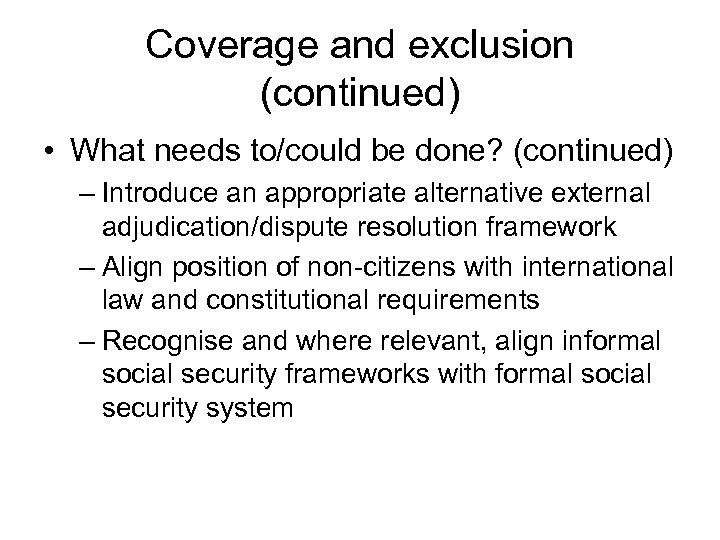 Coverage and exclusion (continued) • What needs to/could be done? (continued) – Introduce an appropriate alternative external adjudication/dispute resolution framework – Align position of non-citizens with international law and constitutional requirements – Recognise and where relevant, align informal social security frameworks with formal social security system
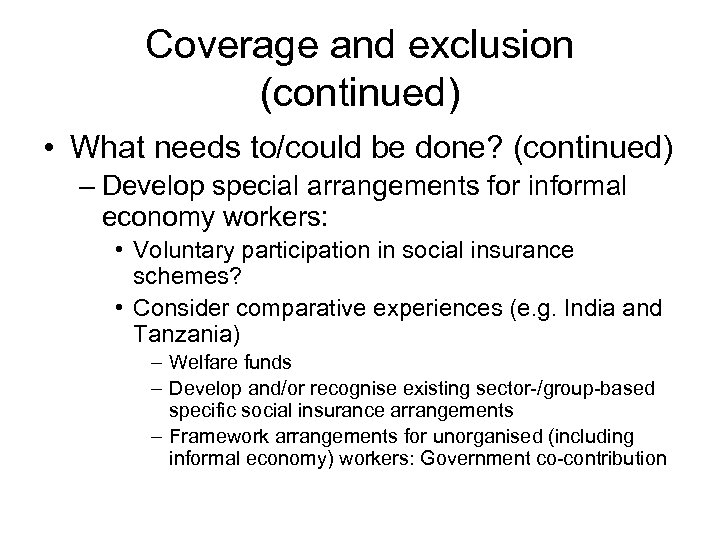 Coverage and exclusion (continued) • What needs to/could be done? (continued) – Develop special arrangements for informal economy workers: • Voluntary participation in social insurance schemes? • Consider comparative experiences (e. g. India and Tanzania) – Welfare funds – Develop and/or recognise existing sector-/group-based specific social insurance arrangements – Framework arrangements for unorganised (including informal economy) workers: Government co-contribution
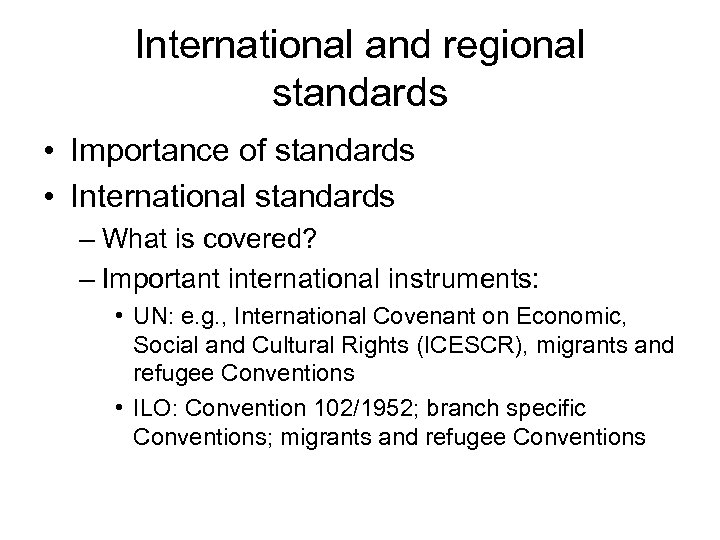 International and regional standards • Importance of standards • International standards – What is covered? – Important international instruments: • UN: e. g. , International Covenant on Economic, Social and Cultural Rights (ICESCR), migrants and refugee Conventions • ILO: Convention 102/1952; branch specific Conventions; migrants and refugee Conventions
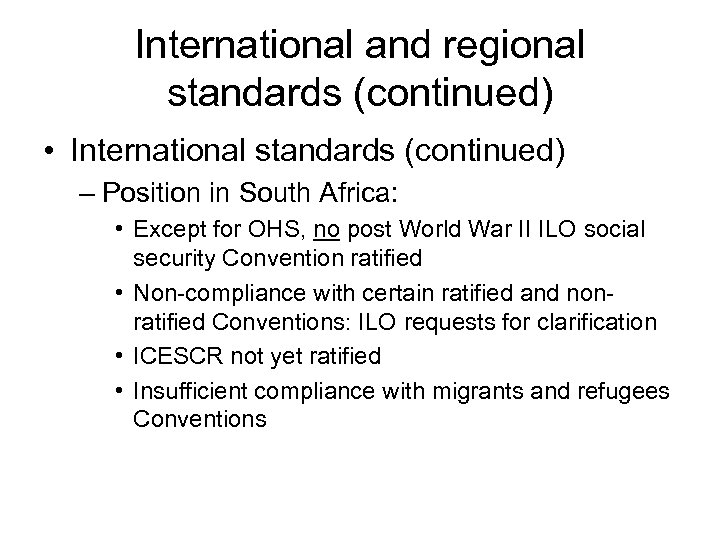 International and regional standards (continued) • International standards (continued) – Position in South Africa: • Except for OHS, no post World War II ILO social security Convention ratified • Non-compliance with certain ratified and nonratified Conventions: ILO requests for clarification • ICESCR not yet ratified • Insufficient compliance with migrants and refugees Conventions
 International and regional standards (continued) • Regional standards – Regional instruments • SADC Treaty • Social Charter (Charter of Fundamental Social Rights) • Draft Code on Social Security • Draft Protocol on the Facilitation of the Movement of Persons – Regional structures/institutional framework
 International and regional standards (continued) • The need for proper co-ordination of social security, in particular when people migrate – Usually: bilateral and/or multilateral arrangements – What is covered: • • Equality of treatment Maintenance of acquired rights Aggregation of insurance periods Exportability of benefits – South Africa: only limited arrangements
 Conclusions • Need for comprehensive, co-ordinated and integrated system • Need to properly extend coverage • Need to align SA social security with international and regional standards • Need to develop appropriate co-ordination mechanisms