 Скачать презентацию Copyright Law Ronald W Staudt Class 23 November
72870fb9e6edfe9923d0689ae3fed1a6.ppt
- Количество слайдов: 21



Copyright Law Ronald W. Staudt Class 23 November 14, 2013
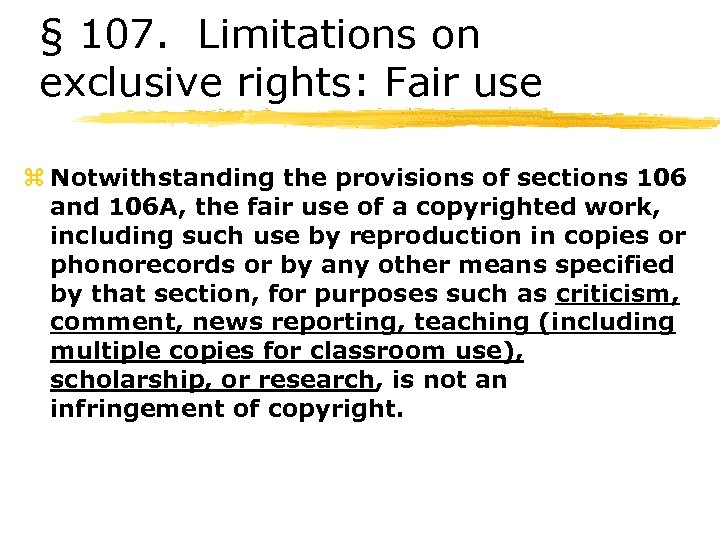
§ 107. Limitations on exclusive rights: Fair use z Notwithstanding the provisions of sections 106 and 106 A, the fair use of a copyrighted work, including such use by reproduction in copies or phonorecords or by any other means specified by that section, for purposes such as criticism, comment, news reporting, teaching (including multiple copies for classroom use), scholarship, or research, is not an infringement of copyright.
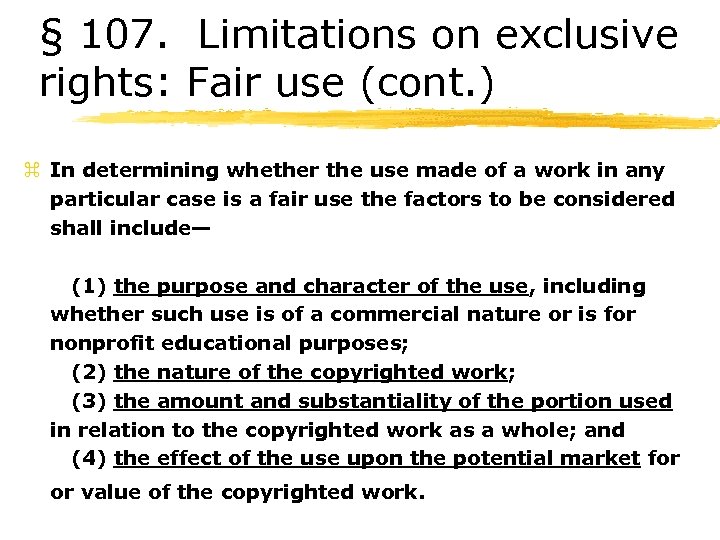
§ 107. Limitations on exclusive rights: Fair use (cont. ) z In determining whether the use made of a work in any particular case is a fair use the factors to be considered shall include— (1) the purpose and character of the use, including whether such use is of a commercial nature or is for nonprofit educational purposes; (2) the nature of the copyrighted work; (3) the amount and substantiality of the portion used in relation to the copyrighted work as a whole; and (4) the effect of the use upon the potential market for or value of the copyrighted work.
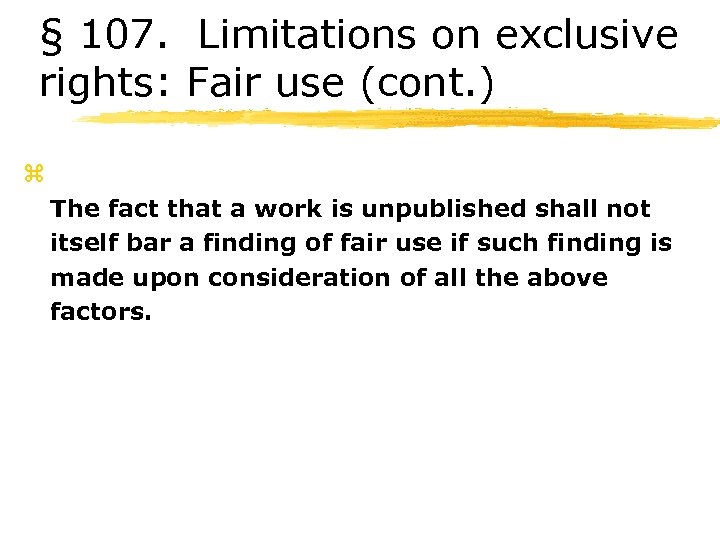
§ 107. Limitations on exclusive rights: Fair use (cont. ) z The fact that a work is unpublished shall not itself bar a finding of fair use if such finding is made upon consideration of all the above factors.
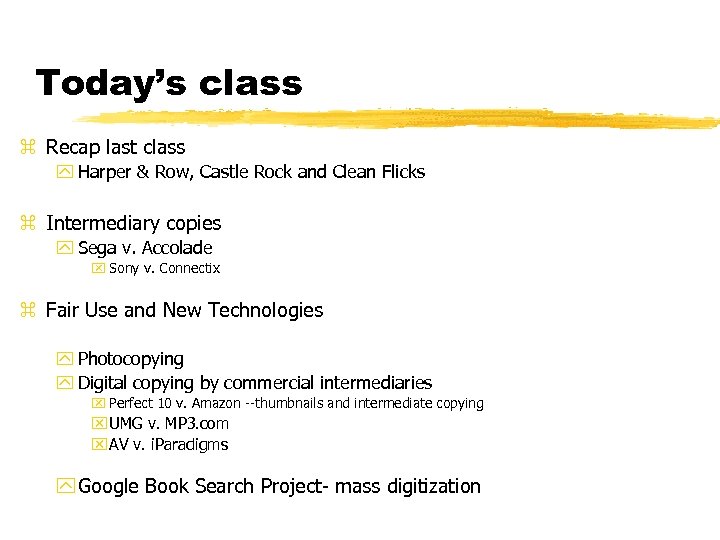
Today’s class z Recap last class y Harper & Row, Castle Rock and Clean Flicks z Intermediary copies y Sega v. Accolade x Sony v. Connectix z Fair Use and New Technologies y Photocopying y Digital copying by commercial intermediaries x Perfect 10 v. Amazon --thumbnails and intermediate copying x UMG v. MP 3. com x AV v. i. Paradigms y Google Book Search Project- mass digitization
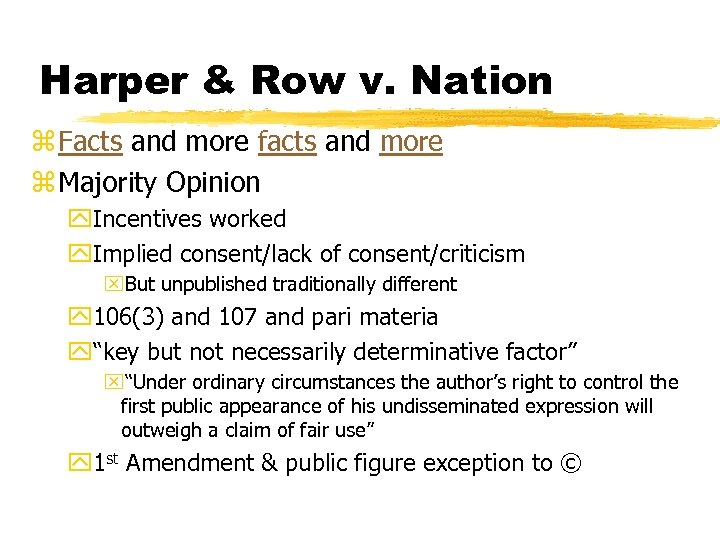
Harper & Row v. Nation z Facts and more facts and more z Majority Opinion y. Incentives worked y. Implied consent/lack of consent/criticism x. But unpublished traditionally different y 106(3) and 107 and pari materia y“key but not necessarily determinative factor” x“Under ordinary circumstances the author’s right to control the first public appearance of his undisseminated expression will outweigh a claim of fair use” y 1 st Amendment & public figure exception to ©
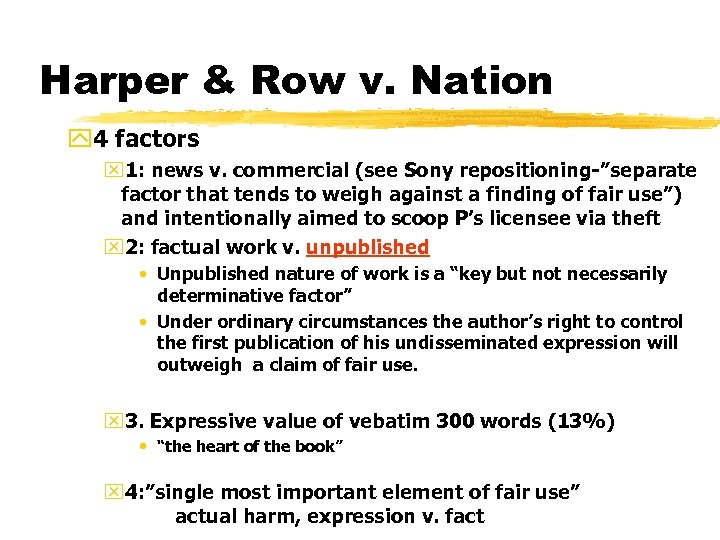
Harper & Row v. Nation y 4 factors x 1: news v. commercial (see Sony repositioning-”separate factor that tends to weigh against a finding of fair use”) and intentionally aimed to scoop P’s licensee via theft x 2: factual work v. unpublished • Unpublished nature of work is a “key but not necessarily determinative factor” • Under ordinary circumstances the author’s right to control the first publication of his undisseminated expression will outweigh a claim of fair use. x 3. Expressive value of vebatim 300 words (13%) • “the heart of the book” x 4: ”single most important element of fair use” actual harm, expression v. fact
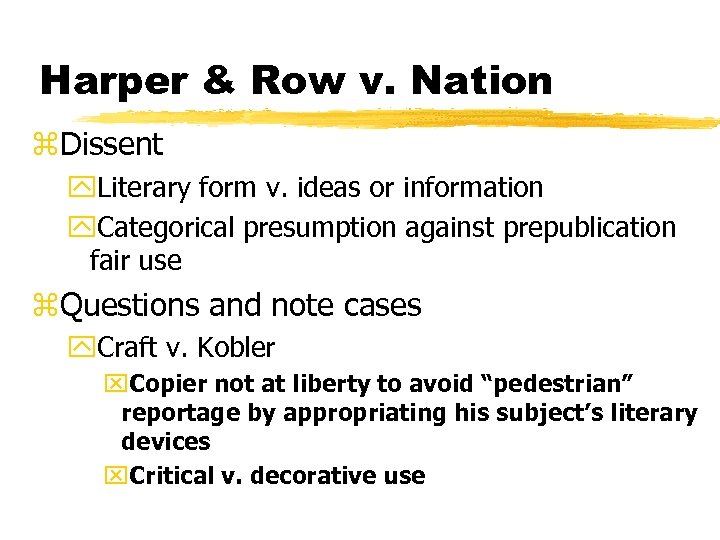
Harper & Row v. Nation z. Dissent y. Literary form v. ideas or information y. Categorical presumption against prepublication fair use z. Questions and note cases y. Craft v. Kobler x. Copier not at liberty to avoid “pedestrian” reportage by appropriating his subject’s literary devices x. Critical v. decorative use
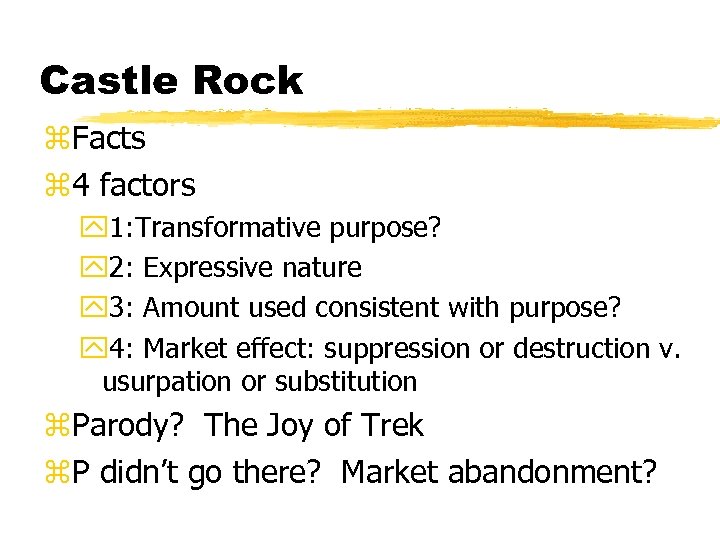
Castle Rock z. Facts z 4 factors y 1: Transformative purpose? y 2: Expressive nature y 3: Amount used consistent with purpose? y 4: Market effect: suppression or destruction v. usurpation or substitution z. Parody? The Joy of Trek z. P didn’t go there? Market abandonment?
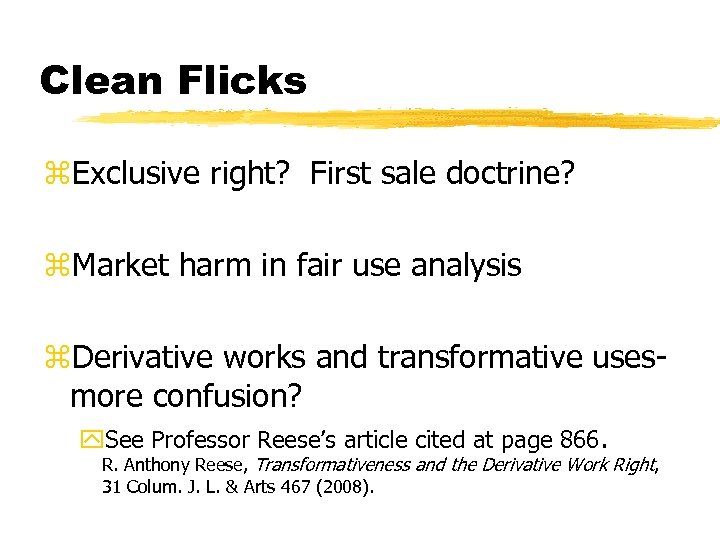
Clean Flicks z. Exclusive right? First sale doctrine? z. Market harm in fair use analysis z. Derivative works and transformative uses- more confusion? y. See Professor Reese’s article cited at page 866. R. Anthony Reese, Transformativeness and the Derivative Work Right, 31 Colum. J. L. & Arts 467 (2008).
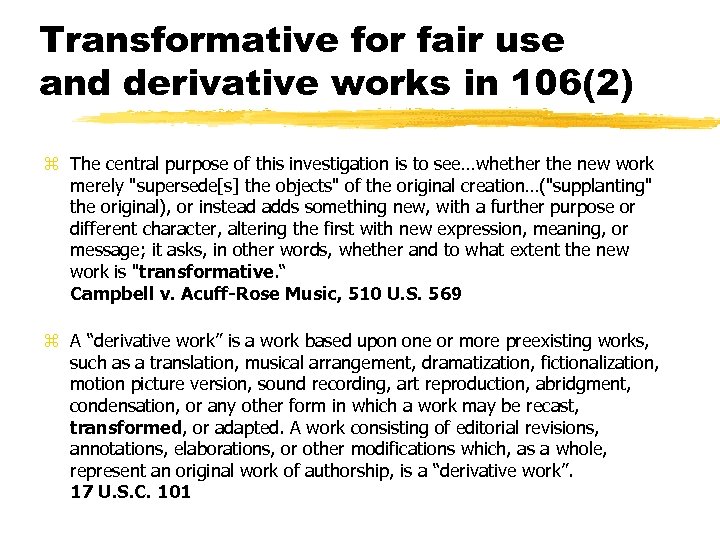
Transformative for fair use and derivative works in 106(2) z The central purpose of this investigation is to see…whether the new work merely "supersede[s] the objects" of the original creation…("supplanting" the original), or instead adds something new, with a further purpose or different character, altering the first with new expression, meaning, or message; it asks, in other words, whether and to what extent the new work is "transformative. “ Campbell v. Acuff-Rose Music, 510 U. S. 569 z A “derivative work” is a work based upon one or more preexisting works, such as a translation, musical arrangement, dramatization, fictionalization, motion picture version, sound recording, art reproduction, abridgment, condensation, or any other form in which a work may be recast, transformed, or adapted. A work consisting of editorial revisions, annotations, elaborations, or other modifications which, as a whole, represent an original work of authorship, is a “derivative work”. 17 U. S. C. 101
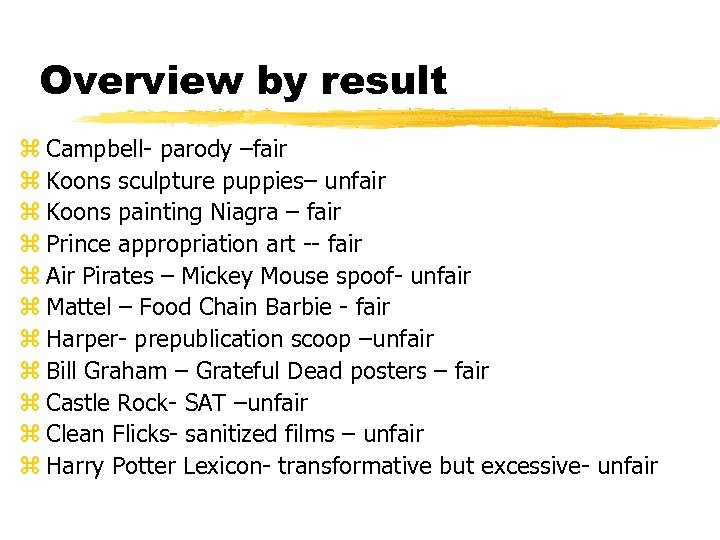
Overview by result z Campbell- parody –fair z Koons sculpture puppies– unfair z Koons painting Niagra – fair z Prince appropriation art -- fair z Air Pirates – Mickey Mouse spoof- unfair z Mattel – Food Chain Barbie - fair z Harper- prepublication scoop –unfair z Bill Graham – Grateful Dead posters – fair z Castle Rock- SAT –unfair z Clean Flicks- sanitized films – unfair z Harry Potter Lexicon- transformative but excessive- unfair
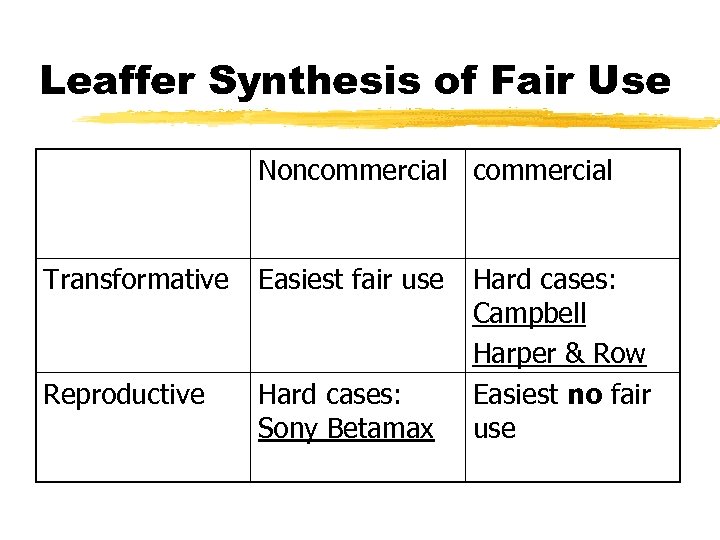
Leaffer Synthesis of Fair Use Noncommercial Transformative Easiest fair use Reproductive Hard cases: Sony Betamax Hard cases: Campbell Harper & Row Easiest no fair use
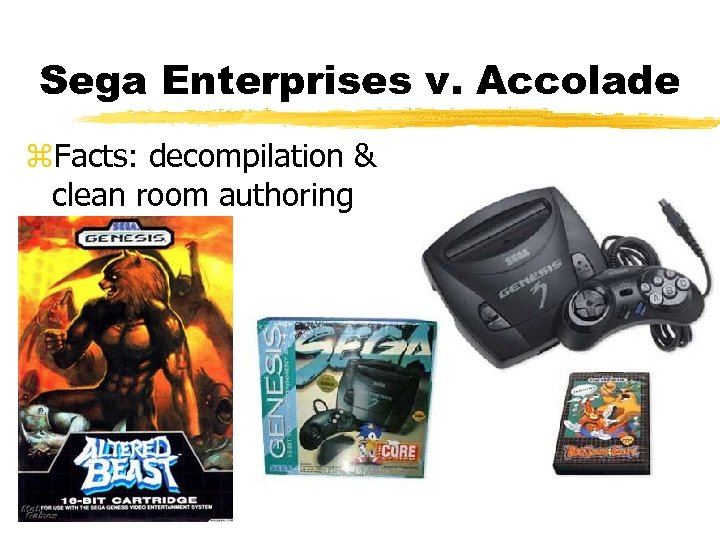
Sega Enterprises v. Accolade z. Facts: decompilation & clean room authoring
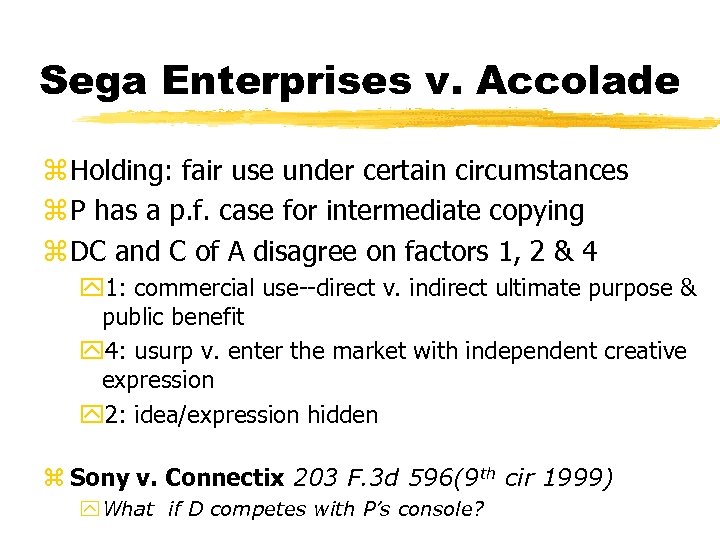
Sega Enterprises v. Accolade z Holding: fair use under certain circumstances z P has a p. f. case for intermediate copying z DC and C of A disagree on factors 1, 2 & 4 y 1: commercial use--direct v. indirect ultimate purpose & public benefit y 4: usurp v. enter the market with independent creative expression y 2: idea/expression hidden z Sony v. Connectix 203 F. 3 d 596(9 th cir 1999) y What if D competes with P’s console?
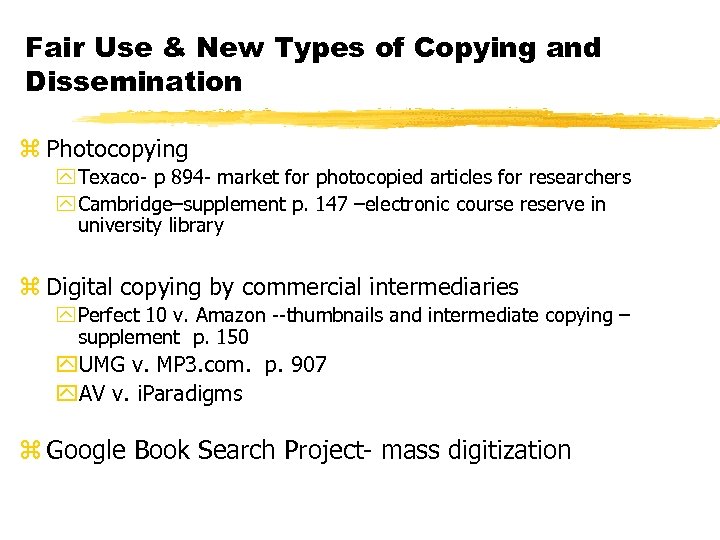
Fair Use & New Types of Copying and Dissemination z Photocopying y Texaco- p 894 - market for photocopied articles for researchers y Cambridge–supplement p. 147 –electronic course reserve in university library z Digital copying by commercial intermediaries y Perfect 10 v. Amazon --thumbnails and intermediate copying – supplement p. 150 y. UMG v. MP 3. com. p. 907 y. AV v. i. Paradigms z Google Book Search Project- mass digitization
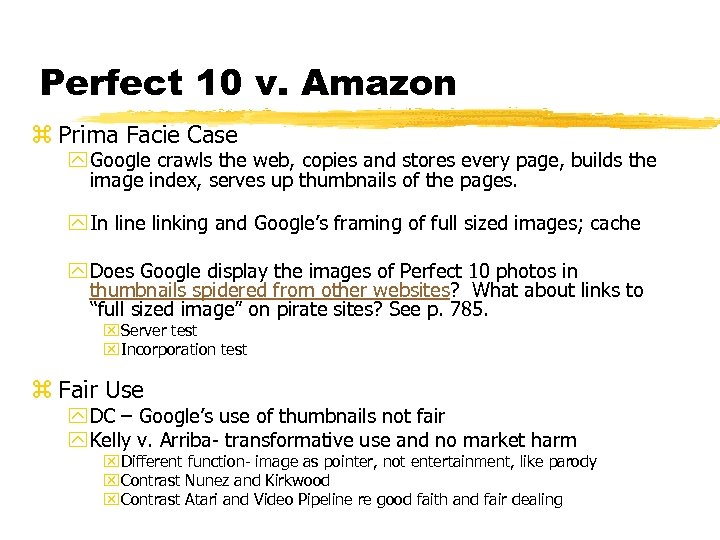
Perfect 10 v. Amazon z Prima Facie Case y Google crawls the web, copies and stores every page, builds the image index, serves up thumbnails of the pages. y In line linking and Google’s framing of full sized images; cache y Does Google display the images of Perfect 10 photos in thumbnails spidered from other websites? What about links to “full sized image” on pirate sites? See p. 785. x Server test x Incorporation test z Fair Use y DC – Google’s use of thumbnails not fair y Kelly v. Arriba- transformative use and no market harm x Different function- image as pointer, not entertainment, like parody x Contrast Nunez and Kirkwood x Contrast Atari and Video Pipeline re good faith and fair dealing
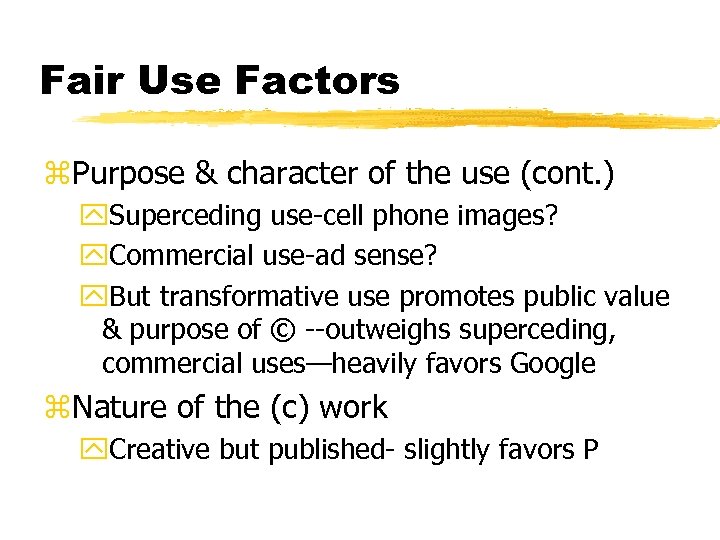
Fair Use Factors z. Purpose & character of the use (cont. ) y. Superceding use-cell phone images? y. Commercial use-ad sense? y. But transformative use promotes public value & purpose of © --outweighs superceding, commercial uses—heavily favors Google z. Nature of the (c) work y. Creative but published- slightly favors P
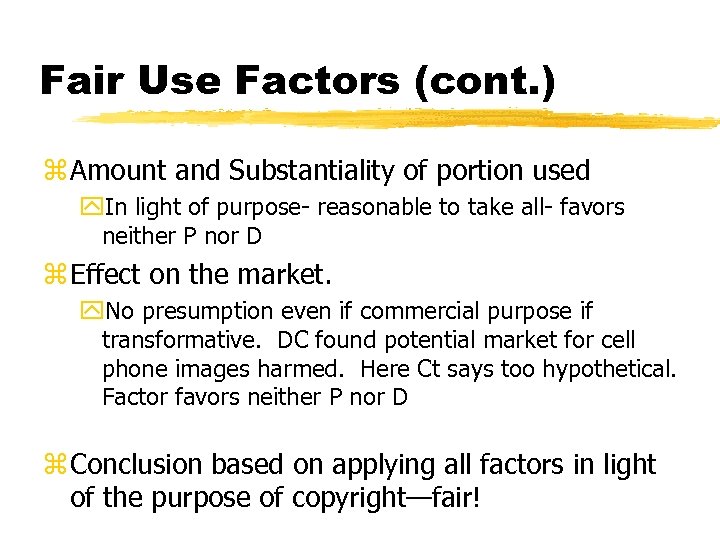
Fair Use Factors (cont. ) z Amount and Substantiality of portion used y. In light of purpose- reasonable to take all- favors neither P nor D z Effect on the market. y. No presumption even if commercial purpose if transformative. DC found potential market for cell phone images harmed. Here Ct says too hypothetical. Factor favors neither P nor D z Conclusion based on applying all factors in light of the purpose of copyright—fair!
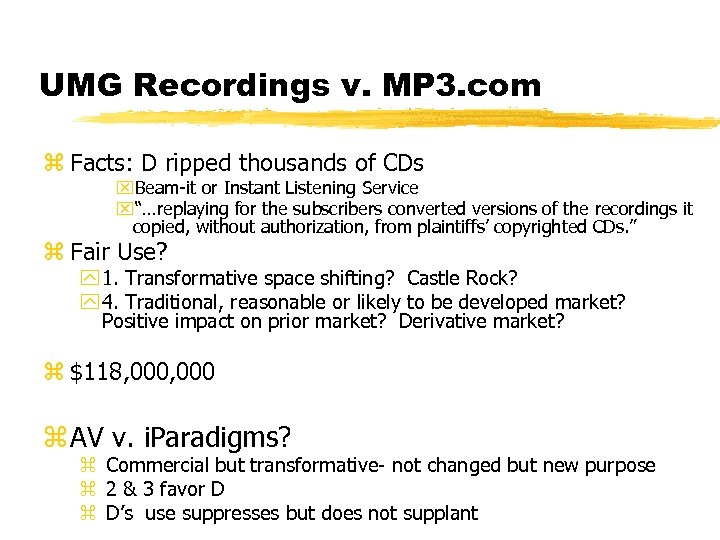
UMG Recordings v. MP 3. com z Facts: D ripped thousands of CDs x. Beam-it or Instant Listening Service x“…replaying for the subscribers converted versions of the recordings it copied, without authorization, from plaintiffs’ copyrighted CDs. ” z Fair Use? y 1. Transformative space shifting? Castle Rock? y 4. Traditional, reasonable or likely to be developed market? Positive impact on prior market? Derivative market? z $118, 000 z AV v. i. Paradigms? z Commercial but transformative- not changed but new purpose z 2 & 3 favor D z D’s use suppresses but does not supplant
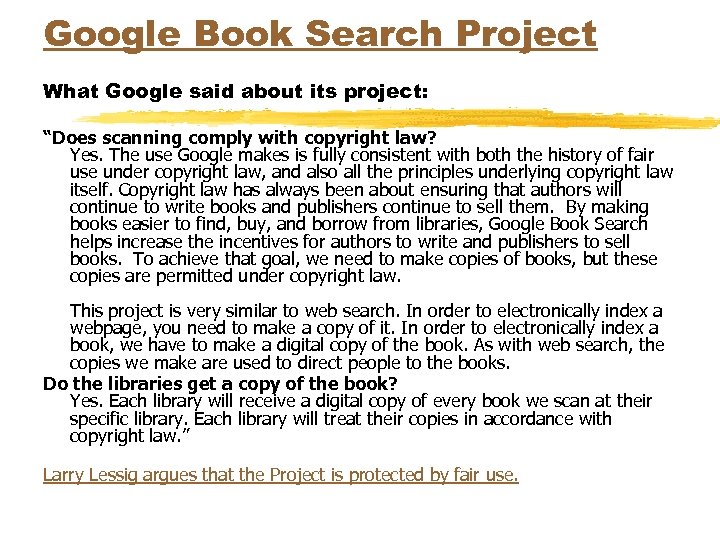
Google Book Search Project What Google said about its project: “Does scanning comply with copyright law? Yes. The use Google makes is fully consistent with both the history of fair use under copyright law, and also all the principles underlying copyright law itself. Copyright law has always been about ensuring that authors will continue to write books and publishers continue to sell them. By making books easier to find, buy, and borrow from libraries, Google Book Search helps increase the incentives for authors to write and publishers to sell books. To achieve that goal, we need to make copies of books, but these copies are permitted under copyright law. This project is very similar to web search. In order to electronically index a webpage, you need to make a copy of it. In order to electronically index a book, we have to make a digital copy of the book. As with web search, the copies we make are used to direct people to the books. Do the libraries get a copy of the book? Yes. Each library will receive a digital copy of every book we scan at their specific library. Each library will treat their copies in accordance with copyright law. ” Larry Lessig argues that the Project is protected by fair use.
Скачать презентацию Copyright Law Ronald W Staudt Class 23 November
72870fb9e6edfe9923d0689ae3fed1a6.ppt