


 Скачать презентацию Copyright in an Innovative Canada Richard Phohl I
4469dc69d363f30b93c26d05e5ca0eea.ppt
- Количество слайдов: 88
 Copyright in an Innovative Canada Richard Phohl I Lisa Clarkson I Giuseppina D'Agostino Music. Canada CBC Osgoode Hall Moderator: Sundeep Chauhan, MPA-Canada
 Copyright in an Innovative Canada: Empowering New Business Models in the Music Industry Richard Pfohl General Counsel Music Canada & Audio-Video Licensing Agency (AVLA) 2012 © Intellectual Property Institute of Canada
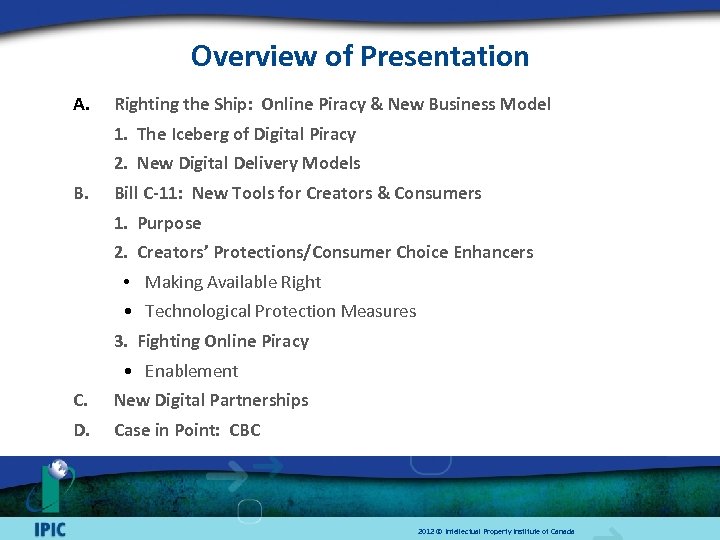 Overview of Presentation A. Righting the Ship: Online Piracy & New Business Model 1. The Iceberg of Digital Piracy 2. New Digital Delivery Models B. Bill C-11: New Tools for Creators & Consumers 1. Purpose 2. Creators’ Protections/Consumer Choice Enhancers • Making Available Right • Technological Protection Measures 3. Fighting Online Piracy • Enablement C. New Digital Partnerships D. Case in Point: CBC 2012 © Intellectual Property Institute of Canada
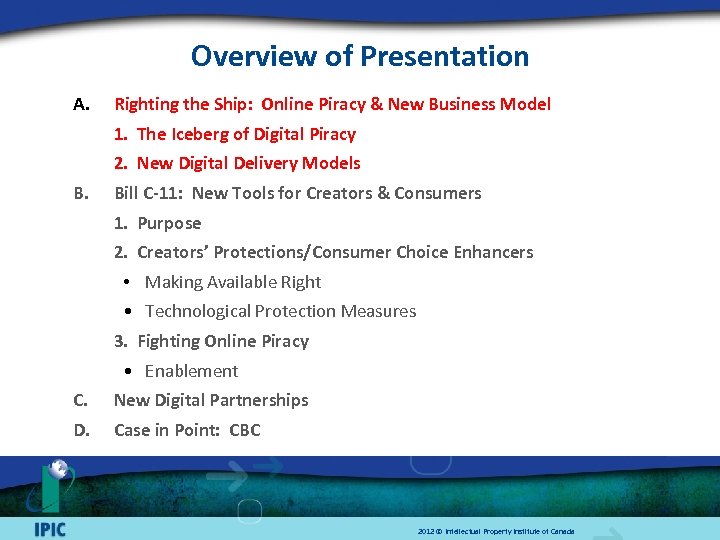 Overview of Presentation A. Righting the Ship: Online Piracy & New Business Model 1. The Iceberg of Digital Piracy 2. New Digital Delivery Models B. Bill C-11: New Tools for Creators & Consumers 1. Purpose 2. Creators’ Protections/Consumer Choice Enhancers • Making Available Right • Technological Protection Measures 3. Fighting Online Piracy • Enablement C. New Digital Partnerships D. Case in Point: CBC 2012 © Intellectual Property Institute of Canada
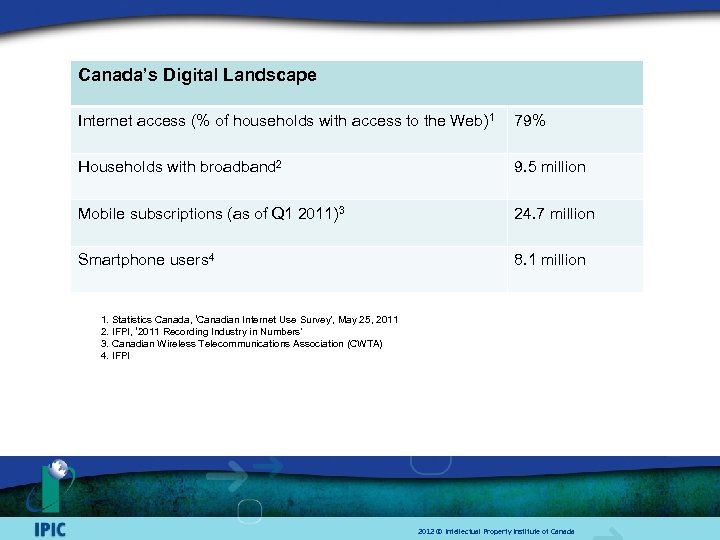 Canada’s Digital Landscape Internet access (% of households with access to the Web)1 79% Households with broadband 2 9. 5 million Mobile subscriptions (as of Q 1 2011)3 24. 7 million Smartphone users 4 8. 1 million 1. Statistics Canada, ‘Canadian Internet Use Survey’, May 25, 2011 2. IFPI, ‘ 2011 Recording Industry in Numbers’ 3. Canadian Wireless Telecommunications Association (CWTA) 4. IFPI 2012 © Intellectual Property Institute of Canada
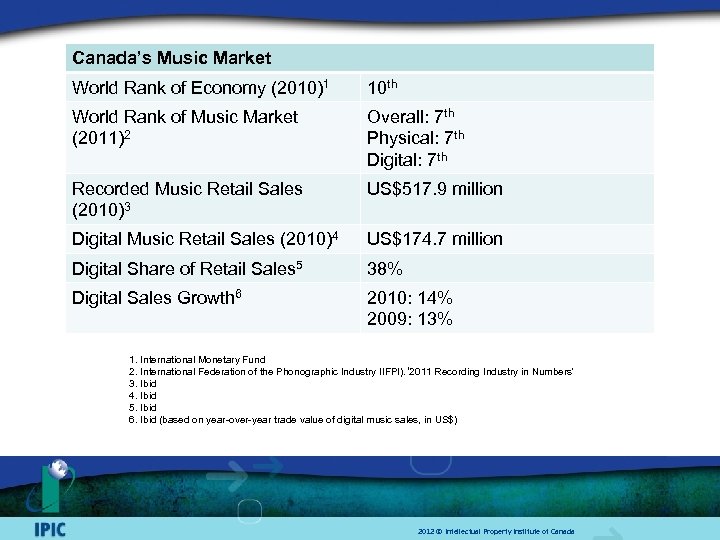 Canada’s Music Market World Rank of Economy (2010)1 10 th World Rank of Music Market (2011)2 Overall: 7 th Physical: 7 th Digital: 7 th Recorded Music Retail Sales (2010)3 US$517. 9 million Digital Music Retail Sales (2010)4 US$174. 7 million Digital Share of Retail Sales 5 38% Digital Sales Growth 6 2010: 14% 2009: 13% 1. International Monetary Fund 2. International Federation of the Phonographic Industry IIFPI). ‘ 2011 Recording Industry in Numbers’ 3. Ibid 4. Ibid 5. Ibid 6. Ibid (based on year-over-year trade value of digital music sales, in US$) 2012 © Intellectual Property Institute of Canada
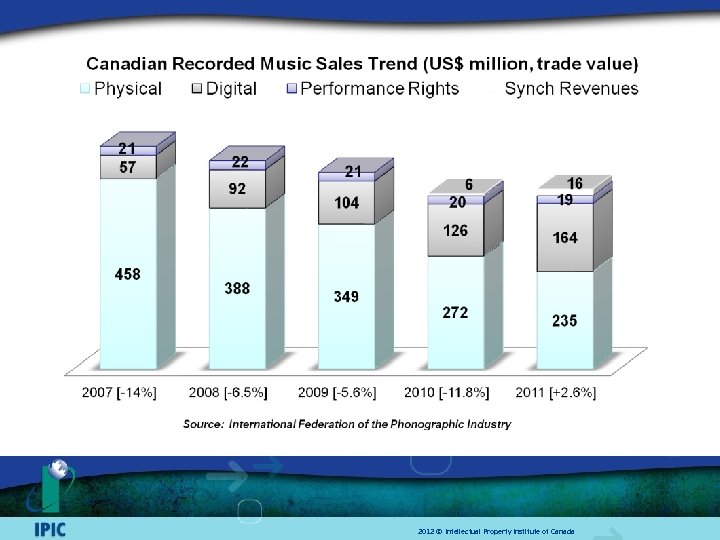 2012 © Intellectual Property Institute of Canada
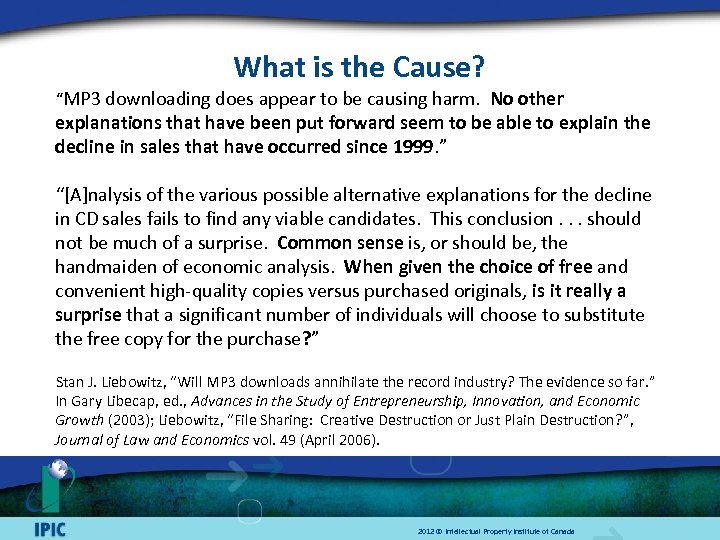 What is the Cause? “MP 3 downloading does appear to be causing harm. No other explanations that have been put forward seem to be able to explain the decline in sales that have occurred since 1999. ” “[A]nalysis of the various possible alternative explanations for the decline in CD sales fails to find any viable candidates. This conclusion. . . should not be much of a surprise. Common sense is, or should be, the handmaiden of economic analysis. When given the choice of free and convenient high-quality copies versus purchased originals, is it really a surprise that a significant number of individuals will choose to substitute the free copy for the purchase? ” Stan J. Liebowitz, “Will MP 3 downloads annihilate the record industry? The evidence so far. ” In Gary Libecap, ed. , Advances in the Study of Entrepreneurship, Innovation, and Economic Growth (2003); Liebowitz, “File Sharing: Creative Destruction or Just Plain Destruction? ”, Journal of Law and Economics vol. 49 (April 2006). 2012 © Intellectual Property Institute of Canada
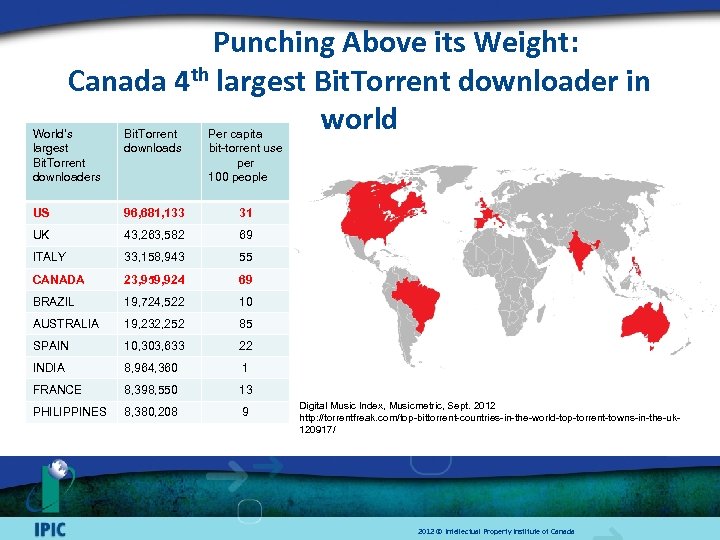 Punching Above its Weight: Canada 4 th largest Bit. Torrent downloader in world World’s largest Bit. Torrent downloaders Bit. Torrent downloads Per capita bit-torrent use per 100 people US 96, 681, 133 31 UK 43, 263, 582 69 ITALY 33, 158, 943 55 CANADA 23, 959, 924 69 BRAZIL 19, 724, 522 10 AUSTRALIA 19, 232, 252 85 SPAIN 10, 303, 633 22 INDIA 8, 964, 360 1 FRANCE 8, 398, 550 13 PHILIPPINES 8, 380, 208 9 Digital Music Index, Musicmetric, Sept. 2012 http: //torrentfreak. com/top-bittorrent-countries-in-the-world-top-torrent-towns-in-the-uk 120917/ 2012 © Intellectual Property Institute of Canada
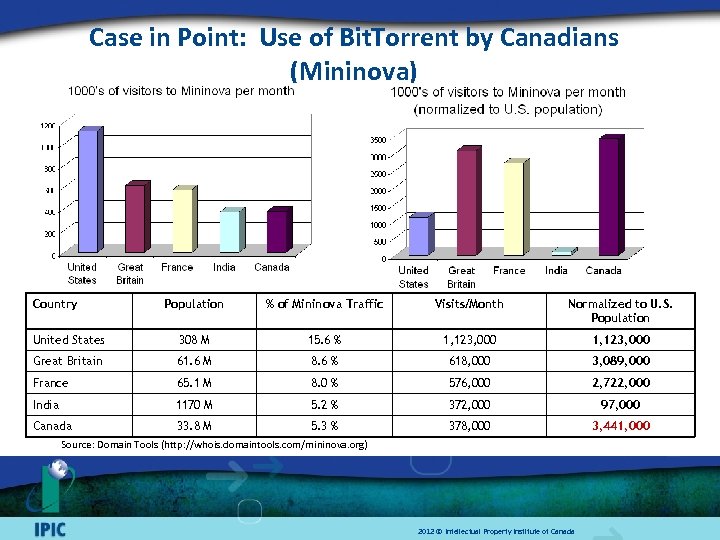 Case in Point: Use of Bit. Torrent by Canadians (Mininova) Country Population % of Mininova Traffic Visits/Month Normalized to U. S. Population United States 308 M 15. 6 % 1, 123, 000 Great Britain 61. 6 M 8. 6 % 618, 000 3, 089, 000 France 65. 1 M 8. 0 % 576, 000 2, 722, 000 India 1170 M 5. 2 % 372, 000 97, 000 Canada 33. 8 M 5. 3 % 378, 000 3, 441, 000 Source: Domain Tools (http: //whois. domaintools. com/mininova. org) 2012 © Intellectual Property Institute of Canada
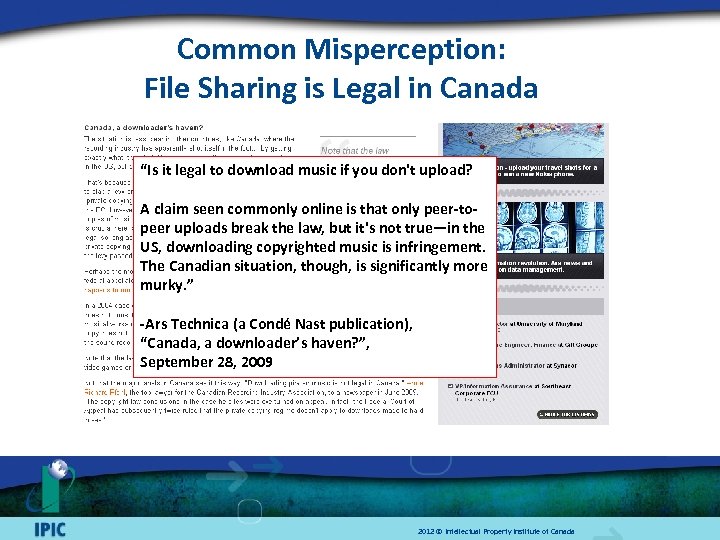 Common Misperception: File Sharing is Legal in Canada “Is it legal to download music if you don't upload? A claim seen commonly online is that only peer-topeer uploads break the law, but it's not true—in the US, downloading copyrighted music is infringement. The Canadian situation, though, is significantly more murky. ” -Ars Technica (a Condé Nast publication), “Canada, a downloader’s haven? ”, September 28, 2009 2012 © Intellectual Property Institute of Canada
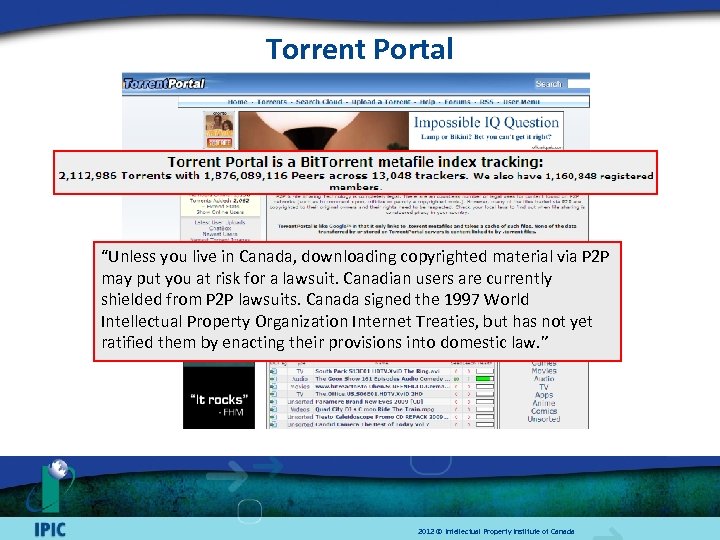 Torrent Portal “Unless you live in Canada, downloading copyrighted material via P 2 P may put you at risk for a lawsuit. Canadian users are currently shielded from P 2 P lawsuits. Canada signed the 1997 World Intellectual Property Organization Internet Treaties, but has not yet ratified them by enacting their provisions into domestic law. ” 2012 © Intellectual Property Institute of Canada
 Canada’s Digital Music Market • Canada’s music market is in transition. Every year, more Canadians buy and enjoy music online and on mobile devices. • Canada’s major and leading independent record labels are proactively helping digital music service providers succeed through initiatives such as this guide. Recent Canadian copyright reform (Billl C-11) offers the prospect of an improved legal environment for digital music. • 2012 © Intellectual Property Institute of Canada
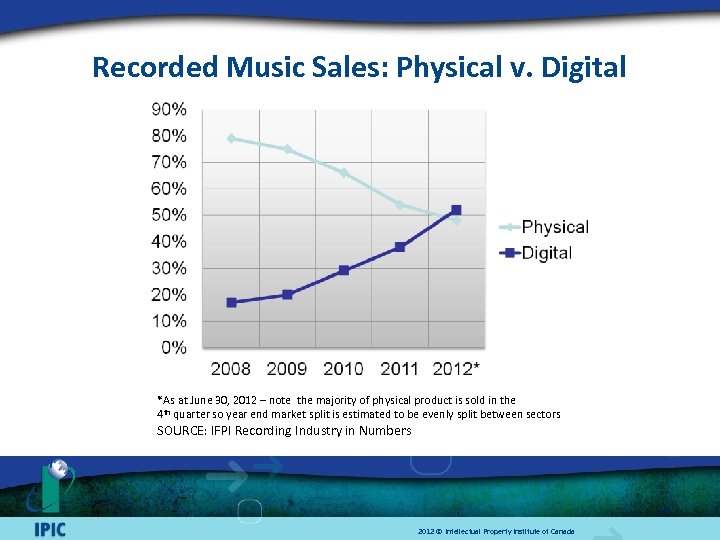 Recorded Music Sales: Physical v. Digital *As at June 30, 2012 – note the majority of physical product is sold in the 4 th quarter so year end market split is estimated to be evenly split between sectors SOURCE: IFPI Recording Industry in Numbers 2012 © Intellectual Property Institute of Canada
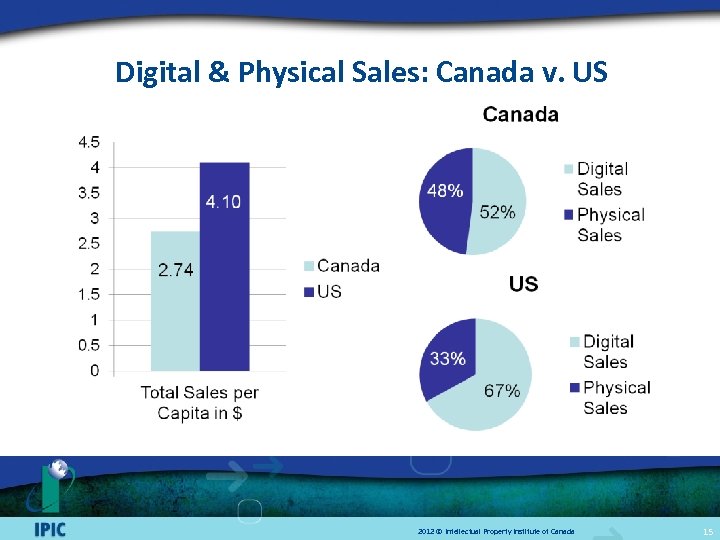 Digital & Physical Sales: Canada v. US 2012 © Intellectual Property Institute of Canada 15
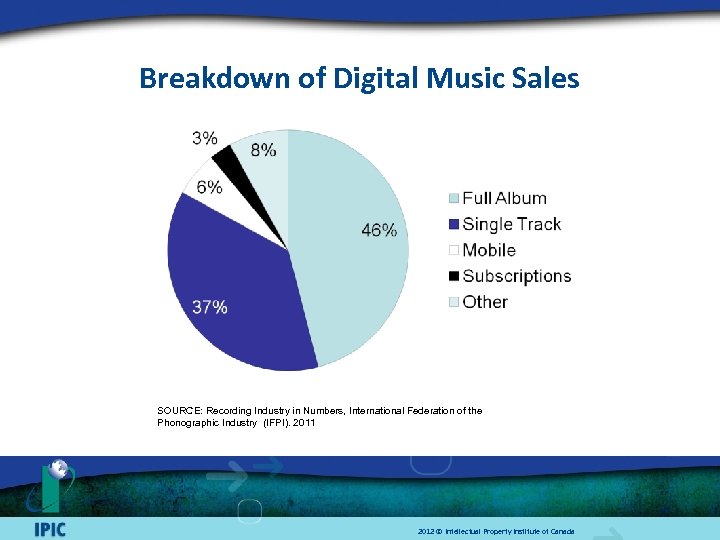 Breakdown of Digital Music Sales SOURCE: Recording Industry in Numbers, International Federation of the Phonographic Industry (IFPI). 2011 2012 © Intellectual Property Institute of Canada
 Overview of Presentation A. Righting the Ship: Online Piracy & New Business Model 1. The Iceberg of Digital Piracy 2. New Digital Delivery Models B. Bill C-11: New Tools for Creators & Consumers 1. Purpose 2. Creators’ Protections/Consumer Choice Enhancers • Making Available Right • Technological Protection Measures 3. Fighting Online Piracy • Enablement C. New Digital Partnerships D. Case in Point: CBC 2012 © Intellectual Property Institute of Canada
 The WIPO Treaties WIPO Copyright Treaty (WCT, 1996) WIPO Performers and Phonogram Treaty (WPPT, 1996) Making Available Right Reproduction Right Technological Measures Protection of Rights Management Information 2012 © Intellectual Property Institute of Canada
 Why was it Needed? Canada’s Outdated Copyright Laws Created Legal Uncertainty Parliament’s response to the [WIPO Treaties] remains to be seen. In the meantime, the courts must struggle to transpose a Copyright Act designed to implement the Berne Convention. . . of 1886, as revised in Berlin in 1908, and subsequent piecemeal amendments, to the information age, and to technologies undreamt of by those early legislators. ” • Supreme Court of Canada, Tariff 22 (2004) 2012 © Intellectual Property Institute of Canada
 Bill C-11: Preamble to Bill to create clear, predictable and fair rules to support creativity and innovation; to address opportunities and challenges that are global in scope for the creation and use of works; to adopt coordinated approaches to copyright protection based on internationally recognized norms; to enhance copyright protection by adopting the norms set out in the WIPO Copyright Treaty and the WIPO Performers and Phonograms Treaty; and to provide rights holders with recognition, remuneration and the ability to assert their rights. to enhance users’ access to copyright works or other subject-matter; to enhance the protection of copyright through the recognition of technological measures and other measures, in a manner that promotes culture and innovation, competition and investment in the Canadian economy; and to bolster Canada’s ability to participate in a knowledge economy driven by innovation and network connectivity fostered by encouraging the use of digital technologies for research and education. 2012 © Intellectual Property Institute of Canada
 Overview of Presentation A. Righting the Ship: Online Piracy & New Business Model 1. The Iceberg of Digital Piracy 2. New Digital Delivery Models B. Bill C-11: New Tools for Creators & Consumers 1. Purpose 2. Creators’ Protections/Consumer Choice Enhancers • Making Available Right • Technological Protection Measures 3. Fighting Online Piracy • Enablement C. New Digital Partnerships D. Case in Point: CBC 2012 © Intellectual Property Institute of Canada
 What is the ‘Making Available’ Right? • Exclusive right • for authors, performers and ‘phonogram producers’ • to authorize or prohibit the dissemination of their works and other protected material through interactive networks such as the Internet. 2012 © Intellectual Property Institute of Canada
 What Does the WIPO Copyright Treaty Require? Authors of Literary and Artistic Works WIPO TREATY TEXT WCT Art. 8. [A]uthors of literary and artistic works shall enjoy the exclusive right of authorising any communication to the public of their works, by wire or wireless means, including the making available to the public of their works in such a way that members of the public may access these works from a place and at a time individually chosen by them. 2012 © Intellectual Property Institute of Canada
 Making Available Right “All copyright owners will now have a "making available right", which is an exclusive right to control the release of copyrighted material on the Internet. This will further clarify that the unauthorized sharing of copyrighted material over peer-to-peer networks constitutes an infringement of copyright. ” - Industry Canada Fact Sheet, June 2010. 2012 © Intellectual Property Institute of Canada
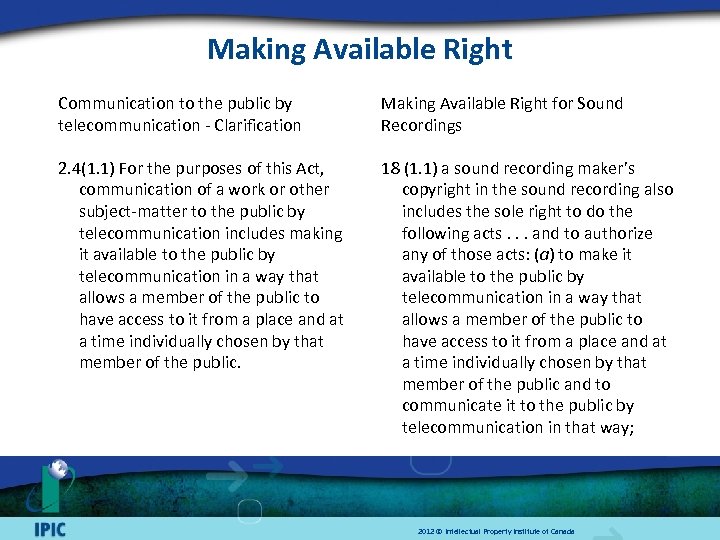 Making Available Right Communication to the public by telecommunication - Clarification 2. 4(1. 1) For the purposes of this Act, communication of a work or other subject-matter to the public by telecommunication includes making it available to the public by telecommunication in a way that allows a member of the public to have access to it from a place and at a time individually chosen by that member of the public. Making Available Right for Sound Recordings 18 (1. 1) a sound recording maker’s copyright in the sound recording also includes the sole right to do the following acts. . . and to authorize any of those acts: (a) to make it available to the public by telecommunication in a way that allows a member of the public to have access to it from a place and at a time individually chosen by that member of the public and to communicate it to the public by telecommunication in that way; 2012 © Intellectual Property Institute of Canada
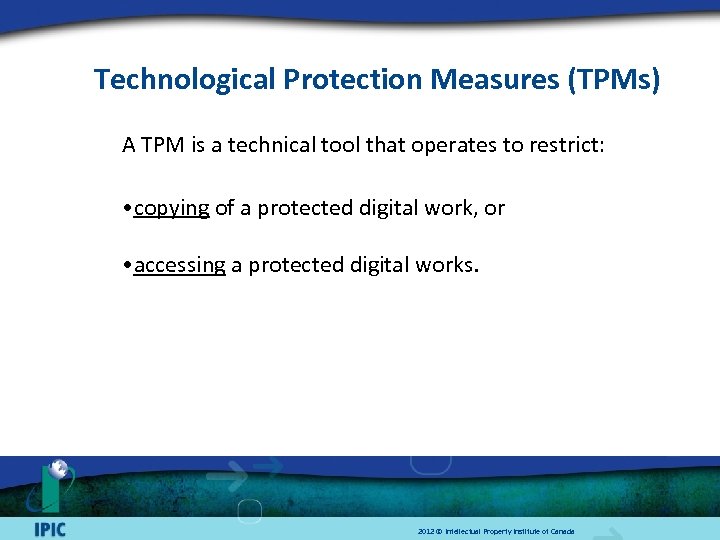 Technological Protection Measures (TPMs) A TPM is a technical tool that operates to restrict: • copying of a protected digital work, or • accessing a protected digital works. 2012 © Intellectual Property Institute of Canada
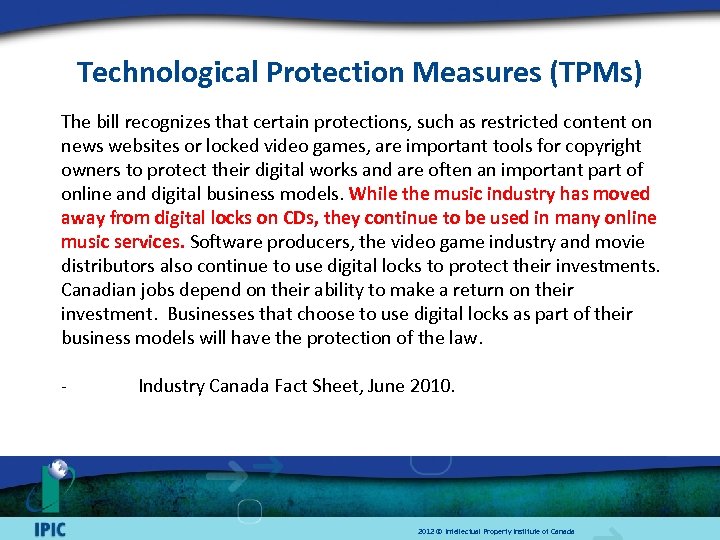 Technological Protection Measures (TPMs) The bill recognizes that certain protections, such as restricted content on news websites or locked video games, are important tools for copyright owners to protect their digital works and are often an important part of online and digital business models. While the music industry has moved away from digital locks on CDs, they continue to be used in many online music services. Software producers, the video game industry and movie distributors also continue to use digital locks to protect their investments. Canadian jobs depend on their ability to make a return on their investment. Businesses that choose to use digital locks as part of their business models will have the protection of the law. - Industry Canada Fact Sheet, June 2010. 2012 © Intellectual Property Institute of Canada
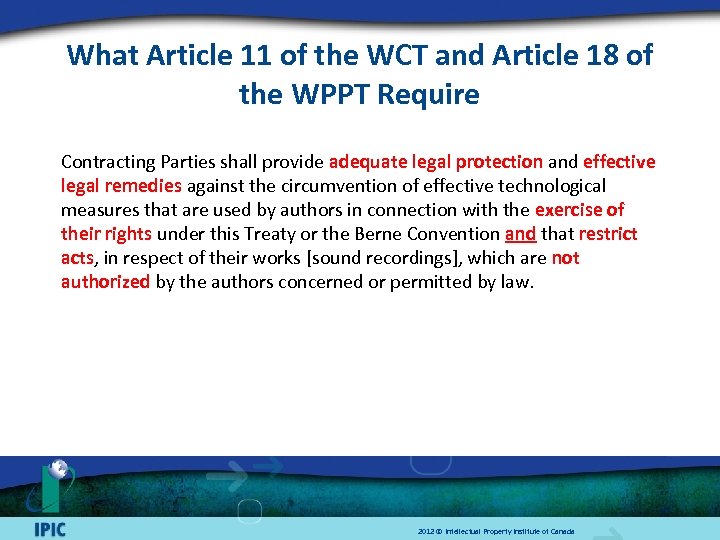 What Article 11 of the WCT and Article 18 of the WPPT Require Contracting Parties shall provide adequate legal protection and effective legal remedies against the circumvention of effective technological measures that are used by authors in connection with the exercise of their rights under this Treaty or the Berne Convention and that restrict acts, in respect of their works [sound recordings], which are not authorized by the authors concerned or permitted by law. 2012 © Intellectual Property Institute of Canada
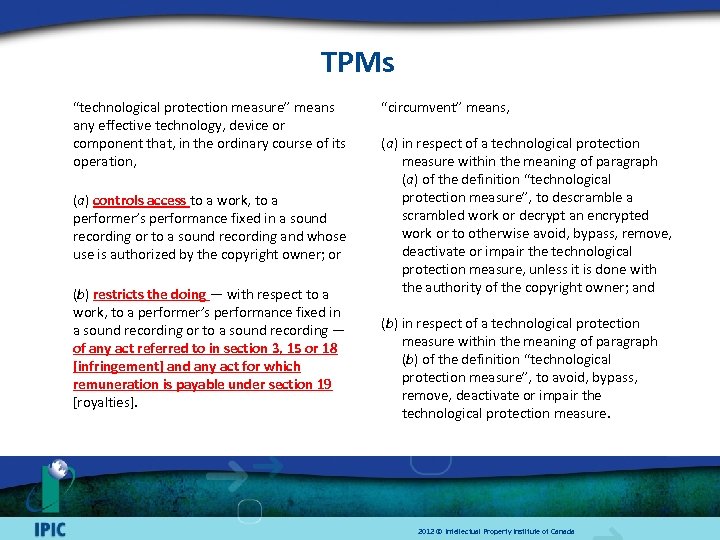 TPMs “technological protection measure” means any effective technology, device or component that, in the ordinary course of its operation, (a) controls access to a work, to a performer’s performance fixed in a sound recording or to a sound recording and whose use is authorized by the copyright owner; or (b) restricts the doing — with respect to a work, to a performer’s performance fixed in a sound recording or to a sound recording — of any act referred to in section 3, 15 or 18 [infringement] and any act for which remuneration is payable under section 19 [royalties]. “circumvent” means, (a) in respect of a technological protection measure within the meaning of paragraph (a) of the definition “technological protection measure”, to descramble a scrambled work or decrypt an encrypted work or to otherwise avoid, bypass, remove, deactivate or impair the technological protection measure, unless it is done with the authority of the copyright owner; and (b) in respect of a technological protection measure within the meaning of paragraph (b) of the definition “technological protection measure”, to avoid, bypass, remove, deactivate or impair the technological protection measure. 2012 © Intellectual Property Institute of Canada
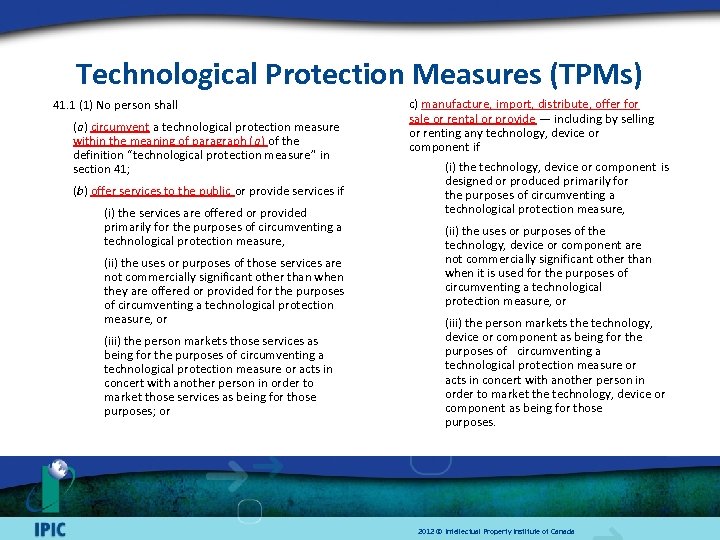 Technological Protection Measures (TPMs) 41. 1 (1) No person shall (a) circumvent a technological protection measure within the meaning of paragraph (a) of the definition “technological protection measure” in section 41; (b) offer services to the public or provide services if (i) the services are offered or provided primarily for the purposes of circumventing a technological protection measure, (ii) the uses or purposes of those services are not commercially significant other than when they are offered or provided for the purposes of circumventing a technological protection measure, or (iii) the person markets those services as being for the purposes of circumventing a technological protection measure or acts in concert with another person in order to market those services as being for those purposes; or c) manufacture, import, distribute, offer for sale or rental or provide — including by selling or renting any technology, device or component if (i) the technology, device or component is designed or produced primarily for the purposes of circumventing a technological protection measure, (ii) the uses or purposes of the technology, device or component are not commercially significant other than when it is used for the purposes of circumventing a technological protection measure, or (iii) the person markets the technology, device or component as being for the purposes of circumventing a technological protection measure or acts in concert with another person in order to market the technology, device or component as being for those purposes. 2012 © Intellectual Property Institute of Canada
 Overview of Presentation A. Righting the Ship: Online Piracy & New Business Model 1. The Iceberg of Digital Piracy 2. New Digital Delivery Models B. Bill C-11: New Tools for Creators & Consumers 1. Purpose 2. Creators’ Protections/Consumer Choice Enhancers • Making Available Right • Technological Protection Measures 3. Fighting Online Piracy • Enablement C. New Digital Partnerships D. Case in Point: CBC 2012 © Intellectual Property Institute of Canada
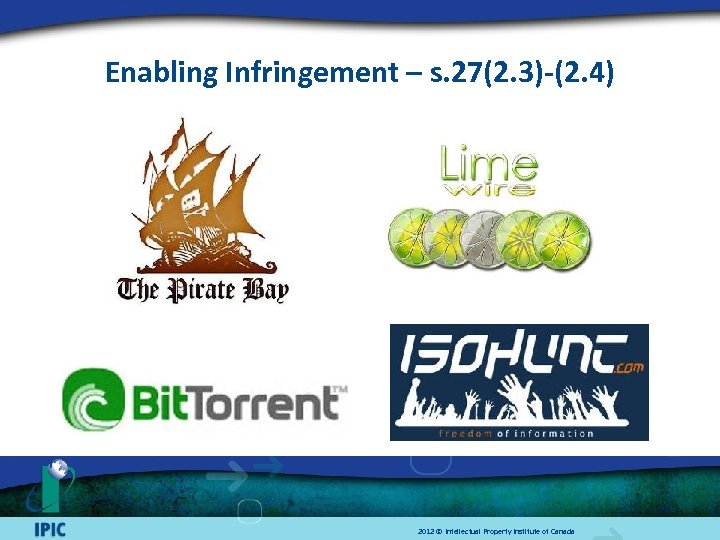 Enabling Infringement – s. 27(2. 3)-(2. 4) 2012 © Intellectual Property Institute of Canada
 Stated Objective of s. 27: Stop The Bad Actors Who “Enable” Online Infringement “The Copyright Modernization Act sends a clear message that copyright infringement is unacceptable. It recognizes that the most effective way to stop online copyright infringement is to target those who enable and profit from the infringements of others. By allowing copyright owners to pursue these "enablers", such as illegal peer-to-peer file sharing sites, this bill supports the development of significant legitimate markets for downloading and streaming in Canada. This supplements existing criminal punishments for those who aid and abet infringement. ” - Industry Canada Fact Sheet, June 2010. 2012 © Intellectual Property Institute of Canada
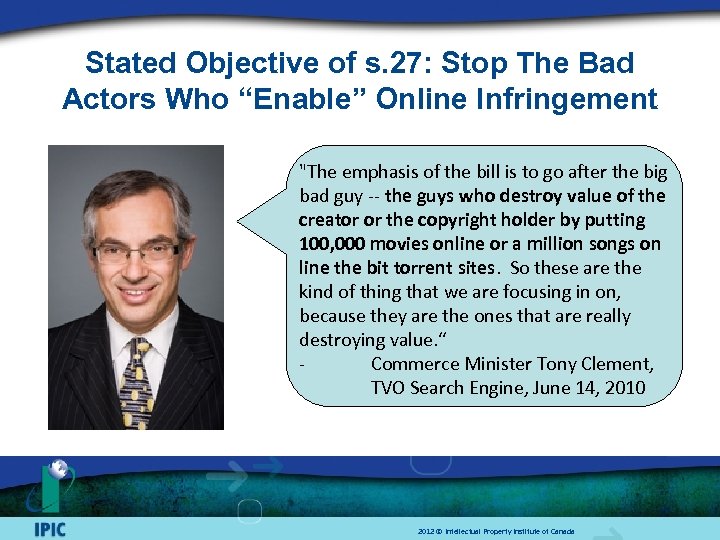 Stated Objective of s. 27: Stop The Bad Actors Who “Enable” Online Infringement "The emphasis of the bill is to go after the big bad guy -- the guys who destroy value of the creator or the copyright holder by putting 100, 000 movies online or a million songs on line the bit torrent sites. So these are the kind of thing that we are focusing in on, because they are the ones that are really destroying value. “ Commerce Minister Tony Clement, TVO Search Engine, June 14, 2010 2012 © Intellectual Property Institute of Canada
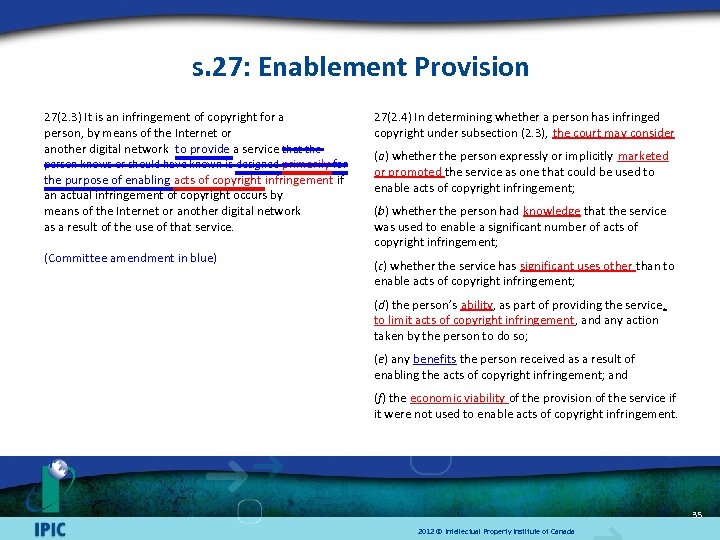 s. 27: Enablement Provision 27(2. 3) It is an infringement of copyright for a person, by means of the Internet or another digital network, to provide a service that the person knows or should have known is designed primarily for the purpose of enabling acts of copyright infringement if an actual infringement of copyright occurs by means of the Internet or another digital network as a result of the use of that service. (Committee amendment in blue) 27(2. 4) In determining whether a person has infringed copyright under subsection (2. 3), the court may consider (a) whether the person expressly or implicitly marketed or promoted the service as one that could be used to enable acts of copyright infringement; (b) whether the person had knowledge that the service was used to enable a significant number of acts of copyright infringement; (c) whether the service has significant uses other than to enable acts of copyright infringement; (d) the person’s ability, as part of providing the service, to limit acts of copyright infringement, and any action taken by the person to do so; (e) any benefits the person received as a result of enabling the acts of copyright infringement; and (f) the economic viability of the provision of the service if it were not used to enable acts of copyright infringement. 35 2012 © Intellectual Property Institute of Canada
 Overview of Presentation A. Righting the Ship: Online Piracy & New Business Model 1. The Iceberg of Digital Piracy 2. New Digital Delivery Models B. Bill C-11: New Tools for Creators & Consumers 1. Purpose 2. Creators’ Protections/Consumer Choice Enhancers • Making Available Right • Technological Protection Measures 3. Fighting Online Piracy • Enablement C. New Digital Partnerships D. Case in Point: CBC 2012 © Intellectual Property Institute of Canada
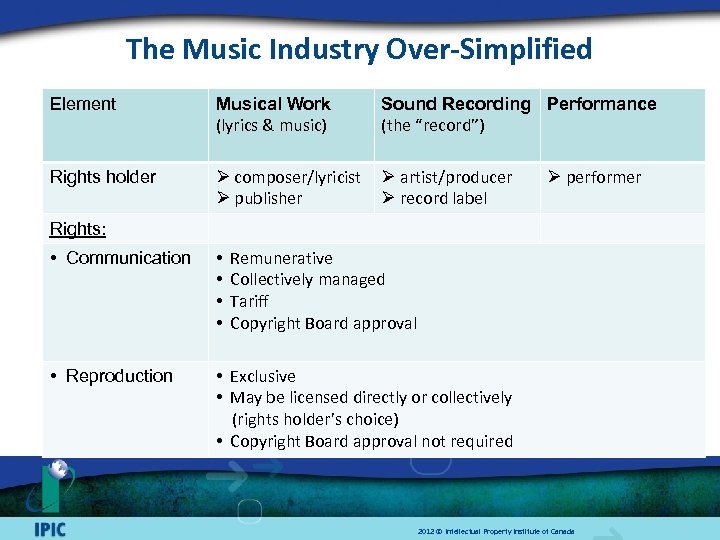 The Music Industry Over-Simplified Element Musical Work (lyrics & music) Sound Recording Performance (the “record”) Rights holder Ø composer/lyricist Ø artist/producer Ø publisher Ø record label Ø performer Rights: • Communication • Remunerative • Collectively managed • Tariff • Copyright Board approval • Reproduction • Exclusive • May be licensed directly or collectively (rights holder’s choice) • Copyright Board approval not required 2012 © Intellectual Property Institute of Canada
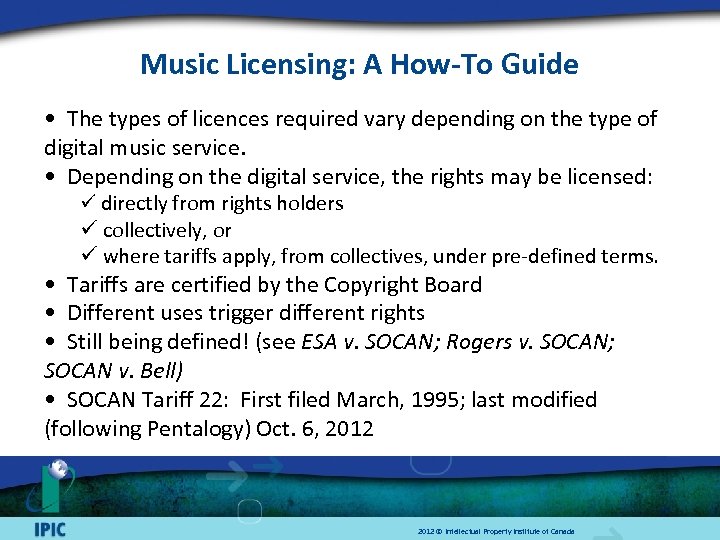 Music Licensing: A How-To Guide • The types of licences required vary depending on the type of digital music service. • Depending on the digital service, the rights may be licensed: ü directly from rights holders ü collectively, or ü where tariffs apply, from collectives, under pre-defined terms. • Tariffs are certified by the Copyright Board • Different uses trigger different rights • Still being defined! (see ESA v. SOCAN; Rogers v. SOCAN; SOCAN v. Bell) • SOCAN Tariff 22: First filed March, 1995; last modified (following Pentalogy) Oct. 6, 2012 © Intellectual Property Institute of Canada
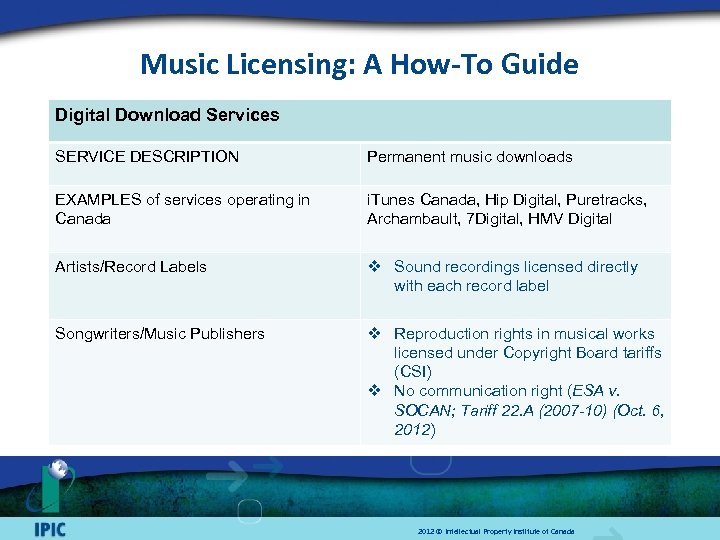 Music Licensing: A How-To Guide Digital Download Services SERVICE DESCRIPTION Permanent music downloads EXAMPLES of services operating in Canada i. Tunes Canada, Hip Digital, Puretracks, Archambault, 7 Digital, HMV Digital Artists/Record Labels v Sound recordings licensed directly with each record label Songwriters/Music Publishers v Reproduction rights in musical works licensed under Copyright Board tariffs (CSI) v No communication right (ESA v. SOCAN; Tariff 22. A (2007 -10) (Oct. 6, 2012) 2012 © Intellectual Property Institute of Canada
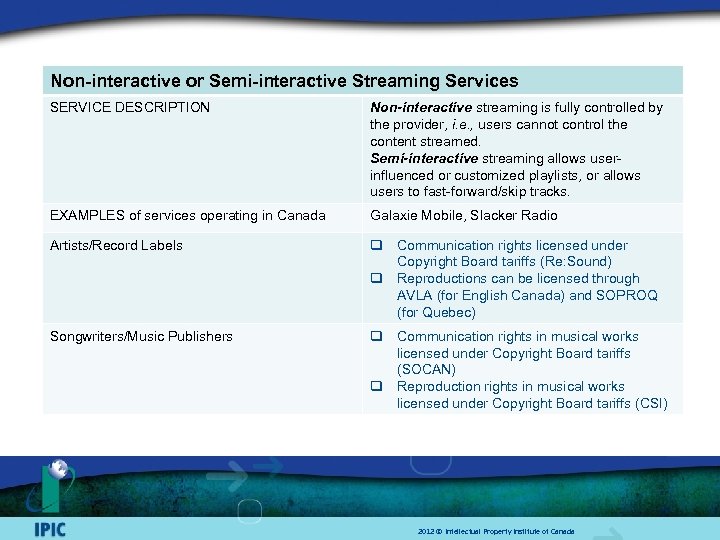 Non-interactive or Semi-interactive Streaming Services SERVICE DESCRIPTION Non-interactive streaming is fully controlled by the provider, i. e. , users cannot control the content streamed. Semi-interactive streaming allows userinfluenced or customized playlists, or allows users to fast-forward/skip tracks. EXAMPLES of services operating in Canada Galaxie Mobile, Slacker Radio Artists/Record Labels q Communication rights licensed under Copyright Board tariffs (Re: Sound) q Reproductions can be licensed through AVLA (for English Canada) and SOPROQ (for Quebec) Songwriters/Music Publishers q Communication rights in musical works licensed under Copyright Board tariffs (SOCAN) q Reproduction rights in musical works licensed under Copyright Board tariffs (CSI) 2012 © Intellectual Property Institute of Canada
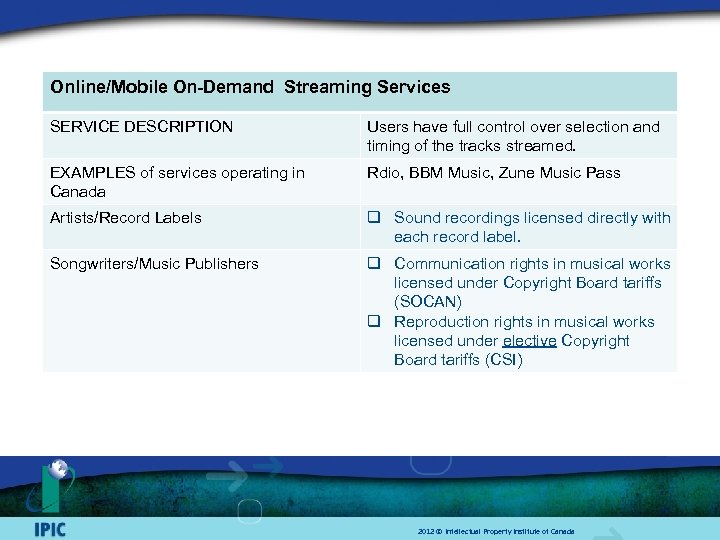 Online/Mobile On-Demand Streaming Services SERVICE DESCRIPTION Users have full control over selection and timing of the tracks streamed. EXAMPLES of services operating in Canada Rdio, BBM Music, Zune Music Pass Artists/Record Labels q Sound recordings licensed directly with each record label. Songwriters/Music Publishers q Communication rights in musical works licensed under Copyright Board tariffs (SOCAN) q Reproduction rights in musical works licensed under elective Copyright Board tariffs (CSI) 2012 © Intellectual Property Institute of Canada
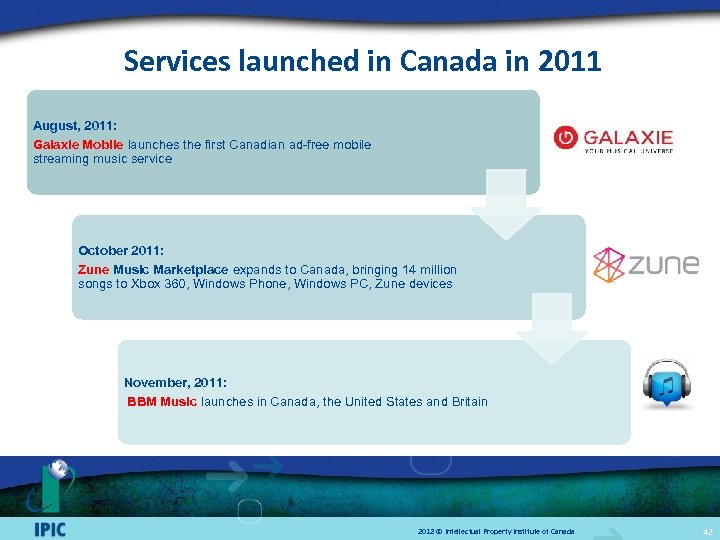 Services launched in Canada in 2011 August, 2011: Galaxie Mobile launches the first Canadian ad-free mobile streaming music service October 2011: Zune Music Marketplace expands to Canada, bringing 14 million songs to Xbox 360, Windows Phone, Windows PC, Zune devices November, 2011: BBM Music launches in Canada, the United States and Britain 2012 © Intellectual Property Institute of Canada 42
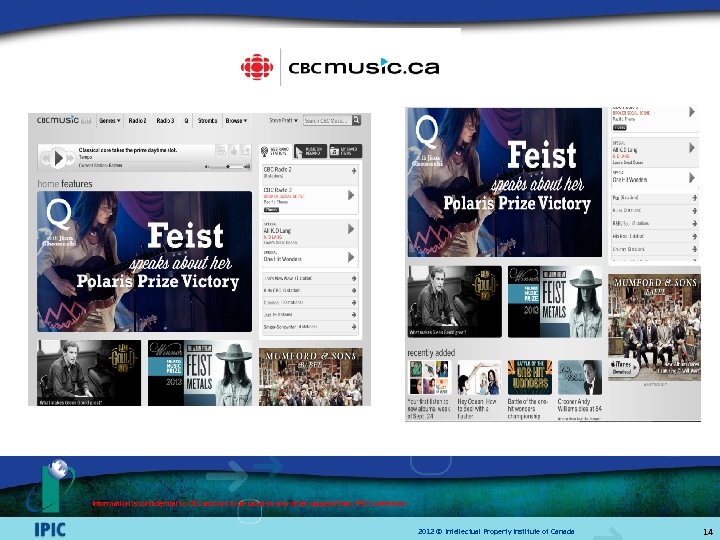
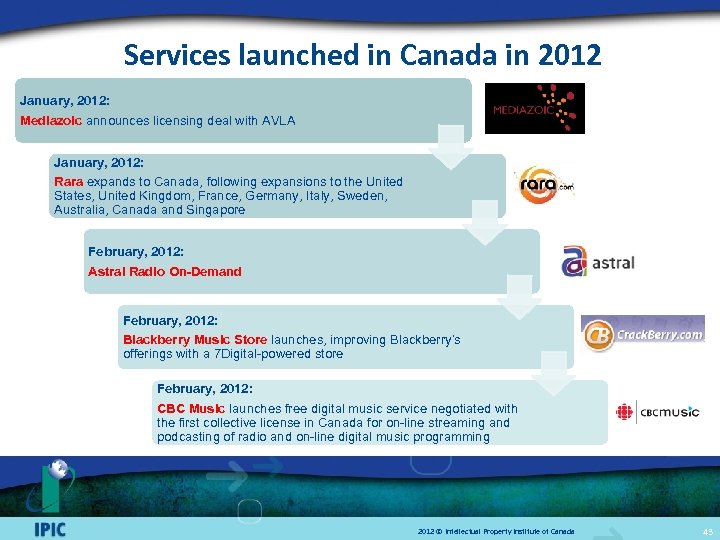 Services launched in Canada in 2012 January, 2012: Mediazoic announces licensing deal with AVLA January, 2012: Rara expands to Canada, following expansions to the United States, United Kingdom, France, Germany, Italy, Sweden, Australia, Canada and Singapore February, 2012: Astral Radio On-Demand February, 2012: Blackberry Music Store launches, improving Blackberry’s offerings with a 7 Digital-powered store February, 2012: CBC Music launches free digital music service negotiated with the first collective license in Canada for on-line streaming and podcasting of radio and on-line digital music programming 2012 © Intellectual Property Institute of Canada 43
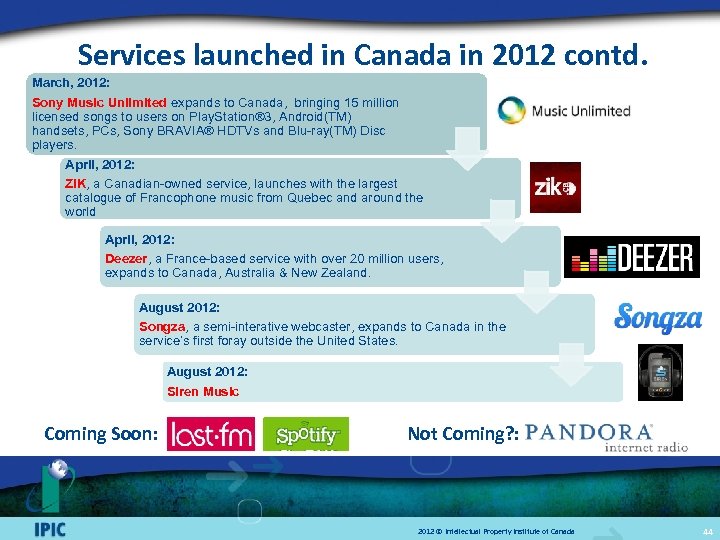 Services launched in Canada in 2012 contd. March, 2012: Sony Music Unlimited expands to Canada, bringing 15 million licensed songs to users on Play. Station® 3, Android(TM) handsets, PCs, Sony BRAVIA® HDTVs and Blu-ray(TM) Disc players. April, 2012: ZIK, a Canadian-owned service, launches with the largest catalogue of Francophone music from Quebec and around the world April, 2012: Deezer, a France-based service with over 20 million users, expands to Canada, Australia & New Zealand. August 2012: Songza, a semi-interative webcaster, expands to Canada in the service’s first foray outside the United States. August 2012: Siren Music Coming Soon: Not Coming? : 2012 © Intellectual Property Institute of Canada 44
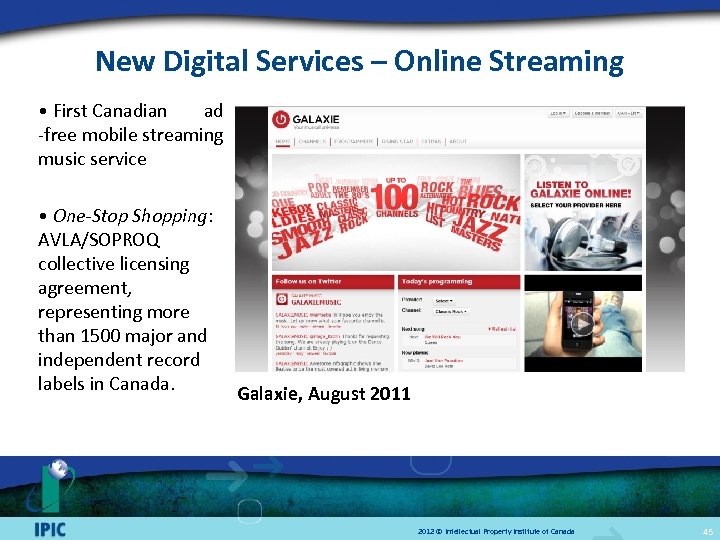 New Digital Services – Online Streaming • First Canadian ad -free mobile streaming music service • One-Stop Shopping: AVLA/SOPROQ collective licensing agreement, representing more than 1500 major and independent record labels in Canada. Galaxie, August 2011 2012 © Intellectual Property Institute of Canada 45
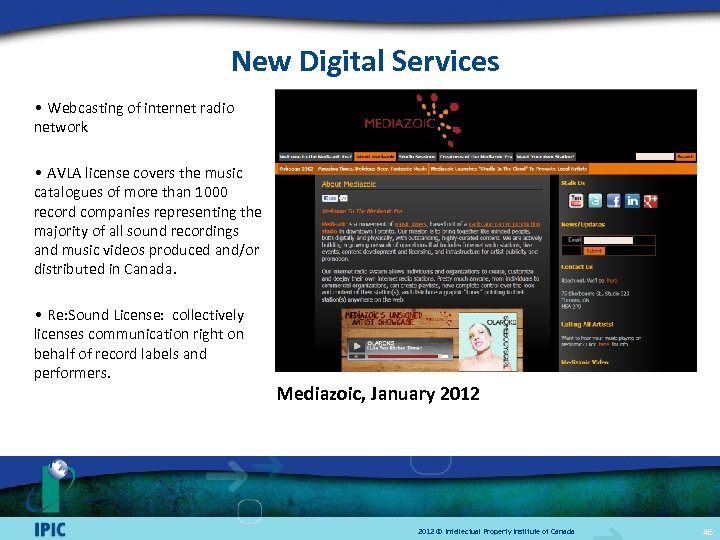 New Digital Services • Webcasting of internet radio network • AVLA license covers the music catalogues of more than 1000 record companies representing the majority of all sound recordings and music videos produced and/or distributed in Canada. • Re: Sound License: collectively licenses communication right on behalf of record labels and performers. Mediazoic, January 2012 © Intellectual Property Institute of Canada 46
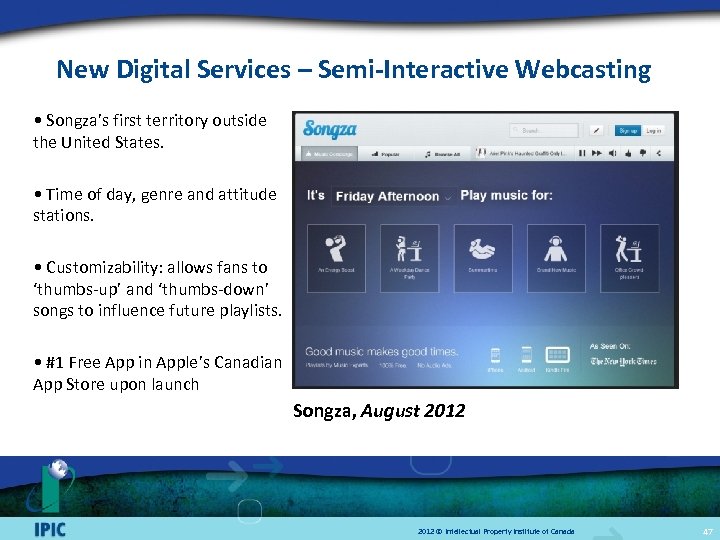 New Digital Services – Semi-Interactive Webcasting • Songza’s first territory outside the United States. • Time of day, genre and attitude stations. • Customizability: allows fans to ‘thumbs-up’ and ‘thumbs-down’ songs to influence future playlists. • #1 Free App in Apple’s Canadian App Store upon launch Songza, August 2012 © Intellectual Property Institute of Canada 47
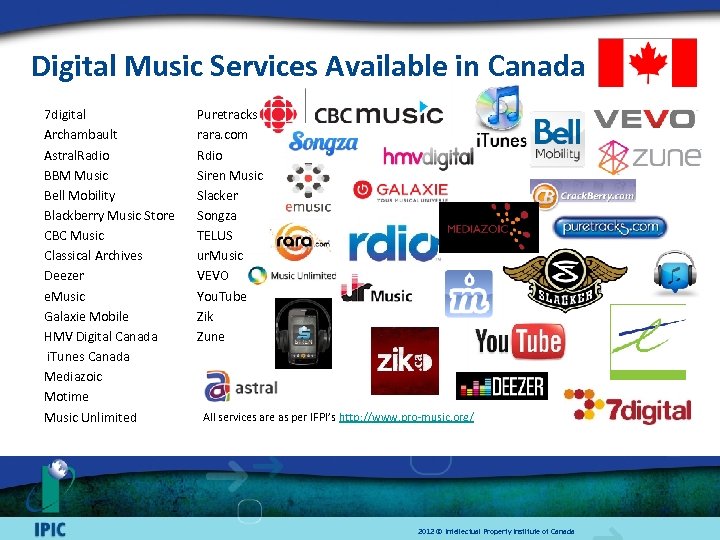 Digital Music Services Available in Canada 7 digital Archambault Astral. Radio BBM Music Bell Mobility Blackberry Music Store CBC Music Classical Archives Deezer e. Music Galaxie Mobile HMV Digital Canada i. Tunes Canada Mediazoic Motime Music Unlimited Puretracks rara. com Rdio Siren Music Slacker Songza TELUS ur. Music VEVO You. Tube Zik Zune All services are as per IFPI’s http: //www. pro-music. org/ 2012 © Intellectual Property Institute of Canada
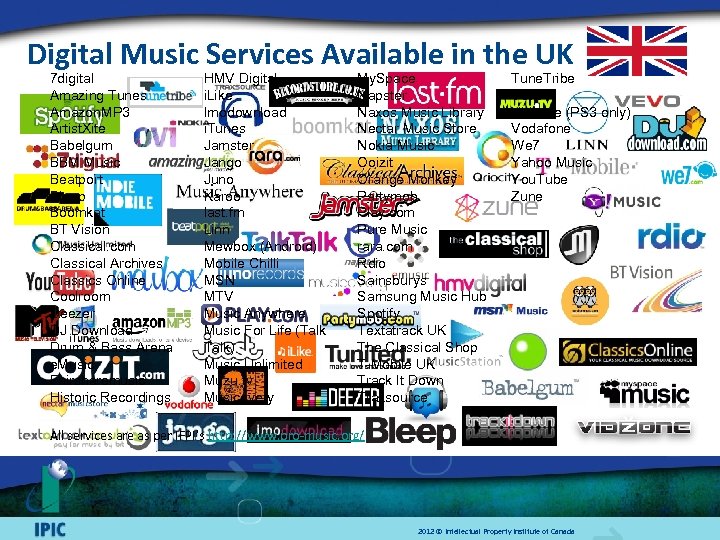 Digital Music Services Available in the UK 7 digital Amazing Tunes Amazon. MP 3 Artist. Xite Babelgum BBM Music Beatport Bleep Boomkat BT Vision Classical. com Classical Archives Classics Online Coolroom Deezer DJ Download Drum & Bass Arena e. Music Fairsharemusic Historic Recordings HMV Digital i. Like Imodownload i. Tunes Jamster Jango Juno Karoo last. fm Linn Mewbox (Android) Mobile Chilli MSN MTV Music Anywhere Music For Life (Talk) Music Unlimited Muzu. tv Musicovery My. Space Napster Naxos Music Library Nectar Music Store Nokia Music Ooizit Orange Monkey Partymob Play. com Pure Music rara. com Rdio Sainsburys Samsung Music Hub Spotify Textatrack UK The Classical Shop T-Mobile UK Track It Down Traxsource Tune. Tribe Vevo Vidzone (PS 3 only) Vodafone We 7 Yahoo Music You. Tube Zune All services are as per IFPI’s http: //www. pro-music. org/ 2012 © Intellectual Property Institute of Canada
 Overview of Presentation A. Righting the Ship: Online Piracy & New Business Model 1. The Iceberg of Digital Piracy 2. New Digital Delivery Models B. Bill C-11: New Tools for Creators & Consumers 1. Purpose 2. Creators’ Protections/Consumer Choice Enhancers • Making Available Right • Technological Protection Measures 3. Fighting Online Piracy • Enablement C. New Digital Partnerships D. Case in Point: CBC 2012 © Intellectual Property Institute of Canada
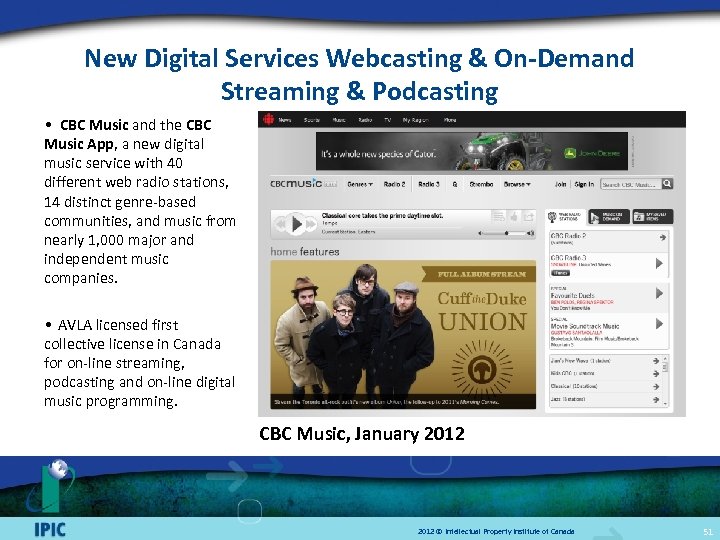 New Digital Services Webcasting & On-Demand Streaming & Podcasting • CBC Music and the CBC Music App, a new digital music service with 40 different web radio stations, 14 distinct genre-based communities, and music from nearly 1, 000 major and independent music companies. • AVLA licensed first collective license in Canada for on-line streaming, podcasting and on-line digital music programming. CBC Music, January 2012 © Intellectual Property Institute of Canada 51
 The Importance of Copyright in the Media Business Lisa Clarkson, Business & Rights, CBC English Media lisa. clarkson@cbc. ca October 2012 Information is confidential to CBC and not to be used for any other purpose than IPIC Conference 2012 © Intellectual Property Institute of Canada
 Information is confidential to CBC and not to be used for any other purpose than IPIC Conference 2012 © Intellectual Property Institute of Canada 2
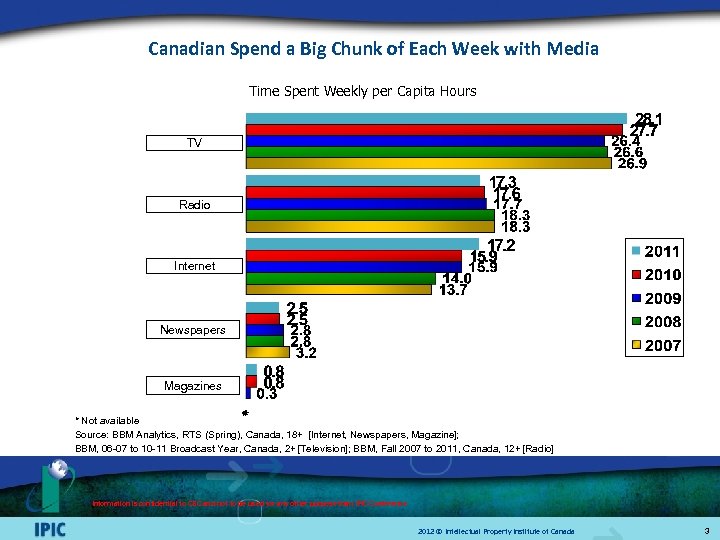 Canadian Spend a Big Chunk of Each Week with Media Time Spent Weekly per Capita Hours TV Radio Internet Newspapers Magazines * Not available Source: BBM Analytics, RTS (Spring), Canada, 18+ [Internet, Newspapers, Magazine]; BBM, 06 -07 to 10 -11 Broadcast Year, Canada, 2+ [Television]; BBM, Fall 2007 to 2011, Canada, 12+ [Radio] Information is confidential to CBC and not to be used for any other purpose than IPIC Conference 2012 © Intellectual Property Institute of Canada 3
 5 courants 1. Où je veux quand de veux 2. Je choisis mon écran 3. Je personnalise 4. J’aime, je partage 5. Je participe, je contribue Information is confidential to CBC and not to be used for any other purpose than IPIC Conference 2012 © Intellectual Property Institute of Canada 4
 Information is confidential to CBC and not to be used for any other purpose than IPIC Conference 2012 © Intellectual Property Institute of Canada 5
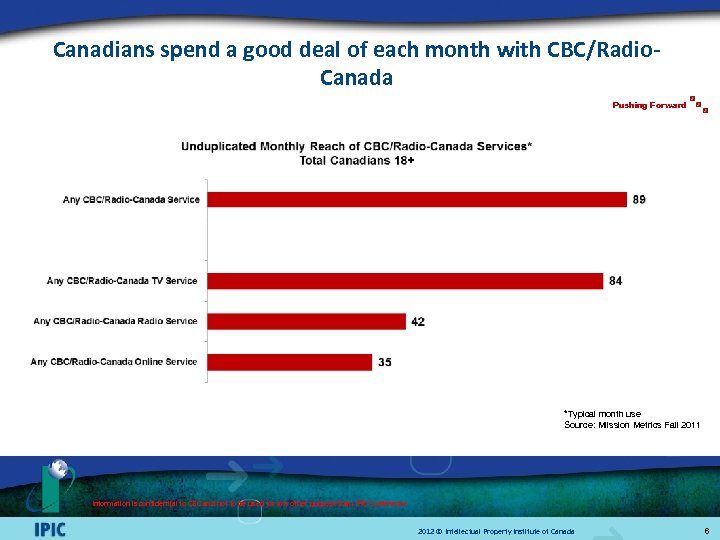 Canadians spend a good deal of each month with CBC/Radio. Canada Pushing Forward *Typical month use Source: Miission Metrics Fall 2011 Information is confidential to CBC and not to be used for any other purpose than IPIC Conference 2012 © Intellectual Property Institute of Canada 6
 Information is confidential to CBC and not to be used for any other purpose than IPIC Conference 2012 © Intellectual Property Institute of Canada 7
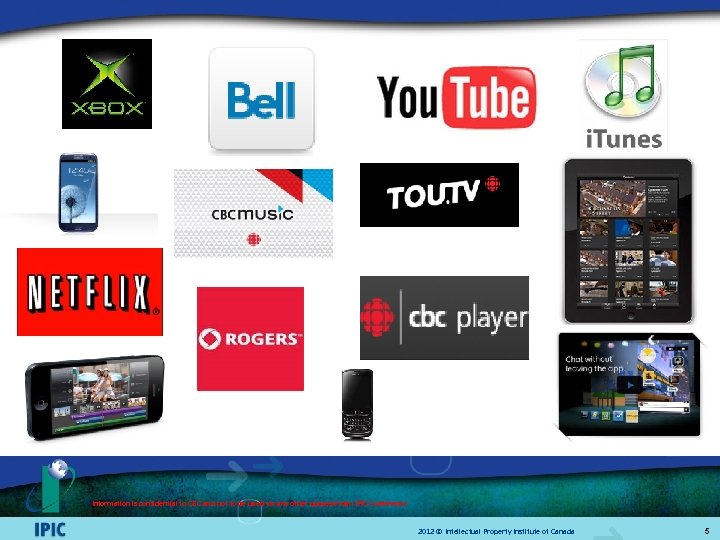
 But what are the web of deals and relationships which make it possible for CBC to get content into the hands of Canadians? 2012 © Intellectual Property Institute of Canada 59
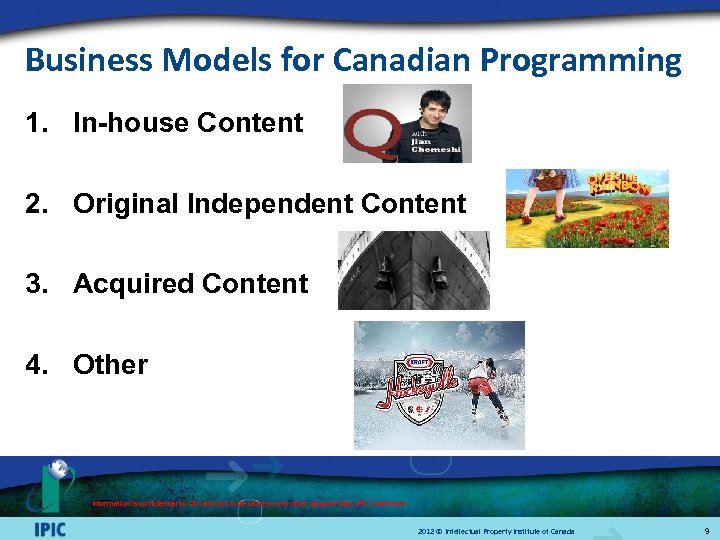 Business Models for Canadian Programming 1. In-house Content 2. Original Independent Content 3. Acquired Content 4. Other Information is confidential to CBC and not to be used for any other purpose than IPIC Conference 2012 © Intellectual Property Institute of Canada 9
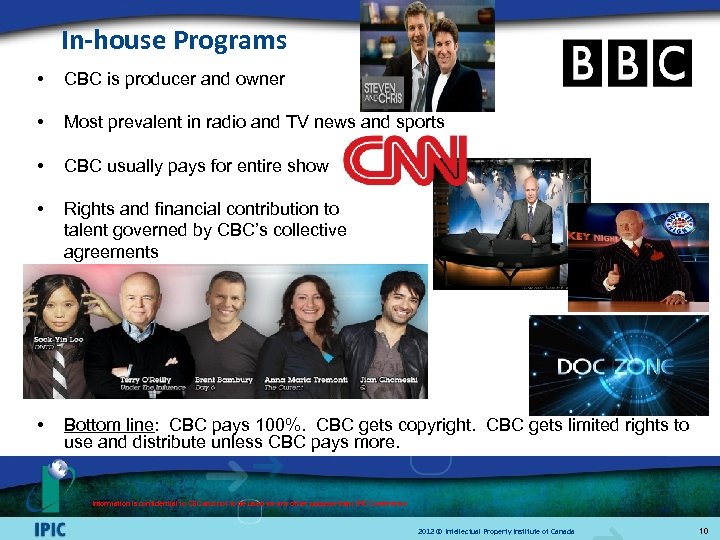 In-house Programs • CBC is producer and owner • Most prevalent in radio and TV news and sports • CBC usually pays for entire show • Rights and financial contribution to talent governed by CBC’s collective agreements • Bottom line: CBC pays 100%. CBC gets copyright. CBC gets limited rights to use and distribute unless CBC pays more. Information is confidential to CBC and not to be used for any other purpose than IPIC Conference 2012 © Intellectual Property Institute of Canada 10
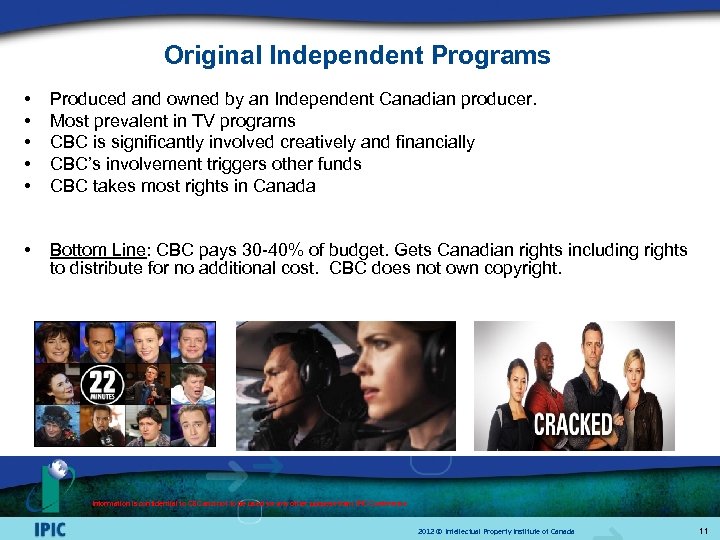 Original Independent Programs • • • Produced and owned by an Independent Canadian producer. Most prevalent in TV programs CBC is significantly involved creatively and financially CBC’s involvement triggers other funds CBC takes most rights in Canada • Bottom Line: CBC pays 30 -40% of budget. Gets Canadian rights including rights to distribute for no additional cost. CBC does not own copyright. Information is confidential to CBC and not to be used for any other purpose than IPIC Conference 2012 © Intellectual Property Institute of Canada 11
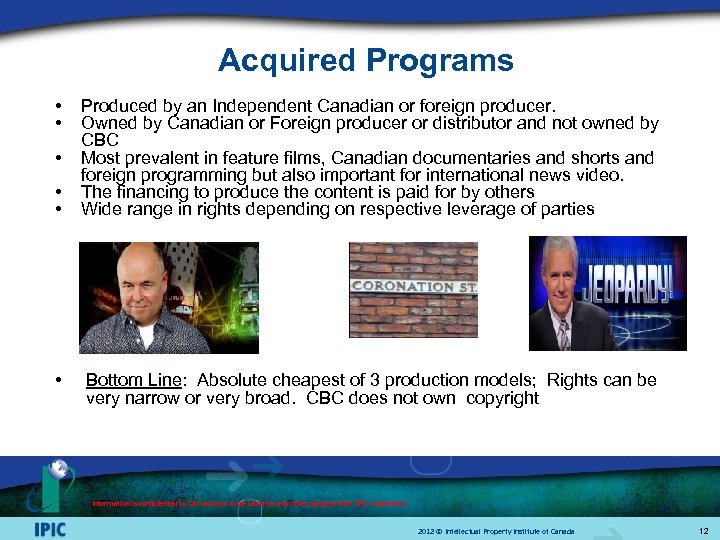 Acquired Programs • • • Produced by an Independent Canadian or foreign producer. Owned by Canadian or Foreign producer or distributor and not owned by CBC Most prevalent in feature films, Canadian documentaries and shorts and foreign programming but also important for international news video. The financing to produce the content is paid for by others Wide range in rights depending on respective leverage of parties Bottom Line: Absolute cheapest of 3 production models; Rights can be very narrow or very broad. CBC does not own copyright Information is confidential to CBC and not to be used for any other purpose than IPIC Conference 2012 © Intellectual Property Institute of Canada 12
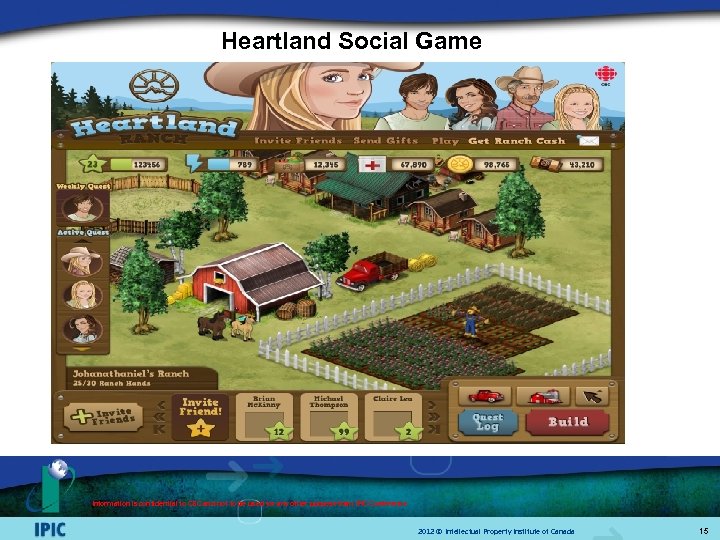
 Partners are Critical 2012 © Intellectual Property Institute of Canada
 Information is confidential to CBC and not to be used for any other purpose than IPIC Conference 2012 © Intellectual Property Institute of Canada 14
 Heartland Social Game Information is confidential to CBC and not to be used for any other purpose than IPIC Conference 2012 © Intellectual Property Institute of Canada 15
 Key Takeaways • If you are a creator, copyright is needed to get you in the door. But it is how business deal is crafted – not who holds copyright – that determines deal’s value. • Make sure you understand the full big picture. Deal must be examined from the perspective of many rights holders to really work in the long term – unions/collectives; talent; Canadian/foreign broadcasters; producers, consumers and Canadian/foreign distributors. • Best deal drivers in rapidly changing environment are facts not assumptions. • Proactively share relevant information as it becomes available. Builds understanding and trust. • Relationship is critical as a value driver to understanding what each party needs and what is the best way to secure it. Try to understand needs of your business partner. Relationship also acts as a buffer to any unforeseen bumps along the way. • Information is confidential to CBC and not to be used for any other purpose than IPIC Conference 2012 © Intellectual Property Institute of Canada 16
 Copyright in an Innovative Canada The Copyright Pentalogy 11 October 2012 IPIC AGM, Vancouver Dr. Giuseppina D’Agostino Osgoode Hall Law School www. iposgoode. ca 2012 © Intellectual Property Institute of Canada
 Overview • The Pentalogy Rulings – in a Nutshell • Key Issues arising from the Pentalogy relating to Innovation 1. Fair Dealing 2. Technological Neutrality 3. Bundling of Rights • Innovation in Canada, as per the SCC… 2012 © Intellectual Property Institute of Canada
 The Copyright Pentalogy • Historic: 5 major copyright cases before the SCC • Decisions were bundled over the course of 2 days & later released simultaneously on July 12, 2012. • Each case originates from the FCA’s judicial review of Copyright Board of Canada decisions • • • Entertainment Software Association v. SOCAN Rogers v. SOCAN Re: Sound v. Motion Pictures Theatre Association SOCAN v. Bell Alberta (Education) v. Access Copyright 2012 © Intellectual Property Institute of Canada
 A Summary of the Cases THE COPYRIGHT PENTALOGY 2012 © Intellectual Property Institute of Canada
 Entertainment Software Association v. SOCAN • The SCC set aside the Copyright Board’s certification of a tariff for the communication to the public by telecommunication of music contained in video games sold via download. • For the court, the downloading of a video game containing a song is not a “communication” and thus not subject to a tariff. • Split 5 to 4 Decision • Maj: Tech. neutrality holds that old and new media must be treated the same: if music from a store-bought copy of the game was not subject to a tariff, nor should be its downloaded counterpart. • Min: Copyright is a creature of statute comprised of a bundle of independent rights. Tech. neutrality should not override fundl copyright principles. Communication & reproduction rights are self-standing rights. 2012 © Intellectual Property Institute of Canada
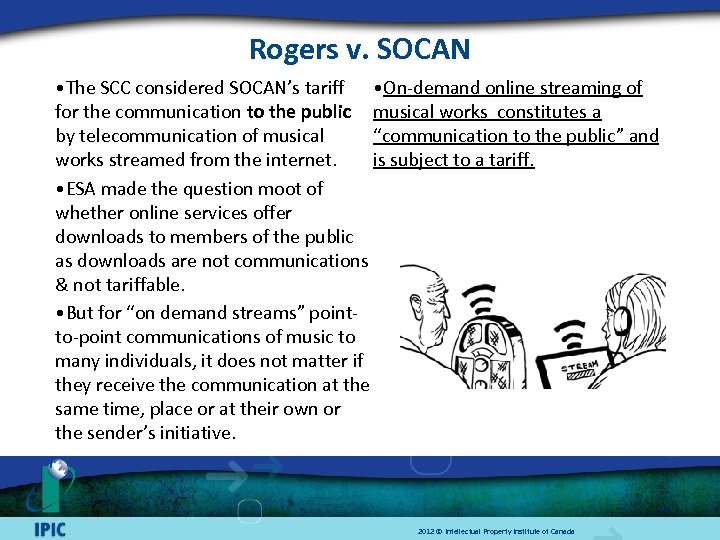 Rogers v. SOCAN • The SCC considered SOCAN’s tariff • On-demand online streaming of for the communication to the public musical works constitutes a by telecommunication of musical “communication to the public” and works streamed from the internet. is subject to a tariff. • ESA made the question moot of whether online services offer downloads to members of the public as downloads are not communications & not tariffable. • But for “on demand streams” pointto-point communications of music to many individuals, it does not matter if they receive the communication at the same time, place or at their own or the sender’s initiative. 2012 © Intellectual Property Institute of Canada
 Re: Sound v. Motion Picture Theatre Association • Re: Sound sought a tariff, on behalf of performers and record labels, for the public performance and communication to the public by telecommunication of sound recordings in movie soundtracks shown at cinemas and on TV. • The SCC affirmed the Copyright Board’s decision that the definition of a sound recording in the Copyright Act does not include a sound recording in a soundtrack when it accompanies a film or TV program and thus was not subject to an additional tariff. 2012 © Intellectual Property Institute of Canada
 SOCAN v. Bell • The SCC agreed with the Copyright Board and ruled that song previews provided by online internet service providers (e. g. i. Tunes), for consumers, constitutes “fair dealing for the purposes of research, ” and thus was not subject to a tariff. • The SCC seized the opportunity to clarify the interpretive framework set out in CCH, especially in relation to the 6 fairness factors. • The term “research” should be given a “large and liberal interpretation” (Abella J. ) 2012 © Intellectual Property Institute of Canada
 Alberta (Education) v. Access Copyright • At issue was whether copies made at the teachers’ initiative with instructions to students that they read the material were made for the allowable purpose of research or private study. • The SCC further demarcated certain aspects of the fairness test, emphasizing the point that fair dealing as a user’s right is here to stay in Canadian law. • Matter was sent back to the Copyright Board; Board has now ruled that the copying at issue is fair dealing. 2012 © Intellectual Property Institute of Canada
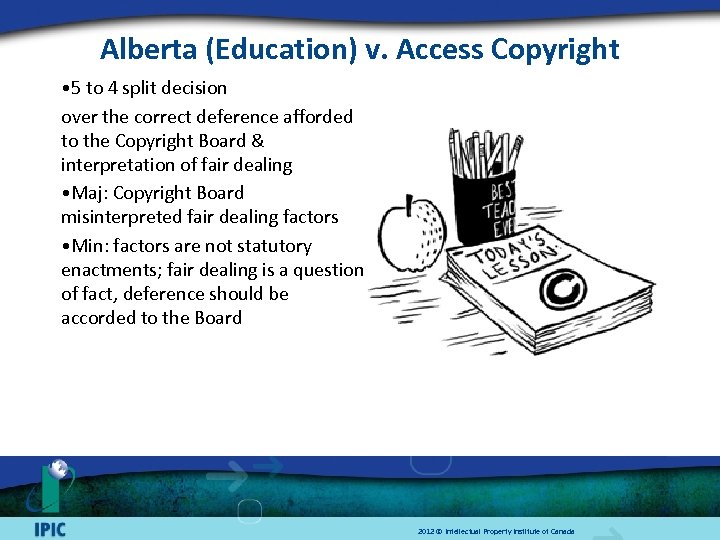 Alberta (Education) v. Access Copyright • 5 to 4 split decision over the correct deference afforded to the Copyright Board & interpretation of fair dealing • Maj: Copyright Board misinterpreted fair dealing factors • Min: factors are not statutory enactments; fair dealing is a question of fact, deference should be accorded to the Board 2012 © Intellectual Property Institute of Canada
 Key Issues Arising from the Pentalogy THE IMPACT ON INNOVATION 2012 © Intellectual Property Institute of Canada
 Key Issues arising from the Pentalogy • Fair Dealing • Technological Neutrality • Bundling of Rights 2012 © Intellectual Property Institute of Canada
 Fair Dealing SCC seems to say: Once and for all, did you finally get it? • Fair dealing is affirmed as a user’s right and is here to stay • “Fair dealing for the purpose of research or private study does not infringe copyright. ” (Copyright Act, s. 29) • Is it a tool for innovation in Canada? (disagreement on who it benefits most, is and seen as a user’s right) • Query: how can and should it benefit all parties in the copyright system? • Direct relationship between fair dealing and licensing (also don’t forget substantial part doctrine to trigger either in first place). 2012 © Intellectual Property Institute of Canada
 Fair Dealing • Broader fair dealing = decreased need for owners to license; more opportunities for user innovation, may lead to more content creation, that could (not) be subject to more licensing? • Creators? Depends (if owners, copyright contract; creators are also users) question more complex • Many unknowns, but we know the user benefits 2012 © Intellectual Property Institute of Canada
 Fair Dealing Cases SOCAN v. Bell (song previews for consumers) Access Copyright (book excerpts for K-12 for students) • 2 part test: (1) must fit within an allowable purpose and (2) dealing must be fair (CCH outlined 6 factors) • (1) Allowable purpose, research - Whose perspective counts? • In both cases, the relevant perspective is of the end user • SOCAN v Bell – consumers streaming previews with a view to purchase ; not the service provider’s. • Access - students not the copyright holders; teachers had a symbiotic purpose when providing copies to students (no ulterior or commercial motive) (nb dissent: teacher’s purpose is instruction) (2) Fairness - Reasonable safeguards make the dealing more fair in the commercial context (SOCAN v Bell [36]; echoes CCH) 2012 © Intellectual Property Institute of Canada
 Technological Neutrality • Concept of “Technological neutrality, ” speaks to 1) keeping rules constant across media, digital and non-digital, 2) ensuring the law treats all technologies equally Example: Majority (SOCAN v Bell) • “Given the ease and magnitude with which digital works are disseminated over the Internet, focusing on the “aggregate” amount of the dealing in cases involving digital works could well lead to disproportionate findings of unfairness when compared with nondigital works. . . [This] potentially undermines the goal of technological neutrality, which seeks to have the Copyright Act applied in a way that operates consistently, regardless of the form of media involved, or its technological sophistication” [43] 2012 © Intellectual Property Institute of Canada
 Technological Neutrality Example: Majority (ESA v SOCAN) “The question in this appeal is whether the rights are nonetheless revived when the work is sold over the Internet instead of in a store. ” [1] “The Board’s conclusion that a separate, “communication” tariff applied to downloads of musical works violates the principle of technological neutrality, which requires that the Copyright Act apply equally between traditional and more technologically advanced forms of the same media” [5] “The internet is simply a technological taxi that delivers a durable copy of the same work to the end user. ” [5] QUERY: using concept of technological neutrality to blur & bundle fundamental principles of copyright (e. g. s. 3 rights)? Again, pro-USER See Rothstein J’s dissent in both cases “In many respects, the Internet may well be described as a technological taxi; but taxis need not give free rides. ” [50] 2012 © Intellectual Property Institute of Canada
 Bundling Rights ESA v SOCAN • S. 3 delineates the exclusive rights of the copyright owner • Maj: delineation of rights are illustrative in scope; agreed with ESA that downloading a video game containing musical works did not amount to “communicating” that game to the public • Already dealt with in the “reproduction” right (as reproduction rights negotiated at outset before the games are packaged for public sale) • Min: copyright is a bundle of independent rights, and each should be protected individually; each subject to its own exploitation rights and should not be lumped together. 2012 © Intellectual Property Institute of Canada
 Innovation in Canada, as per the SCC…. • • Favours a world-view of open, accessible (free? ) collaboration & commerce, users are centre-stage Creative content, i. e. Music, books, the raw materials that can stimulate creative thinking & ultimately, the economy, should not be “locked away” in tariffs, burdened by additional fees So the Court seems to want to encourage “innovation” from the ground up: cases prioritize the rights of the individual and every day user, who would likely have been most affected by the tariffs. Purpose of Copyright: Sanctity of the public interest = encouragement & dissemination of works v. obtaining a just reward for the creator (Théberge) Note bien: strong dissents remain Litigation will continue (pentalogy interplay with C-11, new business models etc) but beware, interventionist SCC… 2012 © Intellectual Property Institute of Canada
 Thank you Dr. Giuseppina D’Agostino Osgoode Hall Law School www. iposgoode. ca 2012 © Intellectual Property Institute of Canada
 Thank You Questions? 2012 © Intellectual Property Institute of Canada