 Скачать презентацию Copyright 2011 Pearson Education Inc Publishing as
79e572dcb1232c5c463988643d9af696.ppt
- Количество слайдов: 72



Copyright © 2011 Pearson Education, Inc. Publishing as Longman
Copyright © 2011 Pearson Education, Inc. Publishing as Longman
Chapter 5: Civil Rights and Public Policy • • • The Struggle for Equality African Americans’ Civil Rights The Rights of Other Minority Groups Women and Public Policy Other Groups Active Under the Civil Rights Umbrella • Affirmative Action • Understanding Civil Rights and Public Policy • Summary Copyright © 2011 Pearson Education, Inc. Publishing as Longman
Chapter Outline and Learning Objectives • The Struggle for Equality • LO 5. 1: Differentiate the Supreme Court’s three standards of review for classifying people under the equal protection clause. • African Americans’ Civil Rights • LO 5. 2: Trace the evolution of protections of the rights of African Americans and explain the application of nondiscrimination principles to issues of race. Copyright © 2011 Pearson Education, Inc. Publishing as Longman
Chapter Outline and Learning Objectives • The Rights of Other Minority Groups • LO 5. 3: Relate civil rights principles to progress made by other ethnic groups in the United States. • Women and Public Policy • LO 5. 4: Trace the evolution of women’s rights and explain how civil rights principles apply to gender issues. Copyright © 2011 Pearson Education, Inc. Publishing as Longman
Chapter Outline and Learning Objectives • Other Groups Active Under the Civil Rights Umbrella • LO 5. 5: Show civil rights principles have been applied to seniors, people with disabilities, and gays and lesbians. • Affirmative Action • LO 5. 6: Trace the evolution of affirmative action policy and assess the arguments for and against it. Copyright © 2011 Pearson Education, Inc. Publishing as Longman
Chapter Outline and Learning Objectives • Understanding Civil Rights and Public Policy • LO 5. 7: Establish how civil rights policy advances democracy and increases the scope of government. Copyright © 2011 Pearson Education, Inc. Publishing as Longman
The Struggle for Equality LO 5. 1: Differentiate the Supreme Court’s three standards of review for classifying people under the equal protection clause. • Conceptions of Equality • The Constitution and Inequality To Learning Objectives Copyright © 2011 Pearson Education, Inc. Publishing as Longman
The Struggle for Equality LO 5. 1 • Conceptions of Equality • Civil Rights - Policies protect people against discrimination. • Equal opportunity - Same chance to use their abilities and skills in order to succeed. • Equal results – Everyone should have the same rewards such as earn the same salary or have the same amount of property. To Learning Objectives Copyright © 2011 Pearson Education, Inc. Publishing as Longman
LO 5. 1 The Struggle for Equality • The Constitution and Inequality • Equality is not in the original Constitution. • First mention of equality in the 14 th Amendment – Equal protection of the laws. To Learning Objectives Copyright © 2011 Pearson Education, Inc. Publishing as Longman
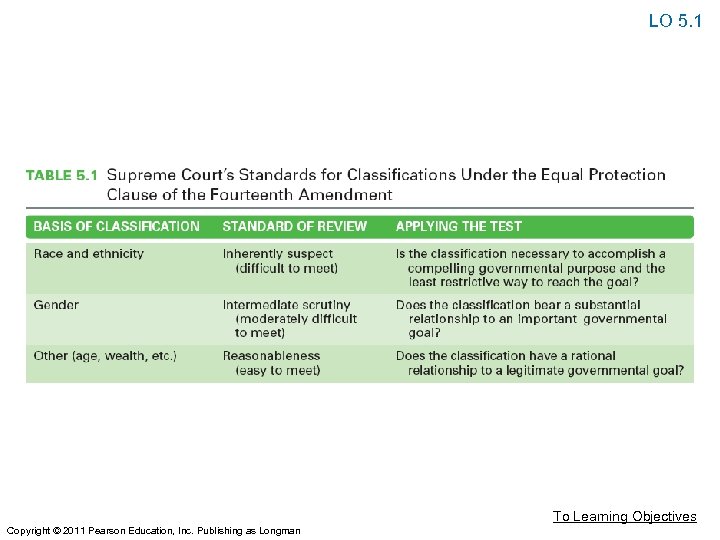
LO 5. 1 To Learning Objectives Copyright © 2011 Pearson Education, Inc. Publishing as Longman
African Americans’ Civil Rights LO 5. 2: Trace the evolution of protections of the rights of African Americans and explain the application of nondiscrimination principles to issues of race. • The Era of Slavery • The Era of Reconstruction and Segregation • Equal Education • The Civil Rights Movement and Public Policy • Voting Rights To Learning Objectives Copyright © 2011 Pearson Education, Inc. Publishing as Longman
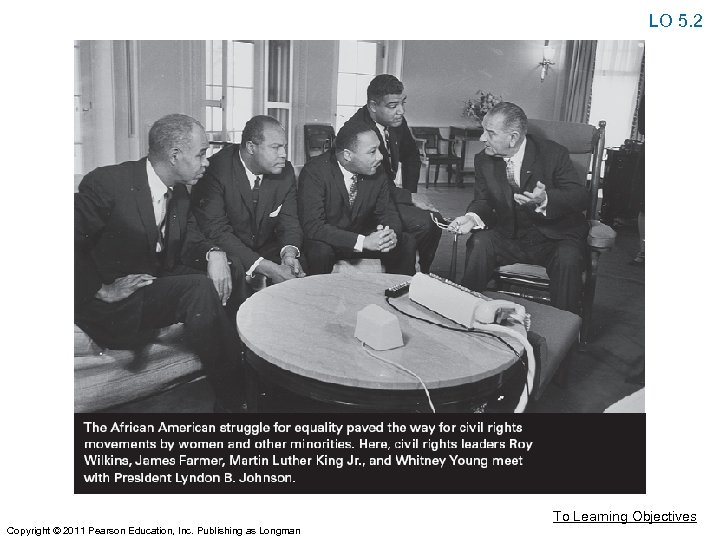
LO 5. 2 To Learning Objectives Copyright © 2011 Pearson Education, Inc. Publishing as Longman
African Americans’ Civil Rights LO 5. 2 • The Era of Slavery • Dred Scott v. Sandford (1857) ruled that slaves had no rights. • The Civil War (1861 -1865) was fought between 11 Southern States and National Government. • 13 th Amendment (1865) was passed after the Civil War and it outlawed slavery. To Learning Objectives Copyright © 2011 Pearson Education, Inc. Publishing as Longman
African Americans’ Civil Rights LO 5. 2 • The Era of Reconstruction and Segregation • Jim Crow Laws (1877– 1954) made separate facilities legal. • Plessy v. Ferguson (1896) ruled separate but equal facilities were constitutional. To Learning Objectives Copyright © 2011 Pearson Education, Inc. Publishing as Longman
African Americans’ Civil Rights LO 5. 2 • Equal Education • Brown v. Board of Education (1954) ruled school segregation inherently unconstitutional. • Busing of students was solution for de jure segregation (by law) and de facto segregation (in reality). To Learning Objectives Copyright © 2011 Pearson Education, Inc. Publishing as Longman
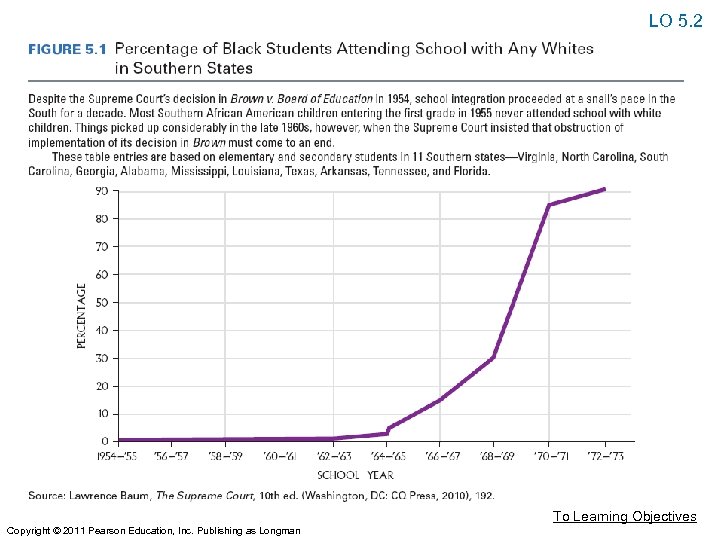
LO 5. 2 To Learning Objectives Copyright © 2011 Pearson Education, Inc. Publishing as Longman
African Americans’ Civil Rights LO 5. 2 • The Civil Rights Movement and Public Policy • Civil Rights Act of 1964 is the public policy that made racial discrimination in hotels, motels, and restaurants illegal and that forbade many forms of job discrimination. To Learning Objectives Copyright © 2011 Pearson Education, Inc. Publishing as Longman
African Americans’ Civil Rights LO 5. 2 • Voting Rights • Suffrage is the legal right to vote. • Fifteenth Amendment extended suffrage to African Americans. • Poll Tax – A small tax levied on the right to vote. • White Primary - Only whites were allowed to vote in the party primaries. To Learning Objectives Copyright © 2011 Pearson Education, Inc. Publishing as Longman
African Americans’ Civil Rights LO 5. 2 • Voting Rights (cont. ) • Smith v. Allwright (1944) ended the white primaries. • 24 th Amendment eliminated poll taxes for federal elections. • Harper v. Virginia State Board of Elections (1966) ruled no poll taxes at all. • Voting Rights Act of 1965 helped end barriers to voting. To Learning Objectives Copyright © 2011 Pearson Education, Inc. Publishing as Longman
The Rights of Other Minority Groups LO 5. 3: Relate civil rights principles to progress made by other ethnic groups in the United States. • • Native Americans Hispanic Americans Asian Americans Arab Americans and Muslims To Learning Objectives Copyright © 2011 Pearson Education, Inc. Publishing as Longman
LO 5. 3 To Learning Objectives Copyright © 2011 Pearson Education, Inc. Publishing as Longman
LO 5. 3 The Rights of Other Minority Groups • Native Americans • Indian Bill of Rights - Title II of the Civil Rights Act of 1968 applied most of the provisions of the Constitution’s Bill of Rights to tribal governments. • Santa Clara Pueblo v. Martinez (1978) strengthened the tribal power of individual tribe members and furthered selfgovernment by Indian tribes. To Learning Objectives Copyright © 2011 Pearson Education, Inc. Publishing as Longman
LO 5. 3 The Rights of Other Minority Groups • Hispanic Americans • Hernandez v. Texas (1954) extended protection against discrimination to Hispanics. • White v. Regester (1973) ruled no multimember electoral districts in Texas. • Plyler v. Doe (1982) allows public education for illegal immigrant children in Texas. To Learning Objectives Copyright © 2011 Pearson Education, Inc. Publishing as Longman
LO 5. 3 The Rights of Other Minority Groups • Asian Americans • During World War II more than 100, 000 Americans of Japanese descent were moved to internment camps. • Korematsu v. U. S. (1944) upheld as constitutional the internment of more than 100, 000 Americans of Japanese descent in encampments during World War II. To Learning Objectives Copyright © 2011 Pearson Education, Inc. Publishing as Longman
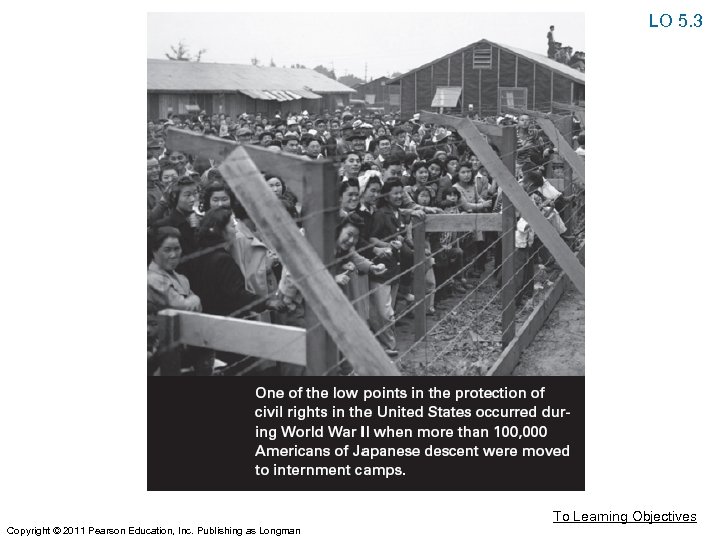
LO 5. 3 To Learning Objectives Copyright © 2011 Pearson Education, Inc. Publishing as Longman
LO 5. 3 The Rights of Other Minority Groups • Arab Americans and Muslims • Hamdi v. Rumsfeld (2004) provided detainees the right to challenge their detention before a judge or other neutral decision maker. • Boumediene v. Bush (2008) provided foreign terrorism suspects the right to challenge their detention in U. S. courts. To Learning Objectives Copyright © 2011 Pearson Education, Inc. Publishing as Longman
LO 5. 4 Women and Public Policy LO 5. 4: Trace the evolution of women’s rights and explain how civil rights principles apply to gender issues. • • • The Battle for the Vote The “Doldrums”: 1920– 1960 The Second Feminist Wave Women in the Workplace Wage Discrimination and Comparable Worth • Sexual Harassment • Women in the Military To Learning Objectives Copyright © 2011 Pearson Education, Inc. Publishing as Longman
Women and Public Policy LO 5. 4 • The Battle for the Vote • The Seneca Falls Declaration of Sentiments and Resolutions that was signed on July 19, 1848 was the beginning of the suffrage movement for women. • The Nineteenth Amendment was adopted in 1920 and guaranteed women the right to vote. To Learning Objectives Copyright © 2011 Pearson Education, Inc. Publishing as Longman
Women and Public Policy LO 5. 4 • The “Doldrums”: 1920– 1960 • Laws were designed to protect women, and protect men from competition with women. • Equal Rights Amendment first introduced in Congress in 1923 To Learning Objectives Copyright © 2011 Pearson Education, Inc. Publishing as Longman
Women and Public Policy LO 5. 4 • The Second Feminist Wave • Reed v. Reed (1971) ruled that arbitrary gender discrimination violated 14 th Amendment’s Equal Protection Clause. • Craig v. Boren (1976) - Medium (intermediate) scrutiny standard established for gender discrimination. • Equal Rights Amendment fails ratification by states in 1982. To Learning Objectives Copyright © 2011 Pearson Education, Inc. Publishing as Longman
Women and Public Policy LO 5. 4 • Women in the Workplace • The Civil Rights Act of 1964 banned gender discrimination in employment. • The Pregnancy Discrimination Act of 1978 made it illegal for employers to exclude pregnancy and childbirth from their sick leave and health benefits plans. To Learning Objectives Copyright © 2011 Pearson Education, Inc. Publishing as Longman
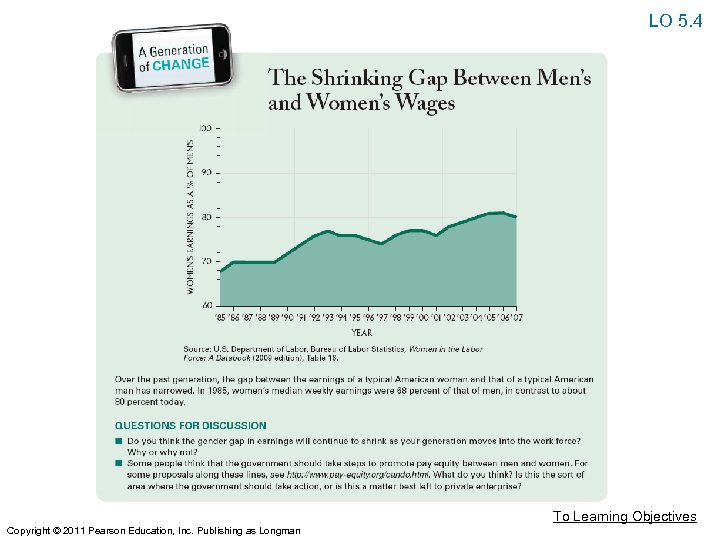
Women and Public Policy LO 5. 4 • Wage Discrimination and Comparable Worth • Median weekly earnings for women working full time are only 80 percent those for men working full time. • The 1 st significant legislation that President Barack Obama signed was a 2009 bill outlawing discrimination in compensation. To Learning Objectives Copyright © 2011 Pearson Education, Inc. Publishing as Longman
LO 5. 4 To Learning Objectives Copyright © 2011 Pearson Education, Inc. Publishing as Longman
LO 5. 4 Women and Public Policy • Sexual Harassment • Prohibited by Title VII of Civil Rights Act of 1964. • Harris v. Forklift Systems (1993) ruled that no single factor is required to win a sexual harassment case. • The law is violated when the workplace environment would reasonably be perceived, and is perceived, as hostile or abusive. ” To Learning Objectives Copyright © 2011 Pearson Education, Inc. Publishing as Longman
LO 5. 4 Women and Public Policy • Women in the Military • Women make up about 14 percent of the active duty armed forces. • Congress opened all the service academies to women in 1975. • Only men may be drafted or serve in ground combat. • January 2013 all exemptions lifted To Learning Objectives Copyright © 2011 Pearson Education, Inc. Publishing as Longman
Other Groups Active Under the Civil Rights Umbrella LO 5. 5: Show civil rights principles have been applied to seniors, people with disabilities, and gays and lesbians. • Civil Rights and the Graying of America • Civil Rights and People with Disabilities • Gay and Lesbian Rights To Learning Objectives Copyright © 2011 Pearson Education, Inc. Publishing as Longman
Other Groups Active Under the Civil Rights Umbrella LO 5. 5 • Civil Rights and the Graying of America • Age classifications fall under rational basis test. • Meacham v. Knolls Atomic Power Laboratory (2008) ruled employer must show that action against a worker stems from reasonable factors other than age. To Learning Objectives Copyright © 2011 Pearson Education, Inc. Publishing as Longman
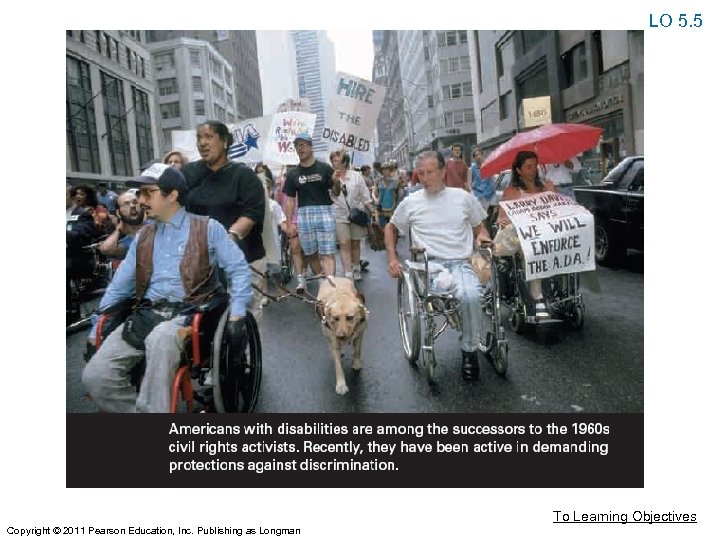
Other Groups Active Under the Civil Rights Umbrella LO 5. 5 • Civil Rights and People with Disabilities • Americans with Disabilities Act of 1990 requires employers and public facilities to make reasonable accommodations for people with disabilities and prohibits discrimination against these individuals in employment. To Learning Objectives Copyright © 2011 Pearson Education, Inc. Publishing as Longman
LO 5. 5 To Learning Objectives Copyright © 2011 Pearson Education, Inc. Publishing as Longman
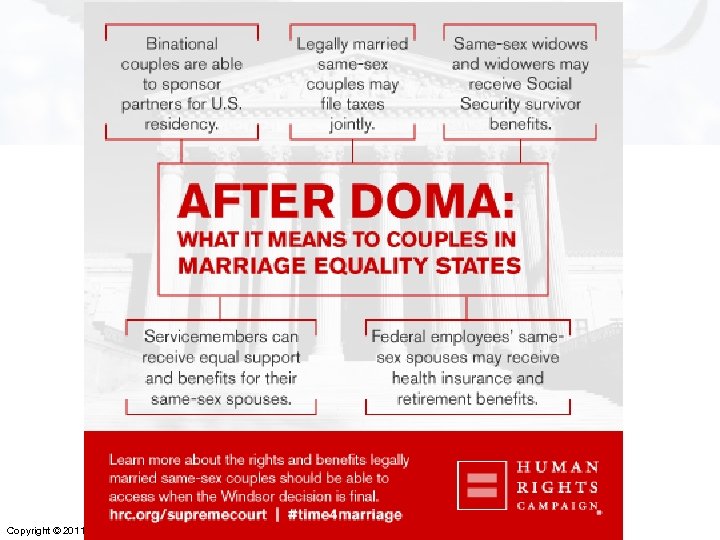
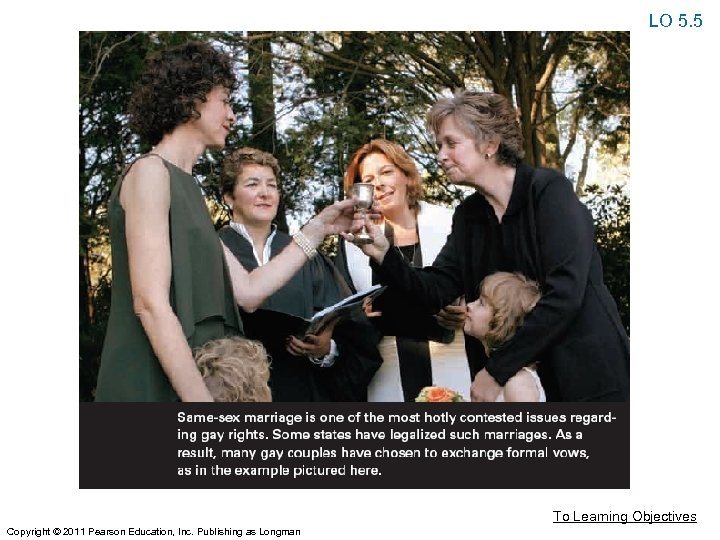
Other Groups Active Under the Civil Rights Umbrella LO 5. 5 • Gay and Lesbian Rights • Defense of Marriage Act (1996) lets states disregard same-sex marriages performed elsewhere. • US v. Windsor (2013) – DOMA does not apply to federal government • Lawrence v. Texas (2003) – Made private homosexual acts protected by the Constitution. • Obergefell v. Hodges To Learning Objectives Copyright © 2011 Pearson Education, Inc. Publishing as Longman
Copyright © 2011 Pearson Education, Inc. Publishing as Longman
LO 5. 5 To Learning Objectives Copyright © 2011 Pearson Education, Inc. Publishing as Longman
Affirmative Action LO 5. 6: Trace the evolution of affirmative action policy and assess the arguments for and against it. • Affirmative Action • Policy designed to give special attention to or compensatory treatment for members of some previously disadvantaged group. • Regents of the University of California v. Bakke (1978) • Ruled that racial set asides were unconstitutional, but can consider race in admissions. To Learning Objectives Copyright © 2011 Pearson Education, Inc. Publishing as Longman
Understanding Civil Rights and Public Policy LO 5. 7: Establish how civil rights policy advances democracy and increases the scope of government. • Civil Rights and Democracy • Civil Rights and the Scope of Government To Learning Objectives Copyright © 2011 Pearson Education, Inc. Publishing as Longman
Understanding Civil Rights and Public Policy LO 5. 7 • Civil Rights and Democracy • Equality favors majority rule. • Suffrage gave many groups political power. To Learning Objectives Copyright © 2011 Pearson Education, Inc. Publishing as Longman
Understanding Civil Rights and Public Policy LO 5. 7 • Civil Rights and the Scope of Government • Civil rights laws increase the size and power of government. • Civil rights protect individuals against collective discrimination. To Learning Objectives Copyright © 2011 Pearson Education, Inc. Publishing as Longman
LO 5. 1 Summary • The Struggle for Equality • Americans have emphasized equal rights and opportunities rather than equal results. • In the Constitution, only the Fourteenth Amendmentions equality. To Learning Objectives Copyright © 2011 Pearson Education, Inc. Publishing as Longman
LO 5. 1 Summary • The Struggle for Equality (cont. ) • To decide whether classifications in laws and regulations abide with 14 th Amendment’s equal protection clause, the Supreme Court developed three standards of review. • Most classifications need only be reasonable, racial or ethnic classifications are inherently suspect, and gender classifications receive intermediate scrutiny. To Learning Objectives Copyright © 2011 Pearson Education, Inc. Publishing as Longman
Courts presume classifications based on race to be _____. A. B. C. D. LO 5. 1 constitutional offensive reasonable inherently suspect To Learning Objectives Copyright © 2011 Pearson Education, Inc. Publishing as Longman
Courts presume classifications based on race to be _____. A. B. C. D. LO 5. 1 constitutional offensive reasonable inherently suspect To Learning Objectives Copyright © 2011 Pearson Education, Inc. Publishing as Longman
LO 5. 2 Summary • African Americans’ Civil Rights • Racial discrimination is rooted in the era of slavery and persisted in an era of segregation. • Civil rights movement won victories through civil disobedience and the Court rulings, beginning with Brown v. the Board of Education (1954). To Learning Objectives Copyright © 2011 Pearson Education, Inc. Publishing as Longman
LO 5. 2 Summary • African Americans’ Civil Rights • 1964 Civil Rights Act prohibited discrimination in public accommodations, employment, and housing. • 1965 Voting Rights Act prohibited discrimination in voting. • African Americans’ struggle for civil rights led the way securing equal rights for all Americans. To Learning Objectives Copyright © 2011 Pearson Education, Inc. Publishing as Longman
Segregation was outlawed first in. A. B. C. D. LO 5. 2 education all areas employment housing To Learning Objectives Copyright © 2011 Pearson Education, Inc. Publishing as Longman
Segregation was outlawed first in. A. B. C. D. LO 5. 2 education all areas employment housing To Learning Objectives Copyright © 2011 Pearson Education, Inc. Publishing as Longman
LO 5. 3 Summary • The Rights of Other Minority Groups • Native Americans, Hispanic Americans, Asian Americans, and Arab Americans and Muslims have suffered discriminatory treatment. • Each group benefited from the Court decisions and legislation of the civil rights era and have also engaged in political action to defend their rights. To Learning Objectives Copyright © 2011 Pearson Education, Inc. Publishing as Longman
Other minority groups and not just African Americans have also struggled for civil rights in. A. B. C. D. LO 5. 3 voting education employment all of the above To Learning Objectives Copyright © 2011 Pearson Education, Inc. Publishing as Longman
Other minority groups and not just African Americans have also struggled for civil rights in. A. B. C. D. LO 5. 3 voting education employment all of the above To Learning Objectives Copyright © 2011 Pearson Education, Inc. Publishing as Longman
LO 5. 4 Summary • Women and Public Policy • In 1920, women won the right to with the passage of 19 th Amendment. • Women have successfully challenged genderbased classifications regarding employment, property, and other economic issues. • Issues remain like lack of parity in wages, participation in the military, and sexual harassment. To Learning Objectives Copyright © 2011 Pearson Education, Inc. Publishing as Longman
In Craig v. Boren (1976), the Supreme Court held gender discrimination to a standard. A. B. C. D. LO 5. 4 strict scrutiny intermediate scrutiny rational least restrictions To Learning Objectives Copyright © 2011 Pearson Education, Inc. Publishing as Longman
In Craig v. Boren (1976), the Supreme Court held gender discrimination to a standard. A. B. C. D. LO 5. 4 strict scrutiny intermediate scrutiny rational least restrictions To Learning Objectives Copyright © 2011 Pearson Education, Inc. Publishing as Longman
LO 5. 5 Summary • Other Groups Active Under the Civil Rights Umbrella • Seniors and people with disabilities have successfully fought bias in employment, and the latter have gained greater access to education and public facilities. • Gays and lesbians have been more successful in areas such as employment and privacy than in obtaining the right to marry. To Learning Objectives Copyright © 2011 Pearson Education, Inc. Publishing as Longman
LO 5. 5 Which of the following is the standard for evaluating age discrimination claims? A. B. C. D. the reasonableness standard the medium scrutiny standard the strict scrutiny standard the employer’s bias standard To Learning Objectives Copyright © 2011 Pearson Education, Inc. Publishing as Longman
LO 5. 5 Which of the following is the standard for evaluating age discrimination claims? A. B. C. D. the reasonableness standard the medium scrutiny standard the strict scrutiny standard the employer’s bias standard To Learning Objectives Copyright © 2011 Pearson Education, Inc. Publishing as Longman
LO 5. 6 Summary • Affirmative Action • Affirmative action policies are designed to bring about increased employment, promotion, or admission for members of groups that have suffered from discrimination. • The Supreme Court has applied the inherently suspect standard to affirmative action policies and prohibited quotas and other means of achieving more equal results. To Learning Objectives Copyright © 2011 Pearson Education, Inc. Publishing as Longman
LO 5. 6 Which statement about affirmative action best reflects current Supreme Court precedent concerning quotas or set-asides? A. They may be used in employment. B. They may be used in education. C. They may be used in both employment and education. D. They are unconstitutional. To Learning Objectives Copyright © 2011 Pearson Education, Inc. Publishing as Longman
LO 5. 6 Which statement about affirmative action best reflects current Supreme Court precedent concerning quotas or set-asides? A. They may be used in employment. B. They may be used in education. C. They may be used in both employment and education. D. They are unconstitutional. To Learning Objectives Copyright © 2011 Pearson Education, Inc. Publishing as Longman
LO 5. 7 Summary • Understanding Civil Rights and Public Policy • Civil rights policies advance democracy because equality is a principle of democratic government. • When majority rule threatens civil rights, the latter must prevail. • Civil rights policies limit government discrimination but also require active government effort to protect the rights of minorities. To Learning Objectives Copyright © 2011 Pearson Education, Inc. Publishing as Longman
The intent of civil rights laws is to promote values. A. B. C. D. LO 5. 7 individualistic traditionalistic moralistic democratic To Learning Objectives Copyright © 2011 Pearson Education, Inc. Publishing as Longman
The intent of civil rights laws is to promote values. A. B. C. D. LO 5. 7 individualistic traditionalistic moralistic democratic To Learning Objectives Copyright © 2011 Pearson Education, Inc. Publishing as Longman
Text Credits • U. S. Census Bureau, News Release, May 14, 2009. U. S. Department of Labor, Bureau of Labor Statistics, Women in the Labor Force: A Databook (2008 edition), Table 16. Copyright © 2011 Pearson Education, Inc. Publishing as Longman
Photo Credits • • • • 132: Francis Miller/Time and Life Pictures/Getty Images 133 T: AP Photo; 133 TC: Corbis 133 TB: Steve Rubin/The Image Works 133 B: AP Photo 135: AP Photo 137: Bettmann/Corbis 142: AP Photo 145: Reuters/Corbis 146: Corbis 149: AP Photo 150: Mark Wilson/Getty Images 152: Tribune Media Services, Inc. All Rights Reserved. Reprinted with permission 154: Steve Rubin/The Image Works 155: Tribune Media Services, Inc. All Rights Reserved 156: AP Photo 158: Tom Cheney/The New Yorker Cartoon Bank. www. cartoonbank. com Copyright © 2011 Pearson Education, Inc. Publishing as Longman
Скачать презентацию Copyright 2011 Pearson Education Inc Publishing as
79e572dcb1232c5c463988643d9af696.ppt