


 Скачать презентацию Copyright 2011 Dorling Kindersley India Pvt Ltd
1e0766d521a6c63c2e00864977cbf485.ppt
- Количество слайдов: 38
 Copyright © 2011 Dorling Kindersley India Pvt Ltd 8 Managing Human Resources Principles of Management
 Follow this Learning Outline as you read and study this chapter. The Human Resource Management Process • Explain why the HRM process is important. • Discuss the environmental factors that most directly affect the HRM process. • Describe the importance and procedure of human resource planning. Identifying and Selecting Competent Employees • Define job analysis, job description and job specification. • Discuss the major sources of potential job candidates. • Describe the different selection devices and which works best for different jobs. • Explain why a realistic job preview is important. Principles of Management Copyright © 2011 Dorling Kindersley India Pvt Ltd Learning Outcomes
 • Providing Employees with Needed Skills and Knowledge Ø Explain why orientation is so important. Ø Describe the different types of training and how that training can be provided. • Retaining Competent, High Performing Employees Ø Describe the different performance appraisal methods. Ø Discuss the factors that influence employee compensation and benefits. Ø Describe skill-based and variable pay systems. Principles of Management Copyright © 2011 Dorling Kindersley India Pvt Ltd Learning Outcomes
 • Contemporary Issues in Managing Human Resources Ø Explain how managers can manage downsizing. Ø Discuss how managers can manage workforce diversity. Ø Explain what sexual harassment is and what managers need to know about it. Ø Describe how organizations are dealing with work-life balance issues. Ø Discuss how organizations are controlling HR costs. Principles of Management Copyright © 2011 Dorling Kindersley India Pvt Ltd LEARNING OUTCOMES
 • As a significant source of competitive advantage Ø People-oriented HR creates superior shareholder value. • As an important strategic tool Ø Achieve competitive success through people by treating employees as partners. • To improve organizational performance Ø High performance work practices lead to both high individual and high organizational performance. Principles of Management Copyright © 2011 Dorling Kindersley India Pvt Ltd The Importance of Human Resource Management (HRM)
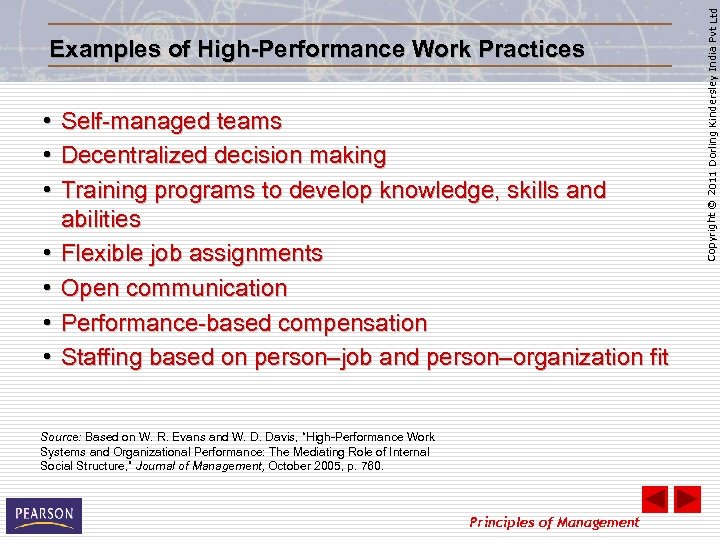 • • Self-managed teams Decentralized decision making Training programs to develop knowledge, skills and abilities Flexible job assignments Open communication Performance-based compensation Staffing based on person–job and person–organization fit Source: Based on W. R. Evans and W. D. Davis, “High-Performance Work Systems and Organizational Performance: The Mediating Role of Internal Social Structure, ” Journal of Management, October 2005, p. 760. Principles of Management Copyright © 2011 Dorling Kindersley India Pvt Ltd Examples of High-Performance Work Practices
 • The HRM process is an ongoing procedure that tries to keep the organization supplied with the right people in the right positions, when they are needed. Principles of Management Copyright © 2011 Dorling Kindersley India Pvt Ltd The HRM Process
 • Includes seven basic activities Ø Human resource planning Ø Recruitment Ø Selection Ø Socialization Ø Training and development Ø Performance appraisal Ø Promotions, transfers, demotions and separations Principles of Management Copyright © 2011 Dorling Kindersley India Pvt Ltd The HRM Process: A Traditional View
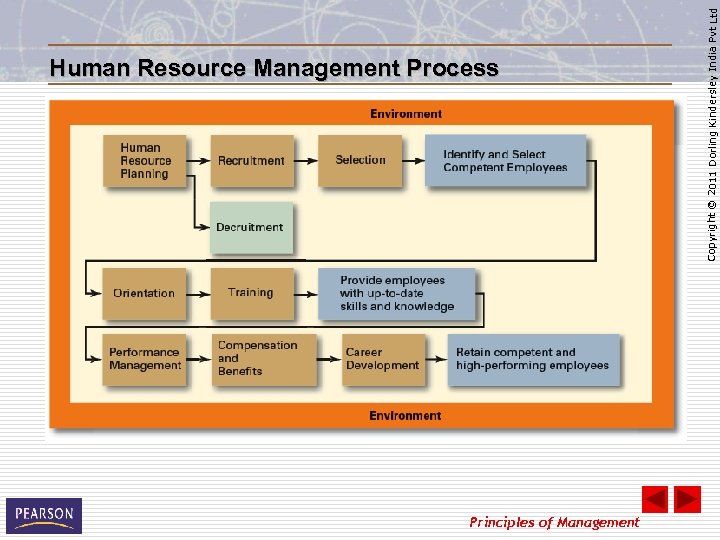 Principles of Management Copyright © 2011 Dorling Kindersley India Pvt Ltd Human Resource Management Process
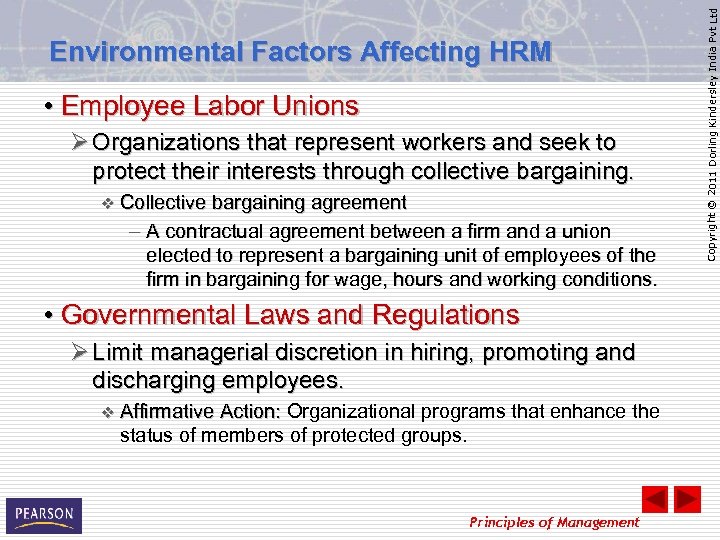 • Employee Labor Unions Ø Organizations that represent workers and seek to protect their interests through collective bargaining. v Collective bargaining agreement – A contractual agreement between a firm and a union elected to represent a bargaining unit of employees of the firm in bargaining for wage, hours and working conditions. • Governmental Laws and Regulations Ø Limit managerial discretion in hiring, promoting and discharging employees. v Affirmative Action: Organizational programs that enhance the status of members of protected groups. Principles of Management Copyright © 2011 Dorling Kindersley India Pvt Ltd Environmental Factors Affecting HRM
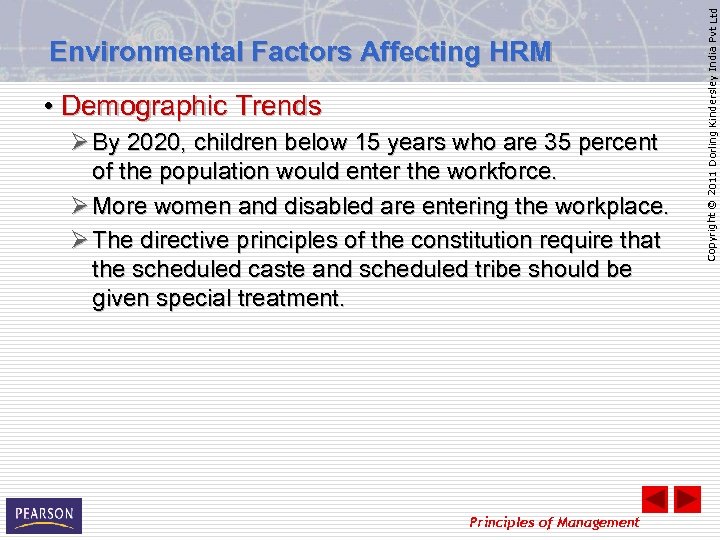 • Demographic Trends Ø By 2020, children below 15 years who are 35 percent of the population would enter the workforce. Ø More women and disabled are entering the workplace. Ø The directive principles of the constitution require that the scheduled caste and scheduled tribe should be given special treatment. Principles of Management Copyright © 2011 Dorling Kindersley India Pvt Ltd Environmental Factors Affecting HRM
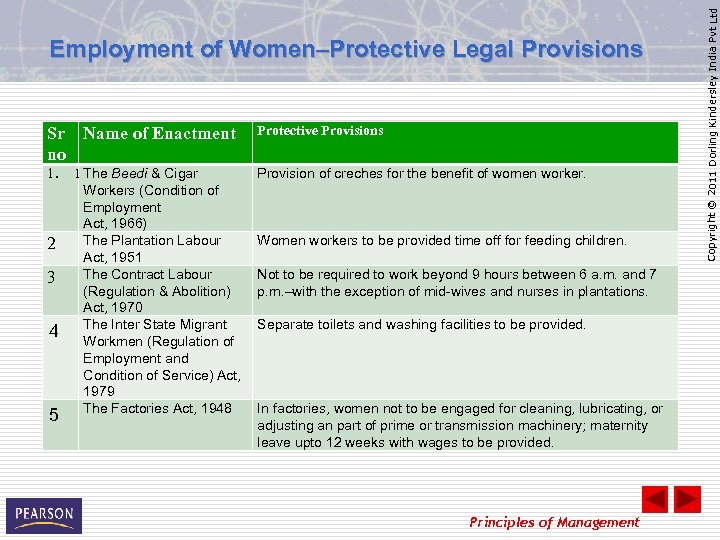 Sr Name of Enactment no Protective Provisions 1. Provision of creches for the benefit of women worker. 2 3 4 5 1 The Beedi & Cigar Workers (Condition of Employment Act, 1966) The Plantation Labour Act, 1951 The Contract Labour (Regulation & Abolition) Act, 1970 The Inter State Migrant Workmen (Regulation of Employment and Condition of Service) Act, 1979 The Factories Act, 1948 Women workers to be provided time off for feeding children. Not to be required to work beyond 9 hours between 6 a. m. and 7 p. m. –with the exception of mid-wives and nurses in plantations. Separate toilets and washing facilities to be provided. In factories, women not to be engaged for cleaning, lubricating, or adjusting an part of prime or transmission machinery; maternity leave upto 12 weeks with wages to be provided. Principles of Management Copyright © 2011 Dorling Kindersley India Pvt Ltd Employment of Women–Protective Legal Provisions
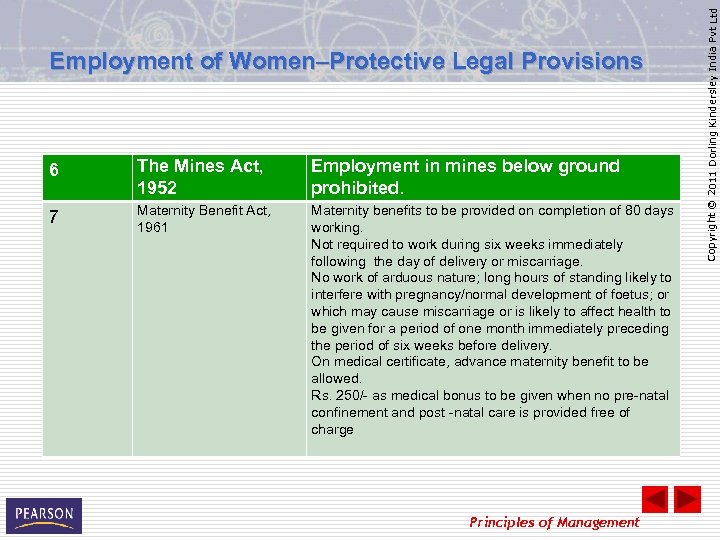 6 The Mines Act, 1952 Employment in mines below ground prohibited. 7 Maternity Benefit Act, 1961 Maternity benefits to be provided on completion of 80 days working. Not required to work during six weeks immediately following the day of delivery or miscarriage. No work of arduous nature; long hours of standing likely to interfere with pregnancy/normal development of foetus; or which may cause miscarriage or is likely to affect health to be given for a period of one month immediately preceding the period of six weeks before delivery. On medical certificate, advance maternity benefit to be allowed. Rs. 250/- as medical bonus to be given when no pre-natal confinement and post -natal care is provided free of charge Principles of Management Copyright © 2011 Dorling Kindersley India Pvt Ltd Employment of Women–Protective Legal Provisions
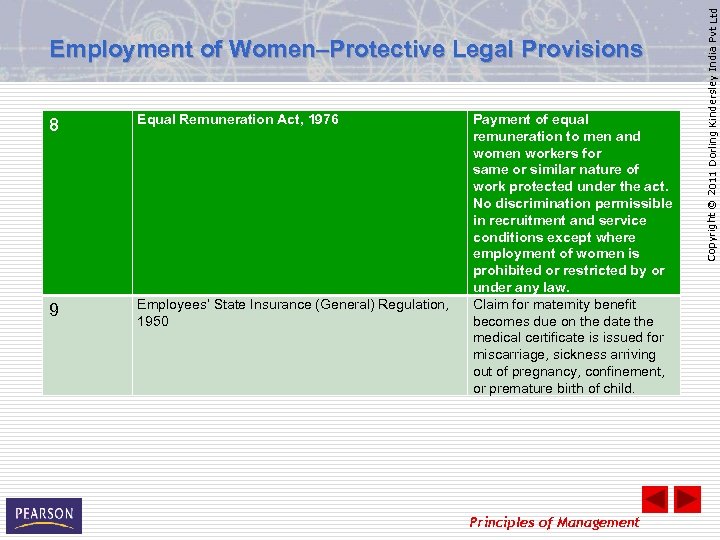 8 Equal Remuneration Act, 1976 9 Employees’ State Insurance (General) Regulation, 1950 Payment of equal remuneration to men and women workers for same or similar nature of work protected under the act. No discrimination permissible in recruitment and service conditions except where employment of women is prohibited or restricted by or under any law. Claim for maternity benefit becomes due on the date the medical certificate is issued for miscarriage, sickness arriving out of pregnancy, confinement, or premature birth of child. Principles of Management Copyright © 2011 Dorling Kindersley India Pvt Ltd Employment of Women–Protective Legal Provisions
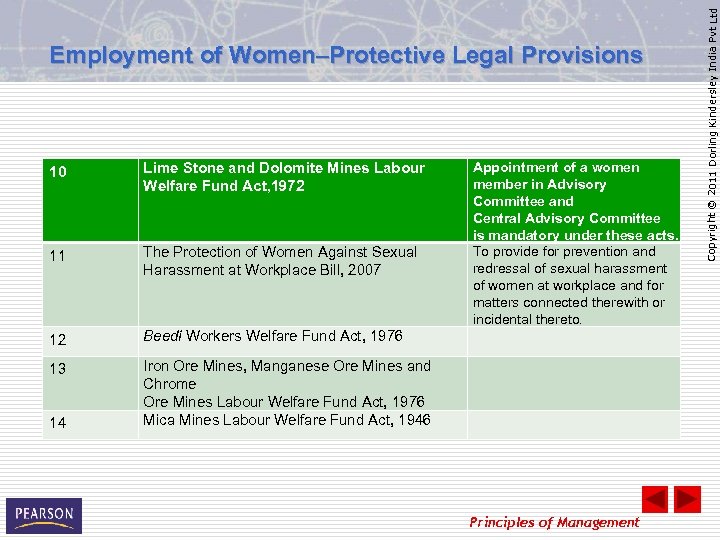 10 Lime Stone and Dolomite Mines Labour Welfare Fund Act, 1972 11 The Protection of Women Against Sexual Harassment at Workplace Bill, 2007 12 Beedi Workers Welfare Fund Act, 1976 13 Appointment of a women member in Advisory Committee and Central Advisory Committee is mandatory under these acts. To provide for prevention and redressal of sexual harassment of women at workplace and for matters connected therewith or incidental thereto. Iron Ore Mines, Manganese Ore Mines and Chrome Ore Mines Labour Welfare Fund Act, 1976 Mica Mines Labour Welfare Fund Act, 1946 14 Principles of Management Copyright © 2011 Dorling Kindersley India Pvt Ltd Employment of Women–Protective Legal Provisions
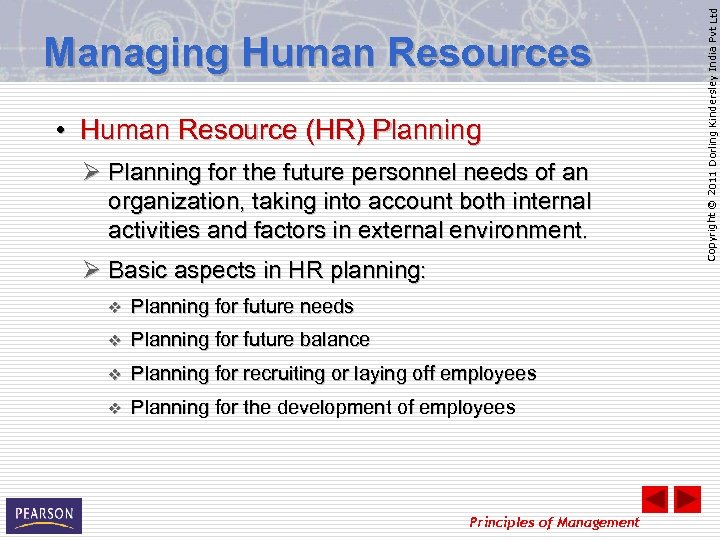 • Human Resource (HR) Planning Ø Planning for the future personnel needs of an organization, taking into account both internal activities and factors in external environment. Ø Basic aspects in HR planning: v Planning for future needs v Planning for future balance v Planning for recruiting or laying off employees v Planning for the development of employees Principles of Management Copyright © 2011 Dorling Kindersley India Pvt Ltd Managing Human Resources
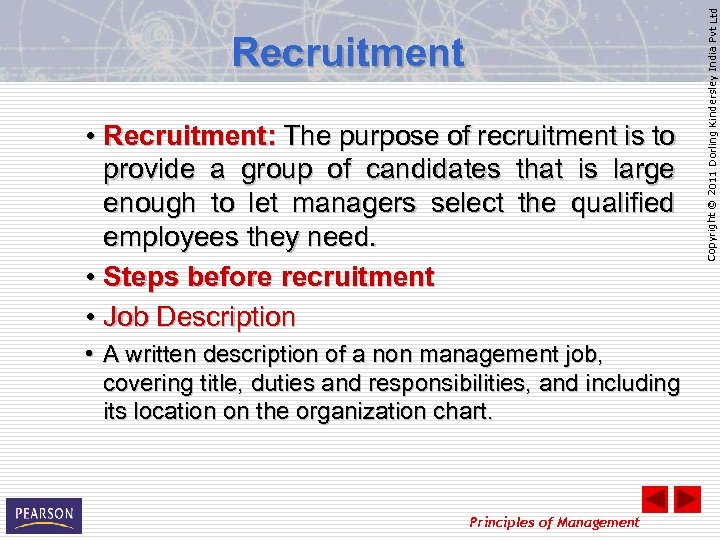 • Recruitment: The purpose of recruitment is to provide a group of candidates that is large enough to let managers select the qualified employees they need. • Steps before recruitment • Job Description • A written description of a non management job, covering title, duties and responsibilities, and including its location on the organization chart. Principles of Management Copyright © 2011 Dorling Kindersley India Pvt Ltd Recruitment
 • Job Specification Ø A written description of a management position, covering title, duties, and responsibilities, and including its location on the organization chart. • Hiring specification: Ø A written description of the education, experience and skills needed to perform a job or fill a position effectively. Principles of Management Copyright © 2011 Dorling Kindersley India Pvt Ltd Recruitment
 • Outside Recruitment for Managers and Professionals • Major sources for entry level jobs: College and graduate school campuses are a major source of entry-level jobs. • For middle level positions: Placement agencies or the purchase of expensive ads • For top level positions: Executive search firms Principles of Management Copyright © 2011 Dorling Kindersley India Pvt Ltd Sources of Recruitment
 • Major advantages • Individuals are familiar with the organization and its members. • Promotion-from-within policy fosters loyalty and inspires greater effort among organization members. • Less expensive. • Disadvantages • Limits the pool of available talent. • Reduces the chance that fresh viewpoints will enter the organization. • May encourage complacency among employees who assume seniority ensures promotion. Principles of Management Copyright © 2011 Dorling Kindersley India Pvt Ltd Recruitment from Within
 • The organization decides whether to make a job offer and how attractive the offer should be, and the job candidate decides whether the organization and the job offer fit his or her needs and goals. Principles of Management Copyright © 2011 Dorling Kindersley India Pvt Ltd Selection
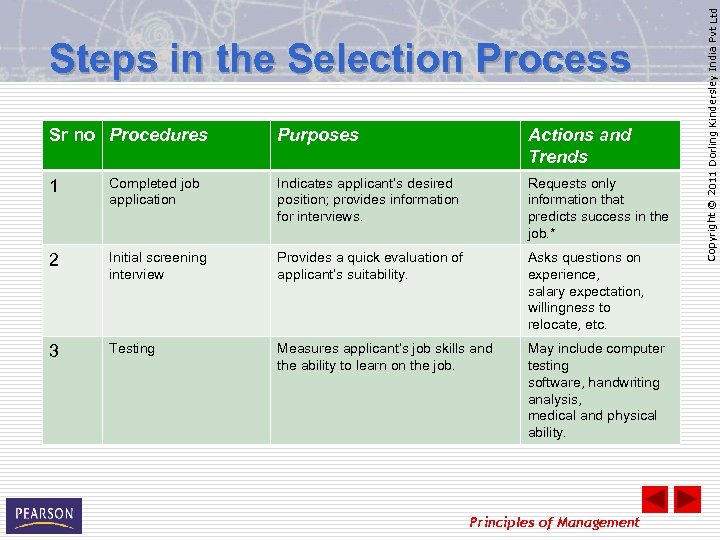 Sr no Procedures Purposes Actions and Trends 1 Completed job application Indicates applicant’s desired position; provides information for interviews. Requests only information that predicts success in the job. * 2 Initial screening interview Provides a quick evaluation of applicant’s suitability. Asks questions on experience, salary expectation, willingness to relocate, etc. 3 Testing Measures applicant’s job skills and the ability to learn on the job. May include computer testing software, handwriting analysis, medical and physical ability. Principles of Management Copyright © 2011 Dorling Kindersley India Pvt Ltd Steps in the Selection Process
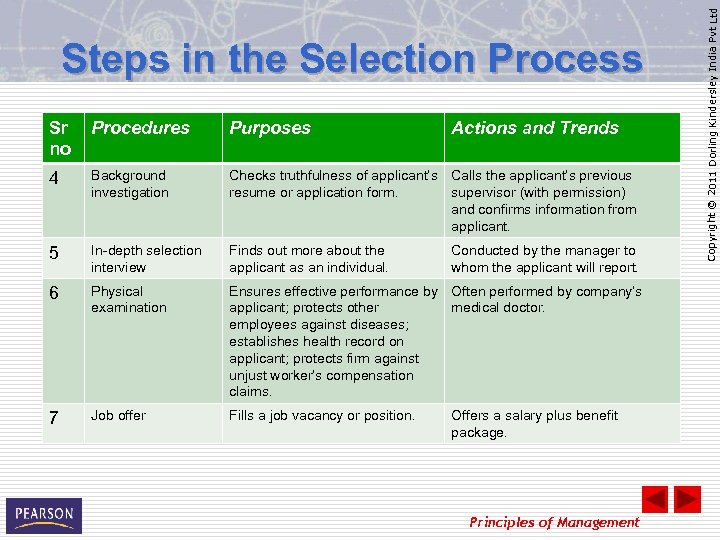 Sr no Procedures Purposes Actions and Trends 4 Background investigation Checks truthfulness of applicant’s Calls the applicant’s previous resume or application form. supervisor (with permission) and confirms information from applicant. 5 In-depth selection interview Finds out more about the applicant as an individual. 6 Physical examination Ensures effective performance by Often performed by company’s applicant; protects other medical doctor. employees against diseases; establishes health record on applicant; protects firm against unjust worker’s compensation claims. 7 Job offer Fills a job vacancy or position. Conducted by the manager to whom the applicant will report. Offers a salary plus benefit package. Principles of Management Copyright © 2011 Dorling Kindersley India Pvt Ltd Steps in the Selection Process
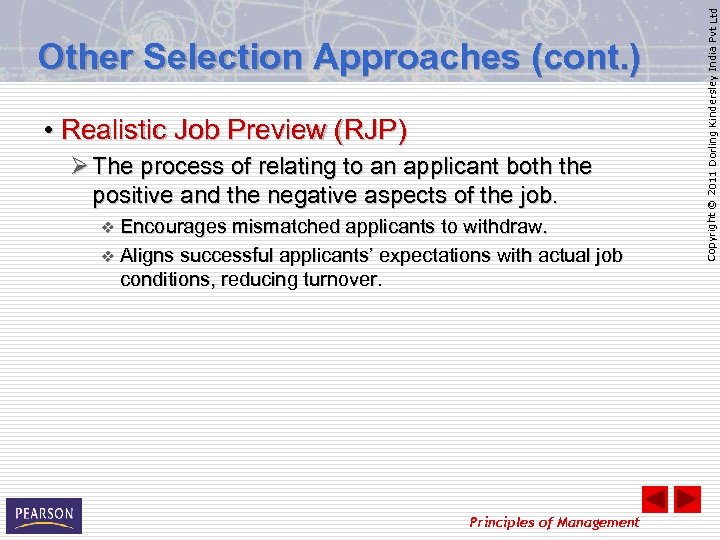 • Realistic Job Preview (RJP) Ø The process of relating to an applicant both the positive and the negative aspects of the job. v Encourages mismatched applicants to withdraw. v Aligns successful applicants’ expectations with actual job conditions, reducing turnover. Principles of Management Copyright © 2011 Dorling Kindersley India Pvt Ltd Other Selection Approaches (cont. )
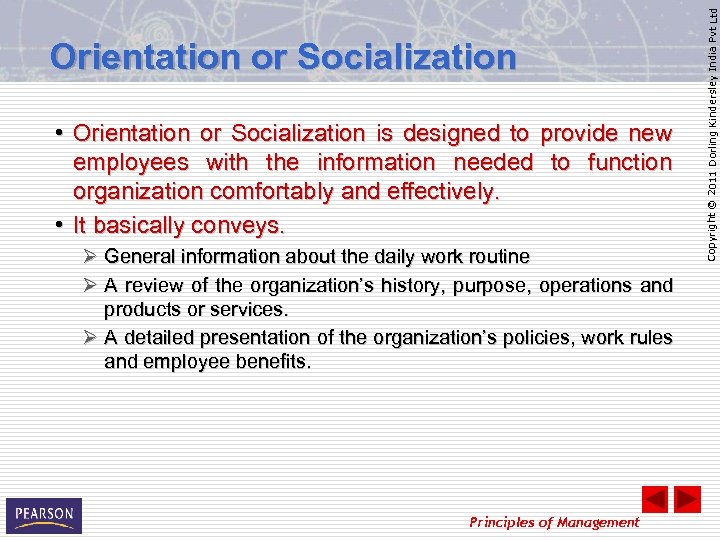 • Orientation or Socialization is designed to provide new employees with the information needed to function organization comfortably and effectively. • It basically conveys. Ø General information about the daily work routine Ø A review of the organization’s history, purpose, operations and products or services. Ø A detailed presentation of the organization’s policies, work rules and employee benefits. Principles of Management Copyright © 2011 Dorling Kindersley India Pvt Ltd Orientation or Socialization
 • Training programs are directed toward maintaining and improving current job performance while development programs seek to develop skills for future jobs. • Employee Training Ø Types of training Ø Training Method Principles of Management Copyright © 2011 Dorling Kindersley India Pvt Ltd Training and Development
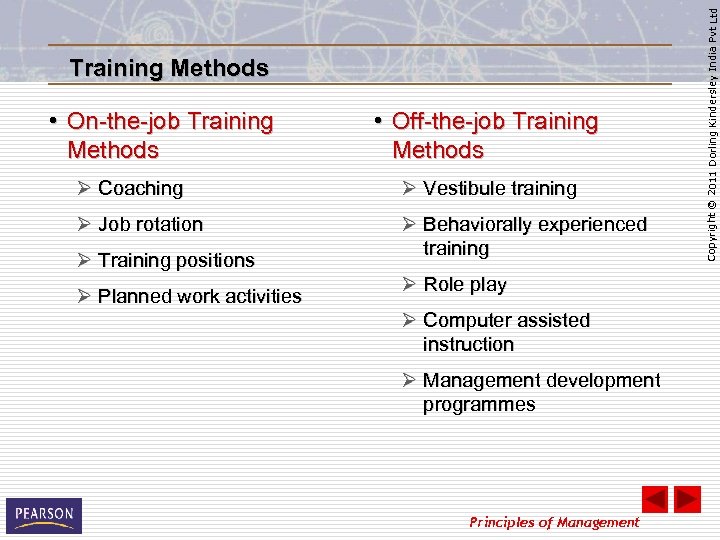 • On-the-job Training Methods • Off-the-job Training Methods Ø Coaching Ø Vestibule training Ø Job rotation Ø Behaviorally experienced training Ø Training positions Ø Planned work activities Ø Role play Ø Computer assisted instruction Ø Management development programmes Principles of Management Copyright © 2011 Dorling Kindersley India Pvt Ltd Training Methods
 • Performance Management System Ø A process of establishing performance standards and appraising employee performance. Principles of Management Copyright © 2011 Dorling Kindersley India Pvt Ltd Employee Performance Management
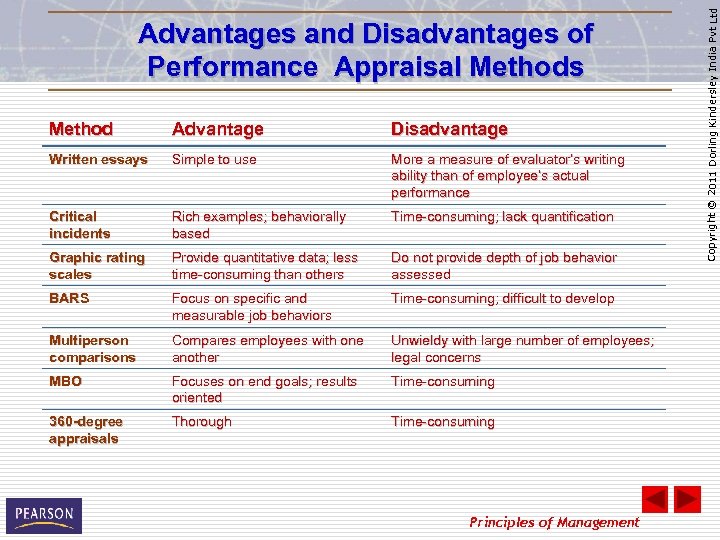 Method Advantage Disadvantage Written essays Simple to use More a measure of evaluator’s writing ability than of employee’s actual performance Critical incidents Rich examples; behaviorally based Time-consuming; lack quantification Graphic rating scales Provide quantitative data; less time-consuming than others Do not provide depth of job behavior assessed BARS Focus on specific and measurable job behaviors Time-consuming; difficult to develop Multiperson comparisons Compares employees with one another Unwieldy with large number of employees; legal concerns MBO Focuses on end goals; results oriented Time-consuming 360 -degree appraisals Thorough Time-consuming Principles of Management Copyright © 2011 Dorling Kindersley India Pvt Ltd Advantages and Disadvantages of Performance Appraisal Methods
 • Benefits of a Fair, Effective and Appropriate Compensation System Ø Helps attract and retain high-performance employees. Ø Impacts the strategic performance of the firm. • Types of Compensation Ø Base wage or salary Ø Wage and salary add-ons Ø Incentive payments Ø Skill-based pay Ø Variable pay Principles of Management Copyright © 2011 Dorling Kindersley India Pvt Ltd Compensation and Benefits
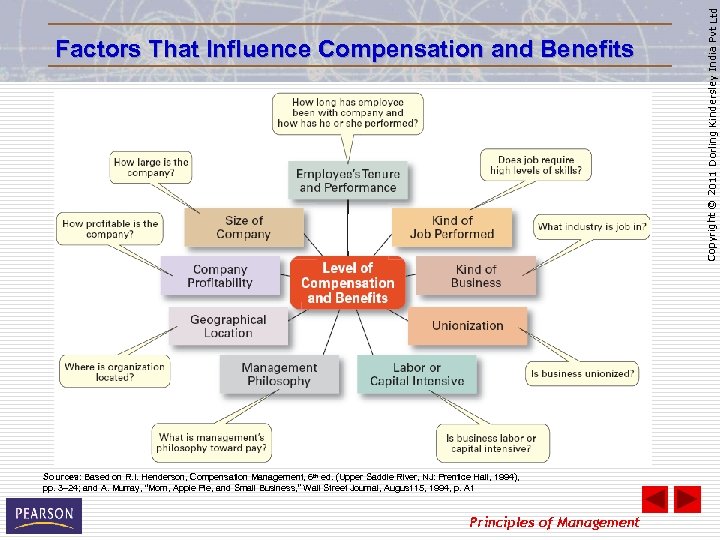 Sources: Based on R. I. Henderson, Compensation Management, 6 th ed. (Upper Saddle River, NJ: Prentice Hall, 1994), pp. 3– 24; and A. Murray, “Mom, Apple Pie, and Small Business, ” Wall Street Journal, August 15, 1994, p. A 1 Principles of Management Copyright © 2011 Dorling Kindersley India Pvt Ltd Factors That Influence Compensation and Benefits
 • Managing Downsizing Ø The planned elimination of jobs in an organization v Provide open and honest communication. v Provide assistance to employees being downsized. v Reassure and counseling to surviving employees. • Managing Workforce Diversity Ø Widen the recruitment net for diversity. Ø Ensure selection without discrimination. Ø Provide orientation and training that is effective. Principles of Management Copyright © 2011 Dorling Kindersley India Pvt Ltd Contemporary Issues in Managing Human Resources
 Tips for Managing Downsizing • Communicate openly and honestly: v Inform those being let go as soon as possible. v Tell surviving employees the new goals and expectations. v Explain impact of layoffs. • Follow any laws regulating severance pay or benefits. • Provide support/counseling for surviving employees. • Reassign roles according to individuals’ talents and backgrounds. • Focus on boosting morale: Ø Offer individualized reassurance. Ø Continue to communicate, especially one-on-one. Ø Remain involved and available. Principles of Management Copyright © 2011 Dorling Kindersley India Pvt Ltd Exhibit 10– 12
 • Sexual Harassment Ø An unwanted activity of a sexual nature that affects an individual’s employment. v Unwanted sexual advances, requests for sexual favors and other verbal or physical conduct of a sexual nature when submission or rejection of this conduct explicitly or implicitly affects an individual’s employment. Ø An offensive or hostile environment v An environment in which a person is affected by elements of a sexual nature. • Workplace Romances Ø Potential liability for harassment Principles of Management Copyright © 2011 Dorling Kindersley India Pvt Ltd Current Issues in HRM (cont. )
 • Work-Life Balance Ø Employees have personal lives that they don’t leave behind when they come to work. Ø Organizations have become more attuned to their employees by offering family-friendly benefits: v v v On-site child care Summer day camps Flextime Job sharing Leave for personal matters Flexible job hours Principles of Management Copyright © 2011 Dorling Kindersley India Pvt Ltd Current Issues in HRM (cont. )
 • Controlling HR Costs Ø Employee health care v Encouraging healthy lifestyles – Financial incentives – Wellness programs – Charging employees with poor health habits more for benefits Ø Employee pension plans v Reducing pension benefits v No longer providing pension plans Principles of Management Copyright © 2011 Dorling Kindersley India Pvt Ltd Current Issues in HRM (cont. )
 • high-performance work practices • human resource management process • labor union • affirmative action • human resource planning • job analysis • job description • job specification • recruitment • decruitment • • selection validity reliability work sampling assessment centers realistic job preview (RJP) orientation performance management system • written essay • critical incidents • graphic rating scales Principles of Management Copyright © 2011 Dorling Kindersley India Pvt Ltd Terms to Know
 • behaviorally anchored rating scales (BARS) • multiperson comparisons • 360 degree feedback • skill-based pay • variable pay • career • downsizing • sexual harassment • family-friendly benefits Principles of Management Copyright © 2011 Dorling Kindersley India Pvt Ltd Terms to Know (cont. )