


 Скачать презентацию Copyright 2011 Dorling Kindersley India Pvt Ltd
03b46294cf313858e4e67ca1ecc5ca58.ppt
- Количество слайдов: 51
 Copyright © 2011 Dorling Kindersley India Pvt Ltd 10 LEADERSHIP Principles of Management
 Follow this Learning Outline as you read and study this chapter. • Manager v/s Leaders Ø Clarifying the distinction between managers and leaders. Ø Should all managers be leaders? • Who Are Leaders and What Is Leadership Ø Define leaders and leadership. • There are four important implications of definition. Other people Influence Power Values Principles of Management Copyright © 2011 Dorling Kindersley India Pvt Ltd Learning Outcomes
 • The Trait Approach to Leadership Ø Comparing the traits of those who have emerged as leaders with the traits of those who have not. Ø Comparing the traits of effective leaders with those of ineffective leaders. • The behavioral approach to leadership • Leadership functions • Leadership styles Principles of Management Copyright © 2011 Dorling Kindersley India Pvt Ltd Learning Outcomes
 • • • The Ohio state and university of Michigan studies Employee-centered leadership and TQM The Managerial Grid Contingency approaches to leadership Hersey and Blanchard’s situational leadership model • Leadership style and the work situation: The Fiedler model Ø Least preferred co-worker (LPC) Principles of Management Copyright © 2011 Dorling Kindersley India Pvt Ltd Learning Outcomes
 • Three leadership situations Ø Leader-member relations Ø Task structure Ø Position power • A path-goal approach to leadership • Pesonal characteristics of employees leadership style • Environmental pressures and workplace demands Ø employees’ tasks Ø organization’s formal authority system Ø employees’ work group Principles of Management Copyright © 2011 Dorling Kindersley India Pvt Ltd Learning Outcomes
 • Deciding when to involve subordinates Ø The Vroom -Yetton and Vroom-Jago models • The kouzes-posner behavioral approach: dynamic engagement again Ø Ø Ø Challenging the process Inspiring a shared vision Enabling others to act Modeling the way Encourage the heart • The future of leadership theory Ø Ø Transactional leaders A charismatic leader House’s theory of charismatic leadership Principles of Management Copyright © 2011 Dorling Kindersley India Pvt Ltd Learning Outcomes
 • Challenges to leadership theory Ø A psychoanalytic approach to leadership Ø The romance of leadership • Leadership issues in 21 st century Ø Managing Power Ø Developing trust • Empowering Employees • Leading Across Culture Ø Cross-Cultural Leadership • Becoming an Effective Leader Ø Leader training Ø Substitutes for leadership Principles of Management Copyright © 2011 Dorling Kindersley India Pvt Ltd Learning Outcomes
 • Managers Ø People who are appointed and have legitimate power that allows them to reward and punish. • Leaders Ø People who are able to influence others and who possess managerial authority. Principles of Management Copyright © 2011 Dorling Kindersley India Pvt Ltd Manager v/s Leaders
 Definition • The process of directing and influencing the task-related activities of group members. • There are four important implications of definition. Ø Leadership involves other people—employees or followers. Ø Leadership involves an unequal distribution of power between leaders and group members. Ø A third aspect of leadership is the ability to use the different forms of power to influence followers’ behaviors in a number of ways. Ø The fourth aspect combines the first three and acknowledges that leadership is about values. Principles of Management Copyright © 2011 Dorling Kindersley India Pvt Ltd Leadership
 Ø The ability to exert influence—that is, to change the attitudes or behavior of individuals or groups. • Influence: Ø Any actions or examples of behavior that cause a change in attitude or behavior of another person or group. Principles of Management Copyright © 2011 Dorling Kindersley India Pvt Ltd • Power:
 • The first systematic effort by psychologists and other researchers to understand leadership was the attempt to identify the personal characteristics of leaders. • This approach assumed that leaders share certain inborn personality traits. Principles of Management Copyright © 2011 Dorling Kindersley India Pvt Ltd The Trait Approach to Leadership
 Ø Most studies on leadership traits have fallen into the first category. Ø However, they have largely failed to uncover any traits that clearly and consistently distinguish leaders from followers. Ø Leaders as a group have been found to be brighter, more extroverted, and more self-confident than nonleaders. Ø Many millions of people have these traits, most of them will never attain leadership positions. Principles of Management Copyright © 2011 Dorling Kindersley India Pvt Ltd In Searching for Measurable Leadership Traits, Researchers Have Taken Two Approaches: • Leaders and Nonleaders
 Ø The second category of leadership trait studies—are more recent and fewer in number. Ø One study did find that intelligence, initiative and selfassurance were associated with high managerial levels and performance. • • • However, this study also found that the single most important factor related to managerial level and performance was the manager’s supervisory ability—that is, his or her skill in using supervisory methods appropriate to the particular situation. Most other studies in this area also have found that effective leadership does not depend on a particular set of traits Some researchers have also found that although women are still less likely than men to emerge as leaders, they are just as effective when they do. Principles of Management Copyright © 2011 Dorling Kindersley India Pvt Ltd • Effective and Ineffective leaders
 Ø Racial stereotyping is another problem when attempting to identify the connections between traits and leadership qualities, because leadership qualities may go unrecognized and untapped. Ø Many minority group members are finding a degree of success in small businesses endeavors, although they remain particularly vulnerable to economic conditions. Principles of Management Copyright © 2011 Dorling Kindersley India Pvt Ltd Effective and Ineffective leaders (cont. )
 • When it became evident that effective leaders did not seem to have a particular set of distinguishing traits, researchers tried to isolate the behaviors characteristic of effective leaders. In other words, rather than try to figure out who effective leaders are, researchers tried to determine what effective leaders do—how they delegate tasks, how they communicate with and try to motivate their followers or employees, how they carry out their tasks, and so on. • Two aspects of leadership behavior: leadership functions and leadership styles. Principles of Management Copyright © 2011 Dorling Kindersley India Pvt Ltd The Behavioral Approach to Leadership
 • The group-maintenance and task-related activities that must be performed by the leader, or someone else, for a group to perform effectively. • An individual who is able to perform both roles successfully would be an especially effective leader. Principles of Management Copyright © 2011 Dorling Kindersley India Pvt Ltd Leadership Functions
 • The various patterns of behavior favored by leaders during the process of directing and influencing workers. • Managers who have a task-oriented style closely supervise employees to be sure the task is performed satisfactorily. • Managers with an employee-oriented style put more emphasis on motivating rather than controlling subordinates. • How a manager leads will undoubtedly be primarily influenced by his or her background, knowledge, values, and experience Principles of Management Copyright © 2011 Dorling Kindersley India Pvt Ltd Leadership Styles
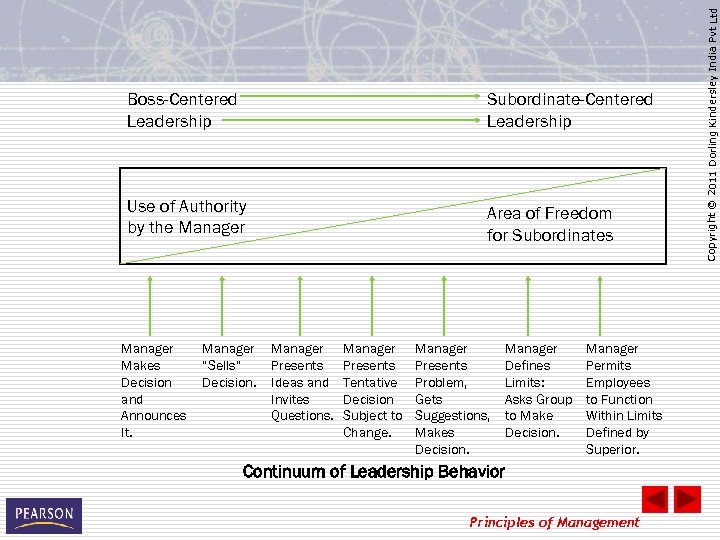 Subordinate-Centered Leadership Use of Authority by the Manager Area of Freedom for Subordinates Manager Makes Decision and Announces It. Manager “Sells” Decision. Manager Presents Ideas and Invites Questions. Manager Presents Tentative Decision Subject to Change. Manager Presents Problem, Gets Suggestions, Makes Decision. Manager Defines Limits: Asks Group to Make Decision. Manager Permits Employees to Function Within Limits Defined by Superior. Continuum of Leadership Behavior Principles of Management Copyright © 2011 Dorling Kindersley India Pvt Ltd Boss-Centered Leadership
 Principles of Management Copyright © 2011 Dorling Kindersley India Pvt Ltd • Characteristics of subordinates must also be considered before managers can choose an appropriate leadership style. • a manager’s choice of leadership style must address such situational forces as the organization’s preferred style, the size and cohesiveness of a specific work group, the nature of the group’s tasks, the pressures of time, and even environmental factors
 • Tannenbaum and Schmidt, along with other early researchers, thought leadership style was a “zero-sum” game: The more task-oriented a manager, the less relationship-oriented he or she could be. • At Ohio State University, researchers studied the effectiveness of what they called “initiating structure” (task-oriented) and “consideration” (employee-oriented) leadership behaviors. Principles of Management Copyright © 2011 Dorling Kindersley India Pvt Ltd The Ohio State and University of Michigan Studies
 Principles of Management Copyright © 2011 Dorling Kindersley India Pvt Ltd • Task-oriented : High grievance and turnover rates among their employees. • Employee-oriented : Employee turnover rates were lowest and employee satisfaction highest. Researchers at the University of Michigan found a different result. • The Michigan studies found that the most productive work groups tended to have leaders who were employee-centered rather than productioncentered. • Most effective leaders had supportive relationships with their employees.
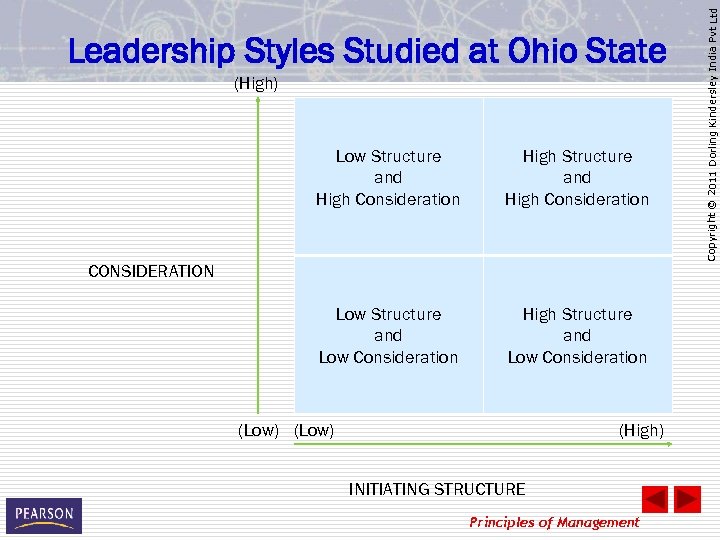 (High) Low Structure and High Consideration High Structure and High Consideration Low Structure and Low Consideration High Structure and Low Consideration CONSIDERATION (Low) (High) INITIATING STRUCTURE Principles of Management Copyright © 2011 Dorling Kindersley India Pvt Ltd Leadership Styles Studied at Ohio State
 • Some aspects of the movement toward quality are in concert with the employee-centered leadership style. Eg. , under TQM managers’ priorities are reordered: Their decision-making and control functions contract while their roles as coaches expand. As the distinction between “those who think” and “those who do” is blurred, the job itself becomes less specialized both horizontally and vertically Principles of Management Copyright © 2011 Dorling Kindersley India Pvt Ltd Employee-Centered Leadership and TQM
 • The Managerial Grid, developed by Robert Blake and Jane Mouton to help measure a manager’s relative concern for people and tasks, reflects this bidimensional nature of leadership. • the lower left-hand corner of the grid, is impoverished management—low concern for people and low concern for tasks or production. This style is sometimes called laissezfaire management because the leader does not take a leadership role. Principles of Management Copyright © 2011 Dorling Kindersley India Pvt Ltd The Managerial Grid
 • The view that the management technique that best contributes to the attainment of organizational goals might vary in different types of situations or circumstances. • These theories focus on the following factors: Ø Ø Task requirements Peers’ expectations and behavior Employees’ characteristics, expectations, and behavior Organizational culture and policies Principles of Management Copyright © 2011 Dorling Kindersley India Pvt Ltd Contingency Approaches to Leadership
 • An approach to leadership developed by Hersey and Blanchard describes how leaders should adjust their leadership style in response to their subordinates’ evolving desire for achievement, experience, ability and willingness to accept responsibility. Principles of Management Copyright © 2011 Dorling Kindersley India Pvt Ltd Hersey and Blanchard’s Situational Leadership Model
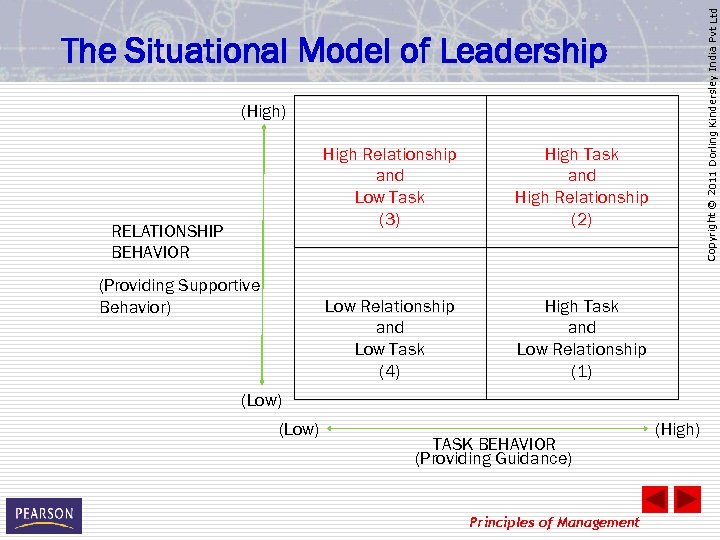 Copyright © 2011 Dorling Kindersley India Pvt Ltd The Situational Model of Leadership (High) High Relationship and Low Task (3) Low Relationship and Low Task (4) RELATIONSHIP BEHAVIOR (Providing Supportive Behavior) High Task and High Relationship (2) High Task and Low Relationship (1) (Low) TASK BEHAVIOR (Providing Guidance) Principles of Management (High)
 • Fiedler believes, most managers are not very flexible and trying to change a manager’s style to fit unpredictable or fluctuating situations is inefficient or useless. • Since styles are relatively inflexible and since no one style is appropriate for every situation, effective group performance can only be achieved by matching the manager to the situation or by changing the situation to fit the manager. Principles of Management Copyright © 2011 Dorling Kindersley India Pvt Ltd Leadership Style and the Work Situation: The Fiedler Model
 Principles of Management Copyright © 2011 Dorling Kindersley India Pvt Ltd Least Preferred Co-worker (LPC): • Fiedler’s measuring instrument for locating a manager on the leadership-style continuum. • Low LPC rating—tends to be managing, taskcontrolling and less concerned with the human relations aspects of the job. • High-LPC -managers want to have warm personal relations with their co-workers and will regard close ties with employees as important to their overall effectiveness.
 Ø Leader-member relations: The quality of the interaction between a leader and his or her employees; according to Fiedler, the most important influence on the manager’s power. Ø Task structure: A work situation variable that, according to Fiedler, helps determine a manager’s power. In structured tasks, managers automatically have high power, in unstructured tasks, their power is diminished. Ø Position power: The power, according to Fiedler, that is inherent in the formal position the leader holds. This power may be great or small, depending on the specific position. Principles of Management Copyright © 2011 Dorling Kindersley India Pvt Ltd • Fiedler has identified three “leadership situations” or variables that help determine which leadership style will be effective.
 • • A leadership theory emphasizing the leader’s role in clarifying for subordinates how they can achieve high performance and its associated rewards. Leadership style and employee skill: Employees who are skilled and capable, like these electronics workers, may prefer a low-supervisory manager who will give them the freedom to do their jobs without unnecessary supervision. Principles of Management Copyright © 2011 Dorling Kindersley India Pvt Ltd A Path-Goal Approach to Leadership
 • The leadership style employees prefer will be partially determined by their personal characteristics. • Who believe their behavior affects the environment favor a participatory leadership style, while those who believe events occur because of luck or fate tend to find an authoritarian style more congenial. Principles of Management Copyright © 2011 Dorling Kindersley India Pvt Ltd Personal Characteristics of Employees
 • Environmental factors also affect the leadership styles preferred by employees. • One such factor is the nature of the employees’ tasks. • Another factor is the organization’s formal authority system. • A third environmental factor is the employees’ work group Principles of Management Copyright © 2011 Dorling Kindersley India Pvt Ltd Environmental Pressures and Workplace Demands
 • In their 1988 book, Victor Vroom and Arthur Jago criticize the path-goal theory because it fails to take into account the situation within which managers decide to involve employees. Principles of Management Copyright © 2011 Dorling Kindersley India Pvt Ltd Deciding When to Involve Subordinates: The Vroom-Yetton and Vroom-Jago Models
 Ø Do I have enough information or skill to solve the problem on my own? Ø Do I need to make a high-quality decision that my employees are likely to disagree with? Ø Is the problem structured? Ø Is the acceptance of the group critical for the success of the decision? Ø If acceptance of the decision is important, are my employees likely to disagree among themselves about which is the best solution? Principles of Management Copyright © 2011 Dorling Kindersley India Pvt Ltd • Vroom and Yetton suggest several questions that managers can ask themselves to help determine which style to use for the particular problem they are facing.
 Principles of Management Copyright © 2011 Dorling Kindersley India Pvt Ltd • Effectiveness of a decision depends on the quality of the decision, the commitment made to the decision and the time expended to make the decision. • Overall effectiveness of leadership is a function of the effectiveness of decisions minus the cost of making the decisions plus the value realized in developing people’s abilities by means of committed decision making.
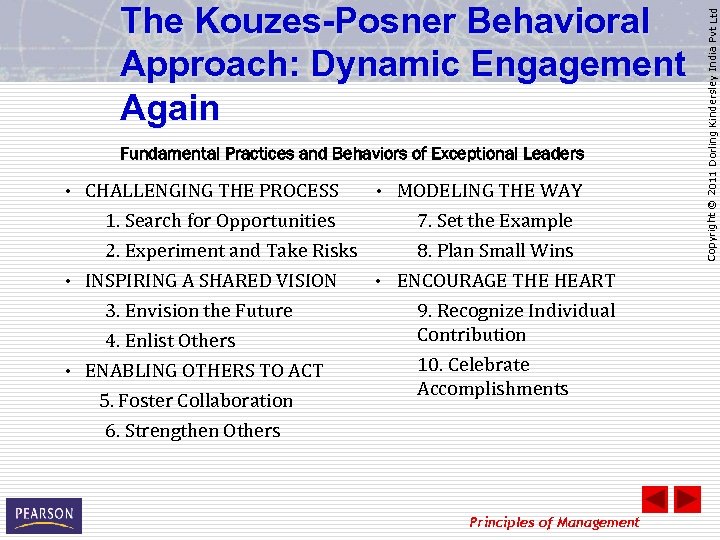 Fundamental Practices and Behaviors of Exceptional Leaders CHALLENGING THE PROCESS MODELING THE WAY 1. Search for Opportunities 7. Set the Example 2. Experiment and Take Risks 8. Plan Small Wins • INSPIRING A SHARED VISION • ENCOURAGE THE HEART 3. Envision the Future 9. Recognize Individual Contribution 4. Enlist Others 10. Celebrate • ENABLING OTHERS TO ACT Accomplishments 5. Foster Collaboration • • 6. Strengthen Others Principles of Management Copyright © 2011 Dorling Kindersley India Pvt Ltd The Kouzes-Posner Behavioral Approach: Dynamic Engagement Again
 • Transactional leaders: Leaders who determine what subordinates need to do to achieve objectives, classify those requirements, and help subordinates become confident they can reach their objectives. Principles of Management Copyright © 2011 Dorling Kindersley India Pvt Ltd The Future of Leadership Theory
 • A charismatic leader: Occasionally a leader emerges whose high visibility and personal charisma catches the public consciousness. • House’s theory of charismatic leadership: House’s theory suggests that charismatic leaders have very high levels of referent power and that some of that power comes from their need to influence others. Ø The charismatic leader has “extremely high levels of self-confidence, dominance, and a strong conviction in the moral righteousness of his/her beliefs” Principles of Management Copyright © 2011 Dorling Kindersley India Pvt Ltd The Future of Leadership Theory (cont. )
 • A psychoanalytic approach to leadership Ø This view, originated by Sigmund Freud, holds that much of human behavior is shaped by unconscious efforts to satisfy unfulfilled needs and drives. • The romance of leadership Ø A second challenge to traditional theories of leadership focuses on the followers—the people who look to leaders for guidance. In this view, followers have developed romanticized, or idealized, views of what leaders do, what they can accomplish, and how they can affect followers’ lives. Principles of Management Copyright © 2011 Dorling Kindersley India Pvt Ltd Challenges to Leadership Theory
 • Managing Power Ø Legitimate power: The power a leader has as a result of his or her position in an organization. Ø Coercive power: The power a leader has to punish or control. Ø Reward power: The power a leader has to give positive rewards. Ø Expert power: Power that’s based on expertise, special skills or knowledge. Ø Referent power: Power that arises because of a person’s desirable resources or personal traits. Principles of Management Copyright © 2011 Dorling Kindersley India Pvt Ltd Leadership Issues in 21 st Century
 • Developing trust Ø Credibility: The degree to which followers perceive someone as honest, competent, and able to inspire. Ø Trust: The belief in the integrity, character, and ability of a leader. • Research has identified five dimensions that make up the concept of trust: Integrity Competence Consistency Loyalty Openness Principles of Management Copyright © 2011 Dorling Kindersley India Pvt Ltd Leadership Issues(cont. )
 Building Trust • Practice openness. • Be fair. • Speak your feelings. • Tell the truth. • Show consistency. • Fulfill your promises. • Maintain confidences. • Demonstrate competence. Principles of Management Copyright © 2011 Dorling Kindersley India Pvt Ltd Leadership Issues(cont. )
 • Empowerment: The act of increasing the decision-making discretion of workers. • Companies are empowering employees is the need for quick decisions by the people who are most knowledgeable about the issues—often those at lower organizational levels. Principles of Management Copyright © 2011 Dorling Kindersley India Pvt Ltd Empowering Employees
 • One general conclusion that surfaces from leadership research is that effective leaders do not use a single style. They adjust their style to the situation. • Although not mentioned explicitly, national culture is certainly an important situational variable in determining which leadership style will be most effective. Principles of Management Copyright © 2011 Dorling Kindersley India Pvt Ltd Leading Across Culture
 Cross-Cultural Leadership • Korean leaders are expected to be paternalistic toward employees. • Arab leaders who show kindness or generosity without being asked to do so are seen by other Arabs as weak. • Japanese leaders are expected to be humble and speak frequently. • Scandinavian and Dutch leaders who single out individuals with public praise are likely to embarrass, not energize, those individuals. • Effective leaders in Malaysia are expected to show compassion while using more of an autocratic than a participative style. • Effective German leaders are characterized by high performance orientation, low compassion, low self-protection, low team orientation, high autonomy, and high Participation. Principles of Management Copyright © 2011 Dorling Kindersley India Pvt Ltd Leading Across Culture (cont. )
 • Misconceptions about the relationship between leadership and gender can adversely affect hiring, performance evaluation, promotion and other human resource decisions for both men and women. • Women are more likely to encourage participation, share power and information • They lead through inclusion and rely on their charisma, expertise, contacts and interpersonal skills to influence others • some researchers have shown that males and females tend to be equally effective as leaders Principles of Management Copyright © 2011 Dorling Kindersley India Pvt Ltd Understanding Gender Differences and Leadership
 • Leader training: Organizations around the globe spend billions of dollars, yen, and Euros on leadership training and development. • Although much of the money spent on leader training may provide doubtful benefits. • Organizations may find that individuals with higher levels of a trait called motivation to lead are more receptive to leadership development opportunities. Principles of Management Copyright © 2011 Dorling Kindersley India Pvt Ltd Becoming an Effective Leader
 • Substitutes for leadership: Despite the belief that some leadership style will always be effective, regardless of the situation, leadership may not always be important. Characteristics such as experience, training, professional orientation, and need for independence can neutralize the effect of leadership. • Jobs that are inherently unambiguous and routine or that are intrinsically satisfying may place fewer demands on the leadership variable. • Organizational characteristics as explicit formalized goals, rigid rules and procedures, and cohesive work groups can substitute formal leadership. Principles of Management Copyright © 2011 Dorling Kindersley India Pvt Ltd Becoming an Effective Leader(Cont. )
 • Leadership • Behavioral theories • Autocratic style • Democratic style • Laissez-faire style • Initiating structure • Consideration • High-high leader • Managerial grid • Fiedler contingency model • Least-preferred co-worker (LPC) questionnaire • Leader-member relations • Task structure • Position power • Situational leadership theory (SLT) • Readiness • Leader participation model • Path-goal theory • Transactional leaders Principles of Management Copyright © 2011 Dorling Kindersley India Pvt Ltd Terms to Know
 • Transformational leaders • Charismatic leader • Visionary leadership • Legitimate power • Coercive power • Reward power • Expert power • Referent power • Credibility • Trust • Empowerment Principles of Management Copyright © 2011 Dorling Kindersley India Pvt Ltd Terms to Know (cont. )