


 Скачать презентацию Copyright 2011 Dorling Kindersley India Pvt Ltd
4dff78bda083996881551f276e4741da.ppt
- Количество слайдов: 37
 Copyright © 2011 Dorling Kindersley India Pvt Ltd 15 Globalization and Management Principles of Management
 Follow this Learning Outline as you read and study this chapter. What’s your global perspective? • Define parochialism. • Contrast ethnocentric, polycentric, and geocentric attitudes towards global business. Understanding the global environment • Describe the current status of the EU, NAFTA, ASEAN and other Regional Trade Allowances. • Discuss the role of the WTO. Principles of Management Copyright © 2011 Dorling Kindersley India Pvt Ltd Learning Outcomes
 Doing business globally • Contrast multinational, multidomestic, global, transnational and born global organizations. • Describe the different ways organizations can go international. Managing in a global environment • Explain how the global legal-political and economic environments affect managers. • Discuss Hofstede’s five dimensions for assessing cultures. • Describe the challenges of doing business globally in today’s world. Principles of Management Copyright © 2011 Dorling Kindersley India Pvt Ltd Learning Outcomes
 The role of Multinational Enterprises • Describe the ways to own foreign assets. • Explain the impact of MNEs on host and host countries. • Explain the role of cultural intelligence in managing multinational enterprises. Principles of Management Copyright © 2011 Dorling Kindersley India Pvt Ltd Learning Outcomes
 • Opportunities and Challenges Ø Coping with the sudden appearance of new competitors Ø Acknowledging cultural, political and economic differences Ø Dealing with increased uncertainty, fear and anxiety Ø Adapting to changes in the global environment Ø Avoiding parochialism Principles of Management Copyright © 2011 Dorling Kindersley India Pvt Ltd The Global Marketplace
 • Parochialism Ø Is viewing the world solely through one’s own eyes and perspectives. Ø Is not recognizing that others have different ways of living and working. Ø Is a significant obstacle for managers working in a global business world. Ø Is falling into the trap of ignoring others’ values and customs and rigidly applying an attitude of “ours is better than theirs” to foreign cultures. Principles of Management Copyright © 2011 Dorling Kindersley India Pvt Ltd What’s Your Global Perspective?
 • Ethnocentric Attitude Ø The parochialistic belief that the best work approaches and practices are those of the home country. • Polycentric Attitude Ø The view that the managers in the host country know the best work approaches and practices for running their business. • Geocentric Attitude Ø A world-oriented view that focuses on using the best approaches and people from around the globe. Principles of Management Copyright © 2011 Dorling Kindersley India Pvt Ltd Adopting a Global Perspective
 • The European Union (EU) Ø A unified economic and trade entity v Belgium, Denmark, France, Greece, Ireland, Italy, Luxembourg, the Netherlands, Portugal, Spain, the United Kingdom, Germany, Austria, Finland Sweden • North American Free Trade Agreement (NAFTA) Ø Eliminated barriers to free trade (tariffs, import licensing requirements and customs user fees) v United States, Canada and Mexico Principles of Management Copyright © 2011 Dorling Kindersley India Pvt Ltd Regional Trading Agreements
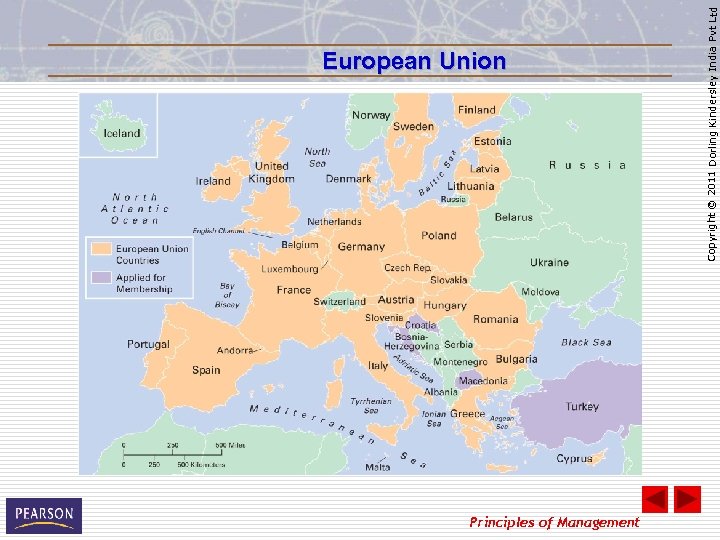 Principles of Management Copyright © 2011 Dorling Kindersley India Pvt Ltd European Union
 • • U. S. -Central America Free Trade Agreement (CAFTA) Free Trade Area of the Americas Southern Cone Common Market (Mercosur) Association of Southeast Asian Nations (ASEAN) Ø Trading alliance of 10 Southeast Asian nations • African Union • South Asian Association for Regional Cooperation (SARRC) Principles of Management Copyright © 2011 Dorling Kindersley India Pvt Ltd Regional Trading Agreements
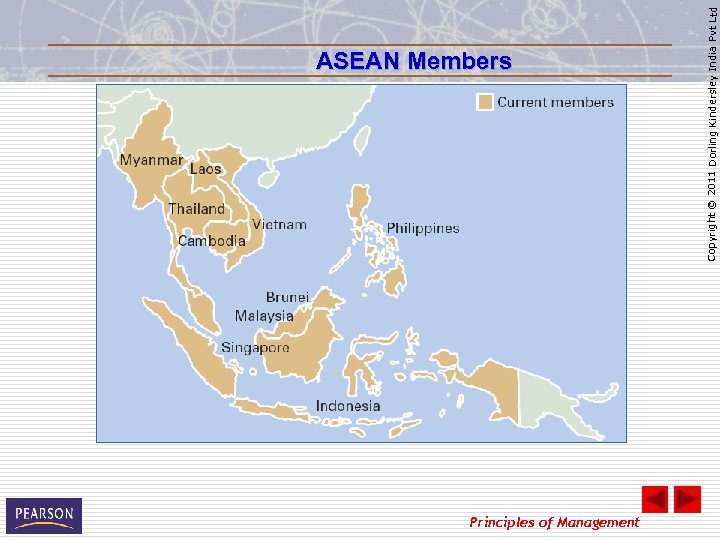 Principles of Management Copyright © 2011 Dorling Kindersley India Pvt Ltd ASEAN Members
 • Evolved from the General Agreement on Tariffs and Trade (GATT) in 1995. • Functions as the only global organization dealing with the rules of trade among nations. • Has 149 member nations and 32 observer governments. • Monitors and promotes world trade. Principles of Management Copyright © 2011 Dorling Kindersley India Pvt Ltd The World Trade Organization (WTO)
 • Multinational Corporation (MNC) Ø Maintains operations in multiple countries. • Multidomestic Corporation Ø Is an MNC that decentralizes management and other decisions to the local country. • Global Company Ø Is an MNC that centralizes its management and other decisions in the home country. Principles of Management Copyright © 2011 Dorling Kindersley India Pvt Ltd Different Types of International Organizations
 • Transnational Corporation (Borderless Organization) Ø Is an MNC that has eliminated structural divisions that impose artificial geographic barriers and is organized along business lines that reflect a geocentric attitude. Principles of Management Copyright © 2011 Dorling Kindersley India Pvt Ltd Different Types of International Organizations (cont. )
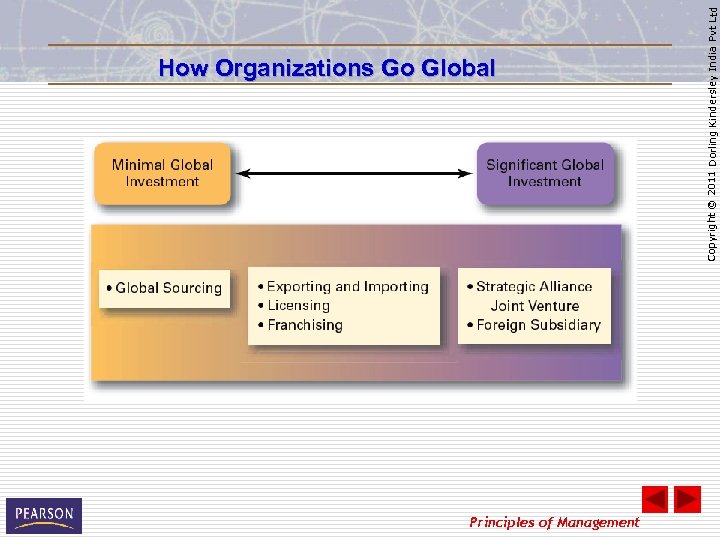 Principles of Management Copyright © 2011 Dorling Kindersley India Pvt Ltd How Organizations Go Global
 • Strategic Alliances Ø Partnerships between organization and a foreign company in which both share resources and knowledge in developing new products or building new production facilities. • Joint Venture Ø A specific type of strategic alliance in which the partners agree to form a separate, independent organization for some business purpose. • Foreign Subsidiary Ø Directly investing in a foreign country by setting up a separate and independent production facility or office. Principles of Management Copyright © 2011 Dorling Kindersley India Pvt Ltd Other Forms of Globalization
 • The Legal Environment Ø Stability or instability of legal and political systems v Legal v Fair procedures are established and followed and honest elections held on a regular basis Ø Differences in the laws of various nations v Effects on business activities v Effects on delivery of products and services Principles of Management Copyright © 2011 Dorling Kindersley India Pvt Ltd Managing in A Global Environment
 • Economic Systems Ø Free market economy v An economy in which resources are primarily owned and controlled by the private sector. Ø Planned economy v An economy in which all economic decisions are planned by a central government. • Monetary and Financial Factors Ø Currency exchange rates Ø Inflation rates Ø Diverse tax policies Principles of Management Copyright © 2011 Dorling Kindersley India Pvt Ltd The Economic Environment
 • National Culture Ø Is the values and attitudes shared by individuals from a specific country that shape their behavior and their beliefs about what is important. Ø May have more influence on an organization than the organization culture. Principles of Management Copyright © 2011 Dorling Kindersley India Pvt Ltd The Cultural Environment
 • Indians are informal. They do not say thank you, please, etc. as much as people say from other countries. They do not think that it is important to make an appointment before going to a friends place. If two people are talking to each other, a third will not think twice before joining the conversation. They will not be shy of asking a stranger about his or her personal information. • Indians are indirect. Indians will find ways of saying unpleasant things so that they do not sound rude. • Indians are both collectivistic and individualistic. Indians will depend on others to get their work done and will also help others in their needs. They do not believe that people control their own destiny and at the same time would not mind to be on their own to achieve their goals. • . Principles of Management Copyright © 2011 Dorling Kindersley India Pvt Ltd What Are Indians Like?
 • Indians view time as stretchable. Indians are not very upset if a meeting does not start on time. Time is defined by how long it takes to get something done • Indians have mostly external locus of control. A typical Indian will not blame oneself for all their failures. It is very common for them to say that this was because of their destiny. • Indians value relationships. Indians will go to great extent to build relationships and their view for relationships is long term. Family is a very important source of relationships for the Indians. Principles of Management Copyright © 2011 Dorling Kindersley India Pvt Ltd What Are Indians Like?
 • Indians are paternalistic. The head of the family is revered and respected. A leader or a boss is looked upon as the caretaker and father figure. A caring boss can get a lot of work done from the Indian subordinates. Whenever you go out to meet a family or for a formal business meeting, it is common to first greet the eldest or the senior-most person in the setting. • Indians value “keeping of word. ” Once trust is established and a word is given, Indians will try hard to honor it. They might be late or a little slow to honor their word but will eventually come back to you and will keep their promise. Principles of Management Copyright © 2011 Dorling Kindersley India Pvt Ltd What Are Indians Like?
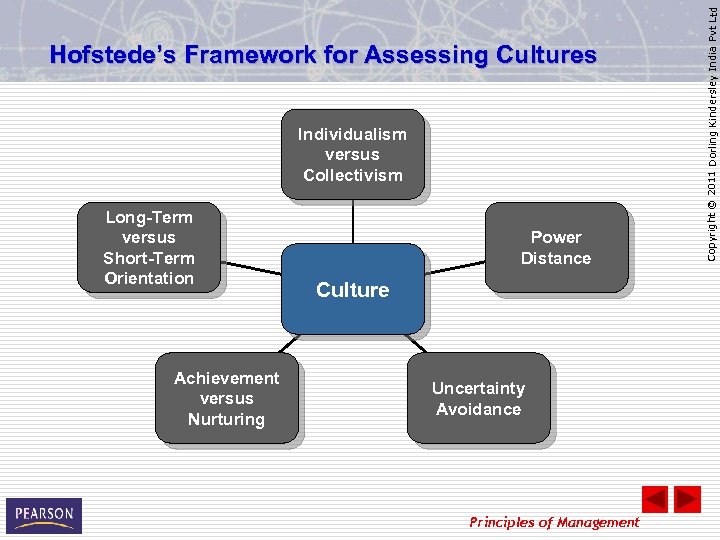 Individualism versus Collectivism Long-Term versus Short-Term Orientation Achievement versus Nurturing Power Distance Culture Uncertainty Avoidance Principles of Management Copyright © 2011 Dorling Kindersley India Pvt Ltd Hofstede’s Framework for Assessing Cultures
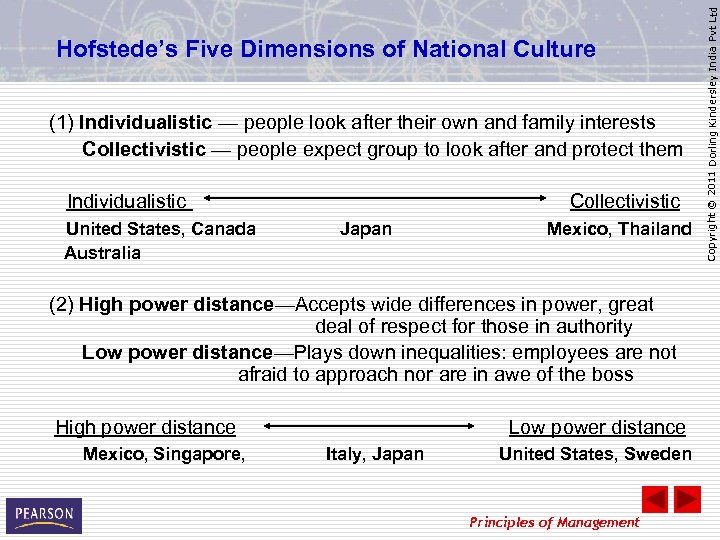 (1) Individualistic — people look after their own and family interests Collectivistic — people expect group to look after and protect them Individualistic United States, Canada Australia Collectivistic Japan Mexico, Thailand (2) High power distance—Accepts wide differences in power, great deal of respect for those in authority Low power distance—Plays down inequalities: employees are not afraid to approach nor are in awe of the boss High power distance Mexico, Singapore, Low power distance Italy, Japan United States, Sweden Principles of Management Copyright © 2011 Dorling Kindersley India Pvt Ltd Hofstede’s Five Dimensions of National Culture
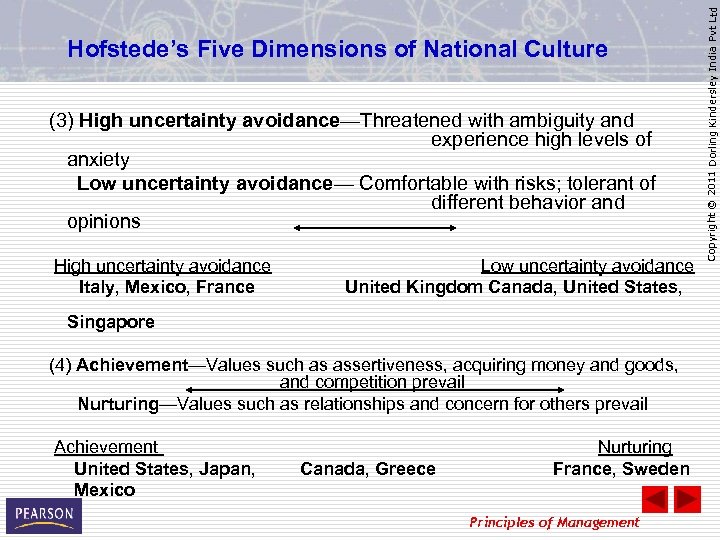 (3) High uncertainty avoidance—Threatened with ambiguity and experience high levels of anxiety Low uncertainty avoidance— Comfortable with risks; tolerant of different behavior and opinions High uncertainty avoidance Italy, Mexico, France Low uncertainty avoidance United Kingdom Canada, United States, Singapore (4) Achievement—Values such as assertiveness, acquiring money and goods, and competition prevail Nurturing—Values such as relationships and concern for others prevail Achievement United States, Japan, Mexico Canada, Greece Nurturing France, Sweden Principles of Management Copyright © 2011 Dorling Kindersley India Pvt Ltd Hofstede’s Five Dimensions of National Culture
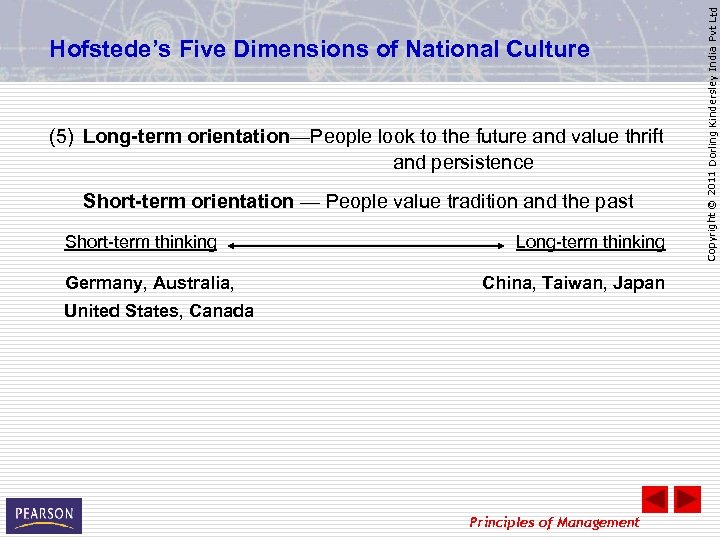 (5) Long-term orientation—People look to the future and value thrift and persistence Short-term orientation — People value tradition and the past Short-term thinking Germany, Australia, Long-term thinking China, Taiwan, Japan United States, Canada Principles of Management Copyright © 2011 Dorling Kindersley India Pvt Ltd Hofstede’s Five Dimensions of National Culture
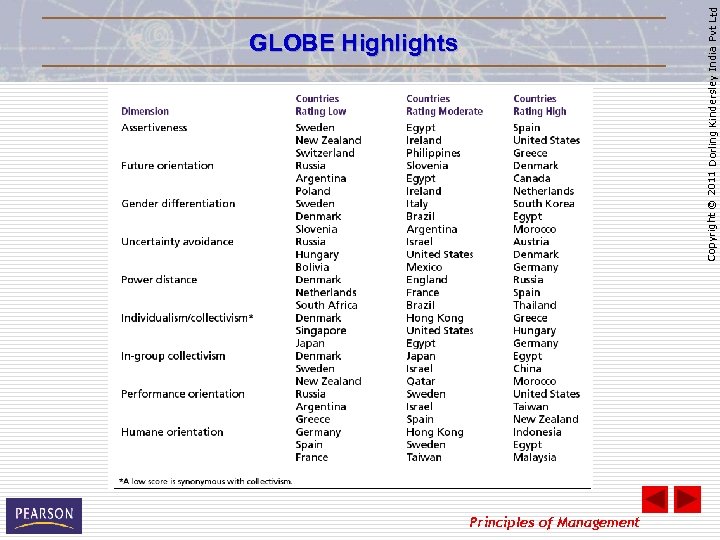 Copyright © 2011 Dorling Kindersley India Pvt Ltd GLOBE Highlights Principles of Management
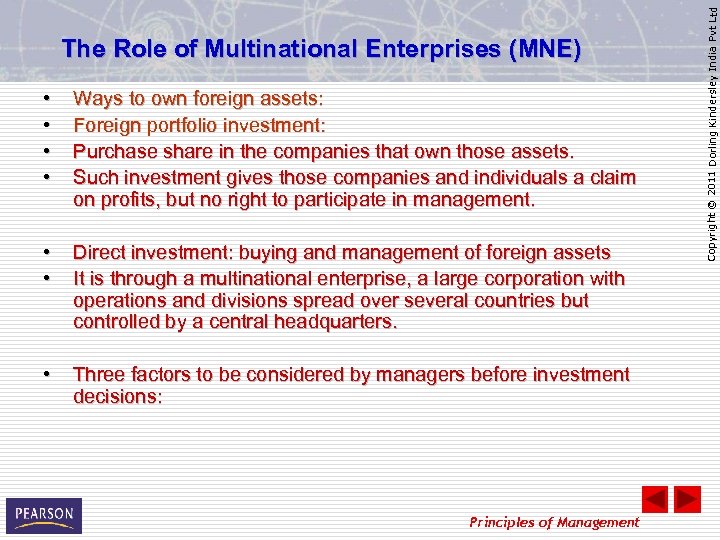 • • Ways to own foreign assets: Foreign portfolio investment: Purchase share in the companies that own those assets. Such investment gives those companies and individuals a claim on profits, but no right to participate in management. • • Direct investment: buying and management of foreign assets It is through a multinational enterprise, a large corporation with operations and divisions spread over several countries but controlled by a central headquarters. • Three factors to be considered by managers before investment decisions: Principles of Management Copyright © 2011 Dorling Kindersley India Pvt Ltd The Role of Multinational Enterprises (MNE)
 • Economies of different nations Infrastructure: Transportation systems, schools, communication systems, hospitals, power plants and sanitary facilities • Political risk: Possibility of political changes • Appropriateness of technology to different cultures Production technology in one country may not work in another Some governments may not encourage the technological changes. Principles of Management Copyright © 2011 Dorling Kindersley India Pvt Ltd The role of Multinational Enterprises (MNE)
 • Not necessarily welcome participants in national economies around the world • Viewed with suspicion Some potential benefits: • Transfer of capital, technology and entrepreneurship to the host country • Improved host country’s balance of payments Principles of Management Copyright © 2011 Dorling Kindersley India Pvt Ltd Impact of MNEs on Host Countries
 • Creation of local job and career opportunities • Improved competition in the local economy • Greater availability of products for local consumers Some potential costs: • MNE may use local financing , thereby absorbing capital which may have financed indigenous companies. • Few well-advertised, standardized consumer products may drive many local produced products from the market, thereby reducing consumer choice. Principles of Management Copyright © 2011 Dorling Kindersley India Pvt Ltd Impact of MNEs on Host Countries
 • Less debatable due to absence of highly charged emotional issues as political interference, cultural disruption and economic dependence. Drawbacks: • Outflow of foreign investments with reduced income from exports may weaken the national balance of payments. • Loss of technological advantage especially with joint ventures. • Loss of domestic jobs. Principles of Management Copyright © 2011 Dorling Kindersley India Pvt Ltd Impact of MNEs on Home Countries
 The Role of Cultural Intelligence • It is often seen that most of the expatriates fail or are not able to perform upto the mark. • One of the reasons given for the failure is lack of cultural intelligence. • Cultural intelligence refers to an individual’s capability to function effectively across cultures— this can include national, ethnic, organizational as well as other types of culture. Principles of Management Copyright © 2011 Dorling Kindersley India Pvt Ltd Managing in Global Environment
 The role of cultural intelligence • It is often seen that most of the expatriates fail or are not able to perform upto the mark. • One of the reasons given for the failure is lack of cultural intelligence. Principles of Management Copyright © 2011 Dorling Kindersley India Pvt Ltd Managing in Global Environment
 • Cultural intelligence refers to an individual’s capability to function effectively across cultures—this can include national, ethnic, organizational as well as other types of culture. • It consists of metacognition and cognition (thinking, learning, and strategizing); motivation (efficacy and confidence, persistence, value congruence and affect for the new culture); and behavior (social mimicry and behavioral repertoire). • Cultural shock refers to frustration and anxiety that results from being constantly being subjected to strange and unfamiliar cues about what to do and how to do it. Principles of Management Copyright © 2011 Dorling Kindersley India Pvt Ltd Managing in Global Environment
 Adaptation of Other Management Activities • Managers will have to be ‘customized’ as per the host country environment. • Expatriates or international managers will have to be extra sensitive or trained to ‘fit’ their style to the host country styles for effective management. Principles of Management Copyright © 2011 Dorling Kindersley India Pvt Ltd Managing in Global Environment
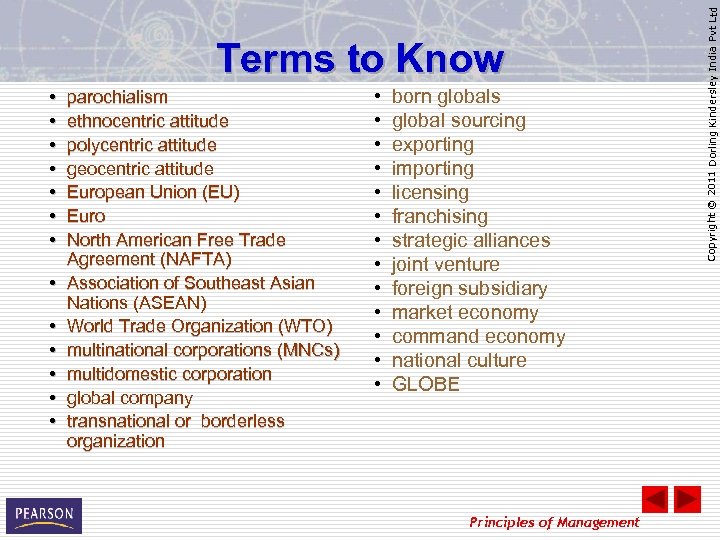 • • • • parochialism ethnocentric attitude polycentric attitude geocentric attitude European Union (EU) Euro North American Free Trade Agreement (NAFTA) Association of Southeast Asian Nations (ASEAN) World Trade Organization (WTO) multinational corporations (MNCs) multidomestic corporation global company transnational or borderless organization • • • • born globals global sourcing exporting importing licensing franchising strategic alliances joint venture foreign subsidiary market economy command economy national culture GLOBE Principles of Management Copyright © 2011 Dorling Kindersley India Pvt Ltd Terms to Know