 Скачать презентацию Copyright 2010 Worth Publishers Public Finance and
306fd45068ea754f96b1ed04c10ec6bf.ppt
- Количество слайдов: 29




Copyright © 2010 Worth Publishers Public Finance and Public Policy Jonathan Gruber Third Edition Copyright © 2010 Worth Publishers 1 of 29
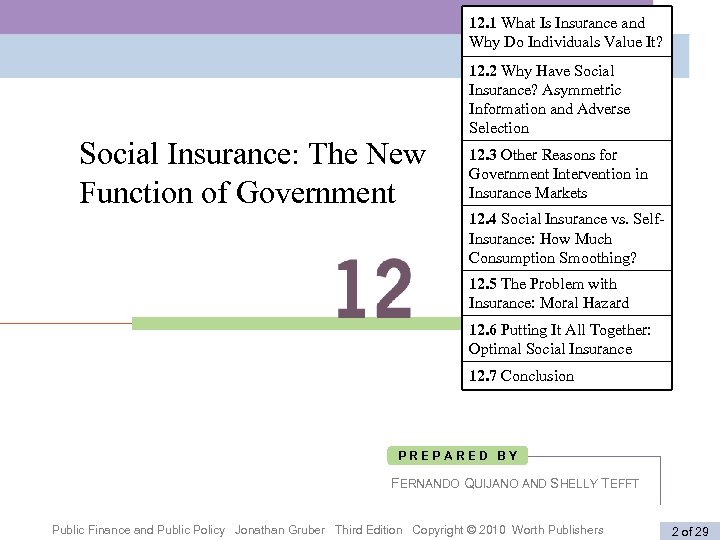
12. 1 What Is Insurance and Why Do Individuals Value It? Social Insurance: The New Function of Government 12. 2 Why Have Social Insurance? Asymmetric Information and Adverse Selection 12. 3 Other Reasons for Government Intervention in Insurance Markets 12. 4 Social Insurance vs. Self. Insurance: How Much Consumption Smoothing? 12. 5 The Problem with Insurance: Moral Hazard 12. 6 Putting It All Together: Optimal Social Insurance 12. 7 Conclusion PREPARED BY FERNANDO QUIJANO AND SHELLY TEFFT Public Finance and Public Policy Jonathan Gruber Third Edition Copyright © 2010 Worth Publishers 2 of 29
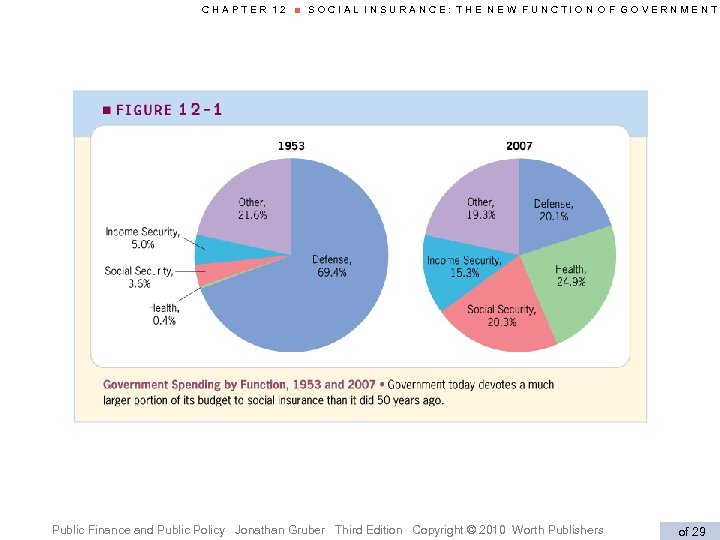
CHAPTER 12 ■ SOCIAL INSURANCE: THE NEW FUNCTION OF GOVERNMENT In the preamble to the United States Constitution, the framers wrote that they were uniting the states in order to “establish justice, insure domestic tranquility, provide for the common defense, promote the general welfare, and secure the blessings of liberty to ourselves and our posterity. ” For most of the country’s history, “common defense” was the federal government’s clear spending priority. Since then, the government’s spending priorities shifted dramatically, away from “common defense” and toward promoting “the general welfare. ” Public Finance and Public Policy Jonathan Gruber Third Edition Copyright © 2010 Worth Publishers of 29
CHAPTER 12 ■ SOCIAL INSURANCE: THE NEW FUNCTION OF GOVERNMENT Public Finance and Public Policy Jonathan Gruber Third Edition Copyright © 2010 Worth Publishers of 29

CHAPTER 12 ■ SOCIAL INSURANCE: THE NEW FUNCTION OF GOVERNMENT social insurance programs Government interventions in the provision of insurance against adverse events. means-tested Programs in which eligibility depends on the level of one’s current income or assets. Public Finance and Public Policy Jonathan Gruber Third Edition Copyright © 2010 Worth Publishers of 29
12. 1 CHAPTER 12 ■ SOCIAL INSURANCE: THE NEW FUNCTION OF GOVERNMENT What Is Insurance and Why Do Individuals Value It? What Is Insurance? insurance premiums Money that is paid to an insurer so that an individual will be insured against adverse events. A sampling of private insurance products that exist in the United States includes: Health insurance. Auto insurance. Life insurance. Casualty and property insurance. Public Finance and Public Policy Jonathan Gruber Third Edition Copyright © 2010 Worth Publishers 6 of 29
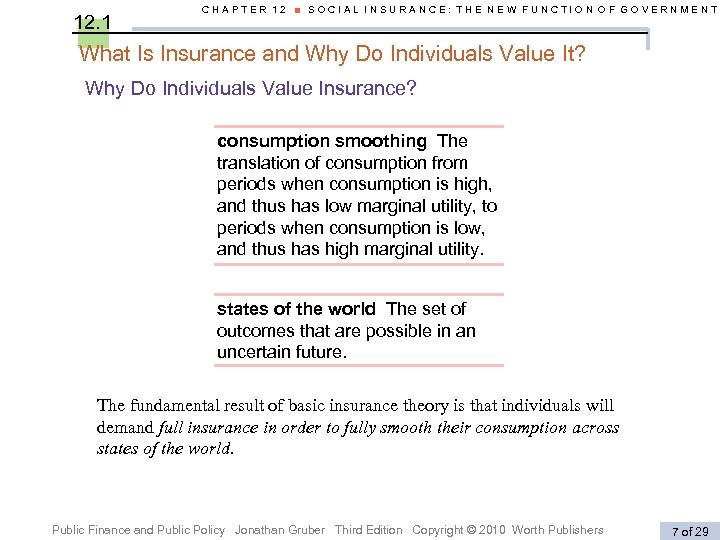
12. 1 CHAPTER 12 ■ SOCIAL INSURANCE: THE NEW FUNCTION OF GOVERNMENT What Is Insurance and Why Do Individuals Value It? Why Do Individuals Value Insurance? consumption smoothing The translation of consumption from periods when consumption is high, and thus has low marginal utility, to periods when consumption is low, and thus has high marginal utility. states of the world The set of outcomes that are possible in an uncertain future. The fundamental result of basic insurance theory is that individuals will demand full insurance in order to fully smooth their consumption across states of the world. Public Finance and Public Policy Jonathan Gruber Third Edition Copyright © 2010 Worth Publishers 7 of 29
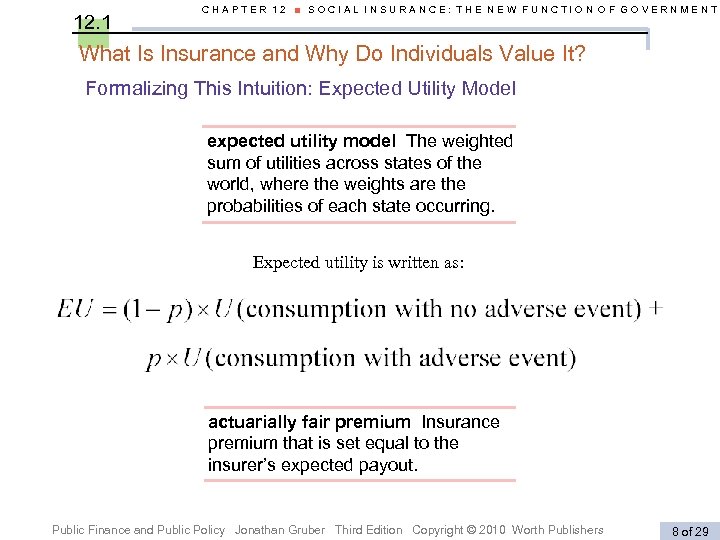
12. 1 CHAPTER 12 ■ SOCIAL INSURANCE: THE NEW FUNCTION OF GOVERNMENT What Is Insurance and Why Do Individuals Value It? Formalizing This Intuition: Expected Utility Model expected utility model The weighted sum of utilities across states of the world, where the weights are the probabilities of each state occurring. Expected utility is written as: actuarially fair premium Insurance premium that is set equal to the insurer’s expected payout. Public Finance and Public Policy Jonathan Gruber Third Edition Copyright © 2010 Worth Publishers 8 of 29
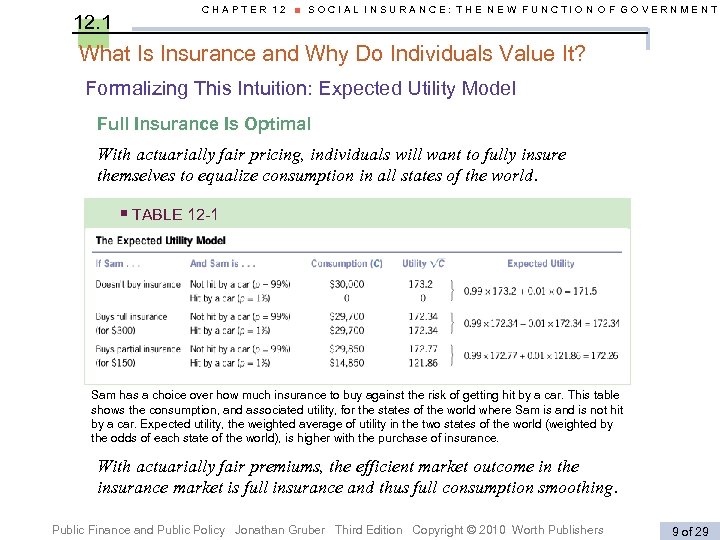
12. 1 CHAPTER 12 ■ SOCIAL INSURANCE: THE NEW FUNCTION OF GOVERNMENT What Is Insurance and Why Do Individuals Value It? Formalizing This Intuition: Expected Utility Model Full Insurance Is Optimal With actuarially fair pricing, individuals will want to fully insure themselves to equalize consumption in all states of the world. § TABLE 12 -1 Sam has a choice over how much insurance to buy against the risk of getting hit by a car. This table shows the consumption, and associated utility, for the states of the world where Sam is and is not hit by a car. Expected utility, the weighted average of utility in the two states of the world (weighted by the odds of each state of the world), is higher with the purchase of insurance. With actuarially fair premiums, the efficient market outcome in the insurance market is full insurance and thus full consumption smoothing. Public Finance and Public Policy Jonathan Gruber Third Edition Copyright © 2010 Worth Publishers 9 of 29
12. 1 CHAPTER 12 ■ SOCIAL INSURANCE: THE NEW FUNCTION OF GOVERNMENT What Is Insurance and Why Do Individuals Value It? Formalizing This Intuition: Expected Utility Model The Role of Risk Aversion risk aversion The extent to which individuals are willing to bear risk. Public Finance and Public Policy Jonathan Gruber Third Edition Copyright © 2010 Worth Publishers 10 of 29
12. 2 CHAPTER 12 ■ SOCIAL INSURANCE: THE NEW FUNCTION OF GOVERNMENT Why Have Social Insurance? Asymmetric Information and Adverse Selection Asymmetric Information information asymmetry The difference in information that is available to sellers and to purchasers in a market. Public Finance and Public Policy Jonathan Gruber Third Edition Copyright © 2010 Worth Publishers 11 of 29
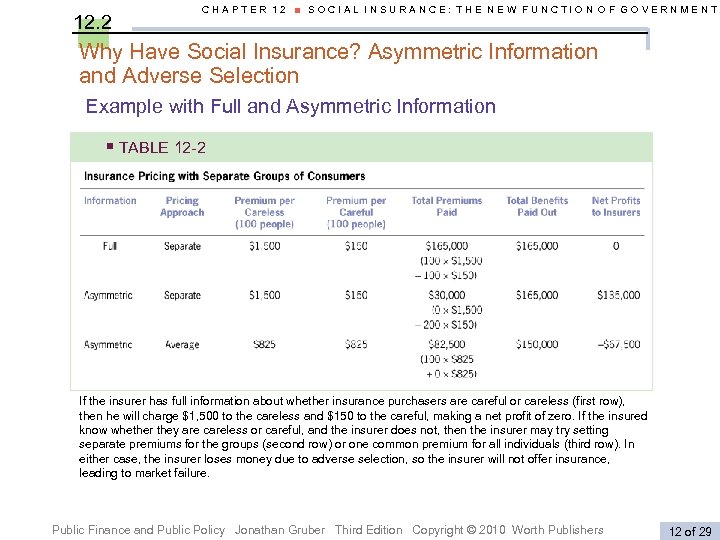
12. 2 CHAPTER 12 ■ SOCIAL INSURANCE: THE NEW FUNCTION OF GOVERNMENT Why Have Social Insurance? Asymmetric Information and Adverse Selection Example with Full and Asymmetric Information § TABLE 12 -2 If the insurer has full information about whether insurance purchasers are careful or careless (first row), then he will charge $1, 500 to the careless and $150 to the careful, making a net profit of zero. If the insured know whether they are careless or careful, and the insurer does not, then the insurer may try setting separate premiums for the groups (second row) or one common premium for all individuals (third row). In either case, the insurer loses money due to adverse selection, so the insurer will not offer insurance, leading to market failure. Public Finance and Public Policy Jonathan Gruber Third Edition Copyright © 2010 Worth Publishers 12 of 29
12. 2 CHAPTER 12 ■ SOCIAL INSURANCE: THE NEW FUNCTION OF GOVERNMENT Why Have Social Insurance? Asymmetric Information and Adverse Selection The Problem of Adverse Selection adverse selection The fact that insured individuals know more about their risk level than does the insurer might cause those most likely to have the adverse outcome to select insurance, leading insurers to lose money if they offer insurance. Public Finance and Public Policy Jonathan Gruber Third Edition Copyright © 2010 Worth Publishers 13 of 29
12. 2 CHAPTER 12 ■ SOCIAL INSURANCE: THE NEW FUNCTION OF GOVERNMENT Why Have Social Insurance? Asymmetric Information and Adverse Selection Does Asymmetric Information Necessarily Lead to Market Failure? risk premium The amount that risk-averse individuals will pay for insurance above and beyond the actuarially fair price. pooling equilibrium A market equilibrium in which all types of people buy full insurance even though it is not fairly priced to all individuals. separating equilibrium A market equilibrium in which different types of people buy different kinds of insurance products designed to reveal their true types. Public Finance and Public Policy Jonathan Gruber Third Edition Copyright © 2010 Worth Publishers 14 of 29
12. 2 CHAPTER 12 ■ SOCIAL INSURANCE: THE NEW FUNCTION OF GOVERNMENT Why Have Social Insurance? Asymmetric Information and Adverse Selection APPLICATION Adverse Selection and Health Insurance “Death Spirals” Harvard offered its employees a wide variety of health insurance plans. The prices charged to the university for these plans were a function of how much each plan’s enrollees made use of the medical care. If a plan had many sick enrollees, then its costs were higher. experience rating Charging a price for insurance that is a function of realized outcomes. The university shielded its employees from the fact that some plans were more expensive than others by paying a larger share of the more expensive health insurance plans. In 1995, Harvard moved to a system in which the university paid the same amount for each plan so that employees had to pay more for the more generous health plans. The insurance group moved to a separating equilibrium, with the less-healthy getting more generous insurance at high prices. Because these less-healthy employees used much more medical care, the experiencerated premiums of the more generous plans increased substantially. By 1998, the most generous plan had gotten so expensive that it was no longer offered. Adverse selection had led to a “death spiral” for this plan. Public Finance and Public Policy Jonathan Gruber Third Edition Copyright © 2010 Worth Publishers 15 of 29
12. 2 CHAPTER 12 ■ SOCIAL INSURANCE: THE NEW FUNCTION OF GOVERNMENT Why Have Social Insurance? Asymmetric Information and Adverse Selection How Does the Government Address Adverse Selection? The government can address adverse selection, and improve market efficiency, in a number of ways, but they involve redistribution from the healthy to the sick, which may be quite unpopular. Public Finance and Public Policy Jonathan Gruber Third Edition Copyright © 2010 Worth Publishers 16 of 29
12. 3 CHAPTER 12 ■ SOCIAL INSURANCE: THE NEW FUNCTION OF GOVERNMENT Other Reasons for Government Intervention in Insurance Markets Externalities • Your lack of insurance can be a cause of illness for me, thereby exerting a negative physical externality. • If you don’t have auto insurance, and you injure me in an auto crash, then my insurer and I bear the cost of my injury, a negative financial externality. Administrative Costs • The administrative costs for Medicare less than 2% of claims paid. • Administrative costs for private insurance average about 12% of claims paid. At those higher prices, some not-very-risk-averse consumers may decide against buying insurance. In this way, administrative inefficiencies can lead to market failure because not all people will be fully insured, as is optimal. Public Finance and Public Policy Jonathan Gruber Third Edition Copyright © 2010 Worth Publishers 17 of 29
12. 3 CHAPTER 12 ■ SOCIAL INSURANCE: THE NEW FUNCTION OF GOVERNMENT Other Reasons for Government Intervention in Insurance Markets Redistribution Genetic testing may ultimately allow insurers to remove many problems of asymmetric information via the testing of individuals to accurately predict their health costs. Those who are genetically ill-fated will pay much higher prices for insurance than those who are genetically healthy. Paternalism Governments may simply feel that individuals will not appropriately insure themselves against risks if the government does not force them to do so. Public Finance and Public Policy Jonathan Gruber Third Edition Copyright © 2010 Worth Publishers 18 of 29
12. 3 CHAPTER 12 ■ SOCIAL INSURANCE: THE NEW FUNCTION OF GOVERNMENT Other Reasons for Government Intervention in Insurance Markets APPLICATION Flood Insurance and the Samaritan’s Dilemma When a disaster hits, the government will transfer resources to help those affected. Since individuals know that the government will bail them out if things go badly, they will not take precautions against things going badly. To reduce taxpayer-funded federal expenditures on flood control, the federal government established the National Flood Insurance Program (NFIP) in 1968: • Areas with a 1% chance of flooding in any given year are given the option of buying flood insurance through the program. • Following Hurricane Katrina in 2005, it was revealed that nearly half of the victims did not have flood insurance. The claims from those who did have flood insurance bankrupted the program. • Failures of the NFIP have many sources. Among these is that many individuals opt out of paying for insurance. This is a classic example of the Samaritan’s Dilemma: If the government is going to continue to help individuals in disasters, and people are not required by law to buy flood insurance, then why buy it? A solution to this problem would be to mandate the purchase of flood insurance at actuarially fair prices in areas at risk of flooding. Congress passed the Flood Insurance Reform and Modernization Act of 2007, but the fundamental problem remains. Public Finance and Public Policy Jonathan Gruber Third Edition Copyright © 2010 Worth Publishers 19 of 29
CHAPTER 12 ■ SOCIAL INSURANCE: THE NEW FUNCTION OF GOVERNMENT 12. 4 Social Insurance vs. Self-Insurance: How Much Consumption Smoothing? self-insurance The private means of smoothing consumption over adverse events, such as through one’s own savings, labor supply of family members, or borrowing from friends. Example: Unemployment Insurance Individuals do not generally have a private form of unemployment insurance, but they do have other potential means to smooth their consumption across unemployment spells: They can draw on their own savings. They can borrow, either in collateralized forms or in uncollateralized forms. Other family members can increase their labor earnings. They can receive transfers from their extended family, friends, or local organizations. Public Finance and Public Policy Jonathan Gruber Third Edition Copyright © 2010 Worth Publishers 20 of 29
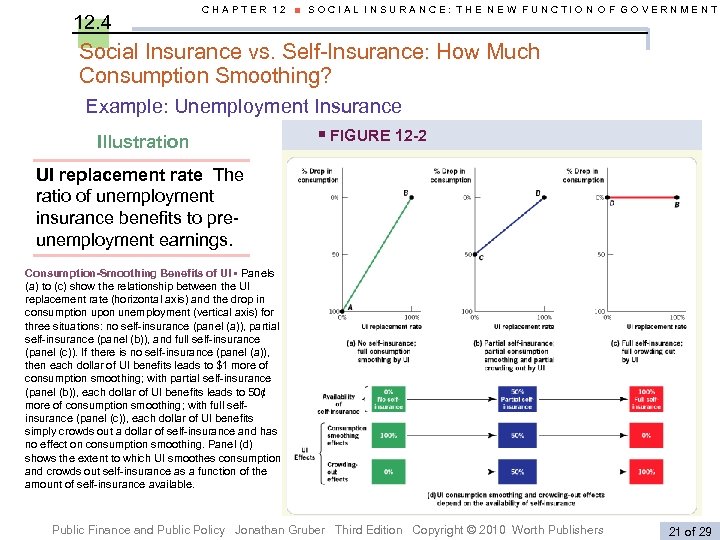
12. 4 CHAPTER 12 ■ SOCIAL INSURANCE: THE NEW FUNCTION OF GOVERNMENT Social Insurance vs. Self-Insurance: How Much Consumption Smoothing? Example: Unemployment Insurance § FIGURE 12 -2 Illustration UI replacement rate The ratio of unemployment insurance benefits to preunemployment earnings. Consumption-Smoothing Benefits of UI • Panels (a) to (c) show the relationship between the UI replacement rate (horizontal axis) and the drop in consumption upon unemployment (vertical axis) for three situations: no self-insurance (panel (a)), partial self-insurance (panel (b)), and full self-insurance (panel (c)). If there is no self-insurance (panel (a)), then each dollar of UI benefits leads to $1 more of consumption smoothing; with partial self-insurance (panel (b)), each dollar of UI benefits leads to 50¢ more of consumption smoothing; with full selfinsurance (panel (c)), each dollar of UI benefits simply crowds out a dollar of self-insurance and has no effect on consumption smoothing. Panel (d) shows the extent to which UI smoothes consumption and crowds out self-insurance as a function of the amount of self-insurance available. Public Finance and Public Policy Jonathan Gruber Third Edition Copyright © 2010 Worth Publishers 21 of 29
12. 4 CHAPTER 12 ■ SOCIAL INSURANCE: THE NEW FUNCTION OF GOVERNMENT Social Insurance vs. Self-Insurance: How Much Consumption Smoothing? Example: Unemployment Insurance Summary The availability of self-insurance determines the value of social insurance to individuals suffering adverse events. Public Finance and Public Policy Jonathan Gruber Third Edition Copyright © 2010 Worth Publishers 22 of 29
12. 4 CHAPTER 12 ■ SOCIAL INSURANCE: THE NEW FUNCTION OF GOVERNMENT Social Insurance vs. Self-Insurance: How Much Consumption Smoothing? Lessons for Consumption-Smoothing Role of Social Insurance The importance of social insurance for consumption smoothing will depend on two factors: Predictability of the event. Cost of the event. Public Finance and Public Policy Jonathan Gruber Third Edition Copyright © 2010 Worth Publishers 23 of 29
12. 5 CHAPTER 12 ■ SOCIAL INSURANCE: THE NEW FUNCTION OF GOVERNMENT The Problem with Insurance: Moral Hazard moral hazard Adverse actions taken by individuals or producers in response to insurance against adverse outcomes. The existence of moral hazard means that it may not be optimal for the government to provide the full insurance that is demanded by risk-averse consumers. Public Finance and Public Policy Jonathan Gruber Third Edition Copyright © 2010 Worth Publishers 24 of 29
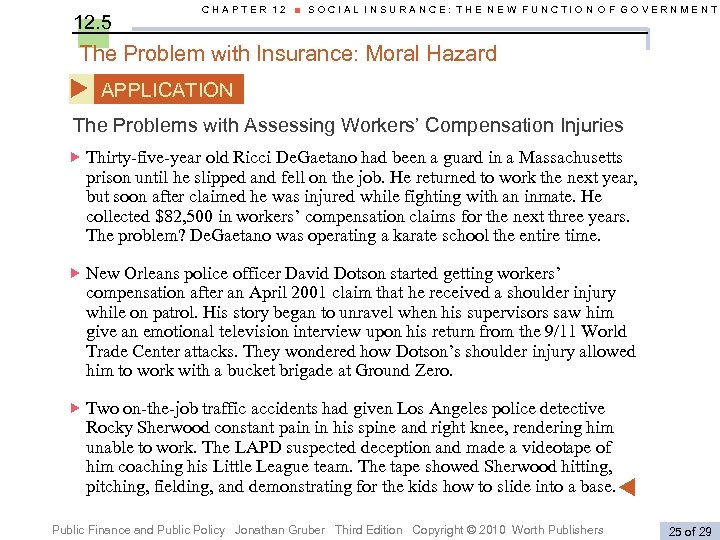
12. 5 CHAPTER 12 ■ SOCIAL INSURANCE: THE NEW FUNCTION OF GOVERNMENT The Problem with Insurance: Moral Hazard APPLICATION The Problems with Assessing Workers’ Compensation Injuries Thirty-five-year old Ricci De. Gaetano had been a guard in a Massachusetts prison until he slipped and fell on the job. He returned to work the next year, but soon after claimed he was injured while fighting with an inmate. He collected $82, 500 in workers’ compensation claims for the next three years. The problem? De. Gaetano was operating a karate school the entire time. New Orleans police officer David Dotson started getting workers’ compensation after an April 2001 claim that he received a shoulder injury while on patrol. His story began to unravel when his supervisors saw him give an emotional television interview upon his return from the 9/11 World Trade Center attacks. They wondered how Dotson’s shoulder injury allowed him to work with a bucket brigade at Ground Zero. Two on-the-job traffic accidents had given Los Angeles police detective Rocky Sherwood constant pain in his spine and right knee, rendering him unable to work. The LAPD suspected deception and made a videotape of him coaching his Little League team. The tape showed Sherwood hitting, pitching, fielding, and demonstrating for the kids how to slide into a base. Public Finance and Public Policy Jonathan Gruber Third Edition Copyright © 2010 Worth Publishers 25 of 29
12. 5 CHAPTER 12 ■ SOCIAL INSURANCE: THE NEW FUNCTION OF GOVERNMENT The Problem with Insurance: Moral Hazard What Determines Moral Hazard? • How easy it is to observe whether the adverse event has happened. • How easy it is to change behavior in order to establish the adverse event. Moral Hazard Is Multidimensional In examining the effects of social insurance, four types of moral hazard play a particularly important role: Reduced precaution against entering the adverse state. Increased odds of entering the adverse state. Increased expenditures when in the adverse state. Supplier responses to insurance against the adverse state. Public Finance and Public Policy Jonathan Gruber Third Edition Copyright © 2010 Worth Publishers 26 of 29
12. 5 CHAPTER 12 ■ SOCIAL INSURANCE: THE NEW FUNCTION OF GOVERNMENT The Problem with Insurance: Moral Hazard The Consequences of Moral Hazard Moral hazard is costly for two reasons: • The adverse behavior encouraged by insurance lowers social efficiency because it reduces the provisions of socially efficient labor supply. • When social insurance encourages adverse events, which raise the cost of the social insurance program, it increases taxes and lowers social efficiency further. Public Finance and Public Policy Jonathan Gruber Third Edition Copyright © 2010 Worth Publishers 27 of 29
12. 6 CHAPTER 12 ■ SOCIAL INSURANCE: THE NEW FUNCTION OF GOVERNMENT Putting It All Together: Optimal Social Insurance • Optimal social insurance systems should partially, but not completely, insure individuals against adverse events. • The benefit of social insurance is the amount of consumption smoothing provided by social insurance programs. • The cost of social insurance is the moral hazard caused by insuring against adverse events. Public Finance and Public Policy Jonathan Gruber Third Edition Copyright © 2010 Worth Publishers 28 of 29
12. 7 CHAPTER 12 ■ SOCIAL INSURANCE: THE NEW FUNCTION OF GOVERNMENT Conclusion Asymmetric information in insurance markets has two important implications: • It can cause adverse selection. • It can cause moral hazard. The ironic feature of asymmetric information is therefore that it simultaneously motivates and undercuts the rationale for government intervention through social insurance. Public Finance and Public Policy Jonathan Gruber Third Edition Copyright © 2010 Worth Publishers 29 of 29
Скачать презентацию Copyright 2010 Worth Publishers Public Finance and
306fd45068ea754f96b1ed04c10ec6bf.ppt