 Скачать презентацию copyright 2008 Driving Private-Public Sector Alliances to Achieve
c750c173911b1a69ad96482253351271.ppt
- Количество слайдов: 33



copyright 2008: Driving Private-Public Sector Alliances to Achieve Breakthrough Growth in the IT-BPO Industry The Philippine Experience JONATHAN DEFENSOR DE LUZURIAGA Executive Director – Industry Affairs Business Processing Association of the Philippines February 10, 2008
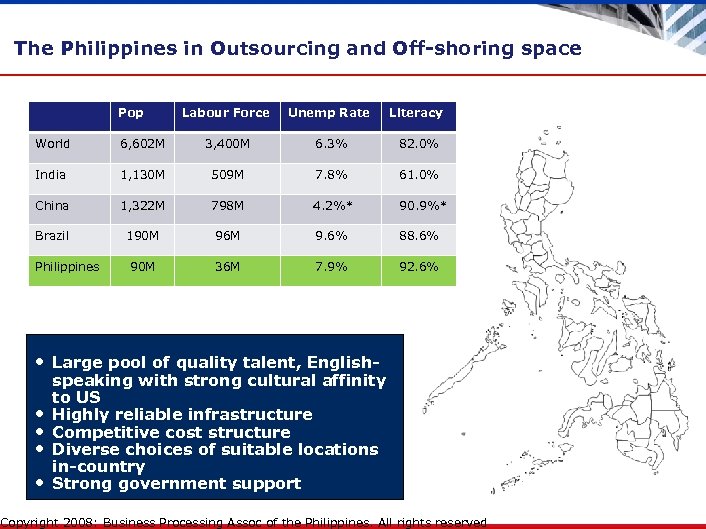
The Philippines in Outsourcing and Off-shoring space Pop Labour Force Unemp Rate Literacy World 6, 602 M 3, 400 M 6. 3% 82. 0% India 1, 130 M 509 M 7. 8% 61. 0% China 1, 322 M 798 M 4. 2%* 90. 9%* Brazil 190 M 96 M 9. 6% 88. 6% 90 M 36 M 7. 9% 92. 6% Philippines • Large pool of quality talent, English • • speaking with strong cultural affinity to US Highly reliable infrastructure Competitive cost structure Diverse choices of suitable locations in-country Strong government support Copyright 2008: Business Processing Assoc of the Philippines. All rights reserved
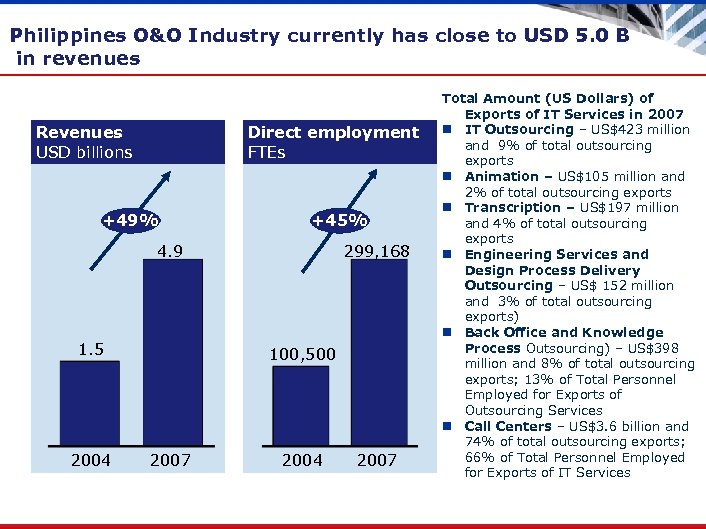
Philippines O&O Industry currently has close to USD 5. 0 B in revenues Revenues USD billions Direct employment FTEs +49% +45% 4. 9 1. 5 2004 299, 168 100, 500 2007 2004 2007 Total Amount (US Dollars) of Exports of IT Services in 2007 g IT Outsourcing – US$423 million and 9% of total outsourcing exports g Animation – US$105 million and 2% of total outsourcing exports g Transcription – US$197 million and 4% of total outsourcing exports g Engineering Services and Design Process Delivery Outsourcing – US$ 152 million and 3% of total outsourcing exports) g Back Office and Knowledge Process Outsourcing) – US$398 million and 8% of total outsourcing exports; 13% of Total Personnel Employed for Exports of Outsourcing Services g Call Centers – US$3. 6 billion and 74% of total outsourcing exports; 66% of Total Personnel Employed for Exports of IT Services
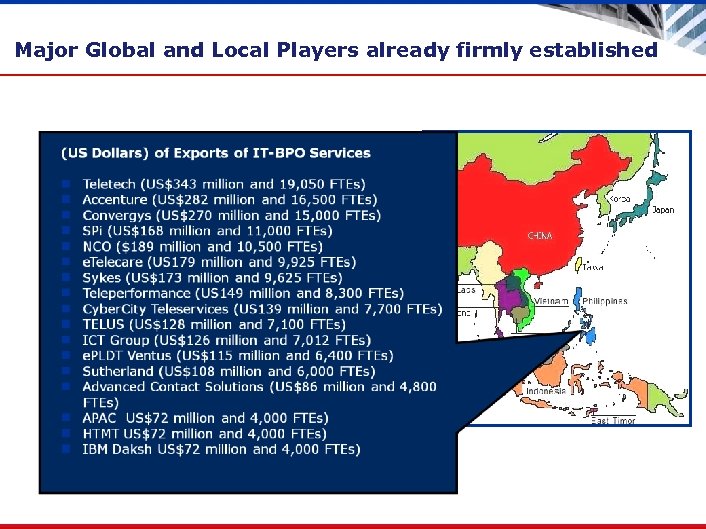
Major Global and Local Players already firmly established
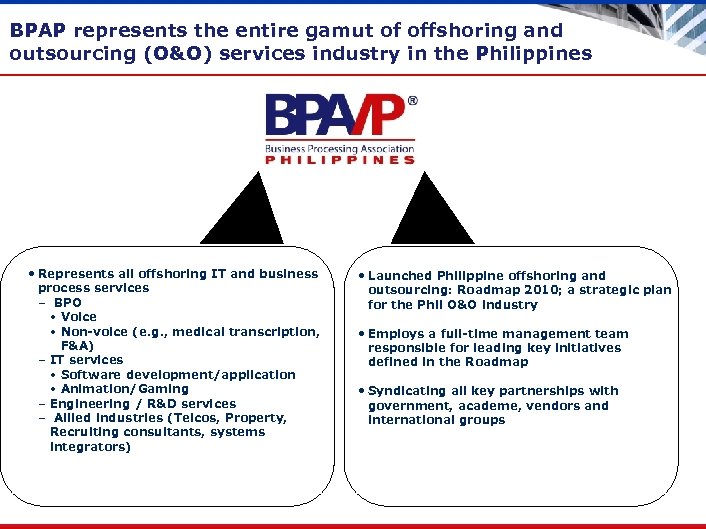
BPAP represents the entire gamut of offshoring and outsourcing (O&O) services industry in the Philippines • Represents all offshoring IT and business process services – BPO • Voice • Non-voice (e. g. , medical transcription, F&A) – IT services • Software development/application • Animation/Gaming – Engineering / R&D services – Allied industries (Telcos, Property, Recruiting consultants, systems integrators) • Launched Philippine offshoring and outsourcing: Roadmap 2010; a strategic plan for the Phil O&O industry • Employs a full-time management team responsible for leading key initiatives defined in the Roadmap • Syndicating all key partnerships with government, academe, vendors and international groups
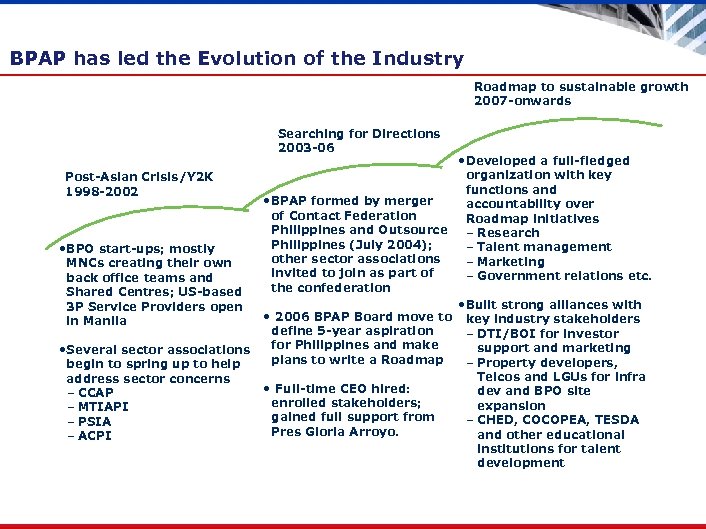
BPAP has led the Evolution of the Industry Roadmap to sustainable growth 2007 -onwards Searching for Directions 2003 -06 Post-Asian Crisis/Y 2 K 1998 -2002 • BPO start-ups; mostly MNCs creating their own back office teams and Shared Centres; US-based 3 P Service Providers open in Manila • Several sector associations begin to spring up to help address sector concerns – CCAP – MTIAPI – PSIA – ACPI • BPAP formed by merger of Contact Federation Philippines and Outsource Philippines (July 2004); other sector associations invited to join as part of the confederation • Developed a full-fledged organization with key functions and accountability over Roadmap initiatives – Research – Talent management – Marketing – Government relations etc. • Built strong alliances with • 2006 BPAP Board move to key industry stakeholders define 5 -year aspiration for Philippines and make plans to write a Roadmap • Full-time CEO hired: enrolled stakeholders; gained full support from Pres Gloria Arroyo. – DTI/BOI for investor support and marketing – Property developers, Telcos and LGUs for infra dev and BPO site expansion – CHED, COCOPEA, TESDA and other educational institutions for talent development
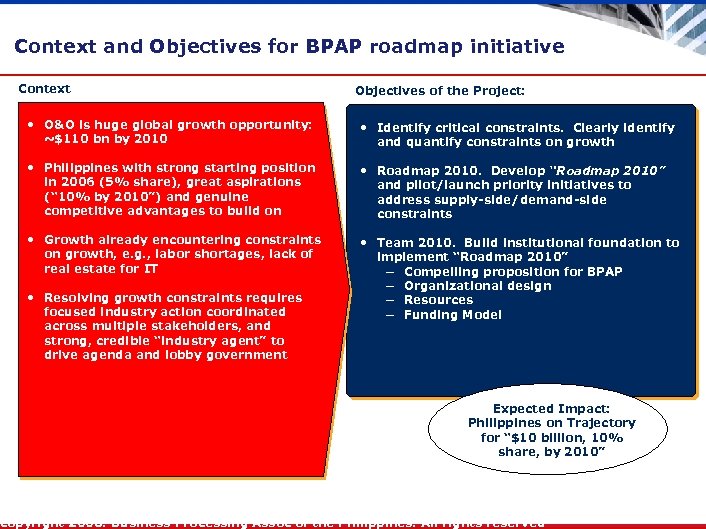
Context and Objectives for BPAP roadmap initiative Context • O&O is huge global growth opportunity: ~$110 bn by 2010 • Philippines with strong starting position in 2006 (5% share), great aspirations (“ 10% by 2010”) and genuine competitive advantages to build on • Growth already encountering constraints on growth, e. g. , labor shortages, lack of real estate for IT • Resolving growth constraints requires focused industry action coordinated across multiple stakeholders, and strong, credible “industry agent” to drive agenda and lobby government Objectives of the Project: • Identify critical constraints. Clearly identify and quantify constraints on growth • Roadmap 2010. Develop “Roadmap 2010” and pilot/launch priority initiatives to address supply-side/demand-side constraints • Team 2010. Build institutional foundation to implement “Roadmap 2010” – Compelling proposition for BPAP – Organizational design – Resources – Funding Model Expected Impact: Philippines on Trajectory for “$10 billion, 10% share, by 2010” copyright 2008: Business Processing Assoc of the Philippines. All rights reserved
The Challenge • Funding • Ownership • Authorship • Leadership and follow-through Copyright 2008: Business Processing Assoc of the Philippines. All rights reserved
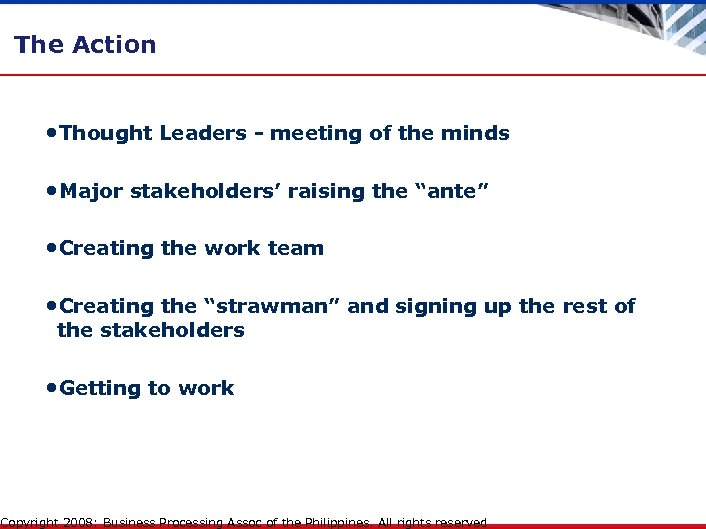
The Action • Thought Leaders - meeting of the minds • Major stakeholders’ raising the “ante” • Creating the work team • Creating the “strawman” and signing up the rest of the stakeholders • Getting to work Copyright 2008: Business Processing Assoc of the Philippines. All rights reserved
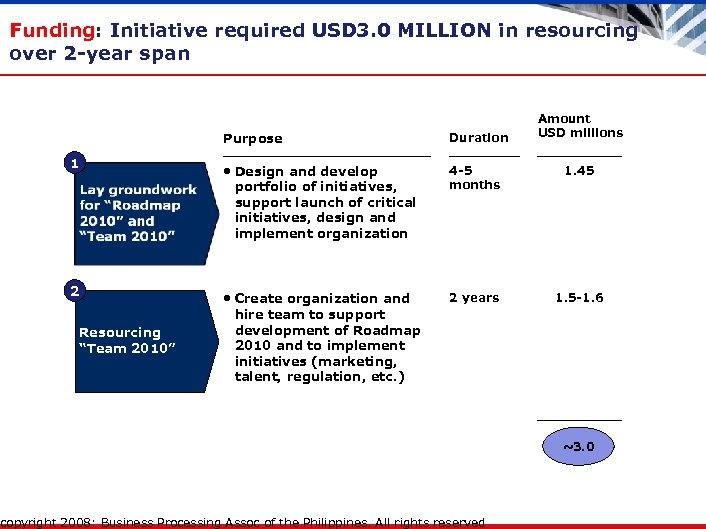
Funding: Initiative required USD 3. 0 MILLION in resourcing over 2 -year span Amount USD millions Purpose 1 Duration • Design and develop 4 -5 months 1. 45 • Create organization and 2 years 1. 5 -1. 6 portfolio of initiatives, support launch of critical initiatives, design and implement organization 2 Resourcing “Team 2010” hire team to support development of Roadmap 2010 and to implement initiatives (marketing, talent, regulation, etc. ) copyright 2008: Business Processing Assoc of the Philippines. All rights reserved ~3. 0
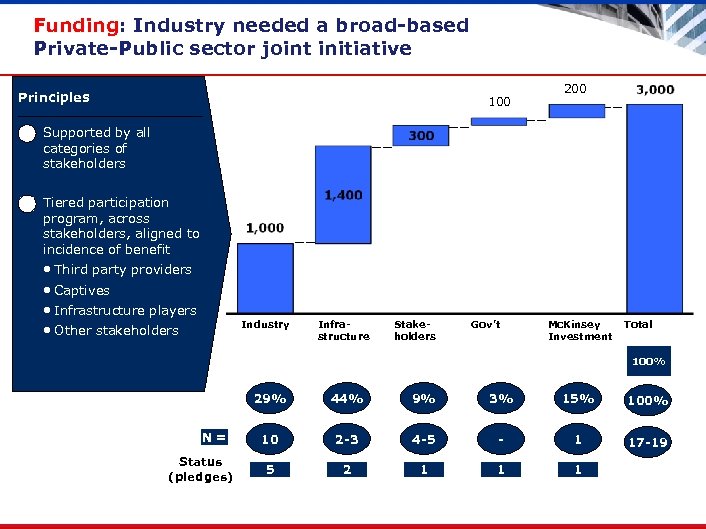
Funding: Industry needed a broad-based Private-Public sector joint initiative Principles 100 200 1 Supported by all categories of stakeholders 2 Tiered participation program, across stakeholders, aligned to incidence of benefit • Third party providers • Captives • Infrastructure players • Other stakeholders Industry Infrastructure Stakeholders Gov’t Mc. Kinsey Investment Total 100% 29% N= Status (pledges) 44% 9% 3% 15% 100% 10 2 -3 4 -5 - 1 17 -19 5 2 1 1 1
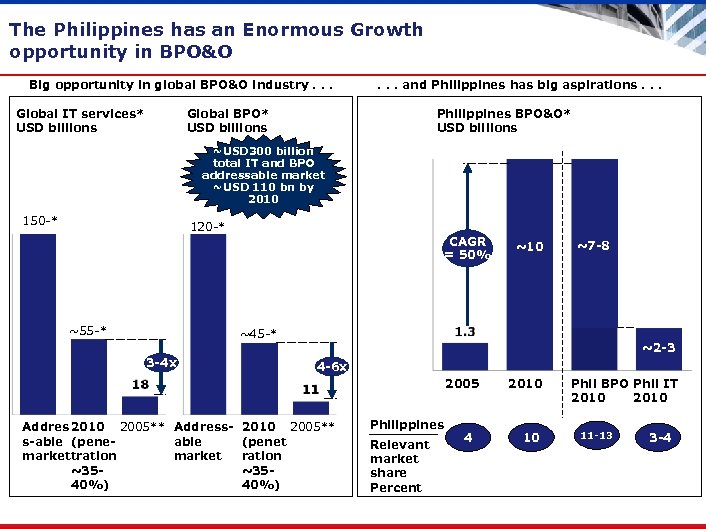
The Philippines has an Enormous Growth opportunity in BPO&O Big opportunity in global BPO&O industry. . . Global IT services* USD billions . . . and Philippines has big aspirations. . . Global BPO* USD billions Philippines BPO&O* USD billions ~USD 300 billion total IT and BPO addressable market ~USD 110 bn by 2010 150 -* 120 -* CAGR = 50% ~55 -* ~10 ~7 -8 ~45 -* 3 -4 x ~2 -3 4 -6 x 2005 Addres 2010 2005** Address- 2010 2005** s-able (penet market tration market ration ~35~3540%) Philippines Relevant market share Percent 4 2010 10 Phil BPO Phil IT 2010 11 -13 3 -4
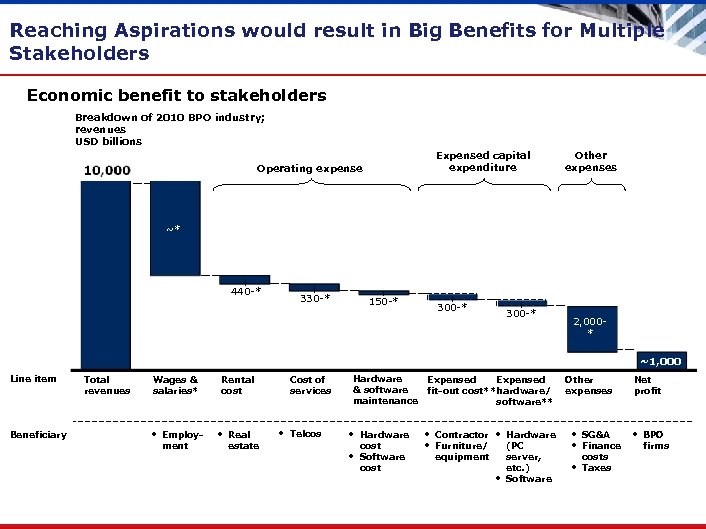
Reaching Aspirations would result in Big Benefits for Multiple Stakeholders Economic benefit to stakeholders Breakdown of 2010 BPO industry; revenues USD billions Expensed capital expenditure Operating expense Other expenses ~* 440 -* 330 -* 150 -* 300 -* 2, 000* ~1, 000 Line item Beneficiary Total revenues Wages & salaries* • Employment Rental cost • Real estate Cost of services • Telcos Hardware & software maintenance • • Hardware cost Software cost Expensed fit-out cost** hardware/ software** • • Contractor Furniture/ equipment • • Hardware (PC server, etc. ) Software Other expenses • • • SG&A Finance costs Taxes Net profit • BPO firms
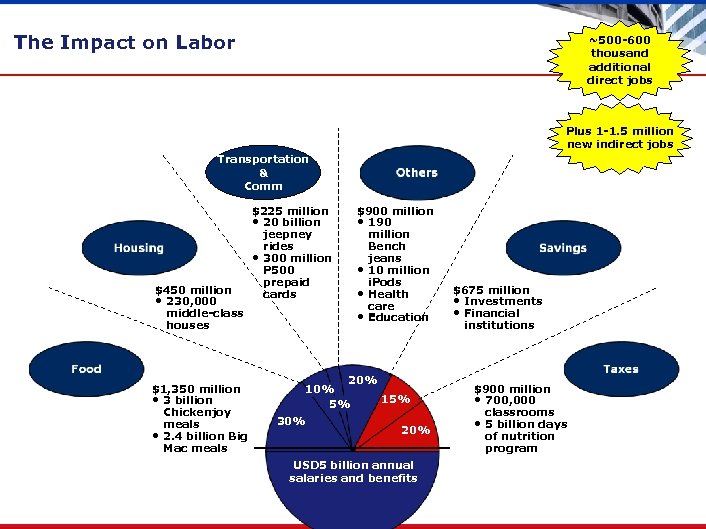
The Impact on Labor ~500 -600 thousand additional direct jobs Plus 1 -1. 5 million new indirect jobs Transportation & Comm $450 million • 230, 000 middle-class houses $1, 350 million • 3 billion Chickenjoy meals • 2. 4 billion Big Mac meals $225 million • 20 billion jeepney rides • 300 million P 500 prepaid cards $900 million • 190 million Bench jeans • 10 million i. Pods • Health care • Education 20% 15% 5% 30% 20% USD 5 billion annual salaries and benefits $675 million • Investments • Financial institutions $900 million • 700, 000 classrooms • 5 billion days of nutrition program
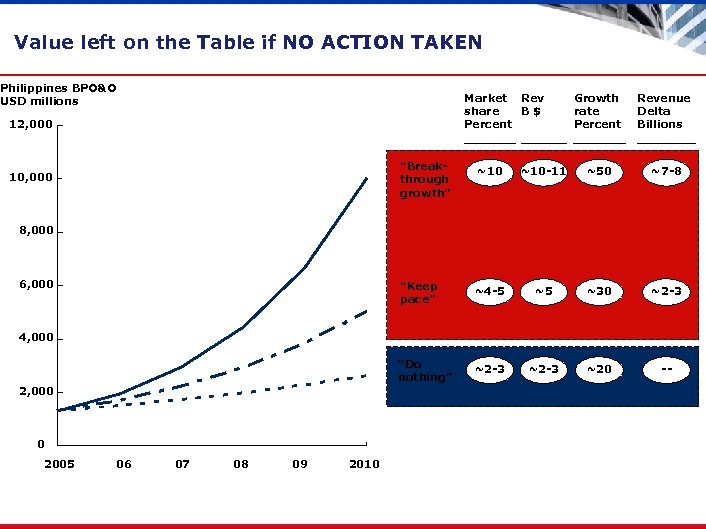
Value left on the Table if NO ACTION TAKEN Philippines BPO&O USD millions Market Rev B$ share Percent 12, 000 Growth rate Percent Revenue Delta Billions “Breakthrough growth” ~10 -11 ~50 ~7 -8 “Keep pace” ~4 -5 ~5 ~30 ~2 -3 “Do nothing” 10, 000 ~2 -3 ~20 -- 8, 000 6, 000 4, 000 2, 000 0 2005 06 07 08 09 2010
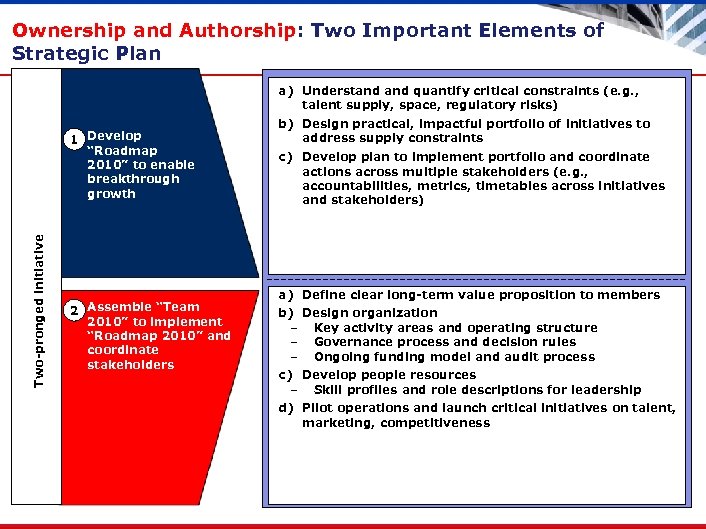
Ownership and Authorship: Two Important Elements of Strategic Plan Two-pronged initiative 1 Develop “Roadmap 2010” to enable breakthrough growth 2 Assemble “Team 2010” to implement “Roadmap 2010” and coordinate stakeholders a) Understand quantify critical constraints (e. g. , talent supply, space, regulatory risks) b) Design practical, impactful portfolio of initiatives to address supply constraints c) Develop plan to implement portfolio and coordinate actions across multiple stakeholders (e. g. , accountabilities, metrics, timetables across initiatives and stakeholders) a) b) – – – c) – d) Define clear long-term value proposition to members Design organization Key activity areas and operating structure Governance process and decision rules Ongoing funding model and audit process Develop people resources Skill profiles and role descriptions for leadership Pilot operations and launch critical initiatives on talent, marketing, competitiveness
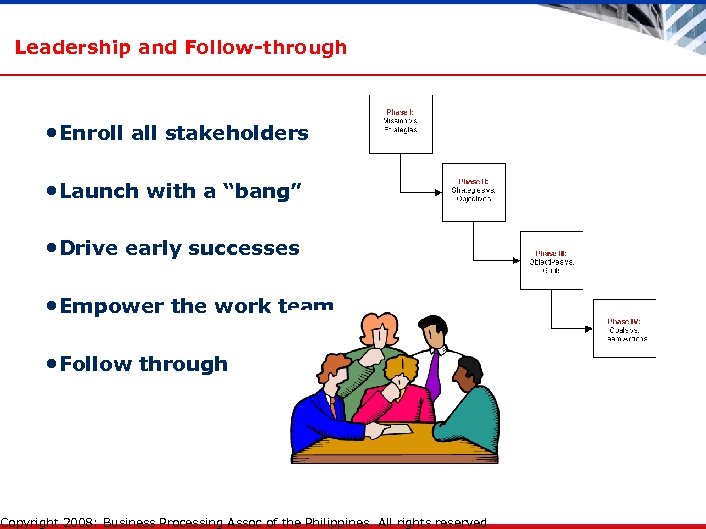
Leadership and Follow-through • Enroll all stakeholders • Launch with a “bang” • Drive early successes • Empower the work team • Follow through Copyright 2008: Business Processing Assoc of the Philippines. All rights reserved
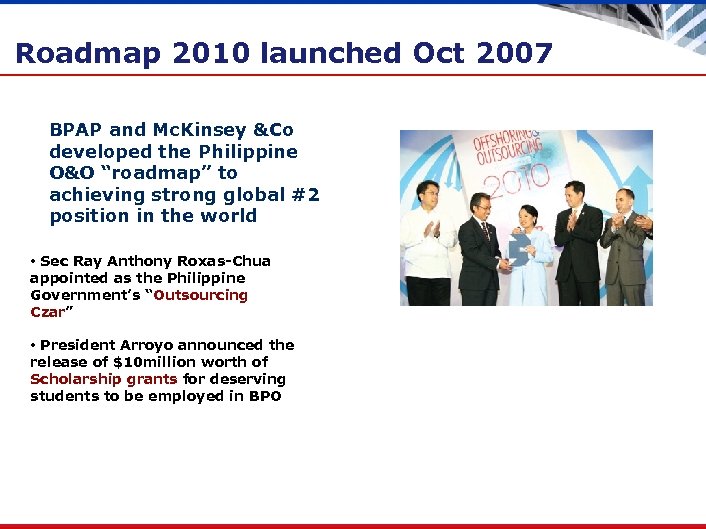
Roadmap 2010 launched Oct 2007 BPAP and Mc. Kinsey &Co developed the Philippine O&O “roadmap” to achieving strong global #2 position in the world • Sec Ray Anthony Roxas-Chua appointed as the Philippine Government’s “Outsourcing Czar” • President Arroyo announced the release of $10 million worth of Scholarship grants for deserving students to be employed in BPO
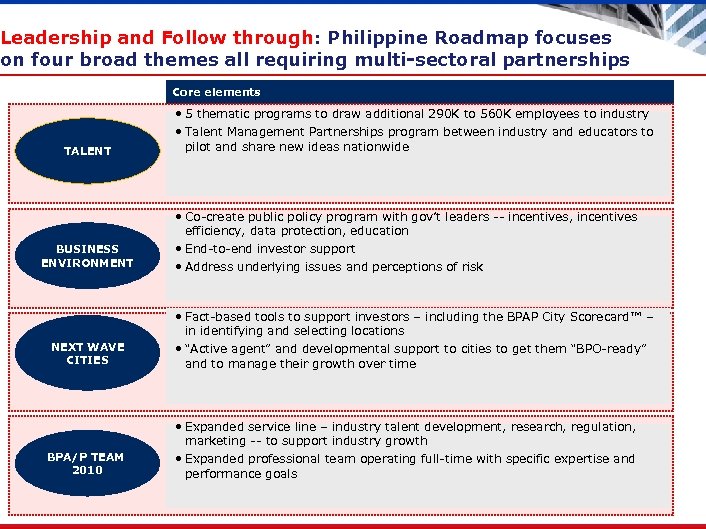
Leadership and Follow through: Philippine Roadmap focuses on four broad themes all requiring multi-sectoral partnerships Core elements • 5 thematic programs to draw additional 290 K to 560 K employees to industry • Talent Management Partnerships program between industry and educators to TALENT pilot and share new ideas nationwide • Co-create public policy program with gov’t leaders -- incentives, incentives BUSINESS ENVIRONMENT efficiency, data protection, education • End-to-end investor support • Address underlying issues and perceptions of risk • Fact-based tools to support investors – including the BPAP City Scorecard™ – NEXT WAVE CITIES in identifying and selecting locations • “Active agent” and developmental support to cities to get them “BPO-ready” and to manage their growth over time • Expanded service line – industry talent development, research, regulation, BPA/P TEAM 2010 marketing -- to support industry growth • Expanded professional team operating full-time with specific expertise and performance goals
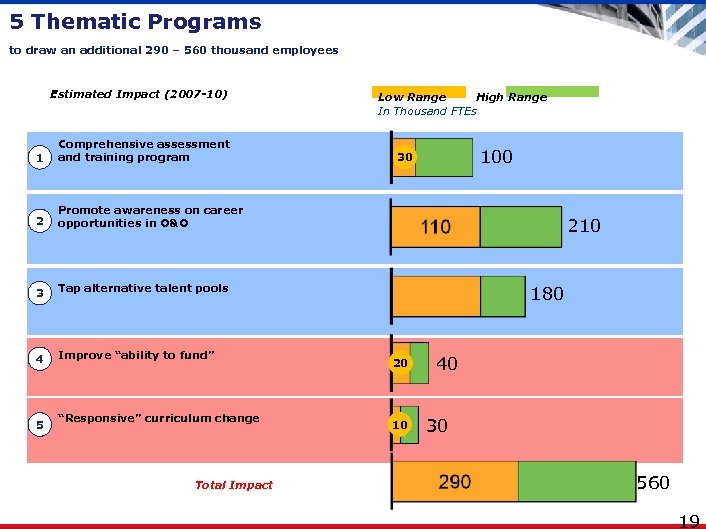
5 Thematic Programs to draw an additional 290 – 560 thousand employees Estimated Impact (2007 -10) 1 Comprehensive assessment and training program 2 Promote awareness on career opportunities in O&O 3 Tap alternative talent pools 4 Improve “ability to fund” Low Range High Range In Thousand FTEs 5 “Responsive” curriculum change Total Impact 100 30 210 180 20 10 40 30 560 19
Short-term finishing courses: closing the gap on “suitability” and “availability” of talent The “Near Hire” Phenomenon What is a Near Hire? - A “Near Hire” is someone who applied for employment in a BPO or IT Company that could have made it but lacking a few necessary skills required by the company. Training of Near Hires: - “Near Hires” can undergo “finishing courses” run by in-house or independent training institutions accredited by TESDA as compliant of Training Regulation/Curriculum developed by the different sectors of the BPO & IT Services Industry. - The PGMA Training for Work Scholarship Program provides help in the form of scholarship vouchers awarded to deserving “near-hires” Copyright 2008: Business Processing Assoc of the Philippines. All rights reserved
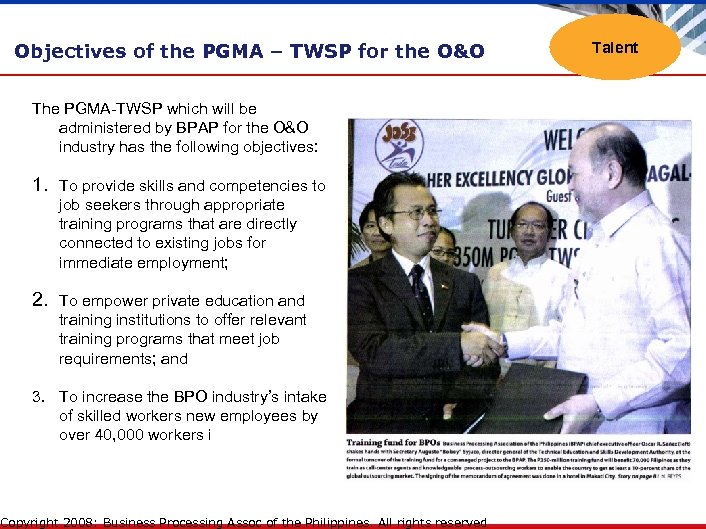
Objectives of the PGMA – TWSP for the O&O The PGMA-TWSP which will be administered by BPAP for the O&O industry has the following objectives: 1. To provide skills and competencies to job seekers through appropriate training programs that are directly connected to existing jobs for immediate employment; 2. To empower private education and training institutions to offer relevant training programs that meet job requirements; and 3. To increase the BPO industry’s intake of skilled workers new employees by over 40, 000 workers i Copyright 2008: Business Processing Assoc of the Philippines. All rights reserved Talent
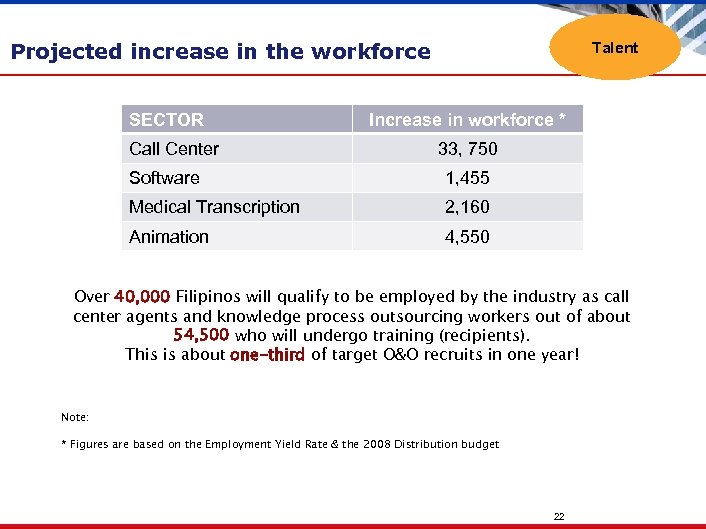
Projected increase in the workforce SECTOR Call Center Talent Increase in workforce * 33, 750 Software 1, 455 Medical Transcription 2, 160 Animation 4, 550 Over 40, 000 Filipinos will qualify to be employed by the industry as call center agents and knowledge process outsourcing workers out of about 54, 500 who will undergo training (recipients). This is about one-third of target O&O recruits in one year! Note: * Figures are based on the Employment Yield Rate & the 2008 Distribution budget 22
TESDA’s responsibilities Talent 1) TESDA turns over to BPAP P 350 million worth of 2) 3) vouchers for distribution to its members and partner O&O associations. Issue Certificates of Program Registration for identified training programs to accredited training providers participating in the program Pays the training providers after completion of the training based on guidelines agreed. Copyright 2008: Business Processing Assoc of the Philippines. All rights reserved
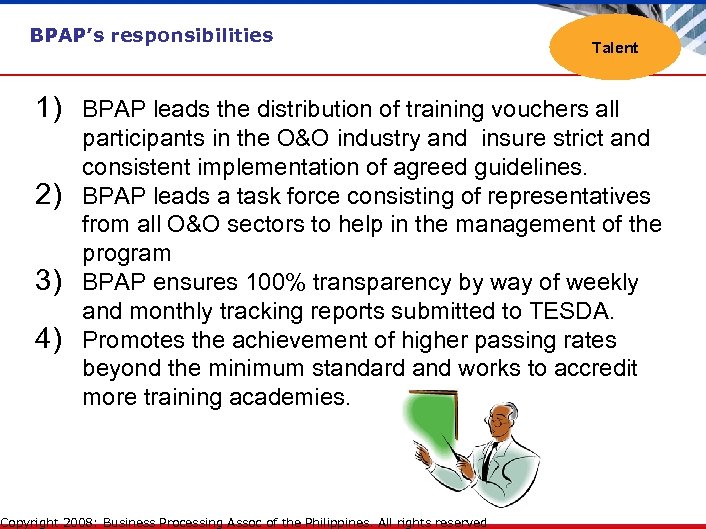
BPAP’s responsibilities Talent 1) BPAP leads the distribution of training vouchers all 2) 3) 4) participants in the O&O industry and insure strict and consistent implementation of agreed guidelines. BPAP leads a task force consisting of representatives from all O&O sectors to help in the management of the program BPAP ensures 100% transparency by way of weekly and monthly tracking reports submitted to TESDA. Promotes the achievement of higher passing rates beyond the minimum standard and works to accredit more training academies. Copyright 2008: Business Processing Assoc of the Philippines. All rights reserved
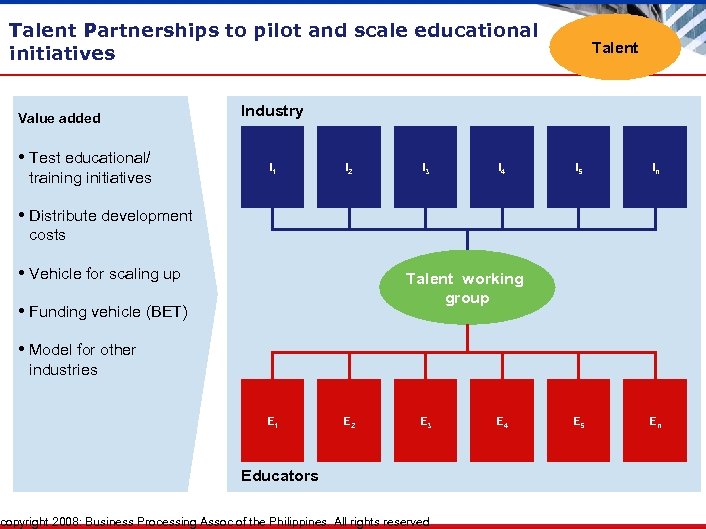
Talent Partnerships to pilot and scale educational initiatives Value added • Test educational/ training initiatives Talent Industry I 1 I 2 I 3 I 4 I 5 In E 5 En • Distribute development costs • Vehicle for scaling up Talent working group • Funding vehicle (BET) • Model for other industries E 1 E 2 E 3 Educators copyright 2008: Business Processing Assoc of the Philippines. All rights reserved E 4
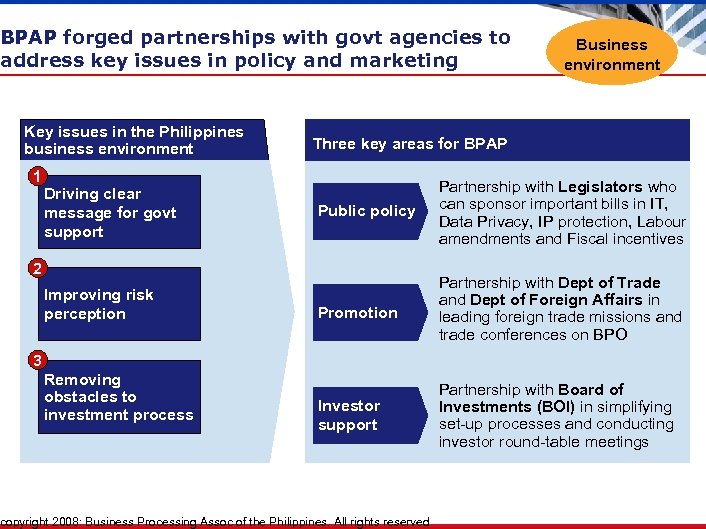
BPAP forged partnerships with govt agencies to address key issues in policy and marketing Key issues in the Philippines business environment 1 Driving clear message for govt support Three key areas for BPAP Public policy Partnership with Legislators who can sponsor important bills in IT, Data Privacy, IP protection, Labour amendments and Fiscal incentives Promotion Partnership with Dept of Trade and Dept of Foreign Affairs in leading foreign trade missions and trade conferences on BPO Investor support Partnership with Board of Investments (BOI) in simplifying set-up processes and conducting investor round-table meetings 2 Improving risk perception Business environment 3 Removing obstacles to investment process copyright 2008: Business Processing Assoc of the Philippines. All rights reserved
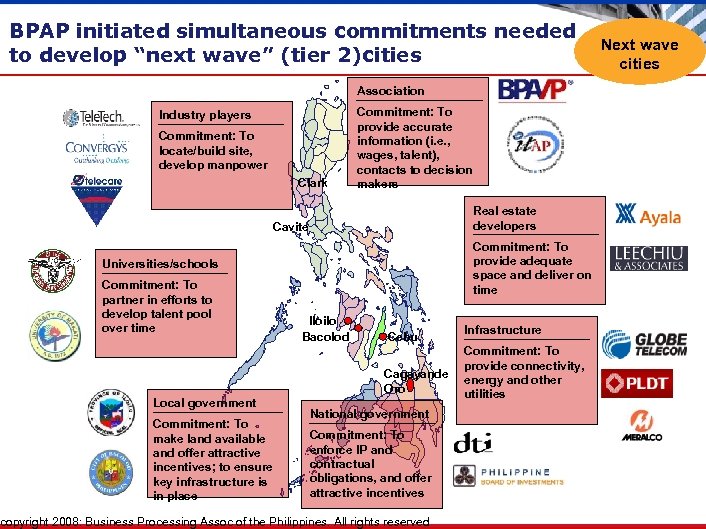
BPAP initiated simultaneous commitments needed to develop “next wave” (tier 2)cities Association Industry players Commitment: To locate/build site, develop manpower Clark Commitment: To provide accurate information (i. e. , wages, talent), contacts to decision makers Real estate developers Cavite Commitment: To provide adequate space and deliver on time Universities/schools Commitment: To partner in efforts to develop talent pool over time Iloilo Bacolod Cebu Cagayande Oro Local government Commitment: To make land available and offer attractive incentives; to ensure key infrastructure is in place National government Commitment: To enforce IP and contractual obligations, and offer attractive incentives copyright 2008: Business Processing Assoc of the Philippines. All rights reserved Infrastructure Commitment: To provide connectivity, energy and other utilities Next wave cities
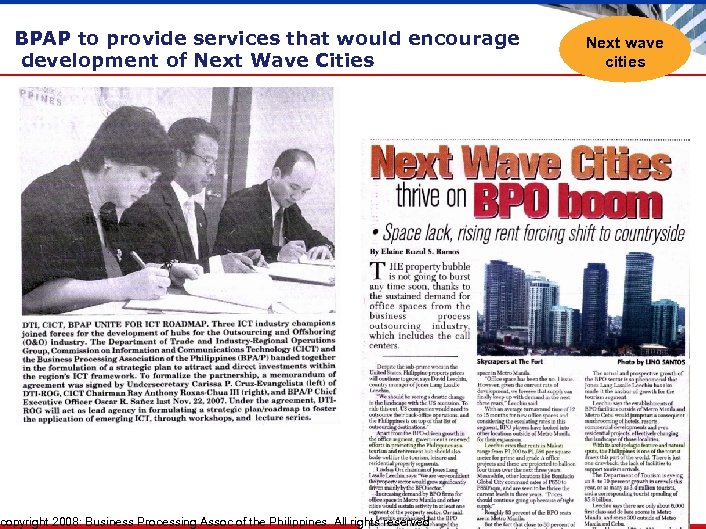
BPAP to provide services that would encourage development of Next Wave Cities copyright 2008: Business Processing Assoc of the Philippines. All rights reserved Next wave cities
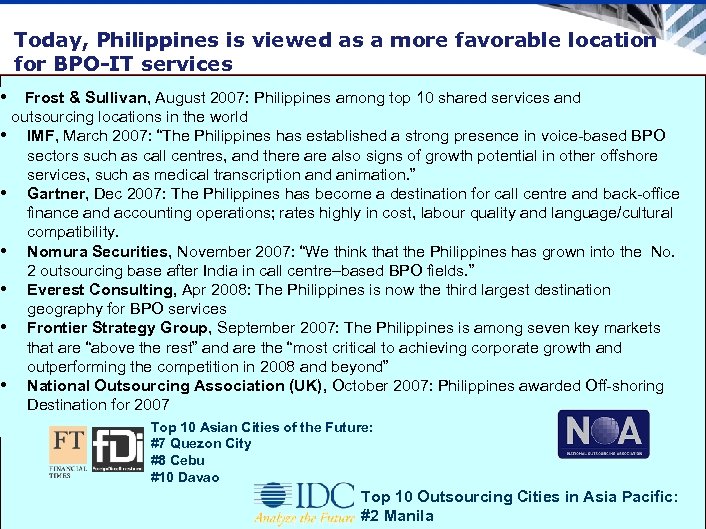
Today, Philippines is viewed as a more favorable location for BPO-IT services • Frost & Sullivan, August 2007: Philippines among top 10 shared services and outsourcing locations in the world • IMF, March 2007: “The Philippines has established a strong presence in voice-based BPO sectors such as call centres, and there also signs of growth potential in other offshore services, such as medical transcription and animation. ” • Gartner, Dec 2007: The Philippines has become a destination for call centre and back-office finance and accounting operations; rates highly in cost, labour quality and language/cultural compatibility. • Nomura Securities, November 2007: “We think that the Philippines has grown into the No. 2 outsourcing base after India in call centre–based BPO fields. ” • Everest Consulting, Apr 2008: The Philippines is now the third largest destination geography for BPO services • Frontier Strategy Group, September 2007: The Philippines is among seven key markets that are “above the rest” and are the “most critical to achieving corporate growth and outperforming the competition in 2008 and beyond” • National Outsourcing Association (UK), October 2007: Philippines awarded Off-shoring Destination for 2007 Top 10 Asian Cities of the Future: #7 Quezon City #8 Cebu #10 Davao Top 10 Outsourcing Cities in Asia Pacific: #2 Manila Copyright 2008: Business Processing Assoc of the Philippines. All rights reserved
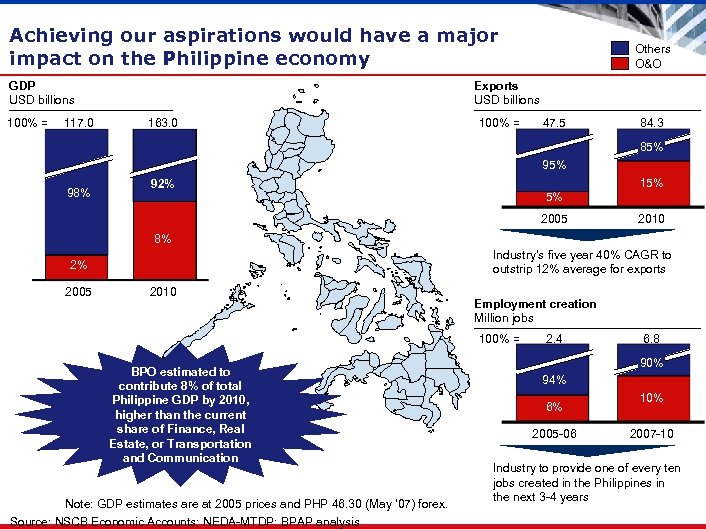
Achieving our aspirations would have a major impact on the Philippine economy GDP USD billions 100% = 117. 0 Others O&O Exports USD billions 163. 0 100% = 47. 5 84. 3 85% 98% 15% 92% 5% 2005 2010 8% Industry’s five year 40% CAGR to outstrip 12% average for exports 2% 2005 2010 Employment creation Million jobs 100% = BPO estimated to contribute 8% of total Philippine GDP by 2010, higher than the current share of Finance, Real Estate, or Transportation and Communication Note: GDP estimates are at 2005 prices and PHP 46. 30 (May ’ 07) forex. Source: NSCB Economic Accounts; NEDA-MTDP; BPAP analysis 2. 4 6. 8 90% 94% 6% 2005 -06 10% 2007 -10 Industry to provide one of every ten jobs created in the Philippines in the next 3 -4 years
Important learnings • Enrolling “stakeholders” means getting everyone’s “skin in the game”. You’re building an industry, not just a company. “Involvement is commitment”. • Leadership from private and public sector has to be “top-level”. Establish clear leadership roles and team responsibilities between both parties. • Follow-through is equally important. Most of the work is multisectoral but one team has to play lead role and be accountable. copyright 2008: Business Processing Assoc of the Philippines. All rights reserved Copyright 2008: Business Processing Assoc of the Philippines. All rights reserved
Muchas gracias! Check us out - www. bpap. org www. dti. gov. ph Experience Excellence Experience Philippines
Скачать презентацию copyright 2008 Driving Private-Public Sector Alliances to Achieve
c750c173911b1a69ad96482253351271.ppt