


 Скачать презентацию Copyright 2007 Pearson Education Canada Chapter 13
df2fa307de02ea596797a3d430121344.ppt
- Количество слайдов: 30
 Copyright © 2007 Pearson Education Canada Chapter 13: Audit of the Sales and Collection Cycle: 1 Tests of Controls
 Chapter 13 objectives w Identify typical records and transactions in the sales cycle w Explain how general controls affect the audit of the sales and collection cycle w Describe the methodology for designing tests of controls for sales w Discuss the effect of the results of tests of controls on the audit w Explain how the tests of control audit program organized 2 Copyright © 2007 Pearson Education Canada
 Classes of transactions in the sales and collection cycle w Sales (cash and on account) w Cash receipts w Sales returns and allowances w Charge-off (or write-off) of uncollectible accounts w Bad-debt expense 3 Copyright © 2007 Pearson Education Canada
 Typical records and transactions in the sales cycle w Sale is initiated with a customer order; shipping documents and invoice accompany the sale, which is recorded both in a transaction file (sales) and summarized in a customer master file (or in a database) w Routine reports include a sales journal and an aged accounts receivable trial balance 4 Copyright © 2007 Pearson Education Canada
 Method of recording the transaction w Can be recorded manually (rare now) w Alternatively, could be entered in batches in the computer system (groups of transactions) w If recorded one transaction at a time, is online transaction processing 5 Copyright © 2007 Pearson Education Canada
 Control differences between batch and online systems: audit trails w Batch systems: w Transactions readily traced from source transaction to general ledger posting w Totals from groups of transactions are totaled, and these totals traced w Online systems: w Transactions may be initiated and recorded without source documents (e. g. phone orders) w Document sequencing is important to track documents. 6 Copyright © 2007 Pearson Education Canada
 Control differences between batch and online systems: error detection and correction w Batch systems: w If one transaction is in error, the whole batch is rejected w Error followup is required to ensure timely processing and avoid cutoff errors w Online systems: w Focus is on preventing errors w Input edit processes check for valid customer data and reasonableness 7 Copyright © 2007 Pearson Education Canada
 Control differences between batch and online systems: segregation of duties w Batch systems: w Online systems: w Can be achieved by w Decentralization may separating totaling result in inadequate and counting from segregation of duties data entry w Use passwords to w Reconciliation and separate transaction error followup should entry from master file be independent of data entry (e. g. update of entry credit limits) 8 Copyright © 2007 Pearson Education Canada
 Effect of general controls w Prior to assessing the individual transaction cycles, the auditor documents general controls that are pervasive and that affect multiple transaction cycles w If general controls are good, the auditor may be able to rely upon and test interdependent or fully automated controls w If general controls are poor, the auditor may be able to rely upon only manual controls, or may need to conduct a substantive-oriented audit 9 Copyright © 2007 Pearson Education Canada
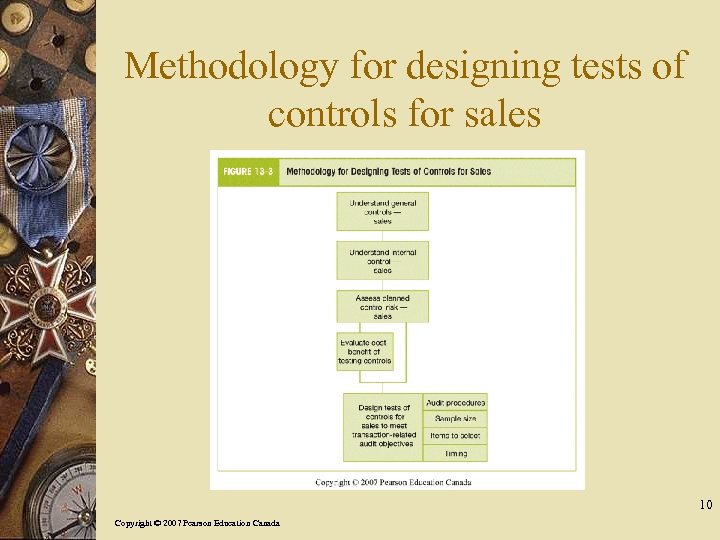 Methodology for designing tests of controls for sales 10 Copyright © 2007 Pearson Education Canada
 Documentation of internal controls w Internal controls need to be documented for every audit assertion for every class of transactions w The auditor focuses on key controls, or those controls that have the greatest effect for that audit assertion w These controls could be manual, automated, or interdependent 11 Copyright © 2007 Pearson Education Canada
 Tests of internal controls w Once the key controls have been identified, the auditor can decide whether the control(s) will be tested or whether tests of details will be conducted instead w Tests of internal controls will be devised for each key control that will be tested 12 Copyright © 2007 Pearson Education Canada
 Example of internal control: occurrence assertion (manual) w Key control: credit is approved before shipment takes place: The sales manager initials all sales orders over $25 to indicate approval. w Possible test of control: Examine a sample of sales orders to ensure that the sales manager’s initial is present. 13 Copyright © 2007 Pearson Education Canada
 Example of internal control: occurrence assertion (automated batch) w Key control: Orders causing balances to exceed credit limits are printed on an exception report and are not processed for shipment. w Possible test of control: Examine a selection of exception reports and ensure that: these orders exceed the credit limit and that the orders were not processed for shipment. 14 Copyright © 2007 Pearson Education Canada
 Example of internal control: occurrence assertion (automated online) w Key control: Orders causing balances to exceed credit limits are held in a separate transaction file and are not processed for shipment. w Possible test of control: Request the client to print off the day’s on-hold transaction file. View the file to ensure that all orders in the file exceed the customer’s credit limits. 15 Copyright © 2007 Pearson Education Canada
 Example of internal control: occurrence assertion (interdependent) w Key control: Orders causing balances to exceed the credit limit are printed on an exception report and must be approved by a credit manager prior to shipment by means of entering a password. w Possible test of control: Review an exception report and ensure that all sales orders there caused the customers’ credit limit to be exceeded. Discuss with the sales manager processes followed to release such held orders. 16 Copyright © 2007 Pearson Education Canada
 Practice problem 13 -22 (p. 412) w Practice identifying the audit assertion that goes with a particular control w How would you test the control? 17 Copyright © 2007 Pearson Education Canada
 Manual, automated and interdependent controls w From the previous examples, you can see that: – Manual controls are controls performed entirely by people – Automated controls (batch or online) are performed only by computerized systems – Interdependent controls rely upon computer processes (automation) but a person must also be involved to fully perform the control 18 Copyright © 2007 Pearson Education Canada
 Frequency of testing of internal controls w Which type of controls must be tested annually? w Which type of controls could potentially be tested every three years? Under what circumstances? 19 Copyright © 2007 Pearson Education Canada
 Full testing of interdependent controls w The interdependent control has two parts: – A function performed by an automated systems – A function performed by an individual w It is only possible to rely upon the automated function if: general controls have been assessed as good w Then, both parts of the control must be tested to enable reliance upon the control 20 Copyright © 2007 Pearson Education Canada
 What if control testing yielded many errors? w The first step is to determine whether the errors (exceptions) were due to a particular circumstance or restricted to a particular time period w For example, the credit manager was on holidays, and so no one approved credit, or the person who approved credit in his/her absence made many errors 21 Copyright © 2007 Pearson Education Canada
 Practice problem 13 -21 (p. 412) w Practice differentiating between what is likely an error or fraud w How would you prevent the error or fraud? 22 Copyright © 2007 Pearson Education Canada
 What if control testing yielded many errors? (cont’d) w If it turns out that the errors are systemic (i. e. throughout the period and cannot be isolated to a particular cause), then w The auditor first looks for a compensating (alternative control) w If this alternative control achieves the same purpose and is functioning correctly, then the auditor can still rely upon internal controls 23 Copyright © 2007 Pearson Education Canada
 How do we decide whethere could be a material error? w If there is no compensating control, then the auditor needs to investigate to determine whethere is potential for this weakness to result in a material error w Conduct dual-purpose or weakness investigation (detail) tests w These tests help to quantify the extent of the error 24 Copyright © 2007 Pearson Education Canada
 Results of quantifying the error w If it turns out that the results of the weakness could result in immaterial error, the weakness will be reported in a management letter, and extended tests of detail may not be required w If a material error could result, the matter needs to be reported both to management and the audit committee and the tests need to be sufficient to provide a reasonable range for the extent of the error 25 Copyright © 2007 Pearson Education Canada
 Design versus performance format of audit program w The initial audit program is organized by audit assertion, to ensure that controls are assessed (and possibly tested) for each assertion w It is then organized into a performance format to maximum efficiency (e. g. all tests for the shipping document would be grouped) w The use of automated working paper software facilitates this process 26 Copyright © 2007 Pearson Education Canada
 Computer-assisted audit tests w Where there a large number of transactions, it is effective for auditors to use computer-assisted audit tests w For example, in internal controls testing, the auditor could use automated sampling routines to access the client sales transaction file and select an attribute sample of sales transactions, printing details of the transactions 27 Copyright © 2007 Pearson Education Canada
 Practice problem 13 -24 (p. 413) w Look at the sampling process for sales w How are results evaluated? 28 Copyright © 2007 Pearson Education Canada
 Suitability of test data w Batch systems: Test data may be inappropriate, as the transactions would be processed by the accounting system. Only transactions that will be rejected could be used. w Online systems: Test data is useful to verify the accurate functioning of online input edit controls (e. g. rejection of invalid customer numbers) 29 Copyright © 2007 Pearson Education Canada
 Suitability of generalized audit software w Best suited for analytical review, tests of detail, or dual-purpose tests, for example: – Adding up the sales transactions to sum to the sales for the day, month or year – Reperformance of tax calculations – Examination of customer master file to determine if any balances exceed their credit limit 30 Copyright © 2007 Pearson Education Canada