


 Скачать презентацию Copyright 2005 Mc Graw-Hill Ryerson Ltd 0
0b0e78e5e014c029948f8ff8fcf4a21f.ppt
- Количество слайдов: 27
 Copyright 2005 © Mc. Graw-Hill Ryerson Ltd. 0
 CHAPTER 12 Monetary Policy and Fiscal Policy in the Very Short Run Learning objectives Understand that both fiscal and monetary policy can be used to stabilize the economy in the short run. Understand that the output effect of expansionary fiscal policy is reduced by crowding out. Understand that the slope of the LM curve has an important bearing on the effectiveness of fiscal and monetary policy. Power. Point® slides prepared by Marc Prud’Homme, University of of Ottawa Power. Point® slides prepared by Marc Prud’Homme, University Ottawa Copyright 2005 © Mc. Graw-Hill Ryerson Ltd.
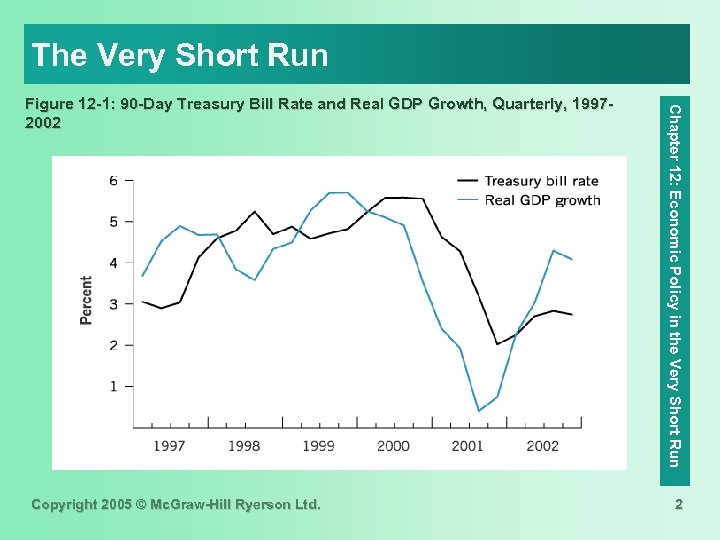 The Very Short Run Copyright 2005 © Mc. Graw-Hill Ryerson Ltd. Chapter 12: Economic Policy in the Very Short Run Figure 12 -1: 90 -Day Treasury Bill Rate and Real GDP Growth, Quarterly, 19972002 2
 Monetary Policy o It must have the ability to lower interest rates. o Its ability to change real output in the very short run depends on the interest rate response in the IS curve. Copyright 2005 © Mc. Graw-Hill Ryerson Ltd. Chapter 12: Economic Policy in the Very Short Run o Monetary Policy: Any decision made by the Bank of Canada concerning the level of the nominal money stock. o The adjustment of the economy as a result of this monetary policy change is dependent on two general responses: 3
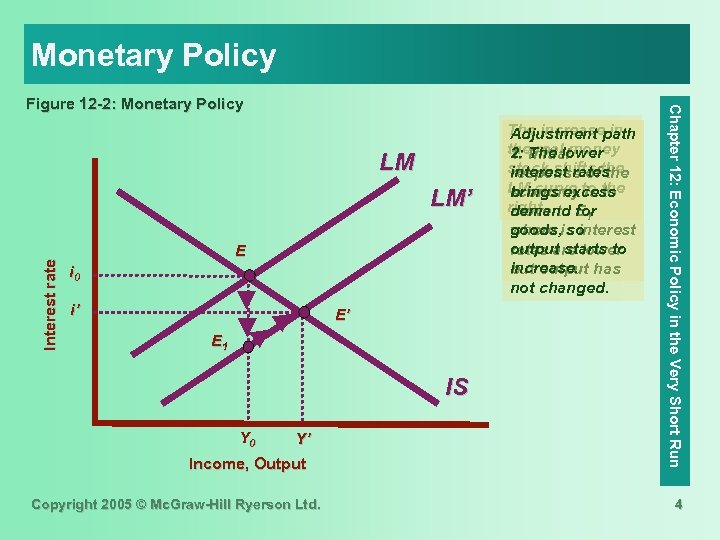 Monetary Policy LM Interest rate LM’ E i 0 i’ E’ E 1 IS Y 0 Y’ Income, Output Copyright 2005 © Mc. Graw-Hill Ryerson Ltd. The increasepath Adjustment in the. Initialmoney 2: real 1: The lower stock shifts the interest rates response of the LM curve to the brings excess economy is to right. to for demand E 1 move goods, so where is interest output starts to rates are lower increase. but output has not changed. Chapter 12: Economic Policy in the Very Short Run Figure 12 -2: Monetary Policy 4
 Monetary Policy o The Economist: Is Japan in a Liquidity Trap? o Modern version of the liquidity trap: When interest rates are so low that a central bank has no scope to lower them further. Copyright 2005 © Mc. Graw-Hill Ryerson Ltd. Chapter 12: Economic Policy in the Very Short Run o Liquidity trap: A situation that arises when the LM curve is horizontal because the interest elasticity of demand is infinite. 5
 Policy in Action The liquidity trap on Canada and the United States. September 11 th Lower interest rates initiated by the Bank of Canada and the US Federal Reserve Board. 40 -year low. Output growth remained sluggish US economy. Output growth rebounded in Canada. Copyright 2005 © Mc. Graw-Hill Ryerson Ltd. 6
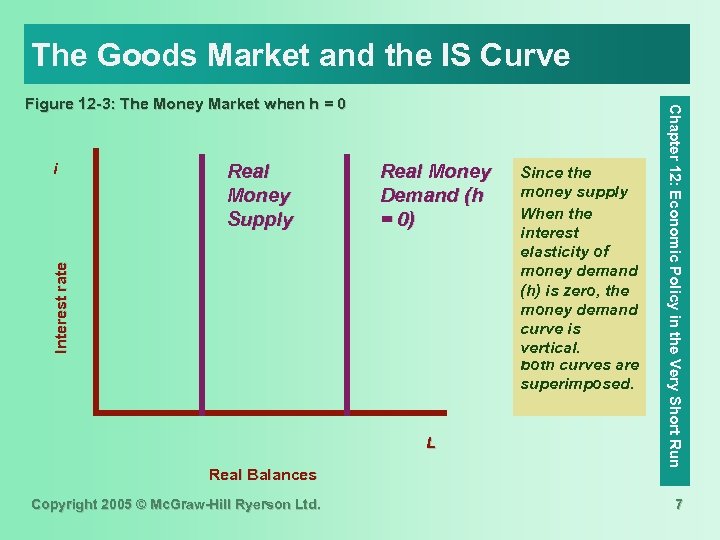 The Goods Market and the IS Curve Real Money Supply Real Money Demand (h = 0) Interest rate i L Real Balances Copyright 2005 © Mc. Graw-Hill Ryerson Ltd. Since the money supply curve is also When the vertical, there interest is either no elasticity of equilibrium (as money demand shown here) or (h) is zero, the an infinite money demand number curve is equilibria if vertical. both curves are superimposed. Chapter 12: Economic Policy in the Very Short Run Figure 12 -3: The Money Market when h = 0 7
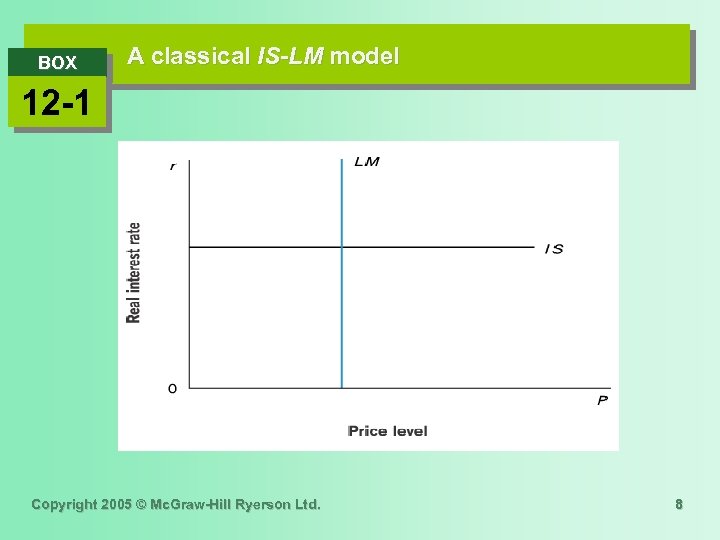 BOX A classical IS-LM model 12 -1 Copyright 2005 © Mc. Graw-Hill Ryerson Ltd. 8
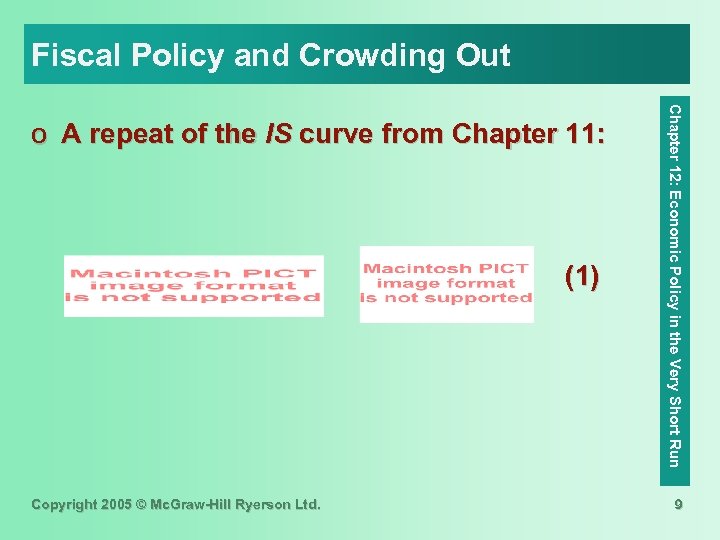 Fiscal Policy and Crowding Out (1) Copyright 2005 © Mc. Graw-Hill Ryerson Ltd. Chapter 12: Economic Policy in the Very Short Run o A repeat of the IS curve from Chapter 11: 9
 Fiscal Policy and Crowding Out o Income increases more and interest rates increase less, the flatter the LM schedule. o Income increases less and interest rates increase less, the flatter the LM schedule. o Income and interest rates increase more the larger the multiplier, and thus the horizontal shift in the IS schedule. Copyright 2005 © Mc. Graw-Hill Ryerson Ltd. Chapter 12: Economic Policy in the Very Short Run o Crowding Out: Occurs when expansionary fiscal policy causes interest rates to rise, thereby reducing private spending, particularly investment. 10
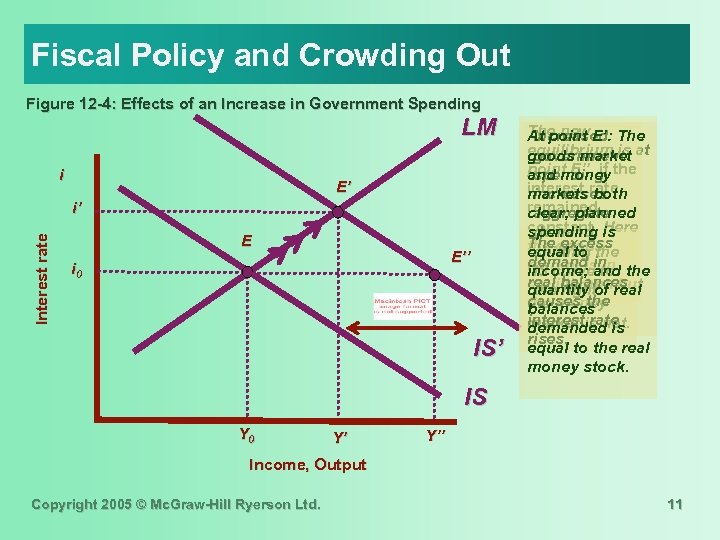 Fiscal Policy and Crowding Out Figure 12 -4: Effects of an Increase in Government Spending LM i E’ Interest rate i’ E E’’ i 0 IS’ The new E’: The Increased At point equilibrium is at government goods market point E’’, if the spending and money interest rate increases markets both remained aggregate clear; planned constant. is demand, spending Here The excess the goods shifting equal to the demand in market is to the IS curve in income; and real balances equilibriumreal the right. quantity of but causes the money balances interest rate market is not. demanded is rises. equal to the real money stock. IS Y 0 Y’ Y’’ Income, Output Copyright 2005 © Mc. Graw-Hill Ryerson Ltd. 11
 Fiscal Policy and Crowding Out 1) In fully employed economies, crowding out occurs through a different mechanism. An increase in demand will lead to an increase in the price level. The increase in price reduces real balances. The LM curve moves to the left, raising interest rates until the increase in aggregate demand is fully crowded out. 2) In an economy with unemployed resources, there will not be full crowding out because the LM curve is not, in fact, vertical. Copyright 2005 © Mc. Graw-Hill Ryerson Ltd. Chapter 12: Economic Policy in the Very Short Run o Is Crowding Out Important? 12
 Fiscal Policy and Crowding Out 3) With unemployment, interest rates need not rise at all when government spending rises, and there need not be any crowding out. This is because the monetary authorities can accommodate the fiscal expansion. o Monetary accommodation: The central bank prints money to buy the bonds with which the government pays for its deficit. Copyright 2005 © Mc. Graw-Hill Ryerson Ltd. Chapter 12: Economic Policy in the Very Short Run o Is Crowding Out Important (Cont’d) ? 13
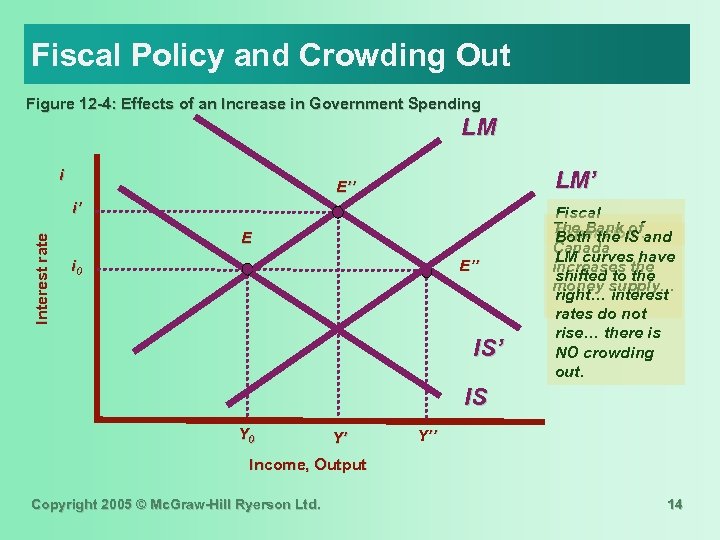 Fiscal Policy and Crowding Out Figure 12 -4: Effects of an Increase in Government Spending LM i LM’ E’’ Interest rate i’ E i 0 E’’ IS’ Fiscal The Bank of Expansion… Both the IS and Canada LM curves have increases the shifted to the money supply… right… interest rates do not rise… there is NO crowding out. IS Y 0 Y’ Y’’ Income, Output Copyright 2005 © Mc. Graw-Hill Ryerson Ltd. 14
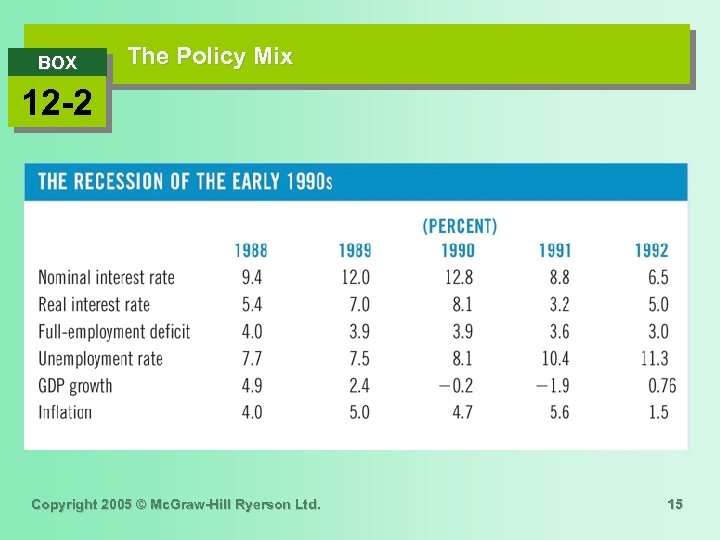 BOX The Policy Mix 12 -2 Copyright 2005 © Mc. Graw-Hill Ryerson Ltd. 15
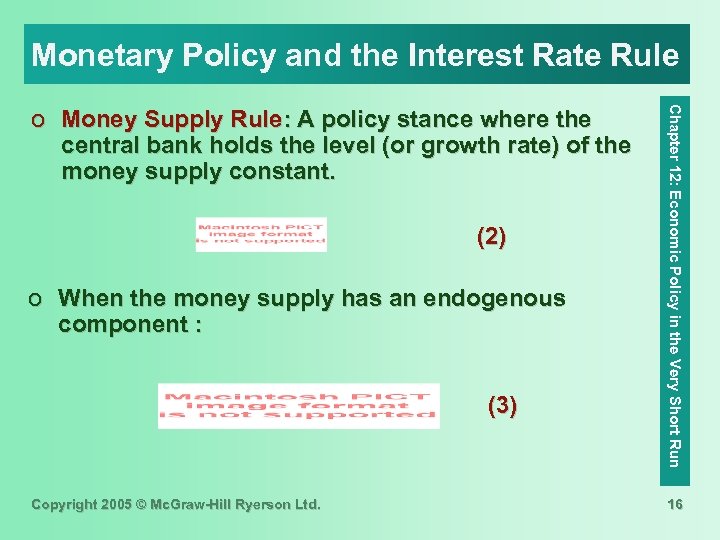 Monetary Policy and the Interest Rate Rule (2) o When the money supply has an endogenous component : (3) Copyright 2005 © Mc. Graw-Hill Ryerson Ltd. Chapter 12: Economic Policy in the Very Short Run o Money Supply Rule: A policy stance where the central bank holds the level (or growth rate) of the money supply constant. 16
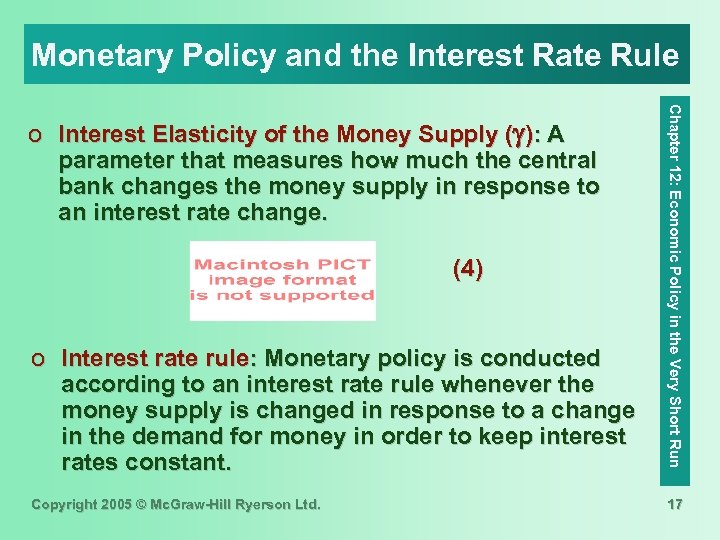 Monetary Policy and the Interest Rate Rule (4) o Interest rate rule: Monetary policy is conducted according to an interest rate rule whenever the money supply is changed in response to a change in the demand for money in order to keep interest rates constant. Copyright 2005 © Mc. Graw-Hill Ryerson Ltd. Chapter 12: Economic Policy in the Very Short Run o Interest Elasticity of the Money Supply ( ): A parameter that measures how much the central bank changes the money supply in response to an interest rate change. 17
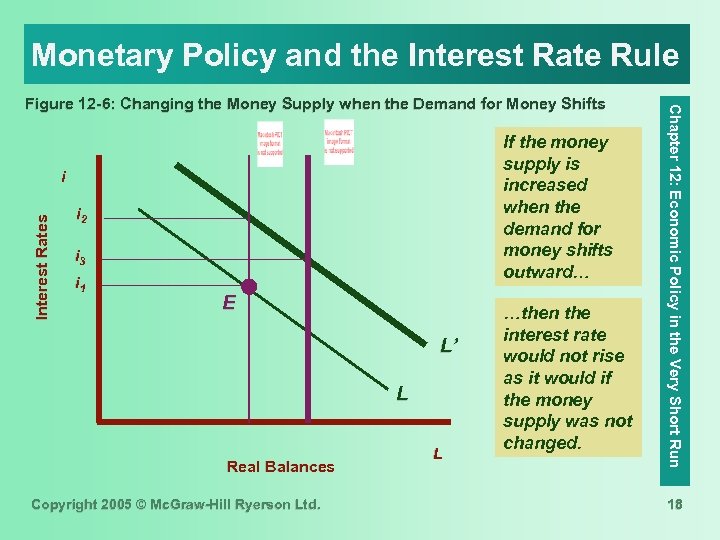 Monetary Policy and the Interest Rate Rule If the money supply is increased when the demand for money shifts outward… Interest Rates i i 2 i 3 i 1 E L’ L Real Balances Copyright 2005 © Mc. Graw-Hill Ryerson Ltd. L …then the interest rate would not rise as it would if the money supply was not changed. Chapter 12: Economic Policy in the Very Short Run Figure 12 -6: Changing the Money Supply when the Demand for Money Shifts 18
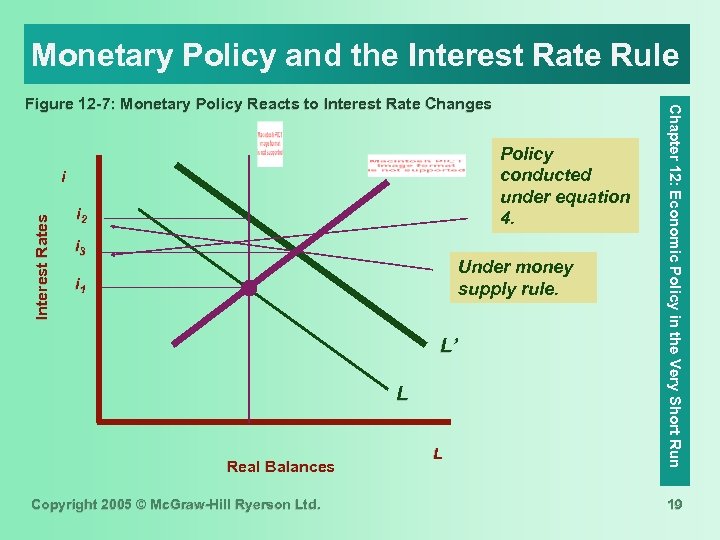 Monetary Policy and the Interest Rate Rule Policy conducted under equation 4. Interest Rates i i 2 i 3 Under money supply rule. i 1 L’ L Real Balances Copyright 2005 © Mc. Graw-Hill Ryerson Ltd. L Chapter 12: Economic Policy in the Very Short Run Figure 12 -7: Monetary Policy Reacts to Interest Rate Changes 19
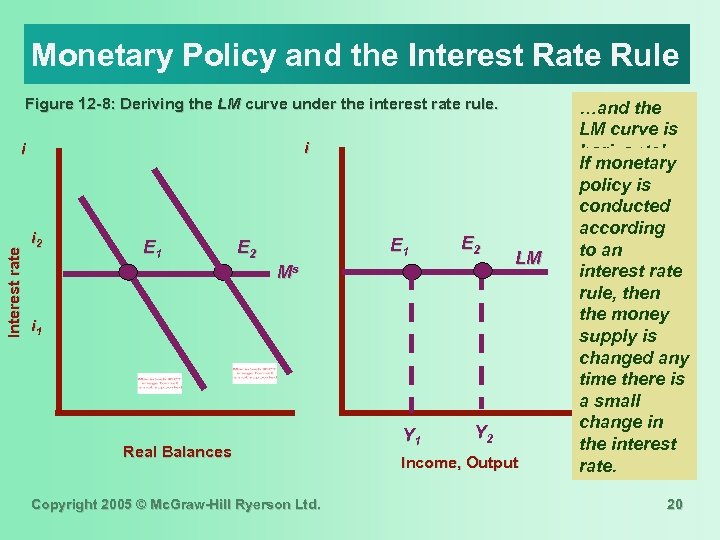 Monetary Policy and the Interest Rate Rule Figure 12 -8: Deriving the LM curve under the interest rate rule. i Interest rate i i 2 E 1 E 2 Ms LM i 1 Real Balances Copyright 2005 © Mc. Graw-Hill Ryerson Ltd. Y 1 Y 2 Income, Output …and the LM curve is horizontal. If monetary policy is conducted according to an interest rate rule, then the money supply is changed any time there is a small change in the interest rate. 20
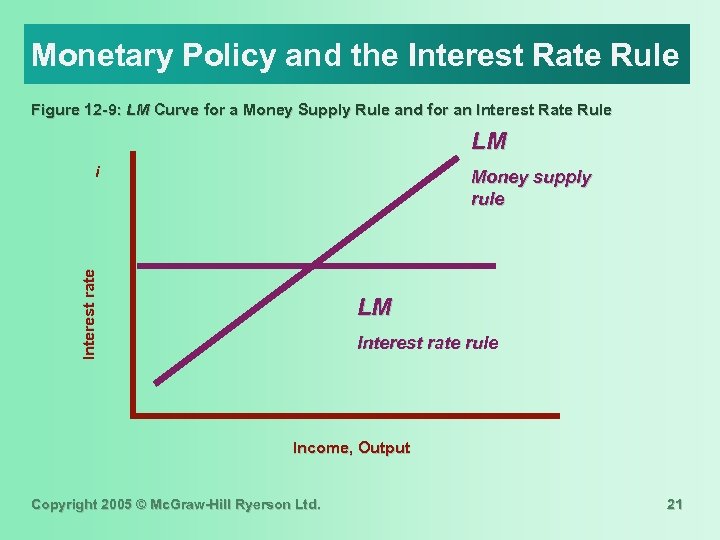 Monetary Policy and the Interest Rate Rule Figure 12 -9: LM Curve for a Money Supply Rule and for an Interest Rate Rule LM i Interest rate Money supply rule LM Interest rate rule Income, Output Copyright 2005 © Mc. Graw-Hill Ryerson Ltd. 21
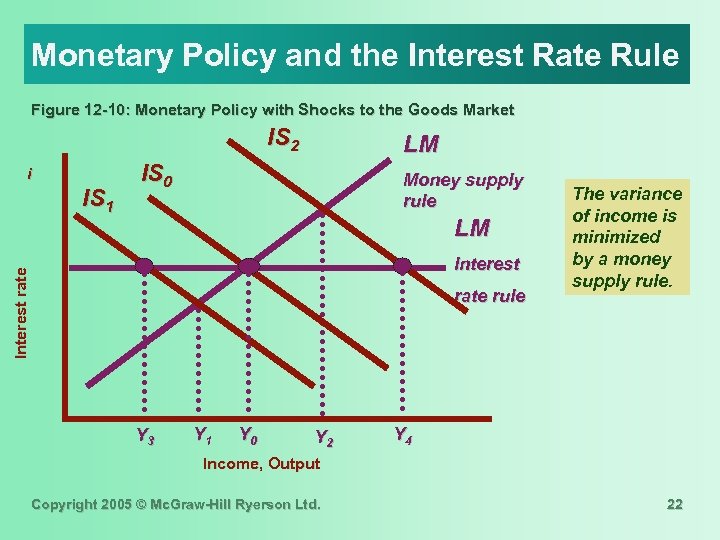 Monetary Policy and the Interest Rate Rule Figure 12 -10: Monetary Policy with Shocks to the Goods Market IS 2 i IS 1 LM IS 0 Money supply rule LM Interest rate rule Y 3 Y 1 Y 0 Y 2 The variance of income is minimized by a money supply rule. Y 4 Income, Output Copyright 2005 © Mc. Graw-Hill Ryerson Ltd. 22
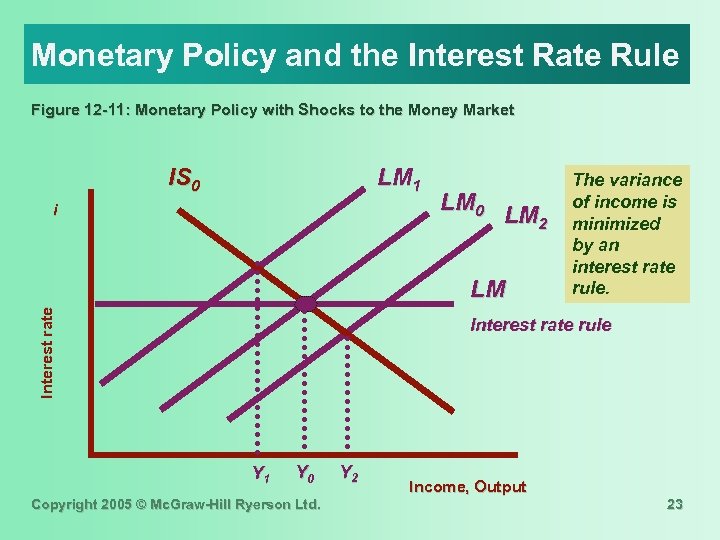 Monetary Policy and the Interest Rate Rule Figure 12 -11: Monetary Policy with Shocks to the Money Market IS 0 LM 1 i LM 0 LM 2 Interest rate LM The variance of income is minimized by an interest rate rule. Interest rate rule Y 1 Y 0 Copyright 2005 © Mc. Graw-Hill Ryerson Ltd. Y 2 Income, Output 23
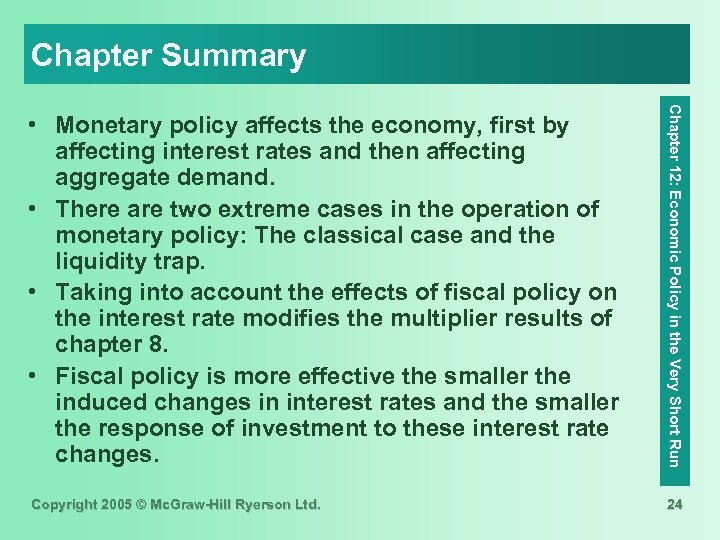 Chapter Summary • Monetary policy affects the economy, first by affecting interest rates and then affecting aggregate demand. • There are two extreme cases in the operation of monetary policy: The classical case and the liquidity trap. • Taking into account the effects of fiscal policy on the interest rate modifies the multiplier results of chapter 8. • Fiscal policy is more effective the smaller the induced changes in interest rates and the smaller the response of investment to these interest rate changes. Chapter 12: Economic Policy in the Very Short Run Copyright 2005 © Mc. Graw-Hill Ryerson Ltd. 24
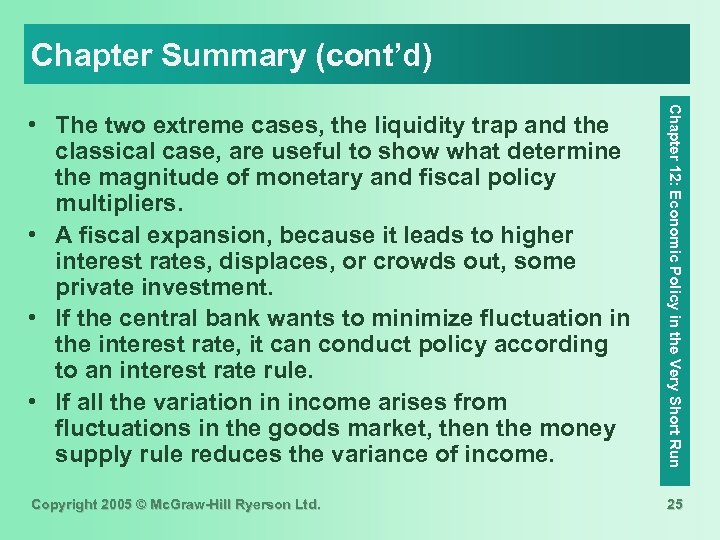 Chapter Summary (cont’d) • The two extreme cases, the liquidity trap and the classical case, are useful to show what determine the magnitude of monetary and fiscal policy multipliers. • A fiscal expansion, because it leads to higher interest rates, displaces, or crowds out, some private investment. • If the central bank wants to minimize fluctuation in the interest rate, it can conduct policy according to an interest rate rule. • If all the variation in income arises from fluctuations in the goods market, then the money supply rule reduces the variance of income. Chapter 12: Economic Policy in the Very Short Run Copyright 2005 © Mc. Graw-Hill Ryerson Ltd. 25
 The End Chapter 12: Economic Policy in the Very Short Run Copyright 2005 © Mc. Graw-Hill Ryerson Ltd. 26