


 Скачать презентацию Copyright 2004 South-Western 2007 Thomson South-Western
e50199bfb28900fcdc6cdb1952c39241.ppt
- Количество слайдов: 32
 Copyright © 2004 South-Western © 2007 Thomson South-Western
 Financial System and Financial Institutions • The financial system (金融體系)is made up of financial institutions (金融機構)that moves the economy’s scarce resources from savers to borrowers. • Financial institutions: 2 categories 1. financial markets (金融市場) 2. financial intermediaries (金融中介) Copyright © 2004 South-Western
 Financial Institutions 1. Financial Markets : 金融市場,直接金融 Savers can directly provide funds to borrowers. • Stock Market 股票市場 • Bond Market 債券市場 2. Financial Intermediaries: 金融中介,間接金融 Savers indirectly provide funds to borrowers. • Banks 銀行 • Mutual Funds 共同基金 Copyright © 2004 South-Western
 Financial Markets : Bond Market 債券市場 • A bond is a certificate of indebtedness that specifies obligations of the borrower to the holder of the bond. IOU • 面額固定,利率是隱含的,視購買價格而定 • 1+r = Face value / Price of bond • Characteristics of a Bond (1) Term (期限): length of time until the bond matures. (2) Credit Risk (信用風險): The probability that the borrower will fail to pay some of the interest or principal. (3) Tax Treatment (稅法): tax on interest income of bond. • Some gov’t bonds are federal tax exempt. Copyright © 2004 South-Western
 Financial Markets: Stock Market 股票市場 • Stock: a claim to partial ownership (profits) in a firm. • equity financing (股票融通): the sale of stock to raise money. • Compared to bonds, stocks offer both higher risk and potentially higher returns. • 美股道瓊指數, and NASDAQ. 台股指數(上市集中市場、上櫃店頭市場) Copyright © 2004 South-Western
 The Stock Market • Most newspaper stock tables provide the following information: • Price (of a share) • Volume (number of shares sold) • Dividend (profits paid to stockholders) • Price-earnings ratio (P/E、PER). 本益比 一家公司某一時點股價相對於年度每股獲利的比值。 • 台灣:證券種類、開盤、收盤、漲跌、最高 、最低、成交量 Copyright © 2004 South-Western
 Financial Intermediaries: Banks 銀行 • Banks people save →bank deposits → loans to borrowers. • Borrowing interest rate > interest rate on deposits. • Banks help create a medium of exchange by allowing people to write checks (支票) against their deposits. • A medium of exchanges(交易媒介)is an item that people can easily use to engage in transactions. This facilitates the purchases of goods and services Copyright © 2004 South-Western
 Financial Intermediaries: Mutual Funds 共同基金 • A mutual fund is an institution (信託投資公司) that sells shares to the public and uses the proceeds to buy a portfolio (資產配置), of various types of stocks, bonds, or both. • They allow people with small amounts of money to easily diversify. Copyright © 2004 South-Western
 Other Financial Intermediaries • • Credit unions 信用合作社 Pension funds 退休基金 Insurance companies 保險公司 Loan sharks 錢莊,放高利貸的人。 Copyright © 2004 South-Western
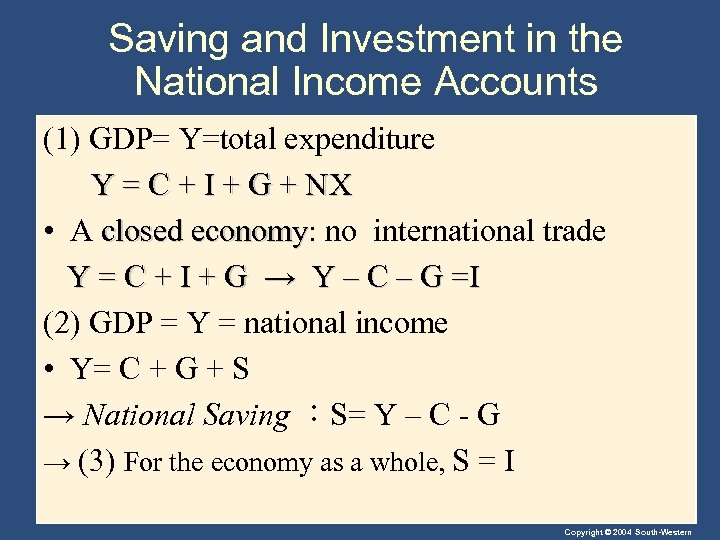 Saving and Investment in the National Income Accounts (1) GDP= Y=total expenditure Y = C + I + G + NX • A closed economy: no international trade economy Y = C + I + G → Y – C – G =I (2) GDP = Y = national income • Y= C + G + S → National Saving :S= Y – C - G → (3) For the economy as a whole, S = I Copyright © 2004 South-Western
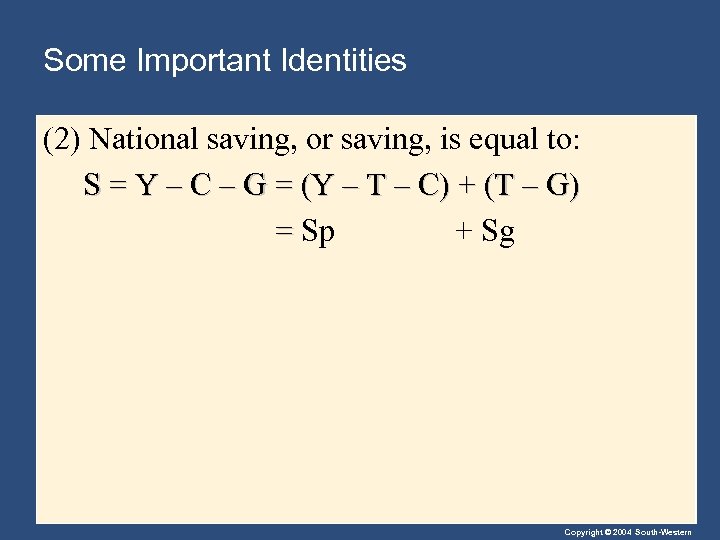 Some Important Identities (2) National saving, or saving, is equal to: S = Y – C – G = (Y – T – C) + (T – G) = Sp + Sg Copyright © 2004 South-Western
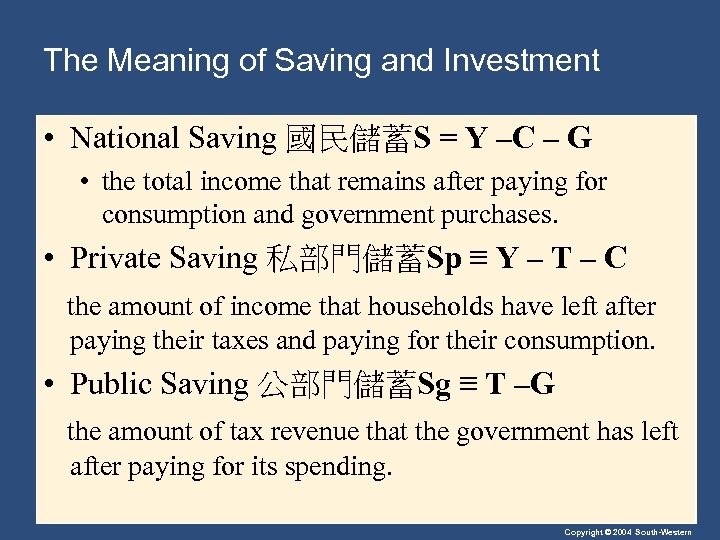 The Meaning of Saving and Investment • National Saving 國民儲蓄S = Y –C – G • the total income that remains after paying for consumption and government purchases. • Private Saving 私部門儲蓄Sp ≡ Y – T – C the amount of income that households have left after paying their taxes and paying for their consumption. • Public Saving 公部門儲蓄Sg ≡ T –G the amount of tax revenue that the government has left after paying for its spending. Copyright © 2004 South-Western
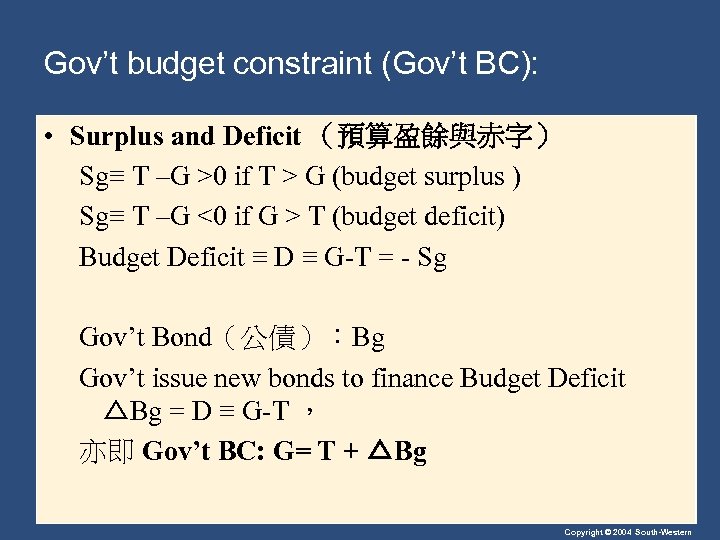 Gov’t budget constraint (Gov’t BC): • Surplus and Deficit (預算盈餘與赤字) Sg≡ T –G >0 if T > G (budget surplus ) Sg≡ T –G <0 if G > T (budget deficit) Budget Deficit ≡ D ≡ G-T = - Sg Gov’t Bond(公債):Bg Gov’t issue new bonds to finance Budget Deficit △Bg = D ≡ G-T , 亦即 Gov’t BC: G= T + △Bg Copyright © 2004 South-Western
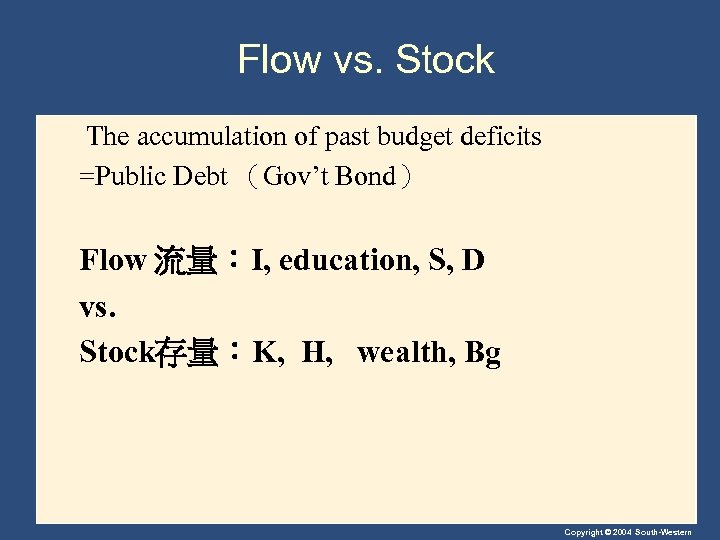 Flow vs. Stock The accumulation of past budget deficits =Public Debt (Gov’t Bond) Flow 流量:I, education, S, D vs. Stock存量:K, H, wealth, Bg Copyright © 2004 South-Western
 Market for Loanable Funds • Financial markets coordinate economy’s saving and investment in the market for loanable funds. (可貸資金市場,LF) Copyright © 2004 South-Western
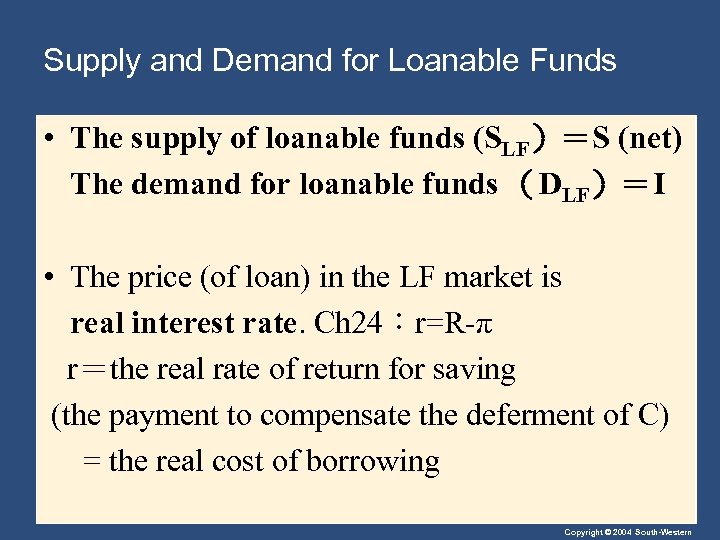 Supply and Demand for Loanable Funds • The supply of loanable funds (SLF)=S (net) The demand for loanable funds (DLF)=I • The price (of loan) in the LF market is real interest rate. Ch 24:r=R-π r=the real rate of return for saving (the payment to compensate the deferment of C) = the real cost of borrowing Copyright © 2004 South-Western
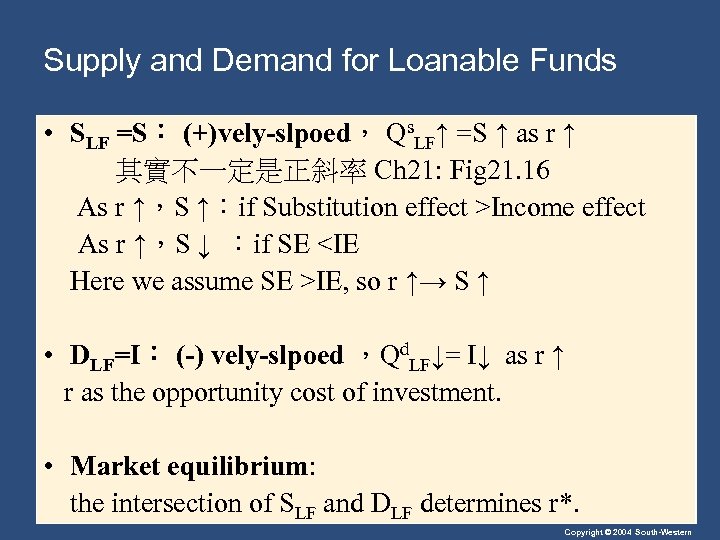 Supply and Demand for Loanable Funds • SLF =S: (+)vely-slpoed, Qs. LF↑ =S ↑ as r ↑ 其實不一定是正斜率 Ch 21: Fig 21. 16 As r ↑,S ↑:if Substitution effect >Income effect As r ↑,S ↓ :if SE
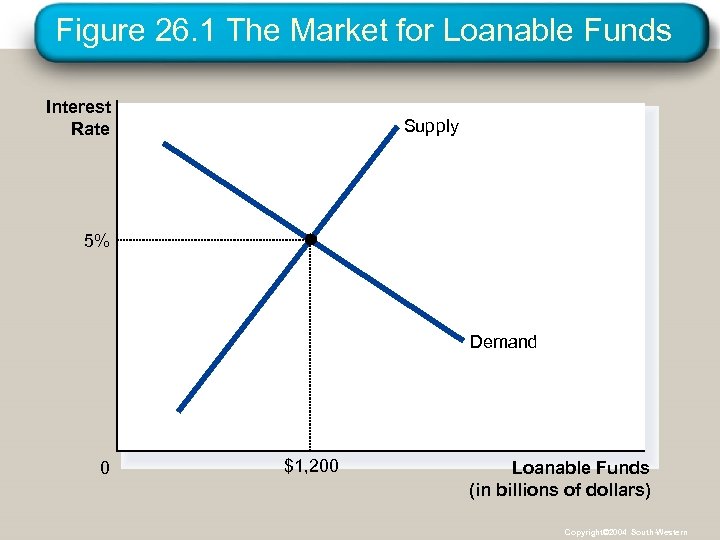 Figure 26. 1 The Market for Loanable Funds Interest Rate Supply 5% Demand 0 $1, 200 Loanable Funds (in billions of dollars) Copyright© 2004 South-Western
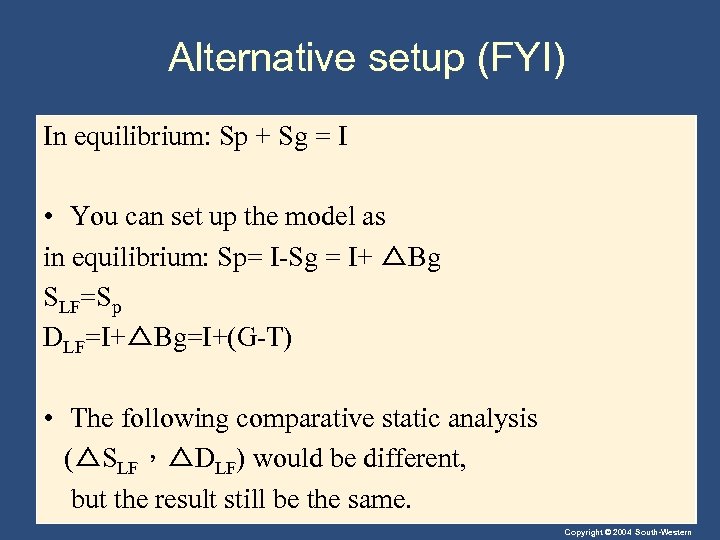 Alternative setup (FYI) In equilibrium: Sp + Sg = I • You can set up the model as in equilibrium: Sp= I-Sg = I+ △Bg SLF=Sp DLF=I+△Bg=I+(G-T) • The following comparative static analysis (△SLF,△DLF) would be different, but the result still be the same. Copyright © 2004 South-Western
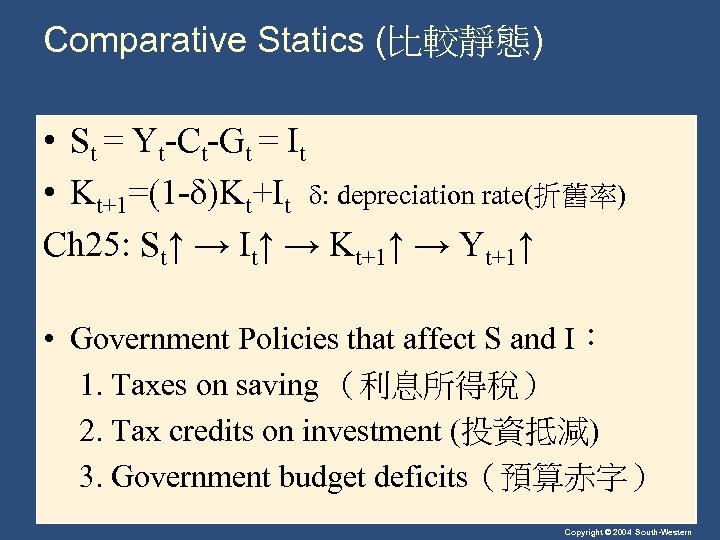 Comparative Statics (比較靜態) • St = Yt-Ct-Gt = It • Kt+1=(1 -δ)Kt+It δ: depreciation rate(折舊率) Ch 25: St↑ → It↑ → Kt+1↑ → Yt+1↑ • Government Policies that affect S and I: 1. Taxes on saving (利息所得稅) 2. Tax credits on investment (投資抵減) 3. Government budget deficits(預算赤字) Copyright © 2004 South-Western
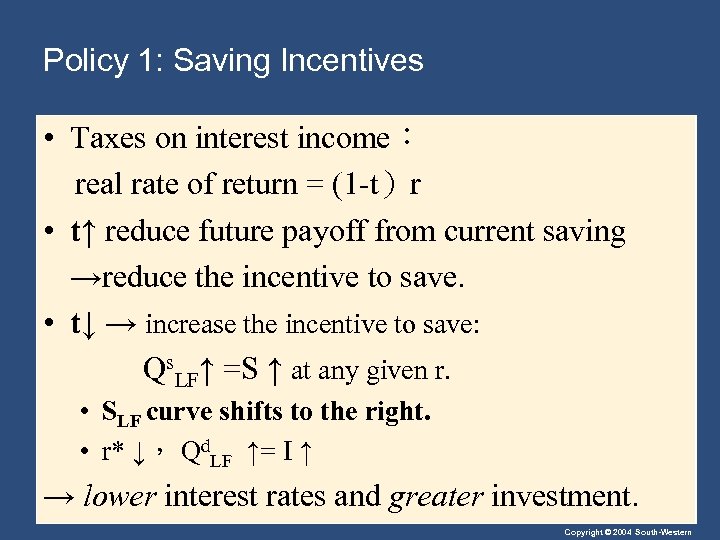 Policy 1: Saving Incentives • Taxes on interest income: real rate of return = (1 -t)r • t↑ reduce future payoff from current saving →reduce the incentive to save. • t↓ → increase the incentive to save: Qs. LF↑ =S ↑ at any given r. • SLF curve shifts to the right. • r* ↓, Qd. LF ↑= I ↑ → lower interest rates and greater investment. Copyright © 2004 South-Western
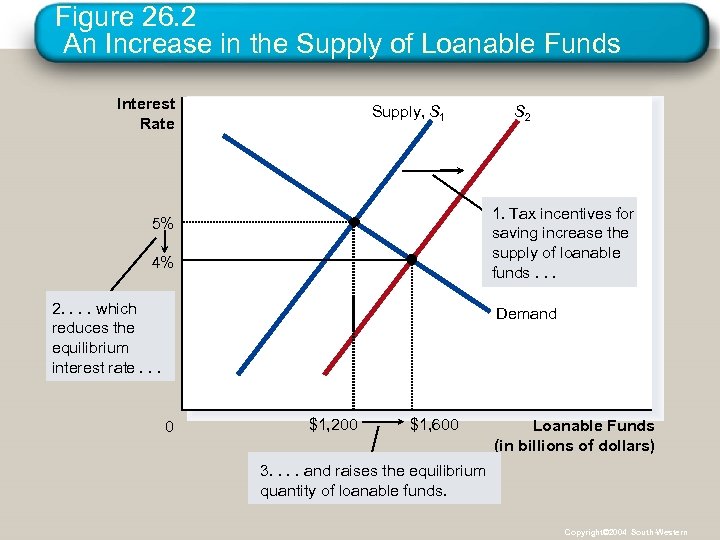 Figure 26. 2 An Increase in the Supply of Loanable Funds Interest Rate Supply, S 1 S 2 1. Tax incentives for saving increase the supply of loanable funds. . . 5% 4% 2. . which reduces the equilibrium interest rate. . . Demand 0 $1, 200 $1, 600 Loanable Funds (in billions of dollars) 3. . and raises the equilibrium quantity of loanable funds. Copyright© 2004 South-Western
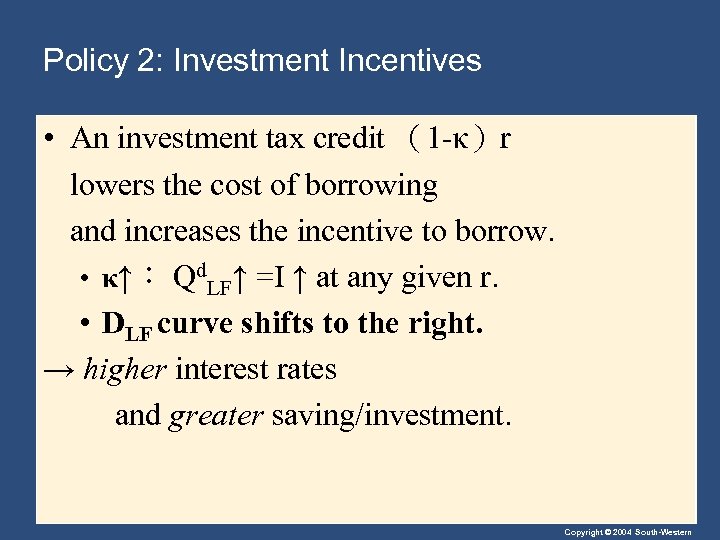 Policy 2: Investment Incentives • An investment tax credit (1 -κ)r lowers the cost of borrowing and increases the incentive to borrow. • κ↑: Qd. LF↑ =I ↑ at any given r. • DLF curve shifts to the right. → higher interest rates and greater saving/investment. Copyright © 2004 South-Western
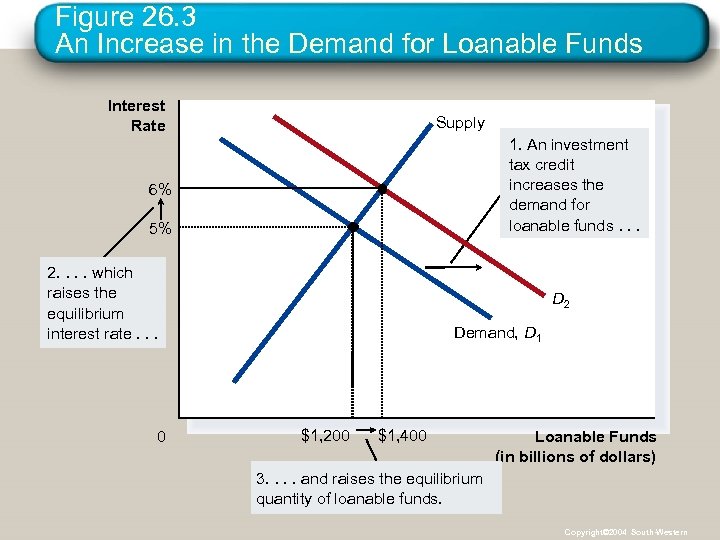 Figure 26. 3 An Increase in the Demand for Loanable Funds Interest Rate Supply 1. An investment tax credit increases the demand for loanable funds. . . 6% 5% 2. . which raises the equilibrium interest rate. . . 0 D 2 Demand, D 1 $1, 200 $1, 400 Loanable Funds (in billions of dollars) 3. . and raises the equilibrium quantity of loanable funds. Copyright© 2004 South-Western
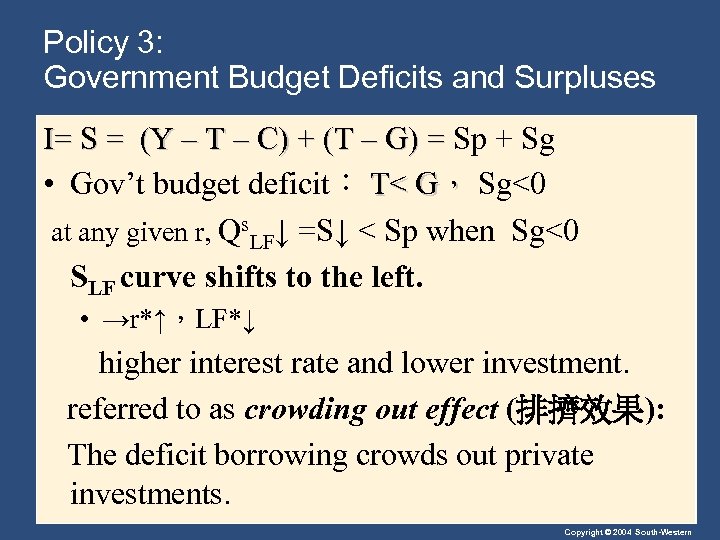 Policy 3: Government Budget Deficits and Surpluses I= S = (Y – T – C) + (T – G) = Sp + Sg • Gov’t budget deficit: T< G, Sg<0 at any given r, Qs. LF↓ =S↓ < Sp when Sg<0 SLF curve shifts to the left. • →r*↑,LF*↓ higher interest rate and lower investment. referred to as crowding out effect (排擠效果): The deficit borrowing crowds out private investments. Copyright © 2004 South-Western
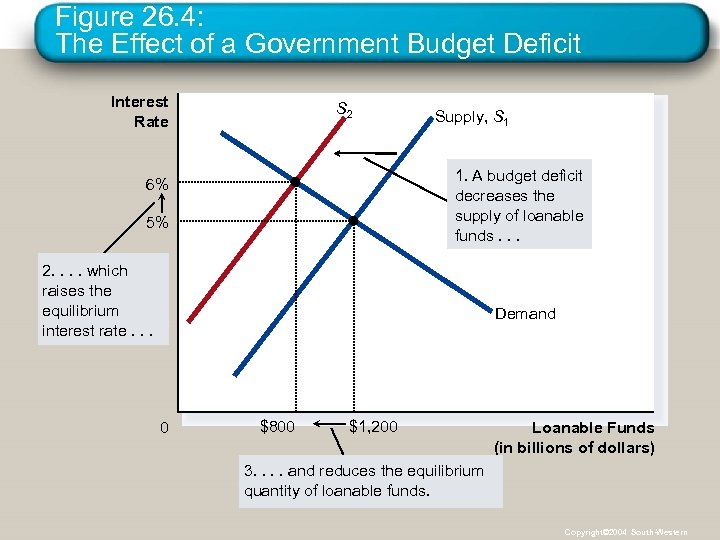 Figure 26. 4: The Effect of a Government Budget Deficit Interest Rate S 2 Supply, S 1 1. A budget deficit decreases the supply of loanable funds. . . 6% 5% 2. . which raises the equilibrium interest rate. . . Demand 0 $800 $1, 200 Loanable Funds (in billions of dollars) 3. . and reduces the equilibrium quantity of loanable funds. Copyright© 2004 South-Western
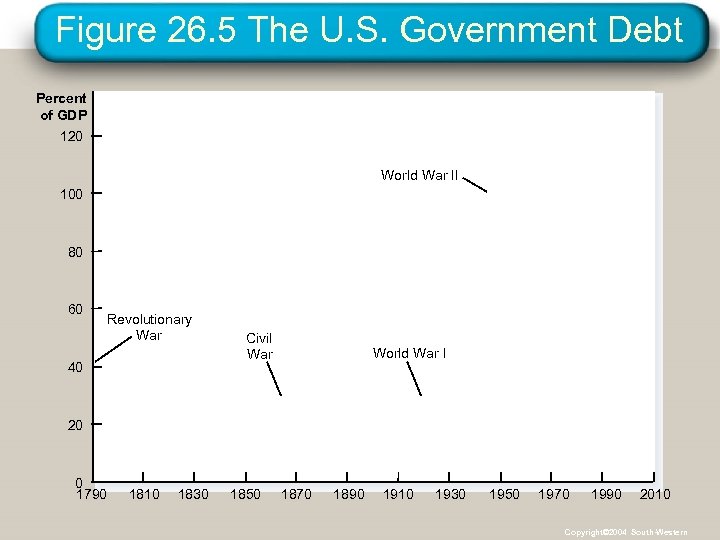 Figure 26. 5 The U. S. Government Debt Percent of GDP 120 World War II 100 80 60 Revolutionary War 40 Civil War World War I 20 0 1790 1810 1830 1850 1870 1890 1910 1930 1950 1970 1990 2010 Copyright© 2004 South-Western
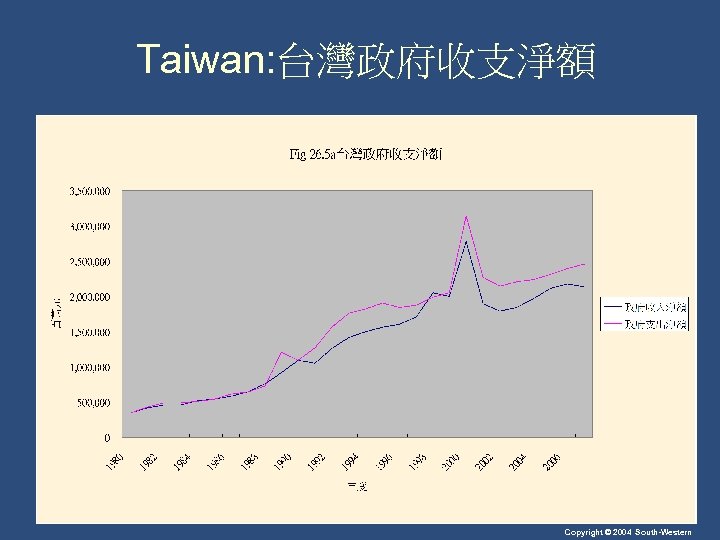 Taiwan: 台灣政府收支淨額 Copyright © 2004 South-Western
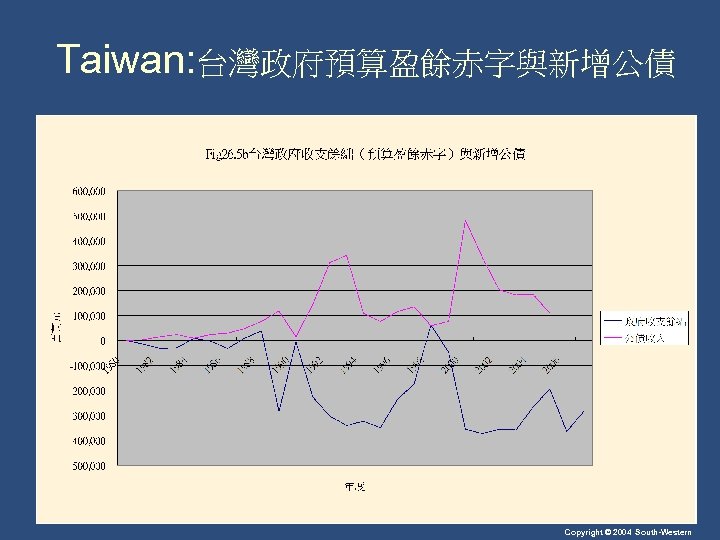 Taiwan: 台灣政府預算盈餘赤字與新增公債 Copyright © 2004 South-Western
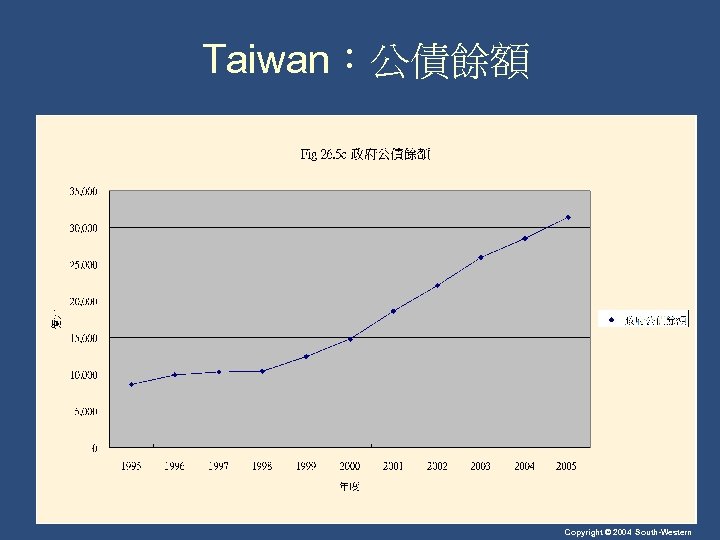 Taiwan:公債餘額 Copyright © 2004 South-Western
 Summary • The financial system is made up of financial institutions such as the bond market, the stock market, banks, and mutual funds. • All these institutions act to direct the resources from savers (households) to borrowers (firms). Copyright © 2004 South-Western
 Summary • National income accounting identities in a closed economy, S=I. • Theoretical framework:LF market SLF =S =Sp + Sg , DLF =I SLF and DLF together determines r*. • Comparative Statics: △ t or △c or △ Sg → △SLF or △DLF → △I , △K, and △Y Copyright © 2004 South-Western