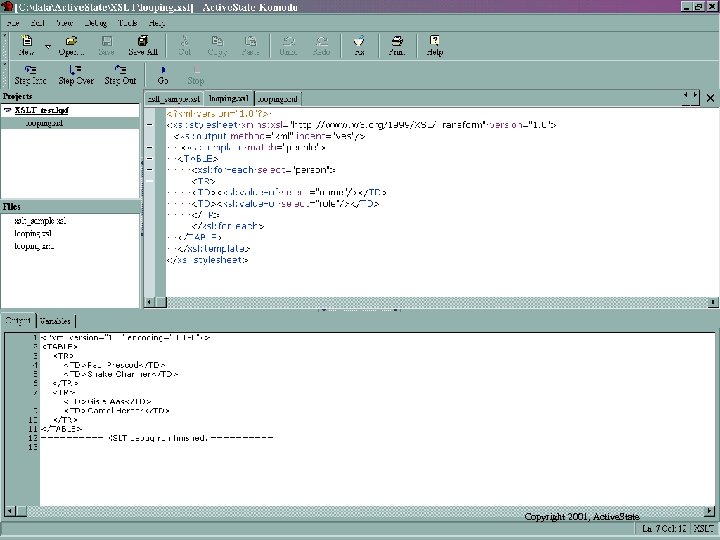
Example of Iterating: XSLT Copyright 2001, Active. State
 Copyright 2001, Active. State
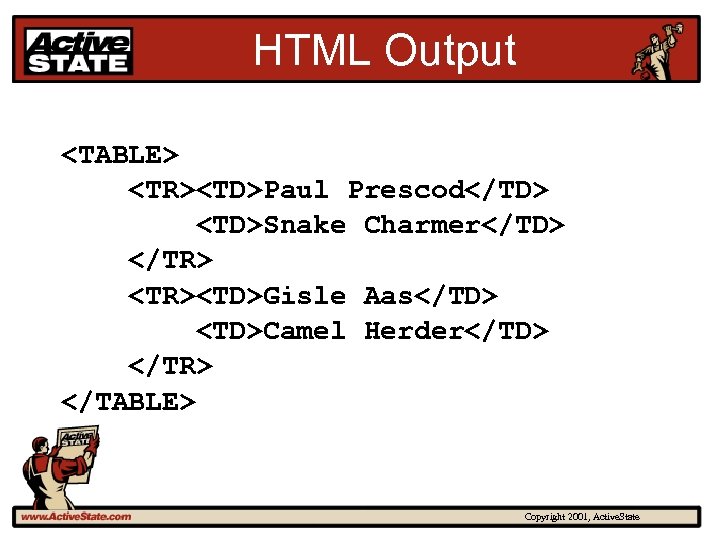 HTML Output
| Paul Prescod | Snake Charmer | | Gisle Aas | Camel Herder | Copyright 2001, Active. State
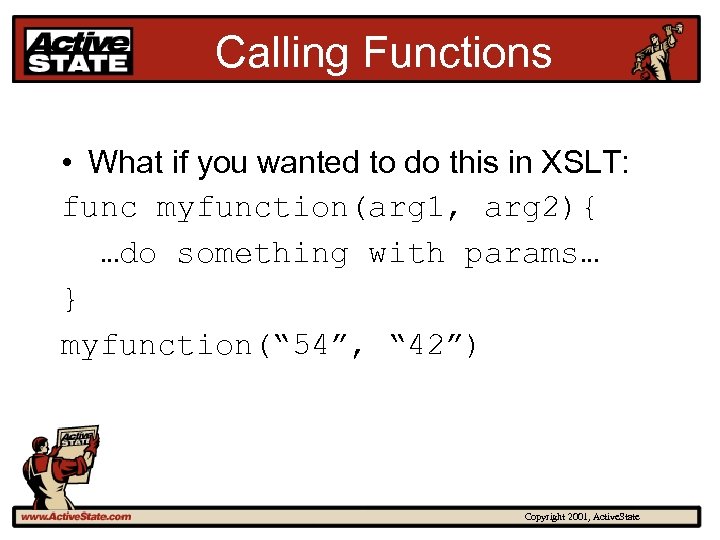 Calling Functions • What if you wanted to do this in XSLT: func myfunction(arg 1, arg 2){ …do something with params… } myfunction(“ 54”, “ 42”) Copyright 2001, Active. State
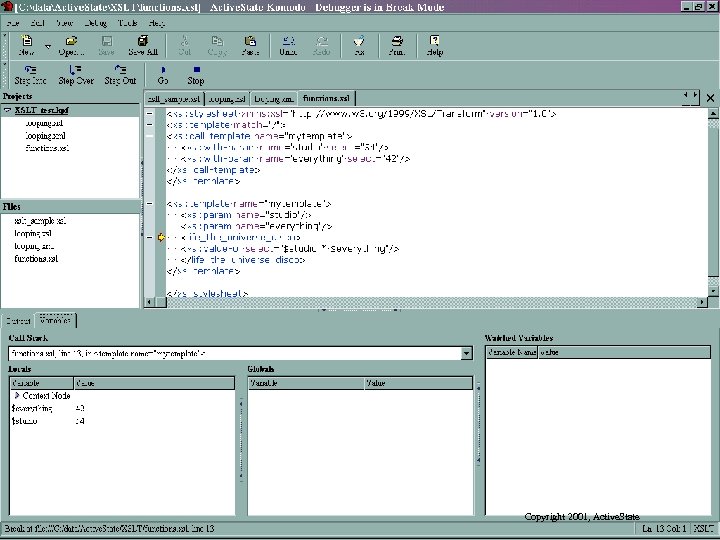
 Functions, Parameters, Variables Copyright 2001, Active. State
 Template Call Copyright 2001, Active. State
 Copyright 2001, Active. State
 Bottom Line • XSLT can be used to compute anything that can be computed • It is “Turing complete” • But…. – Certain coding paradigms are VERY awkward – Non-textual Input/Output is typically not possible Copyright 2001, Active. State
 Scripting Languages • Scripting languages are designed to be general purpose • “Modern” scripting languages go well beyond “scripting” • They are general purpose multiparadigm languages – But XSLT wins for specificity Copyright 2001, Active. State
 XSLT XML Support • XSLT has deep native support for XML • “Built-in”, highly consistent parser • “XPath” XML navigation (“query”) language • Special syntax for working with elements Copyright 2001, Active. State
 XML Recursion • XSLT makes input-based recursion easy: – Sections within sections within … – Part descriptions within part descriptions … • XSLT automatically selects the right rule to go with the right element in the input document Copyright 2001, Active. State
 Context • XSLT keeps track of context: namespaces, current node list etc. • Relevant contexts are in both the stylesheet and the document. • In most traditional programming languages, the programmer would have to be explicit. Copyright 2001, Active. State
 … …
XSLT Example … Copyright 2001, Active. State … …
XSLT Example … Copyright 2001, Active. State
 “) nodes" src="https://present5.com/presentation/48f4cfe685c44b996bf1e4ff9ac43445/image-22.jpg" alt="Explicit Code Equivalent class my_template{ XPath match = "section" method action(context){ output("“) nodes" />
Explicit Code Equivalent class my_template{ XPath match = "section" method action(context){ output("“) nodes = XPath. Engine. evaluate( "paragraph", context) for(node in nodes){ template = rules. lookup(node) template. evaluate(node) } output("“) } }rules. addrule(new my_template()) Copyright 2001, Active. State “) nodes" src="https://present5.com/presentation/48f4cfe685c44b996bf1e4ff9ac43445/image-22.jpg" alt="Explicit Code Equivalent class my_template{ XPath match = "section" method action(context){ output("“) nodes" />
Explicit Code Equivalent class my_template{ XPath match = "section" method action(context){ output("“) nodes = XPath. Engine. evaluate( "paragraph", context) for(node in nodes){ template = rules. lookup(node) template. evaluate(node) } output("“) } }rules. addrule(new my_template()) Copyright 2001, Active. State
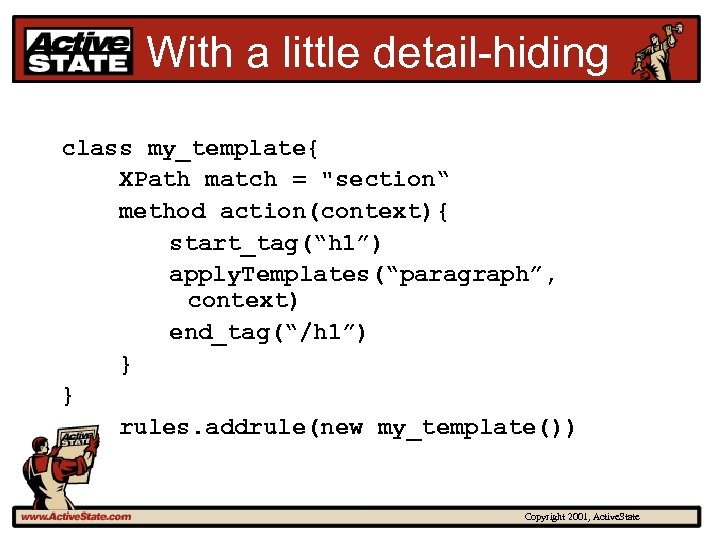 With a little detail-hiding class my_template{ XPath match = "section“ method action(context){ start_tag(“h 1”) apply. Templates(“paragraph”, context) end_tag(“/h 1”) } } rules. addrule(new my_template()) Copyright 2001, Active. State
 Bottom line • Given a good OO language, you can emulate XSLT • But it requires a lot of infrastructure • And it still requires you to take care of a lot of details… Copyright 2001, Active. State
 How do you choose? • • Spoon! Fork! Copyright 2001, Active. State
 Connectivity • XSLT is only good at talking to “XML systems” • Scripting languages can talk to anything • This is typically the deciding factor. • If you need to build a GUI, you need to do it in a language with a GUI library! Copyright 2001, Active. State
 Navigation • XSLT is really good at walking around the document tree. • Scripting languages are typically not as concise at navigation – but very flexible. • XSLT strongly “encourages” you to walk the tree top-down, front to back. Copyright 2001, Active. State
 Data Structures • XSLT makes it very difficult to create structured data containers • The idea is that the only data you need is in the input document: it already has a data structure! • But some computations are much easier if you can restructure the information yourself. Copyright 2001, Active. State
 Community • • There are dozens of APIs for processing XML. Popular ones are not as powerful as XSLT. Powerful ones are not as popular as XSLT. Nobody gets fired for using XSLT – but you can get fired for inventing your own XML API. Copyright 2001, Active. State
 Implementations: XSLT • XSLT presents a lot of opportunity for optimization • Smart implementers pre-compile XPaths and some even compile templates. • There are many different XSLT implementations with different tradeoffs. Copyright 2001, Active. State
 Implementations: Scripting • Scripting code is hard to optimize. • On the other hand, the programmer can choose algorithms and datastructures! • Plus you could write a SAX application that does not use an in-memory tree at all. • This is efficient but difficult. Copyright 2001, Active. State
 Standardization • XSLT is installed in – browsers, – database engines, – directory engines, – programming languages, – and operating systems! – Java. Script is the only language that even comes close. Copyright 2001, Active. State
 Best of Both Worlds? • The easy way to split work is to use general purpose languages to generate or consume XML used by XSLT tempfile. write("") run("xslttrans conv. xsl tempfile outfile") data = outfile. read() Copyright 2001, Active. State
 More Sophisticated Approach • XSLT has a concept of “extension functions” • If the implementation is smart enough, functions can be defined in any scripting language Copyright 2001, Active. State
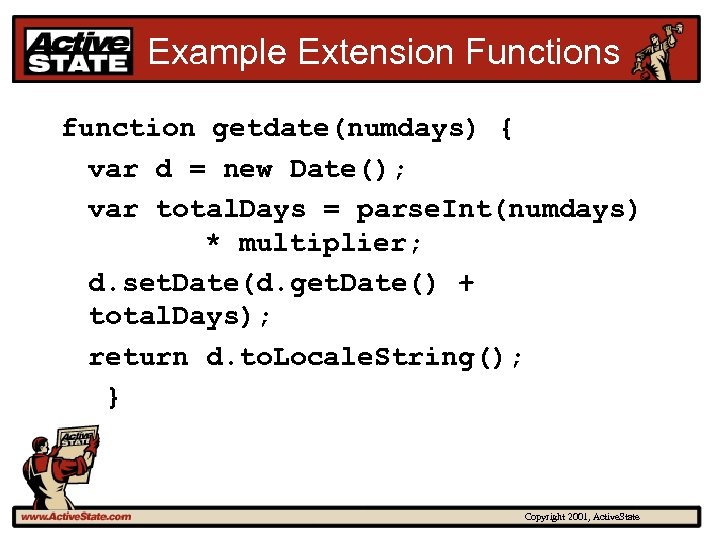 Example Extension Functions function getdate(numdays) { var d = new Date(); var total. Days = parse. Int(numdays) * multiplier; d. set. Date(d. get. Date() + total. Days); return d. to. Locale. String(); } Copyright 2001, Active. State

We have logged your enquiry and will" src="https://present5.com/presentation/48f4cfe685c44b996bf1e4ff9ac43445/image-36.jpg" alt="Using an Extension Function We have logged your enquiry and will" />
Using an Extension Function We have logged your enquiry and will respond by . Copyright 2001, Active. State
 Extension Elements in Xalan-J • “Xalan-Java uses the Bean Scripting Framework (BSF), an architecture for incorporating scripting into Java applications and applets. ” http: //oss. software. ibm. com/developerworks/project s/bsf Copyright 2001, Active. State
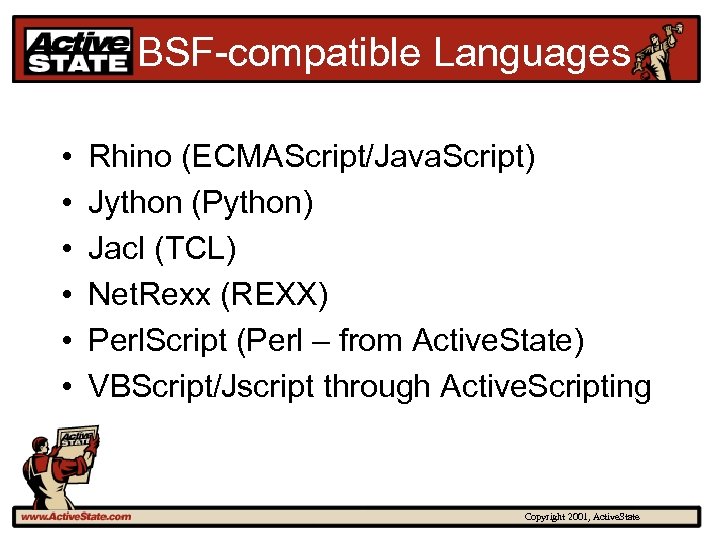 BSF-compatible Languages • • • Rhino (ECMAScript/Java. Script) Jython (Python) Jacl (TCL) Net. Rexx (REXX) Perl. Script (Perl – from Active. State) VBScript/Jscript through Active. Scripting Copyright 2001, Active. State
 function getdate(numdays){ var d =" src="https://present5.com/presentation/48f4cfe685c44b996bf1e4ff9ac43445/image-39.jpg" alt="Inline Extensions function getdate(numdays){ var d =" />
Inline Extensions function getdate(numdays){ var d = new Date(); … return d. to. Locale. String(); } Copyright 2001, Active. State function getdate(numdays){ var d =" src="https://present5.com/presentation/48f4cfe685c44b996bf1e4ff9ac43445/image-39.jpg" alt="Inline Extensions function getdate(numdays){ var d =" />
Inline Extensions function getdate(numdays){ var d = new Date(); … return d. to. Locale. String(); } Copyright 2001, Active. State
 In the Microsoft Universe • Microsoft has a concept of “Active. Scripting Host” – used by MSXSL – – – VBScript JScript Python (Active. Python) Perl. Script (Active. Perl) REXX Tcl Copyright 2001, Active. State
 In the Linux/C world? • Nothing yet…but maybe some day: Active. Scripting for XPCOM • XPCOM is a portable variant of COM from the Mozilla project • Active. Scripting for XPCOM would allow languages to be embedded in Linux/C apps like Xalan-C Copyright 2001, Active. State
 " src="https://present5.com/presentation/48f4cfe685c44b996bf1e4ff9ac43445/image-42.jpg" alt="What about Standardization? • XSLT 1. 1 defines " />
What about Standardization? • XSLT 1. 1 defines function f(x) {. . . } function g(y, z) {. . . } Copyright 2001, Active. State " src="https://present5.com/presentation/48f4cfe685c44b996bf1e4ff9ac43445/image-42.jpg" alt="What about Standardization? • XSLT 1. 1 defines " />
What about Standardization? • XSLT 1. 1 defines function f(x) {. . . } function g(y, z) {. . . } Copyright 2001, Active. State
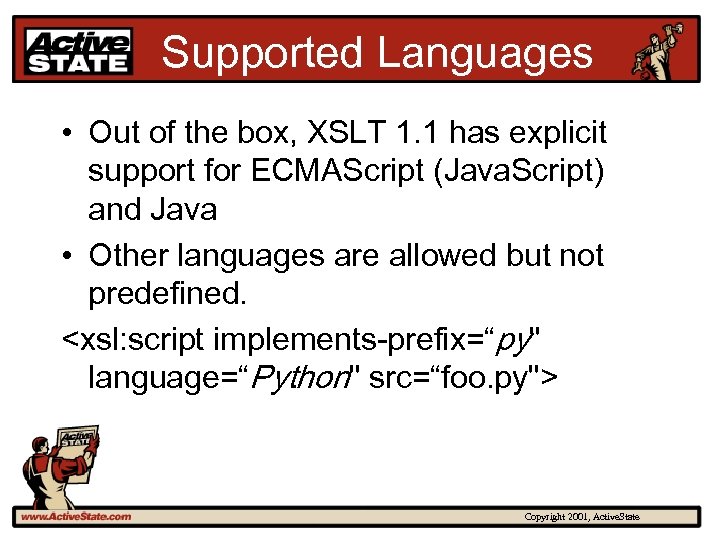 Supported Languages • Out of the box, XSLT 1. 1 has explicit support for ECMAScript (Java. Script) and Java • Other languages are allowed but not predefined. Copyright 2001, Active. State
 “From the spec” • XSLT processors are not required to support any particular language binding. • xsl: script elements with language values not supported by the processor are ignored. Copyright 2001, Active. State
 Active. State and XSLT • Active. State is the leading vendor of Visual Studio. NET plugins: – Visual Perl – Visual Python – Visual XSLT Copyright 2001, Active. State
 Visual XSLT • Visual XSLT brings the features of Visual Studio to XSLT stylesheet and transformation development • Improved productivity in creating XSLT transformations Copyright 2001, Active. State
 Komodo XSLT • Komodo is a multi-language IDE for Windows and Linux • Komodo has the same XSLT feature set as Visual XSLT. • Visual XSLT is appropriate for “Visual Studio” shops. • Komodo is best for cross-platform shops. Copyright 2001, Active. State
 Summary • XSLT and scripting languages work together. • XSLT engines can integrate them through extension functions (inline or out of line). • Our debuggers and IDEs can bring them into a common development interface. Copyright 2001, Active. State
 Resources paulp@activestate. com http: //aspn. activestate. com/ASPN/XSLT http: //www. w 3. org/TR/xslt http: //www. xslt. com/ Copyright 2001, Active. State
 Copyright 2001, Active. State
 Copyright 2001, Active. State
| 


 Скачать презентацию Copyright 2001 Active State XSLT and Scripting
 Copyright 2001, Active. State
  XSLT and Scripting Languages or…XSLT: what is everyone so hot and bothered about? Copyright 2001, Active. State
  Background: Active. State • Active. State creates tools for open source and standards-based high-level languages: – Perl – Python – PHP – XSLT – Tcl Copyright 2001, Active. State
  What is XSLT? • A language for transforming between XML vocabularies. • Standardized by the World Wide Web Consortium • Integrated with. NET, Apache, IE, Java, Oracle, Perl, Python, … Copyright 2001, Active. State
  XSLT • XSLT is a slightly new twist: – Not a scripting language – Not, strictly-speaking, “open source” • But not radically different: – Typically interpreted – Open source implementations – Not vendor dominated Copyright 2001, Active. State
 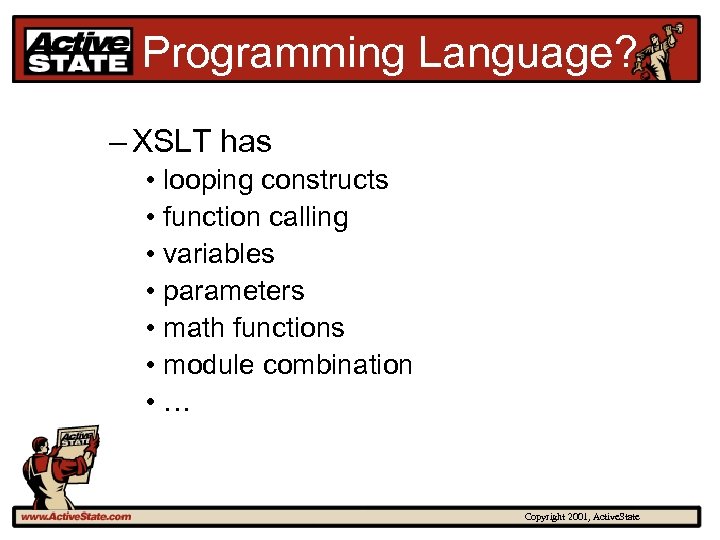 Programming Language? – XSLT has • looping constructs • function calling • variables • parameters • math functions • module combination • … Copyright 2001, Active. State
 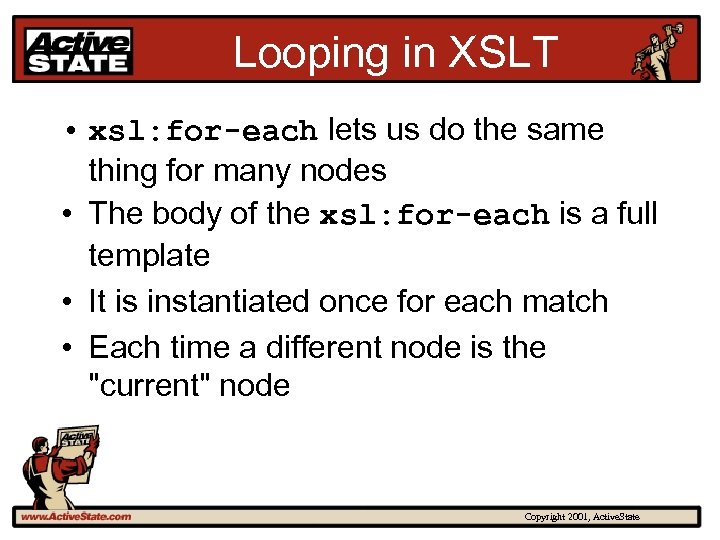 Looping in XSLT • xsl: for-each lets us do the same thing for many nodes • The body of the xsl: for-each is a full template • It is instantiated once for each match • Each time a different node is the "current" node Copyright 2001, Active. State
 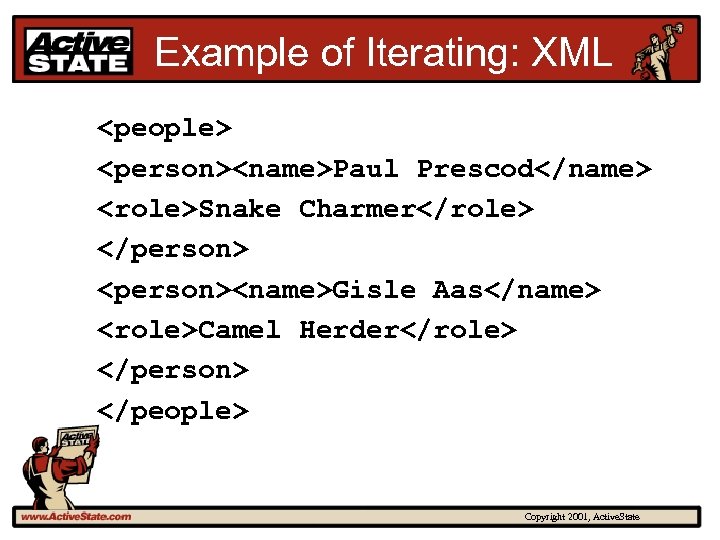 Example of Iterating: XML