


 Скачать презентацию Copyright 102 Challenges and Changes to Fair Use
722d31947391f5a026c3dde9be6a752d.ppt
- Количество слайдов: 26
 Copyright 102 Challenges and Changes to “Fair Use” in the Electronic Environment Computer Study Group, Endacott Society 13 October 2004 Richard Fyffe and Scott Walter University of Kansas Libraries
 Overview w Fair Use (Fairly Quickly) w Challenges n n n The Lure of the “Open Web” Educating the User Licensed Information w Changes n n New Legislation New Models for Scholarly Communication
 Copyright Basics w Copyright protects: “Books, articles, photographs, paintings, sculpture, software, websites, architecture, pantomimes, ballets, music, sound recordings, and even doodles, scribbles, and graffiti. ” w Copyright protection is automatic as soon as you have created a work, and does not require registration or use of the © symbol
 Common Copyright Exceptions w Works in the public domain w Works created “for hire” w Works for which copyright has been transferred w Fair use
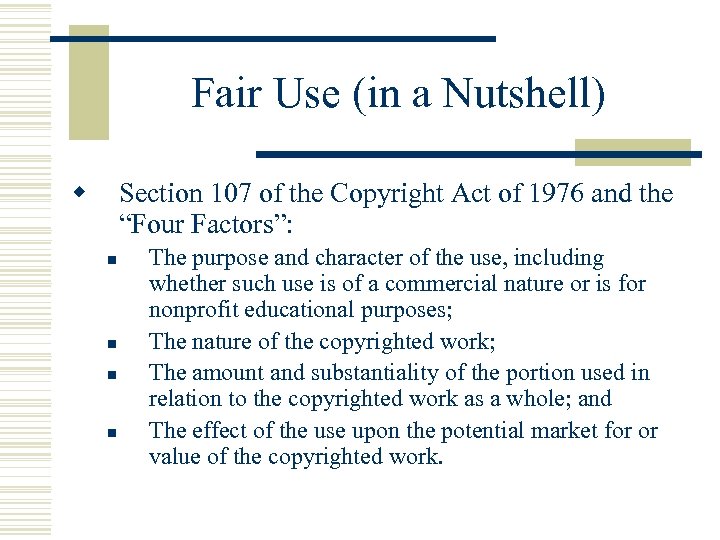 Fair Use (in a Nutshell) w Section 107 of the Copyright Act of 1976 and the “Four Factors”: n n The purpose and character of the use, including whether such use is of a commercial nature or is for nonprofit educational purposes; The nature of the copyrighted work; The amount and substantiality of the portion used in relation to the copyrighted work as a whole; and The effect of the use upon the potential market for or value of the copyrighted work.
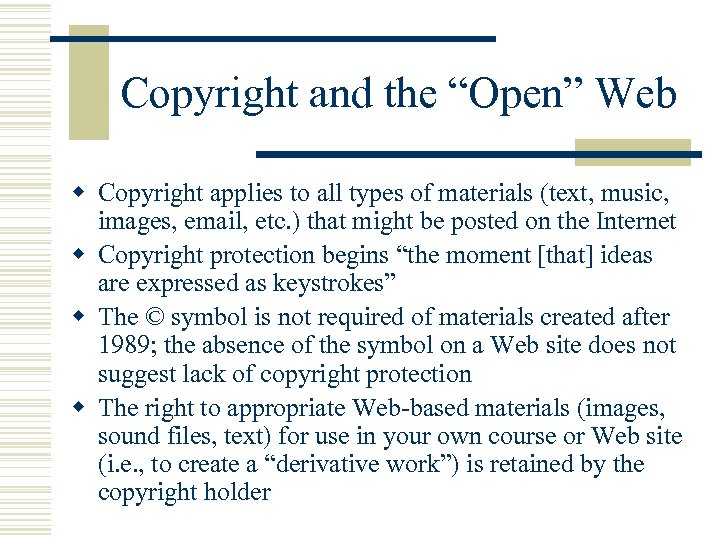 Copyright and the “Open” Web w Copyright applies to all types of materials (text, music, images, email, etc. ) that might be posted on the Internet w Copyright protection begins “the moment [that] ideas are expressed as keystrokes” w The © symbol is not required of materials created after 1989; the absence of the symbol on a Web site does not suggest lack of copyright protection w The right to appropriate Web-based materials (images, sound files, text) for use in your own course or Web site (i. e. , to create a “derivative work”) is retained by the copyright holder
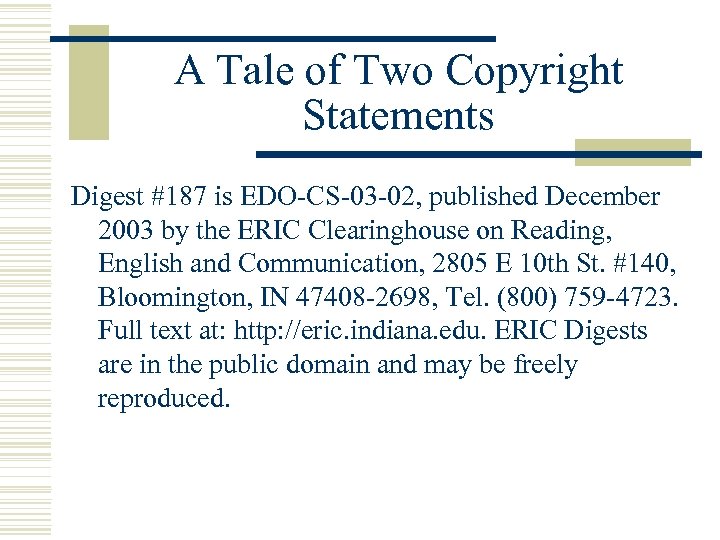 A Tale of Two Copyright Statements Digest #187 is EDO-CS-03 -02, published December 2003 by the ERIC Clearinghouse on Reading, English and Communication, 2805 E 10 th St. #140, Bloomington, IN 47408 -2698, Tel. (800) 759 -4723. Full text at: http: //eric. indiana. edu. ERIC Digests are in the public domain and may be freely reproduced.
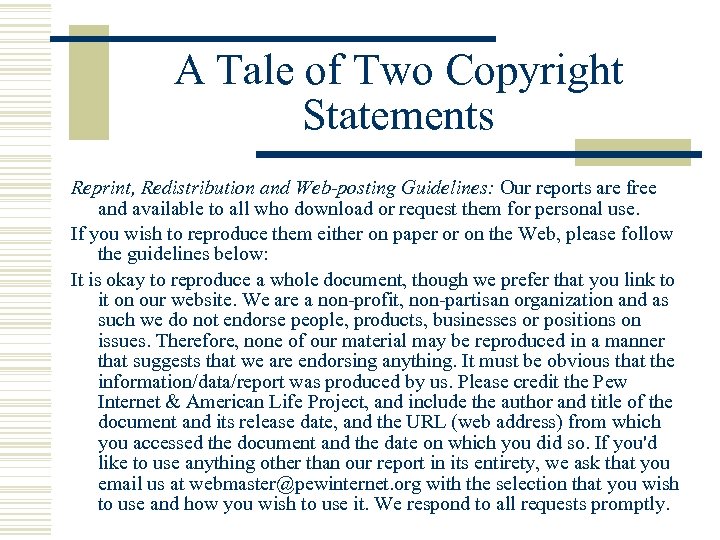 A Tale of Two Copyright Statements Reprint, Redistribution and Web-posting Guidelines: Our reports are free and available to all who download or request them for personal use. If you wish to reproduce them either on paper or on the Web, please follow the guidelines below: It is okay to reproduce a whole document, though we prefer that you link to it on our website. We are a non-profit, non-partisan organization and as such we do not endorse people, products, businesses or positions on issues. Therefore, none of our material may be reproduced in a manner that suggests that we are endorsing anything. It must be obvious that the information/data/report was produced by us. Please credit the Pew Internet & American Life Project, and include the author and title of the document and its release date, and the URL (web address) from which you accessed the document and the date on which you did so. If you'd like to use anything other than our report in its entirety, we ask that you email us at webmaster@pewinternet. org with the selection that you wish to use and how you wish to use it. We respond to all requests promptly.
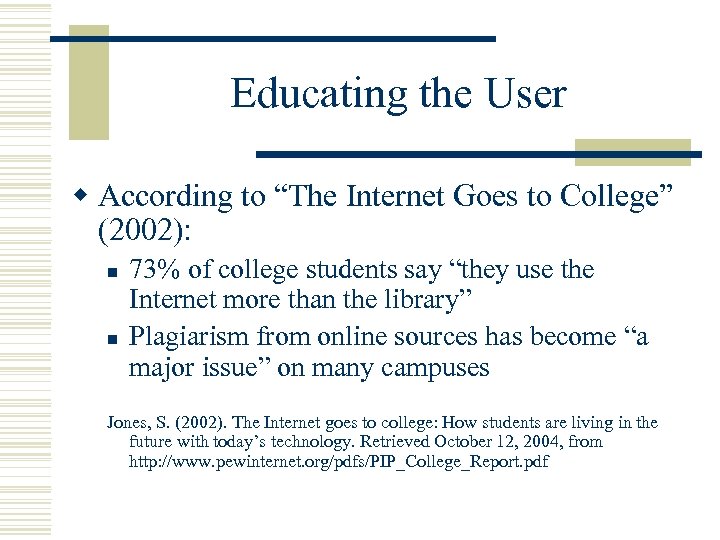 Educating the User w According to “The Internet Goes to College” (2002): n n 73% of college students say “they use the Internet more than the library” Plagiarism from online sources has become “a major issue” on many campuses Jones, S. (2002). The Internet goes to college: How students are living in the future with today’s technology. Retrieved October 12, 2004, from http: //www. pewinternet. org/pdfs/PIP_College_Report. pdf
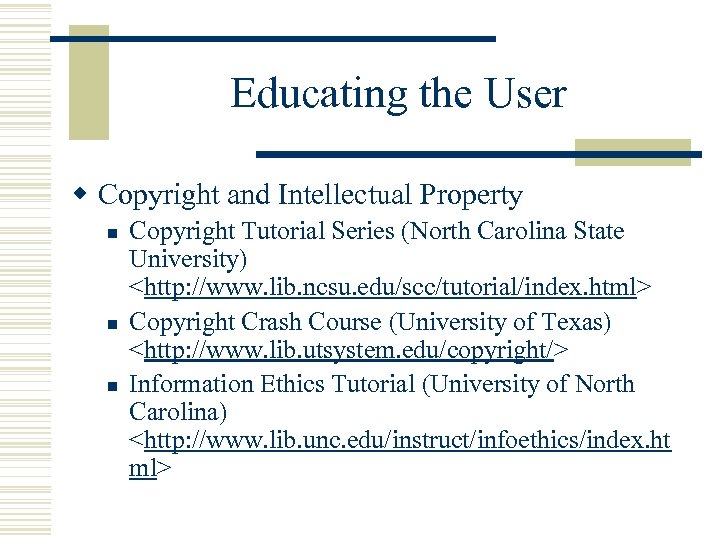 Educating the User w Copyright and Intellectual Property n n n Copyright Tutorial Series (North Carolina State University)
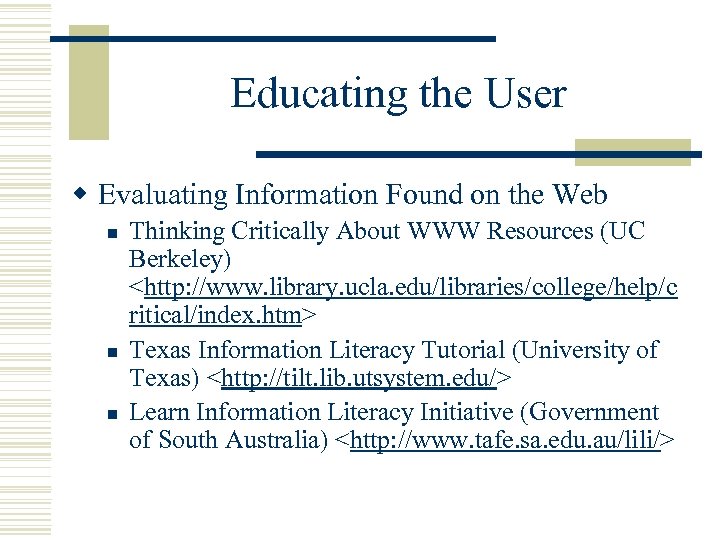 Educating the User w Evaluating Information Found on the Web n n n Thinking Critically About WWW Resources (UC Berkeley)
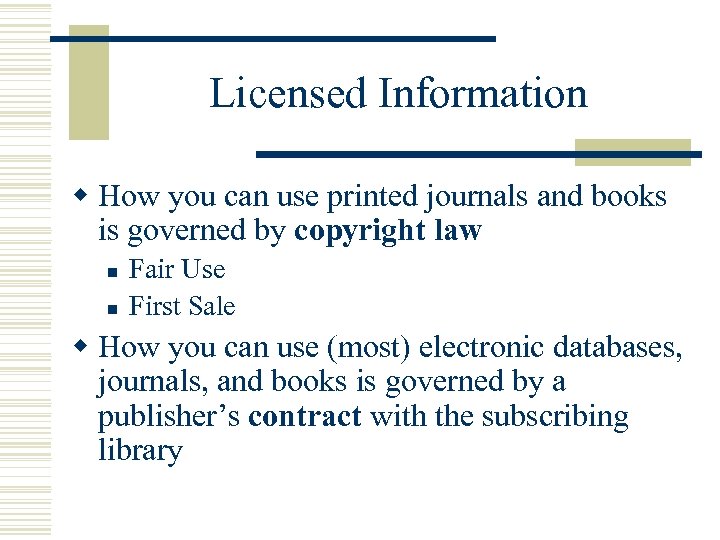 Licensed Information w How you can use printed journals and books is governed by copyright law n n Fair Use First Sale w How you can use (most) electronic databases, journals, and books is governed by a publisher’s contract with the subscribing library
 Contracting for Access w Subscriptions involve signing a license w The license sets the business terms and the terms of use w The license (or contract) overrides copyright law w Libraries devote significant time to negotiating terms (but we can’t always get what we want)
 Living with the License w The license may determine: n n Who may use the database, journal, or book What they may (and may not) do with it w The goal of negotiations conducted by the KU Libraries is to assure that whatever you could do under the doctrine of fair use can still be done under our contract
 Who is Covered? w The license identifies “authorized users” of electronic resources. At KU, these are: n n Persons officially registered as full or part-time students in both degree and non-degree programs; faculty (including emeritus faculty) and other members of the teaching staff; administrators; and employed staff Authorized affiliates (affiliated or visiting scholars or researchers, registered participants in outreach programs and internships, etc. ) (cont. )
 Who is Covered? n n n Other users sponsored by KU for guest accounts in order to complete academic or administrative work Any of these at any location in the world, with appropriate authentication All on-site (“walk-in”) users within the facilities of the KU Libraries
 Typical License Guidelines w You may use the content only for non-commercial educational, clinical, or research purposes w You may not share portions of the content in excess of fair use with individuals who are not affiliated with KU w You may not systematically print or save substantial portions of an electronic title (e. g. , you cannot save an entire issue or volume of a journal on your hard drive)
 Beyond Section 107: New Legislation Governing Use of Digital Content w Digital Millennium Copyright Act (1998) n n Prohibits the “circumvention” of protective measures (e. g. , data encryption) Prohibits removal of information imbedded in digital content by the copyright holder Permits libraries to up to three “preservation copies” of a copyrighted digital work Permits digital preservation of material stored in an obsolete medium
 Beyond Section 107: New Legislation Governing Use of Digital Content w The TEACH Act (2002) n n n Focuses on use of copyrighted materials in distance education Expands the range of materials that may be “performed” in the electronic environment Expands eligible “receiving locations” Requires that access to digital information be limited to currently enrolled students at the class level Prefers “linking” to “storage”
 New Models for Scholarly Communication w Self-archiving by scholarly authors of papers published in conventional journals n n Portions of the copyright are retained by authors, not transferred to publishers No-fee access through disciplinary and institutional repositories Ar. Xiv. org e-print archive
 New Models for Scholarly Communication w Open Access Journals n n Authors retain copyright No fee for readers (or libraries) Revenues are generated from sources other than subscriptions There are 1, 288 journals currently available through the Directory of Open Access Journals
 New Models for Scholarly Communication w Creative Commons Licensing n n An alternative to copyright transfer Defines explicitly which rights the author retains and which rights she grants to users (e. g. , use, reproduction, creation of derivative works)
 For More Information w Copyright n n Copyright Management Center (IUPUI) http: //www. copyright. iupui. edu/index. htm Scholarly Communication Center – Tutorial Series (NCSU) http: //www. lib. ncsu. edu/scc/tutorial/index. html w DMCA and TEACH Act n n DMCA (American Library Association) http: //www. ala. org/ala/washoff/WOissues/copyrightb/dmca/ Distance Education and the TEACH Act (American Library Association) http: //www. ala. org/ala/washoff/WOissues/copyrightb/distance ed/
 For More Information w Licensing n n n KU Libraries’ Terms and Conditions for Using EResources: http: //www 2. lib. ku. edu/electro/terms. htm Liblicense: Licensing Digital Information (Yale University) http: //www. library. yale. edu/~llicense/ Okerson, Ann. 1996. “Buy or Lease? Two Models for Scholarly Information at the End (or the Beginning) of an Era, ” Daedalus: Journal of the American Academy of Arts and Sciences, 125 (4), 55 -76 (also available at http: //www. library. yale. edu/~okerson/daedalus. html)
 For More Information w Open Access n Budapest Open Access Initiative (BOAI) http: //www. soros. org/openaccess/ w Creative Commons http: //creativecommons. org/
 Contacts Richard Fyffe, Assistant Dean of Libraries for Scholarly Communication rfyffe@ku. edu Scott Walter, Assistant Dean of Libraries for Information & Instructional Services slwalter@ku. edu