 Скачать презентацию Copy-number estimation on the latest generation of high-density
bdd0a4f138526dec9eb8011b4bc2d5af.ppt
- Количество слайдов: 74



Copy-number estimation on the latest generation of high-density oligonucleotide microarrays Henrik Bengtsson (work with Terry Speed) Dept of Statistics, UC Berkeley January 24, 2008 Postdoctoral Seminars, Mathematical Biosciences Institute, The Ohio State University
Acknowledgments UC Berkeley: James Bullard Kasper Hansen Elizabeth Purdom Terry Speed WEHI, Melbourne: Mark Robinson Ken Simpson ISREC, Lausanne: “Asa” Wirapati John Hopkins: Benilton Carvalho Rafael Irizarry Affymetrix, California: Ben Bolstad Simon Cawley Luis Jevons Chuck Sugnet Jim Veitch
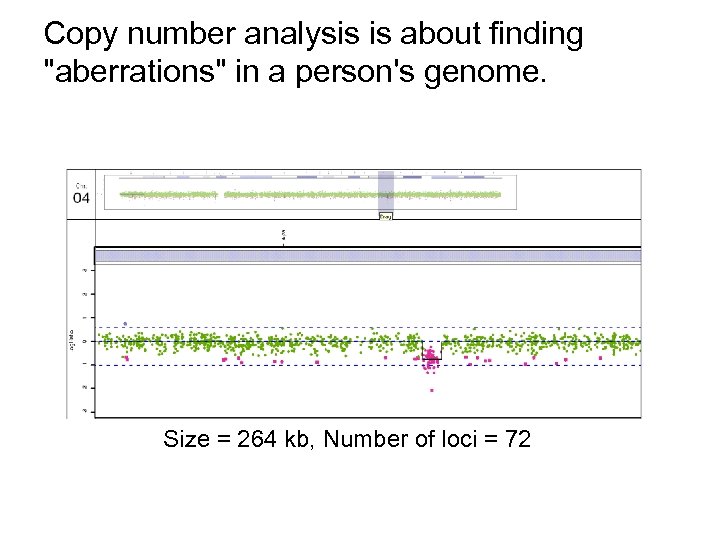
Copy number analysis is about finding "aberrations" in a person's genome. Size = 264 kb, Number of loci = 72
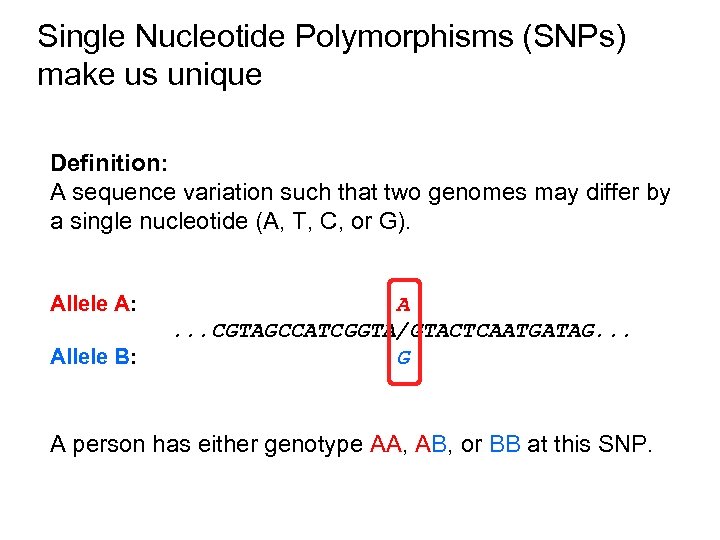
Single Nucleotide Polymorphisms (SNPs) make us unique Definition: A sequence variation such that two genomes may differ by a single nucleotide (A, T, C, or G). Allele A: Allele B: A. . . CGTAGCCATCGGTA/GTACTCAATGATAG. . . G A person has either genotype AA, AB, or BB at this SNP.
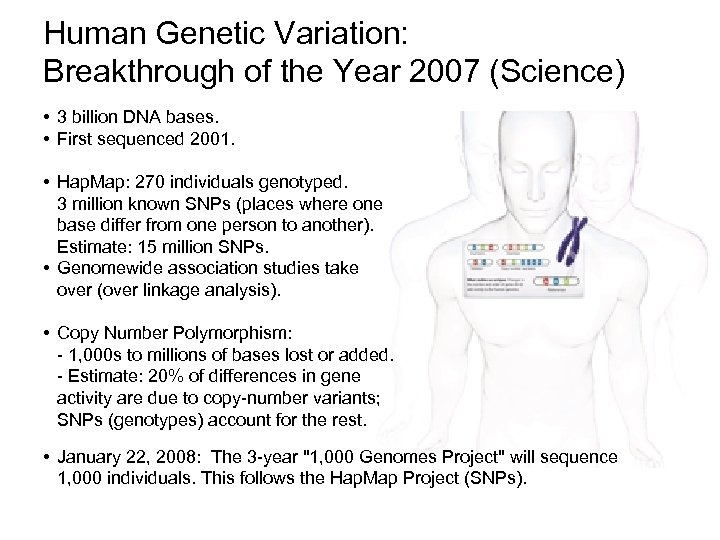
Human Genetic Variation: Breakthrough of the Year 2007 (Science) • 3 billion DNA bases. • First sequenced 2001. • Hap. Map: 270 individuals genotyped. 3 million known SNPs (places where one base differ from one person to another). Estimate: 15 million SNPs. • Genomewide association studies take over (over linkage analysis). • Copy Number Polymorphism: - 1, 000 s to millions of bases lost or added. - Estimate: 20% of differences in gene activity are due to copy-number variants; SNPs (genotypes) account for the rest. • January 22, 2008: The 3 -year "1, 000 Genomes Project" will sequence 1, 000 individuals. This follows the Hap. Map Project (SNPs).
Objectives of this presentation • Total copy number estimation/segmentation • Estimate single-locus CNs well (segmentation methods take it from there) • All generations of Affymetrix SNP arrays: – SNP chips: 10 K, 100 K, 500 K – SNP & CN chips: 5. 0, 6. 0 • Small and very large data sets
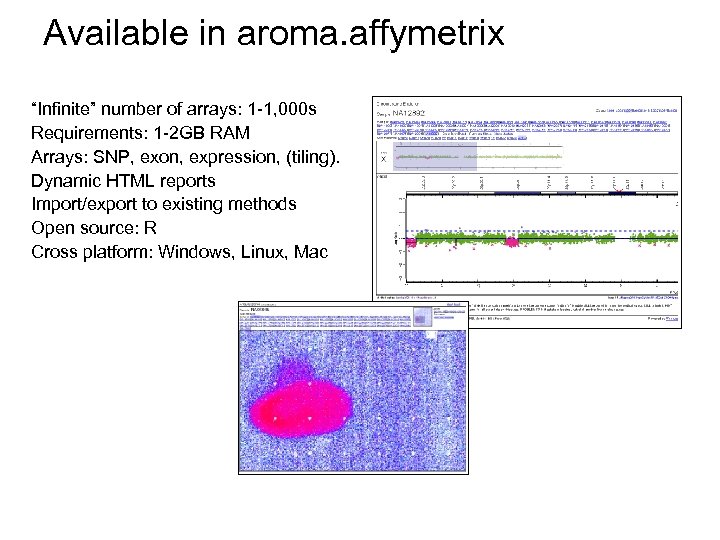
Available in aroma. affymetrix “Infinite” number of arrays: 1 -1, 000 s Requirements: 1 -2 GB RAM Arrays: SNP, exon, expression, (tiling). Dynamic HTML reports Import/export to existing methods Open source: R Cross platform: Windows, Linux, Mac
Affymetrix chips
Running the assay take 4 -5 working days 1. Start with target g. DNA (genomic DNA) or m. RNA. 2. Obtain labeled single-stranded target DNA fragments for hybridization to the probes on the chip. 3. After hybridization, washing, and scanning we get a digital image. 4. Image summarized across pixels to probe-level intensities before we begin. Thisis our "raw data".
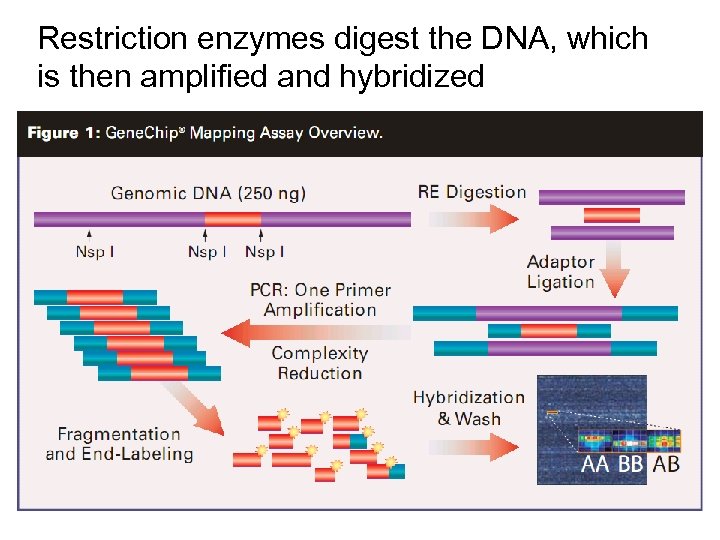
Restriction enzymes digest the DNA, which is then amplified and hybridized
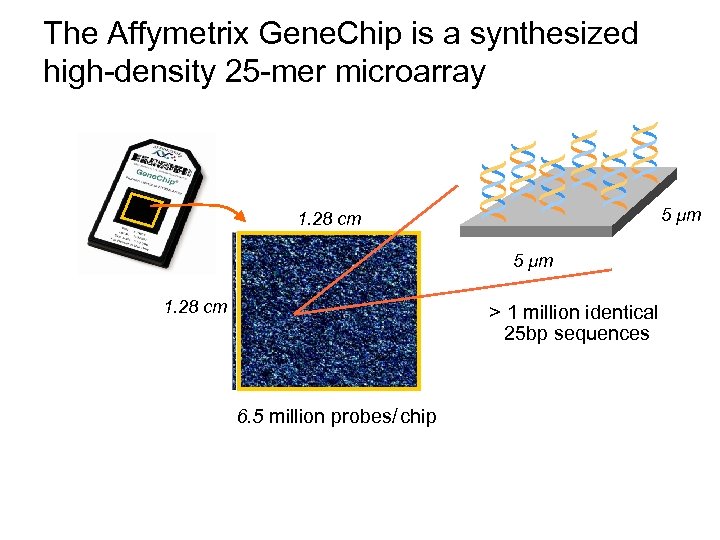
The Affymetrix Gene. Chip is a synthesized high-density 25 -mer microarray * * * 5 µm 1. 28 cm > 1 million identical 25 bp sequences 6. 5 million probes/ chip
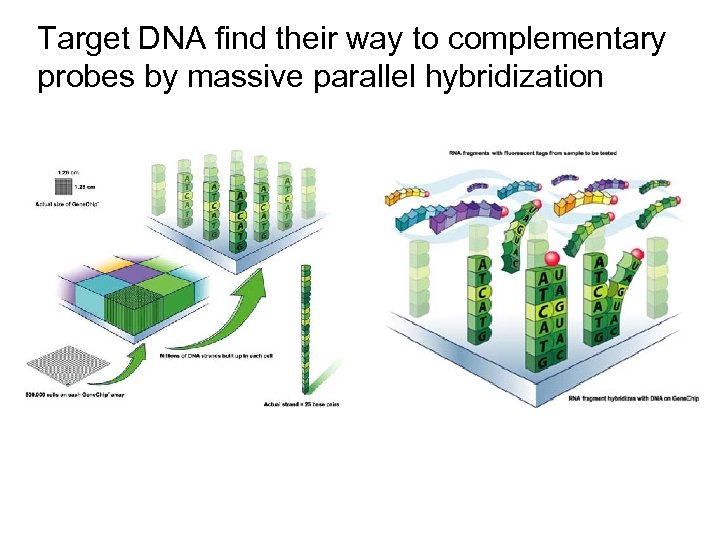
Target DNA find their way to complementary probes by massive parallel hybridization
![Hybridization + Scanning DAT File(s) [Image, pixel intensities] Image analysis workable raw data CEL](https://present5.com/presentation/bdd0a4f138526dec9eb8011b4bc2d5af/image-13.jpg "Hybridization + Scanning DAT File(s) [Image, pixel intensities] Image analysis workable raw data CEL")
Hybridization + Scanning DAT File(s) [Image, pixel intensities] Image analysis workable raw data CEL File(s) [Probe Cell Intensity] Pre-processing Segmentation + CDF [Chip Description File]
Affymetrix copy-number & genotyping arrays
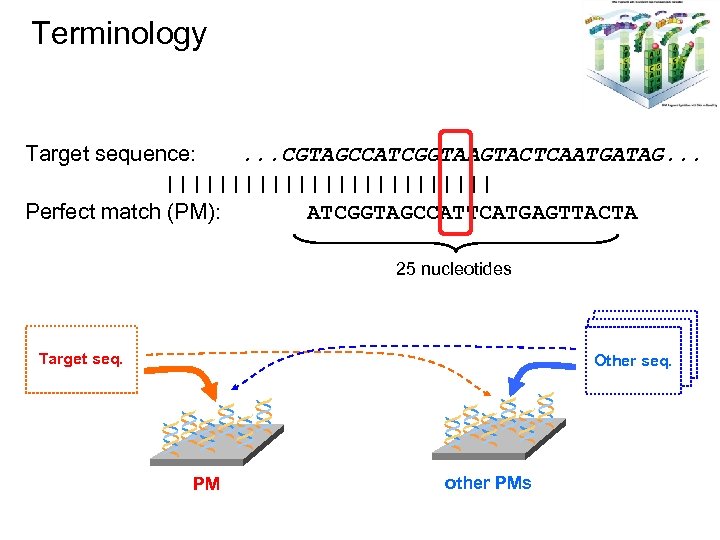
Terminology Target sequence: . . . CGTAGCCATCGGTAAGTACTCAATGATAG. . . ||||||||||||| Perfect match (PM): ATCGGTAGCCATTCATGAGTTACTA 25 nucleotides * Target seq. ** PM * * ** Other DNA Other seq. * other PMs
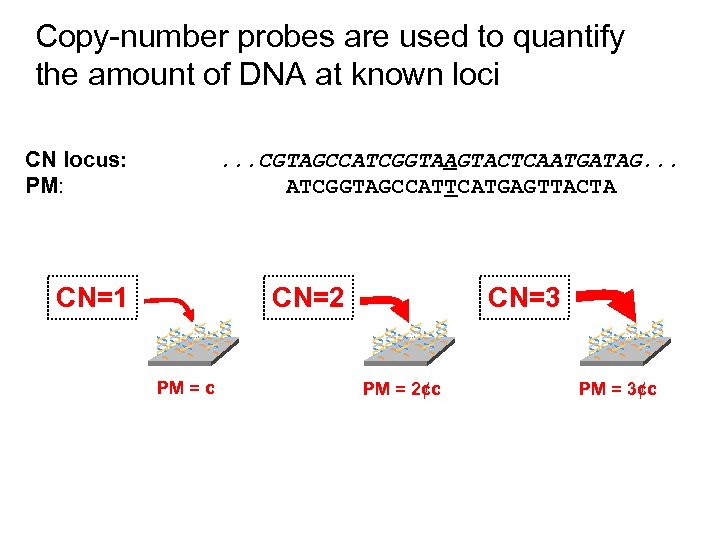
Copy-number probes are used to quantify the amount of DNA at known loci CN locus: PM: . . . CGTAGCCATCGGTAAGTACTCAATGATAG. . . ATCGGTAGCCATTCATGAGTTACTA CN=1 CN=2 ** * PM = c CN=3 ** * PM = 2¢c PM = 3¢c
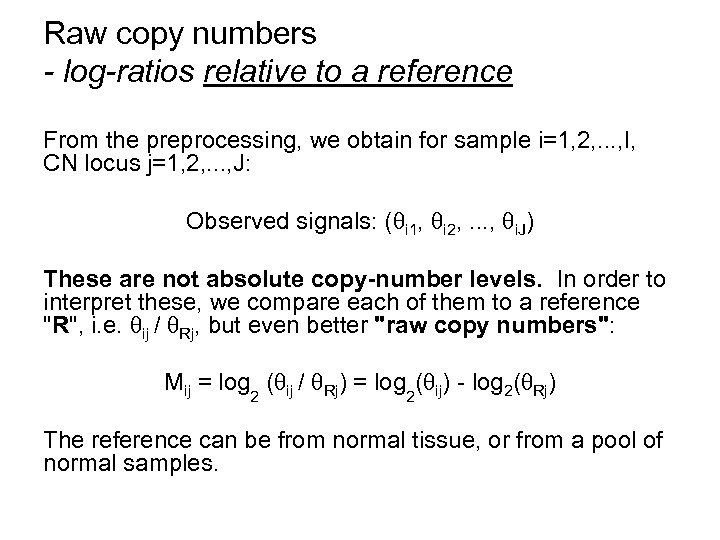
Raw copy numbers - log-ratios relative to a reference From the preprocessing, we obtain for sample i=1, 2, . . . , I, CN locus j=1, 2, . . . , J: Observed signals: ( i 1, i 2, . . . , i. J) These are not absolute copy-number levels. In order to interpret these, we compare each of them to a reference "R", i. e. ij / Rj, but even better "raw copy numbers": Mij = log 2 ( ij / Rj) = log 2( ij) - log 2( Rj) The reference can be from normal tissue, or from a pool of normal samples.
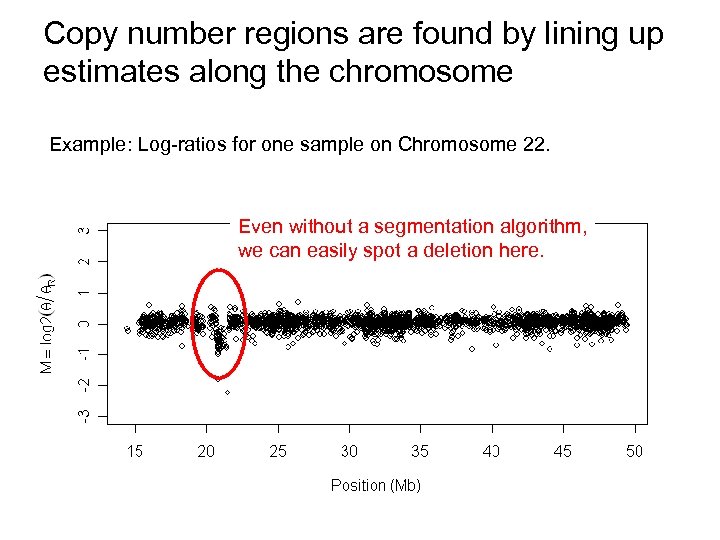
Copy number regions are found by lining up estimates along the chromosome Example: Log-ratios for one sample on Chromosome 22. Even without a segmentation algorithm, we can easily spot a deletion here.
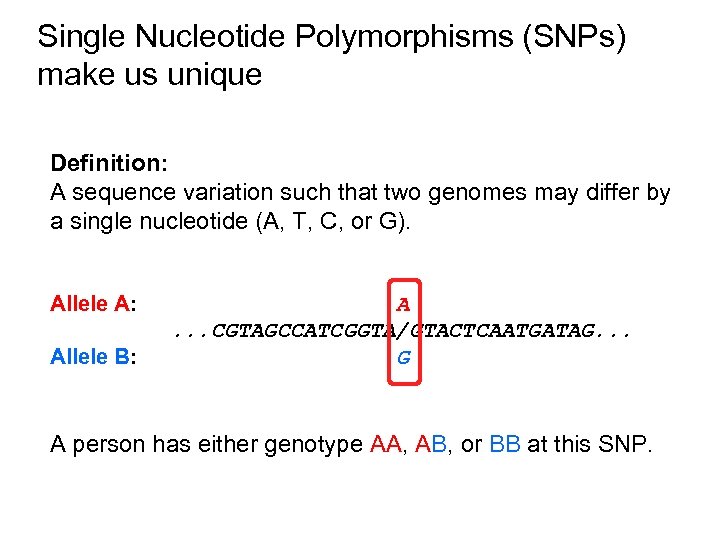
Single Nucleotide Polymorphisms (SNPs) make us unique Definition: A sequence variation such that two genomes may differ by a single nucleotide (A, T, C, or G). Allele A: Allele B: A. . . CGTAGCCATCGGTA/GTACTCAATGATAG. . . G A person has either genotype AA, AB, or BB at this SNP.
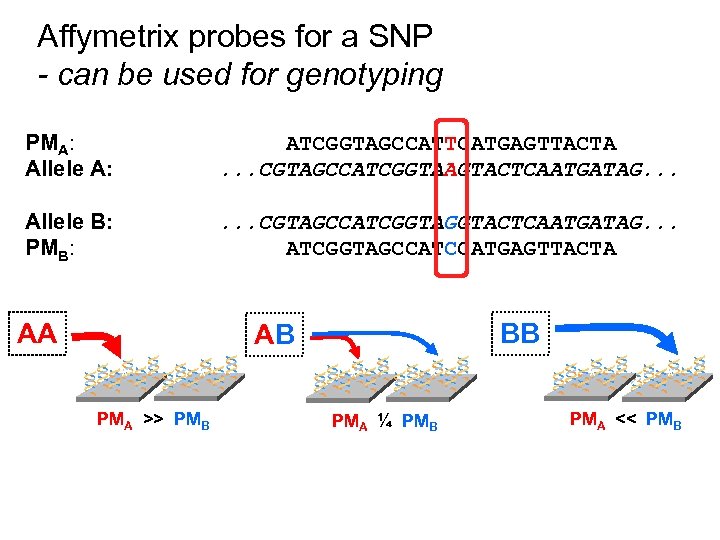
Affymetrix probes for a SNP - can be used for genotyping PMA: Allele A: ATCGGTAGCCATTCATGAGTTACTA. . . CGTAGCCATCGGTAAGTACTCAATGATAG. . . Allele B: PMB: . . . CGTAGCCATCGGTACTCAATGATAG. . . ATCGGTAGCCATGAGTTACTA AA BB AB ** * PMA >> PMB * ** * PMA ¼ PMB ** * PMA << PMB
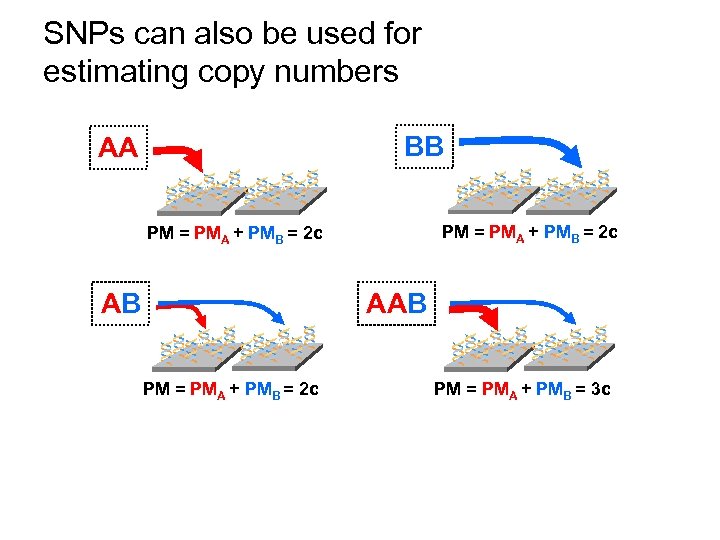
SNPs can also be used for estimating copy numbers BB AA ** * PM = PMA + PMB = 2 c AB ** * AAB ** * PM = PMA + PMB = 2 c ** * PM = PMA + PMB = 3 c *
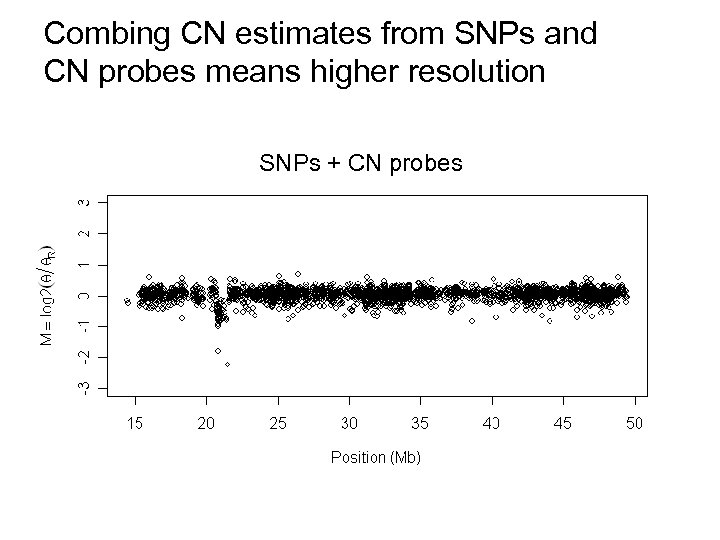
Combing CN estimates from SNPs and CN probes means higher resolution SNPs + CN probes

A brief history. . .
Genome-Wide Human SNP Array 6. 0 is the state-of-the-art array • > 906, 600 SNPs: – Unbiased selection of 482, 000 SNPs: historical SNPs from the SNP Array 5. 0 (== 500 K) – Selection of additional 424, 000 SNPs: • • • Tag SNPs from chromosomes X and Y Mitochondrial SNPs Recent SNPs added to the db. SNP database SNPs in recombination hotspots • > 946, 000 copy-number probes: – 202, 000 probes targeting 5, 677 CNV regions from the Toronto Database of Genomic Variants. Regions resolve into 3, 182 distinct, non-overlapping segments; on average 61 probe sets per region – 744, 000 probes, evenly spaced along the genome
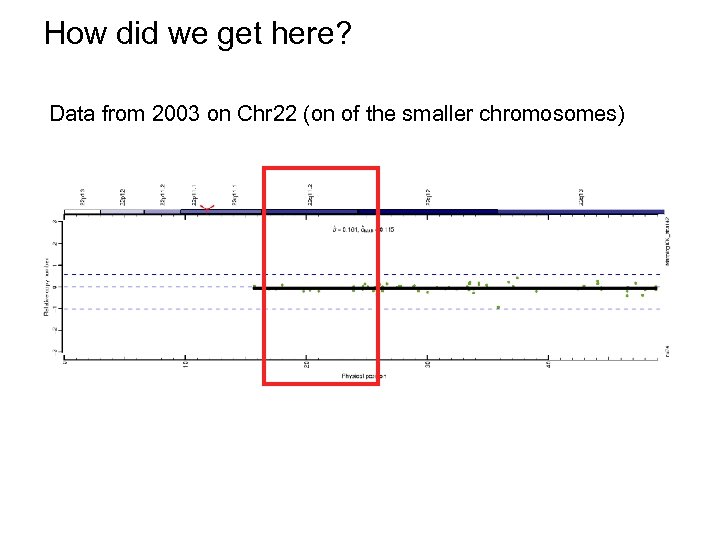
How did we get here? Data from 2003 on Chr 22 (on of the smaller chromosomes)
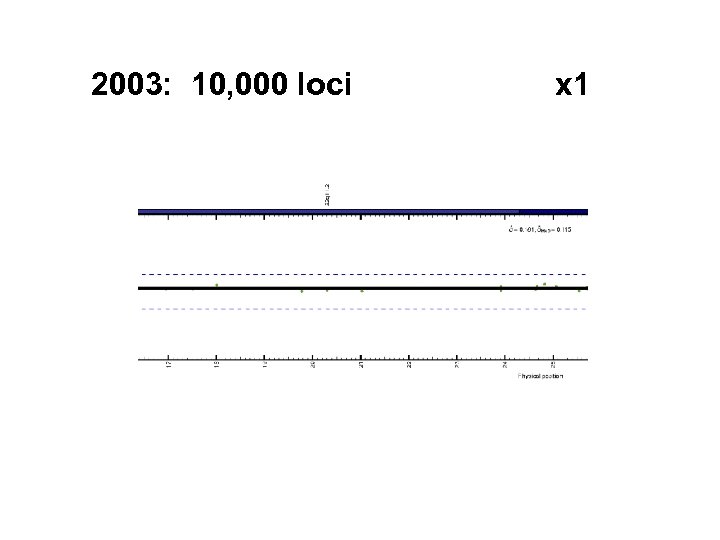
2003: 10, 000 loci x 1
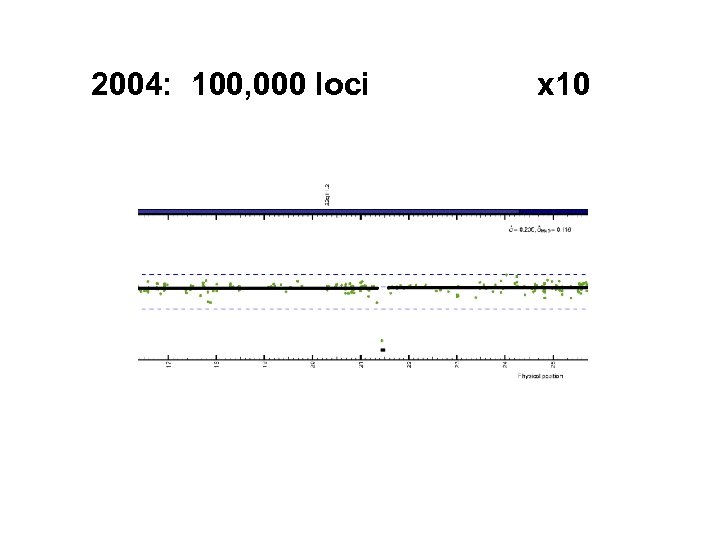
2004: 100, 000 loci x 10
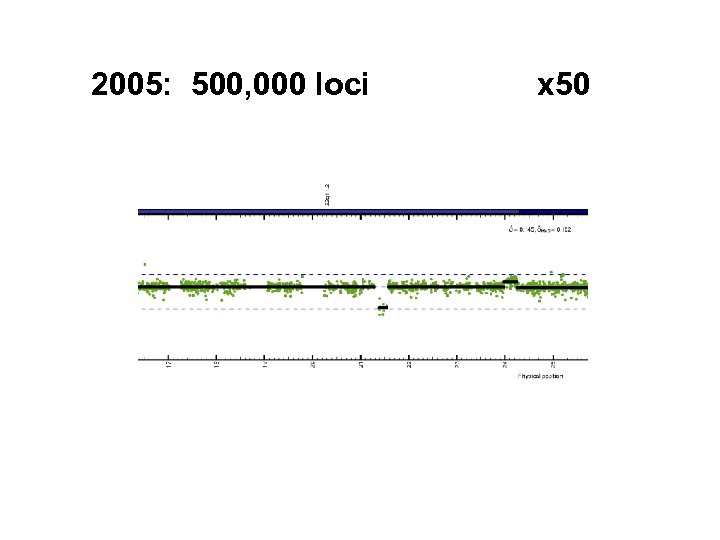
2005: 500, 000 loci x 50
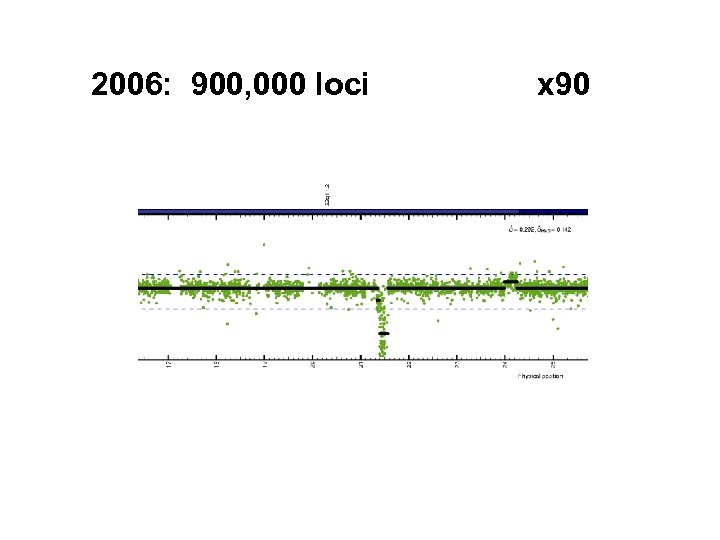
2006: 900, 000 loci x 90
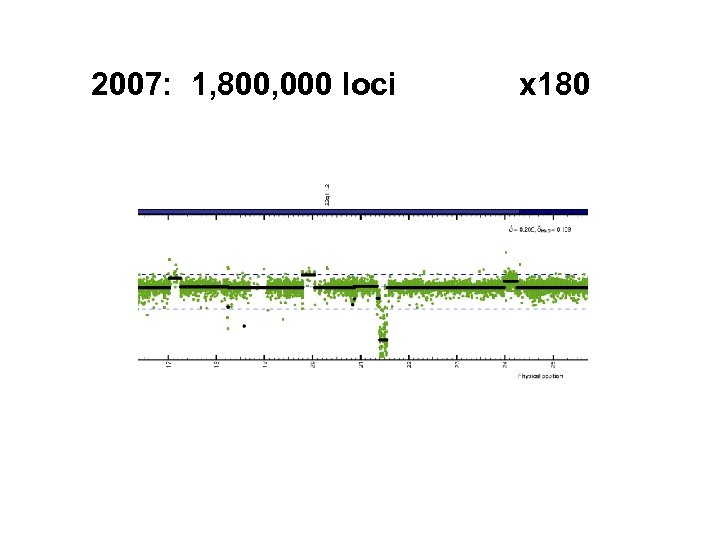
2007: 1, 800, 000 loci x 180
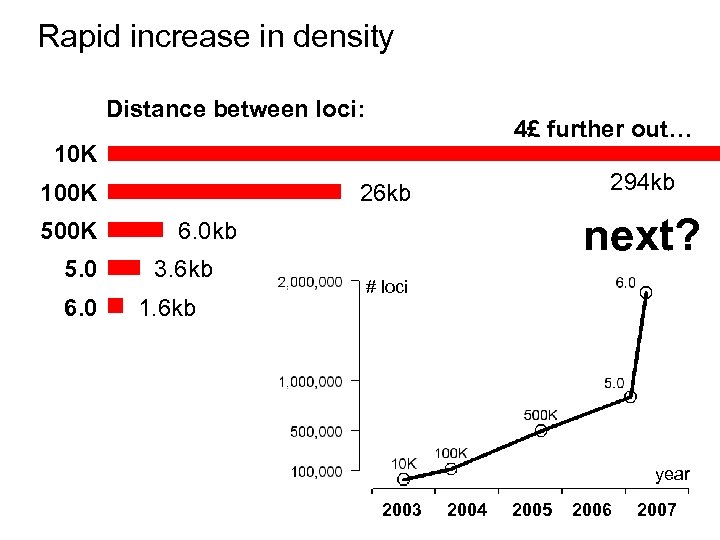
Rapid increase in density Distance between loci: 4£ further out… 10 K 100 K 5. 0 6. 0 294 kb 26 kb next? 6. 0 kb 3. 6 kb 1. 6 kb # loci year 2003 2004 2005 2006 2007
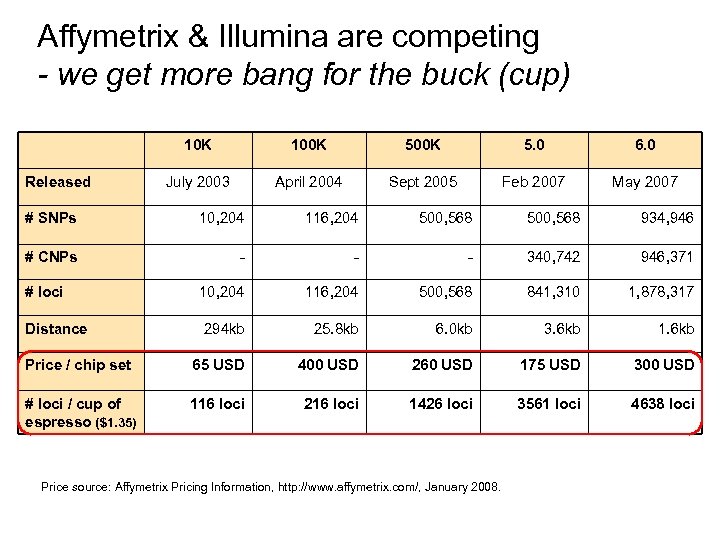
Affymetrix & Illumina are competing - we get more bang for the buck (cup) 10 K Released 100 K 5. 0 6. 0 July 2003 April 2004 Sept 2005 Feb 2007 May 2007 # SNPs 10, 204 116, 204 500, 568 934, 946 # CNPs - - - 340, 742 946, 371 10, 204 116, 204 500, 568 841, 310 1, 878, 317 294 kb 25. 8 kb 6. 0 kb 3. 6 kb 1. 6 kb Price / chip set 65 USD 400 USD 260 USD 175 USD 300 USD # loci / cup of espresso ($1. 35) 116 loci 216 loci 1426 loci 3561 loci 4638 loci # loci Distance Price source: Affymetrix Pricing Information, http: //www. affymetrix. com/, January 2008.
Preprocessing for copy-number analysis Copy-number estimation using Robust Multichip Analysis (CRMA)
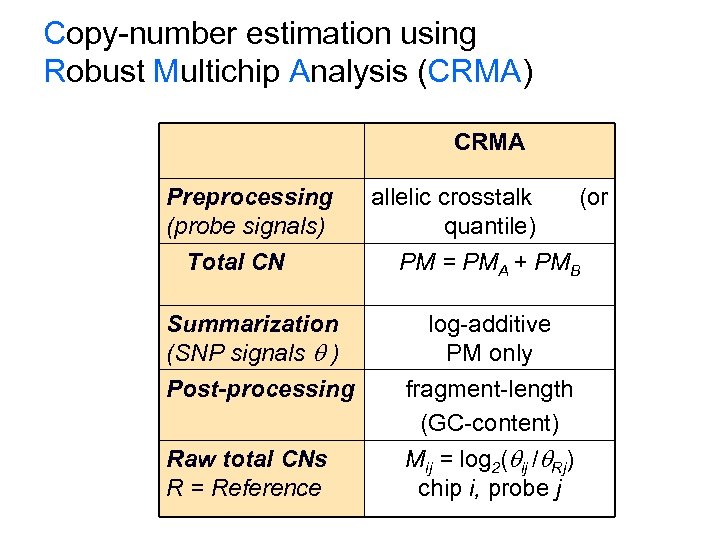
Copy-number estimation using Robust Multichip Analysis (CRMA) CRMA Preprocessing (probe signals) Total CN Summarization (SNP signals ) Post-processing Raw total CNs R = Reference allelic crosstalk quantile) (or PM = PMA + PMB log-additive PM only fragment-length (GC-content) Mij = log 2( ij / Rj) chip i, probe j
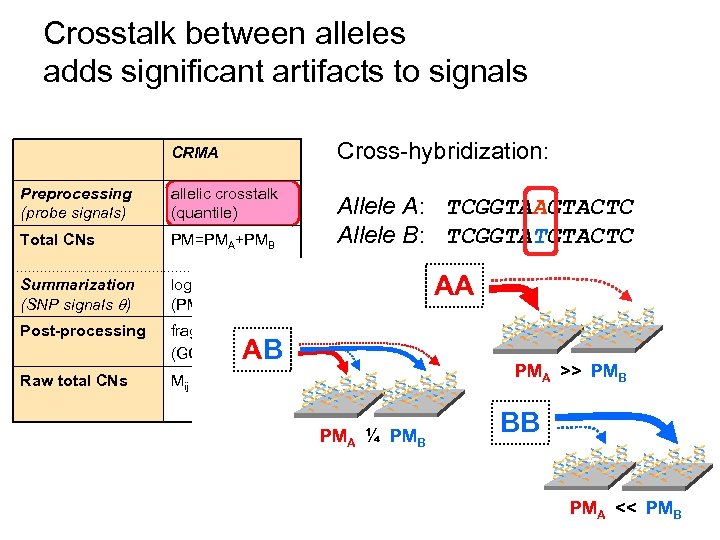
Crosstalk between alleles adds significant artifacts to signals CRMA Cross-hybridization: Preprocessing (probe signals) allelic crosstalk (quantile) Total CNs PM=PMA+PMB Allele A: TCGGTAAGTACTC Allele B: TCGGTATGTACTC Summarization (SNP signals ) log-additive (PM-only) Post-processing fragment-length (GC-content) Raw total CNs Mij = log 2( ij/ Rj) AA ** * AB ** * PMA ¼ PMB ** * PMA >> PMB * BB ** * PMA << PMB
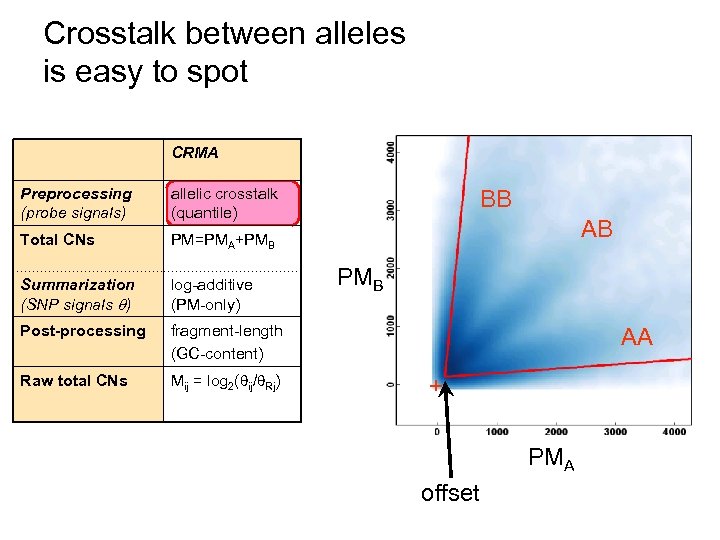
Crosstalk between alleles is easy to spot CRMA Preprocessing (probe signals) allelic crosstalk (quantile) Total CNs PM=PMA+PMB Summarization (SNP signals ) log-additive (PM-only) Post-processing fragment-length (GC-content) Raw total CNs Mij = log 2( ij/ Rj) BB AB PMB AA + PMA offset
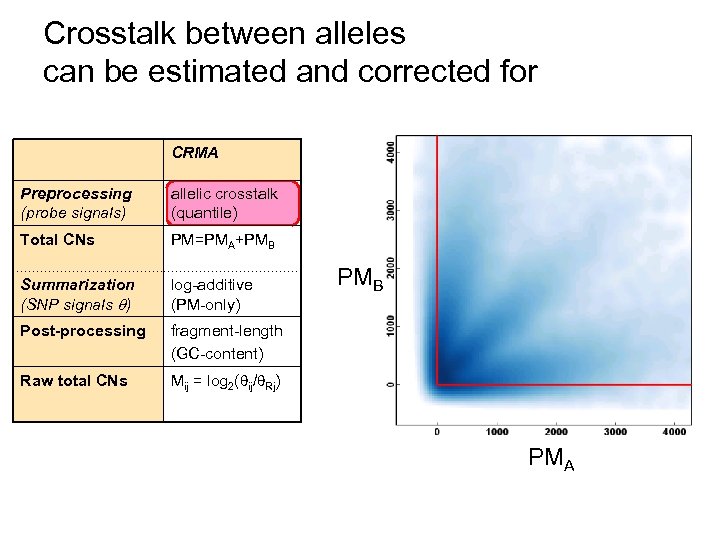
Crosstalk between alleles can be estimated and corrected for CRMA Preprocessing (probe signals) allelic crosstalk (quantile) Total CNs PM=PMA+PMB Summarization (SNP signals ) log-additive (PM-only) Post-processing fragment-length (GC-content) Raw total CNs Mij = log 2( ij/ Rj) PMB PMA
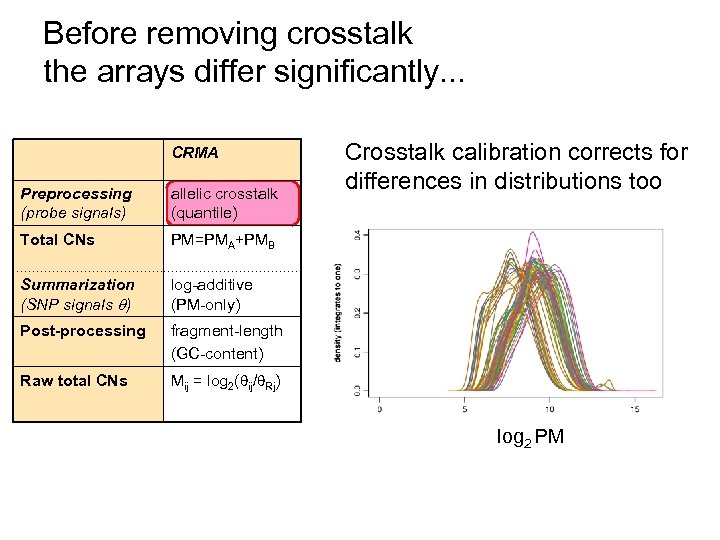
Before removing crosstalk the arrays differ significantly. . . CRMA Preprocessing (probe signals) allelic crosstalk (quantile) Total CNs PM=PMA+PMB Summarization (SNP signals ) log-additive (PM-only) Post-processing fragment-length (GC-content) Raw total CNs Crosstalk calibration corrects for differences in distributions too Mij = log 2( ij/ Rj) log 2 PM
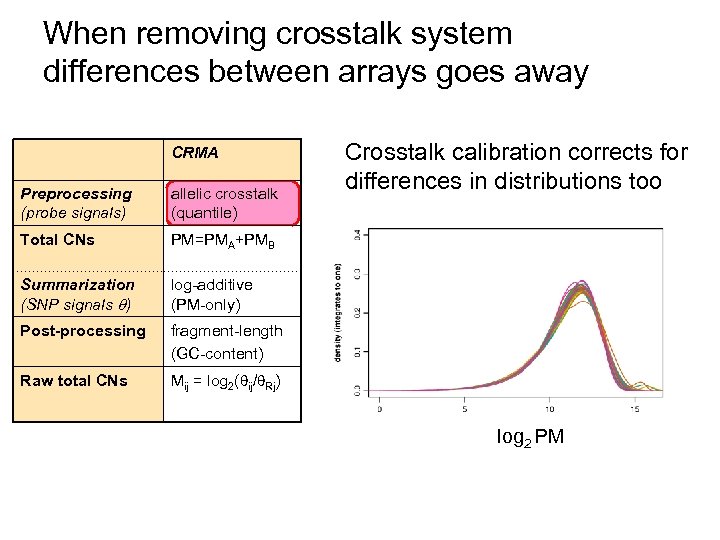
When removing crosstalk system differences between arrays goes away CRMA Preprocessing (probe signals) allelic crosstalk (quantile) Total CNs PM=PMA+PMB Summarization (SNP signals ) log-additive (PM-only) Post-processing fragment-length (GC-content) Raw total CNs Crosstalk calibration corrects for differences in distributions too Mij = log 2( ij/ Rj) log 2 PM
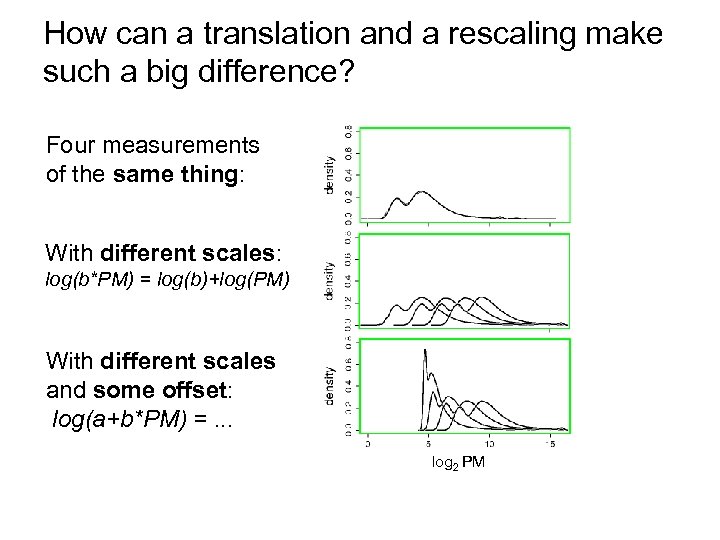
How can a translation and a rescaling make such a big difference? Four measurements of the same thing: With different scales: log 2 PM log(b*PM) = log(b)+log(PM) With different scales and some offset: log(a+b*PM) =. . . log 2 PM
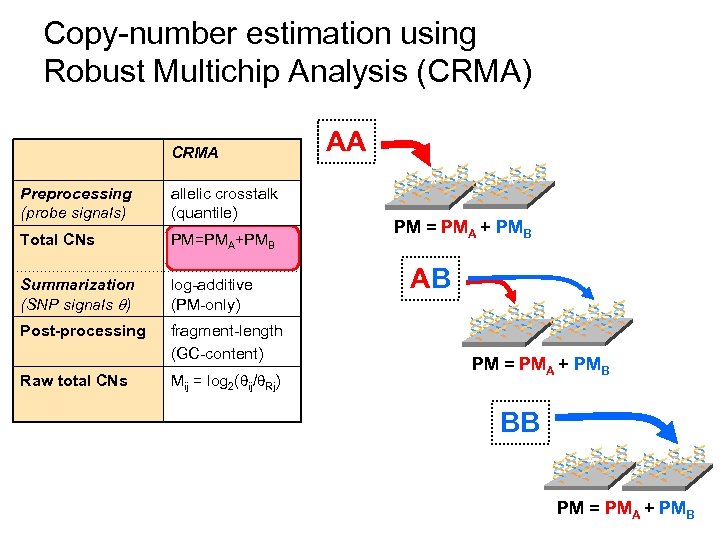
Copy-number estimation using Robust Multichip Analysis (CRMA) CRMA Preprocessing (probe signals) allelic crosstalk (quantile) Total CNs PM=PMA+PMB Summarization (SNP signals ) log-additive (PM-only) Post-processing fragment-length (GC-content) Raw total CNs Mij = log 2( ij/ Rj) AA ** * PM = PMA + PMB AB ** * PM = PMA + PMB * BB ** * PM = PMA + PMB
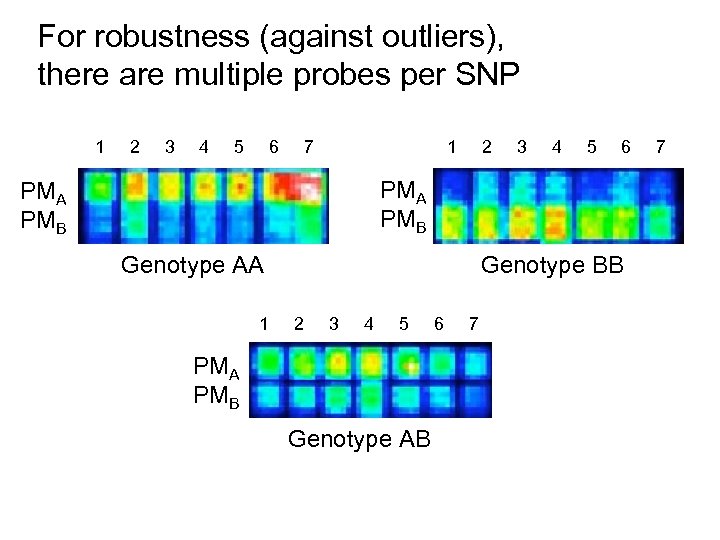
For robustness (against outliers), there are multiple probes per SNP 1 2 3 4 5 6 7 1 2 3 4 5 6 PMA PMB Genotype AA 1 Genotype BB 2 3 4 5 PMA PMB Genotype AB 6 7 7
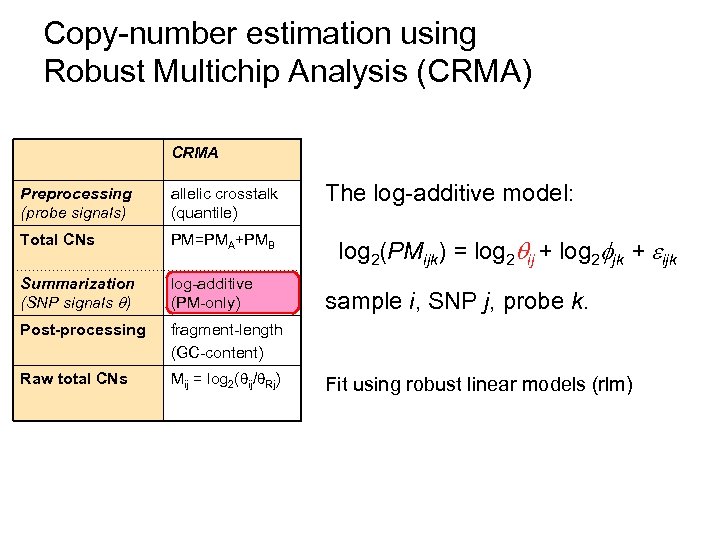
Copy-number estimation using Robust Multichip Analysis (CRMA) CRMA Preprocessing (probe signals) allelic crosstalk (quantile) Total CNs PM=PMA+PMB Summarization (SNP signals ) log-additive (PM-only) Post-processing fragment-length (GC-content) Raw total CNs Mij = log 2( ij/ Rj) The log-additive model: log 2(PMijk) = log 2 ij + log 2 jk + ijk sample i, SNP j, probe k. Fit using robust linear models (rlm)
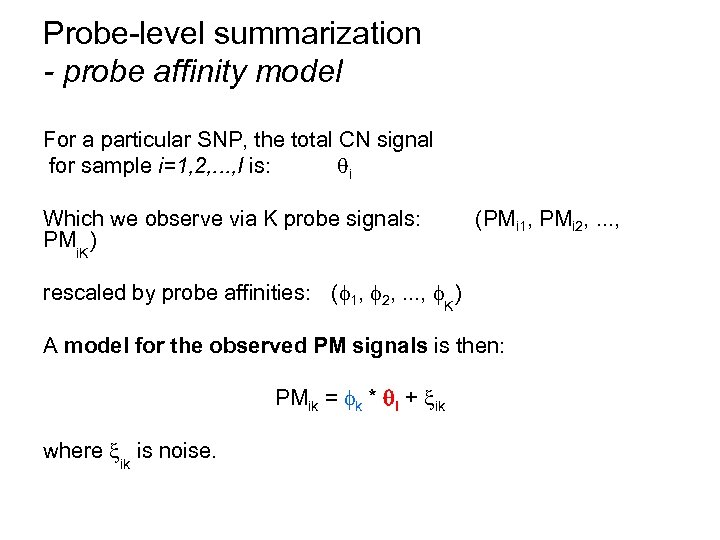
Probe-level summarization - probe affinity model For a particular SNP, the total CN signal for sample i=1, 2, . . . , I is: i Which we observe via K probe signals: PMi. K) (PMi 1, PMi 2, . . . , rescaled by probe affinities: ( 1, 2, . . . , K) A model for the observed PM signals is then: PMik = k * i + ik where ik is noise.
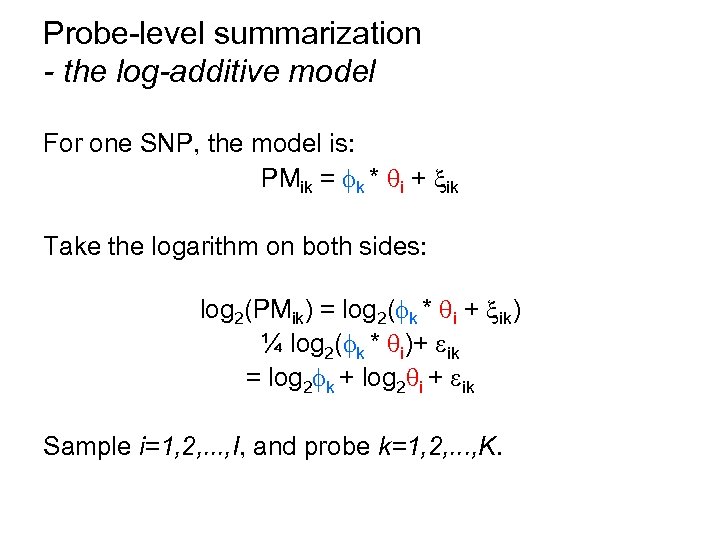
Probe-level summarization - the log-additive model For one SNP, the model is: PMik = k * i + ik Take the logarithm on both sides: log 2(PMik) = log 2( k * i + ik) ¼ log 2( k * i)+ ik = log 2 k + log 2 i + ik Sample i=1, 2, . . . , I, and probe k=1, 2, . . . , K.
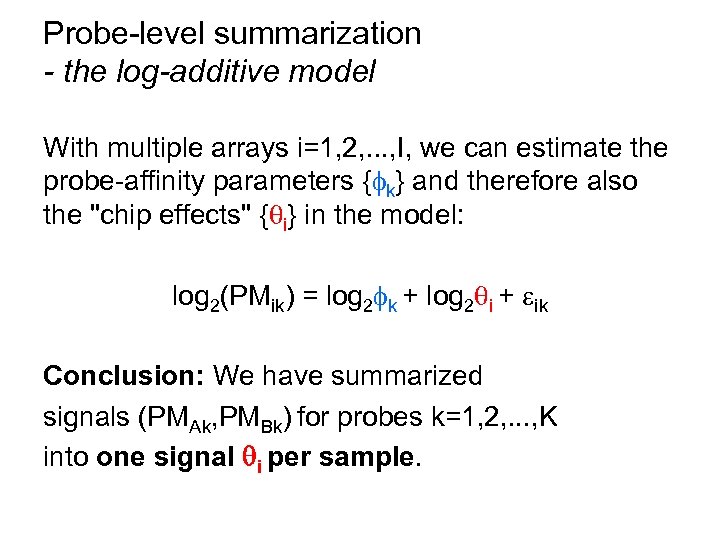
Probe-level summarization - the log-additive model With multiple arrays i=1, 2, . . . , I, we can estimate the probe-affinity parameters { k} and therefore also the "chip effects" { i} in the model: log 2(PMik) = log 2 k + log 2 i + ik Conclusion: We have summarized signals (PMAk, PMBk) for probes k=1, 2, . . . , K into one signal i per sample.
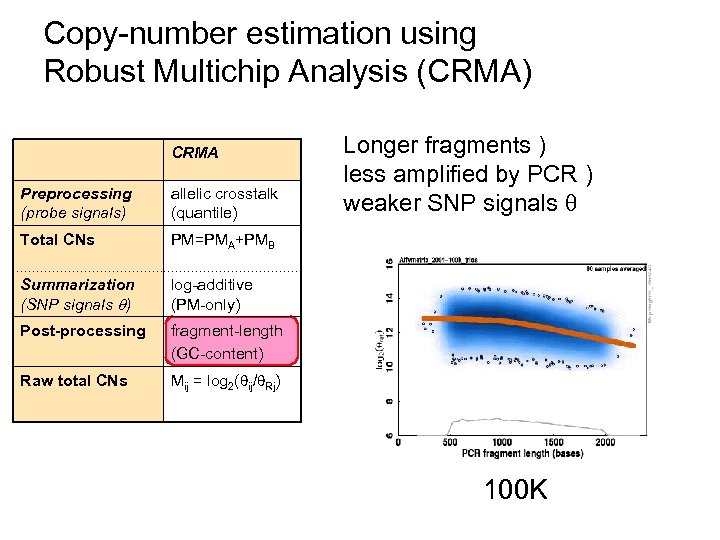
Copy-number estimation using Robust Multichip Analysis (CRMA) CRMA Preprocessing (probe signals) allelic crosstalk (quantile) Total CNs PM=PMA+PMB Summarization (SNP signals ) log-additive (PM-only) Post-processing fragment-length (GC-content) Raw total CNs Longer fragments ) less amplified by PCR ) weaker SNP signals Mij = log 2( ij/ Rj) 100 K
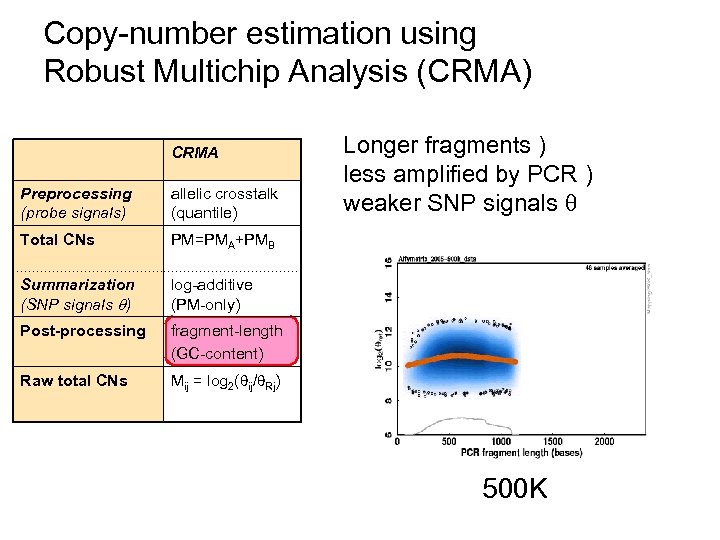
Copy-number estimation using Robust Multichip Analysis (CRMA) CRMA Preprocessing (probe signals) allelic crosstalk (quantile) Total CNs PM=PMA+PMB Summarization (SNP signals ) log-additive (PM-only) Post-processing fragment-length (GC-content) Raw total CNs Longer fragments ) less amplified by PCR ) weaker SNP signals Mij = log 2( ij/ Rj) 500 K
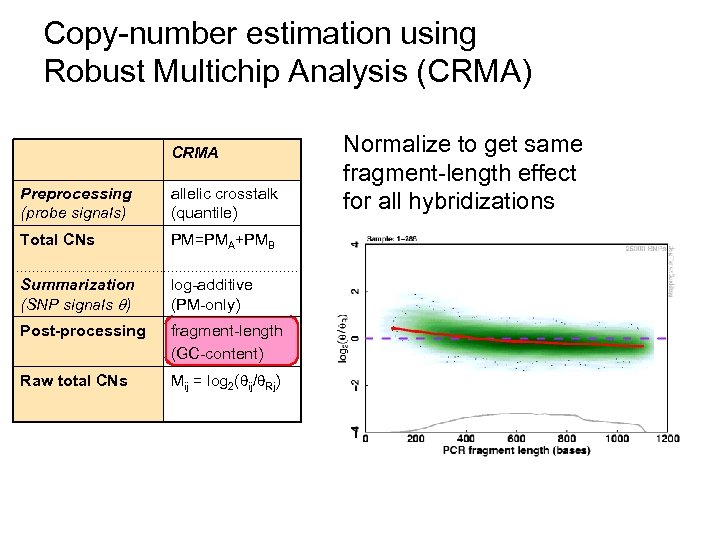
Copy-number estimation using Robust Multichip Analysis (CRMA) CRMA Preprocessing (probe signals) allelic crosstalk (quantile) Total CNs PM=PMA+PMB Summarization (SNP signals ) log-additive (PM-only) Post-processing fragment-length (GC-content) Raw total CNs Mij = log 2( ij/ Rj) Normalize to get same fragment-length effect for all hybridizations
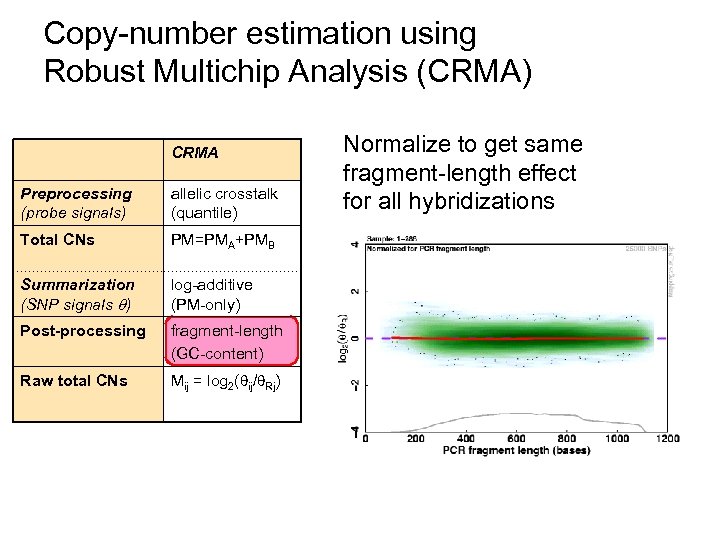
Copy-number estimation using Robust Multichip Analysis (CRMA) CRMA Preprocessing (probe signals) allelic crosstalk (quantile) Total CNs PM=PMA+PMB Summarization (SNP signals ) log-additive (PM-only) Post-processing fragment-length (GC-content) Raw total CNs Mij = log 2( ij/ Rj) Normalize to get same fragment-length effect for all hybridizations
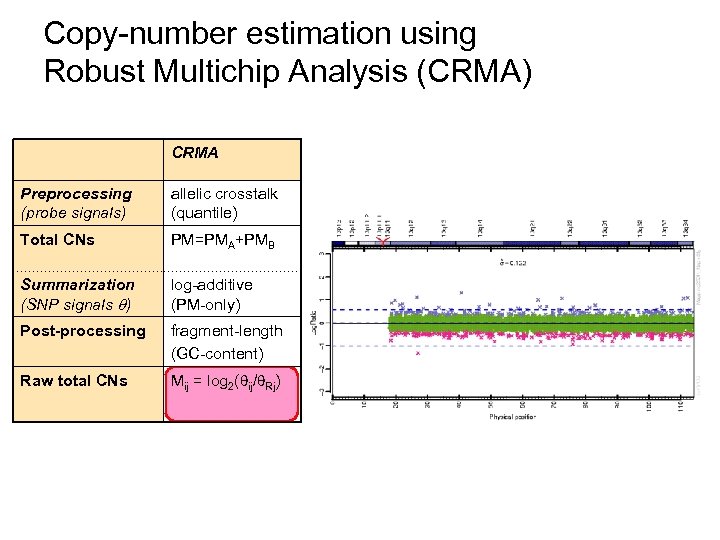
Copy-number estimation using Robust Multichip Analysis (CRMA) CRMA Preprocessing (probe signals) allelic crosstalk (quantile) Total CNs PM=PMA+PMB Summarization (SNP signals ) log-additive (PM-only) Post-processing fragment-length (GC-content) Raw total CNs Mij = log 2( ij/ Rj)
Results (comparing with other methods)
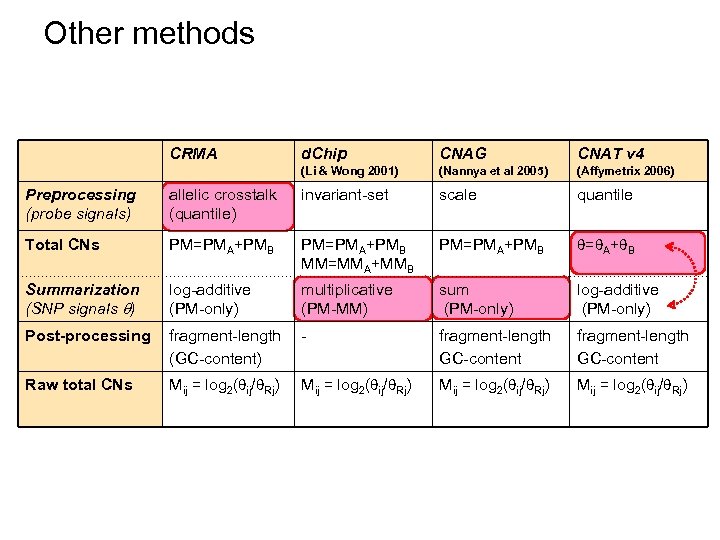
Other methods CRMA d. Chip CNAG CNAT v 4 (Li & Wong 2001) (Nannya et al 2005) (Affymetrix 2006) Preprocessing (probe signals) allelic crosstalk (quantile) invariant-set scale quantile Total CNs PM=PMA+PMB MM=MMA+MMB PM=PMA+PMB = A+ B Summarization (SNP signals ) log-additive (PM-only) multiplicative (PM-MM) sum (PM-only) log-additive (PM-only) Post-processing fragment-length (GC-content) - fragment-length GC-content Raw total CNs Mij = log 2( ij/ Rj)
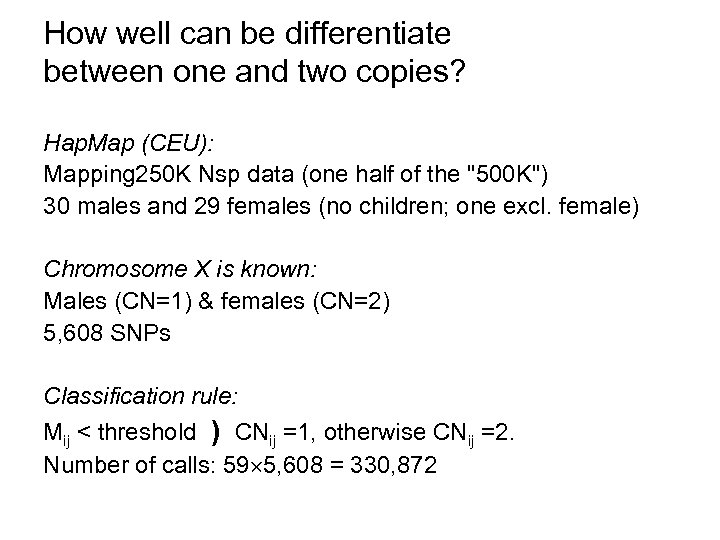
How well can be differentiate between one and two copies? Hap. Map (CEU): Mapping 250 K Nsp data (one half of the "500 K") 30 males and 29 females (no children; one excl. female) Chromosome X is known: Males (CN=1) & females (CN=2) 5, 608 SNPs Classification rule: Mij < threshold ) CNij =1, otherwise CNij =2. Number of calls: 59 5, 608 = 330, 872
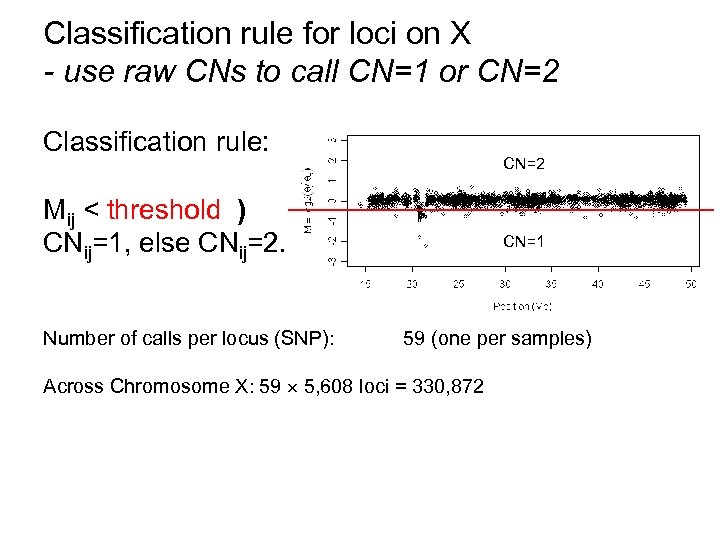
Classification rule for loci on X - use raw CNs to call CN=1 or CN=2 Classification rule: CN=2 Mij < threshold ) CNij=1, else CNij=2. Number of calls per locus (SNP): CN=1 59 (one per samples) Across Chromosome X: 59 5, 608 loci = 330, 872
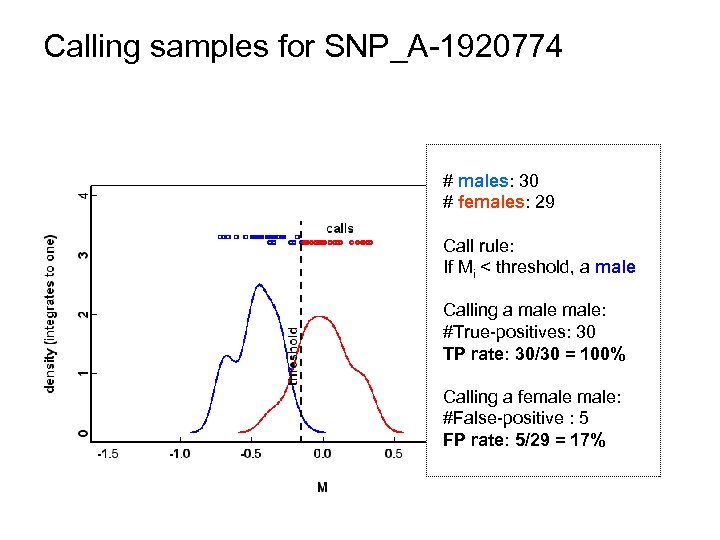
Calling samples for SNP_A-1920774 # males: 30 # females: 29 Call rule: If Mi < threshold, a male Calling a male: #True-positives: 30 TP rate: 30/30 = 100% Calling a female: #False-positive : 5 FP rate: 5/29 = 17%
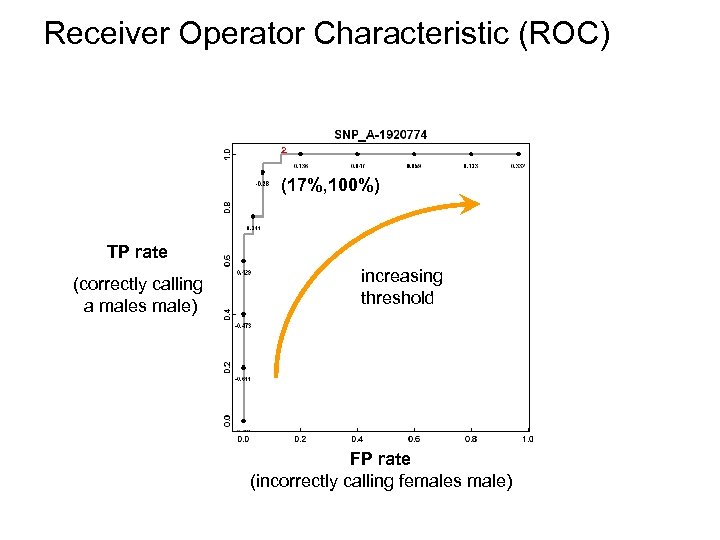
Receiver Operator Characteristic (ROC) ² (17%, 100%) TP rate (correctly calling a males male) increasing threshold FP rate (incorrectly calling females male)
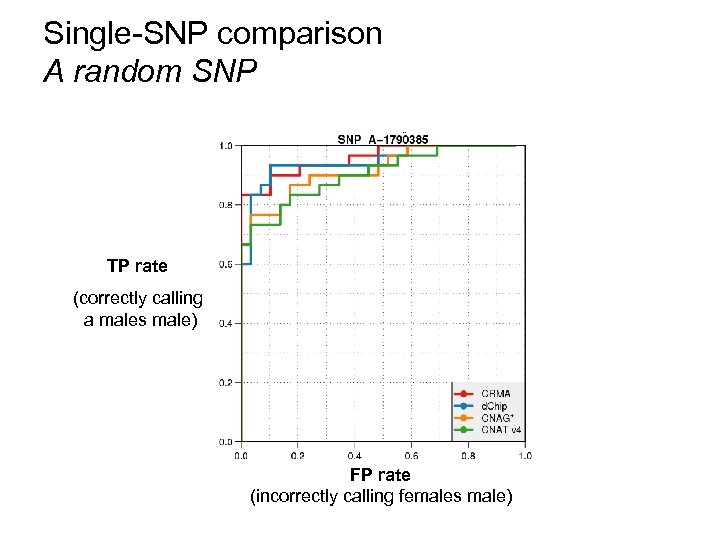
Single-SNP comparison A random SNP TP rate (correctly calling a males male) FP rate (incorrectly calling females male)
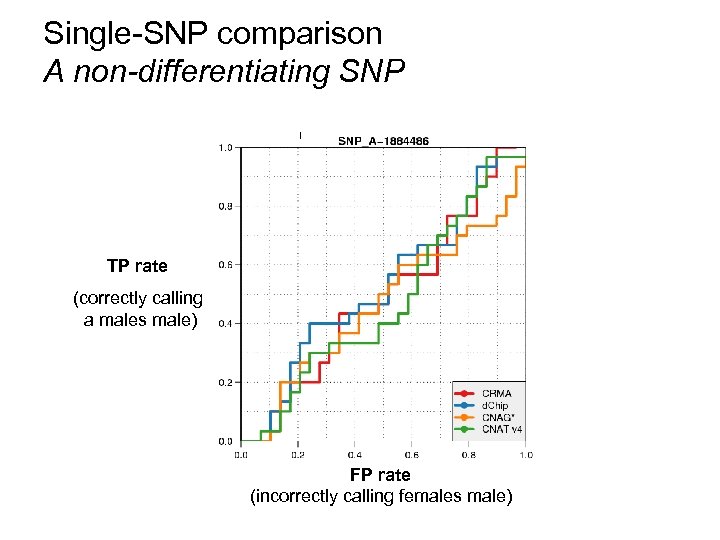
Single-SNP comparison A non-differentiating SNP TP rate (correctly calling a males male) FP rate (incorrectly calling females male)
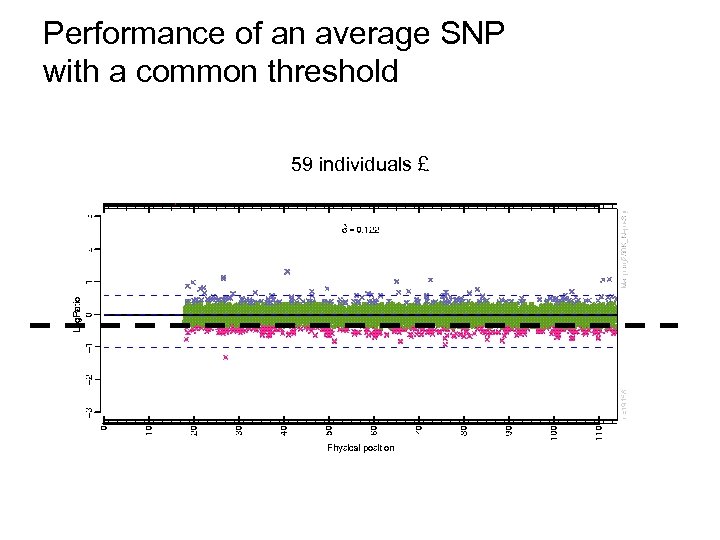
Performance of an average SNP with a common threshold 59 individuals £
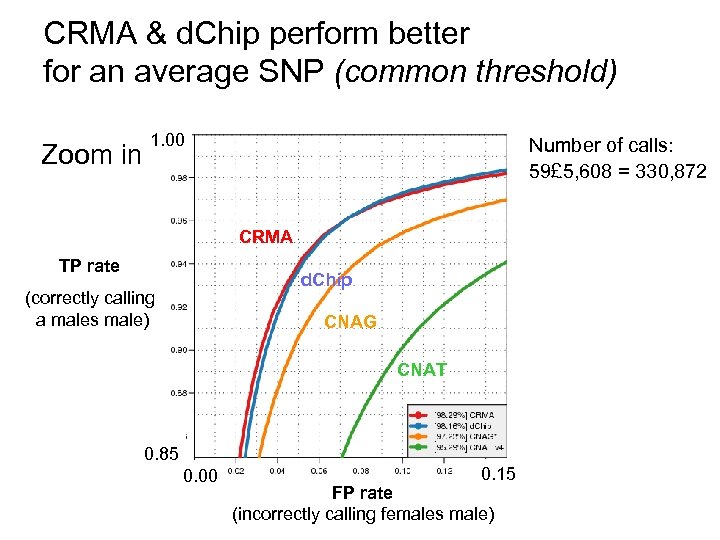
CRMA & d. Chip perform better for an average SNP (common threshold) Zoom in 1. 00 Number of calls: 59£ 5, 608 = 330, 872 CRMA TP rate d. Chip (correctly calling a males male) CNAG CNAT 0. 85 0. 00 0. 15 FP rate (incorrectly calling females male)

"Smoothing"
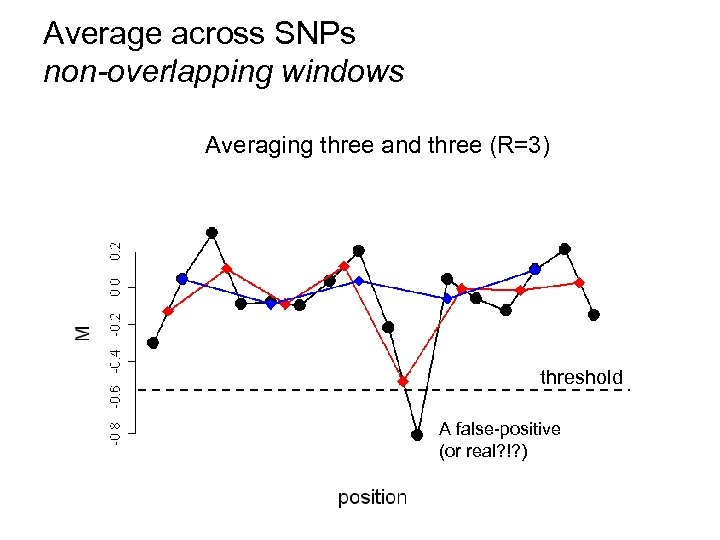
Average across SNPs non-overlapping windows Averaging three and (R=1) (R=3) Averaging two and two (R=2) No averaging three threshold A false-positive (or real? !? )
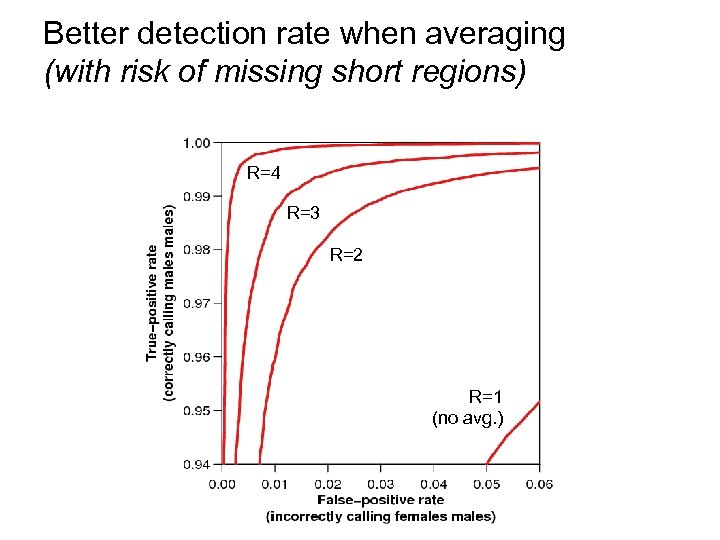
Better detection rate when averaging (with risk of missing short regions) R=4 R=3 R=2 R=1 (no avg. )
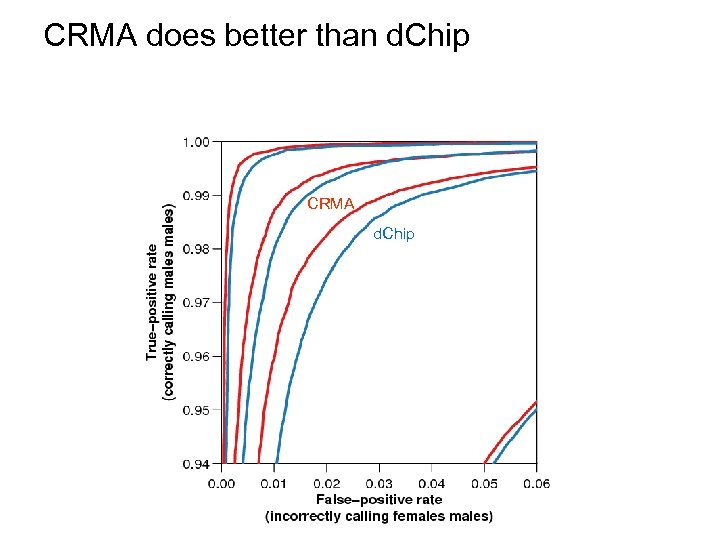
CRMA does better than d. Chip CRMA d. Chip
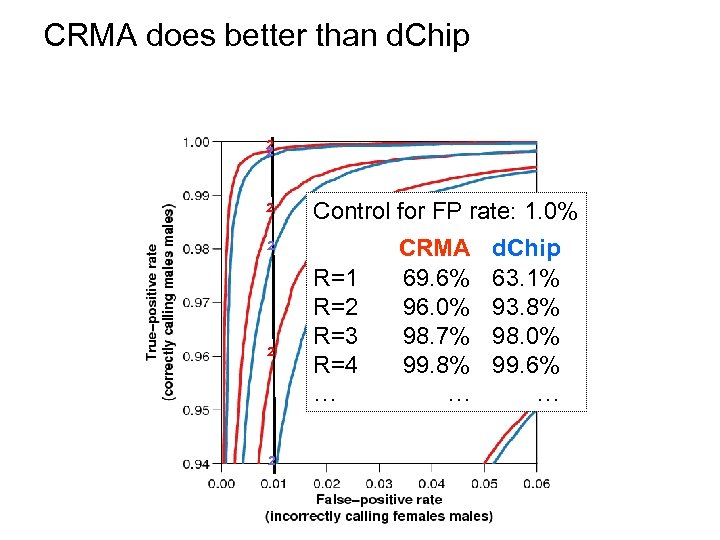
CRMA does better than d. Chip ² ² ² CRMA Control for FP rate: 1. 0% d. Chip ² ² ² R=1 R=2 R=3 R=4 … CRMA 69. 6% 96. 0% 98. 7% 99. 8% … d. Chip 63. 1% 93. 8% 98. 0% 99. 6% …
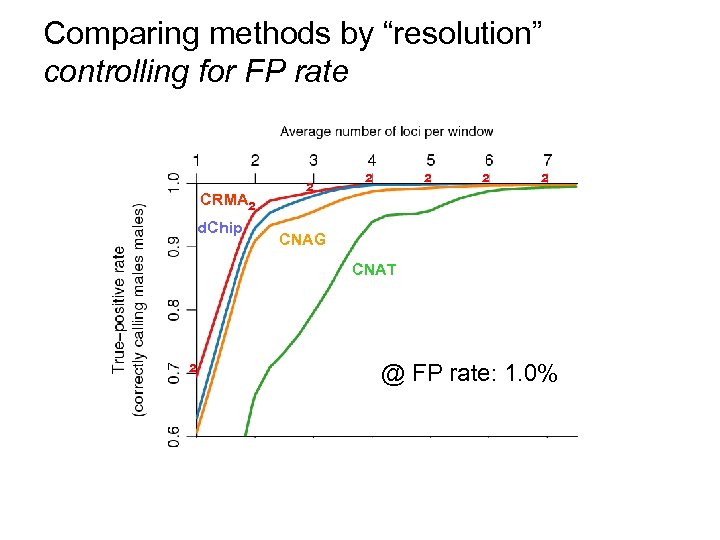
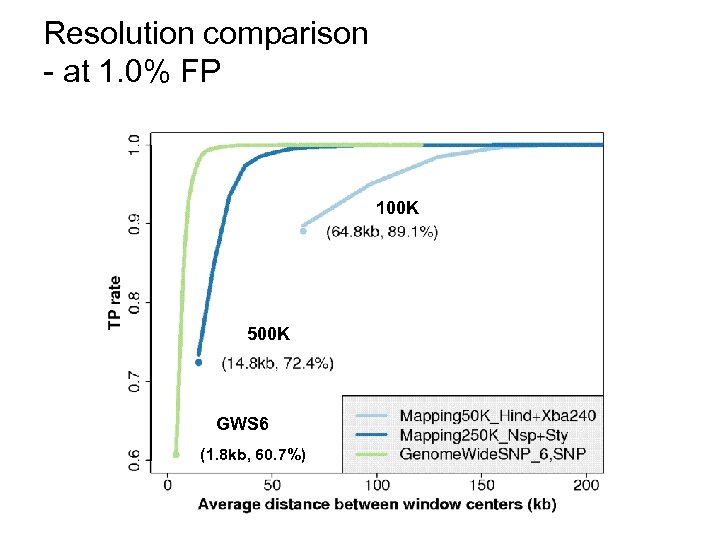
Comparing methods by “resolution” controlling for FP rate CRMA d. Chip ² ² ² CNAG CNAT ² @ FP rate: 1. 0%
Comparison across generations (100 K - 500 K - 6. 0)
We have Hap. Map data for several generations of platforms Hap. Map (CEU): 30 males and 29 females (no children; one excl. female) Chromosome X is known: Males (CN=1) & females (CN=2) 5, 608 SNPs Platforms: 100 K, 500 K, 6. 0.
Resolution comparison - at 1. 0% FP 100 K 500 K GWS 6 (1. 8 kb, 60. 7%)
Summary
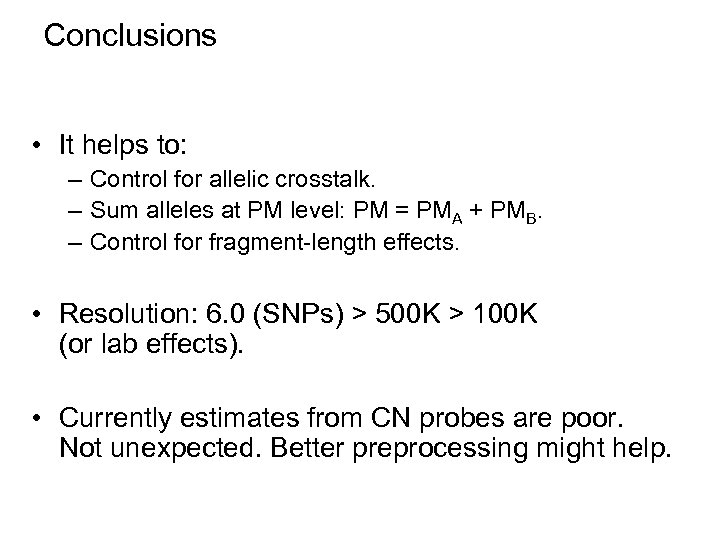
Conclusions • It helps to: – Control for allelic crosstalk. – Sum alleles at PM level: PM = PMA + PMB. – Control for fragment-length effects. • Resolution: 6. 0 (SNPs) > 500 K > 100 K (or lab effects). • Currently estimates from CN probes are poor. Not unexpected. Better preprocessing might help.
2008: >30, 000 loci >x 3000? On January 10, 2008: Dr Stephen Fodor, CEO of Affymetrix, outlined new products: Affymetrix has been focusing on new chemistry techniques, such as a new higher yield synthesis technique. The first product that will be launched - around the first half of 2008 - is an ultra-high resolution copy number tool. "This product will allow us to analyze the genome at around 30 times the resolution of the current state-of-the-art technology in the marketplace, " claimed Fodor. Source: http: //www. labtechnologist. com/
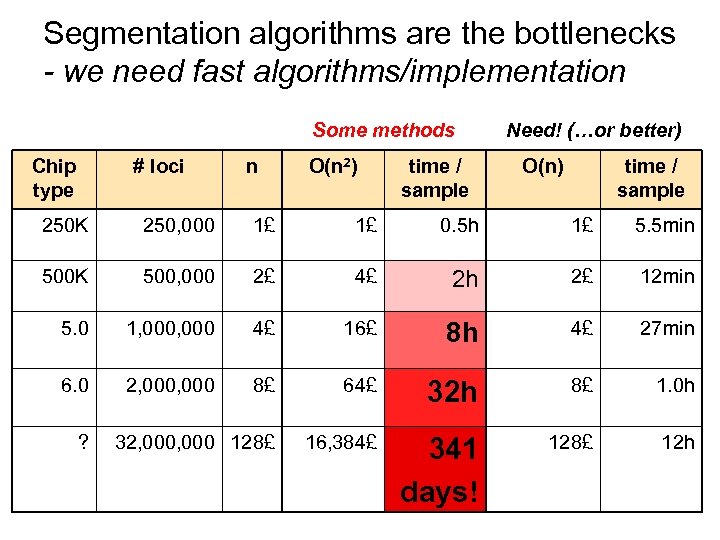
Segmentation algorithms are the bottlenecks - we need fast algorithms/implementation Some methods Chip type # loci n O(n 2) time / sample Need! (…or better) O(n) time / sample 250 K 250, 000 1£ 1£ 0. 5 h 1£ 5. 5 min 500 K 500, 000 2£ 4£ 2 h 2£ 12 min 5. 0 1, 000 4£ 16£ 8 h 4£ 27 min 6. 0 2, 000 8£ 64£ 32 h 8£ 1. 0 h 32, 000 128£ 16, 384£ 341 days! 128£ 12 h ?
Скачать презентацию Copy-number estimation on the latest generation of high-density
bdd0a4f138526dec9eb8011b4bc2d5af.ppt