


 Скачать презентацию Coping with Exchange Rates Week 2 Professor Dermot
520f0eb21b1c82d7c9a01e6eb567f59a.ppt
- Количество слайдов: 41
 Coping with Exchange Rates Week 2 Professor Dermot Mc. Aleese
 OUTLINE Definitions Exchange rate in practice Exchange rate theories (PPP) Capital flows and exchange rate volatility Coping with exchange rate risk
 EXCHANGE RATE The exchange rate is defined as the price of a unit of foreign currency in terms of domestic currency. The nominal effective exchange rate (EER) of a country A is A’s exchange rate vis-a vis other currencies weighted by their share in A’s trade. Real effective exchange rate (REER) takes account of price level changes between trading partners by adjusting the nominal effective exchange rate by the ratio of foreign to domestic inflation.
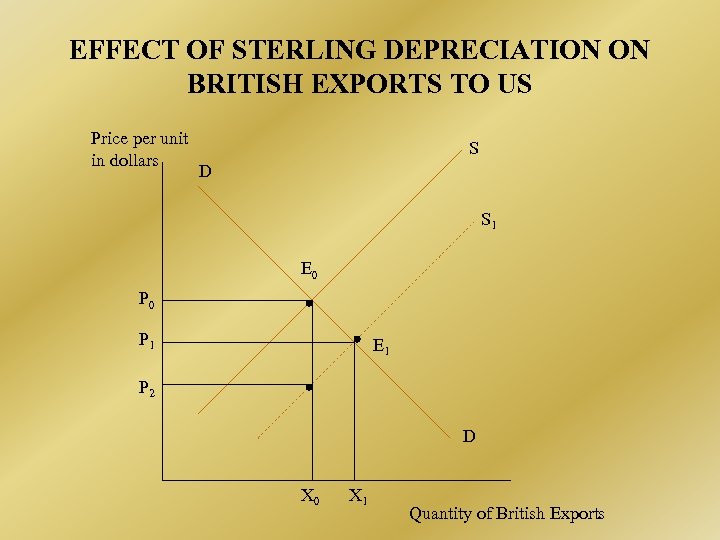 EFFECT OF STERLING DEPRECIATION ON BRITISH EXPORTS TO US Price per unit in dollars S D S 1 E 0 P 1 E 1 P 2 D X 0 X 1 Quantity of British Exports
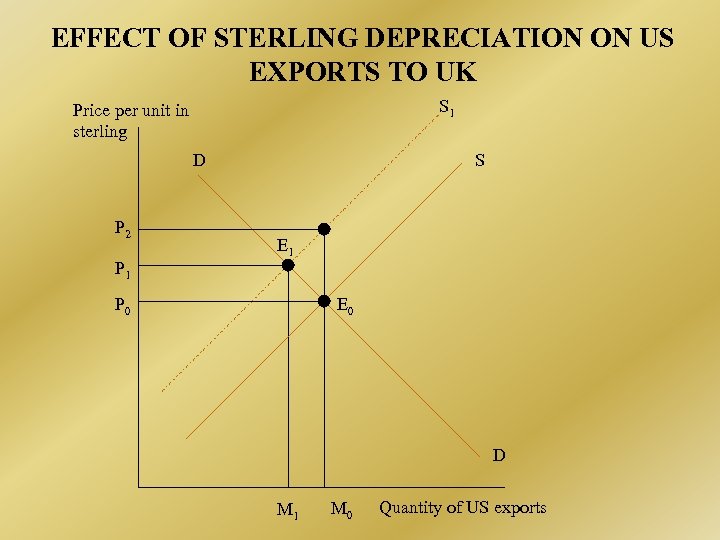 EFFECT OF STERLING DEPRECIATION ON US EXPORTS TO UK S 1 Price per unit in sterling D P 2 P 1 S E 1 P 0 E 0 D M 1 M 0 Quantity of US exports
 DEPRECIATION OF STERLING A depreciation of sterling will, other things being equal, lead to: an increase in volume of UK exports a reduction in the volume of UK imports a fall in the dollar price and a rise in the sterling price of UK exports a rise in the sterling price of UK imports
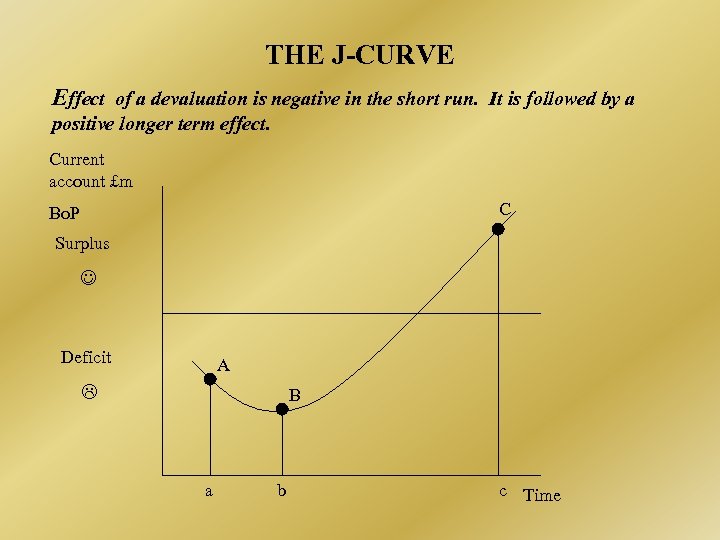 THE J-CURVE Effect of a devaluation is negative in the short run. It is followed by a positive longer term effect. Current account £m C Bo. P Surplus Deficit A B a b c Time
 PURCHASING POWER PARITY Purchasing power parity (PPP) links movements in exchange rates to differences between price level in the domestic country and that of its major trading partners Law of one price: if two goods are identical, they will sell at the same price Arbitrage: process which ensures that the existence of any price differential between one country and another is exploited in order to make a riskless profit
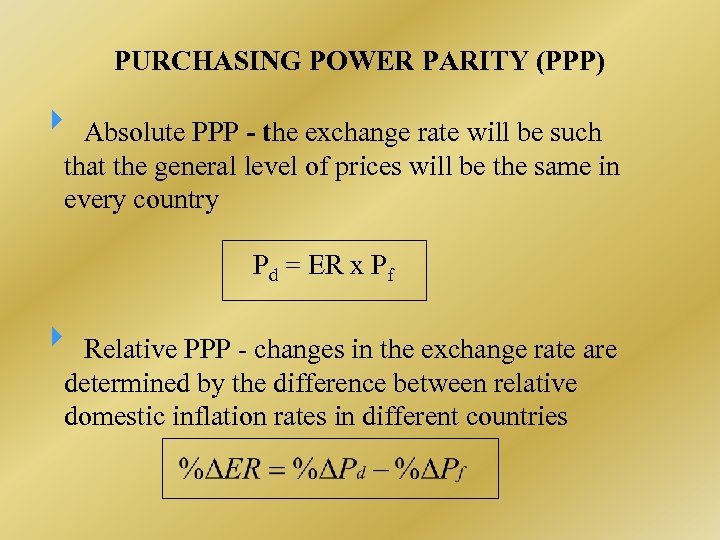 PURCHASING POWER PARITY (PPP) Absolute PPP - the exchange rate will be such that the general level of prices will be the same in every country Pd = ER x Pf Relative PPP - changes in the exchange rate are determined by the difference between relative domestic inflation rates in different countries
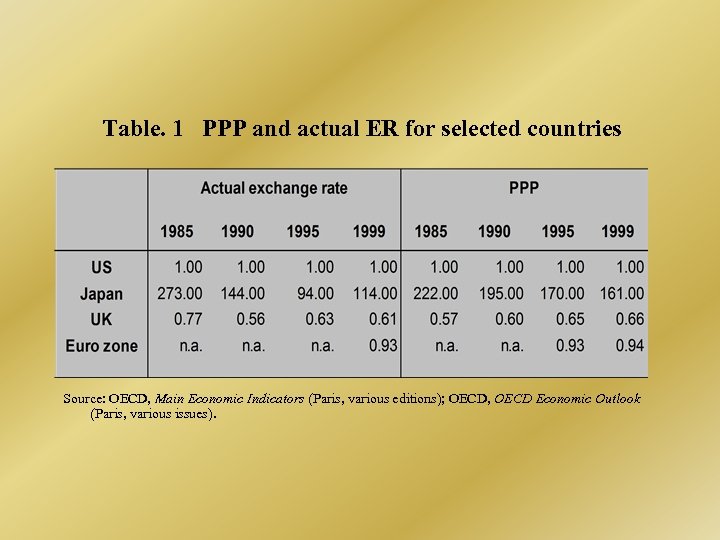 Table. 1 PPP and actual ER for selected countries Source: OECD, Main Economic Indicators (Paris, various editions); OECD, OECD Economic Outlook (Paris, various issues).
 VERDICT ON PPP It works well in the long run, especially in conditions of very large inflation differentials. It provides a guide to the general trend in exchange rates, in particular where the main shocks underlying the trend are of monetary origin. In a fixed exchange rate system inflation differences give a useful indicator of pressure for currency realignment For the conduct of macroeconomic policy, it is an important reminder that the exchange rate and the price level cannot be divorced from each other.
 BALANCE OF PAYMENTS AND MONETARY APPROACHES Balance of payments approach focus is more directly on the link between the trade/current account balance, modified to take account of long-term capital flows and movements in ER allows for the possibility that ERs are affected by ‘real’ factors, as well as relative inflation rates (changes in growth rate, changes in composition of aggregate demand, equity and bond market performance, size of BD and public debt a government and political stability) Monetary approach emphasises the role of money supply growth rates in the home country relative to foreign countries a restrictive monetary policy reduces money supply, raises interest rates, diminishes import demand improves the current account
 CAPITAL FLOWS AND EXCHANGE RATE VOLATILITY International capital flows FDI private portfolio private credit other (public capital, aid, reserves, …) Determinants of international portfolio capital movements difference between interest rates at home and abroad differences between expected returns at home and abroad expectations about future exchange rates
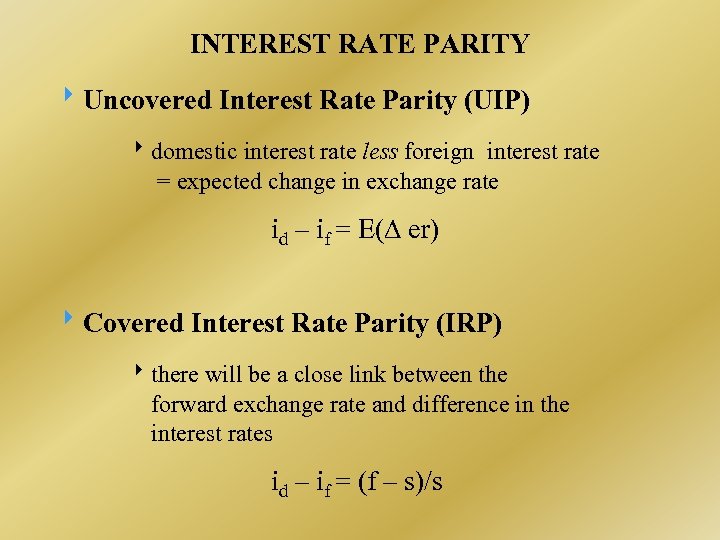 INTEREST RATE PARITY Uncovered Interest Rate Parity (UIP) domestic interest rate less foreign interest rate = expected change in exchange rate id – if = E( er) Covered Interest Rate Parity (IRP) there will be a close link between the forward exchange rate and difference in the interest rates id – if = (f – s)/s
 EXCHANGE RATE EXPECTATIONS Fundamentals: - inflation - budget deficit - public debt - interest rate - past exchange rate changes - GDP growth - unemployment - export growth - balance of payment “Irrational impulses” and Contagion: - bubbles - bandwagons and contagion
 ‘Capital markets have the heart of a lamb, the legs of a hare and the memory of an elephant. ’ Prof. Luigi Enaudi
 ‘In 1973 the experts claimed that exchange rate fluctuations serve to automatically adjust the differences in industrial competitive power among countries. Now I am tempted to ask whether the experts were right in claiming this. What was not anticipated in 1973 was that freely fluctuating rates would spawn speculation and money trading. The resulting rates did not necessarily reflect competitive power or the fundamentals of national economies. ……. Money trading has a tendency to distort reality. ’ Akio Morita Chairman Sony Corporation “How to Renew the Global Economic Framework” International Economic Insights, Washington DC. March/April 1993 p. 25
 STRATEGIES FOR COPING WITH EXCHANGE RATE RISK Using the forward market A foreign exchange forward contract is an over-the-counter (OTC) transaction between a bank and its customer, whereby the bank agrees to buy or sell a specified amount of currency at an agreed rate for delivery at a specified future date. Options A foreign currency options contract gives the company the right to buy (call option) or sell (put option) a specified amount of foreign currency on or before a specified expiration date at a fixed strike price. Hedges A company offsets an existing exposure in a given currency by taking an opposite position in that currency with the same or similar risk.
 ADVERSE EFFECTS OF EXCHANGE RATE VOLATILITY Large devaluation = more inflation Competitive devaluation = damage trade relations ’Contagion’ problem Sustained exchange rate misalignments –‘overshooting’ Increased uncertainty
 Exchange Rate Regimes Week 2, lecture 2
 Lecture 2 week 2 The global exchange rate system Floating exchange rate in theory and practice Search for stability Conclusions
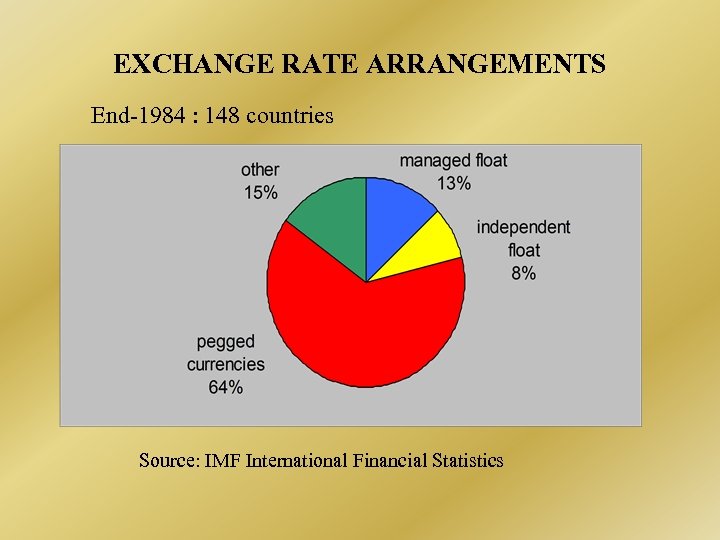 EXCHANGE RATE ARRANGEMENTS End-1984 : 148 countries Source: IMF International Financial Statistics
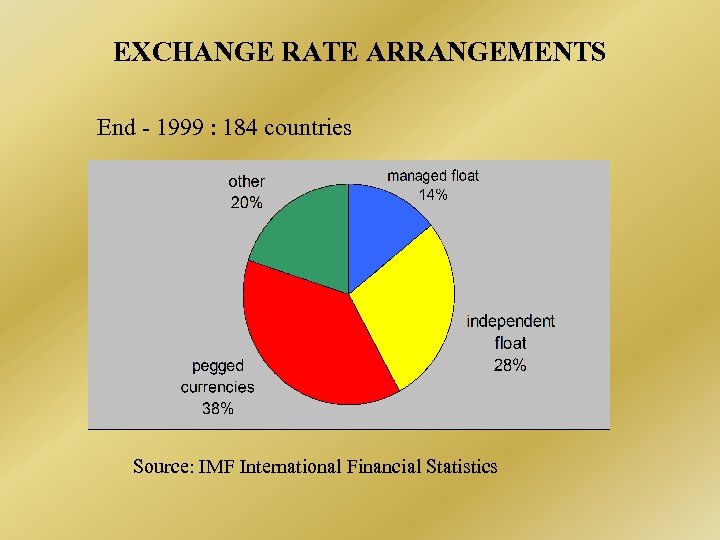 EXCHANGE RATE ARRANGEMENTS End - 1999 : 184 countries Source: IMF International Financial Statistics
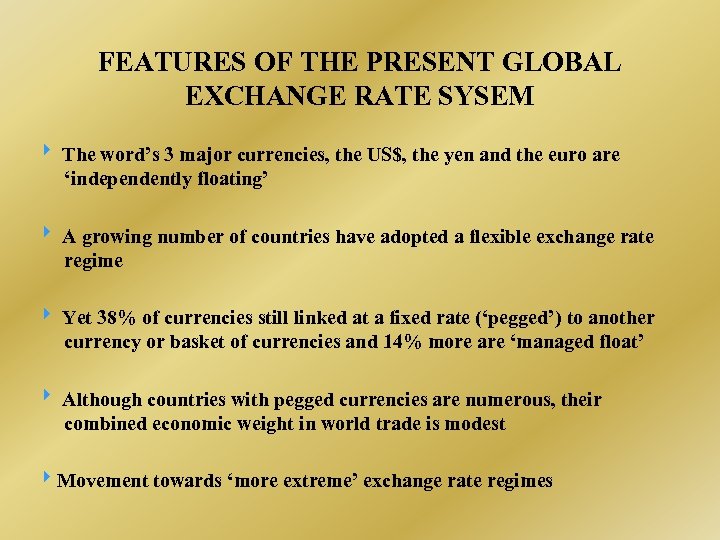 FEATURES OF THE PRESENT GLOBAL EXCHANGE RATE SYSEM The word’s 3 major currencies, the US$, the yen and the euro are ‘independently floating’ A growing number of countries have adopted a flexible exchange rate regime Yet 38% of currencies still linked at a fixed rate (‘pegged’) to another currency or basket of currencies and 14% more are ‘managed float’ Although countries with pegged currencies are numerous, their combined economic weight in world trade is modest Movement towards ‘more extreme’ exchange rate regimes
 “There are no major difficulties to prevent the prompt establishment by countries of a system of exchange rates freely determined in open markets, primarily by private transactions, and the simultaneous abandonment of direct controls over exchange transactions. A move in this direction is the fundamental prerequisite for the economic integration of the free world through multilateral trade. ” Milton Friedman, 1956
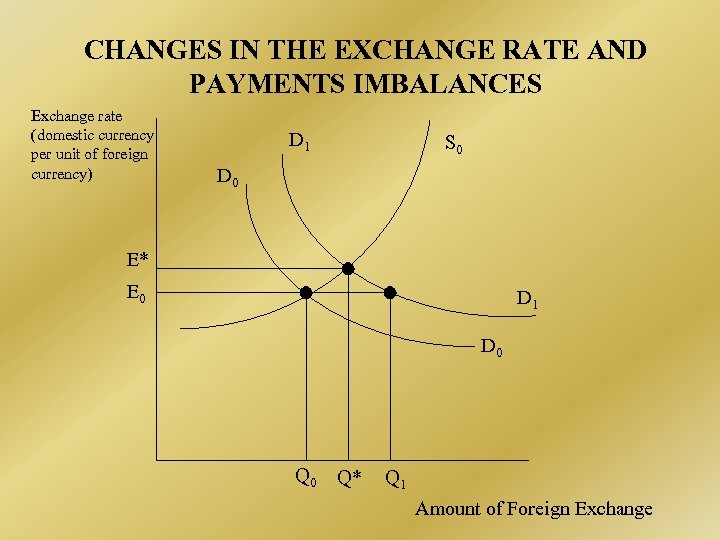 CHANGES IN THE EXCHANGE RATE AND PAYMENTS IMBALANCES Exchange rate (domestic currency per unit of foreign currency) D 1 S 0 D 0 E* E 0 D 1 D 0 Q* Q 1 Amount of Foreign Exchange
 EXCHANGE RATE DETERMINANTS Supply of forex Demand forex Equilibrium exchange rate Direct and indirect effects of ER Balance of payment deficit/surplus Changes in ER over time
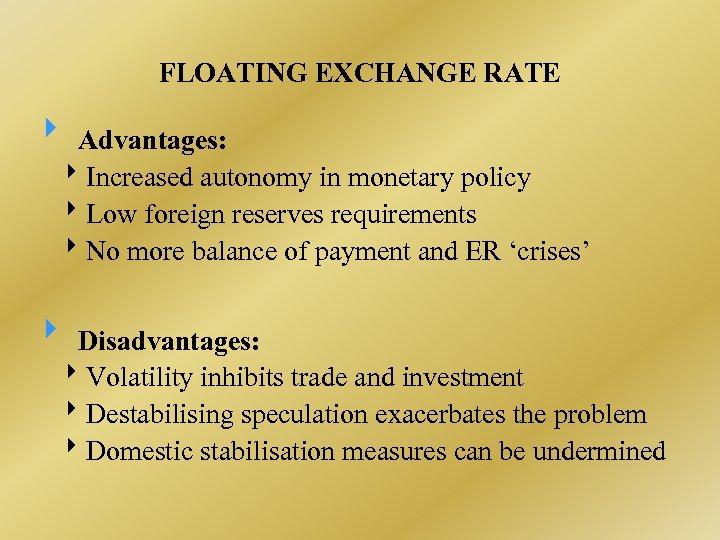 FLOATING EXCHANGE RATE Advantages: Increased autonomy in monetary policy Low foreign reserves requirements No more balance of payment and ER ‘crises’ Disadvantages: Volatility inhibits trade and investment Destabilising speculation exacerbates the problem Domestic stabilisation measures can be undermined
 A key objection to floating exchange rates – and capital liberalisation -- is that the exchange rate market system is fundamentally flawed …. Because of the problem and costs of CONTAGION
 Exchange rate crises and contagion Contagion a new subject in this context – though banking literature has many references. Banking contagion arises where bank that is sound is rendered insolvent by reckless actions of other banks. Exchange rate crises caused by record real interest rates in the US in the 1980 s. In the 1990 s, contagion seen as a problem: – – Mexico 1994 -5 -- tequila effect East Asian flu 1997 -8 Russian virus 1998 Brazil 1999
 What is Contagion? • Fundamentals Based Contagion • True Contagion
 Fundamentals Based Contagion Affected country linked to country with initial shock by trade or finance. Which is more important? Trade or finance? Finance Contagion more likely to be regional than global Susceptibility to contagion non-linear – the more countries affected, the more vulnerable the rest.
 ‘True’ Contagion Influence of ‘news’ about creditworthiness of a sovereign borrower on the spreads charged to others, after controlling for country-specific macro fundamentals Crisis driven by herd behaviour (‘irrational’) and irrational Excessive co-variation across countries in asset returns (debt or equity).
 Co-movement is excessive if it persists after fundamentals (and idiosyncratic factors) have been allowed for. That is, the existence of a crisis elsewhere increases the probability of a crisis at home, even when fundamentals are taken into account.
 Theories of Contagion • Trade links (Nurkse): crisis followed by a devaluation in one country leads to BP problems in trading partners (competitive devaluations). Hence high syncronisation of crises among countries that trade heavily with each other. • But not merely a matter of bilateral trade between affected countries. Competitive position in 3 rd country markets a more important factor.
 The depreciation of the Mexican peso had a major effect on Argentina, but very little on Korea. This is not consistent with the trade linkages explanation of contagion. True Korea conducts little trade with Mexico. But only 1. 7% of Argentina’s exports went to Mexico, yet “tequila effect” showed that devaluation of Mexican peso led to capital outflow from Argentina.
 Financial assets These models de-emphasise the role of of trade in gds and services and stress role of trade in financial assets. High fixed costs of gathering country-specific info gives rise to herding behaviour even when investors are rational. Financial market linkages, through banks and capital mrkts, an important element in propagating shocks.
 Another channel of transmission comes from cross-market hedging. Calvo (1998) stresses role of liquidity. A leveraged investor facing margin calls needs to sell to less informed party (market for lemons problem). Tendency will be not to sell the asset whose price has collapsed but to sell other assets in the portfolio.
 Still another caused by commercial banks. Japanese banks in Asia crisis exacerbate problem by calling loans and drying up credit lines in other countries. Commercial bank credit to the 5 affected countries (Indon, Kor, M, Philippines and Th) shifted from inflow of $50 bn in 1996 to outflow $21 bn in 1997
 Countries with closed cap mrkts are shielded from financial market type of contagion (India) -- hence the debate about the desirability of capital liberalisation
 SEARCH FOR STABILITY Pegging to an anchor currency A single currency