


 Скачать презентацию Coordination of the Physician Office and Hospital EHR
e4e9ccc1b035d52b6eef352191cd827f.ppt
- Количество слайдов: 61

 Coordination of the Physician Office and Hospital EHR Bill French, VP e. Health Strategies Wisconsin Office of Rural Health HIT Implementation Workshop Stevens Point, WI August 24, 2007
 Today’s Objectives Explore methods for sharing information between the hospital and physician office electronic health record Which is really a small part of the discussion of Continuity of Care (COC) Review Wisconsin and National initiatives addressing COC
 Meta. Star is: An independent, not-for-profit organization Mission: to effect positive change in the quality, efficiency and effectiveness of health care Contract with Centers for Medicare & Medicaid Services (CMS) as the Medicare Quality Improvement Organization (QIO) for Wisconsin
 The Doctor’s Office Quality – Information Technology Project (DOQ-IT) DOQ-IT project promotes the adoption of EHRs in physician offices. Assist physician offices who already have EHRs with disease/population management and internal or external reporting FREE service to office practices Meta. Star does not endorse any specific vendor or services
 Wisconsin DOQ-IT Project Meta. Star is currently working with approximately 40 clinics ranging in size from one to 70 physicians
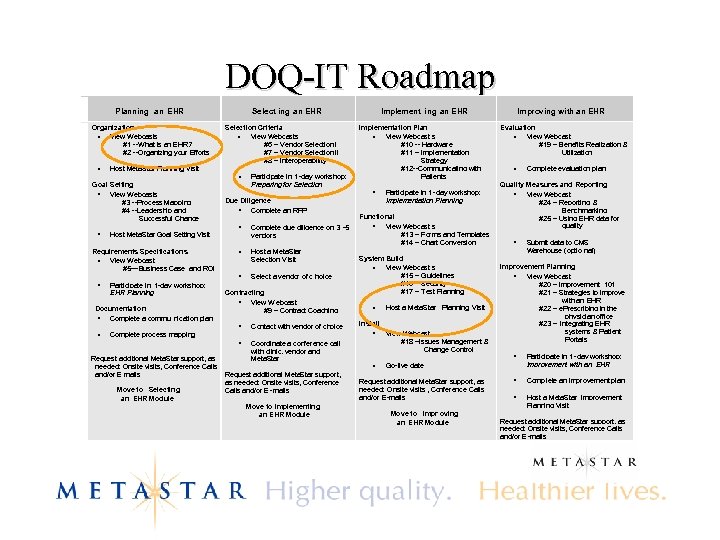 DOQ-IT Roadmap Planning an EHR Organization · View Webcasts #1 --What is an EHR? #2 --Organizing your Efforts · Host Meta. Star Planning Visit Goal Setting · View Webcasts #3 --Process Mapping #4 --Leadership and Successful Change · Participate in 1 -day workshop: EHR Planning Documentation · Complete a commu nication plan · Selection Criteria · View Webcasts #6 – Vendor Selection I #7 – Vendor Selection II #8 – Interoperability · Complete process mapping Request additional Meta. Star support, as needed: Onsite visits, Conference Calls and/or E mails Move to Selecting an EHR Module Participate in 1 -day workshop: Preparing for Selection Due Diligence · Complete an RFP · Complete due diligence on 3 -5 vendors · Host a Meta. Star Selection V isit · Select a vendor of c hoice Host Meta. Star Goal Setting Visit Requirements Specifications · View Webcast #5—Business Case and ROI · Select ing an EHR Contracting · View W ebcast #9 – Contract Coaching · Contact with vendor of choice · Coordinate a conference call with clinic, vendor and Meta. Star Request additional Meta. Star support, as needed: Onsite visits, Conference Calls and/or E -mails Move to Implementing an EHR Module Implement ing an EHR Implementation Plan · View Webcast s #10 -- Hardware #11 – Implementation Strategy #12 --Communicating with Patients · Participate in 1 -day workshop: Implementation Planning Functional · View Webcast s #13 – Forms and Templates #14 – Chart Conversion System Build · View Webcast s #15 – Guidelines #16 – Security #17 – Test Planning · Host a Meta. Star Planning Visit Install · View Webcast #18 –Issues Management & Change Control · Improving with an EHR Evaluation · View Webcast #19 – Benefits Realization & Utilization · Quality Measures and Reporting · View Webcast #24 – Reporting & Benchmarking #25 – Using EHR data for quality · Move to Impr oving an EHR Module Submit data to CMS Warehouse (optio nal) Improvement Planning · View Webcast #20 – Improvement 101 #21 – Strategies to improve with an EHR #22 – e. Prescribing in the physician office #23 -- Integrating EHR systems & Patient Portals · Participate in 1 -day workshop: Improvement with an EHR · Comp lete an improvement plan · Host a Meta. Star Improvement Planning Visit Go-live date Request additional Meta. Star support, as needed: Onsite visits , Conference Calls and/or E-mails Complete evaluation plan Request additional Meta. Star support, as needed: Onsite visits, Conference Calls and/or E -mails
 Hospital IT-Related Projects Computer Provider Order Entry (CPOE) Patient Centered Bar Code Technology Telemedicine/telehealth
 Other Meta. Star Hospital Projects Reporting of Quality Measures Improvement on Appropriate Care Measures Surgical Care Improvement Project Rural Organizational Safety Culture Hospital Payment Monitoring Program
 Other Meta. Star EHR-Related Activities Board position on the Wisconsin Health Information Exchange Governor’s e. Health and Patient Safety Board work groups
 Other Projects Culture in Medicine Quality improvement project for Medicare drug benefit Beneficiary protection
 Commercial Services HEDIS Auditor Completed an environmental scan of EMRs in Wisconsin hospitals and physician practices for the Governor’s e. Health and Patient Safety Board
 Meta. Star’s Web Site DOQ-IT and Hospital EHR tools available. www. metastar. com
 Hospital & Physician Office HER - One Path to Continuity of Care (COC) Why are we concerned with COC? Quality of care - patient safety Efficiency of care Patient satisfaction Market share
 COC and Quality of Care Extrapolation of national estimates to SE Wisconsin 400 people die for lack of recommended care 55% of patients fail to receive recommended evidence-based care
 COC and Efficiency of Care Missed prevention opportunities cost $7 M in hospital bills, $80. 5 M in lost work days Wisconsin clinicians and staff in outpatient clinics spend up to 25% of their time searching for information needed to care for patients – estimated to be $668 in SE Wisconsin
 Patient Satisfaction Patients do not like to repeat information Patients will change providers that lack the technology for the patient to communicate with all of their providers
 Market Share Physicians will not continue to refer patients to hospitals and providers who do not keep the referral physician informed
 What Does the Hospital EHR Need from the Physician Office EHR? Why the patient is being referred to the hospital Admission for medical and/or surgical therapy? Period of observation? Diagnostic tests?
 What Clinical Information Does the Hospital EHR Need from the Physician Office EHR? Test results and findings indicating the need for hospital services Admitting orders Medication status to include drug allergies Patient and family medical history
 What Does the Physician Office EHR Need from the Hospital EHR? When the patient needs to be seen next? What follow-up care is required? Medication status when discharged? Lab Results?
 How May COC Be Achieved? Health Systems with integrated EHRs across all providers Local initiates to share health information National initiatives to further interoperability
 Health Systems with Integrated EHRs Small number of large providers will realize this level of functionality Large number of small physician practices, community and rural hospitals will not be able to obtain this level of functionality
 Meta. Star Experience Integration is often a reason to select a product Lab interfacing is much easier Buy-in can be difficult if the hospital doesn’t include provider in selecting Workflow needs to be addressed in both settings
 Meta. Star Experience The flow between settings should be mapped Need to have both hospital and clinic representation on the implementation team Clinical implementation is typically more difficult Functionality vs. integration debate
 National Initiatives to Achieve COC American National Standards Institute (ANSI) Health Level 7 (HL 7) American Society for Testing and Materials (ASTM)
 National Initiatives to Achieve CCR (Cont) CCHIT Ambulatory Interoperability 2007 Final Criteria Regional Health Information Organizations (RHIOs)
 American National Standards Institute (ANSI) coordinates the development and use of voluntary consensus standards in the United States and represents the needs and views of U. S. stakeholders in standardization forums around the globe Approves many HL 7 standards
 Health Level 7 Standards for electronic interchange of clinical, financial, and administrative information among health care-oriented computer systems; e. g. hospital information systems, clinical laboratory systems Collaborated with ASTM to develop the Continuity of Care Document (CCD)
 CCD is a “melding” of HL 7’s Clinical Document Architecture (CDA) and the Continuity of Care Record (CCR) developed by ASTM The final (CCD) will describe how to implement the CCR dataset with the standard architecture for clinical records developed by HL 7
 American Society for Testing and Materials (ASTM) (CCR) CCR developed jointly by ASTM International, the Massachusetts Medical Society, the Health Information Management and Systems Society, the American Academy of Family Physicians and the American Academy of Pediatrics to improve continuity of care, to reduce medical errors, and to assure a minimum standard of health information transportability when a patient is referred or transferred to, or is otherwise seen by another provider.
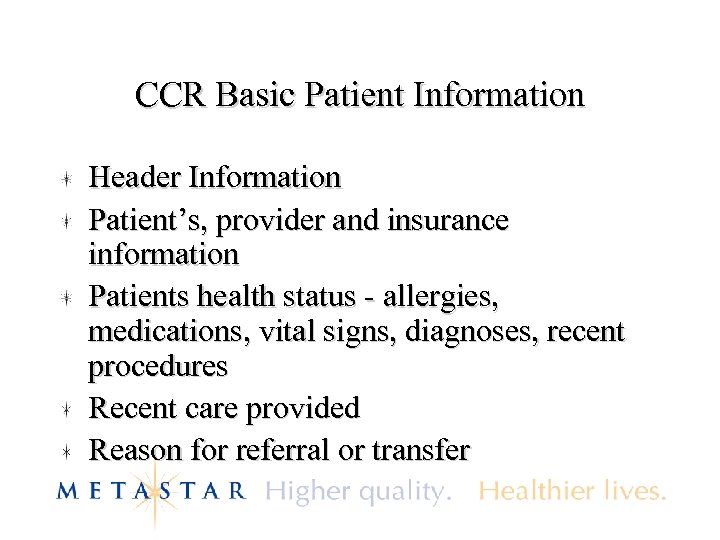 CCR Basic Patient Information Header Information Patient’s, provider and insurance information Patients health status - allergies, medications, vital signs, diagnoses, recent procedures Recent care provided Reason for referral or transfer
 Patient, Provider and Insurance Information. Header, or Document Identifying Information , contains required information about the referring or "from" clinician, as well as information about the referral or "to" provider, and document date. It also addresses the purpose for creating the document and reason for referral.
 Patient, Provider and Insurance Information (Cont) Patient Identifying Information : This section includes the required information to identify and distinguish the patient throughout the referral process, transitioning to and from hospital, clinic, physician office, or home environments (any care setting). (Note: The CCR is not based on a centralized system or a national patient identifier. Rather, it is based on a federated or distributed identification system that links various providers and contains the minimal set of identifying information that could be used by any record system [paper or electronic] to assign the individual their own identifier. ) Additional information in this section includes support contacts and advanced directives.
 Patient, Provider and Insurance Information (cont. ) Patient's Insurance and Financial Information. The individual's Medicare or commercial insurance information. Data elements include Insurance Company Name, Subscriber's Name, Subscriber's Date of Birth, Subscriber's Member ID, and Other Insurance Information. These are the minimal data elements from which eligibility for insurance coverage may be determined.
 Patients Health Status - diagnoses Health Status of the Patient : Diagnoses, Problems, and Conditions are preferably ranked by order of importance or in reverse chronological order. They are described in plain English and by code, according to the selected coding system. Also included are date of onset, date of most recent resolution, status, patient awareness of condition, family history, social history, and a source field.
 Patients health status - allergies, medications, (Cont) Adverse Reactions/Alerts lists allergies by agent and symptom with optional fields for source and date of last reaction, as well as other pertinent alerts about the patient. Current Medications are listed by brand name, generic name (optional), code system, code, start date, dose, schedule, refills, prescriber, status, and a comments field.
 Patient Health Status - Immunizations documentation includes information about each disease against which immunization was given, the date the immunization was received, and (optional) dose strength, unit and route of administration as well as manufacturer and lot #.
 Patient Health Status- Vital Signs documentation includes height, weight, blood pressure, temperature, respiratory rate, date vital signs were recorded, pulse oximetry, and optional peak expiratory flow rate (PEFR), as well as head circumference (for Pediatrics).
 Patient Health Status- Laboratory Results documentation includes blood sugar, urine protein, creatinine, sodium, potassium, hemoglobin, hematocrit, WBC, and the date the sample was taken.
 Patient Health Status- Procedures/Assessments documentation includes descriptions of procedures, code system, procedure code, procedure date and time, location, result and performed by whom. Also included here assessments, such as mental health assessment, functional assessment.
 Patient Health Status- Extension The Health Status section may be amplified in the optional “extension” for medical specialty-specific information. For instance, pediatric providers may want to include a growth chart in the CCR.
 Recent Care Provided Care Documentation: Includes detail on the patient-clinician encounter history, such as the dates and times of recent and pertinent visits and the purposes of the visits and names of clinicians or providers. This documentation section may be significantly expanded in the optional “extensions. ”
 Reason for Referral or Transfer Care Plan Recommendation: The Care Plan is a free text entry section that includes planned or scheduled tests, procedures, or regimens of care
 Extensions of the Six Major Sections Enterprise and Institution-specific Information particularly regarding discharge or transfer, e. g. , hospital to nursing and rehabilitation facilities or to home care agencies, and vice versa. Minimum data sets oriented toward Medical Specialties , e. g. , Pediatrics, Surgery, OB-GYN, Cardiology, Orthopedics, etc. Disease Management will accommodate recording specific disease management information, measures or guidelines, e. g. , diabetes, congestive heart failure, asthma, etc. This extension may be utilized by health plans, pharmaceutical companies, patient advocacy groups, and others interested in promoting “best practices”
 Extensions of the Six Major Sections (Cont) An extension for Patient-entered, Personal Health Record use, e. g. , for complementary and alternative medicine care documentation or other patient considerations such as private or sensitive health information a patient may be reluctant to share with certain practitioners or spouses. An extension for more comprehensive Payerspecific Information and possibly claims attachments.
 CCR Goal Enable the next provider to easily access the information at the beginning of a first encounter and easily update the information when the patient goes on to another provider to support the safety, quality and continuity of care.
 CCR Format XML standard document Machine and human readable Displayed or printed through use of web browser, PDF reader and word processor Developing the ability to forward and receive this XML document will be useful when integration of EHR is not present
 CCR is Not an EHR : Although the CCR is meant to address the need for continuity of care from one provider or practitioner to any other practitioner, it is not designed to be a mini EHR. Lab and x-ray and other testing results are included only to the extent the provider completing the document finds them relevant. It does not list symptoms as its primary function. Rather it lists diagnoses and the “Reason for Referral” to the next provider or diagnostician. The “Reason for Referral” may include problems or symptoms but not in the manner in which a traditional EHR uses them as the starting point for a documentation of the SOAP-type note. Nor does it include a chronology of events, in the fashion expected in an EHR
 CCR is Not a Progress Note : Completion of the CCR should not be thought of as mandatory after every visit to a primary care physician (PCP) or specialist or other clinician who is delivering care to the patient. Thus, it is not replacing a progress note used in the traditional record. However, if the clinician is planning to refer the patient to another provider, then the CCR should be updated and prepared specifically for the next anticipated provider and customized to assist at the next “point of care”. Any relevant information for the next provider should be added to the CCR, just prior to the referral, if feasible.
 CCR is Not a Discharge Summary : The CCR differs from the Discharge Summary mainly in that the CCR is much more concise, involves less narrative or free text, and emphasizes the brief care plan for the next steps to assist the patient to recover or be rehabilitated following the most recent episode of illness/care. The CCR highlights or spells out the next appointments and follow-up visits and instructions to assist the Visiting Nurse or other next caregiver regarding expectations of the follow-up encounter from the perspective of the clinician completing the form
 CCR is Not a Consultation Note : The CCR is not intended to replace the initial consultant's note to the referring physician. There is, however, a potential for the CCR to be used in lieu of the consultant's note back to the referring PCP after the second visit, provided the lengthier summary of findings and plan of care were documented after the first visit and sent to the original provider
 Medical Records Institute (MRI) Supports CCR The Medical Records Institute Inc invites healthcare practitioners, provider institutions, payers, managed care organizations, and others to submit their application for MRI ’s prestigious Continuity of Care Awards 2007. For the purpose of this Awards program, a Continuity of Care application is the adoption and utilization by a healthcare entity (e. g. , solo practitioner, RHIO, provider institution, physician practice, employer, payer) of the Continuity of Care Record (CCR) data set detailed in the ASTM Continuity of Care Record Standard Specification 1 for the direct purpose of giving clinicians access to relevant current and past patient information in order that they make informed healthcare assessments and treatment decisions. Such applications seek to reduce wasteful duplication, improve patient safety, and enhance quality of care. Adoption of the CCR data set may be through implementation of the ASTM E 31 CCR and/or through integration of its data set into HL 7 ’s Continuity of Care Document (CCD). Utilization of the CCR data set must include import and export of the data set to/from other healthcare entities and/or patients for the purpose of supporting delivery of healthcare. (Note: Recognizing that not every provider entity may have implemented everything addressed in the CCR data set, submissions will be accepted for partial implementations as well. ) MRI awarded the winner a $3000 prize during the 2007 TEPR meeting in Dallas
 CCHIT Link http: //www. cchit. org/files/Ambulatory_Domai n/Ambulatory_INTEROPERABILITY_200 7_Proposed_Final_Criteria_14 Feb 07. pdf http: //www. cchit. org/files/Inpatient_Domain/I npatient_Interoperability_2007_Draft_Crite ria. pdf
 CCHIT Ambulatory Interoperability 2007 Final Criteria Implement HL-7 ASTM CCD and ASTM CCR IA-3. 10 Access and view a medication history from a PHR IA-5. 09 Send data to PHR
 CCHIT Ambulatory Interoperability 2007 Final Criteria (Cont) IA-5. 10 Receive data from PHR and import to EHR IA 5. 11 Receive registration summary from patient and import into EHR
 Regional Health Information Organizations (RHIOs) A RHIO is a group of organizations with a business stake in improving the quality, safety and efficiency of healthcare delivery. RHIOs are the building blocks of the proposed National Health Information Network (NHIN). To build a national network of interoperable health records, the effort must first develop at the local and state levels.
 A Wisconsin RHIO The Wisconsin Health Information Exchange (WHIE) is a project that is the first step in establishing a multi-purpose health information exchange system in southeastern Wisconsin to improve the quality and efficiency of health care National Institute of Medical Informationics (NIMI) is registered in Wisconsin as a non-profit 501 C 3 corporation and serves as the non-profit organizational entity that is creating WHIE
 A Wisconsin RHIO (Cont) Providers may join the WHIE Membership will enable access to clinical information required to achieve COC
 Questions?
 Contact Information Meta. Star, Inc. 2909 Landmark Place Madison, WI 53713 Phone number 608 441 -8246 www. metastar. com bfrench@metastar. com This material was prepared by Meta. Star, the Medicare Quality Improvement Organization for Wisconsin, under contract with the Centers for Medicare & Medicaid Services (CMS), an agency of the U. S. Department of Health and Human Services. The contents presented do not necessarily reflect CMS policy. 8 SOW-WI-INP-07 -65