


 Скачать презентацию Coordination in Response to a Pandemic Threat What
d6c49780bd16a368435ff983f576b0b7.ppt
- Количество слайдов: 23
 Coordination in Response to a Pandemic Threat What It Is, Should Be and Should Not Be Charles “Pat” Patterson U. S. Department of State
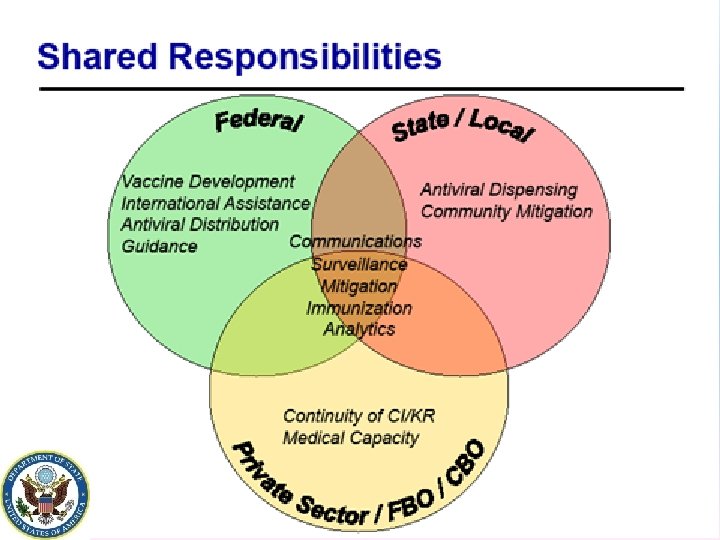
 Three Dimensional Coordination As we approach our Symposium’s conclusion, a constant theme emerges: coordination in preparing for, and responding to a pandemic, whether threatened or real, is absolutely essential. - Coordination must be vertical – from the pinnacle to the base of organizations, and - Horizontal – across agencies and organizations, but - It must also function in a third dimension – involving communities, NGOs and different layers of functional, geographic, and organizational structures
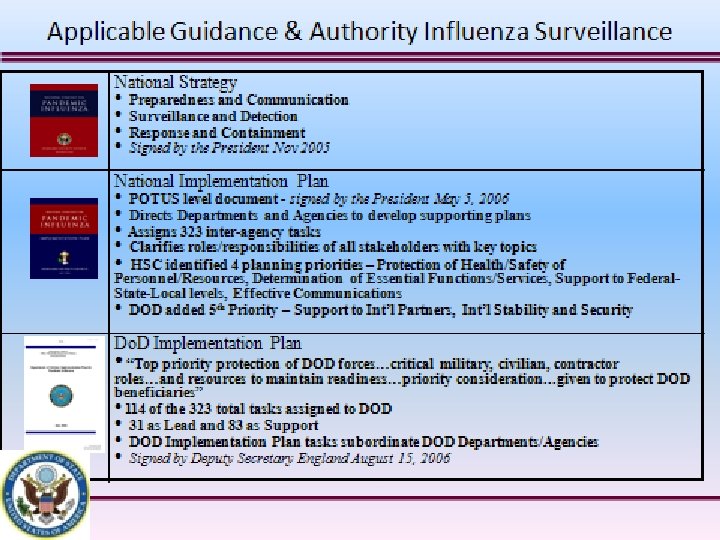
 NAP Goals – Enhance Collaboration to: • Detect, contain and control an (avian) influenza outbreak and prevent transmission (to humans); • Prevent or slow the entry of a novel strain of human influenza to North America; • Minimize illness and deaths; and • Sustain infrastructure and mitigate the impact to the economy and the functioning of society.
 International Community September, 2005 – The UN Secretary General appoints Dr. David Nabarro as UN System Influenza Coordinator – UNSIC International Partnership (IPAPI) – Washington, October 2005; Vienna, June 2006; 93 countries, 20 int’l orgs attend Beijing, 2006 – $1. 9 billion pledged Bamako, December 2006 – African Union hosts New Delhi, December 2007 – U. S. pledges $195 million Egypt, October 2008 – One hundred twenty (120) countries participate; total global commitment surpasses $4 billion
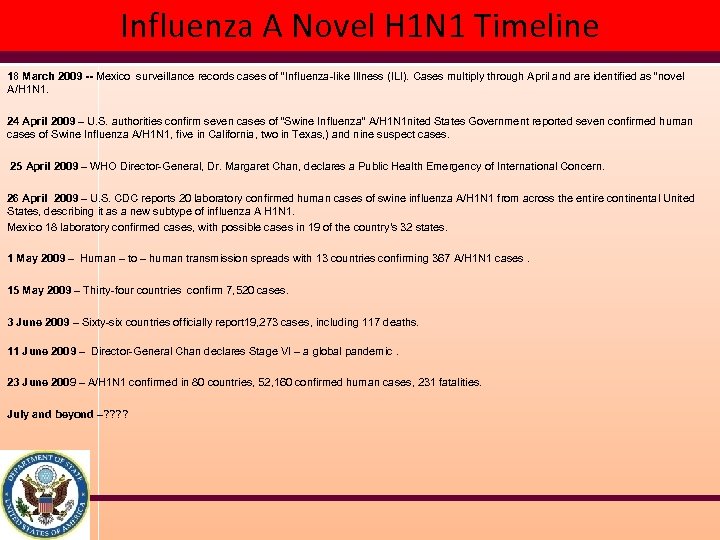 Influenza A Novel H 1 N 1 Timeline 18 March 2009 -- Mexico surveillance records cases of “Influenza-like Illness (ILI). Cases multiply through April and are identified as “novel A/H 1 N 1. 24 April 2009 – U. S. authorities confirm seven cases of “Swine Influenza” A/H 1 N 1 nited States Government reported seven confirmed human cases of Swine Influenza A/H 1 N 1, five in California, two in Texas, ) and nine suspect cases. 25 April 2009 – WHO Director-General, Dr. Margaret Chan, declares a Public Health Emergency of International Concern. 26 April 2009 – U. S. CDC reports 20 laboratory confirmed human cases of swine influenza A/H 1 N 1 from across the entire continental United States, describing it as a new subtype of influenza A H 1 N 1. Mexico 18 laboratory confirmed cases, with possible cases in 19 of the country's 32 states. 1 May 2009 – Human – to – human transmission spreads with 13 countries confirming 367 A/H 1 N 1 cases. 15 May 2009 – Thirty-four countries confirm 7, 520 cases. 3 June 2009 – Sixty-six countries officially report 19, 273 cases, including 117 deaths. 11 June 2009 – Director-General Chan declares Stage VI – a global pandemic. 23 June 2009 – A/H 1 N 1 confirmed in 80 countries, 52, 160 confirmed human cases, 231 fatalities. July and beyond –? ?
 Emergency demands action - When the current pandemic emerged in Mexico there was, first, a measured response - But, after cases were identified in California, the big guns became involved
 The Terminator is here!
 …but calibrated… - In the U. S. a core group of U. S. G. agency representatives engaged in teleconferences HHS, CDC, USAID, DOS, DHS - But, when the virus gained the name “swine flu” and the concern over a pandemic climbed, more and more agencies became involved - By early May, the daily teleconferences had nearly 150 persons “on the line”, with more joining
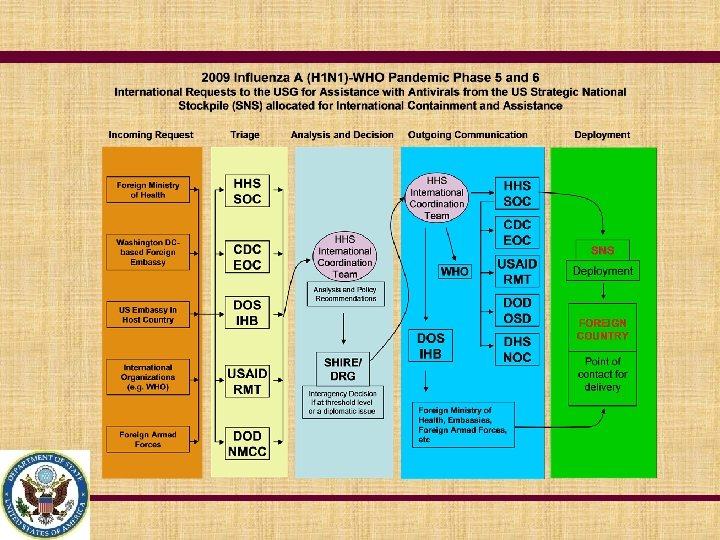
 …and Sharply Focused • Chaos loomed; the White House (National Security Council & Homeland Security Council) narrowed and focus efforts • For international engagement, the Department of State established a Task Force to deal with issues, from international coordination –bilateral and multilateral, assistance requests, U. S. persons outside the U. S. , etc. • By the time the dust settled – and as the WHO moved toward declaring Phase VI – a global pandemic, the international coordination “matrix” looked like this
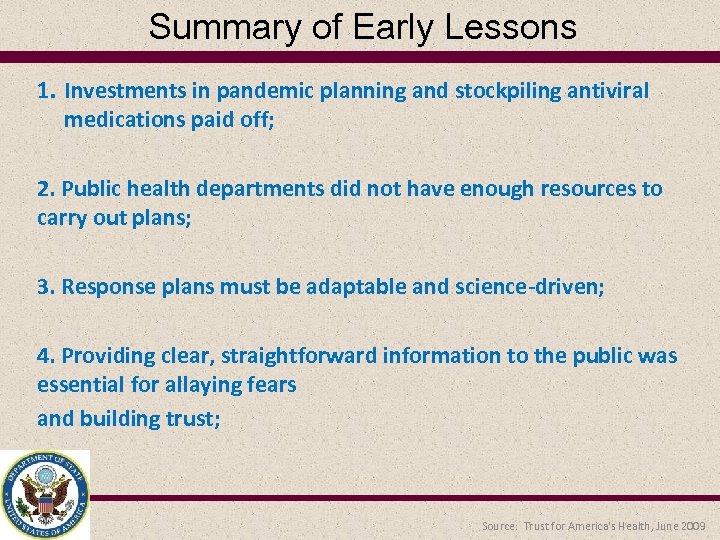 Summary of Early Lessons 1. Investments in pandemic planning and stockpiling antiviral medications paid off; 2. Public health departments did not have enough resources to carry out plans; 3. Response plans must be adaptable and science-driven; 4. Providing clear, straightforward information to the public was essential for allaying fears and building trust; Source: Trust for America's Health, June 2009
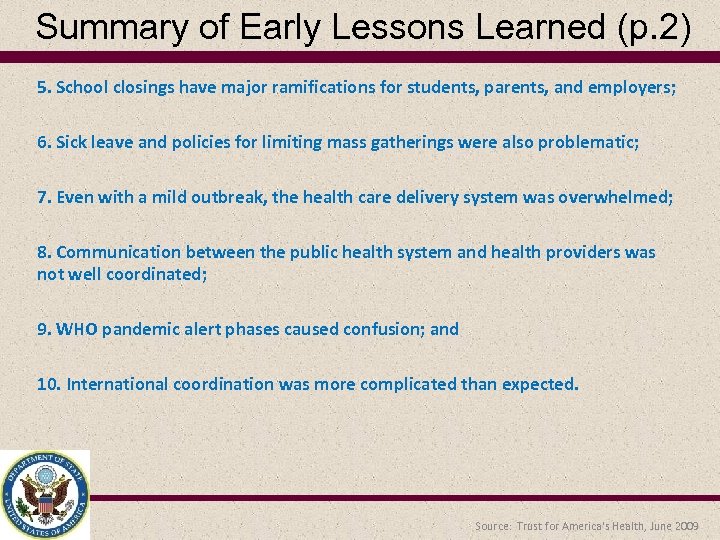 Summary of Early Lessons Learned (p. 2) 5. School closings have major ramifications for students, parents, and employers; 6. Sick leave and policies for limiting mass gatherings were also problematic; 7. Even with a mild outbreak, the health care delivery system was overwhelmed; 8. Communication between the public health system and health providers was not well coordinated; 9. WHO pandemic alert phases caused confusion; and 10. International coordination was more complicated than expected. Source: Trust for America's Health, June 2009
![Lessons [learned] Observed • Pandemic planning may not survive reality, but… • The only](https://present5.com/presentation/d6c49780bd16a368435ff983f576b0b7/image-18.jpg "Lessons [learned] Observed • Pandemic planning may not survive reality, but… • The only") Lessons [learned] Observed • Pandemic planning may not survive reality, but… • The only thing harder than planning for a pandemic is explaining why you did not! • “Pandemic 2009” blind-sided planners, coming from within rather from outside, but • …When the feathers settled, the links established proved vital to response.
Lessons [learned] Observed • Pandemic planning may not survive reality, but… • The only thing harder than planning for a pandemic is explaining why you did not! • “Pandemic 2009” blind-sided planners, coming from within rather from outside, but • …When the feathers settled, the links established proved vital to response.
 “Swine flu” – The Gift for Next Time Pandemic 2009: • a special gift, requiring fast, flexible response by all: patients, first responders, scientists, stability & security personnel; and civilian decision makers at the highest levels; • a gift because Novel H 1 N 1 lacks the lethality causing panic; • a valuable test of plans for a killer like H 5 N 1 becoming pandemic; • a key opportunity – we may not have such a “benign threat” next time; • … and there will be a next time.
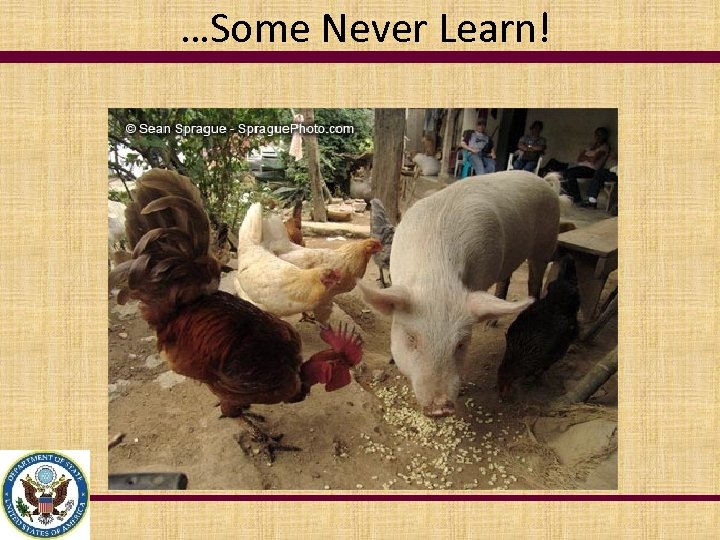 …Some Never Learn!
 Forward – Hanoi 2010 International Ministerial Conference on Avian & Pandemic Influenza, Hanoi, April 2010 • Goals: - Summarize – Ready!! … … Or not? !? - Synthesize – “Bird Flu” meets “Swine Flu” - Synergize – Human-Animal Disease Nexus • Now that we have your attention, World….
 Thanks again! Patterson U. S. Department of State October 14, 2009