


 Скачать презентацию Coordination Group for Meteorological Satellites — CGMS SCOPE-CM
fddb38d6720ca20d243f13cb8ee7910b.ppt
- Количество слайдов: 17
 Coordination Group for Meteorological Satellites - CGMS SCOPE-CM Sustained, Co-Ordinated Processing of Environmental Satellite Data for Climate Monitoring by EUMETSAT Presented to CGMS-41 WGII/3 EUMETSAT, July 2013
 Coordination Group for Meteorological Satellites - CGMS Introduction to SCOPE-CM EUMETSAT, July 2013
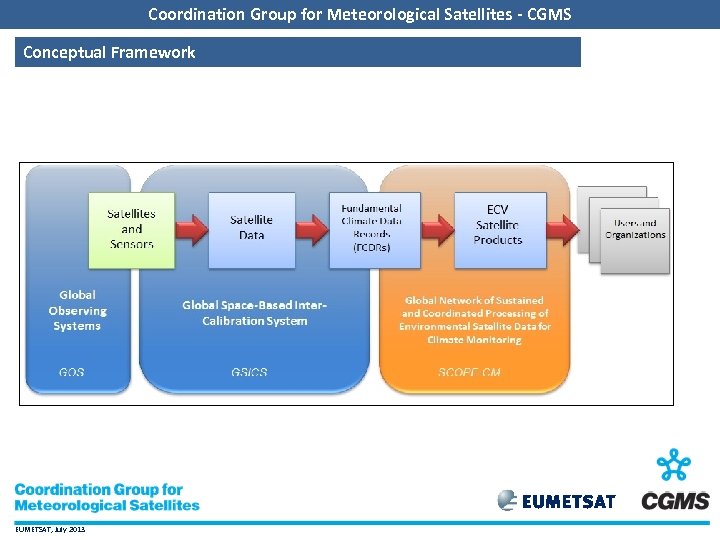
 Coordination Group for Meteorological Satellites - CGMS Background • The aim of the Sustained, Co-Ordinated Processing of Environmental Satellite Data for Climate Monitoring (SCOPE-CM) is to enable a network of facilities ensuring continuous and sustained provision of high-quality Climate Data Records (CDRs) from satellite observations. • The foundation of SCOPE-CM is the network of relevant space agencies and other organizations (including GSICS) with the aim to develop, extend and preserve the capabilities and skills of generating and re-generating CDRs. • Participants: Operational Satellite operators: NOAA, JMA, CMA, EUMETSAT Stakeholder: WMO Space Programme, GCOS, CEOS, GEO, CGMS/GSICS, WCRP/GEWEX, ESA (observer) EUMETSAT, July 2013
 Coordination Group for Meteorological Satellites - CGMS Conceptual Framework EUMETSAT, July 2013
 Coordination Group for Meteorological Satellites - CGMS SCOPE-CM Current Status EUMETSAT, July 2013
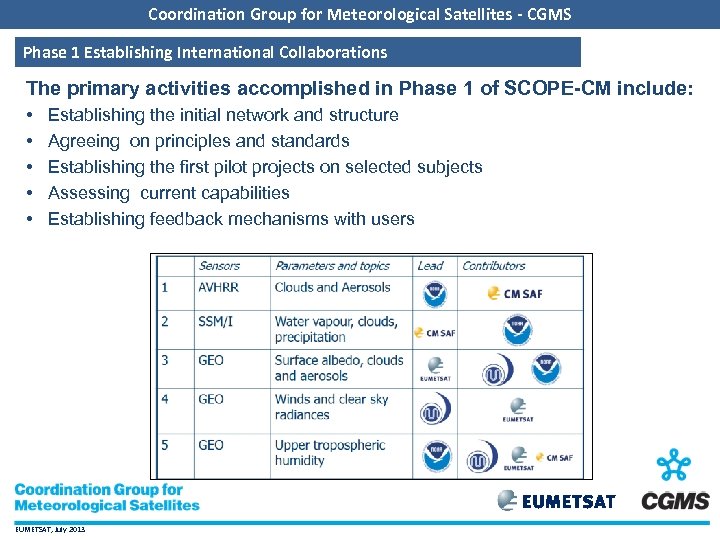 Coordination Group for Meteorological Satellites - CGMS Phase 1 Establishing International Collaborations The primary activities accomplished in Phase 1 of SCOPE-CM include: • • • Establishing the initial network and structure Agreeing on principles and standards Establishing the first pilot projects on selected subjects Assessing current capabilities Establishing feedback mechanisms with users EUMETSAT, July 2013
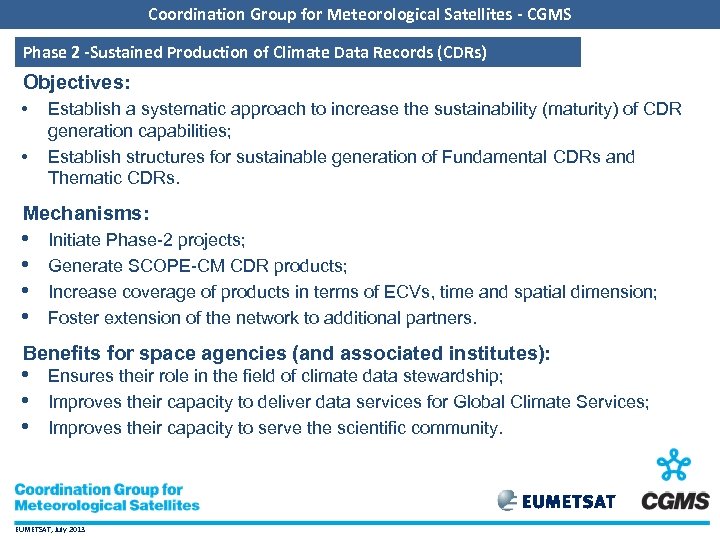 Coordination Group for Meteorological Satellites - CGMS Phase 2 -Sustained Production of Climate Data Records (CDRs) Objectives: • • Establish a systematic approach to increase the sustainability (maturity) of CDR generation capabilities; Establish structures for sustainable generation of Fundamental CDRs and Thematic CDRs. Mechanisms: • • Initiate Phase-2 projects; Generate SCOPE-CM CDR products; Increase coverage of products in terms of ECVs, time and spatial dimension; Foster extension of the network to additional partners. Benefits for space agencies (and associated institutes): • • • Ensures their role in the field of climate data stewardship; Improves their capacity to deliver data services for Global Climate Services; Improves their capacity to serve the scientific community. EUMETSAT, July 2013
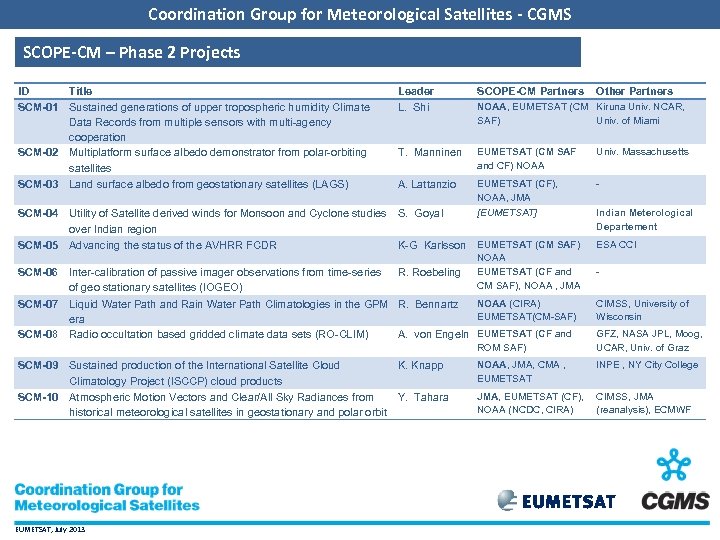 Coordination Group for Meteorological Satellites - CGMS SCOPE-CM – Phase 2 Projects ID Title SCM-01 Sustained generations of upper tropospheric humidity Climate Data Records from multiple sensors with multi-agency cooperation SCM-02 Multiplatform surface albedo demonstrator from polar-orbiting satellites SCM-03 Land surface albedo from geostationary satellites (LAGS) Leader L. Shi SCOPE-CM Partners T. Manninen EUMETSAT (CM SAF and CF) NOAA Univ. Massachusetts A. Lattanzio EUMETSAT (CF), NOAA, JMA - NOAA, EUMETSAT (CM Kiruna Univ. NCAR, SAF) Univ. of Miami [EUMETSAT] SCM-04 Utility of Satellite derived winds for Monsoon and Cyclone studies S. Goyal over Indian region SCM-05 Advancing the status of the AVHRR FCDR K-G Karlsson EUMETSAT (CM SAF) NOAA EUMETSAT (CF and CM SAF), NOAA , JMA SCM-06 Inter-calibration of passive imager observations from time-series R. Roebeling of geo stationary satellites (IOGEO) NOAA (CIRA) SCM-07 Liquid Water Path and Rain Water Path Climatologies in the GPM R. Bennartz EUMETSAT(CM-SAF) era SCM-08 Radio occultation based gridded climate data sets (RO-CLIM) A. von Engeln EUMETSAT (CF and ROM SAF) SCM-09 Sustained production of the International Satellite Cloud K. Knapp Climatology Project (ISCCP) cloud products SCM-10 Atmospheric Motion Vectors and Clear/All Sky Radiances from Y. Tahara historical meteorological satellites in geostationary and polar orbit EUMETSAT, July 2013 Other Partners NOAA, JMA, CMA , EUMETSAT Indian Meterological Departement ESA CCI - CIMSS, University of Wisconsin GFZ, NASA JPL, Moog, UCAR, Univ. of Graz INPE , NY City College JMA, EUMETSAT (CF), CIMSS, JMA NOAA (NCDC, CIRA) (reanalysis), ECMWF
 Coordination Group for Meteorological Satellites - CGMS Elevating the maturity of CDRs EUMETSAT, July 2013
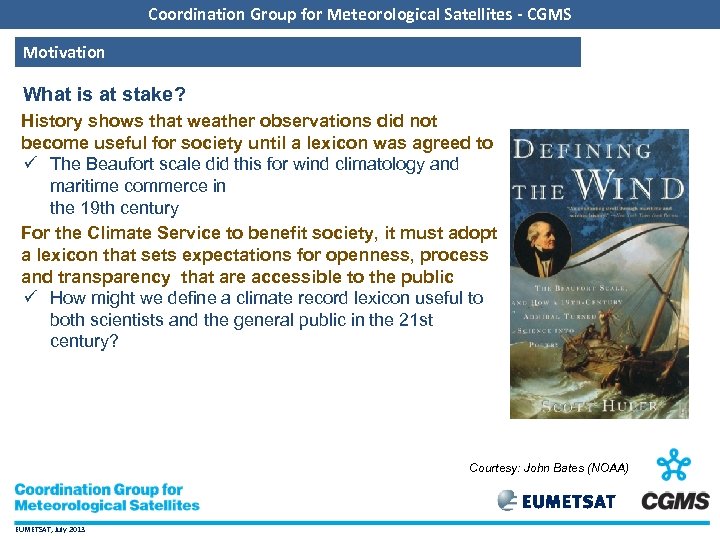 Coordination Group for Meteorological Satellites - CGMS Motivation What is at stake? History shows that weather observations did not become useful for society until a lexicon was agreed to ü The Beaufort scale did this for wind climatology and maritime commerce in the 19 th century For the Climate Service to benefit society, it must adopt a lexicon that sets expectations for openness, process and transparency that are accessible to the public ü How might we define a climate record lexicon useful to both scientists and the general public in the 21 st century? Courtesy: John Bates (NOAA) EUMETSAT, July 2013
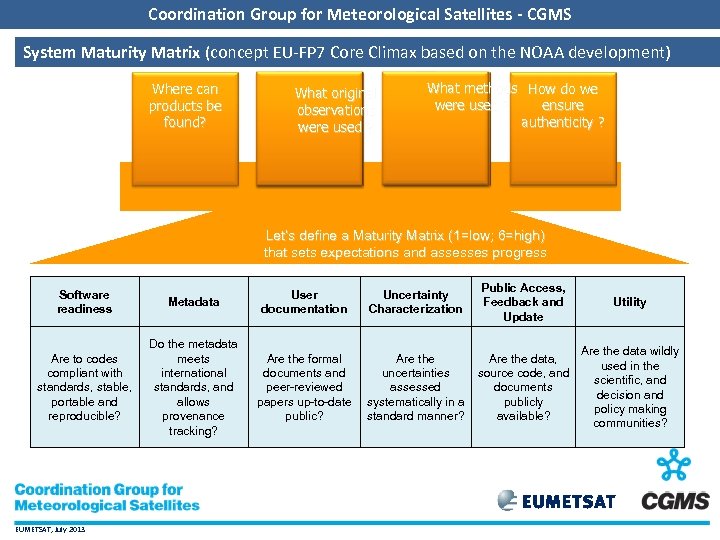 Coordination Group for Meteorological Satellites - CGMS System Maturity Matrix (concept EU-FP 7 Core Climax based on the NOAA development) Where can products be found? What original observations were used inobservations the product? What methods were What methods used to create the were product? used ? were used ? How do we ensure authenticity ? Let’s define a Maturity Matrix (1=low; 6=high) that sets expectations and assesses progress Software readiness Metadata User documentation Are to codes compliant with standards, stable, portable and reproducible? Do the metadata meets international standards, and allows provenance tracking? Are the formal documents and peer-reviewed papers up-to-date public? EUMETSAT, July 2013 Uncertainty Characterization Public Access, Feedback and Update Are the data, uncertainties source code, and assessed documents systematically in a publicly standard manner? available? Utility Are the data wildly used in the scientific, and decision and policy making communities?
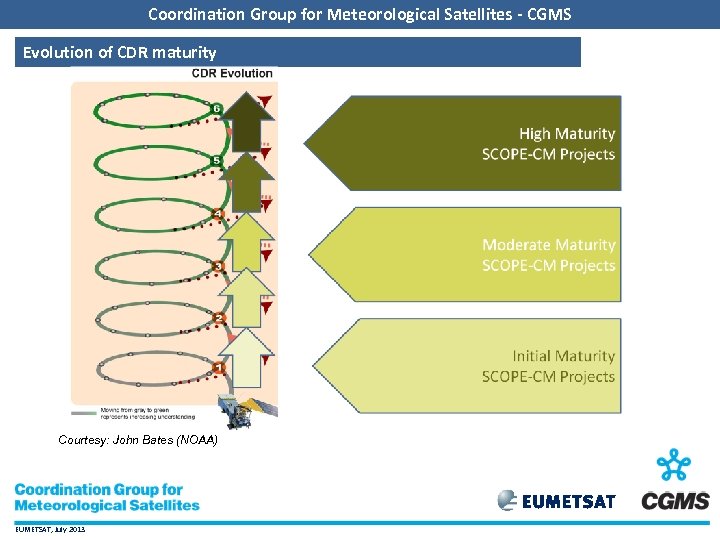 Coordination Group for Meteorological Satellites - CGMS Evolution of CDR maturity Courtesy: John Bates (NOAA) EUMETSAT, July 2013
 Coordination Group for Meteorological Satellites - CGMS Conclusions EUMETSAT, July 2013
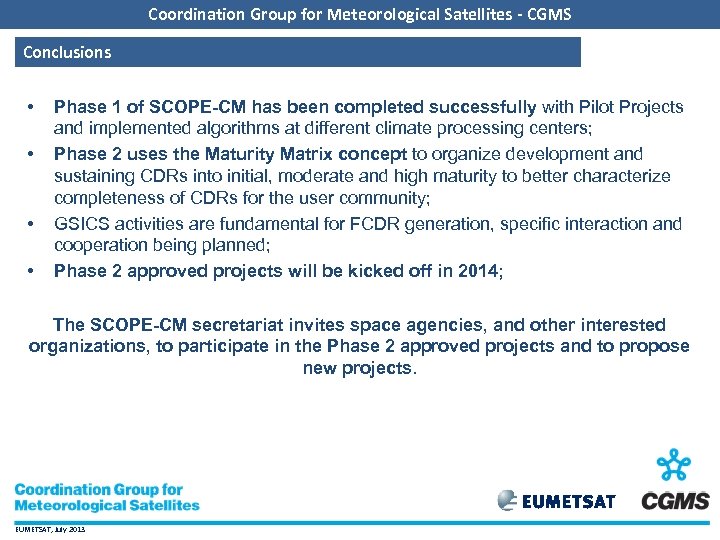 Coordination Group for Meteorological Satellites - CGMS Conclusions • • Phase 1 of SCOPE-CM has been completed successfully with Pilot Projects and implemented algorithms at different climate processing centers; Phase 2 uses the Maturity Matrix concept to organize development and sustaining CDRs into initial, moderate and high maturity to better characterize completeness of CDRs for the user community; GSICS activities are fundamental for FCDR generation, specific interaction and cooperation being planned; Phase 2 approved projects will be kicked off in 2014; The SCOPE-CM secretariat invites space agencies, and other interested organizations, to participate in the Phase 2 approved projects and to propose new projects. EUMETSAT, July 2013
 Coordination Group for Meteorological Satellites - CGMS Recommendations EUMETSAT, July 2013
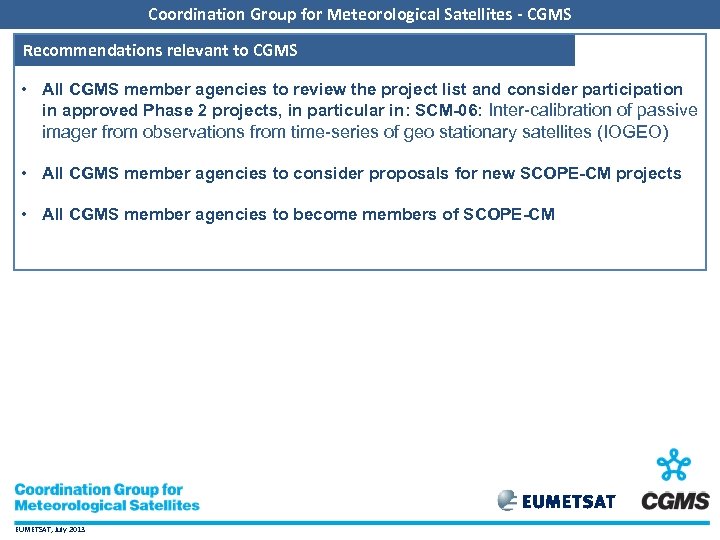 Coordination Group for Meteorological Satellites - CGMS Recommendations relevant to CGMS • All CGMS member agencies to review the project list and consider participation in approved Phase 2 projects, in particular in: SCM-06: Inter-calibration of passive imager from observations from time-series of geo stationary satellites (IOGEO) • All CGMS member agencies to consider proposals for new SCOPE-CM projects • All CGMS member agencies to become members of SCOPE-CM EUMETSAT, July 2013
 Coordination Group for Meteorological Satellites - CGMS Thank You Any Questions? EUMETSAT, July 2013