


 Скачать презентацию Cooperative Monographic Collection Development Recent Trends RUSA CODES STARS
5dd129c42a2a7ba8afe216d5509efa5f.ppt
- Количество слайдов: 104
 Cooperative Monographic Collection Development Recent Trends RUSA CODES/STARS Cooperative Collection Development Committee ALA Annual June 23, 2007
 Definition • “Cooperation, coordination, or sharing in the development and management of collections by two or more libraries entering into an agreement for this purpose” • Harloe, 1994
 Why? • • • Libraries can’t be self-sufficient Contain costs/stretch resources Broaden access Improve coverage Ensure the exotic
 Components • • • Usually academic libraries Subset of library cooperation Resource sharing/document delivery Shared catalog Shared storage Shared information
 Keys to Success • • • Limit to research materials Clear vision and goals Administrative and financial structure that supports cooperation • Recognition of need for mutual dependence • Involve operational staff and provide support
 Organizational models • • • Geographic area Political jurisdiction Type of library Funding source Consortia
 Types of cooperation • • • Subject area Geographic area Language Format Coordinated approval plan Item by item
 Barriers/Issues • • • Local control/autonomy Legacy collections Governance/administration Overhead costs Lack of national library system
 History • • • Farmington Plan Center for Research Libraries (shared purchase) Federal Programs Research Libraries Group (RLG) OCLC
 State/Regional Cooperation (selected examples) • Triangle University Libraries (NC) • University of California Shared Collections and Access Program (SCAP) • Committee on Institutional Cooperation (CIC) • More in a few minutes!
 Current and Future • Julia Gammon, University of Akron • Ewa Elizabeth Barczyk, University of Wisconsin Milwaukee • Eric Pumroy, Bryn Mawr College • Michael Levine-Clark, University of Denver • Susi Seiler, Alvin Sherman Library
 More information – RUSA CODES/STARS wiki • http: //ccdc. pbwiki. com/Front. Page
 Cooperative Monographic Collection Development—Recent Trends CODES/STARS CCD Committee June 23, 2007
 Julia Gammon University of Akron & Chair, Ohio. LINK Collection Building Task Force jgammon@uakron. edu 330. 972. 6254
 Consortial CCD • Word is getting out • Interest is high • Technology is there • Money & staff are tight
 Consortial World Tour • • Colorado Missouri Wisconsin Minnesota Tennessee Kentucky Washington Oregon
 Why CCD in Ohio. LINK? It was the mid-80 s… • Because: – – Too many books No space No new buildings Group commissioned to find a solution – Resource sharing began
 Who belongs to Ohio. LINK?
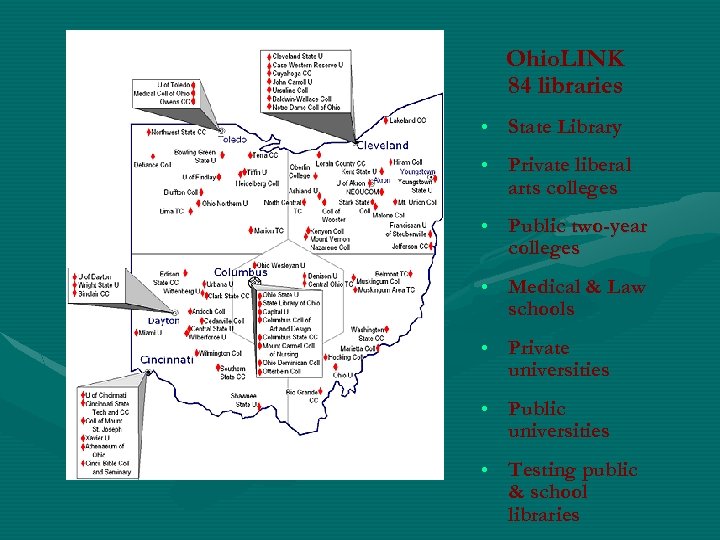 Ohio. LINK 84 libraries • State Library • Private liberal arts colleges • Public two-year colleges • Medical & Law schools • Private universities • Public universities • Testing public & school libraries
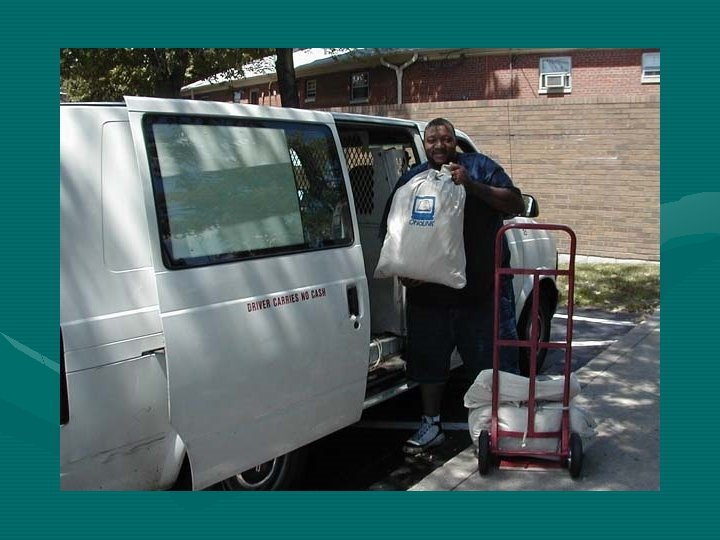
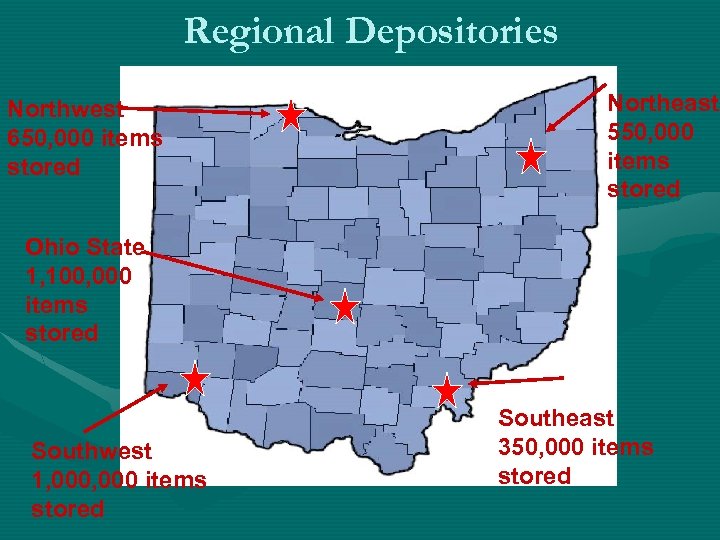 Regional Depositories Northwest 650, 000 items stored Northeast 550, 000 items stored Ohio State 1, 100, 000 items stored Southwest 1, 000 items stored Southeast 350, 000 items stored
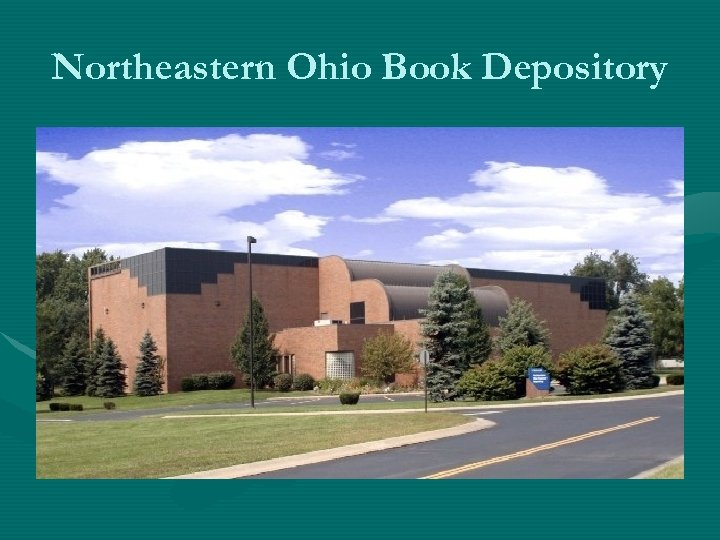 Northeastern Ohio Book Depository
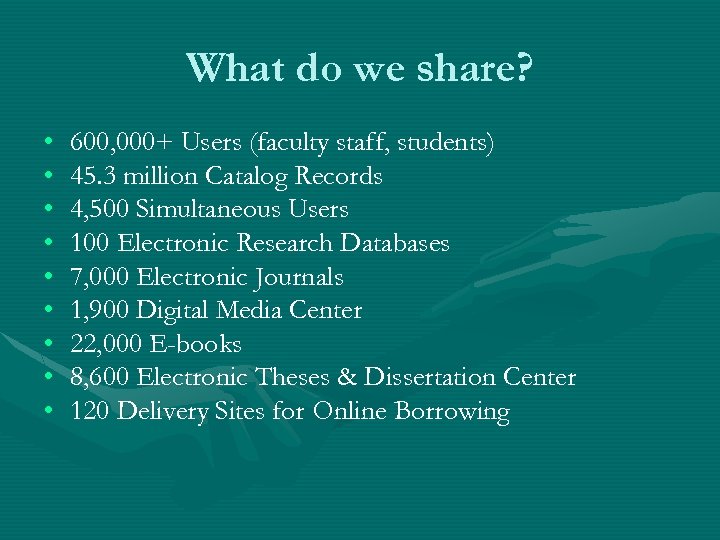 What do we share? • • • 600, 000+ Users (faculty staff, students) 45. 3 million Catalog Records 4, 500 Simultaneous Users 100 Electronic Research Databases 7, 000 Electronic Journals 1, 900 Digital Media Center 22, 000 E-books 8, 600 Electronic Theses & Dissertation Center 120 Delivery Sites for Online Borrowing
 What did our Ohio. LINK collection look like in 1997?
 Approval Plans: Duplication & Homogenization • In 1997 Tom Sanville, Director of Ohio. LINK found: – Number of titles with 5+copies increasing – Number of unfilled borrowing requests growing
 Duplication and Homogenization? Why was this happening? • Why? It was attributed to our approval plans. We were all buying the same books
 Leadership & Cheerleading for CCD
 Ohio. LINK’s Collection Building Task Force (CBTF) Charge • To reduce duplication • To increase local CD activities • To expand the amount spent on cooperative purchases • To move beyond books…
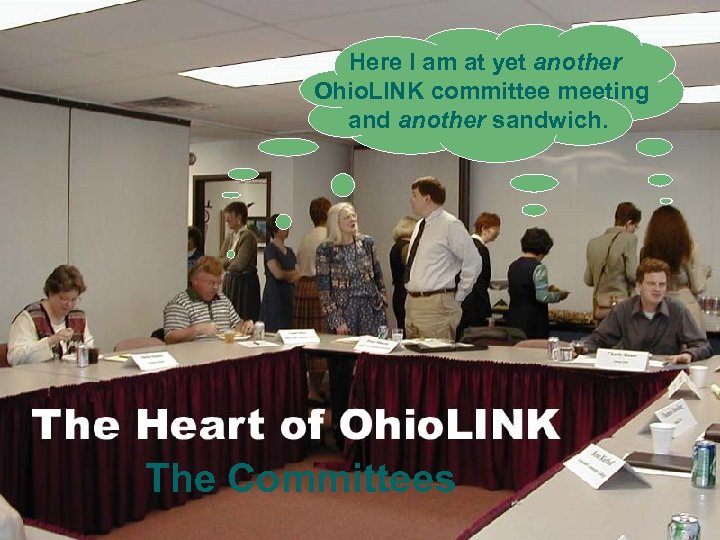 Here I am at yet another Ohio. LINK committee meeting and another sandwich. The Committees
 We meet often…. • • 5, 560 + Meetings 31, 100 + Cups of coffee 18, 433 + Muffins 20, 800 + Lunches 4, 000 Frequent driver miles 65, 000 Hours of singing to the radio 8, 000 Lunch upgrades
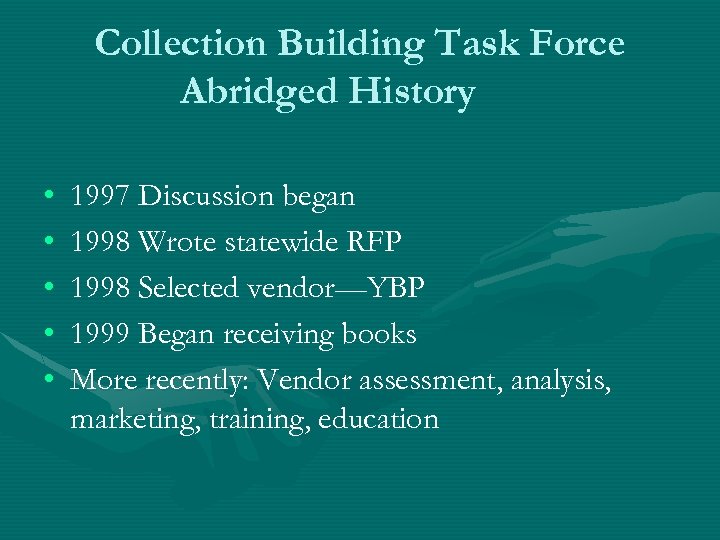 Collection Building Task Force Abridged History • • • 1997 Discussion began 1998 Wrote statewide RFP 1998 Selected vendor—YBP 1999 Began receiving books More recently: Vendor assessment, analysis, marketing, training, education
 Ohio. LINK’s Current Tools for CCD • • YBP’s Gobi. Tween “Not Bought” Lists Peer reports Subject Groups Cooperative projects Road Shows
 Tools: Gobi. Tween in Ohio. LINK • Can make an informed purchase decision because…. expected buying • Know actual purchases • Know potential purchases • Can review approval plan receipts • Know how many copies can be expected within the state
 Tools: “Not Bought in Ohio” • • • Select a time frame Run list on GOBI Evaluate choices Select items to order Any number can play Year end list
 Tools: Peer & Management Reports • • Compare ourselves Inside consortium Outside consortium Selection and purchase decisions visible to all!
 Tools: Cooperative projects …. • • Share profiles Coordinate standing orders • Maintain a CCD website • “Last copy” lists • Depository duplication limits
 Tools: Subject Group Listservs • Purpose: To facilitate CCD and resource sharing • Grassroots level • Independent • 28+ groups & listservs • Anthropology to Psych • Buying decisions
 Tools: Road Shows • Taking the show on the road…. – Consortial wide meetings – Summit meeting Director level – Vendor driven training sessions
 Ohio. LINK New Trends
 How Many Copies Do We Need?
 Assessment • • • “Selling” CCD without data Need info to make informed decisions Questions: What do we want to know? Commercial products OCLC Research
 Questions: Collection Usage • • What subjects are being used? What subjects are not being used? Who is using them? What subject areas have the lowest usage? Highest? Most? • What areas do we have too many copies? Not enough? • What % of items circulate in subject areas?
 Questions: Collection Usage • Does circulation change by year by subject? • What publishers have the highest Circulation? Lowest? • What is the average number of circulations per book? By Subject? • What is the optimum range of copies for Ohio. LINK by subject areas?
 Questions: Collection Analysis • • • Is our collection getting more diverse? Is duplication of titles increasing or decreasing? What does the overall Ohio. LINK collection look like? Does the 80/20 rule apply? Are we spending our money on speculative materials or materials in demand?
 Questions: Collection Analysis • What is the average of books circulated by subject? • What is the half-life of books in a subject area? • Do the circulation transactions correlate with the strengths of the libraries’ collections
 OCLC Research Project • Project Goal – Collect, analyze and compare book circulation data from all Ohio. LINK libraries – Use OCLC #, ISBN or LCCN to link circulation records to World. Cat bib records
 OCLC Research Project • • • Met with OCLC Research Planned the information to gather Tested data gathering Wrote procedures Advertised, promoted & encouraged participation • Results: All but 3 libraries participated!
 OCLC—Ohio. LINK Preliminary Data • • • 81 Institutions participated 33, 000 records received 47, 000 circ transactions 43% books circulated by item 1. 7% average circ per book by items Answers to questions?
 Vision Document
 Ohio. LINK White Paper on Co-op Book Purchasing—In Process • • Maintain the status quo Get director buy in Expand pilot projects More Marketing & Education Soft caps vs. hard caps More approval plan coordination Expand circulation decisions
 White Paper Continued… • Increase e-book resources • Provide predictability on what will be purchased and retained • Provide bibliographic support for purchasing unique titles • Create war chest funding model • Create centralized collection development unit
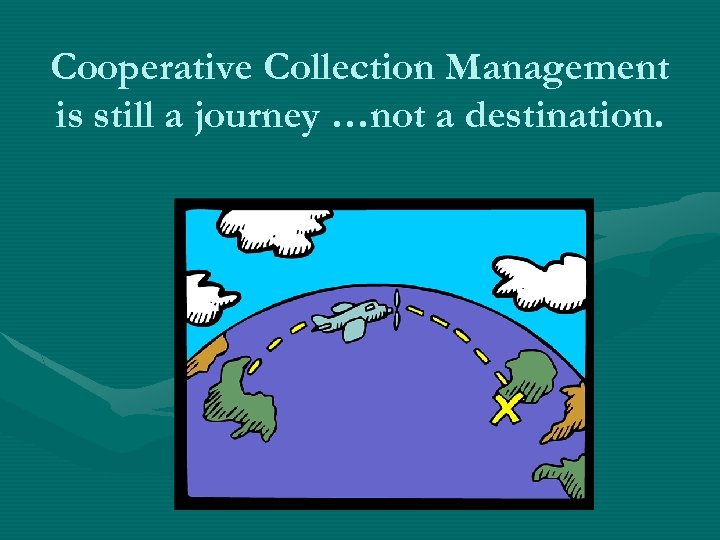 Cooperative Collection Management is still a journey …not a destination.
 Julia Gammon University of Akron & Chair, Ohio. LINK Collection Building TF jgammon@uakron. edu 330. 972. 6254
 “…no useless lumber is more useless than unused books. ” John Cotton Dana Collaboration among University of Wisconsin System Libraries Ewa Barczyk Director, University of Wisconsin-Milwaukee Libraries ALA Conference Washington, D. C. June 23, 2007
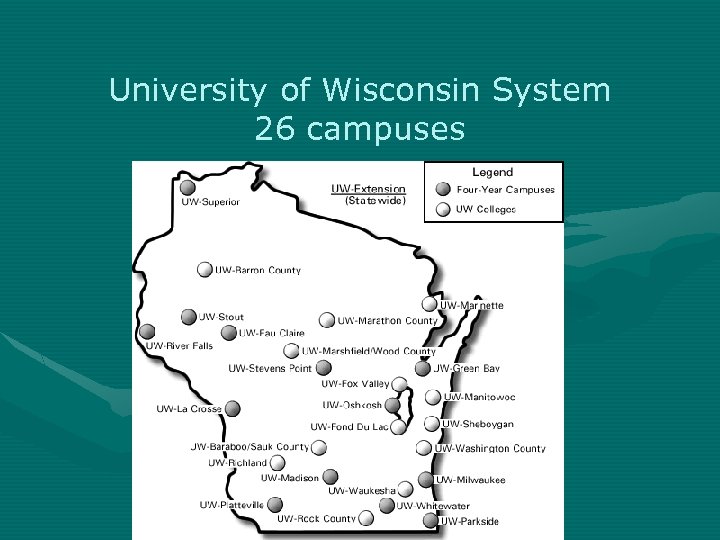 University of Wisconsin System 26 campuses
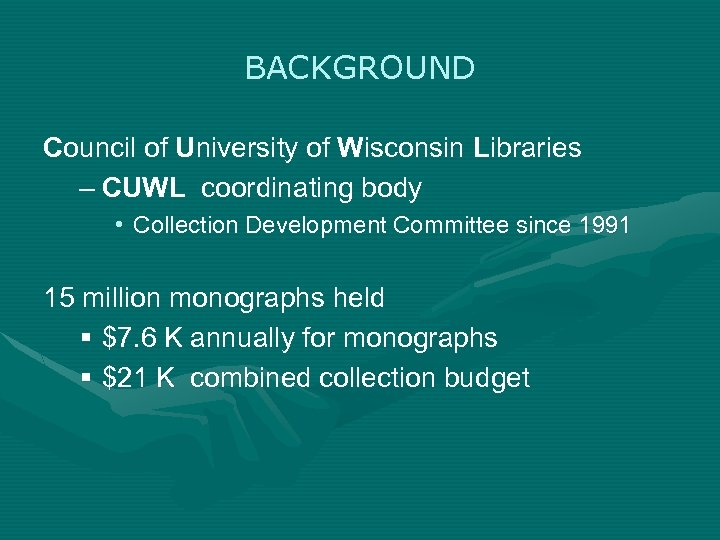 BACKGROUND Council of University of Wisconsin Libraries – CUWL coordinating body • Collection Development Committee since 1991 15 million monographs held § $7. 6 K annually for monographs § $21 K combined collection budget
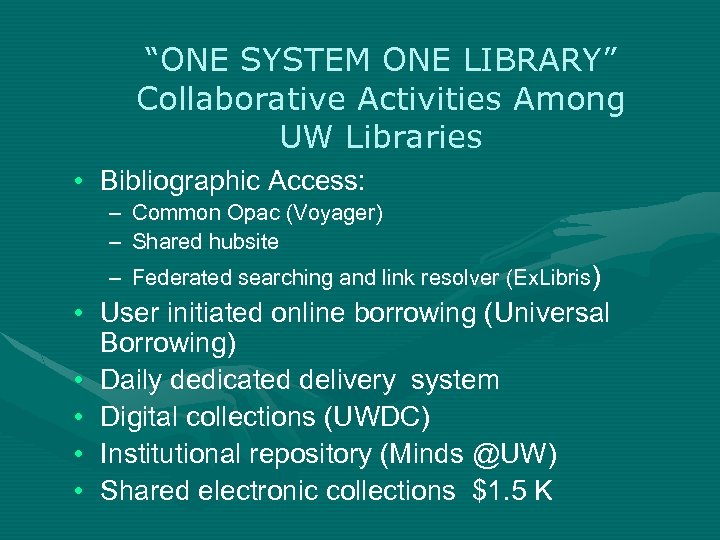 “ONE SYSTEM ONE LIBRARY” Collaborative Activities Among UW Libraries • Bibliographic Access: – Common Opac (Voyager) – Shared hubsite – Federated searching and link resolver (Ex. Libris) • User initiated online borrowing (Universal Borrowing) • Daily dedicated delivery system • Digital collections (UWDC) • Institutional repository (Minds @UW) • Shared electronic collections $1. 5 K
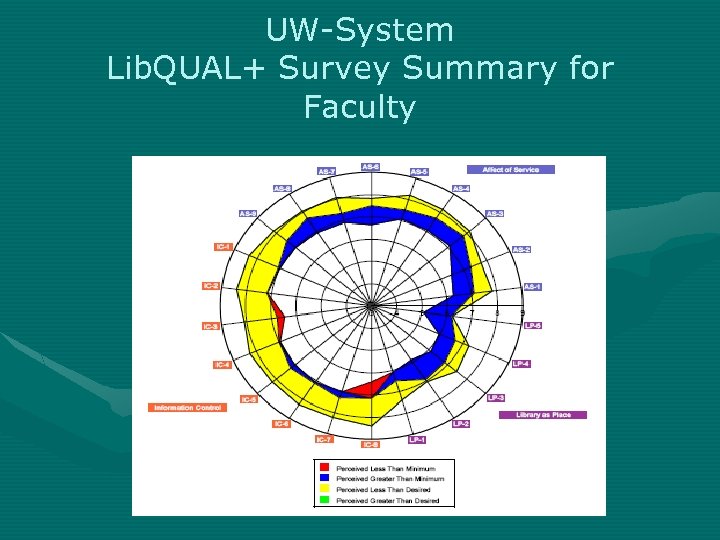 UW-System Lib. QUAL+ Survey Summary for Faculty
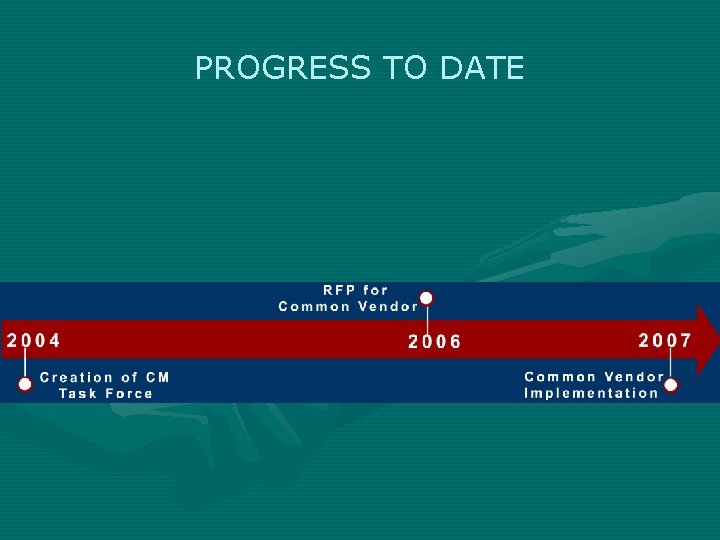
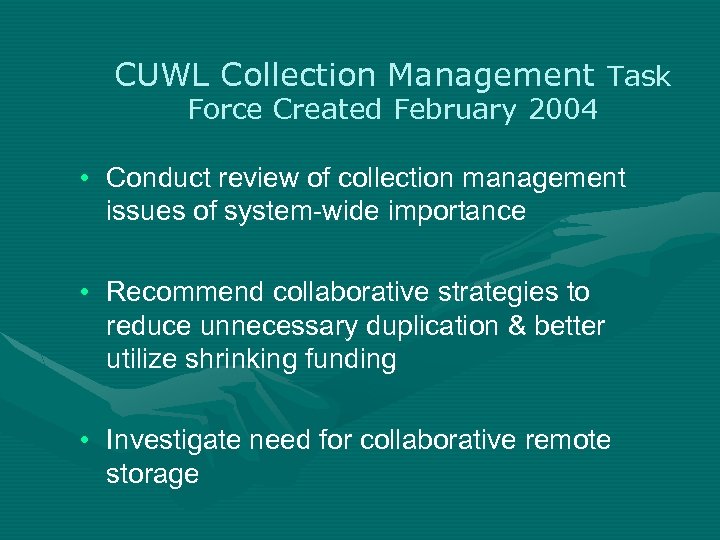 CUWL Collection Management Task Force Created February 2004 • Conduct review of collection management issues of system-wide importance • Recommend collaborative strategies to reduce unnecessary duplication & better utilize shrinking funding • Investigate need for collaborative remote storage
 Initial activities • • • Surveyed existing consortial approaches Serials overlap study initiated Gauge barrier-free borrowing across UWS – UWS funding to support document delivery from British Library to remove barriers to access – Eliminate ILL fees & reimburse net lenders • March 2005 Summit for Collaborative Collection Development
 • • • Top Summit Suggestions to Promote Collaboration Explore collaborative book purchasing trial Create shared statewide reference collection Confirm areas of excellence within collections building on individual UW strengths • Create funding model for volume discount for document delivery of articles • Update last copy issue & create repository for journals available electronically
 Study of the Impact of Consortial Book Purchasing • Initiate trial with vendor on state contract YBP – 6 month voluntary participation July- December 2005 – 12 libraries (4 UW Colleges + 8 four year UW’s) • Communication with participants critical – Face-to-face overview and hands-on training meeting – Emails and articles sent to participants by Taskforce • Survey instrument developed and shared at start of trial
 Results of Trial • Over 400 titles identified as consciously not purchased – Over 30% ++ duplication rate • New collaborative activities – UW Colleges focus on UW Press titles – UW La Crosse conducts study using performance indicators for consortial monograph purchasing – UW Madison & Milwaukee look at subject coverage through approval plans
 What We Learned • Local practices dictate procedures – Need to identify best practices for acquisition to optimize consortial project • Vendor interface, ease of use, delivery time, loyalty, and discounts are important • Not all formats available through one vendor • Vendor tools can support collaborative activities & provide additional information
 Primary Vendor Will Enhance Collaborative Book Purchasing • Appointed new taskforce for book bid – RFP submitted Winter 2006 • Evaluation of submissions completed Spring 2007 • Blackwell selected effective July 2007 – Firm & standing orders, approval plans – $2, 500, 000 minimum spending
 CHALLENGES • • • No new state funding likely in near future UWS support for collaborative activities 1 FTE Wide discrepancy in acquisition budgets $12, 000 to $11, 600, 000 • No governance body to enforce policies • 26 different collection development policies – Control over acquisition dollars often maintained by faculty • CUWL reorganizes committee structure - Spring 2007
 NEXT STEPS • Develop a User-Focused Model for CCD – Conduct second Lib. QUAL+ assessment – Utilize ILL data, universal borrowing & circulation statistics • Measure collection development performance indicators & establish benchmark assessment of collection strengths • Work on shared off-site storage/preservation facility • Pursue broadening collaboration with other state funded libraries
 NEXT STEPS -- MORE • Develop acceptance of using access & delivery in lieu of ownership • Develop policy on consortial purchasing guidelines • Implement best practice book purchasing • Expand communication –internal/external • Launch common publicity campaign
 Our Vision • Buy strategically – Reduce duplication – Enhance diversity of resources across the UW Community – Maximize use of limited funding • Realize economic advantages to collaborative purchasing • One system one library with many location throughout the state readily accessible with richer collections for our use • Jointly develop integrated, interdependent resources for University research and teaching
 PROGRESS TO DATE
 QUESTIONS ewa@uwm. edu (414) 229 -4781 University of Wisconsin Libraries
 Cooperative Monographic Collection Development – Recent Trends http: //ccdc. pbwiki. com/Front. Page
 Building a Consortial Monographic Purchase Plan: The Colorado Alliance of Research Libraries Experience ALA Annual Conference Washington, DC June 23, 2007 Michael Levine-Clark Collections Librarian University of Denver miclark@du. edu
 The Colorado Alliance of Research Libraries • Auraria Library • • • University of Colorado, Boulder – CU Denver – Metro State College • University of Colorado, – Comm. College of Denver Colorado Springs Colorado College • University of Denver Colorado School of Mines • University of Northern Colorado State University Colorado Denver Public Library • University of Wyoming Regis University
 Prospector • Serves 25 academic, public, and special libraries in Colorado and Wyoming • Over 23 million items • A shared collection
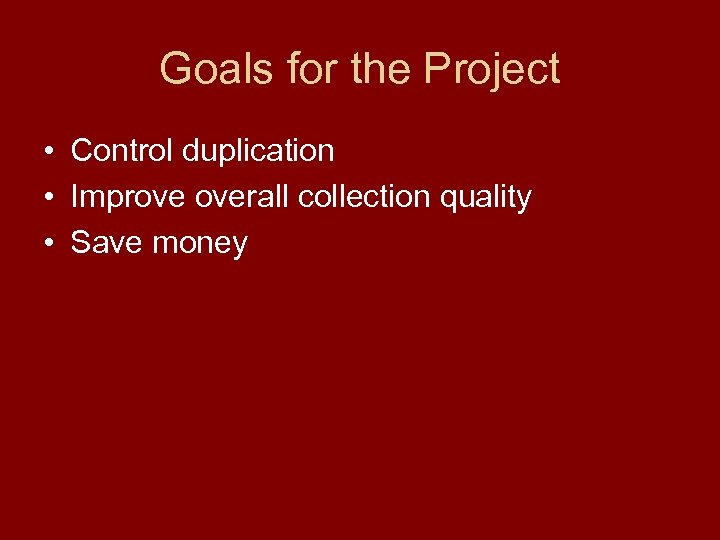 Goals for the Project • Control duplication • Improve overall collection quality • Save money
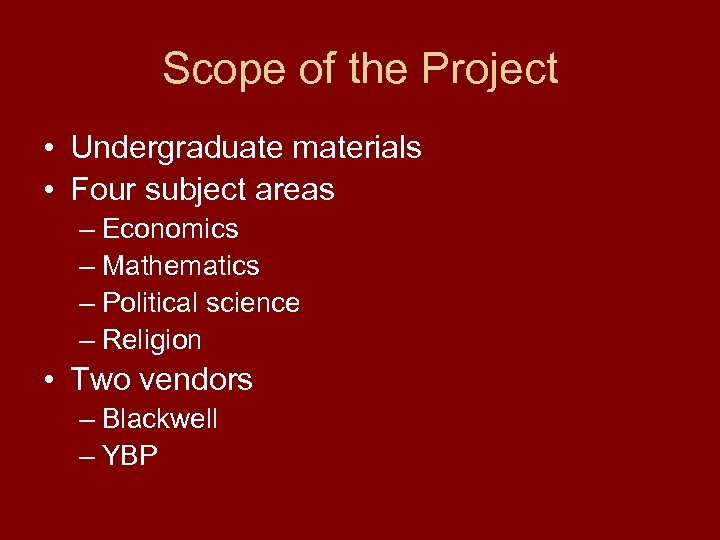 Scope of the Project • Undergraduate materials • Four subject areas – Economics – Mathematics – Political science – Religion • Two vendors – Blackwell – YBP
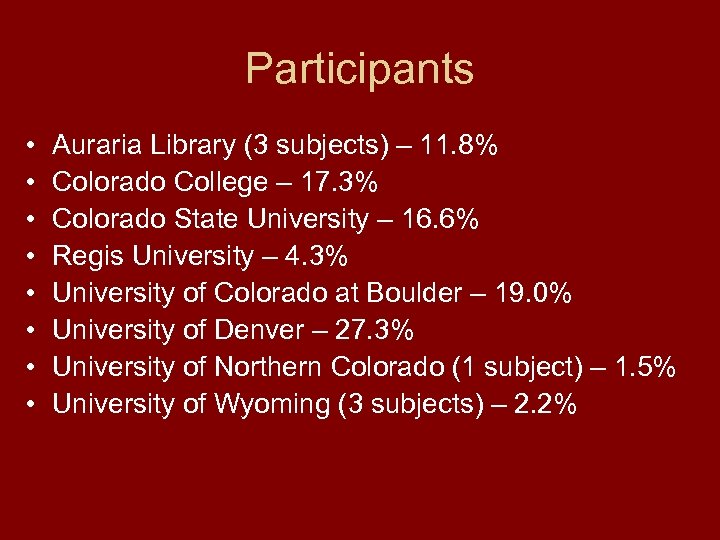 Participants • • Auraria Library (3 subjects) – 11. 8% Colorado College – 17. 3% Colorado State University – 16. 6% Regis University – 4. 3% University of Colorado at Boulder – 19. 0% University of Denver – 27. 3% University of Northern Colorado (1 subject) – 1. 5% University of Wyoming (3 subjects) – 2. 2%
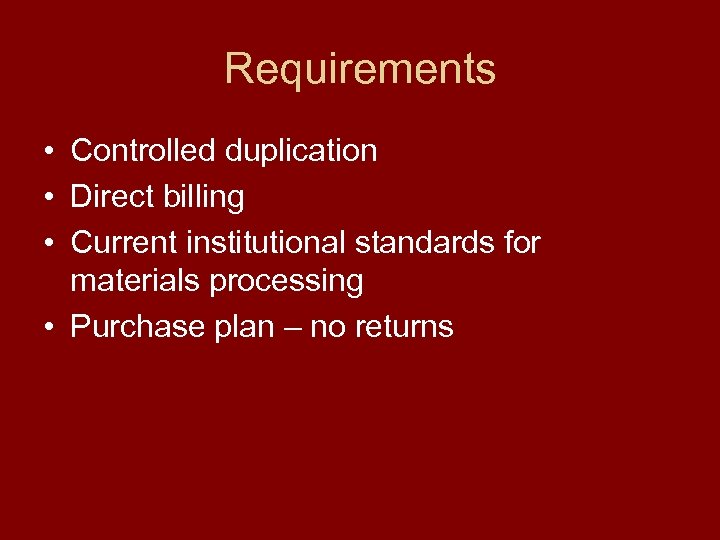 Requirements • Controlled duplication • Direct billing • Current institutional standards for materials processing • Purchase plan – no returns
 Profiling • All books (undergraduate and graduate) with one vendor • Institutional priorities • Anticipated usage
 Collection Analysis • Spectra Dimension – Annualized use per title – Percent of zero usage – Number of copies per title – Number of titles
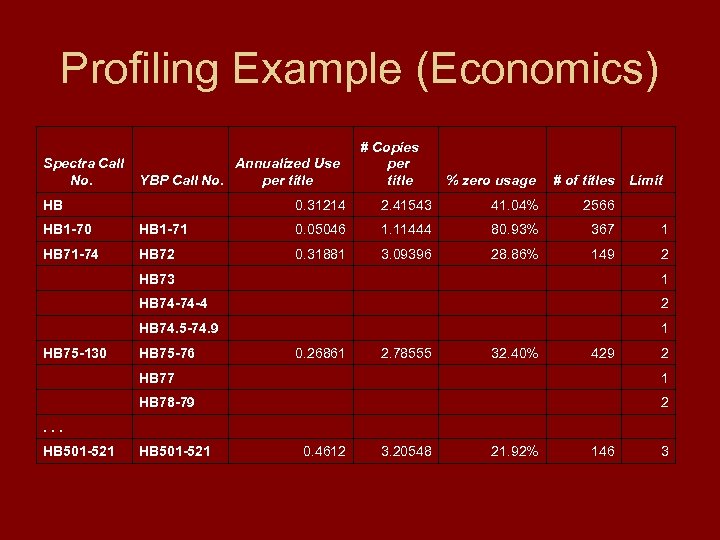 Profiling Example (Economics) # Copies per title Spectra Call No. Annualized Use per title YBP Call No. HB 0. 31214 HB 1 -70 HB 1 -71 HB 71 -74 HB 72 HB 73 1 HB 74 -74 -4 2 HB 74. 5 -74. 9 1 HB 75 -130 HB 75 -76 HB 77 1 HB 78 -79 2 . . . HB 501 -521 % zero usage # of titles 2. 41543 41. 04% 2566 0. 05046 1. 11444 80. 93% 367 1 0. 31881 3. 09396 28. 86% 149 2 0. 26861 0. 4612 2. 78555 3. 20548 32. 40% 21. 92% Limit 429 2 146 3
 Distribution of Books • • Individual profiles Group profile (limits) $ commitment Weekly patterns
 Reports • Group Reports – Monthly • Titles sent and to whom • Titles missed • Individual Reports – From existing vendor – Titles that would have been sent
 Assessment – Quantitative Measures At start and six-month intervals: • Percent of LC English titles in collection • Number of copies per title • Percent zero usage • Annualized use per title • Usage within each library • Snapshots in Prospector
 Assessment – Qualitative Measures • • Selector satisfaction Faculty and student satisfaction Titles missed Titles that would have been sent
 Levine-Clark, Michael, “Building a Consortial Monographic Purchase Plan: The Colorado Alliance of Research Libraries Experience, ” Hugh A. Thompson, ed. Sailing into the Future: Charting Our Destiny: Proceedings of the Thirteenth National Conference of the Association of College and Research Libraries, March 29 -April 1, 2007, Baltimore, Maryland. Chicago: Association of College and Research Libraries, 2007: 39 -45.
 Thank You
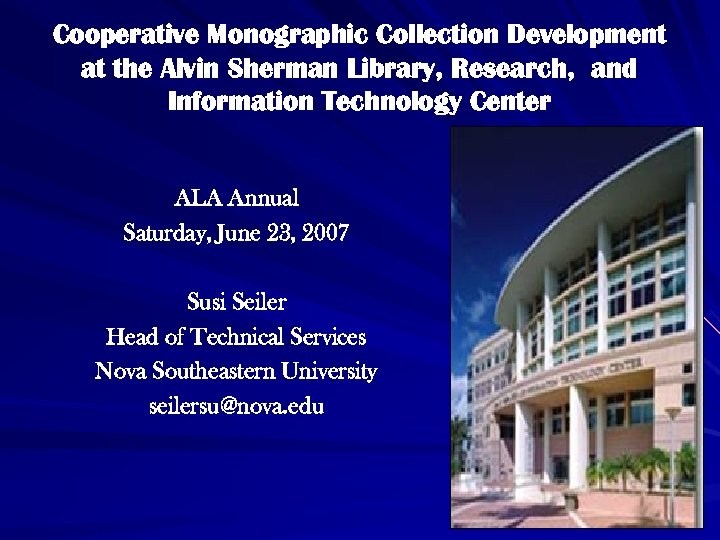 Cooperative Monographic Collection Development at the Alvin Sherman Library, Research, and Information Technology Center ALA Annual Saturday, June 23, 2007 Susi Seiler Head of Technical Services Nova Southeastern University seilersu@nova. edu
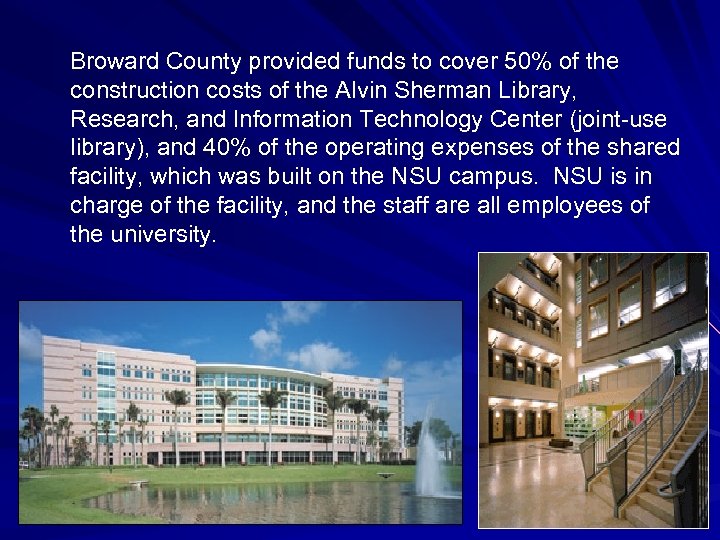 Broward County provided funds to cover 50% of the construction costs of the Alvin Sherman Library, Research, and Information Technology Center (joint-use library), and 40% of the operating expenses of the shared facility, which was built on the NSU campus. NSU is in charge of the facility, and the staff are all employees of the university.
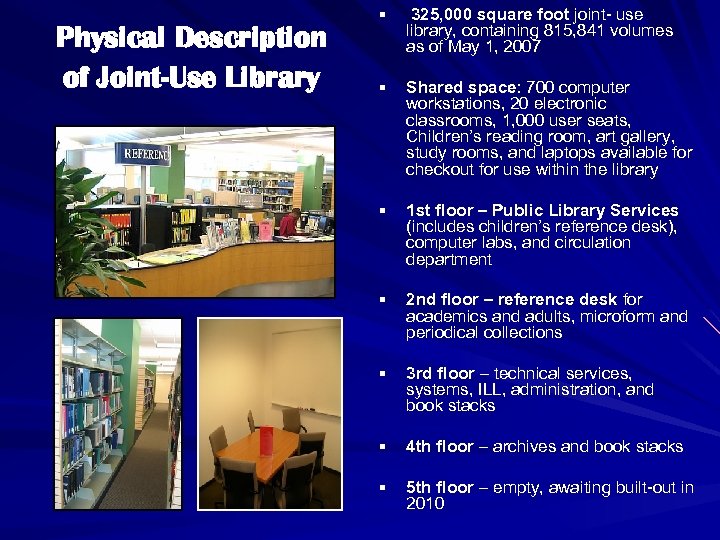 Physical Description of Joint-Use Library § 325, 000 square foot joint- use library, containing 815, 841 volumes as of May 1, 2007 § Shared space: 700 computer workstations, 20 electronic classrooms, 1, 000 user seats, Children’s reading room, art gallery, study rooms, and laptops available for checkout for use within the library § 1 st floor – Public Library Services (includes children’s reference desk), computer labs, and circulation department § 2 nd floor – reference desk for academics and adults, microform and periodical collections § 3 rd floor – technical services, systems, ILL, administration, and book stacks § 4 th floor – archives and book stacks § 5 th floor – empty, awaiting built-out in 2010
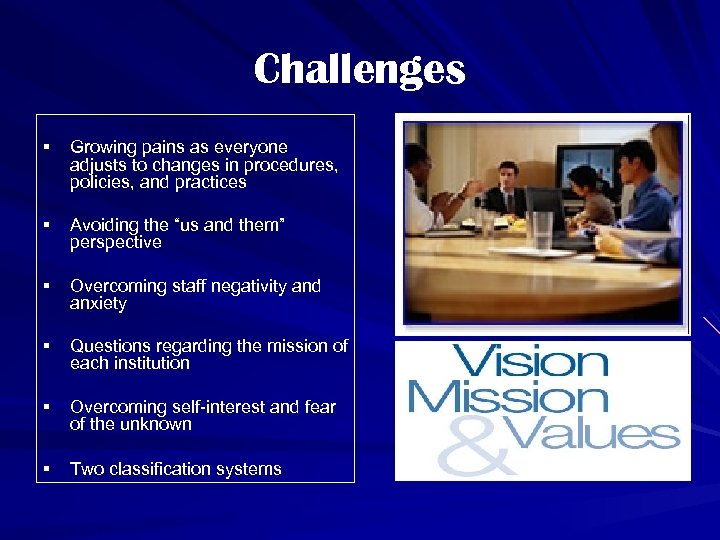 Challenges § Growing pains as everyone adjusts to changes in procedures, policies, and practices § Avoiding the “us and them” perspective § Overcoming staff negativity and anxiety § Questions regarding the mission of each institution § Overcoming self-interest and fear of the unknown § Two classification systems
 Advantages § Dramatic and continual increase in gate count, circulation, ILL, program attendance, and reference statistics. § Combined financial and technological resources. § Combined collection resources cover collection gaps. Library material in more languages and more formats. § Diverse cultural and educational programming
 Collaborative Collection Development Efforts between NSU and Broward County § Joint CD Committee with established with members of both BCL and NSU staff, that decide what ventures are worth pursuing, and select material to be acquired § First collaborative effort was planning shelving and space for opening day collection, comprised of material for children and adults. § Advantages for NSU: - collection now contained popular non-fiction and art - enhanced collection for education students - Foreign Language collection for Adults § Second collaborative effort was the acquisition of online databases § NSU subscribes to 231 online databases (198 available to BCL users), which provides access to 23, 221 unique e-journal titles
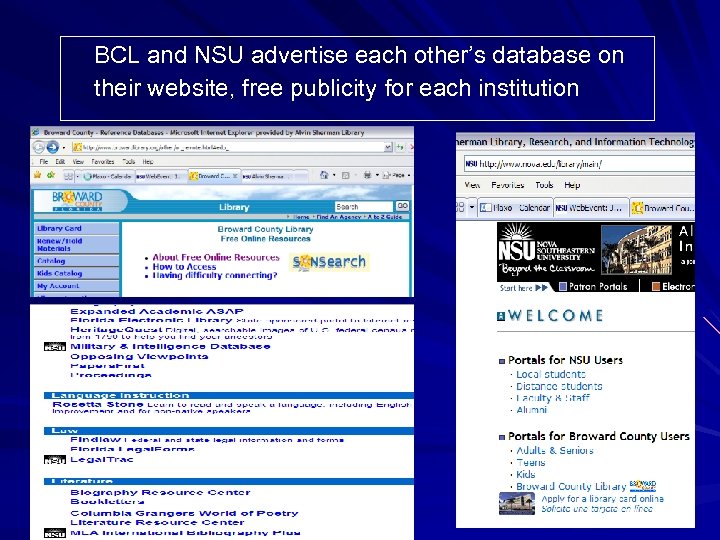 BCL and NSU advertise each other’s database on their website, free publicity for each institution
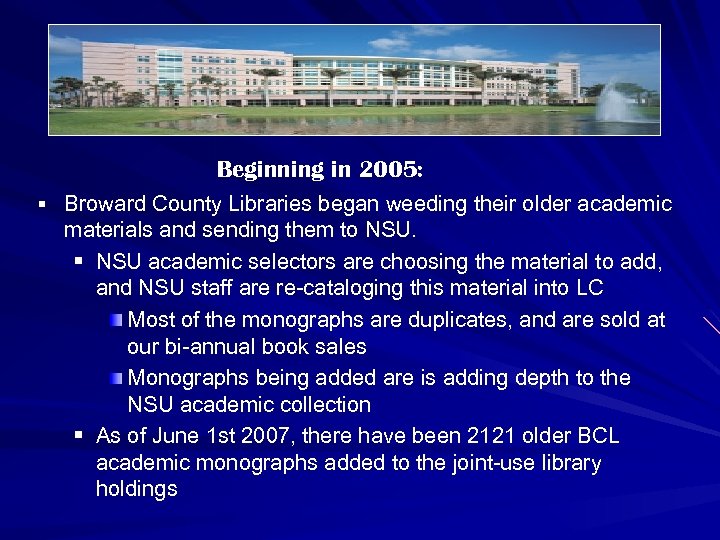 Beginning in 2005: § Broward County Libraries began weeding their older academic materials and sending them to NSU. § NSU academic selectors are choosing the material to add, and NSU staff are re-cataloging this material into LC Most of the monographs are duplicates, and are sold at our bi-annual book sales Monographs being added are is adding depth to the NSU academic collection § As of June 1 st 2007, there have been 2121 older BCL academic monographs added to the joint-use library holdings
 Beginning in 2006: § A joint Approval Plan for academic and popular material was created - NSU funding pays for 50% of this approval plan, and Broward County pays for 50% - Selection of material is done by staff from both NSU and BCL
 In 2007…NSU became the Genealogy center for Broward County. § Our first acquisition was the entire collection from the Genealogical Society of Broward County collection, which we received as a gift. § This material had never been cataloged. NSU staff is cataloging this material into LC. § All BCL libraries will send us their genealogy material, NSU will hire a genealogy librarian, and they will be able to deploy their staff elsewhere
 Cooperative Collection Development Monographic resources available for Broward County Library patrons offered by NSU § 34, 674 e-books have been purchased and added to the NSU online catalog since the building opened § At the request of the Joint CD Committee, NSU President Ferrero gave $50, 000 special one-time funding next year for us to purchase Latino Literature from Alexander Street Press, and the 6 th SOLINET shared collection of e-books (7030 titles)
 Cooperative Collection Development Monographic resources available for NSU patrons offered by Broward County Library system § § § Broward County Library has subscribed to Overdrive, and their collection has 500+ E-Audio books. Over 30 titles are added each month 214 e-books from Adobe and Mobipocket Large collections of audios (292, 547) and videos (205, 215)
 Cooperative Technical Services § NSU is responsible for all acquisitions, and absorbs the cost of staffing, technology, binding, and supplies § BC is responsible for the cost of cataloging and processing § For juvenile, popular, and young adult material (cataloged in Dewey) § The majority of this work is outsourced § Vendor cataloging and processing specifications developed by NSU staff § If vendor cataloging records are not acceptable, NSU has the option of cataloging and processing the material in-house, and billing BCL for staff time and processing supplies § For adult material (cataloged in LC) § NSU catalogs the material, and BCL reimbursed us for staff time and processing supplies
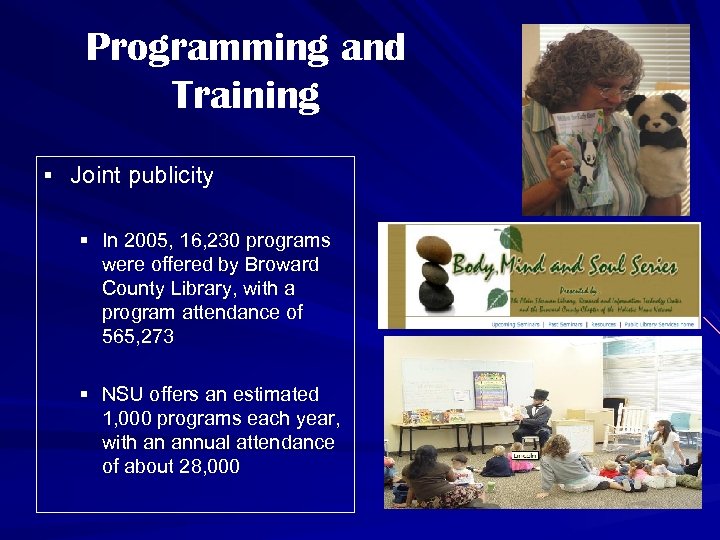 Programming and Training § Joint publicity § In 2005, 16, 230 programs were offered by Broward County Library, with a program attendance of 565, 273 § NSU offers an estimated 1, 000 programs each year, with an annual attendance of about 28, 000
 Latest initiative § NSU has been searching for ways to increase our patron list and circulation statistics § Broward County Library is assisting by links on their website for Broward patrons to get a NSU library card, and forms at their reference and circulation desks