


 Скачать презентацию Cooperation with China under the European 7 th
218e73cd3ee6a728b48031c7344dc5e8.ppt
- Количество слайдов: 26
 Cooperation with China under the European 7 th Framework Programme (FP 7) for Research and Development INCO BILAT-SILK June 2009 Michele Genovese DG Research Specific International Cooperation Activities
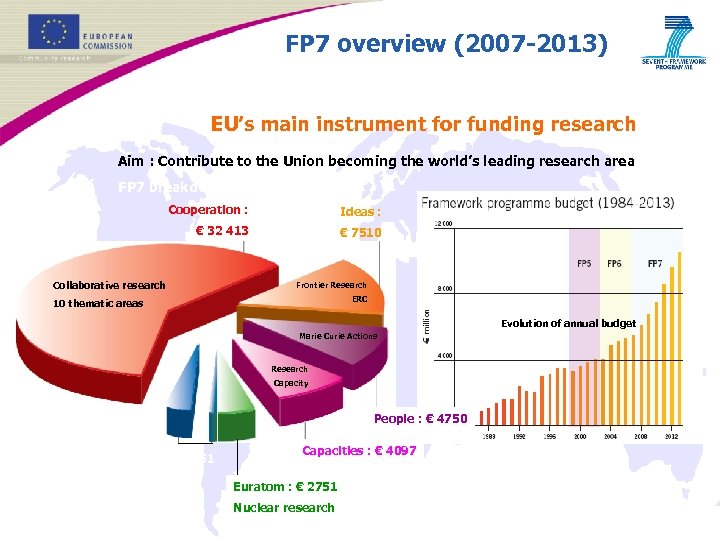 FP 7 overview (2007 -2013) EU’s main instrument for funding research Aim : Contribute to the Union becoming the world’s leading research area FP 7 breakdown (€ million) Cooperation : Ideas : € 32 413 € 7510 Collaborative research Frontier Research ERC 10 thematic areas Evolution of annual budget Marie Curie Actions Research Capacity People : € 4750 JRC : € 1751 Capacities : € 4097 Euratom : € 2751 Nuclear research
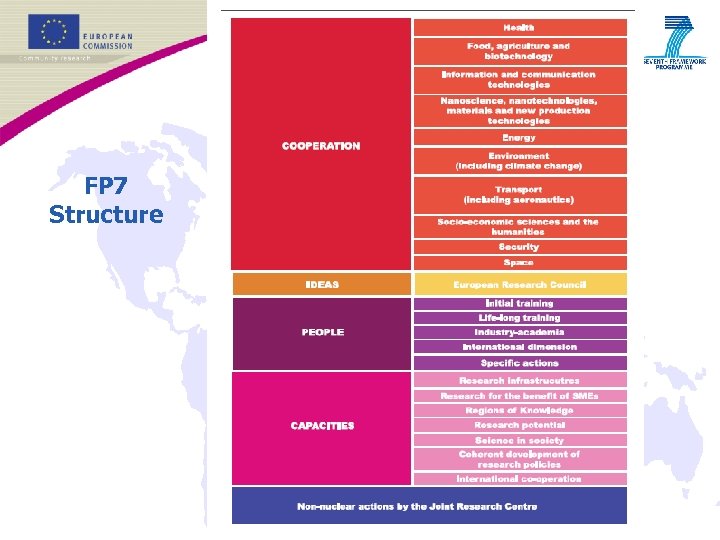 FP 7 Structure
 Basic Principles • Public calls for proposals detailed in annual workprogrammes • Peer review, competitive selection based on scientific excellence • Trans-national cooperation • Cost-sharing • Participants own the results
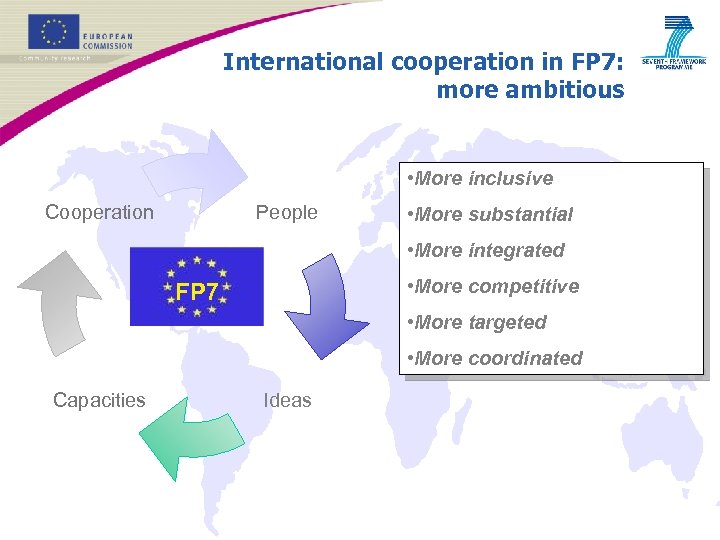 International cooperation in FP 7: more ambitious • More inclusive People Cooperation • More substantial • More integrated • More competitive FP 7 • More targeted • More coordinated Capacities Ideas
 Why International Cooperation? • To support European competitiveness through strategic partnerships with third countries • On the basis of mutual interest and mutual benefit • To address specific problems faced by developing countries
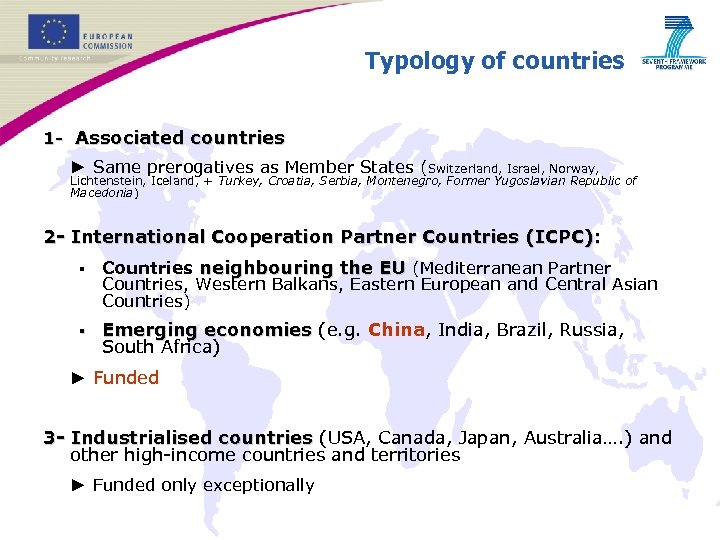 Typology of countries 1 - Associated countries ► Same prerogatives as Member States (Switzerland, Israel, Norway, Lichtenstein, Iceland, + Turkey, Croatia, Serbia, Montenegro, Former Yugoslavian Republic of Macedonia) 2 - International Cooperation Partner Countries (ICPC): § Countries neighbouring the EU (Mediterranean Partner Countries, Western Balkans, Eastern European and Central Asian Countries) § Emerging economies (e. g. China, India, Brazil, Russia, South Africa) ► Funded 3 - Industrialised countries (USA, Canada, Japan, Australia…. ) and other high-income countries and territories ► Funded only exceptionally
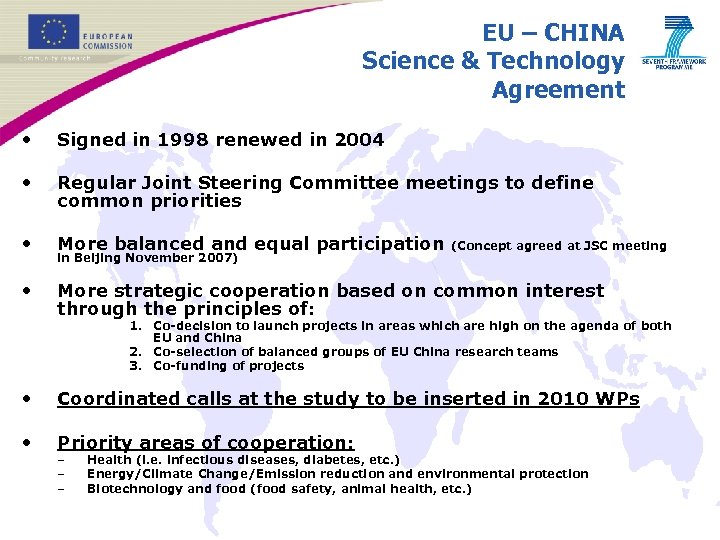 EU – CHINA Science & Technology Agreement • Signed in 1998 renewed in 2004 • Regular Joint Steering Committee meetings to define common priorities • More balanced and equal participation • More strategic cooperation based on common interest through the principles of: in Beijing November 2007) (Concept agreed at JSC meeting 1. Co-decision to launch projects in areas which are high on the agenda of both EU and China 2. Co-selection of balanced groups of EU China research teams 3. Co-funding of projects • Coordinated calls at the study to be inserted in 2010 WPs • Priority areas of cooperation: – – – Health (i. e. infectious diseases, diabetes, etc. ) Energy/Climate Change/Emission reduction and environmental protection Biotechnology and food (food safety, animal health, etc. )
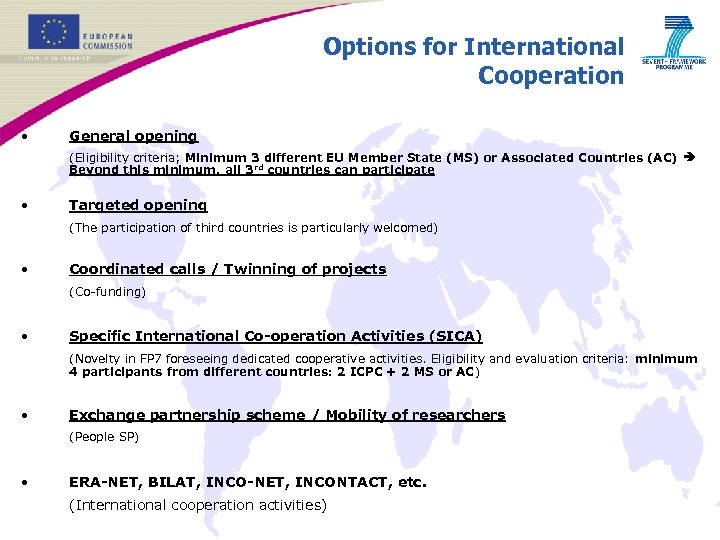 Options for International Cooperation • General opening (Eligibility criteria; Minimum 3 different EU Member State (MS) or Associated Countries (AC) Beyond this minimum, all 3 rd countries can participate • Targeted opening (The participation of third countries is particularly welcomed) • Coordinated calls / Twinning of projects (Co-funding) • Specific International Co-operation Activities (SICA) (Novelty in FP 7 foreseeing dedicated cooperative activities. Eligibility and evaluation criteria: minimum 4 participants from different countries: 2 ICPC + 2 MS or AC) • Exchange partnership scheme / Mobility of researchers (People SP) • ERA-NET, BILAT, INCO-NET, INCONTACT, etc. (International cooperation activities)
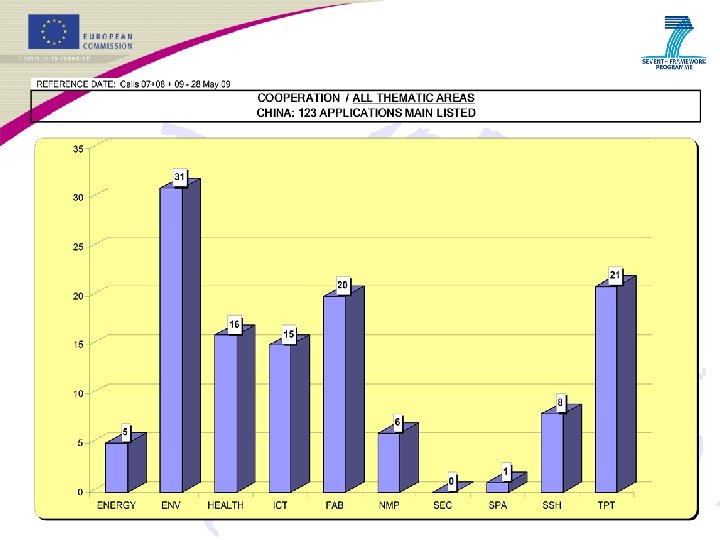
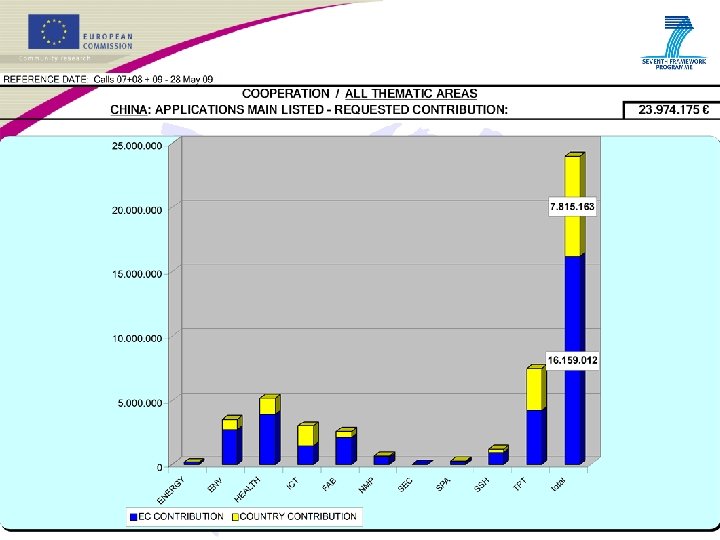
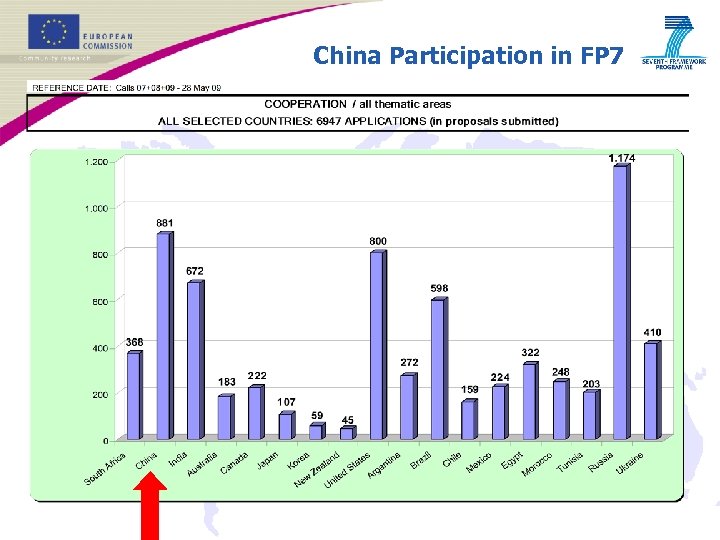 China Participation in FP 7
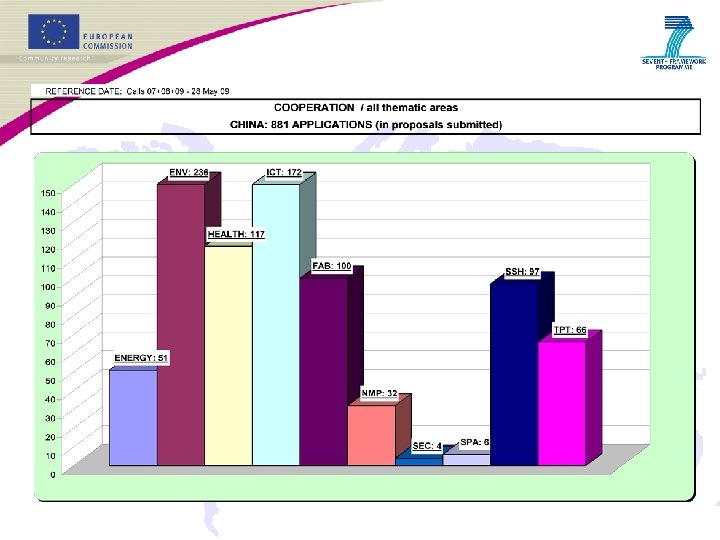
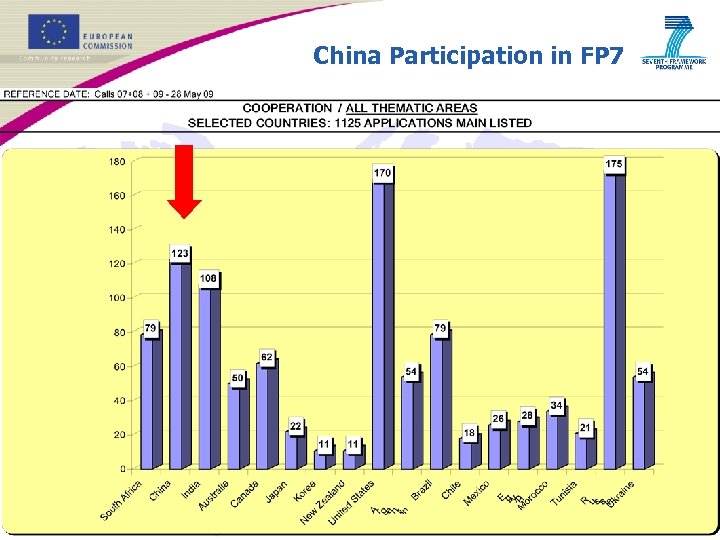 China Participation in FP 7
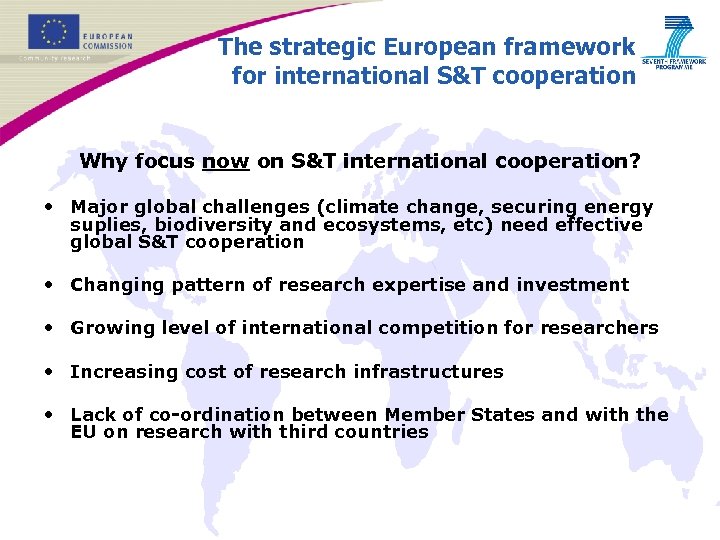 The strategic European framework for international S&T cooperation Why focus now on S&T international cooperation? • Major global challenges (climate change, securing energy suplies, biodiversity and ecosystems, etc) need effective global S&T cooperation • Changing pattern of research expertise and investment • Growing level of international competition for researchers • Increasing cost of research infrastructures • Lack of co-ordination between Member States and with the EU on research with third countries
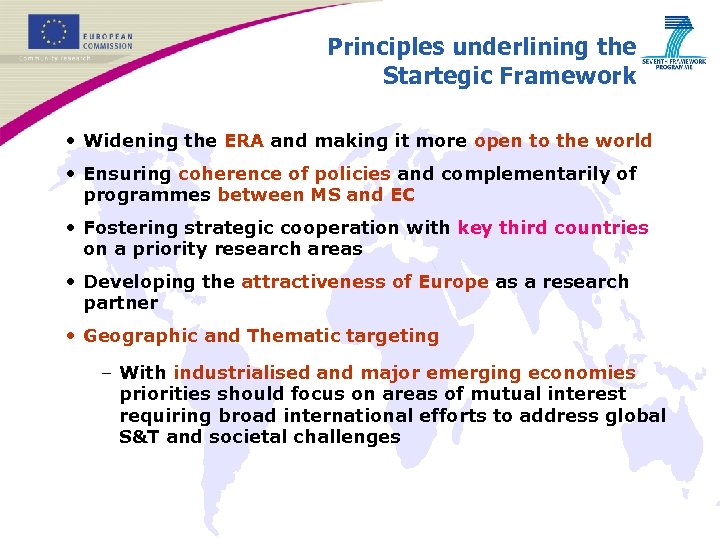 Principles underlining the Startegic Framework • Widening the ERA and making it more open to the world • Ensuring coherence of policies and complementarily of programmes between MS and EC • Fostering strategic cooperation with key third countries on a priority research areas • Developing the attractiveness of Europe as a research partner • Geographic and Thematic targeting – With industrialised and major emerging economies priorities should focus on areas of mutual interest requiring broad international efforts to address global S&T and societal challenges
 CAPACITIES - International Cooperation ERA-NET - Objectives Coordination of national policies and activities on international S&T cooperation (ERA-NET): Objective: To increase the cooperation and coordination of research programmes carried out at national or regional level in the Member States and Associated Countries and which target one third country or several third countries in a given region
 CAPACITIES - International Cooperation ERA-NET - Activities ERA-NET actions can network four types of activities: 1. Information exchange amongst Member States, Associated Countries and Community on S&T international cooperation, thus promoting an effective and efficient international scientific cooperation strategy at EU level; 2. Definition and preparation of joint activities; 3. Implementation of commonly agreed objectives and joint activities by facilitating innovative programmatic approaches; 4. Funding of joint trans-national research actions.
 CAPACITIES - International Cooperation ERA-NET – target groups and country coverage Target groups: - programme owners (e. g. ministries) and - programme managing institutions (e. g. research councils or funding agencies), and others Countries/regions covered in the first call (2008): - WBC, Russia, India, Black Sea, South Korea Target region/country in WP 2010: - Africa, - Brazil, Canada, China, Japan, USA
 CAPACITIES - International Cooperation ERA-NET – Specific activities Africa: The proposals should help implement the Africa-EU Joint Strategy and its Action Plan. The joint activities should: • be embedded in a coherent and co-ordinated long term vision and sustainable strategy; • cover collaborative research, networking, training and/or mobility activities, and should aim at increasing the research capacity of African centres of excellence; • be developed in complementarity with the projects supported by the EC.
 CAPACITIES - International Cooperation ERA-NET – Specific activities Brazil, Canada, China, Japan & USA: The proposals should focus either at the coordination of research, innovation and/or mobility programmes of MS & AC. The proposal should strengthen collaboration between existing and new programmes, aim to create the best possible framework conditions for research and/or innovation, identify good practices, promote the use of e. g. programmes both in the private and the public sector, and establish a favourable legal and regulatory policy environment that will promote and protect research findings.
 CAPACITIES - International Cooperation ERA-NET – Specific activities The details of the joint funding activities should be prepared during the first 12 months of the project. The project should deliver a strategy and/or recommendations for future joint activities. The strategy should prepare the way for joint programming and needs to be backed up by a traceable roadmap describing: • The implementation steps for joint funding activities; • A clear plan describing how programmes will be initiated, trans-national mobility (when applicable) realised and the working conditions of the final beneficiaries enhanced; • Budgetary aspects of the contributions of each participating project partner (ie financial commitments); • Monitoring and evaluation plans on project and programme level.
 CAPACITIES - International Cooperation ERA-NET – Expected impact • Reinforce the impact of the ongoing bilateral S&T cooperation between MS & target countries, • Enhance complementarities between the Community & MS and broaden the institutional cooperation, • Reduce the fragmentation of the ERA by increasing coordination between national research programmes across the MS & AC, • Avoid overlap between the programmes of MS & AC and to develop expertise from mutual learning, • Help increase the international dimension of projects, which coordinate national thematic programmes in Europe successfully. • Achieve critical mass, to ensure the better use of scarce resources, • Develop common governance principles (e. g. with respect to ethics, good practices); • Bring together national programmes which deal with cooperation with third countries, and enable them to speak with a 'single voice‘.
 CAPACITIES - International Cooperation ERA-NET – Call fiche • Call identifier: FP 7 -INCO-2010 -3 • Call publication date: 30/07/09 • Call closure date: 19/01/10 • Indicative budget: 6 M€ incl. 2 M€ for Africa • Funding scheme: CSA-CA, typ 2 M€/project for 3 years • Eligibility criteria: min 3 independent legal entities which finance or manage publicly funded national or regional programmes. Each of these must be established in a different Member State or Associated Country. • Evaluation criteria: threshold of 3 on criteria and 10 on total, specific ERANET evaluation criteria
 Further Information • CORDIS http: //cordis. europa. eu/home_fr. html • INCO info-desk inco@ec. europa. eu • INCO portal: http: //cordis. europa. eu/inco/home_en. html • International Scientific Cooperation Policy: http: //ec. europa. eu/research/iscp/index. cfm • IPR Helpdesk = project funded by the Commission to provide free advice regarding IPR (http: //www. ipr-helpdesk. org/) + FP 7 ( Helpdesk (http: //ec. europa. eu/research/index. cfm? pg=enquiries) (
 THANK YOU FOR YOUR ATTENTION