


 Скачать презентацию Conversion in different parts of speech Made
Conversion Zubrilina MBL-31.pptx
- Количество слайдов: 18
 «Conversion in different parts of speech» Made by: Зубрилина Валерия Александровна, MBL-31 Supervisor: Муругова Елена Валерьевна Don State Technical University 2012
 1. Introduction: the purpose of the course work, the novelty and the relevance of investigation. 2. Theoretical part. v the definition of conversion v different approaches to the problem v the main types of conversion v productivity of conversion in different parts of speech 3. Practical part. Analysis of the productive models of conversion on the bases of fiction literature ( « 1984» , Part I, by G. Orwell) 4. Conclusion
 What is the purpose of the work? To investigate conversion in different parts of speech and to see the main peculiarities of its utilization on the bases of the fiction analysis.
 The object and the subject. The object of investigation is conversion in different parts of speech. The subject of the research is the models of conversion investigated on the basis of the novel « 1984» by G. Orwell.
 The relevance and the novelty of investigation. The relevance of the research topic is determined by: high-productivity of this way of word-formation in the language the necessity to clear out the process of conversion the interest to find some regularities of the usage of this way of word-building in fiction literature The novelty depends on the fact that this research is based on the investigation of the productive models of conversion in fiction.
 What are the principal methods of investigation? Morphological analysis Word-formation analysis Descriptive analysis Analysis into IC
 Theoretical part. The definition of conversion. We stick to the point of view of I. V. Arnold and A. Y. Zagoruiko: «Сonversion is a morphological-syntactic wordbuilding means of a word of one part of speech from the stem or wordform of another part of speech by means of changing its paradigm(if any) and environment characteristic of a word of a definite part of speech» [A. Y. Zagoruiko: 82]
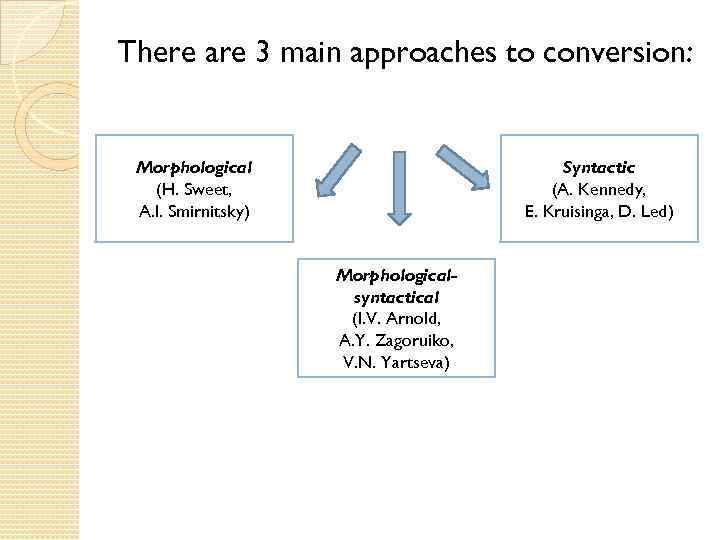 There are 3 main approaches to conversion: Morphological (H. Sweet, A. I. Smirnitsky) Syntactic (A. Kennedy, E. Kruisinga, D. Led) Morphologicalsyntactical (I. V. Arnold, A. Y. Zagoruiko, V. N. Yartseva)
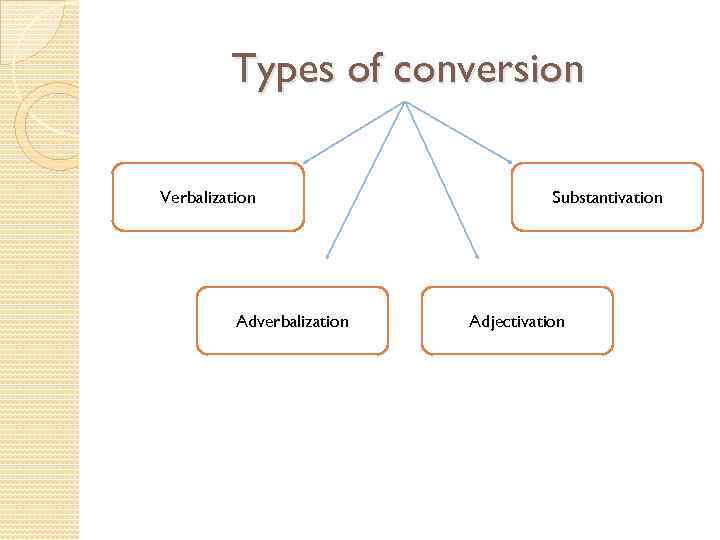 Types of conversion Verbalization Adverbalization Substantivation Adjectivation
 Productivity of conversion as a wordbuilding means in different parts of speech Nouns and verbs in the present-day English are generally formed by means of conversion. Secondary word-classes ( transitive and intransitive verbs, gradable and non-gradable adjectives), many idiomatic prepositional phrases and verbal collocations are affected by conversion as well.
 The practical part. The general tasks of the investigation are: ü To classify the words of the vocabulary of the given book according to the types of conversion ü To define the most frequently used models of conversion
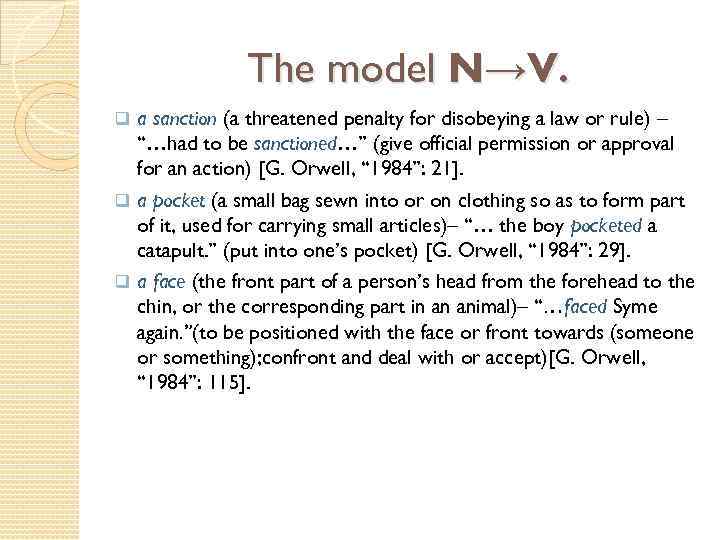 The model N→V. a sanction (a threatened penalty for disobeying a law or rule) – “…had to be sanctioned…” (give official permission or approval for an action) [G. Orwell, “ 1984”: 21]. q a pocket (a small bag sewn into or on clothing so as to form part of it, used for carrying small articles)– “… the boy pocketed a catapult. ” (put into one’s pocket) [G. Orwell, “ 1984”: 29]. q a face (the front part of a person’s head from the forehead to the chin, or the corresponding part in an animal)– “…faced Syme again. ”(to be positioned with the face or front towards (someone or something); confront and deal with or accept)[G. Orwell, “ 1984”: 115]. q
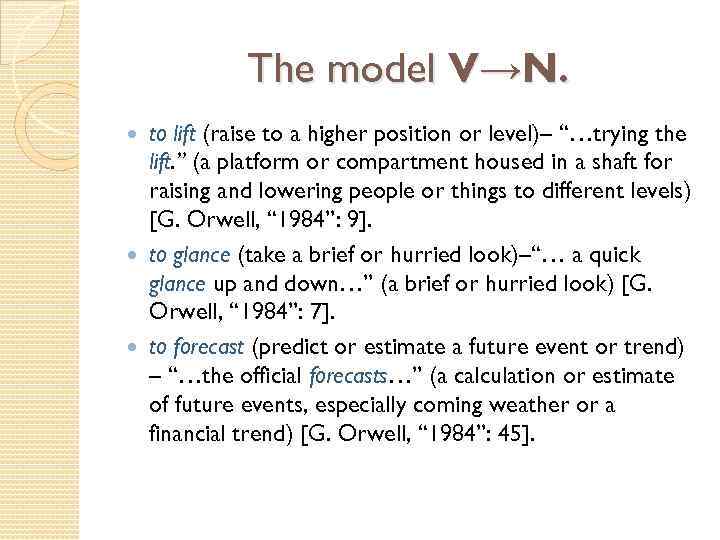 The model V→N. to lift (raise to a higher position or level)– “…trying the lift. ” (a platform or compartment housed in a shaft for raising and lowering people or things to different levels) [G. Orwell, “ 1984”: 9]. to glance (take a brief or hurried look)–“… a quick glance up and down…” (a brief or hurried look) [G. Orwell, “ 1984”: 7]. to forecast (predict or estimate a future event or trend) – “…the official forecasts…” (a calculation or estimate of future events, especially coming weather or a financial trend) [G. Orwell, “ 1984”: 45].
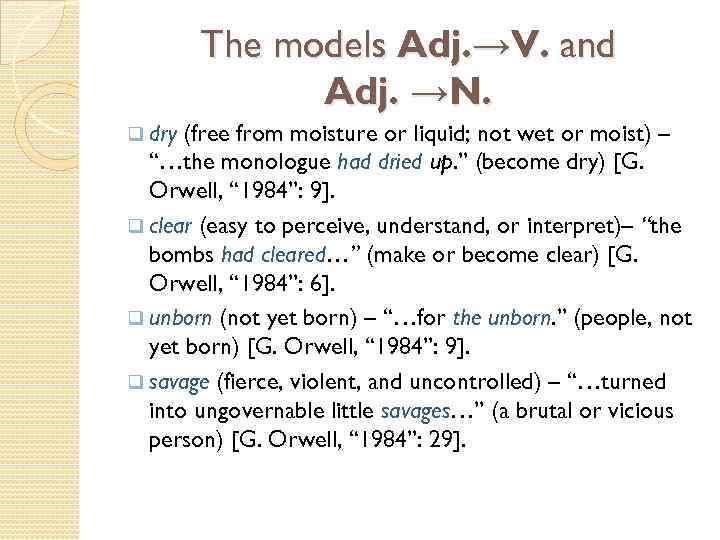 The models Adj. →V. and Adj. →N. q dry (free from moisture or liquid; not wet or moist) – “…the monologue had dried up. ” (become dry) [G. Orwell, “ 1984”: 9]. q clear (easy to perceive, understand, or interpret)– “the bombs had cleared…” (make or become clear) [G. Orwell, “ 1984”: 6]. q unborn (not yet born) – “…for the unborn. ” (people, not yet born) [G. Orwell, “ 1984”: 9]. q savage (fierce, violent, and uncontrolled) – “…turned into ungovernable little savages…” (a brutal or vicious person) [G. Orwell, “ 1984”: 29].
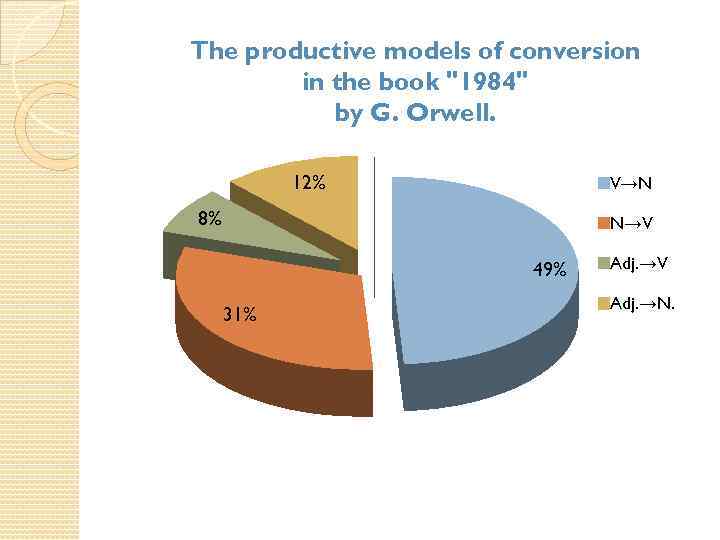 The productive models of conversion in the book "1984" by G. Orwell. 12% V→N 8% N→V 49% 31% Adj. →V Adj. →N.
 Conclusion. When the investigation is over, we can define whether the purpose of the work is completed or not: We adopted a definition proposed by I. V. Arnold and A. Y. Zagoruiko who defined conversion as a morphological-syntactical word-building means. Ø Conversion is a very productive way of word-formation. The most frequently used models are N>V and V>N. Ø The analysis of the book “ 1984” by G. Orwell (51 words) shows that the most frequently used models of conversion in fiction are V→N (49%) and N→V (31%). That proves a statement that nouns and verbs are generally affected by conversion. Ø
 References. 1. 2. 3. 4. 5. 6. Антрушина Г. Б. Лексикология английского языка: Учебное пособие для студентов. /Г. Б. Антрушина, О. В. Афанасьева, Н. Н. Морозова – М. : Дрофа, 1999. – 288 с. Арнольд И. В. Лексикология современного английского языка: Учеб. для ин-тов и фак. иностр. яз. – 3 -е изд. , перераб. и доп. / И. В. Арнольд. М. : Высш. шк. , 1986. – 293 с. Гинзбург Р. З. Лексикология английского языка: Учебник для ин-тов и фак. иностр. яз. – 2 -е изд. , испр. и доп. /Р. З. Гинзбург [и др. ] М. : Высш. шк. , 1979. – 269 с. Дубенец Э. М. Лексикология современного английского языка: лекции и семинары. Пособие для студентов гуманитарных вузов. — М. : «Глосса-Пресс» , 2002. — 192 с. Загоруйко А. Я. Лекции по лексикологии современного английского языка: Учебное пособие для студентов. – Загоруйко А. Я. Ростов н/Д: Изд-во РГПУ, 2005. – 128 с. Зыкова И. В. Практический курс английской лексикологии. – 3 -е изд. , стер. / И. В. Зыкова М. : Издательский центр «Академия» 2008. – 288 с.
 Dictionaries. An etymological dictionary of the English Language by the Rev. Walter W. Skeat, M. A. [электронный ресурс] URL: http: //archive. org/stream/etymologicaldict 00 skeauoft#page/n 5/ mode/2 up Online Etymology Dictionary. [электронный ресурс] URL: http: //dictionary. reference. com/etymology/ Online Etymology dictionary. [электронный ресурс] URL: http: //www. etymonline. com/ Oxford Dictionaries Online [электронный ресурс] URL: http: //oxforddictionaries. com/ Merriam-Webster Online Dictionary [электронный ресурс] URL: http: //www. merriam-webster. com/dictionary/ My. Etymology [электронный ресурс] URL: http: //www. myetymology. com/