


 Скачать презентацию Conveners Government of Guatemala and the Secretariat of
e139c0e2b9de70e708d0333b172d12f6.ppt
- Количество слайдов: 75
 Conveners: Government of Guatemala and the Secretariat of the Convention on Biological Diversity (SCBD). Organisers: Swed. Bio at Stockholm Resilience Centre and the Secretariat of the Convention on Biological Diversity together with local hosts in Guatemala National Council of Protected Areas (CONAP) and Asociación Sotz´il. Funding: Economic support was provided by the Swedish International Development Cooperation Agency (Sida) through Swed. Bio at Stockholm Resilience Centre, European Commission and Japan Biodiversity Fund.
 Background • COP 12, Decision XII/3 on Resource mobilization recognizes role of collective action; to include in financial reporting; notes the report “Conceptual and Methodological Framework for Evaluating the Contribution of Collective Action to Biodiversity Conservation”; invites its further development; and requests the ES of the CBD to make information available through the CBD Clearing House Mechanism and to the SBI for its consideration for relevant guidelines. • Synergies COP decisions on Article 8 j and Article 10 c; the Global Plan of Action on Customary Sustainable Use in COP 12, and the welcoming and development of Community Based Monitoring and Information Systems (CBMIS) in Decision XII/12 • Decision XII/5 on Biodiversity for poverty eradication and sustainable development • Decision XII/1 on the Mid-term review of progress in implementation of the Strategic Plan for Biodiversity 2011 -2020 including the fourth edition of the Global Biodiversity Outlook.
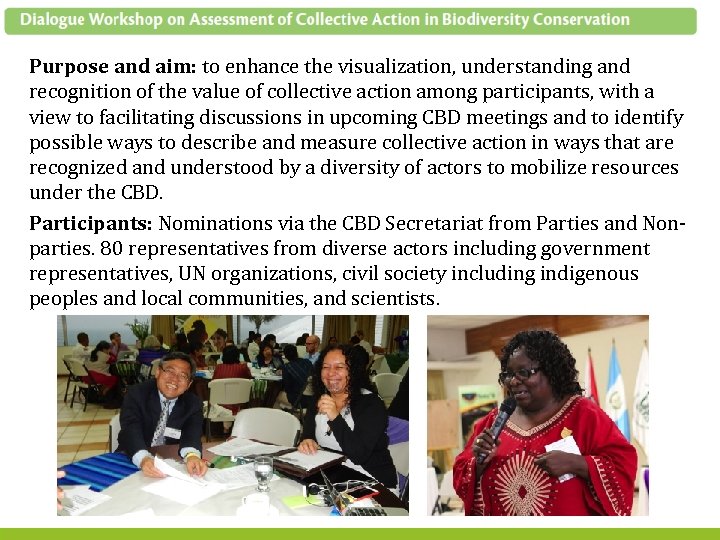 Purpose and aim: to enhance the visualization, understanding and recognition of the value of collective action among participants, with a view to facilitating discussions in upcoming CBD meetings and to identify possible ways to describe and measure collective action in ways that are recognized and understood by a diversity of actors to mobilize resources under the CBD. Participants: Nominations via the CBD Secretariat from Parties and Nonparties. 80 representatives from diverse actors including government representatives, UN organizations, civil society including indigenous peoples and local communities, and scientists.
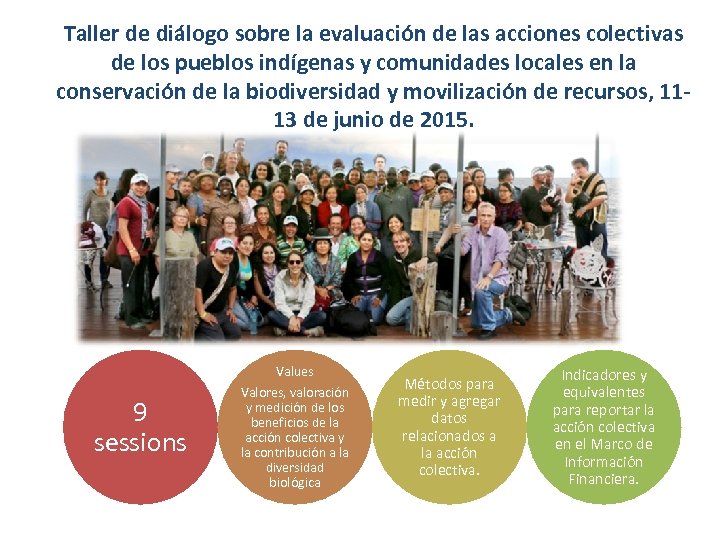 Taller de diálogo sobre la evaluación de las acciones colectivas de los pueblos indígenas y comunidades locales en la conservación de la biodiversidad y movilización de recursos, 1113 de junio de 2015. Values 9 sessions Valores, valoración y medición de los beneficios de la acción colectiva y la contribución a la diversidad biológica Métodos para medir y agregar datos relacionados a la acción colectiva. Indicadores y equivalentes para reportar la acción colectiva en el Marco de Información Financiera.
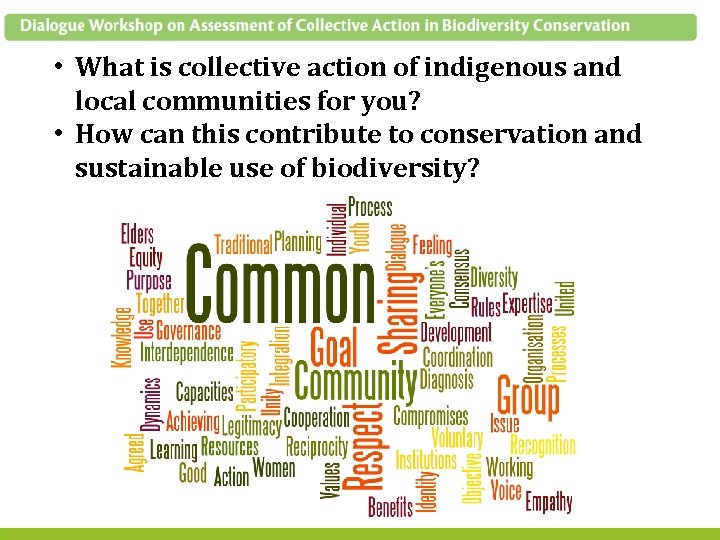 • What is collective action of indigenous and local communities for you? • How can this contribute to conservation and sustainable use of biodiversity?
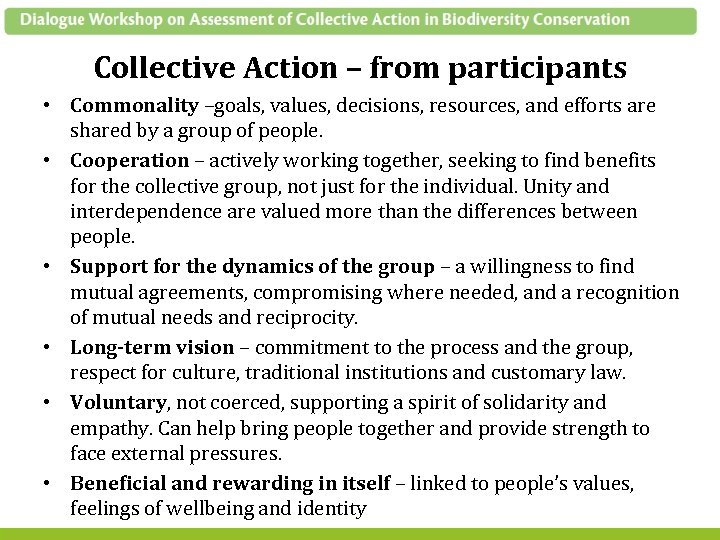 Collective Action – from participants • Commonality –goals, values, decisions, resources, and efforts are shared by a group of people. • Cooperation – actively working together, seeking to find benefits for the collective group, not just for the individual. Unity and interdependence are valued more than the differences between people. • Support for the dynamics of the group – a willingness to find mutual agreements, compromising where needed, and a recognition of mutual needs and reciprocity. • Long-term vision – commitment to the process and the group, respect for culture, traditional institutions and customary law. • Voluntary, not coerced, supporting a spirit of solidarity and empathy. Can help bring people together and provide strength to face external pressures. • Beneficial and rewarding in itself – linked to people’s values, feelings of wellbeing and identity
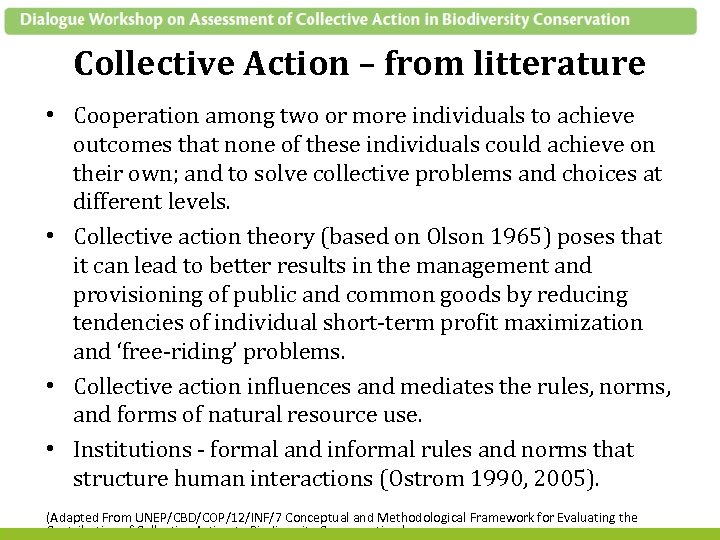 Collective Action – from litterature • Cooperation among two or more individuals to achieve outcomes that none of these individuals could achieve on their own; and to solve collective problems and choices at different levels. • Collective action theory (based on Olson 1965) poses that it can lead to better results in the management and provisioning of public and common goods by reducing tendencies of individual short-term profit maximization and ‘free-riding’ problems. • Collective action influences and mediates the rules, norms, and forms of natural resource use. • Institutions - formal and informal rules and norms that structure human interactions (Ostrom 1990, 2005). (Adapted From UNEP/CBD/COP/12/INF/7 Conceptual and Methodological Framework for Evaluating the Contribution of Collective Action to Biodiversity Conserva tion. )
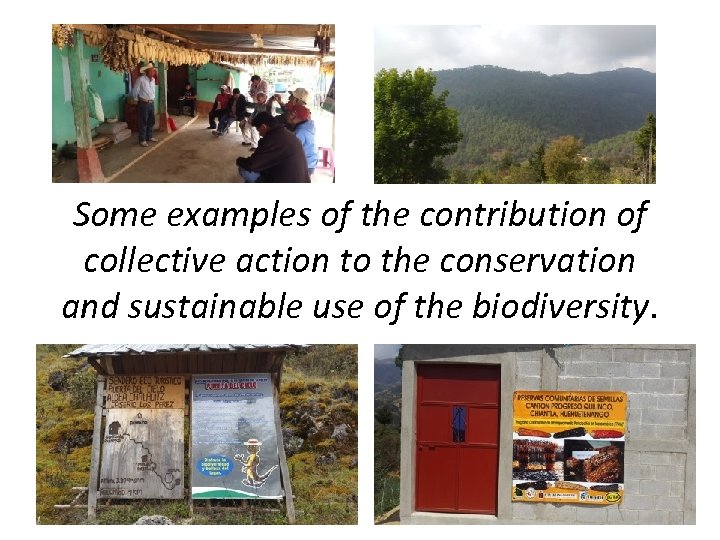 Some examples of the contribution of collective action to the conservation and sustainable use of the biodiversity.
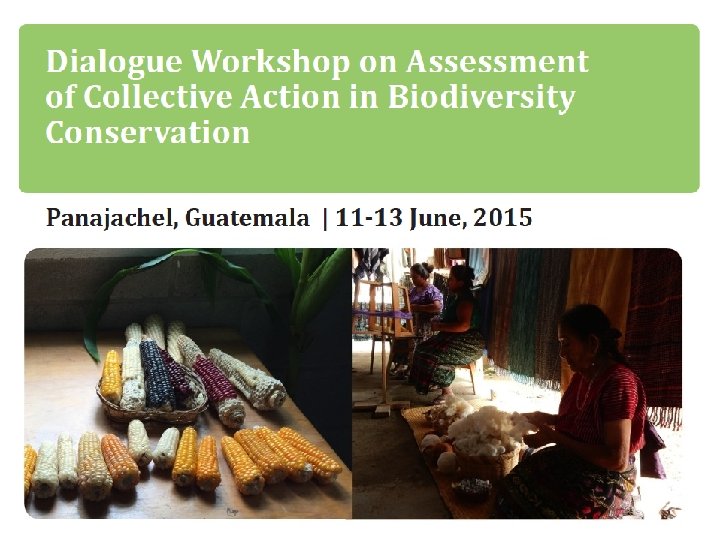
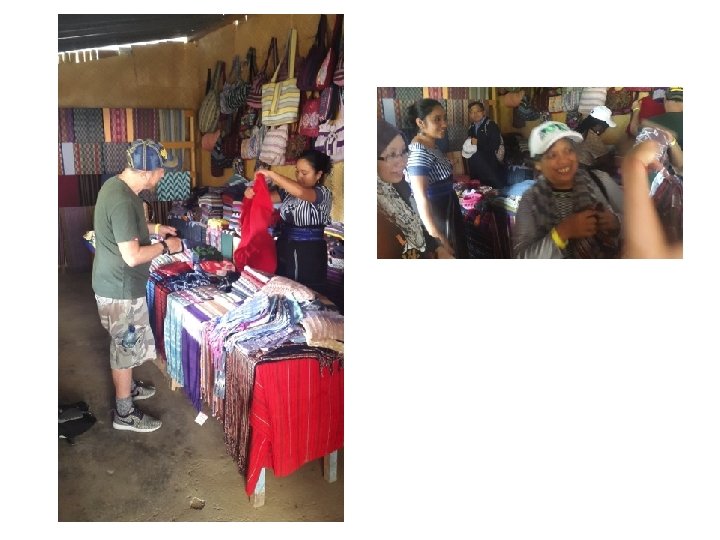
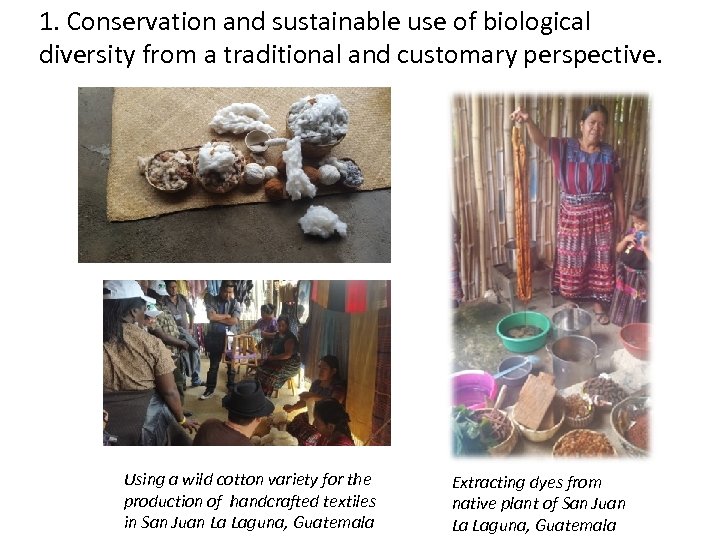 1. Conservation and sustainable use of biological diversity from a traditional and customary perspective. Using a wild cotton variety for the production of handcrafted textiles in San Juan La Laguna, Guatemala Extracting dyes from native plant of San Juan La Laguna, Guatemala
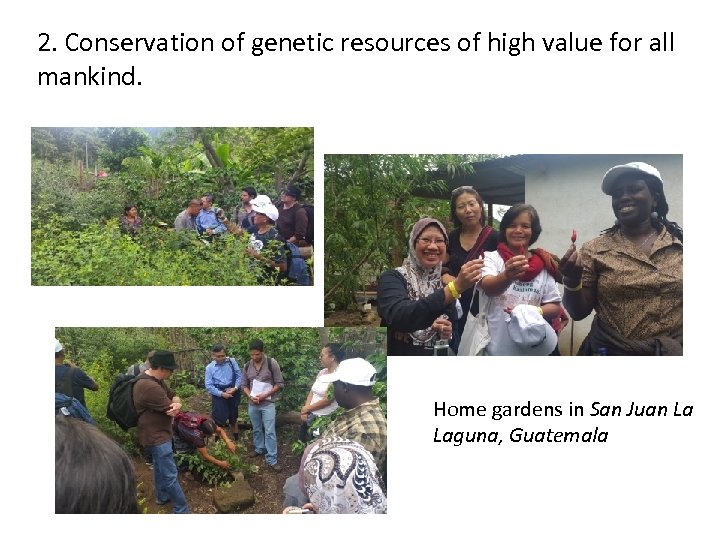 2. Conservation of genetic resources of high value for all mankind. Home gardens in San Juan La Laguna, Guatemala
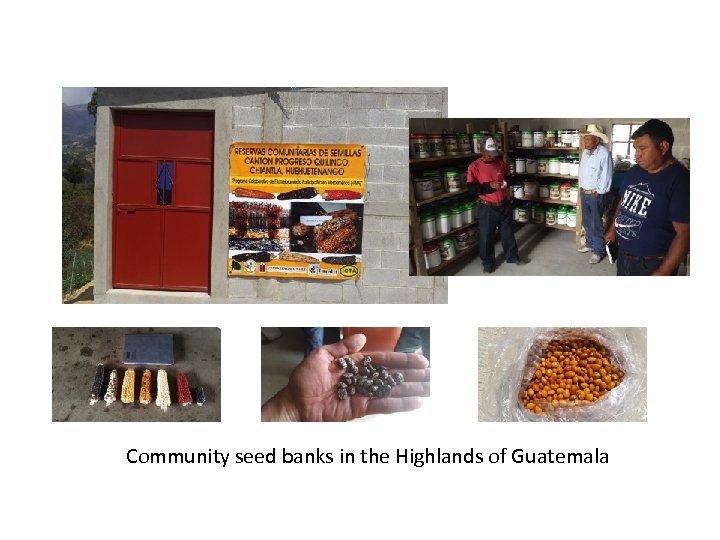 Community seed banks in the Highlands of Guatemala
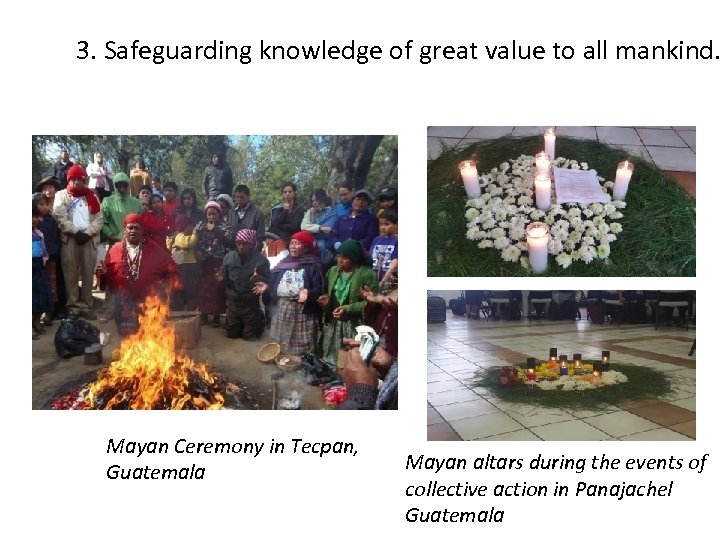 3. Safeguarding knowledge of great value to all mankind. Mayan Ceremony in Tecpan, Guatemala Mayan altars during the events of collective action in Panajachel Guatemala
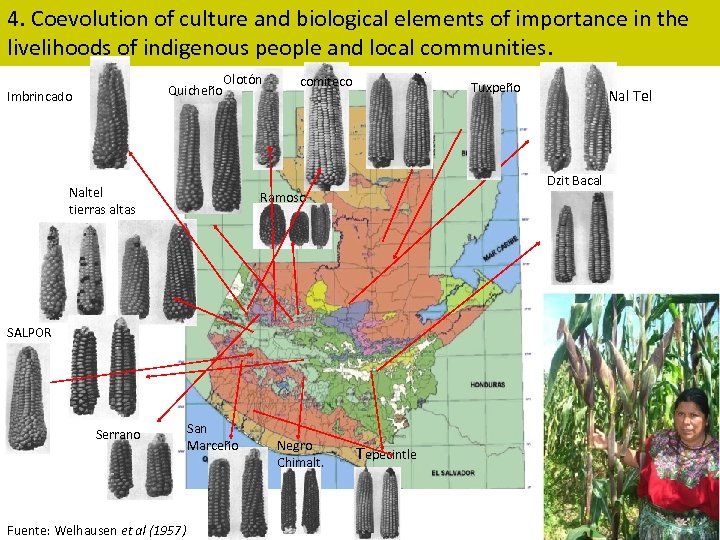 4. Coevolution of culture and biological elements of importance in the livelihoods of indigenous people and local communities. Quicheño Imbrincado Olotón Naltel tierras altas comiteco Tepecintle Ramoso Fuente: Welhausen et al (1957) San Marceño Negro Chimalt. Nal Tel Dzit Bacal SALPOR Serrano Tuxpeño Tepecintle
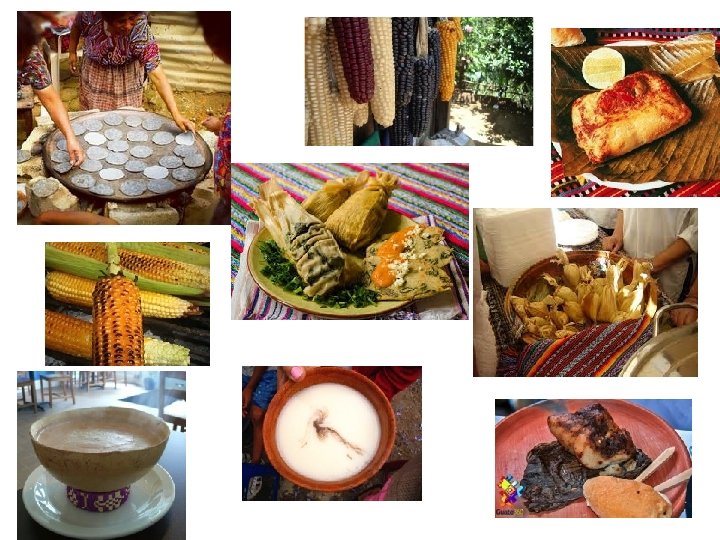
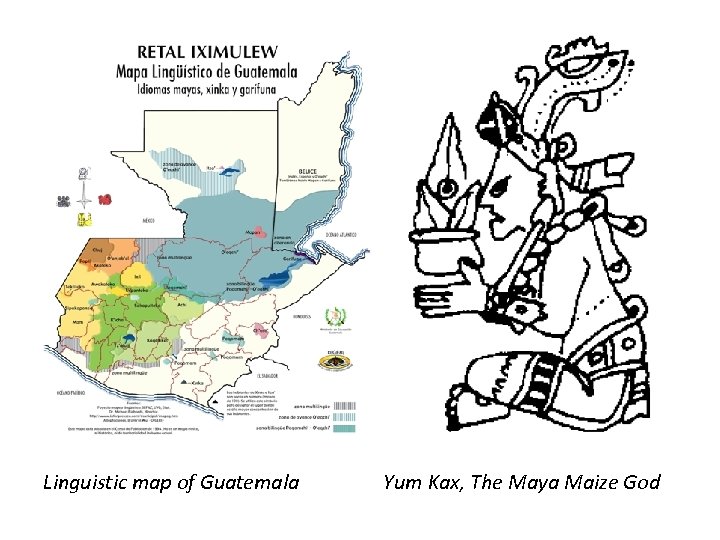 Linguistic map of Guatemala Yum Kax, The Maya Maize God
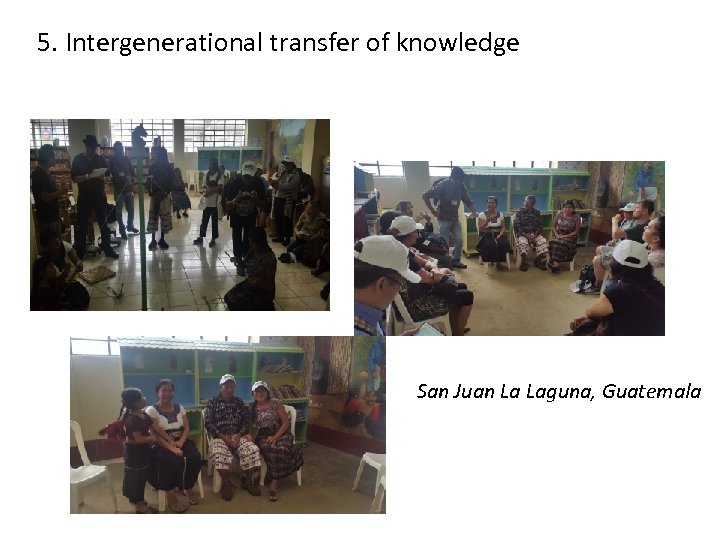 5. Intergenerational transfer of knowledge San Juan La Laguna, Guatemala
 Strategy for Resource Mobilization and Collective Action under Convention on Biological Diversity Yibin Xiang Financial Mechanisms and Resources Secretariat of the Convention on Biological Diversity
 Outline of the Presentation • Mandate on the work related to collective action • Why to consider collective action • How to reflect on collective action
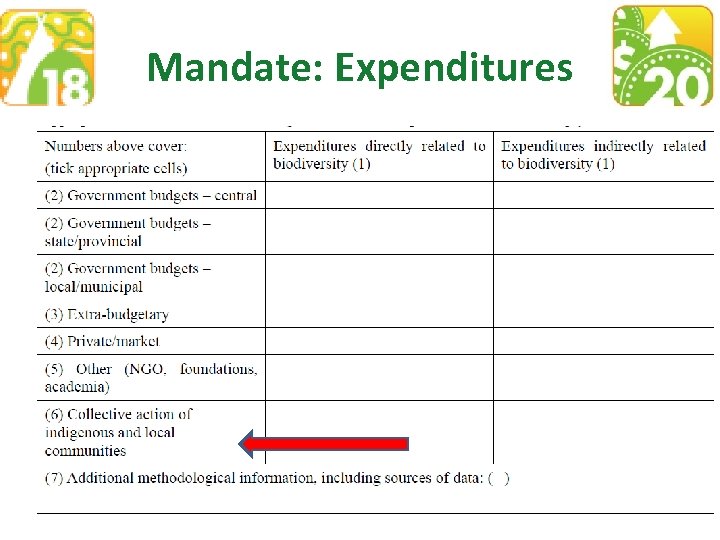 Mandate: Expenditures
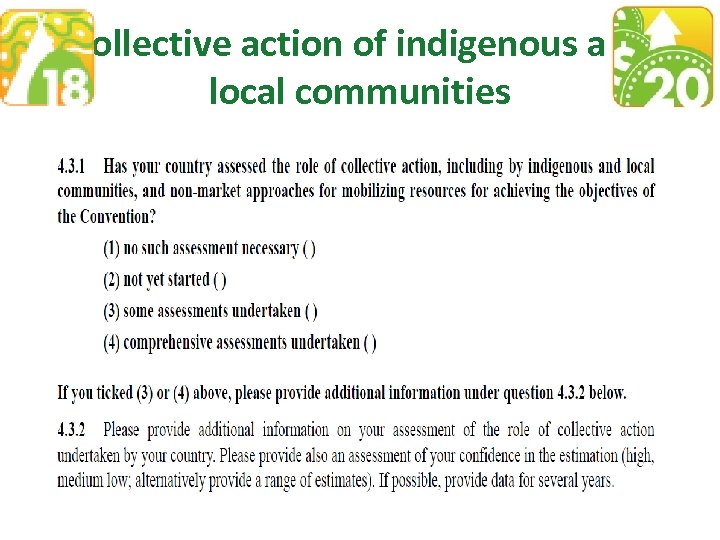 Collective action of indigenous and local communities
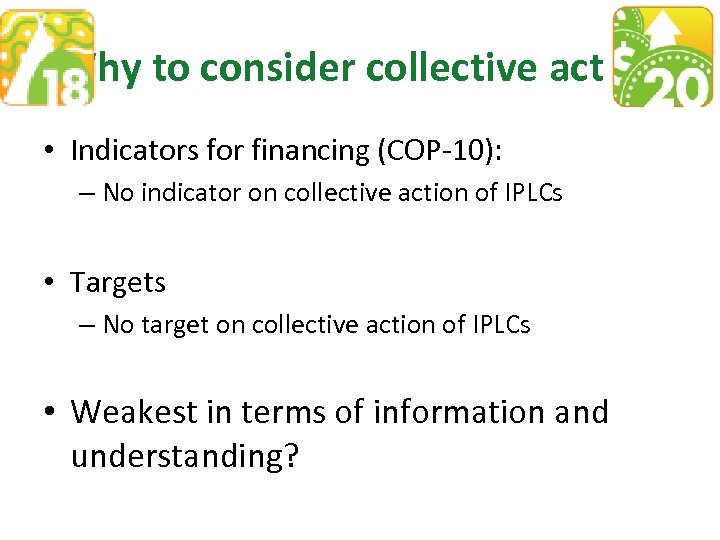 Why to consider collective action • Indicators for financing (COP 10): – No indicator on collective action of IPLCs • Targets – No target on collective action of IPLCs • Weakest in terms of information and understanding?
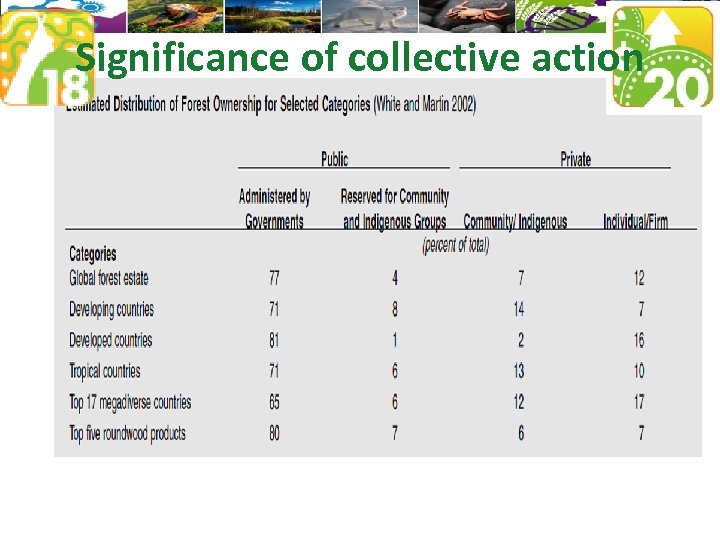 Significance of collective action
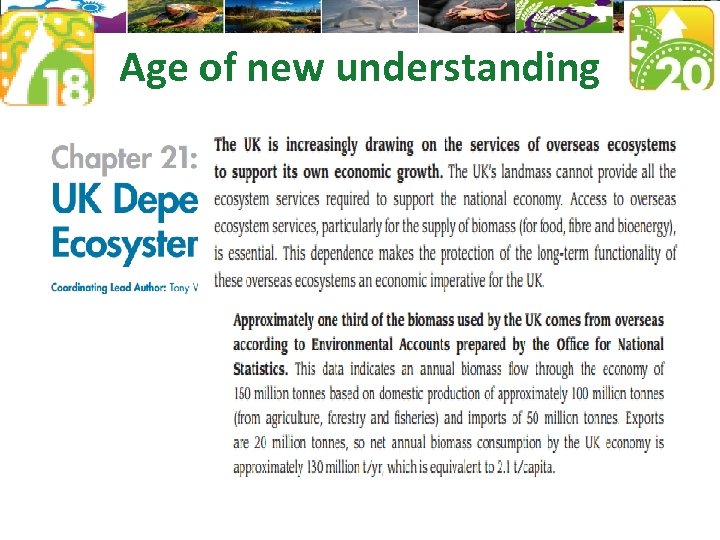 Age of new understanding Historic arguments New studies
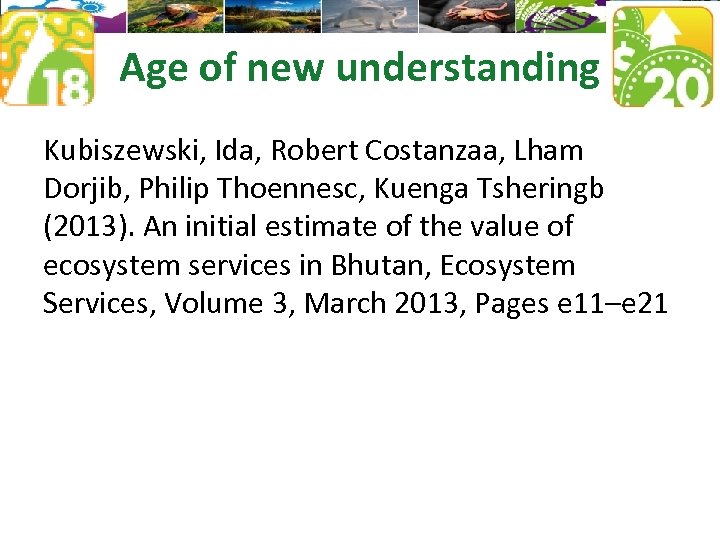 Age of new understanding Kubiszewski, Ida, Robert Costanzaa, Lham Dorjib, Philip Thoennesc, Kuenga Tsheringb (2013). An initial estimate of the value of ecosystem services in Bhutan, Ecosystem Services, Volume 3, March 2013, Pages e 11–e 21
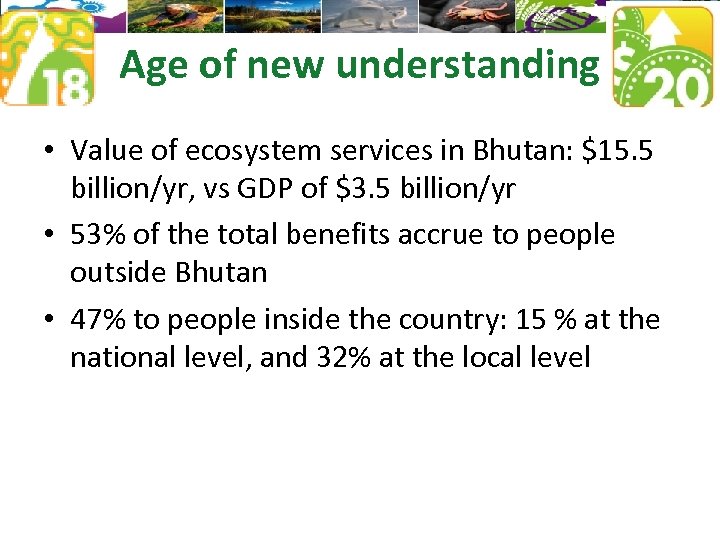 Age of new understanding • Value of ecosystem services in Bhutan: $15. 5 billion/yr, vs GDP of $3. 5 billion/yr • 53% of the total benefits accrue to people outside Bhutan • 47% to people inside the country: 15 % at the national level, and 32% at the local level
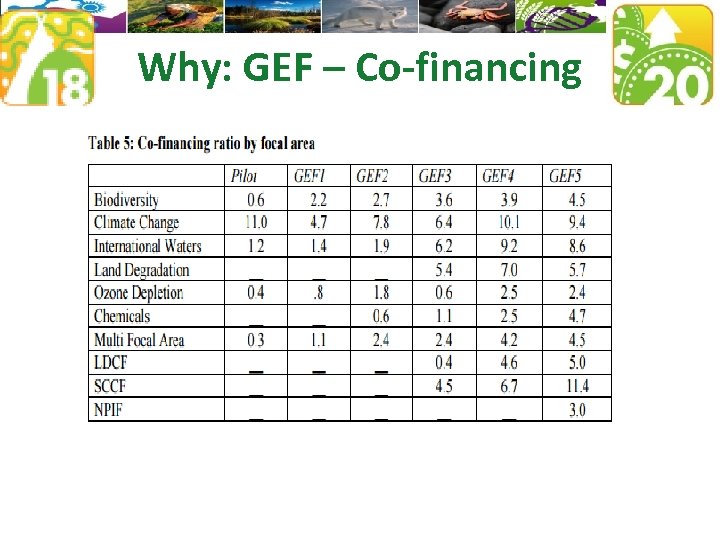 Why: GEF – Co-financing
 How to work on collective action • UNEP/CBD/COP/12/13/ADD 5/REV 1: Report on Activities on Collective Actions and Non Market Based Approaches for Resource Mobilization • “Dialogue Workshop on Assessment of Collective Action of Indigenous Peoples and Local Communities in Biodiversity Conservation and Resource Mobilization", 11 13 June 2015, in Panajachel, Guatemala
 Collective learning is a starting point
 What was discussed? Values, valuation and measurement of the benefits of collective action and its contribution to biological diversity • Multiple values need to be recognized in assessing collective action. • Can be reported in monetary terms but in most cases as nonmonetary contributions. • Many participants stressed that socio-cultural values cannot be measured adequately through monetary valuation, • Conceived within a cultural framework, constitutes perspective on values through many social roles and socialbiological relationships that are specific for each territory and knowledge system. • Traditional knowledge can provide an important contribution on an equal level to scientific knowledge in decision-making and reporting processes.
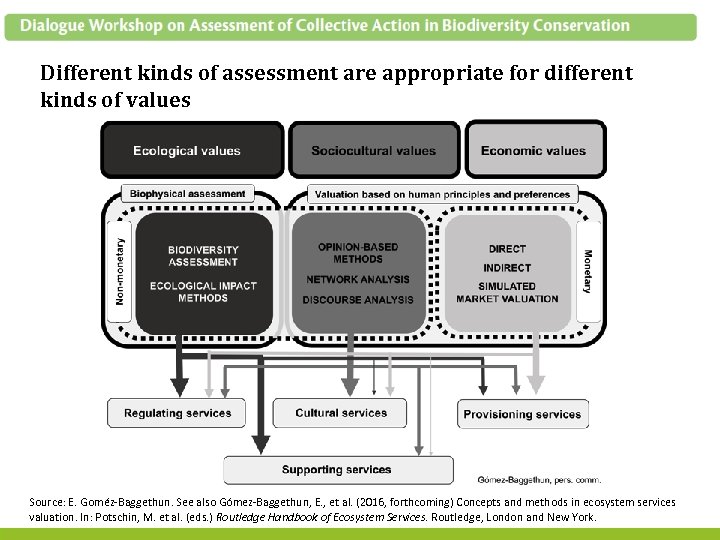 Different kinds of assessment are appropriate for different kinds of values Source: E. Goméz Baggethun. See also Gómez Baggethun, E. , et al. (2016, forthcoming) Concepts and methods in ecosystem services valuation. In: Potschin, M. et al. (eds. ) Routledge Handbook of Ecosystem Services. Routledge, London and New York.
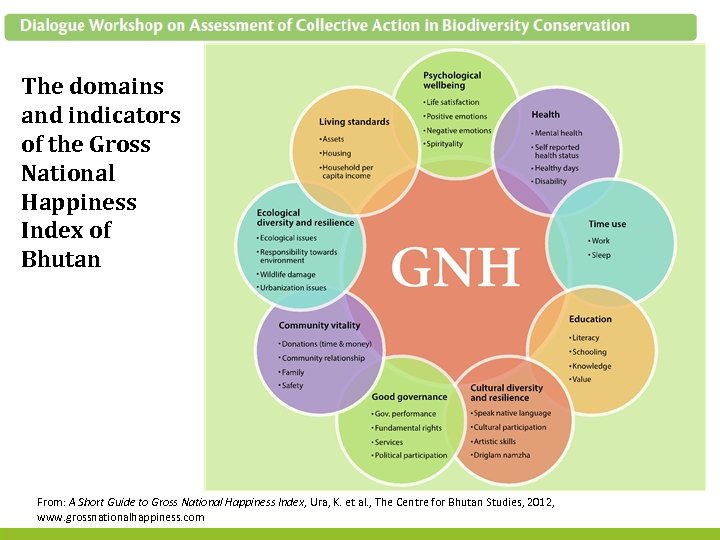 The domains and indicators of the Gross National Happiness Index of Bhutan From: A Short Guide to Gross National Happiness Index, Ura, K. et al. , The Centre for Bhutan Studies, 2012, www. grossnationalhappiness. com
 What was discussed? Methods for measuring and aggregating data related to collective action • Examples, experiences, and methods on valuation, measurement and aggregation of data • Multiple Evidence Base approach - scientific and traditional knowledge systems side by side on equal terms • Global assessment of contributions of indigenous peoples and local communities • Community Based Monitoring and Information Systems (CBMIS) • Participatory mapping and GIS, video and photo stories, biocultural, community protocols, and toolkits for environmental monitoring and assessment • Participants noted that top-down methods present particular methodological and ethical challenges, such as FPIC • Hybrid modes and integrated approaches, from local to global
 What was discussed? Indicators and equivalents for reporting collective action in the financial reporting framework • Both quantitative and qualitative measures as indicators - Quantified resource commitments – not necessarily monetised • Time and effort invested - Hours of labour in collective action; • Material resources - Land area maintained • Social cohesion, which can represent both gains and losses - Monetary measures – appropriate where there is direct quantified resource use • Revenue generating initiatives - Ecotourism, artisanal production, village medicine, cooperatives, herbal parks/botanical gardens, • Co-financing by indigenous peoples and local communities - Mostly in-kind, for activities such as reforestation, monitoring, recovery of traditional knowledge, etc. • Benefits of customary sustainable use - Food and materials from hunting, gathering, etc.
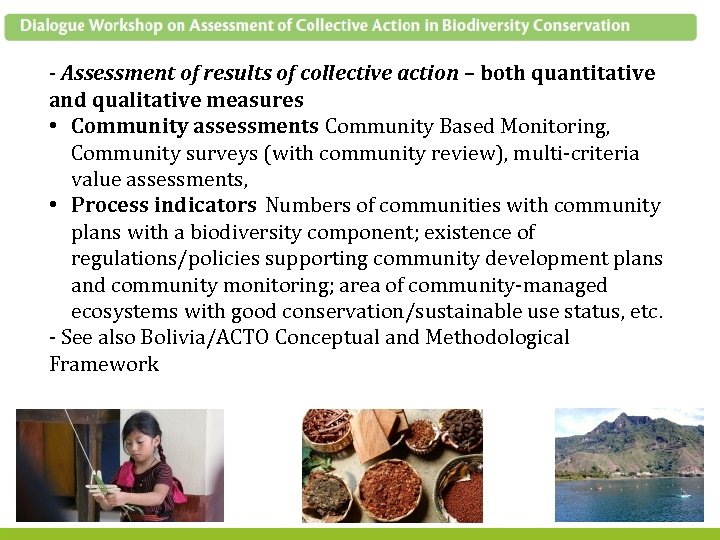 - Assessment of results of collective action – both quantitative and qualitative measures • Community assessments Community Based Monitoring, Community surveys (with community review), multi-criteria value assessments, • Process indicators Numbers of communities with community plans with a biodiversity component; existence of regulations/policies supporting community development plans and community monitoring; area of community-managed ecosystems with good conservation/sustainable use status, etc. - See also Bolivia/ACTO Conceptual and Methodological Framework
 What was discussed? Continuation – how to proceed; e. g. for COP 13 • Cross-cutting relevance for compliance all of the 20 Aichi Biodiversity Targets. • Committed engagement across scales • Inter-cultural meeting spaces required for cross scale interchange, e. g. engagement of indigenous peoples and local communities in ways that are relevant and useful for them, • More time is needed for the process of including collective action, in the resource mobilization framework, haste in this process might bring risks for inadequate monetization and misleading financial estimates • Support for IPLCs and developing countries for measuring and reporting • Suggested to establish pilot projects • Assessing collective actions may require investments, but may have many benefits, such as strengthening public policies
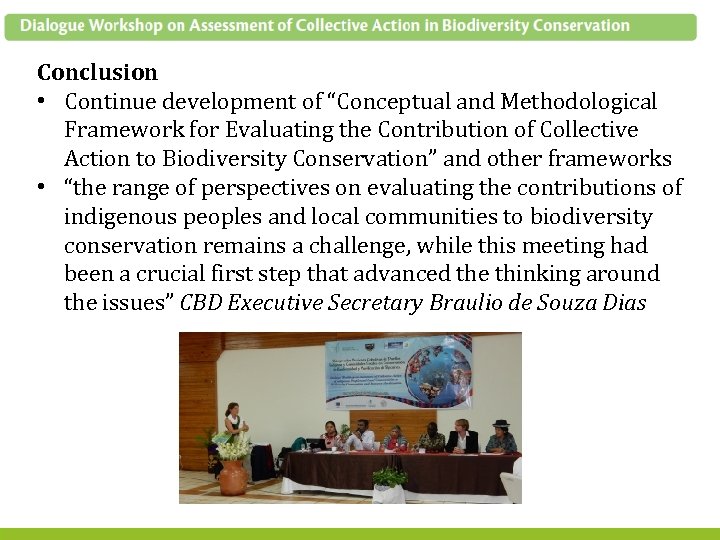 Conclusion • Continue development of “Conceptual and Methodological Framework for Evaluating the Contribution of Collective Action to Biodiversity Conservation” and other frameworks • “the range of perspectives on evaluating the contributions of indigenous peoples and local communities to biodiversity conservation remains a challenge, while this meeting had been a crucial first step that advanced the thinking around the issues” CBD Executive Secretary Braulio de Souza Dias
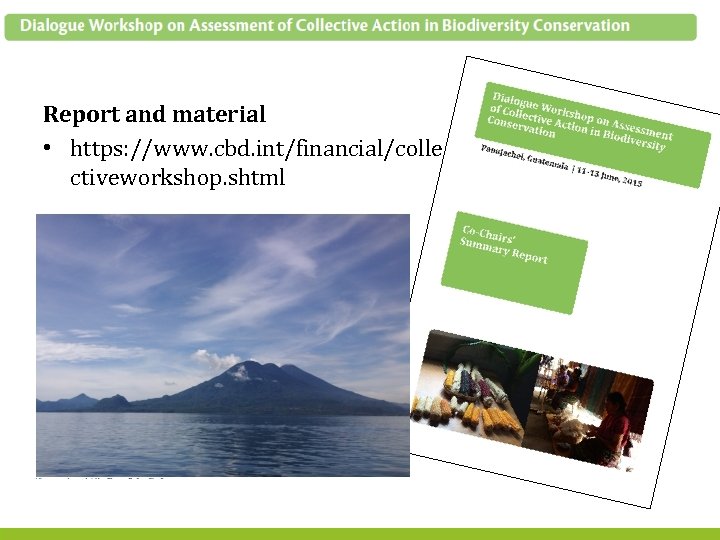 Report and material • https: //www. cbd. int/financial/colle ctiveworkshop. shtml
 ESTADO PLURINACIONAL DE BOLIVIA MINISTERIO DE RELACIONES EXTERIORES Acción Colectiva de los Pueblos Indígenas y las Comunidades Locales para la Conservación y el Uso Sostenible de la Biodiversidad
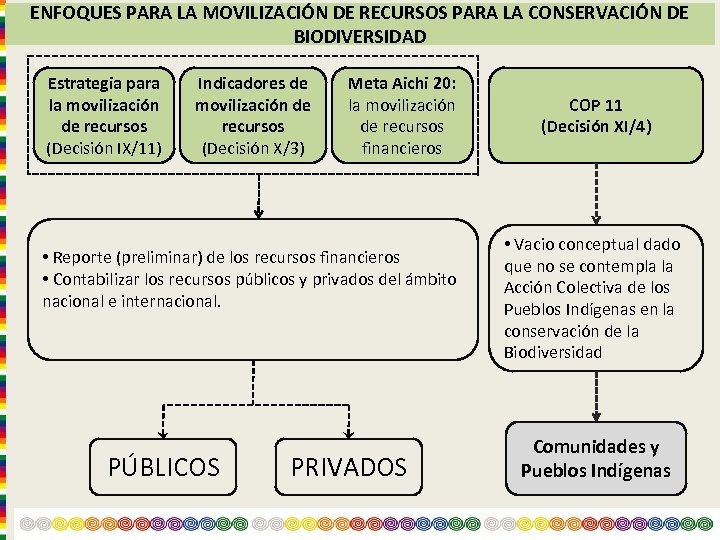 ENFOQUES PARA LA MOVILIZACIÓN DE RECURSOS PARA LA CONSERVACIÓN DE BIODIVERSIDAD Estrategia para la movilización de recursos (Decisión IX/11) Indicadores de movilización de recursos (Decisión X/3) Meta Aichi 20: la movilización de recursos financieros • Reporte (preliminar) de los recursos financieros • Contabilizar los recursos públicos y privados del ámbito nacional e internacional. PÚBLICOS PRIVADOS COP 11 (Decisión XI/4) • Vacio conceptual dado que no se contempla la Acción Colectiva de los Pueblos Indígenas en la conservación de la Biodiversidad Comunidades y Pueblos Indígenas
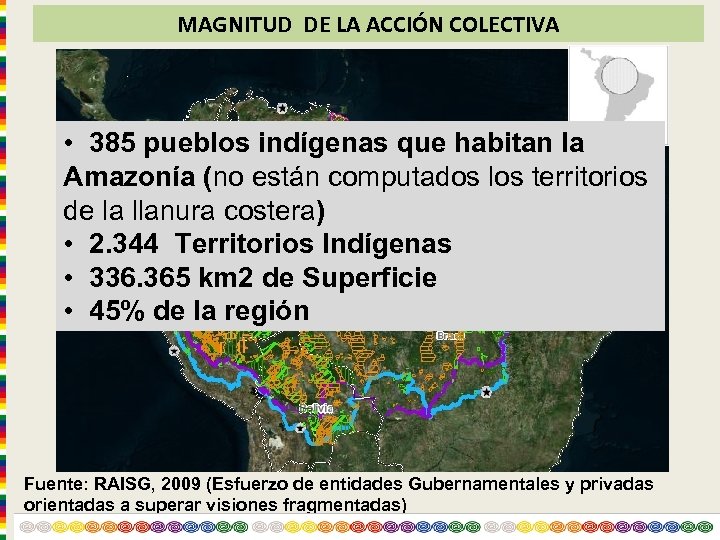 MAGNITUD DE LA ACCIÓN COLECTIVA • 385 pueblos indígenas que habitan la Amazonía (no están computados los territorios de la llanura costera) • 2. 344 Territorios Indígenas • 336. 365 km 2 de Superficie • 45% de la región Fuente: RAISG, 2009 (Esfuerzo de entidades Gubernamentales y privadas orientadas a superar visiones fragmentadas)
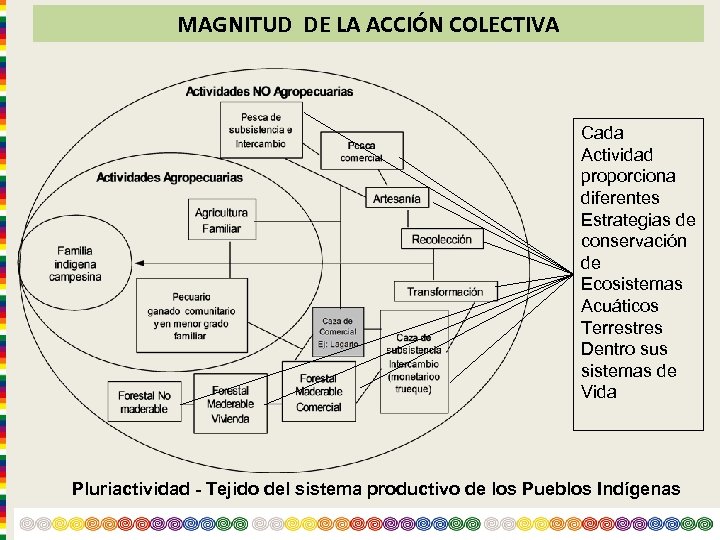 MAGNITUD DE LA ACCIÓN COLECTIVA Cada Actividad proporciona diferentes Estrategias de conservación de Ecosistemas Acuáticos Terrestres Dentro sus sistemas de Vida Pluriactividad - Tejido del sistema productivo de los Pueblos Indígenas
 MARCO CONCEPTUAL PROPUESTO PARA EVALUAR EL ROL DE LAS ACCIONES COLECTIVAS DE LOS PUEBLOS INDÍGENAS EN LA CONSERVACIÓN DE LA BIODIVERSIDAD
 Qué sabemos? Las comunidades locales y Pueblos Indígenas – Frecuentemente son vista como “el problema” en ves de considerarlas parte de la solución (Andersson, 2002; Gibson et al 2000; Agrawal 2005). – Pueden manejar sus recursos de manera sustentable (Ostrom, 1990; Balland Platteau, 1994; Agrawal, 2000; Acheson, 1994) – A menudo obtienen mejores resultados que los gobiernos nacionales (Somanthan et al, 2009; Hayes and Ostrom, 2005; Phelps et al 2010; Porter Bolland 2012)
 Premisa Ecosistemas puede ser protegido por: • Protección oficial – designación de un área • Zonas Geográficamente remotas, inaccesibles • Acciones Colectivas por pueblos indígenas
 Propuesta • Usar información SIG para identificar las áreas protegidas por las comunidades y pueblos indígenas • Generar una modelación: “Anomalías” del Paisaje (Andam et al 2008; Ferraro et al 2009; Pfaff et al 2008) • Estimar indicadores: – Área protegidas por los Pueblos Indígenas y Comunidades Locales COMO?
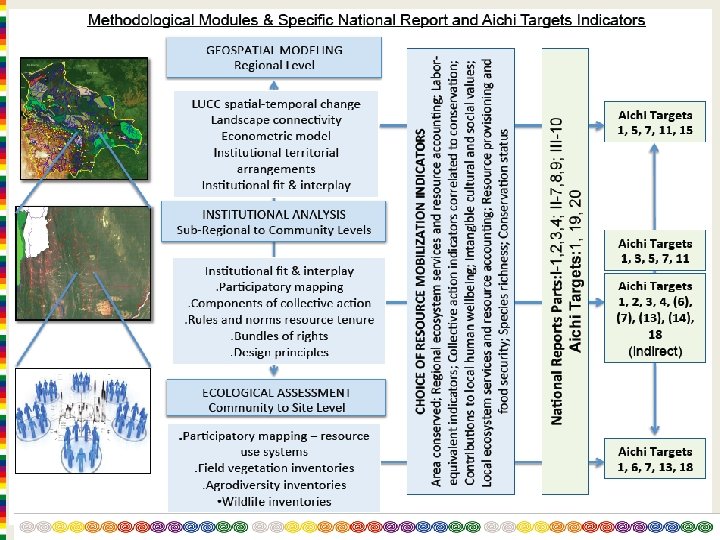
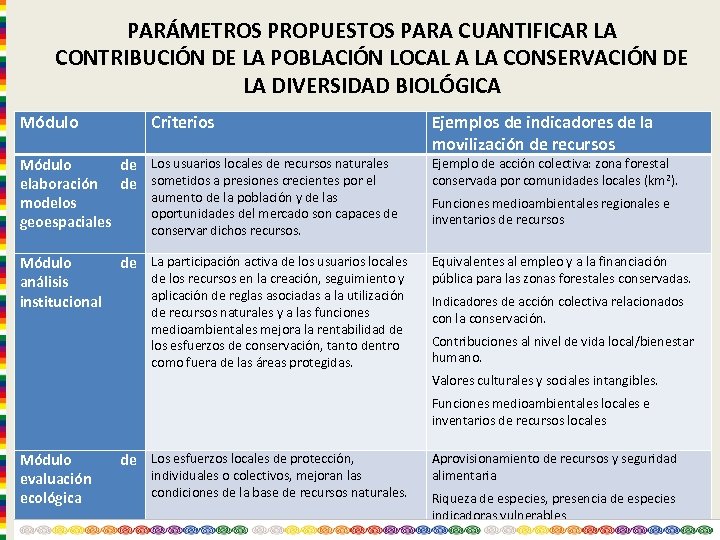 PARÁMETROS PROPUESTOS PARA CUANTIFICAR LA CONTRIBUCIÓN DE LA POBLACIÓN LOCAL A LA CONSERVACIÓN DE LA DIVERSIDAD BIOLÓGICA Módulo Criterios Módulo de Los usuarios locales de recursos naturales elaboración de sometidos a presiones crecientes por el aumento de la población y de las modelos oportunidades del mercado son capaces de geoespaciales conservar dichos recursos. Módulo análisis institucional de La participación activa de los usuarios locales de los recursos en la creación, seguimiento y aplicación de reglas asociadas a la utilización de recursos naturales y a las funciones medioambientales mejora la rentabilidad de los esfuerzos de conservación, tanto dentro como fuera de las áreas protegidas. Ejemplos de indicadores de la movilización de recursos Ejemplo de acción colectiva: zona forestal conservada por comunidades locales (km 2). Funciones medioambientales regionales e inventarios de recursos Equivalentes al empleo y a la financiación pública para las zonas forestales conservadas. Indicadores de acción colectiva relacionados con la conservación. Contribuciones al nivel de vida local/bienestar humano. Valores culturales y sociales intangibles. Funciones medioambientales locales e inventarios de recursos locales Módulo evaluación ecológica de Los esfuerzos locales de protección, individuales o colectivos, mejoran las condiciones de la base de recursos naturales. Aprovisionamiento de recursos y seguridad alimentaria Riqueza de especies, presencia de especies indicadoras vulnerables
 CONDICIONES Y APLICACIÓN DE LA METODOLOGIA Y MARCO CONCEPTUAL PROPUESTO
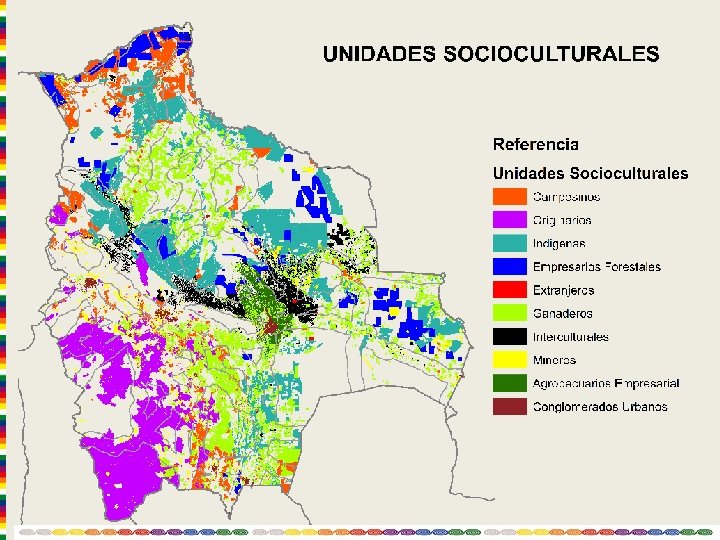
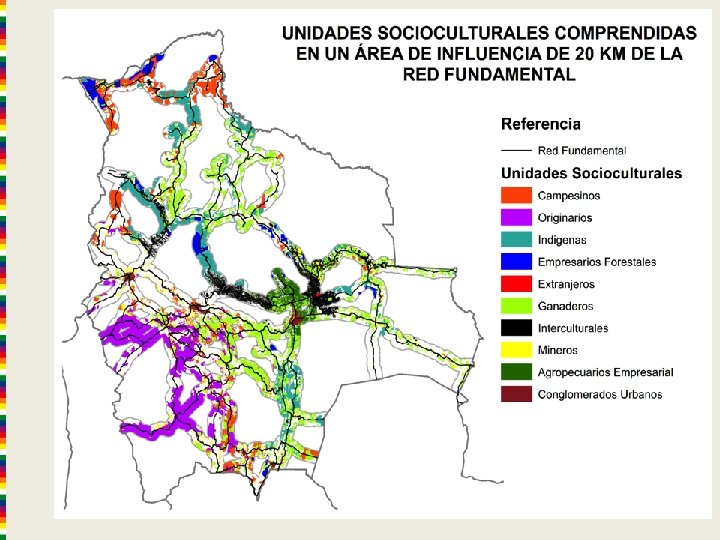
 1) LUCHA POR LA TIERRA EL TERRITORIO DE LOS PUEBLOS INDIGENAS PARA EFECTIVIZAR EL ROL DE LAS ACCIONES COLECTIVAS COMO BASE CLAVE DE LA PROTECCIÓN DE LA BIODIVERSIDAD • La estructura de la tenencia de la tierra – Eje determinante para la gobernanza de las zonas de vida, la biodiversidad y la gobernanza de los bosques. • La reconfiguración de la tenencia de la tierra – la conquista de los Pueblos Indígenas, Originario Campesinos, Interculturales y Afrodescendientes de Bolivia
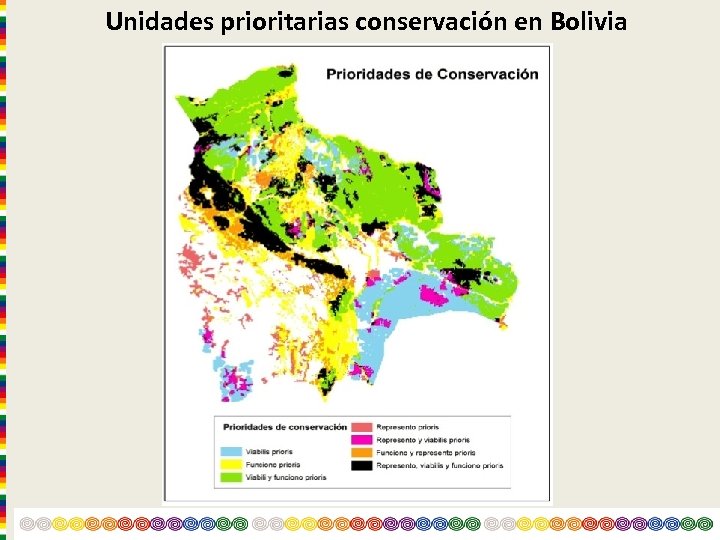 Unidades prioritarias conservación en Bolivia
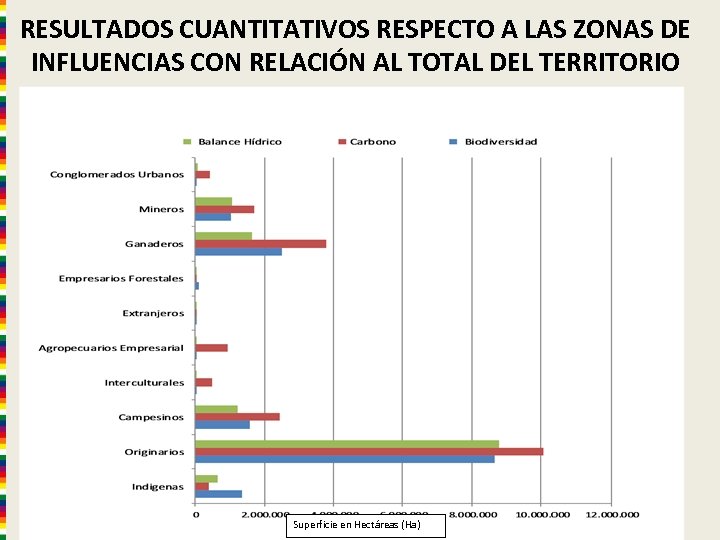 RESULTADOS CUANTITATIVOS RESPECTO A LAS ZONAS DE INFLUENCIAS CON RELACIÓN AL TOTAL DEL TERRITORIO Superficie en Hectáreas (Ha)
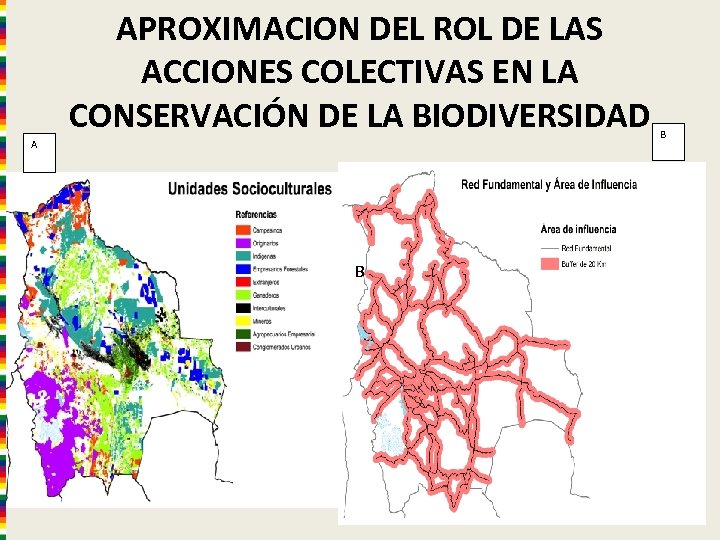 APROXIMACION DEL ROL DE LAS ACCIONES COLECTIVAS EN LA CONSERVACIÓN DE LA BIODIVERSIDAD B A B
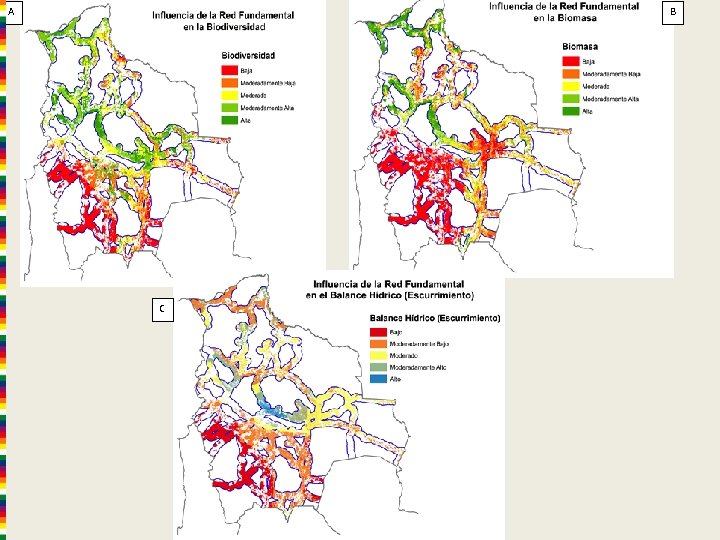 A B C
A B C
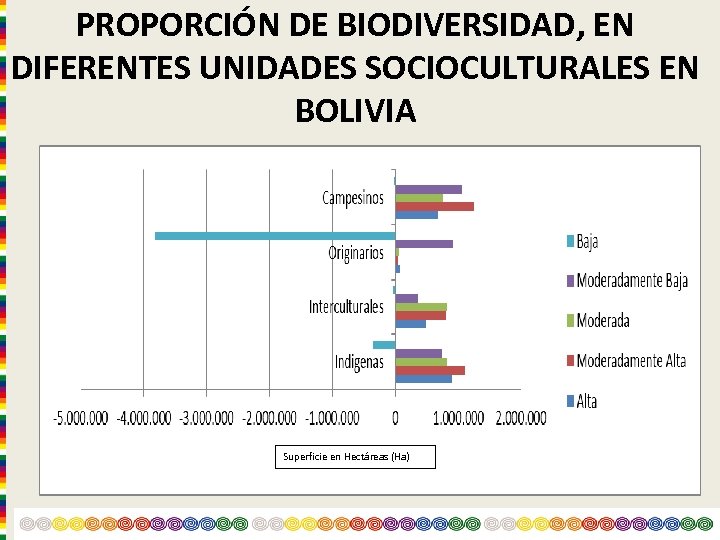 PROPORCIÓN DE BIODIVERSIDAD, EN DIFERENTES UNIDADES SOCIOCULTURALES EN BOLIVIA Superficie en Hectáreas (Ha)
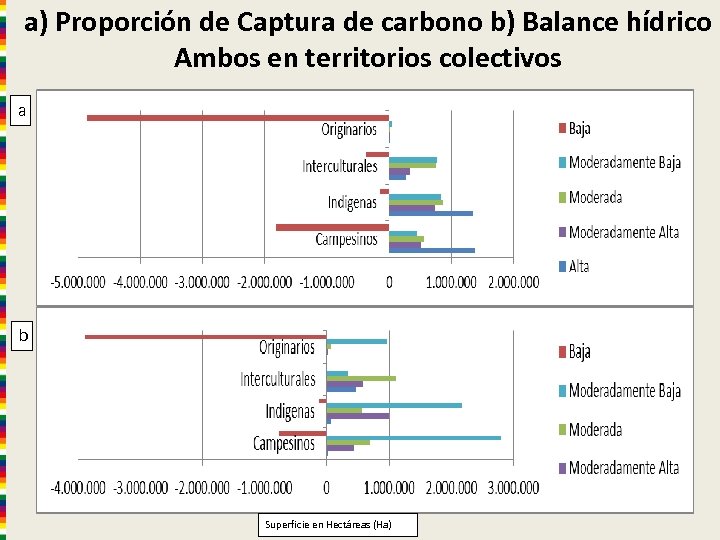 a) Proporción de Captura de carbono b) Balance hídrico Ambos en territorios colectivos a b Superficie en Hectáreas (Ha)
 Muchas Gracias…….
 Collective Action by Indigenous peoples and local communities Reporting and Indicators under Aichi Targets including the financial reporting framework SBSTTA 19 Montreal 2 November 2015 Methods for monitoring collective action, and the Multiple Evidence Base Approach (MEB) Pernilla Malmer Swed. Bio at Stockholm Resilience Centre
 Aggregation of data about collective action across scales • • Why ? Who? What methods? Risks and opportunities? How can positive impact from Customary sustainable use be aggregated across scales in ways that are legitimate credible and useful for IPLCs and policy alike? 63
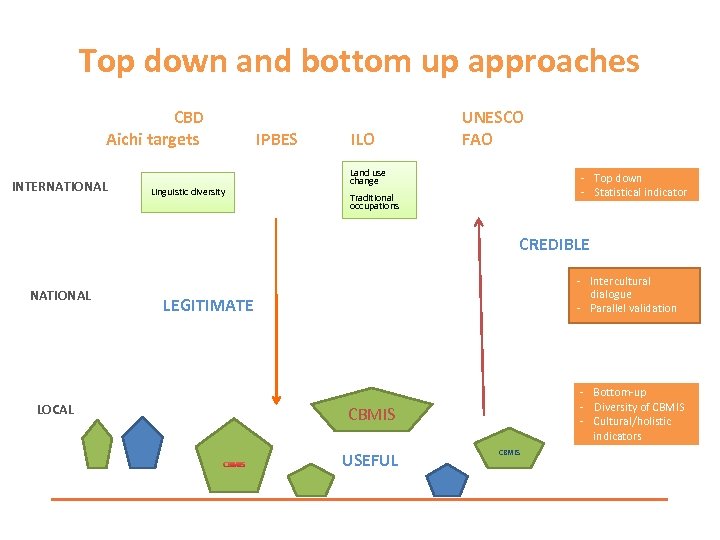 Top down and bottom up approaches CBD Aichi targets IPBES ILO INTERNATIONAL Linguistic diversity UNESCO FAO Land use change Top down Statistical indicator Traditional occupations CREDIBLE NATIONAL Intercultural dialogue Parallel validation LEGITIMATE LOCAL Bottom up Diversity of CBMIS Cultural/holistic indicators CBMIS USEFUL CBMIS
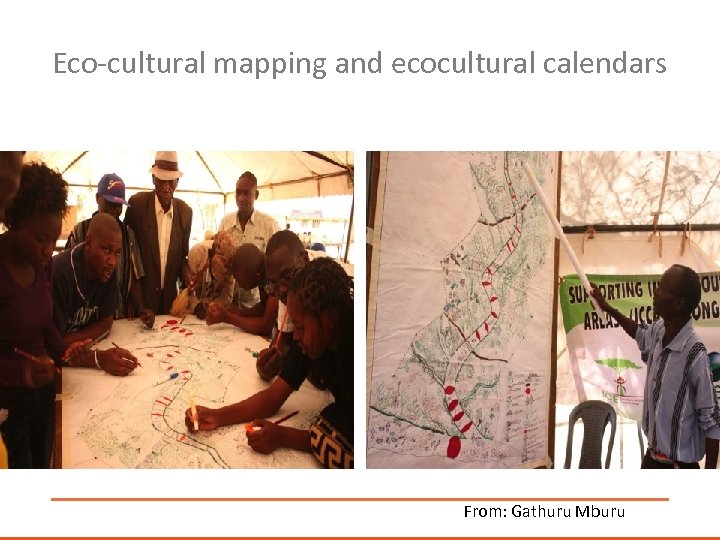 Eco cultural mapping and ecocultural calendars From: Gathuru Mburu
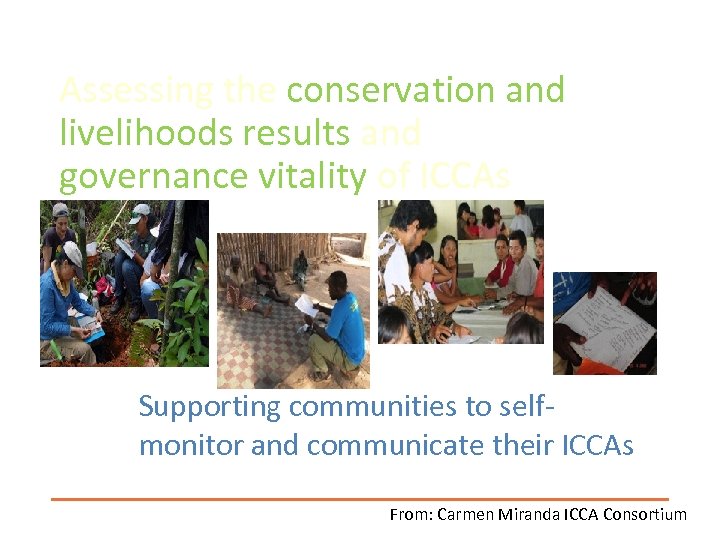 Assessing the conservation and livelihoods results and governance vitality of ICCAs Supporting communities to self monitor and communicate their ICCAs From: Carmen Miranda ICCA Consortium
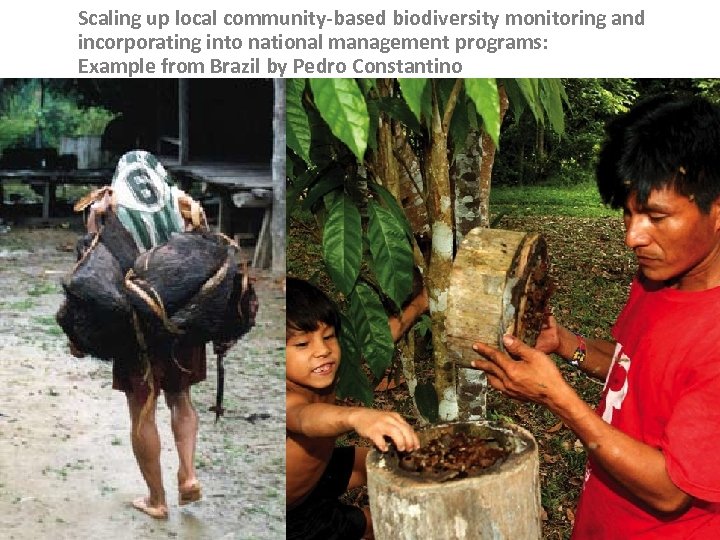 Scaling up local community-based biodiversity monitoring and incorporating into national management programs: Example from Brazil by Pedro Constantino
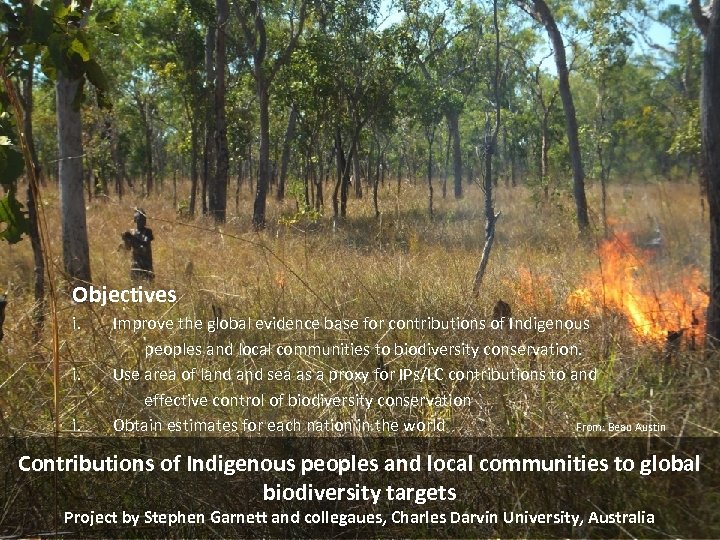 Objectives i. i. i. Improve the global evidence base for contributions of Indigenous peoples and local communities to biodiversity conservation. Use area of land sea as a proxy for IPs/LC contributions to and effective control of biodiversity conservation Obtain estimates for each nation in the world From: Beau Austin Contributions of Indigenous peoples and local communities to global biodiversity targets Project by Stephen Garnett and collegaues, Charles Darvin University, Australia
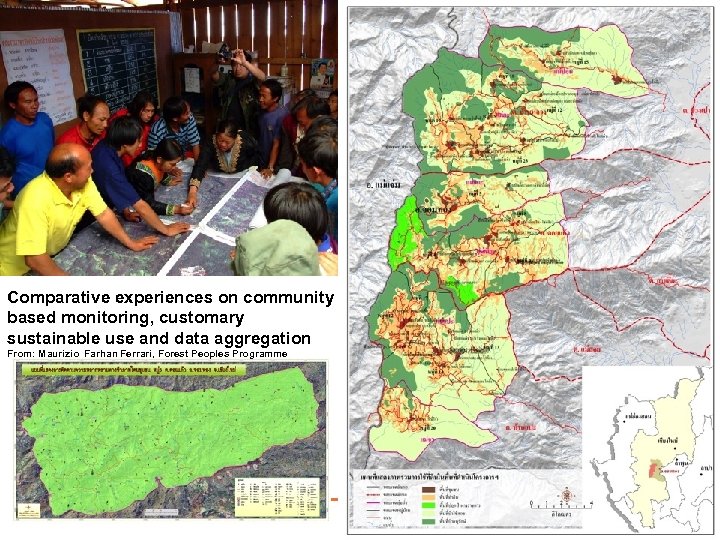 Comparative experiences on community based monitoring, customary sustainable use and data aggregation From: Maurizio Farhan Ferrari, Forest Peoples Programme
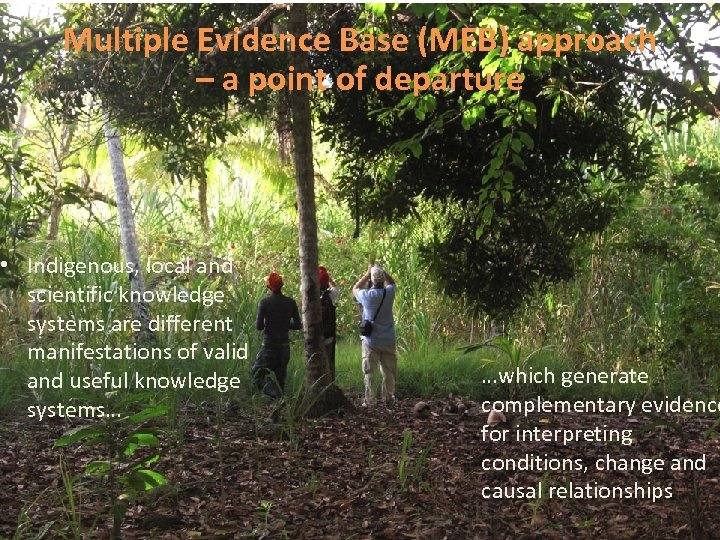 Multiple Evidence Base (MEB) approach – a point of departure • Indigenous, local and scientific knowledge systems are different manifestations of valid and useful knowledge systems… …which generate complementary evidence for interpreting conditions, change and causal relationships
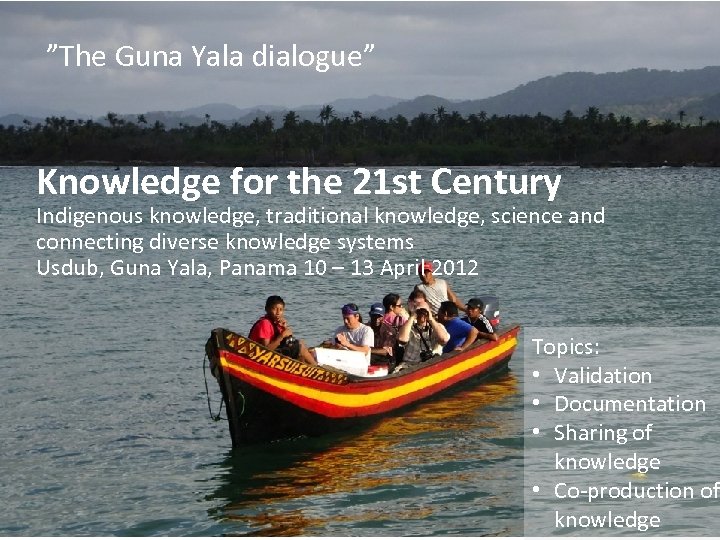 ”The Guna Yala dialogue” Knowledge for the 21 st Century Indigenous knowledge, traditional knowledge, science and connecting diverse knowledge systems Usdub, Guna Yala, Panama 10 – 13 April 2012 Topics: • Validation • Documentation • Sharing of knowledge • Co production of knowledge
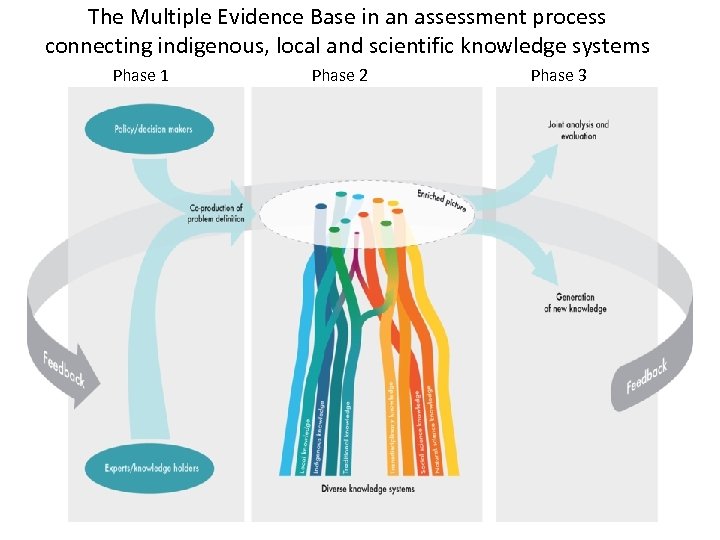 The Multiple Evidence Base in an assessment process connecting indigenous, local and scientific knowledge systems Phase 1 Phase 2 Phase 3
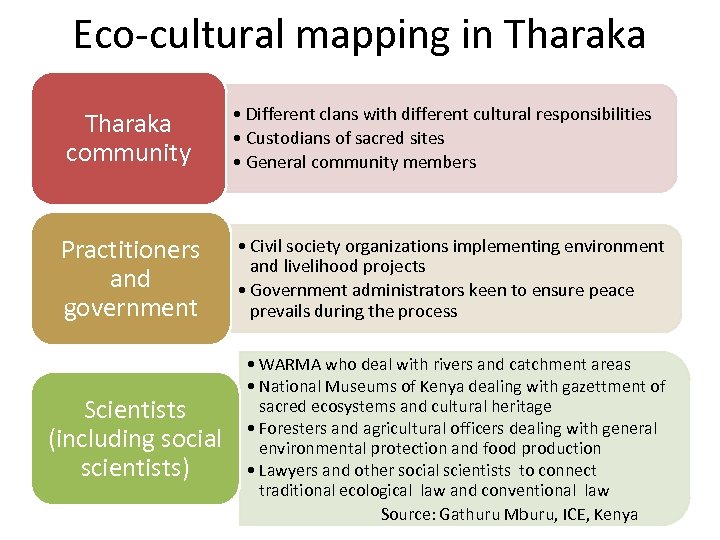 Eco cultural mapping in Tharaka community • Different clans with different cultural responsibilities • Custodians of sacred sites • General community members Practitioners and government • Civil society organizations implementing environment and livelihood projects • Government administrators keen to ensure peace prevails during the process Scientists (including social scientists) • WARMA who deal with rivers and catchment areas • National Museums of Kenya dealing with gazettment of sacred ecosystems and cultural heritage • Foresters and agricultural officers dealing with general environmental protection and food production • Lawyers and other social scientists to connect traditional ecological law and conventional law Source: Gathuru Mburu, ICE, Kenya
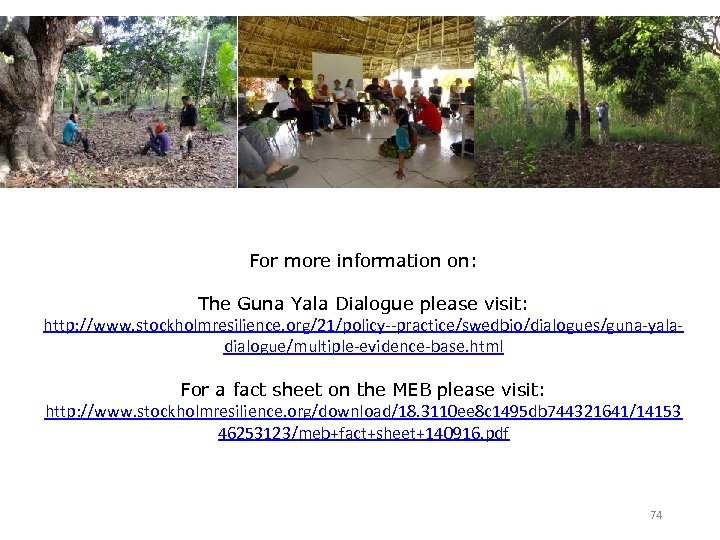 For more information on: The Guna Yala Dialogue please visit: http: //www. stockholmresilience. org/21/policy practice/swedbio/dialogues/guna yala dialogue/multiple evidence base. html For a fact sheet on the MEB please visit: http: //www. stockholmresilience. org/download/18. 3110 ee 8 c 1495 db 744321641/14153 46253123/meb+fact+sheet+140916. pdf 74
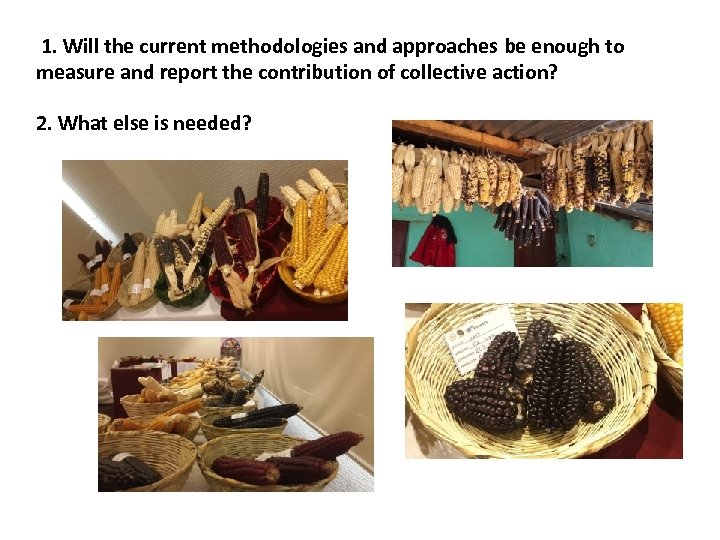 1. Will the current methodologies and approaches be enough to measure and report the contribution of collective action? 2. What else is needed?