 Скачать презентацию Controls Global System Review John Carwardine ANL For
d6b7e5afd1a56fd44694c4274ab6c0e4.ppt
- Количество слайдов: 24



Controls Global System Review John Carwardine, ANL (For Controls Global Group Team) Vancouver GDE Meeting, July 2006 Global Design Effort: Control System 1
Outline • • • Scope of controls costing exercise. Status of design. Assumptions. Bases of estimates. Manpower and M&S pie-chart breakdowns. Plans. Vancouver GDE Meeting, July 2006 Global Design Effort: Control System 2
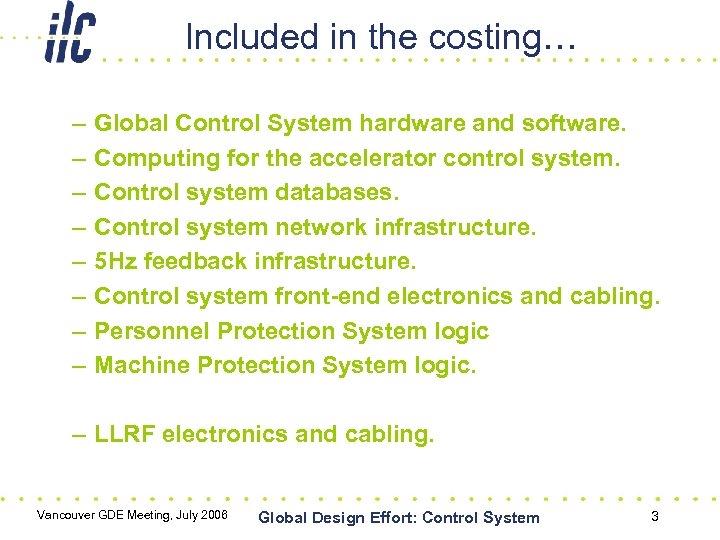
Included in the costing… – – – – Global Control System hardware and software. Computing for the accelerator control system. Control system databases. Control system network infrastructure. 5 Hz feedback infrastructure. Control system front-end electronics and cabling. Personnel Protection System logic Machine Protection System logic. – LLRF electronics and cabling. Vancouver GDE Meeting, July 2006 Global Design Effort: Control System 3
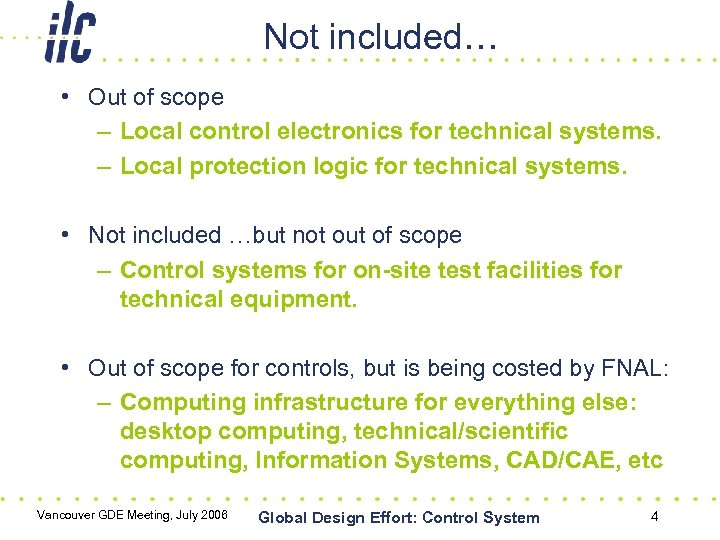
Not included… • Out of scope – Local control electronics for technical systems. – Local protection logic for technical systems. • Not included …but not out of scope – Control systems for on-site test facilities for technical equipment. • Out of scope for controls, but is being costed by FNAL: – Computing infrastructure for everything else: desktop computing, technical/scientific computing, Information Systems, CAD/CAE, etc Vancouver GDE Meeting, July 2006 Global Design Effort: Control System 4
Design & costing status: controls • Conceptual design done for all sub-systems but MPS. • Simplified costing model developed for front-end electronics. • Initial device counts are known for all area systems. • Area System costing details and roll-ups are complete. • Global control system costing details and roll-ups are complete. Vancouver GDE Meeting, July 2006 Global Design Effort: Control System 5
Design & costing status: LLRF • LLRF for Main Linac and RTML are well understood. • Crab Cavities and Damping Ring LLRF are less well defined but are a small percentage of the total system. • Key components exist as prototypes at DESY and FNAL – Designs will progress for test stands in all regions and will be upgraded as technology improves. • RF phase reference specs are beyond state of the art – Design concepts in the costing model have been tested, but performance is not demonstrated – Will require simple harmonic relationships between 1. 3 GHz and other generated frequencies. Vancouver GDE Meeting, July 2006 Global Design Effort: Control System 6
Assumptions: standardization • A standard LLRF building block is assumed across all machine areas and HLRF technologies. • A high level of standardization is assumed for the technical system interfaces to the control system – Not just defined as “Ethernet”, but also specify protocols, equipment behavior, functionality, etc • Standardization is necessary to… – Reduce controls manpower. – Have consistent look/feel for similar equipment. – Ensure that equipment can be fully integrated. Vancouver GDE Meeting, July 2006 Global Design Effort: Control System 7
Assumptions: High Availability • HA is inherent in the control system baseline. • Impact on overall controls methodology (QA): – More formalism in the design process. – Greater emphasis on standards, standardization, testing, and configuration control. • Impact on design choices – HA compliant front-end platform (ATCA). – Additional functionality to support automated diagnosis and recovery from failures. – HA for computing & networking infrastructure. Vancouver GDE Meeting, July 2006 Global Design Effort: Control System 8
Assumptions: manufacturing • Individual components manufactured off site, either to specification, COTS, or “built to print. ” • Where possible, equipment assembly, integration, testing will be done on site and on the surface – Deliver fully assembled and pre-tested electronics relay racks to Installations Group. – Deliver pre-terminated, pre-tested cables. Vancouver GDE Meeting, July 2006 Global Design Effort: Control System 9
Basis of estimates: controls • Global Integrated Control System – Conceptual design uses a 3 -tier architecture. – Assume control system will be founded on an existing well-established software framework. • Front-end electronics – High level interfaces assumed in most cases (“Ethernet”) rather than discrete I/O. – Costing model uses ATCA, redundant processors. – Bottom-up estimates from AS device counts. Vancouver GDE Meeting, July 2006 Global Design Effort: Control System 10
Bases of estimates: LLRF • LLRF – Cost estimates are extrapolations of current systems at DESY, KEK, SNS, and FNAL. – Consolidated estimates from all three regions. • RF Phase reference distribution – Global (fiber): costing of conceptual design component parts. – Local (copper): extrapolated from SNS design. – Assumes simple harmonic relationships between 1. 3 GHz and all other frequencies. Vancouver GDE Meeting, July 2006 Global Design Effort: Control System 11
Basis of estimates: computing • Computing and network infrastructure – Costing model derived from assumptions about data rates, processing, and 5 Hz feedback needs. – Component costs come from COTS products. • Control Rooms – Costs based on recent designs for other facilities. Vancouver GDE Meeting, July 2006 Global Design Effort: Control System 12
Basis of estimates: PPS, MPS • Personnel Protection System – Conventional dual-chain PLC-based system. – Costing based on existing equipment with assumed zone sizes (eg 500 m in linac) • Machine Protection System – “Pre-conceptual” design stage. – Made assumptions about numbers of electronics modules and data distribution links. Vancouver GDE Meeting, July 2006 Global Design Effort: Control System 13
Basis of estimates: manpower • Top-down estimate based on ‘typical’ functional needs – Common core software development. – Applications engineers embedded in each technical area (eg PS, RF, Vac, Cryo, MPS, …) – Engineering & technical support functions. – Manufacturing function for relay rack assembly. – LLRF hardware and software. • We did not include any additional manpower overhead for managing a globally distributed controls effort. Vancouver GDE Meeting, July 2006 Global Design Effort: Control System 14
Manpower ramp-up • The following tasks are assumed to have been completed prior to project start: – Essential R&D has been completed. – Critical state-of-the-art requirements have been demonstrated through prototyping. – Major hardware and software design tasks have been completed. – Controls standards & interface specifications have been communicated to technical groups. – Requirements from the technical groups are broadly known. Vancouver GDE Meeting, July 2006 Global Design Effort: Control System 15
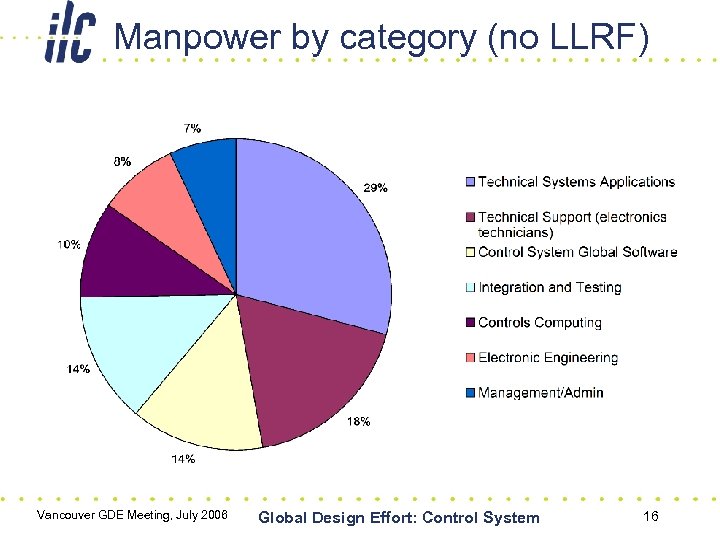
Manpower by category (no LLRF) Vancouver GDE Meeting, July 2006 Global Design Effort: Control System 16
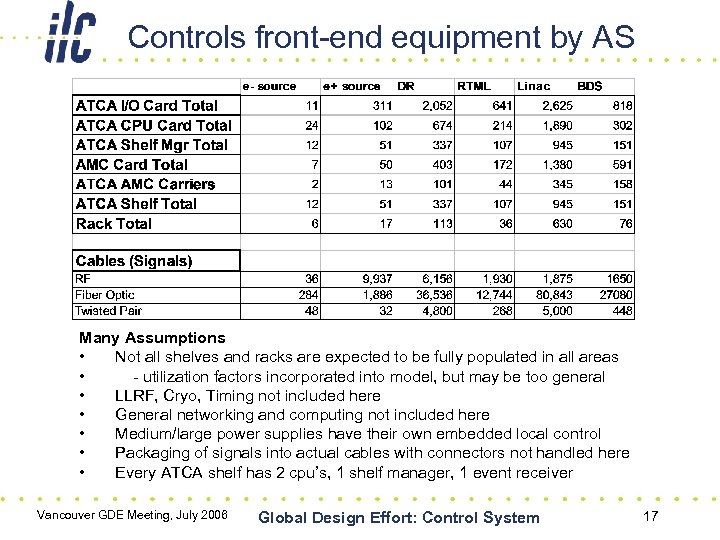
Controls front-end equipment by AS Many Assumptions • Not all shelves and racks are expected to be fully populated in all areas • - utilization factors incorporated into model, but may be too general • LLRF, Cryo, Timing not included here • General networking and computing not included here • Medium/large power supplies have their own embedded local control • Packaging of signals into actual cables with connectors not handled here • Every ATCA shelf has 2 cpu’s, 1 shelf manager, 1 event receiver Vancouver GDE Meeting, July 2006 Global Design Effort: Control System 17
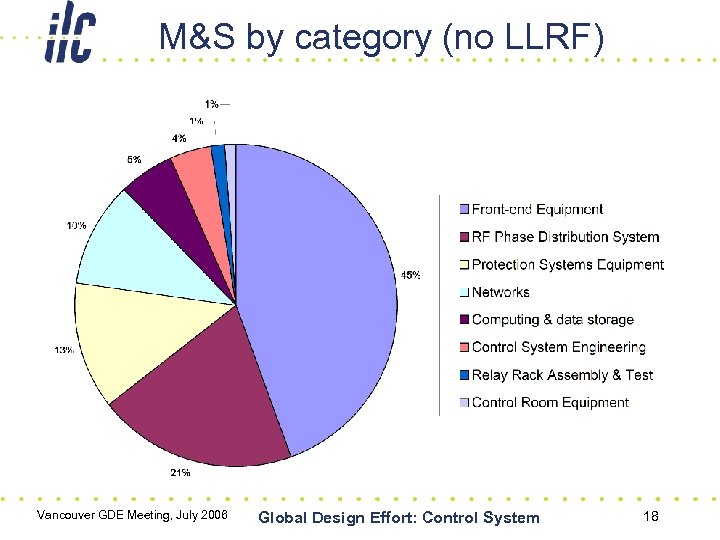
M&S by category (no LLRF) Vancouver GDE Meeting, July 2006 Global Design Effort: Control System 18
Cost impact of High Availability • HA-specific M&S costs in baseline (~20% of total): – ATCA with redundant processors vs VME/VXI. – Redundant networks. – Redundant RF phase distribution links. • HA-specific manpower in baseline (~7% of total): – HA framework management, QA, testing. – HA specific core software development. • Further R&D is required to better assess the cost of HA implementation. Vancouver GDE Meeting, July 2006 Global Design Effort: Control System 19
Potential for cost optimizations • • • Local RF phase reference distribution. Front-end electronics rack utilization – Could reduce the total number of relay racks. Technical System interfaces – Add a low-complexity front-end for equipment with signal-level interfaces. Cabling and connector costs – Optimize selections and manufacturing costs. Place electronics in the accelerator tunnel – eg mixers. Custom vs COTS electronic modules Vancouver GDE Meeting, July 2006 Global Design Effort: Control System 20
Cross-checks on our costing • Benchmarking against common “rules of thumb” – Control system costs as a percentage of accelerator technical system costs. – Cost per I/O channel. • Peer reviews – Estimates have been reviewed by team members in all three regions. – Limited informal external reviews of top-level estimates and costing methodology. • Informal comparisons have been made with other facilities: SNS, NLC, Fermilab, NIF, LHC, . . . Vancouver GDE Meeting, July 2006 Global Design Effort: Control System 21
R&D activities with cost implications • High precision local & global RF phase reference distribution. • Implementing High Availability. • Implementing system level automated diagnosis and recovery. Vancouver GDE Meeting, July 2006 Global Design Effort: Control System 22
Plans… • At Vancouver: – Resolve any issues regarding our assumptions or scope with technical systems groups. • By Valencia – Develop conceptual design for MPS. – Refine costing model for cable plant. – Rack optimization (depends on how well we know the technical system interfaces). – Update BCD with the latest design information. – Respond to feedback/assignments from DCB. Vancouver GDE Meeting, July 2006 Global Design Effort: Control System 23
Towards the TDR • Continue to develop the engineering design – Refine integrated control system design. – Develop integrated detailed views of MPS, Timing, beam-based feedback, etc – Further refine the technical interfaces. – Define site-wide controls infrastructure: networks, timing, etc • Establish basis for standards for controls hardware, software, protocols, etc. • Define controls expectations of the technical systems. • Implement an R&D program to address critical issues. Vancouver GDE Meeting, July 2006 Global Design Effort: Control System 24
Скачать презентацию Controls Global System Review John Carwardine ANL For
d6b7e5afd1a56fd44694c4274ab6c0e4.ppt