 Скачать презентацию controlling Workers compensation costs www ohiobwc com
1143c922e7c380db3d081fc00f2e5134.ppt
- Количество слайдов: 124



controlling Workers’ compensation costs www. ohiobwc. com
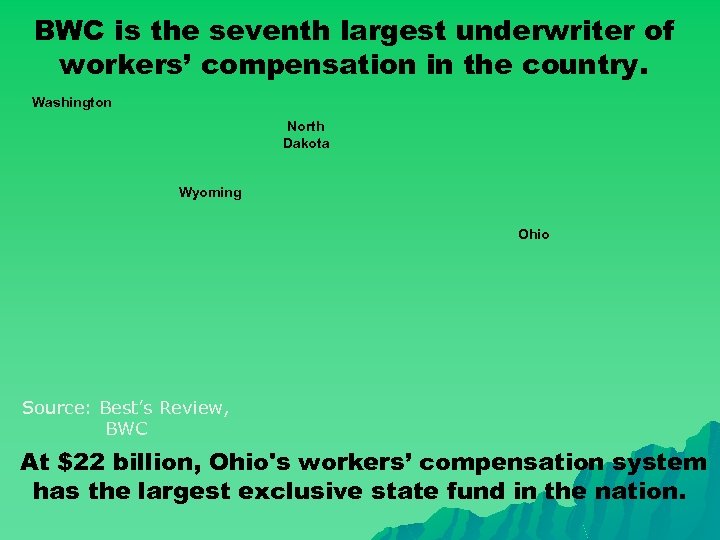
BWC is the seventh largest underwriter of workers’ compensation in the country. Washington North Dakota Wyoming Ohio Source: Best’s Review, BWC At $22 billion, Ohio's workers’ compensation system has the largest exclusive state fund in the nation.
2007 275, 000 Active Policies 1. 5 Million Open Claims Ohio 87% of injured employees return to jobs within 1 week
The Ohio Workers’ Compensation Act G Ohio law established exclusive state fund in 1913. G The act provides no-fault insurance. G It protects employers and their employees.
Ohio Revised Code “Sections 4123. 01 to 4123. 94, inclusive, of the Revised Code shall be liberally construed in favor of employees and the dependents of deceased employees”
Compensability Criteria Ø Employer / Employee Relationship Ø Physical Injury Ø In Course Of / Arising Out Of Employment Ø Jurisdiction
Intentional Tort Ø Workers’ compensation is sole remedy for workplace injuries unless: 1. Employer knew there was a hazard to the employee AND 2. Employer did not protect the employee AND 3. Employer knew with certainty that the employee would be injured or killed
Controlling Workers’ Compensation Costs Section 2 Safety Culture Wheel
Safety Culture? Why are we concerned about safety when discussing controlling workers’ compensation costs?
Safety Culture Wheel
Safety Culture Wheel Instructions § Consider the questions in each category. § Rate your company on a scale from 0 to 3. 0 = Weakness 1 = Some aspects covered 2 = Could be improved 3 = Strength § Total the points under each category. § Plot the totals onto the corresponding axis. § Connect the plotted points from axis to adjacent axis.
Defining Safety Culture (#660065 in catalog) § What are the attitudes of top managers? § Why do you think they felt this way? § What is the most powerful safety tool ever invented? § What was the bad water, bad fish thing about?
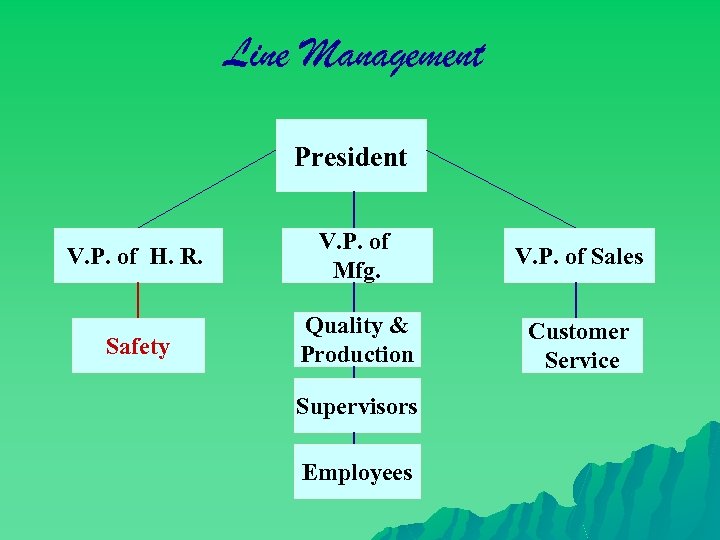
Line Management President V. P. of H. R. V. P. of Mfg. V. P. of Sales Safety Quality & Production Customer Service Supervisors Employees
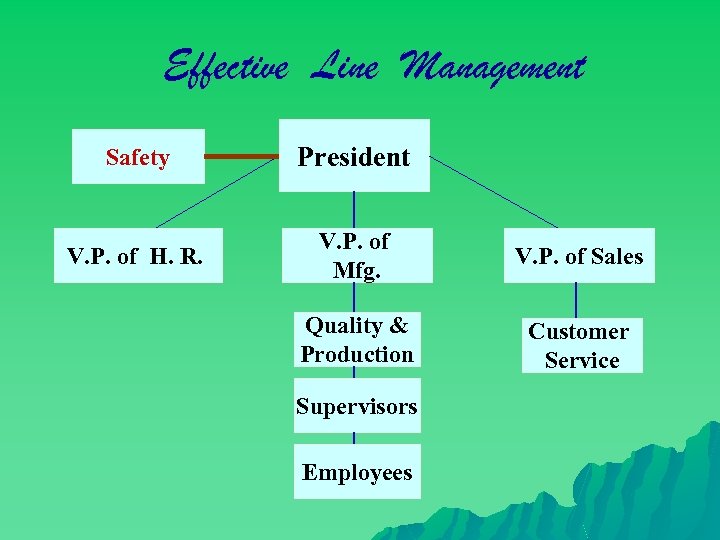
Effective Line Management Safety President V. P. of H. R. V. P. of Mfg. V. P. of Sales Quality & Production Customer Service Supervisors Employees
Safety Culture Wheel Leadership
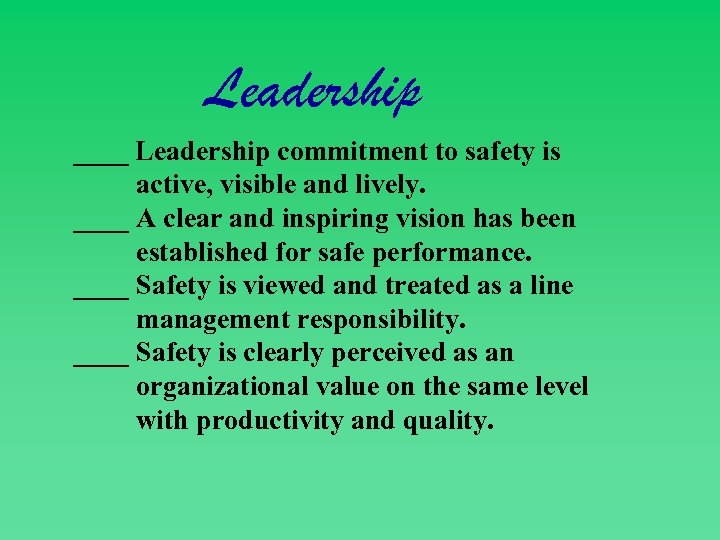
Leadership ____ Leadership commitment to safety is active, visible and lively. ____ A clear and inspiring vision has been established for safe performance. ____ Safety is viewed and treated as a line management responsibility. ____ Safety is clearly perceived as an organizational value on the same level with productivity and quality.
Team Exercise If great safety is zero accidents, do you believe every accident can be prevented?
Safety Culture Wheel Systems & Processes
Systems and Processes ____ Supervisors and workers partner to find and correct systems causes of incidents. ____ Communication systems are abundant, effective and flow well in all directions. ____ Training systems deliberately and systematically create competency for the right people at the right time. ____ Safe operating procedures and policies are clearly defined and communicated. (By Who? )
Controlling Workers’ Compensation Costs Section 3 Money and Ratemaking
Ratemaking The main question is…. u How does BWC determine what an employer pays in premium? ØBWC must collect enough money in premium to pay claims costs ØCosts must be equitably divided among all employers
Simply put… CLAIMS COSTS drive RATES
BWC Rating Concept Compare ACTUAL CLAIMS COSTS and EXPECTED CLAIMS COSTS
Claims Costs 1. MEDICAL COSTS 2. INDEMNITY 3. RESERVES
Claims Costs MEDICAL COSTS Money paid for doctor bills, diagnostic tests, drugs, etc.
Claims Costs INDEMNITY u Money (compensation) paid to injured workers to compensate for lost wages u Money paid to injured workers to compensate for permanent damage
Reserves Reserve – The anticipated future cost in a claim A reserve is set only on claims that are designated as lost-time claims
BWC Reserves Ø Ø Reserves set using MIRA II (Micro Insurance Reserving Analysis system) (effective July 1, 2008) MIRA is built using data from 5. 9 million Ohio claims Allows employers to see what factors are driving the Reserves Weekly listing of claims with changed Reserves
BWC Reserves MIRA assigns Reserves to claims based on over 180 individual characteristics of each claim Why are individual claim characteristics important?
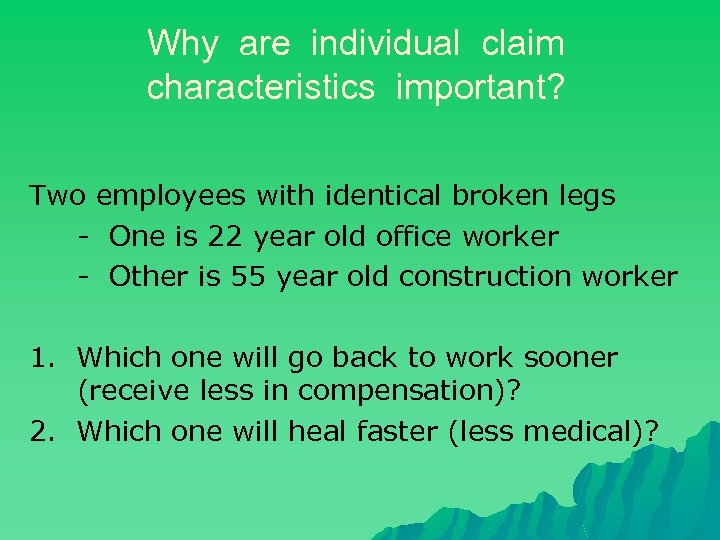
Why are individual claim characteristics important? Two employees with identical broken legs - One is 22 year old office worker - Other is 55 year old construction worker 1. Which one will go back to work sooner (receive less in compensation)? 2. Which one will heal faster (less medical)?
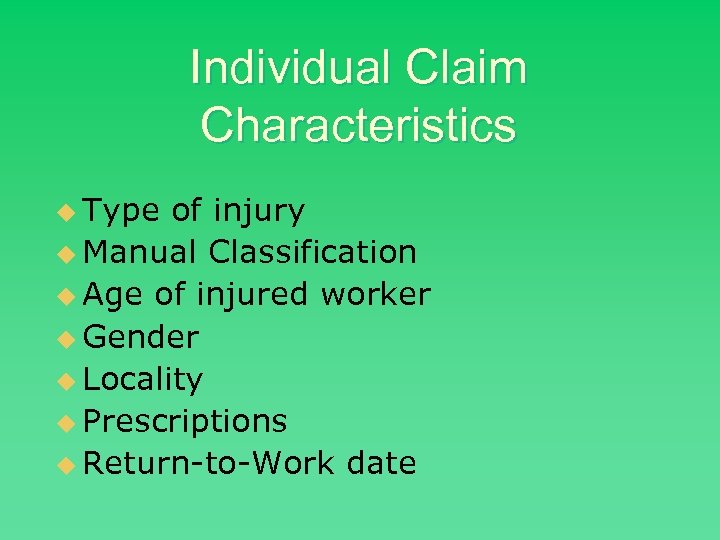
Individual Claim Characteristics u Type of injury u Manual Classification u Age of injured worker u Gender u Locality u Prescriptions u Return-to-Work date
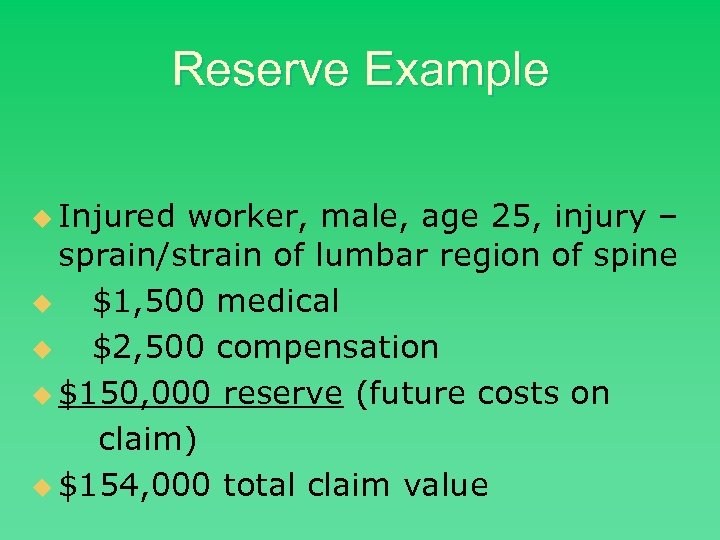
Reserve Example u Injured worker, male, age 25, injury – sprain/strain of lumbar region of spine u $1, 500 medical u $2, 500 compensation u $150, 000 reserve (future costs on claim) u $154, 000 total claim value
Result § § A large reserve has a significant impact on the value of a claim Claims with large reserves can be the driving factor in an employer’s rates
Max Value Claim Ø Ø Ø Each employer is assigned a maximum value for each individual claim Based on employer size (determined by expected losses) Prevents large claims from negatively impacting small employers Injured employee receives all benefits due Amounts over Max Value are assigned to Surplus Fund (a shared liability)
4 -year Calculation Private Employers* u For policy year beginning 7/1/2008, BWC used data from calendar years 2003, 2004, 2005, 2006 for ratemaking purposes. u Each year, the oldest year drops off and a new year is added. u For policy year beginning 7/1/2009, BWC will use data from calendar years 2004, 2005, 2006, 2007 for ratemaking purposes. *Public employers’ rating year begins on January 1 st
Expected Claims Costs u Amount of claims costs an employer is expected to have, based on business pursuit and payroll level. u This value is also a four-year figure, based on the same time period as the claims cost figure.
BWC Ratemaking Once actual claims costs and expected claims costs are obtained, BWC uses that information to determine the rate that the employer will pay Ø Note that the BWC is “revenue neutral” when it comes to ratemaking Ø
Base Rating u If a company has less than $ 8, 000 in expected claims costs, it will be base-rated. u The company will pay the base rate established for its manual classification, regardless of the amount of claims costs it has. Experience Modifier (EM) is always 1. 00.
Experience Rating u When an employer has expected losses in excess of $ 8, 000, it is 8, 000 experience-rated. u Premium costs are driven by the level of claims costs. u An employer can be credit-rated or penalty-rated.
Experience Rating Credit-rated An employer has less claims cost than BWC would expect. The experience modifier (EM) is less than 1. 00. Penalty-rated An employer has more claims cost than BWC would expect. The EM is greater than 1. 00.
Experience Rating u There is a limit on credit rating. Currently, an employer can be no more than 85% credit-rated. u There is no limit to penalty rating (surcharge) for an employer. u The higher the surcharge, the higher the premium paid by an employer.
Savings through Discount Programs and Optional Rating Plans* ØGroup Rating ØSelf-Insurance ØDrug Free (DFWP) ØSafety Grants ØPremium Discount ØSafety Council Rebates Program (PDP) ØRetrospective Rating Ø$15 K Program ØOne Claim Program *Note: These programs are currently under review and may be revised.
Group Rating u Allows an employer with low claims experience to earn an attractive discount. u Groups combine payroll and experience of the members to earn a significant discount.
Drug-Free Workplace Program Ø Can stack discount with Group Rating up to maximum cap of 85% Ø Can stack with PDP up to a maximum cap of 10%
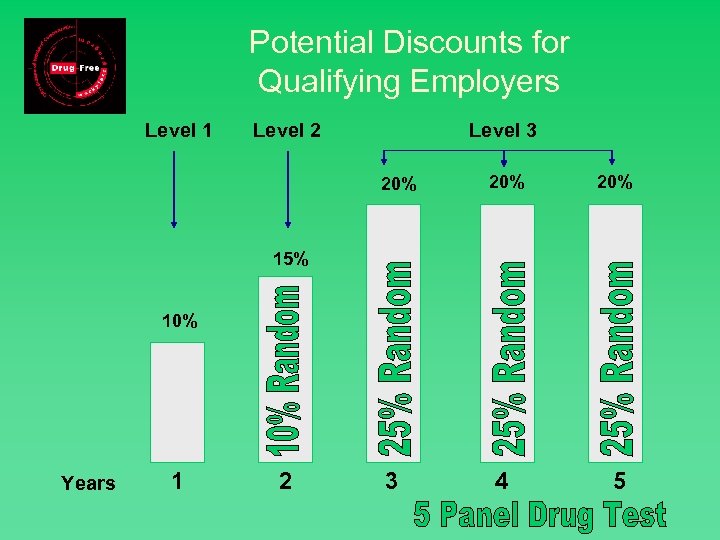
Potential Discounts for Qualifying Employers Level 1 Level 2 Level 3 20% 20% 4 5 15% 2 10% Years 1 2 3
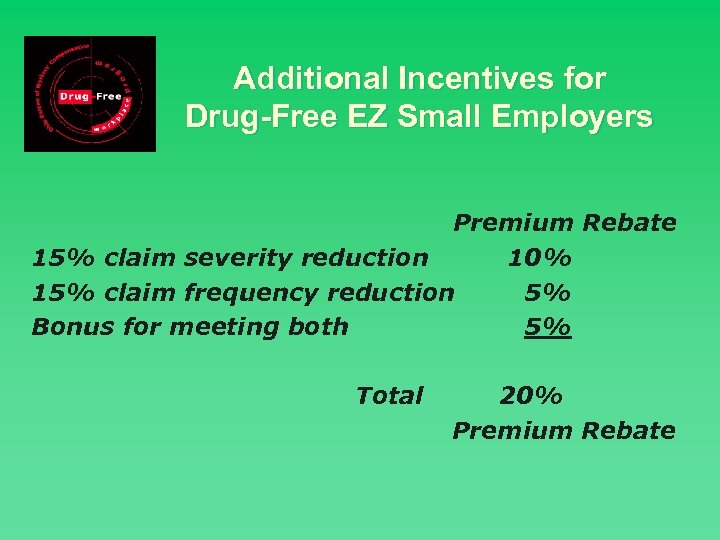
Additional Incentives for Drug-Free EZ Small Employers Premium Rebate 15% claim severity reduction 10% 15% claim frequency reduction 5% Bonus for meeting both 5% Total 20% Premium Rebate
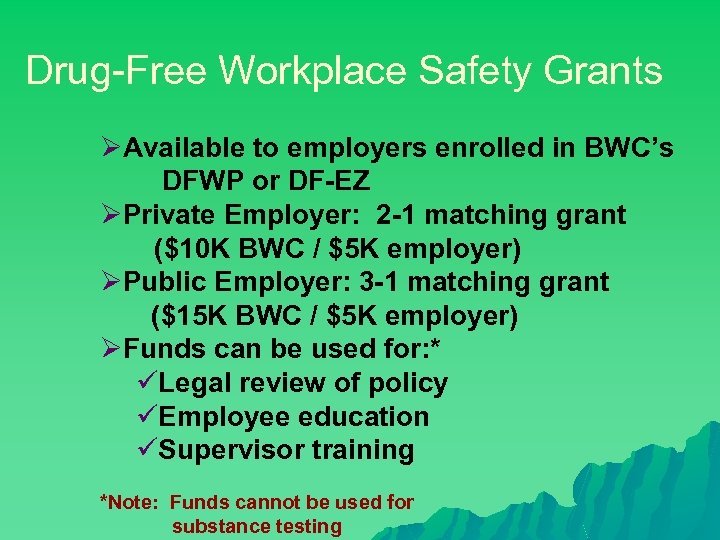
Drug-Free Workplace Safety Grants ØAvailable to employers enrolled in BWC’s DFWP or DF-EZ ØPrivate Employer: 2 -1 matching grant ($10 K BWC / $5 K employer) ØPublic Employer: 3 -1 matching grant ($15 K BWC / $5 K employer) ØFunds can be used for: * üLegal review of policy üEmployee education üSupervisor training *Note: Funds cannot be used for substance testing
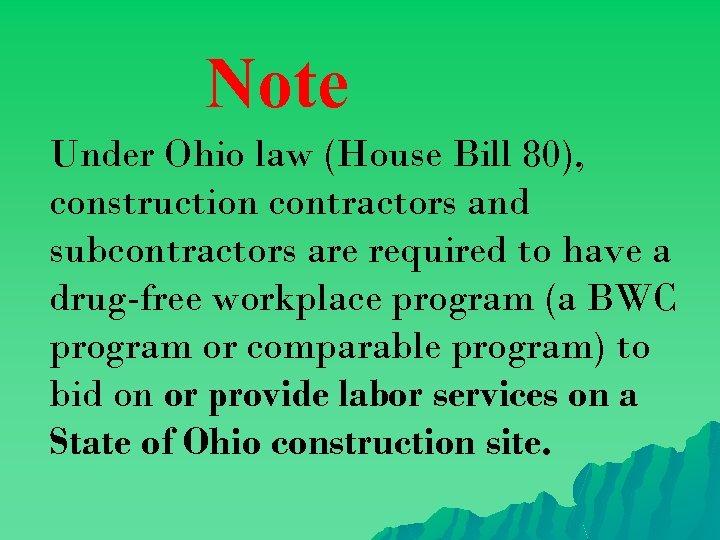
Note Under Ohio law (House Bill 80), construction contractors and subcontractors are required to have a drug-free workplace program (a BWC program or comparable program) to bid on or provide labor services on a State of Ohio construction site.
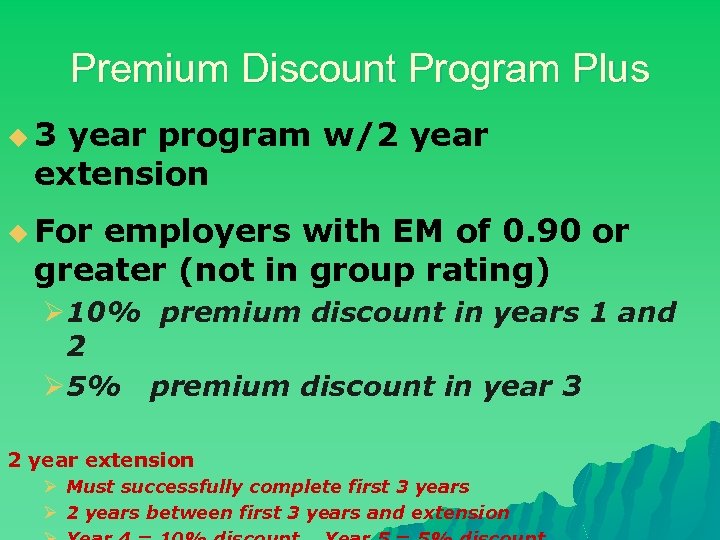
Premium Discount Program Plus u 3 year program w/2 year extension u For employers with EM of 0. 90 or greater (not in group rating) Ø 10% premium discount in years 1 and 2 Ø 5% premium discount in year 3 2 year extension Ø Must successfully complete first 3 years Ø 2 years between first 3 years and extension
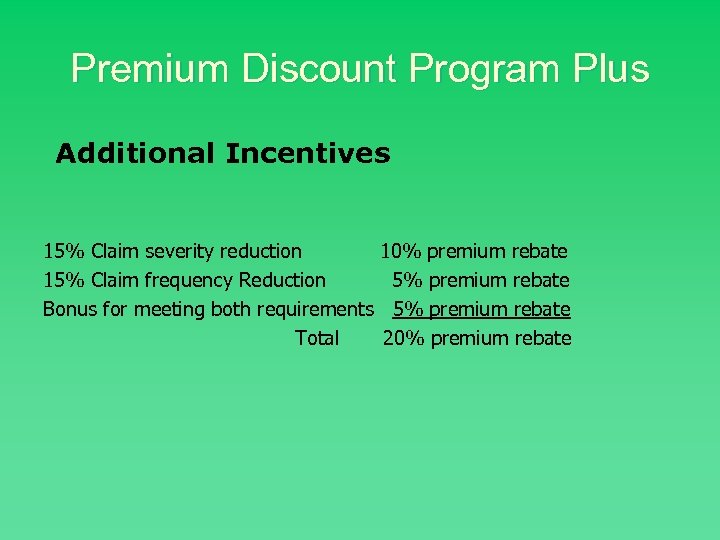
Premium Discount Program Plus Additional Incentives 15% Claim severity reduction 15% Claim frequency Reduction Bonus for meeting both requirements Total 10% premium rebate 5% premium rebate 20% premium rebate
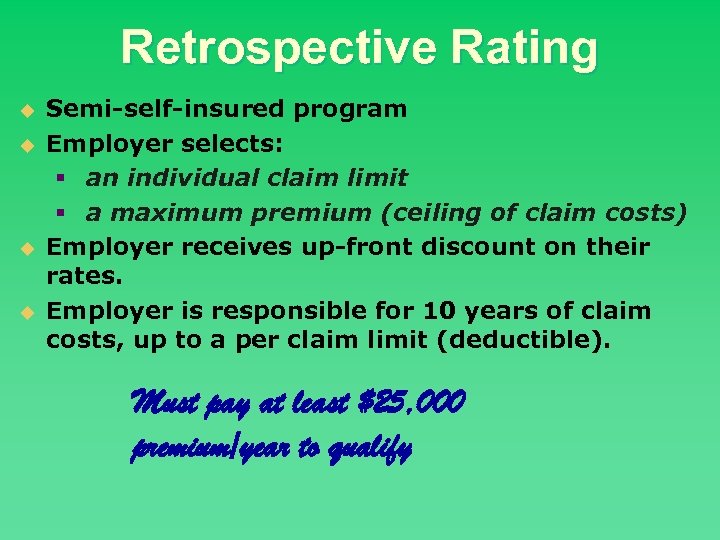
Retrospective Rating u u Semi-self-insured program Employer selects: § an individual claim limit § a maximum premium (ceiling of claim costs) Employer receives up-front discount on their rates. Employer is responsible for 10 years of claim costs, up to a per claim limit (deductible). Must pay at least $25, 000 premium/year to qualify
Self-Insurance Large employers ( 500+ employees ) u Pay assessments to BWC u Pay all of claim costs u BWC grants employers this privilege based on: § Profit margin § Debt structure § Self-insured readiness u
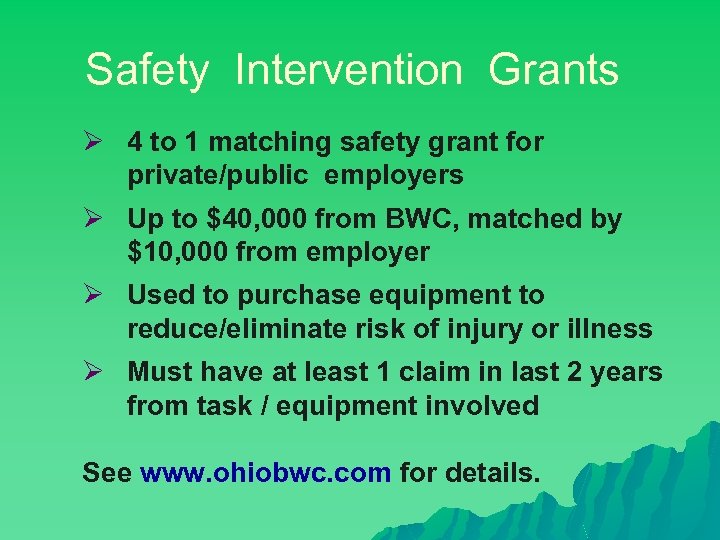
Safety Intervention Grants Ø 4 to 1 matching safety grant for private/public employers Ø Up to $40, 000 from BWC, matched by $10, 000 from employer Ø Used to purchase equipment to reduce/eliminate risk of injury or illness Ø Must have at least 1 claim in last 2 years from task / equipment involved See www. ohiobwc. com for details.
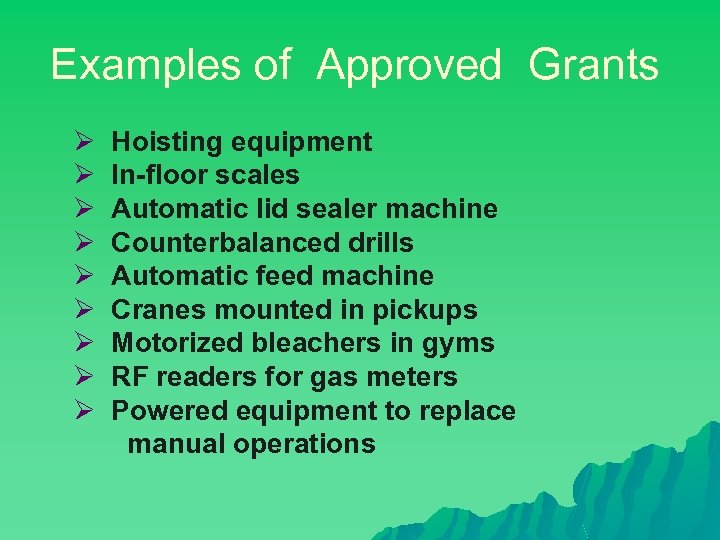
Examples of Approved Grants Ø Ø Ø Ø Ø Hoisting equipment In-floor scales Automatic lid sealer machine Counterbalanced drills Automatic feed machine Cranes mounted in pickups Motorized bleachers in gyms RF readers for gas meters Powered equipment to replace manual operations
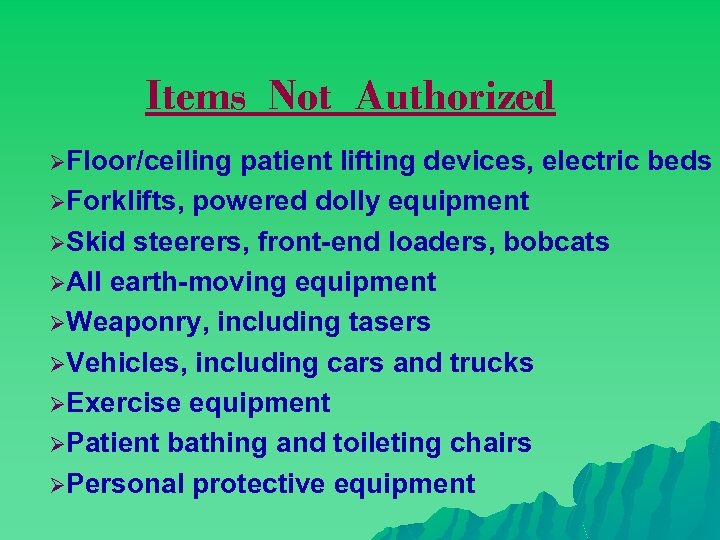
Items Not Authorized ØFloor/ceiling patient lifting devices, electric beds ØForklifts, powered dolly equipment ØSkid steerers, front-end loaders, bobcats ØAll earth-moving equipment ØWeaponry, including tasers ØVehicles, including cars and trucks ØExercise equipment ØPatient bathing and toileting chairs ØPersonal protective equipment
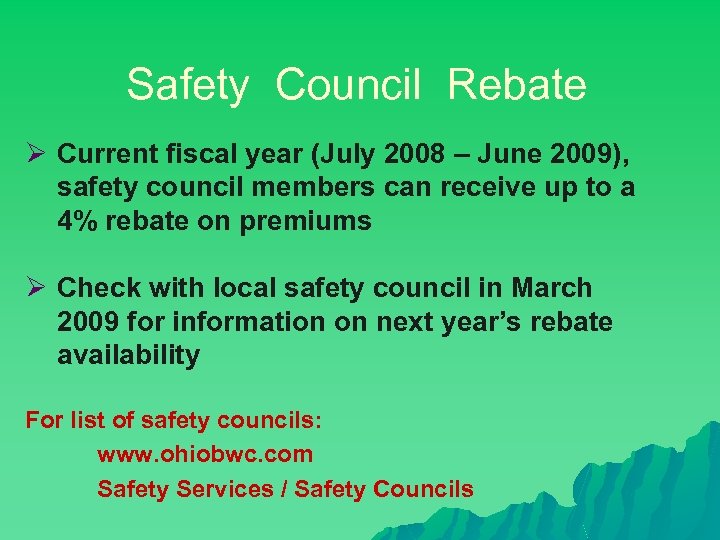
Safety Council Rebate Ø Current fiscal year (July 2008 – June 2009), safety council members can receive up to a 4% rebate on premiums Ø Check with local safety council in March 2009 for information on next year’s rebate availability For list of safety councils: www. ohiobwc. com Safety Services / Safety Councils
$15, 000 Medical-Only Program Employer is medical manager of claim in which IW is off no more than 7 days. u Employer pays bills within 30 days. u Employer keeps record of the injury. u Effective with claims of Sep 10, 2007 or later u See www. ohiobwc. com for details. Employer Services / Programs
One Claim Program (40% discount) u State-fund employers only u Single significant claim entering experience from Green Year that caused removal from group u Up to 3 medical-only claims in experience period u Attend Workers’ Comp. University each year + one additional class
Controlling Workers’ Compensation Costs Section 4 Direct and Indirect Costs
Accident-related Costs u. Insured - Direct Costs u. Uninsured Costs - Indirect
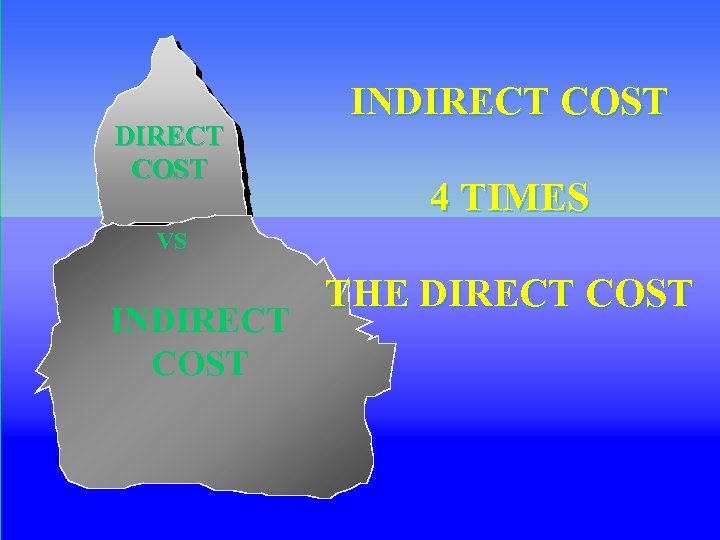
DIRECT COST INDIRECT COST 4 TIMES VS INDIRECT COST THE DIRECT COST
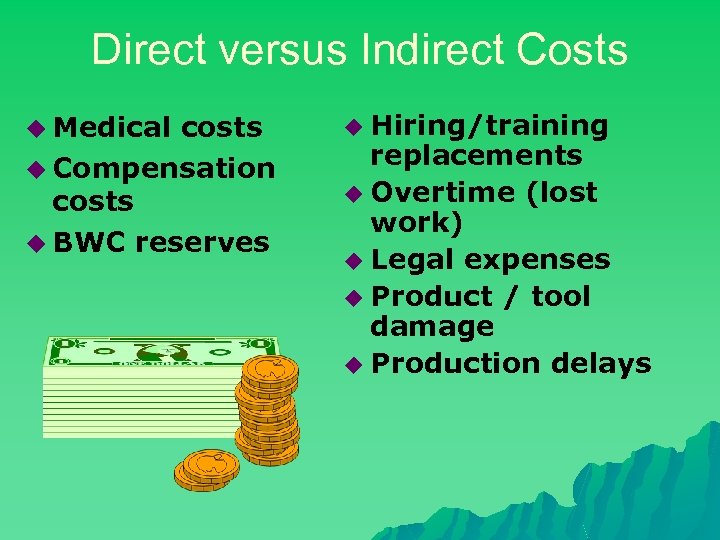
Direct versus Indirect Costs u Medical costs u Compensation costs u BWC reserves u Hiring/training replacements u Overtime (lost work) u Legal expenses u Product / tool damage u Production delays
Other Indirect Costs u Morale u Admin Ø Ø Ø time Claims handling Supervisory duties Accident analysis u J. I. T. operations u OSHA u Loss of business (customer goodwill) u VSSR
Violation of a Specific Safety Requirement (VSSR) $An injured worker may receive additional compensation if employer is found to have violated a specific safety requirement that led to an injury. $Award can be 15% to 50% of compensation paid (minors = 100%) $Out-of-pocket expense for employer www. legislature. state. oh. us/laws. cfm Ohio Administrative Codes 4123: 1 Division of Safety & Hygiene
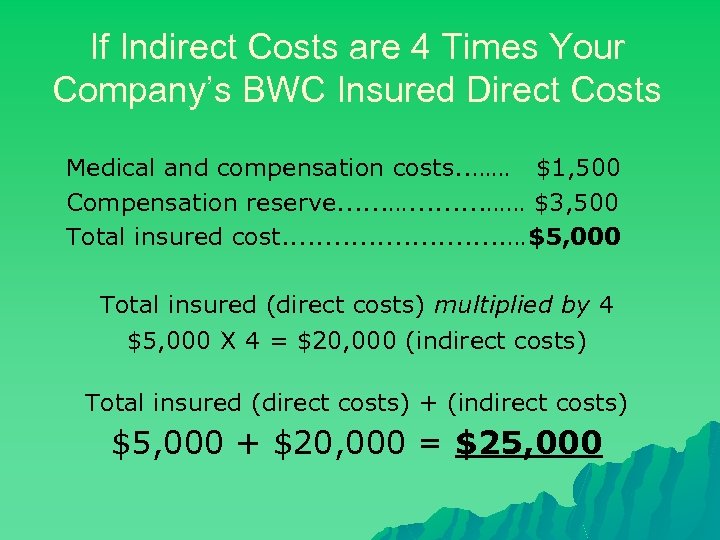
If Indirect Costs are 4 Times Your Company’s BWC Insured Direct Costs Medical and compensation costs. . …… $1, 500 Compensation reserve. . . …… $3, 500 Total insured cost. . . …$5, 000 Total insured (direct costs) multiplied by 4 $5, 000 X 4 = $20, 000 (indirect costs) Total insured (direct costs) + (indirect costs) $5, 000 + $20, 000 = $25, 000
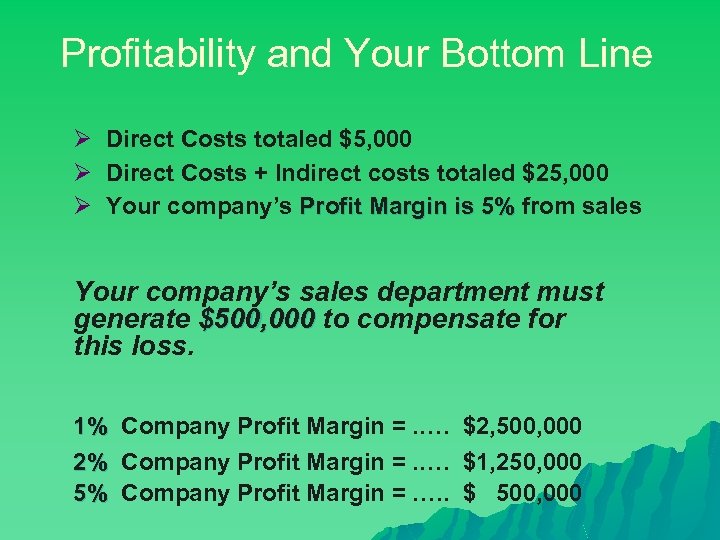
Profitability and Your Bottom Line Ø Direct Costs totaled $5, 000 Ø Direct Costs + Indirect costs totaled $25, 000 Ø Your company’s Profit Margin is 5% from sales Your company’s sales department must generate $500, 000 to compensate for this loss. 1% Company Profit Margin =. . … $2, 500, 000 2% Company Profit Margin =. . … $1, 250, 000 5% Company Profit Margin =. …. $ 500, 000
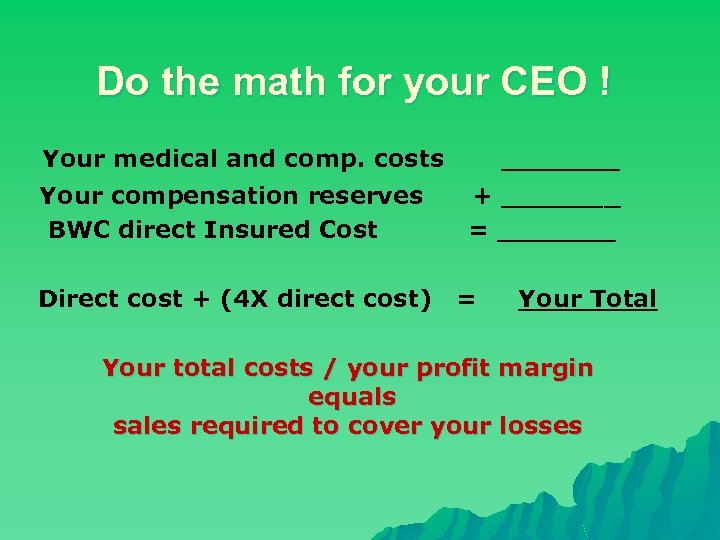
Do the math for your CEO ! Your medical and comp. costs Your compensation reserves BWC direct Insured Cost Direct cost + (4 X direct cost) _______ + _______ = Your Total Your total costs / your profit margin equals sales required to cover your losses
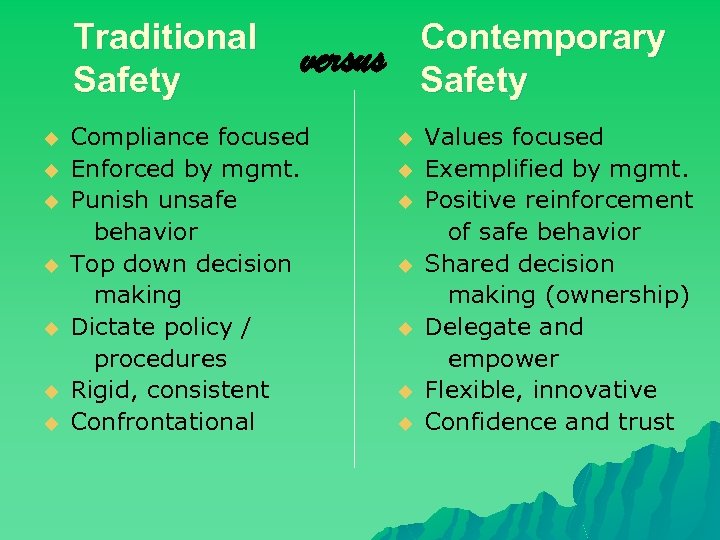
Traditional Safety u u u u Contemporary Safety versus Compliance focused Enforced by mgmt. Punish unsafe behavior Top down decision making Dictate policy / procedures Rigid, consistent Confrontational u u u u Values focused Exemplified by mgmt. Positive reinforcement of safe behavior Shared decision making (ownership) Delegate and empower Flexible, innovative Confidence and trust
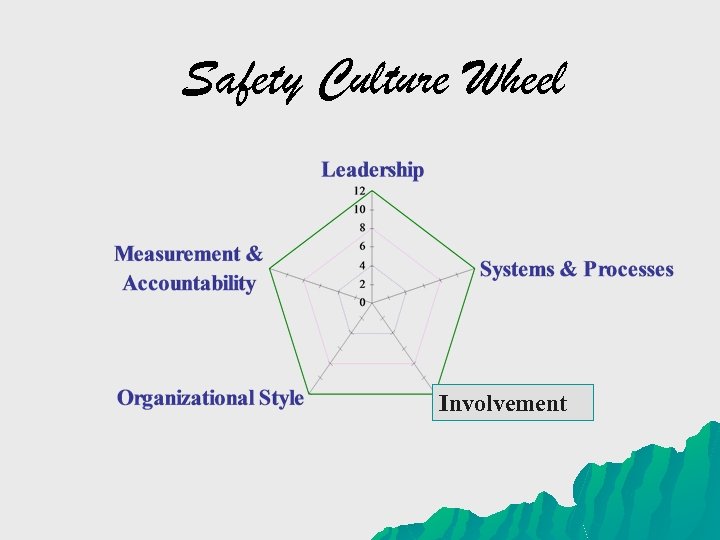
Safety Culture Wheel Involvement
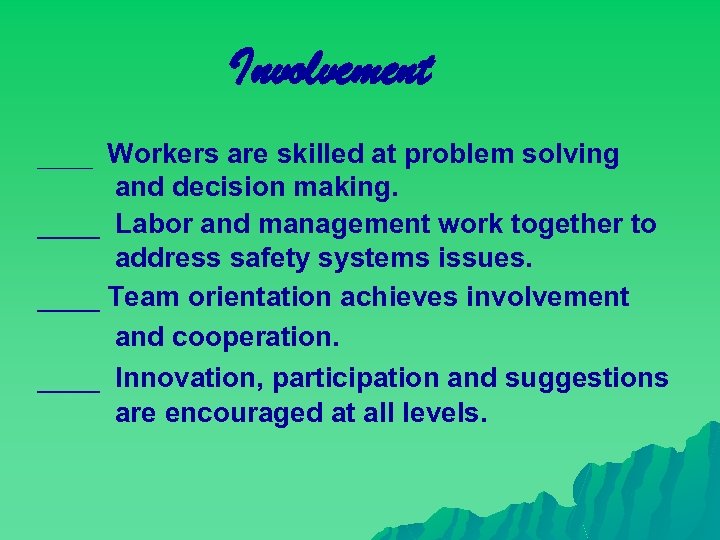
Involvement ____ Workers are skilled at problem solving and decision making. ____ Labor and management work together to address safety systems issues. ____ Team orientation achieves involvement and cooperation. ____ Innovation, participation and suggestions are encouraged at all levels.
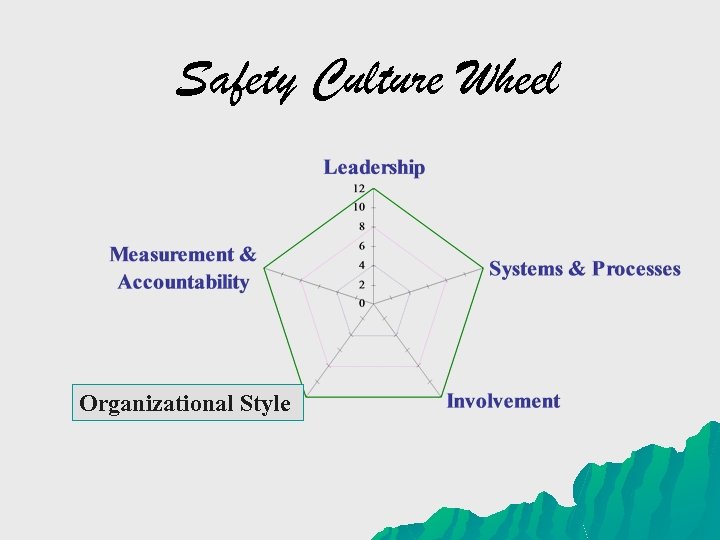
Safety Culture Wheel Organizational Style
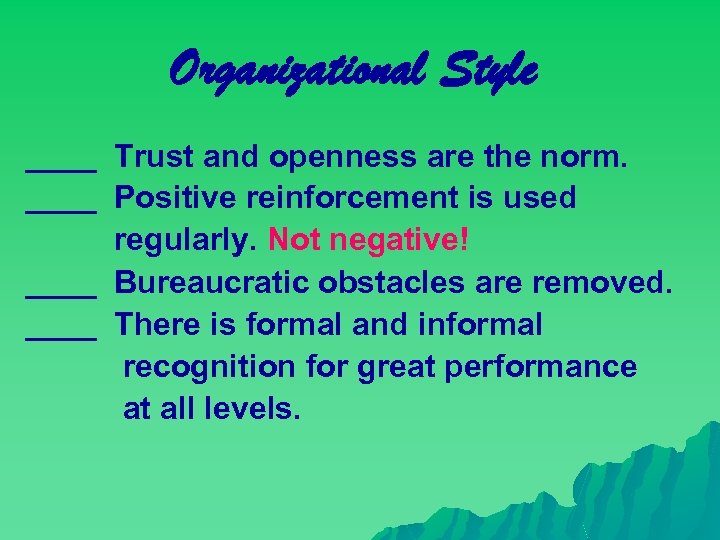
Organizational Style ____ Trust and openness are the norm. ____ Positive reinforcement is used regularly. Not negative! ____ Bureaucratic obstacles are removed. ____ There is formal and informal recognition for great performance at all levels.
Controlling Workers’ Compensation Costs Section 5 Risk Management Strategies

60 Day Appeal
Claims Cost Management Who are the players? § Employer § Managed Care Organization (MCO) § BWC § Third Party Administrator (TPA)
The Employer’s Role § Employer and/or MCO reports claim timely § Investigates accident promptly § Decides to certify or reject the claim When an employer certifies a claim, they are stating that: 1. An injury occurred at work 2. The injured person was their 3. employee
The Employer’s Role § Follows up with their injured worker § Coordinates remain-at-work / return-to -work strategies with MCO, medical providers, and BWC
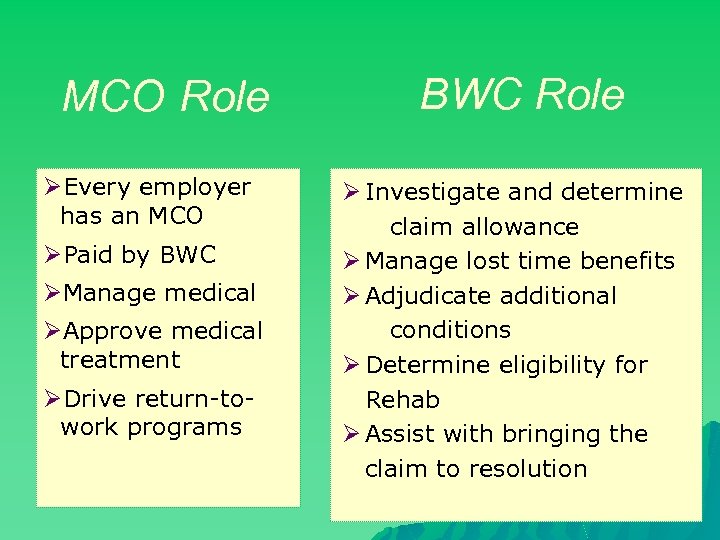
MCO Role ØEvery employer has an MCO ØPaid by BWC ØManage medical ØApprove medical treatment ØDrive return-towork programs BWC Role Ø Investigate and determine claim allowance Ø Manage lost time benefits Ø Adjudicate additional conditions Ø Determine eligibility for Rehab Ø Assist with bringing the claim to resolution
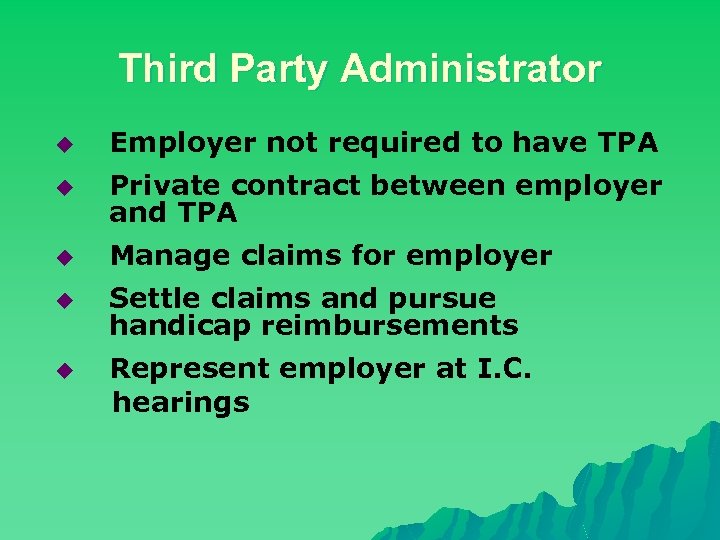
Third Party Administrator u Employer not required to have TPA u Private contract between employer and TPA u Manage claims for employer u Settle claims and pursue handicap reimbursements u Represent employer at I. C. hearings
Claim Management “remain at Work” “return to Work” “transitional Work” Plan Now!
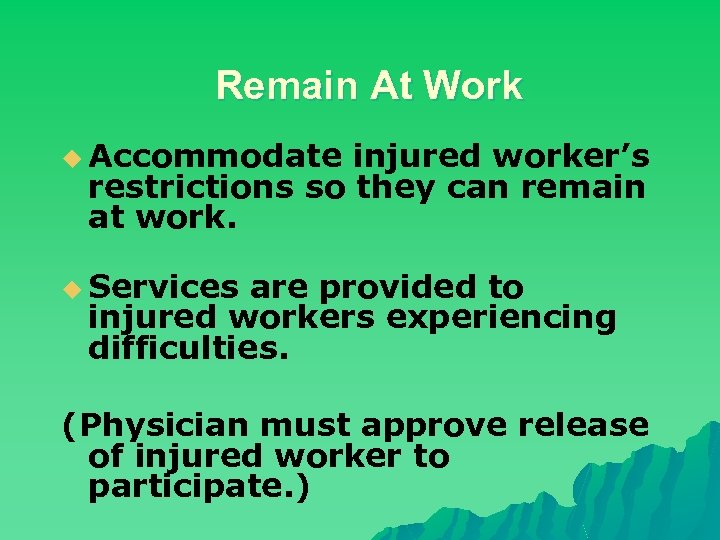
Remain At Work u Accommodate injured worker’s restrictions so they can remain at work. u Services are provided to injured workers experiencing difficulties. (Physician must approve release of injured worker to participate. )
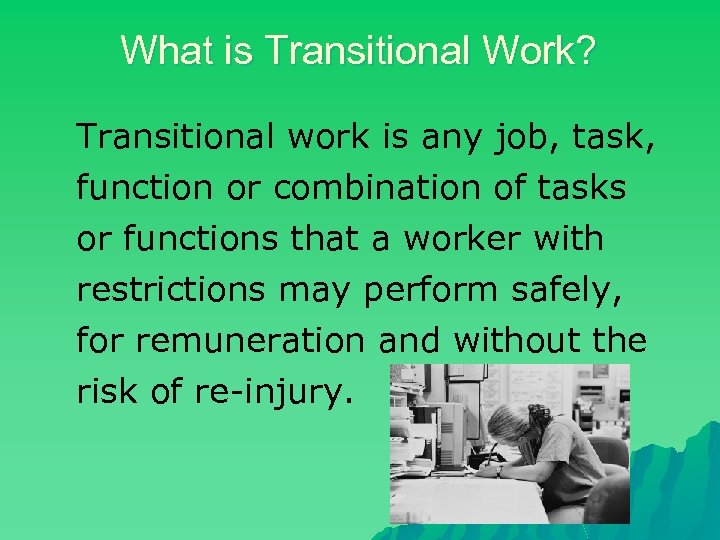
What is Transitional Work? Transitional work is any job, task, function or combination of tasks or functions that a worker with restrictions may perform safely, for remuneration and without the risk of re-injury.
Benefits of Transitional Work u Eliminate/decrease time away from work. u Eliminate/decrease temporary total. u Increase productivity.
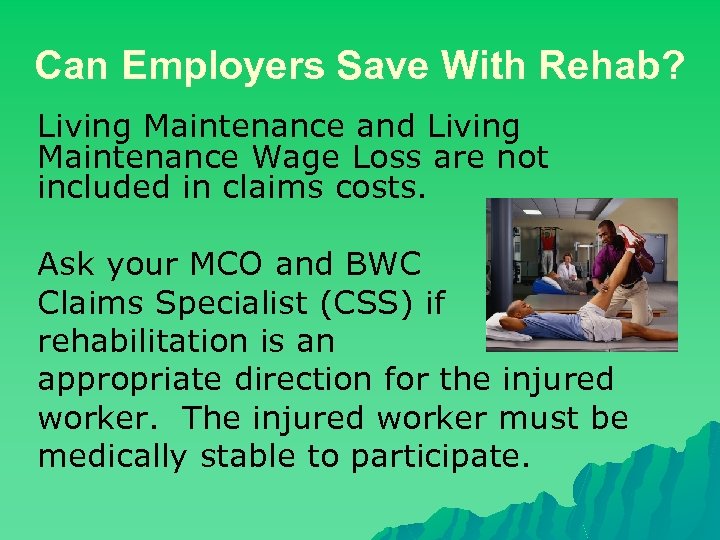
Can Employers Save With Rehab? Living Maintenance and Living Maintenance Wage Loss are not included in claims costs. Ask your MCO and BWC Claims Specialist (CSS) if rehabilitation is an appropriate direction for the injured worker. The injured worker must be medically stable to participate.
Focus On Remain-at-Work or Return-To-Work Policy Lost Time Claim = reserve Salary continuation and/or followed by Living Maintenance = zero reserve BWC pays TT followed by Living Maintenance = 50% reduction of reserve
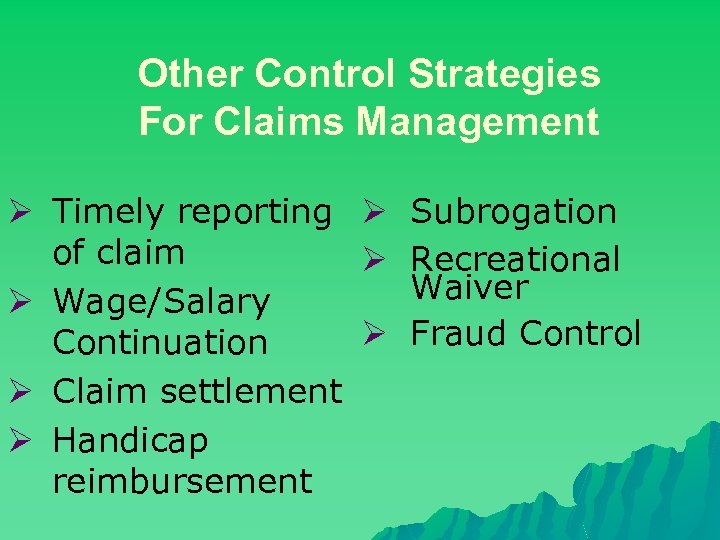
Other Control Strategies For Claims Management Ø Timely reporting Ø Subrogation of claim Ø Recreational Waiver Ø Wage/Salary Ø Fraud Control Continuation Ø Claim settlement Ø Handicap reimbursement
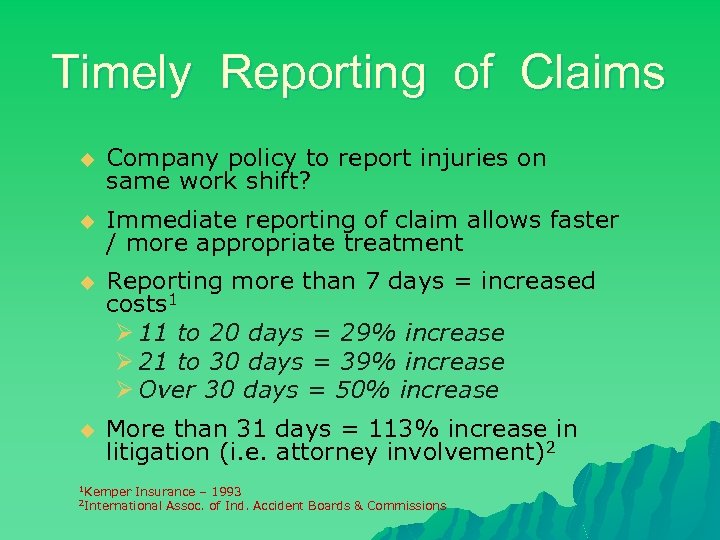
Timely Reporting of Claims u Company policy to report injuries on same work shift? u Immediate reporting of claim allows faster / more appropriate treatment u Reporting more than 7 days = increased costs 1 Ø 11 to 20 days = 29% increase Ø 21 to 30 days = 39% increase Ø Over 30 days = 50% increase u More than 31 days = 113% increase in litigation (i. e. attorney involvement)2 1 Kemper Insurance – 1993 Assoc. of Ind. Accident Boards & Commissions 2 International
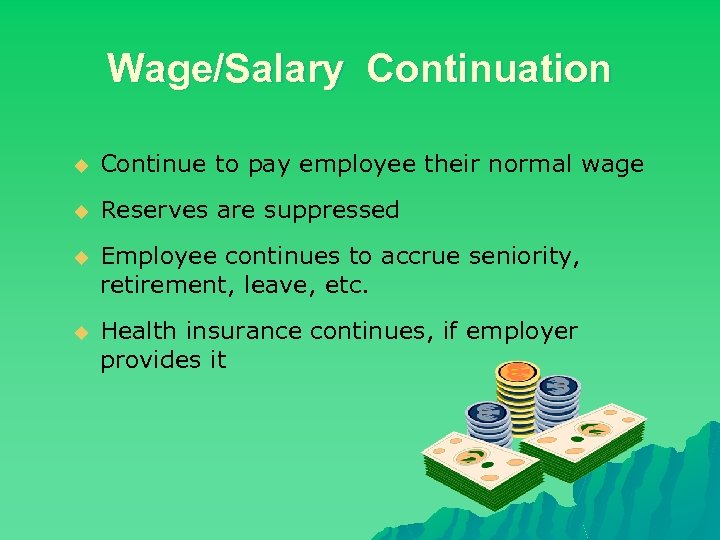
Wage/Salary Continuation u Continue to pay employee their normal wage u Reserves are suppressed u Employee continues to accrue seniority, retirement, leave, etc. u Health insurance continues, if employer provides it
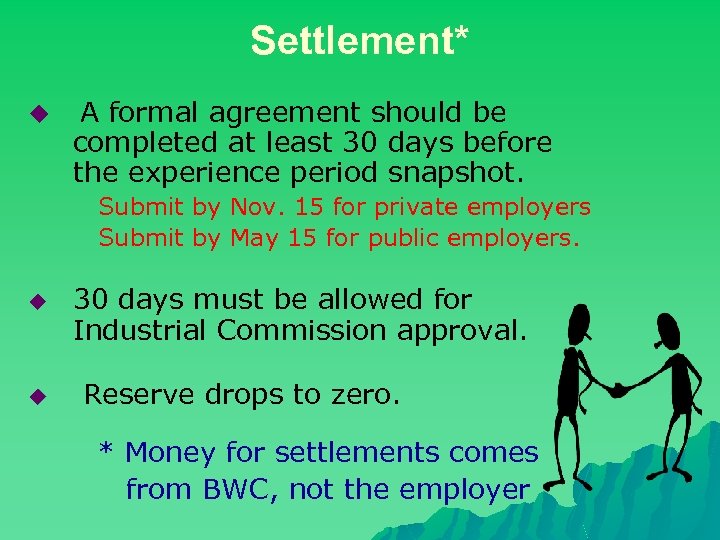
Settlement* u A formal agreement should be completed at least 30 days before the experience period snapshot. Submit by Nov. 15 for private employers Submit by May 15 for public employers. u u 30 days must be allowed for Industrial Commission approval. Reserve drops to zero. * Money for settlements comes from BWC, not the employer
Facilitate Settlement u u Settlement efforts should be on-going. Create a system in which Human Resources automatically contacts your TPA or attorney when an employee departs.
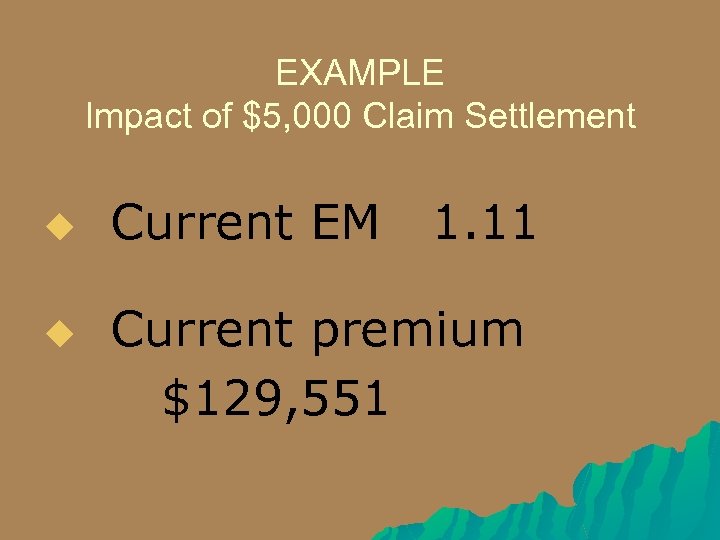
EXAMPLE Impact of $5, 000 Claim Settlement u u Current EM 1. 11 Current premium $129, 551
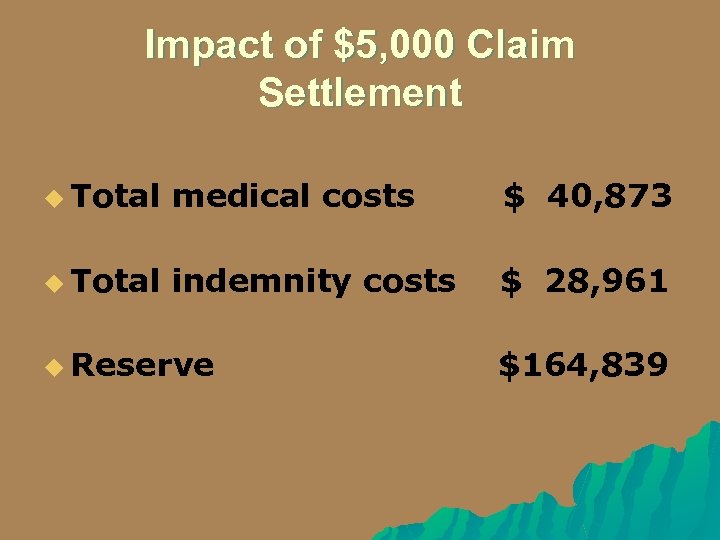
Impact of $5, 000 Claim Settlement u Total medical costs $ 40, 873 u Total indemnity costs $ 28, 961 u Reserve $164, 839
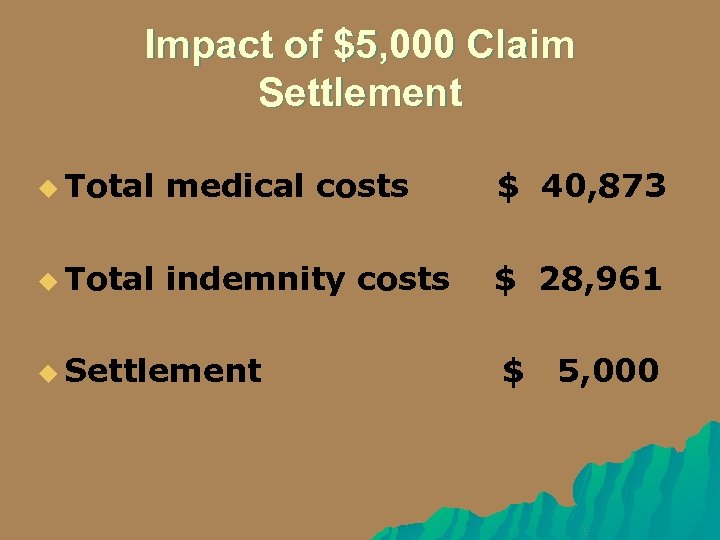
Impact of $5, 000 Claim Settlement u Total medical costs $ 40, 873 u Total indemnity costs $ 28, 961 u Settlement $ 5, 000
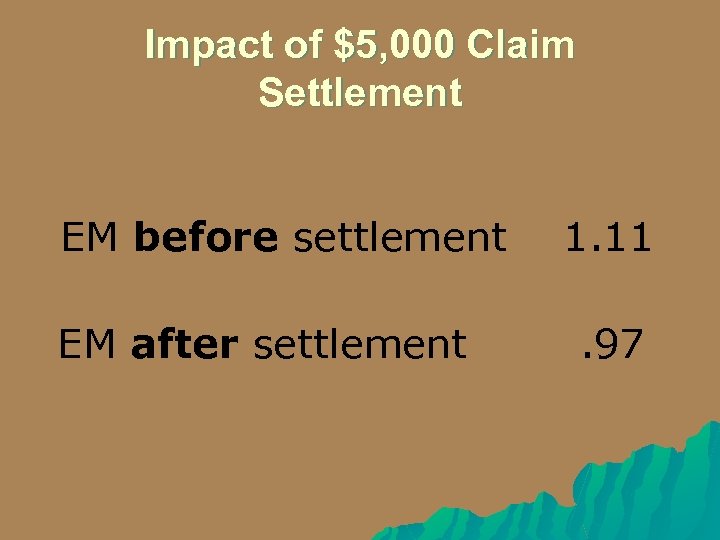
Impact of $5, 000 Claim Settlement EM before settlement EM after settlement 1. 11. 97
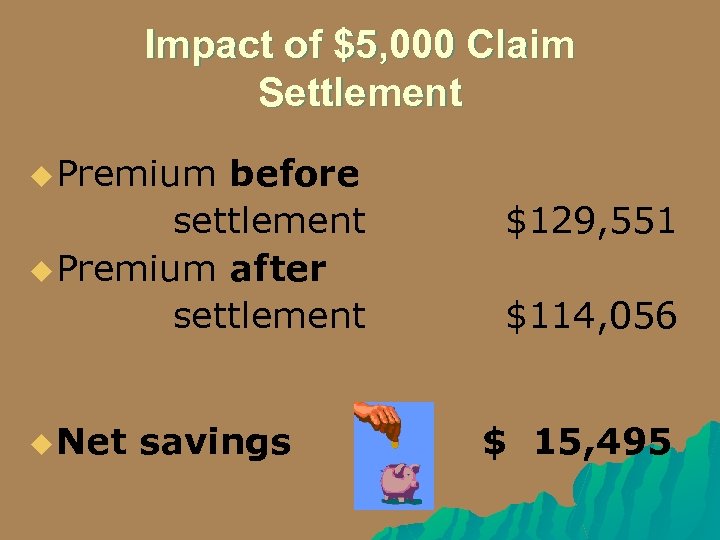
Impact of $5, 000 Claim Settlement u Premium before settlement u Premium after settlement u Net savings $129, 551 $114, 056 $ 15, 495
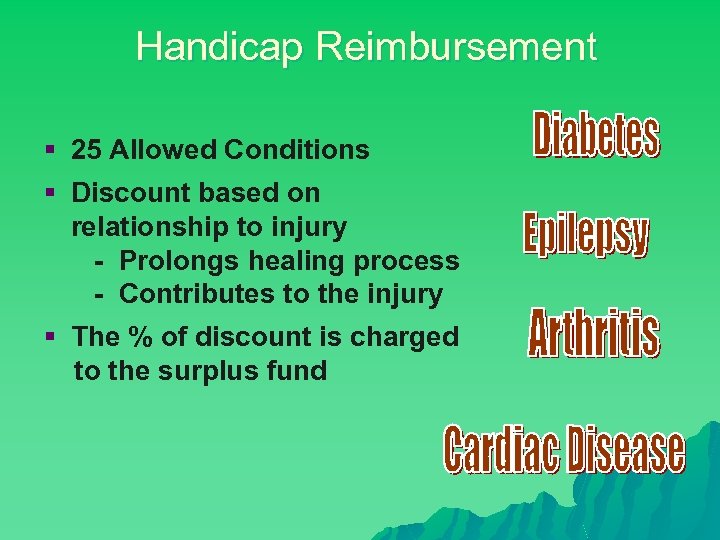
Handicap Reimbursement § 25 Allowed Conditions § Discount based on relationship to injury - Prolongs healing process - Contributes to the injury § The % of discount is charged to the surplus fund
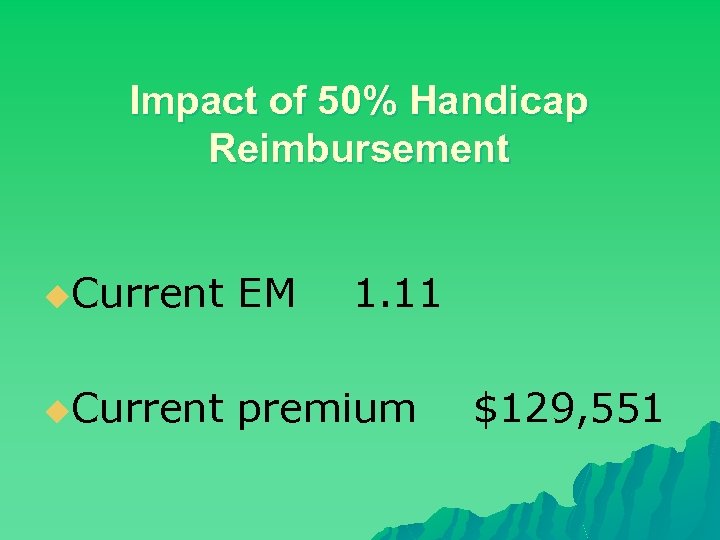
Impact of 50% Handicap Reimbursement u. Current EM 1. 11 u. Current premium $129, 551
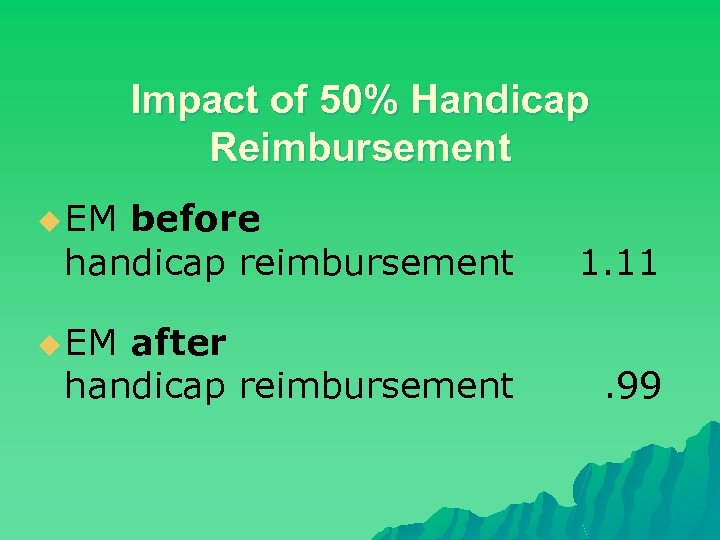
Impact of 50% Handicap Reimbursement u EM before handicap reimbursement u EM after handicap reimbursement 1. 11. 99
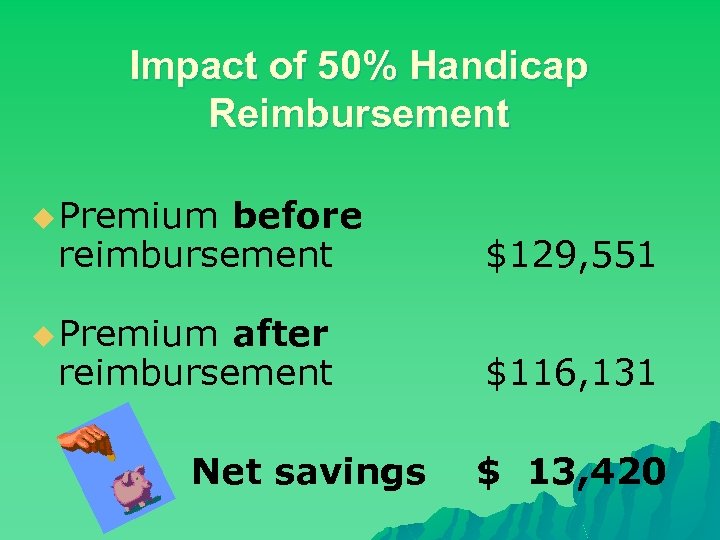
Impact of 50% Handicap Reimbursement u Premium before reimbursement u Premium after reimbursement Net savings $129, 551 $116, 131 $ 13, 420
Subrogation u The right to recover benefits from a third party because of negligence. u Senate Bill 227 effective for claims with a date of injury on or after April 9, 2003.
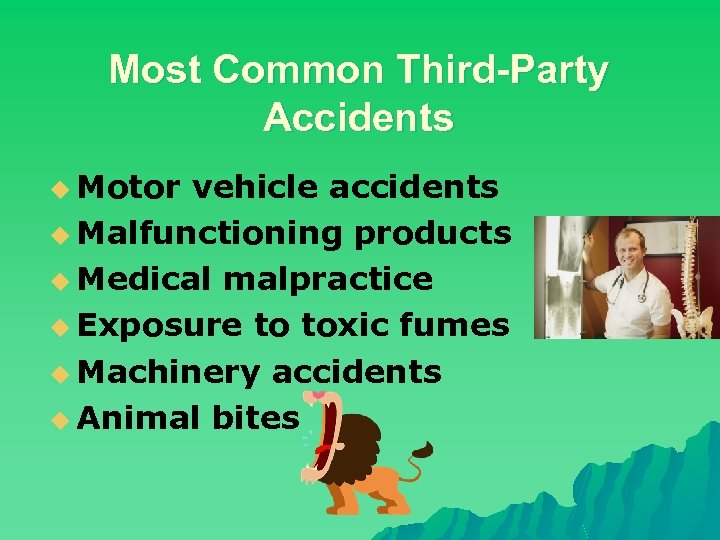
Most Common Third-Party Accidents u Motor vehicle accidents u Malfunctioning products u Medical malpractice u Exposure to toxic fumes u Machinery accidents u Animal bites
Group Discussion Your boss asks you to help organize a company picnic on a Saturday. This will be during nonworking hours and attendance is voluntary by all employees. During a softball game, you slide into second base and break your leg. Is this a workers’ compensation claim?
Recreational Waiver Legal liability vs. workers’ compensation claim When does your workday BEGIN and END ?
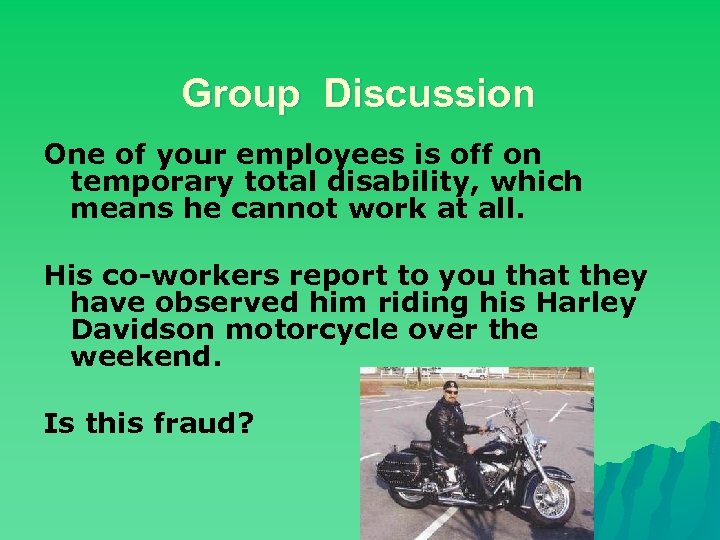
Group Discussion One of your employees is off on temporary total disability, which means he cannot work at all. His co-workers report to you that they have observed him riding his Harley Davidson motorcycle over the weekend. Is this fraud?
Fraud u Requires “Knowledge & Intent” u Overt Act u Intentional Omission versus Abuse Excessive use or misuse of workers’ compensation system u Abuse can not be criminally prosecuted under the law u Dealt with through administrative channels (IC) u
Red Flag Indicators Of Injured Worker Fraud § Injured worker can’t be reached. § Tips from co-workers. § No witnesses to accident. § Cross-outs, white-outs and erasures on forms. § Date, time and place of accident unknown. § Specific details of injury not recalled.
Red Flag Indicators Of Medical Provider Fraud § Billing for services not provided § High cost of medical care relative to injury § Length of treatment inconsistent with injury or disability § Injured worker receives an unusually high number of prescriptions.
Red Flag Indicators Of Employer Fraud § No workers’ compensation coverage § Misreporting payroll (Excessive payroll reported to clerical manual) § Current Certificate of Coverage but system indicates lapsed coverage
Controlling Workers’ Compensation Costs Section 6 Accountability
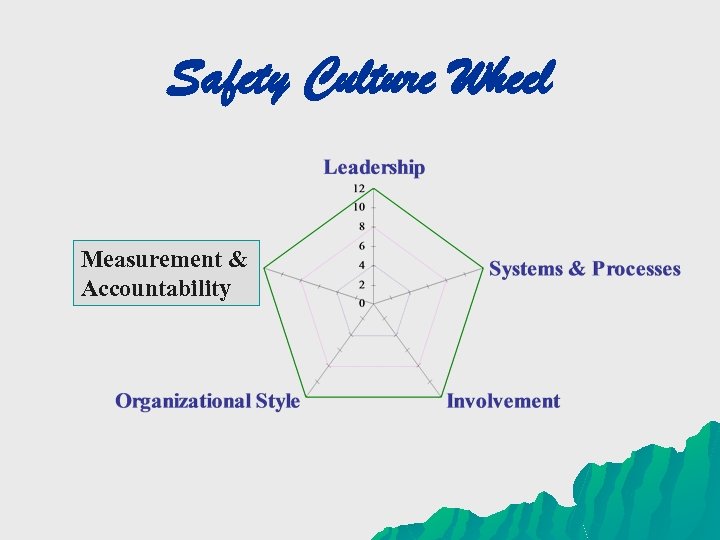
Safety Culture Wheel Measurement & Accountability
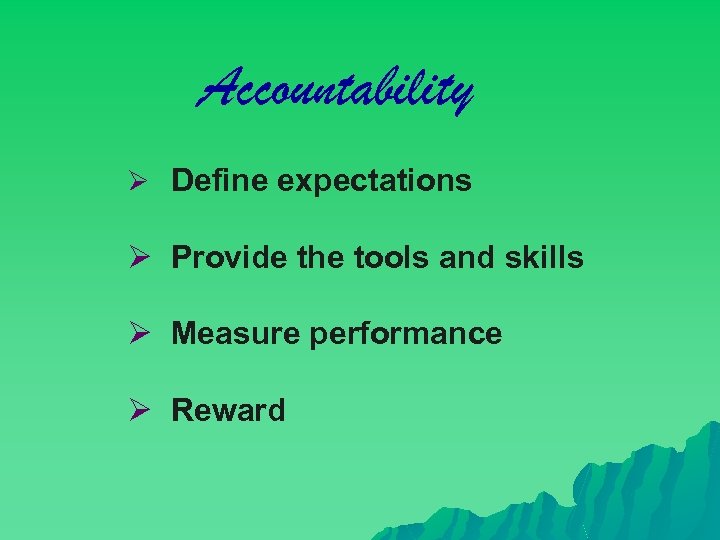
Accountability Ø Define expectations Ø Provide the tools and skills Ø Measure performance Ø Reward
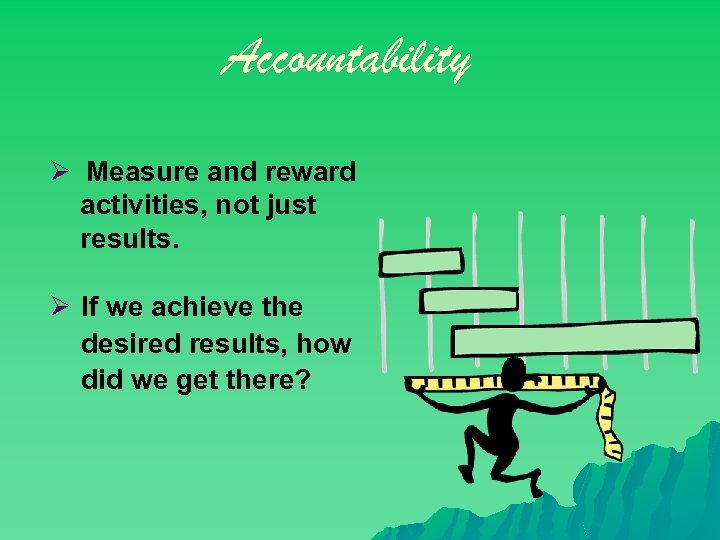
Accountability Ø Measure and reward activities, not just results. Ø If we achieve the desired results, how did we get there?
Measurement and Accountability ____ All levels of the organization have safety goals and process responsibilities clearly defined. ____ The process of achieving results is a key safety measure. ____ Performance reviews include accountability for safe performance at all levels. ____ Supervision is accountable to perform safety observations and feedback.
Does Upper Management Know the Cost? u The Premium u Cost by department? u Accident trends by department?
Personal Impact Makes A Difference Ø Are department budgets impacted by their claims and costs? (charge backs) Ø Or, are the overall costs equally divided among departments?
So what options does an employer have to control workers’ compensation costs?
What are Your Options? üPDP üDFWP üSettlement üSubrogation üRehabilitation üDFWP Grants üReturn-to-Work
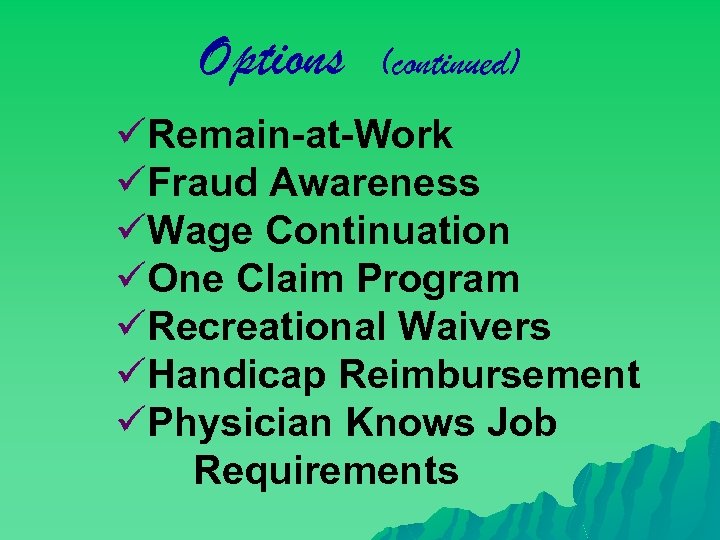
Options (continued) üRemain-at-Work üFraud Awareness üWage Continuation üOne Claim Program üRecreational Waivers üHandicap Reimbursement üPhysician Knows Job Requirements
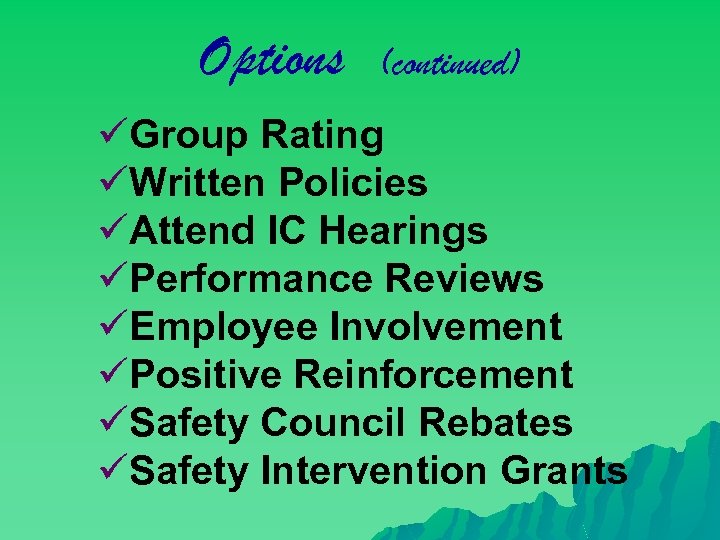
Options (continued) üGroup Rating üWritten Policies üAttend IC Hearings üPerformance Reviews üEmployee Involvement üPositive Reinforcement üSafety Council Rebates üSafety Intervention Grants
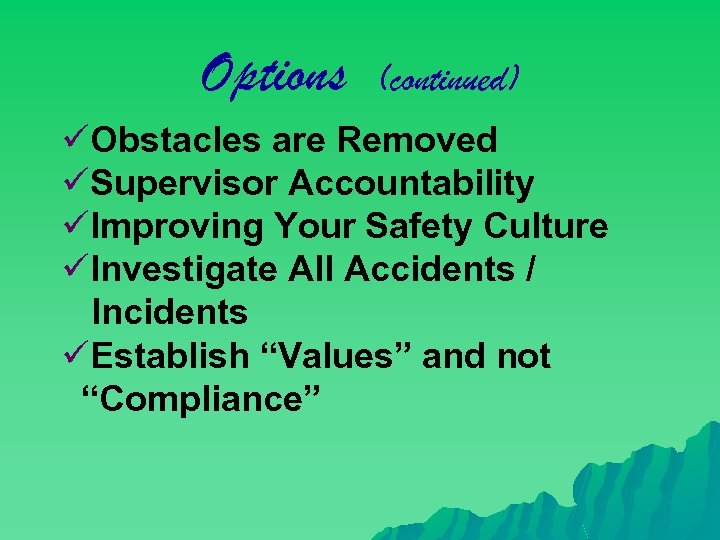
Options (continued) üObstacles are Removed üSupervisor Accountability üImproving Your Safety Culture üInvestigate All Accidents / Incidents üEstablish “Values” and not “Compliance”
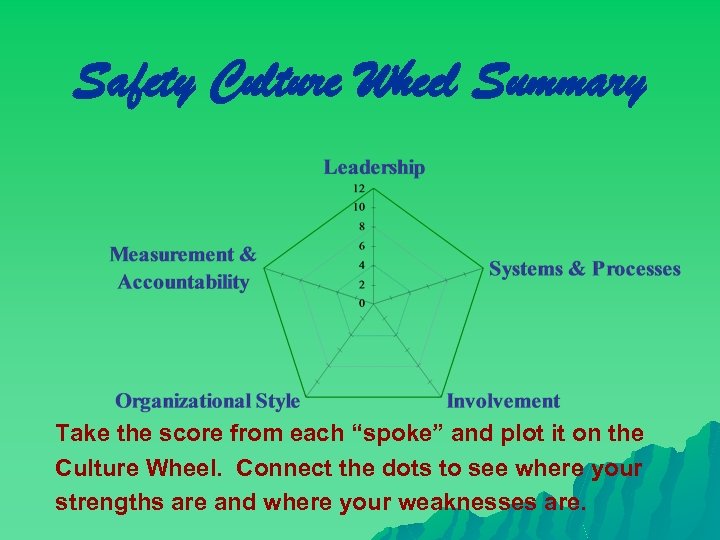
Safety Culture Wheel Summary Take the score from each “spoke” and plot it on the Culture Wheel. Connect the dots to see where your strengths are and where your weaknesses are.
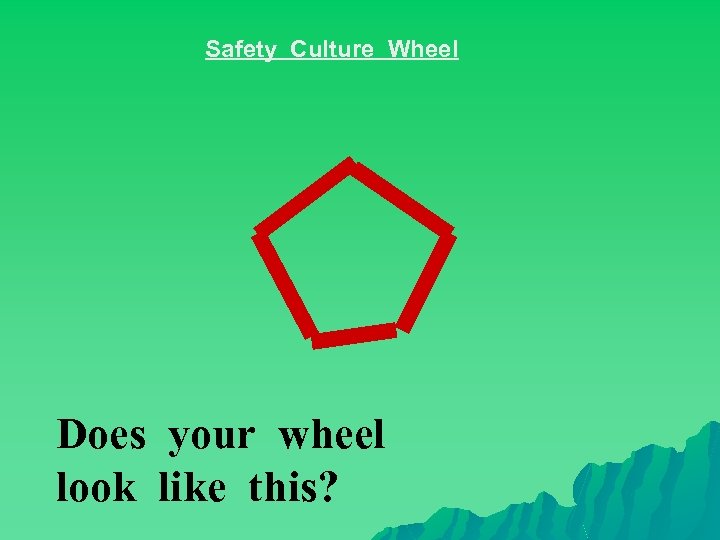
Safety Culture Wheel Does your wheel look like this?
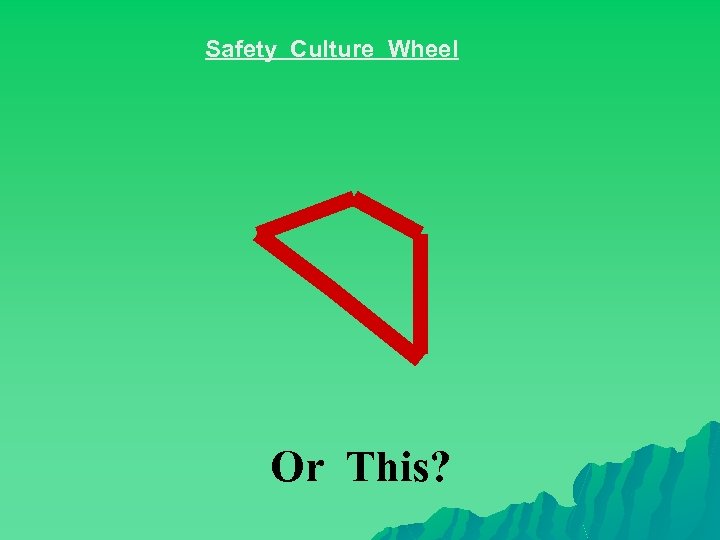
Safety Culture Wheel Or This?
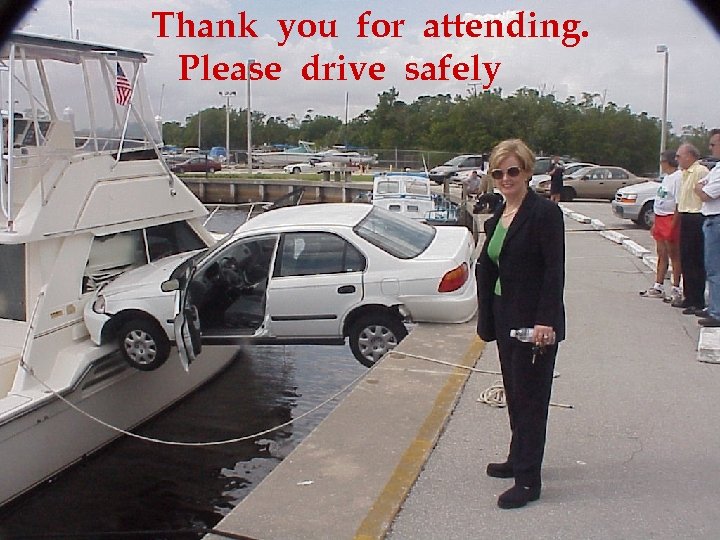
Thank you for attending. Please drive safely
Скачать презентацию controlling Workers compensation costs www ohiobwc com
1143c922e7c380db3d081fc00f2e5134.ppt