


 Скачать презентацию CONTROLLING Monitoring and assessment 1 Answer the
Lecture 20 Djonisova controlling.ppt.pptx
- Количество слайдов: 17
 CONTROLLING: Monitoring and assessment 1
 Answer the questions: Making objective assessment in profile school What to assess: Content or language? Criteria of assessment in Profile school 2
 Content Definitions The main objects of assessment Functions of control Forms of control Types of control 3
 Controlling The process of evaluating and regulating ongoing activities to ensure that goals are achieved “Controlling is the measurement and correction of performance in order to make sure that enterprise objectives and the plans devised to attain them are accomplished” By Harold Koontz 4
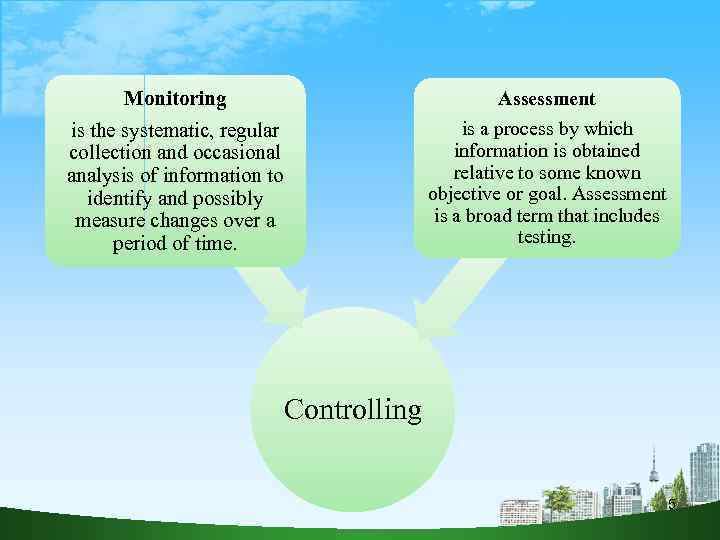 Monitoring Assessment is a process by which information is obtained relative to some known objective or goal. Assessment is a broad term that includes testing. is the systematic, regular collection and occasional analysis of information to identify and possibly measure changes over a period of time. Controlling 5
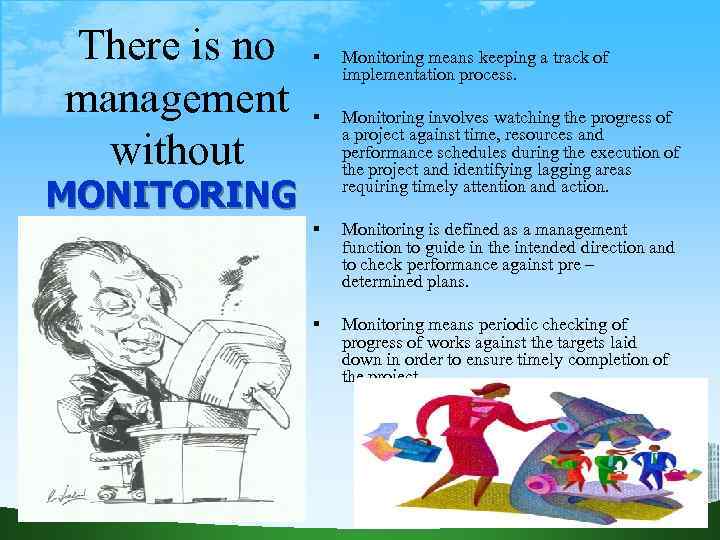 There is no management without Monitoring means keeping a track of implementation process. Monitoring involves watching the progress of a project against time, resources and performance schedules during the execution of the project and identifying lagging areas requiring timely attention and action. Monitoring is defined as a management function to guide in the intended direction and to check performance against pre – determined plans. Monitoring means periodic checking of progress of works against the targets laid down in order to ensure timely completion of the project. MONITORING 6
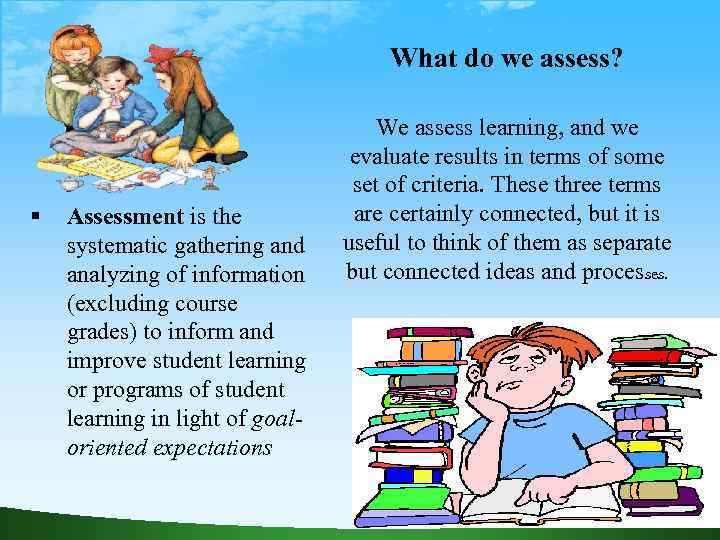 What do we assess? Assessment is the systematic gathering and analyzing of information (excluding course grades) to inform and improve student learning or programs of student learning in light of goaloriented expectations We assess learning, and we evaluate results in terms of some set of criteria. These three terms are certainly connected, but it is useful to think of them as separate but connected ideas and processes. 7
 A brief history of assessment 8
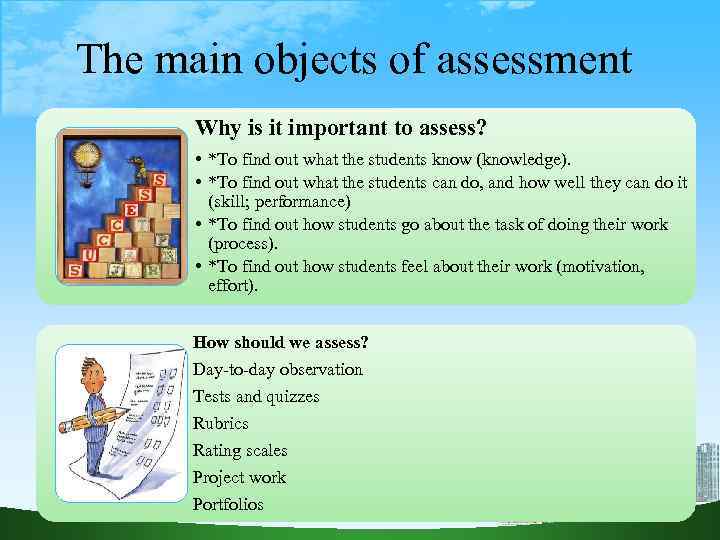 The main objects of assessment Why is it important to assess? • *To find out what the students know (knowledge). • *To find out what the students can do, and how well they can do it (skill; performance) • *To find out how students go about the task of doing their work (process). • *To find out how students feel about their work (motivation, effort). How should we assess? Day-to-day observation Tests and quizzes Rubrics Rating scales Project work Portfolios
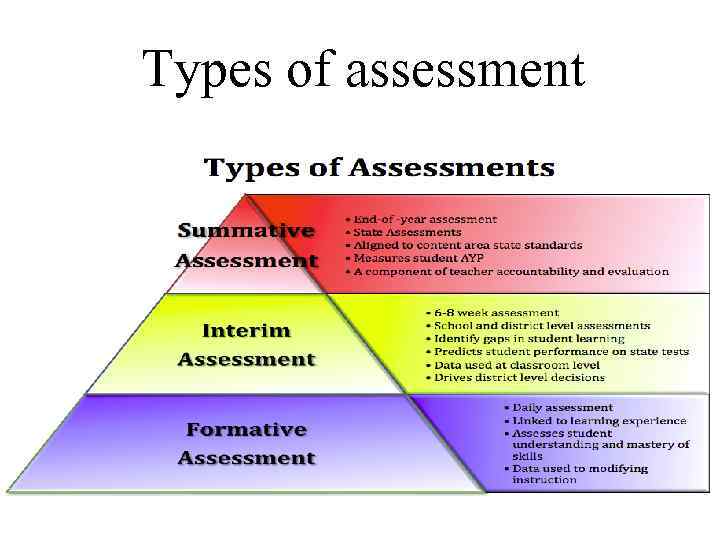 Types of assessment
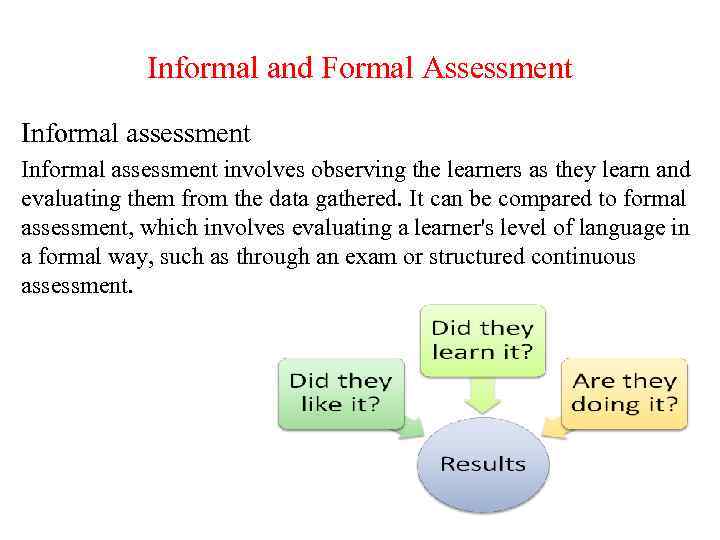 Informal and Formal Assessment Informal assessment involves observing the learners as they learn and evaluating them from the data gathered. It can be compared to formal assessment, which involves evaluating a learner's level of language in a formal way, such as through an exam or structured continuous assessment.
 Example • The teacher has carried out informal assessment of the learners during speaking activities throughout the course by keeping notes about how well individuals are doing in speaking and uses the data gathered to evaluate the learners at the end of the course.
 Formal assessment uses formal tests or structured continuous assessment to evaluate a learner's level of language. It can be compared to informal assessment, which involves observing the learners' performance as they learn and evaluating them from the data gathered.
 Example • At the end of the course, the learners have a final exam to see if they pass to the next course or not. Alternatively, the results of a structured continuous assessment process are used to make the same decision.
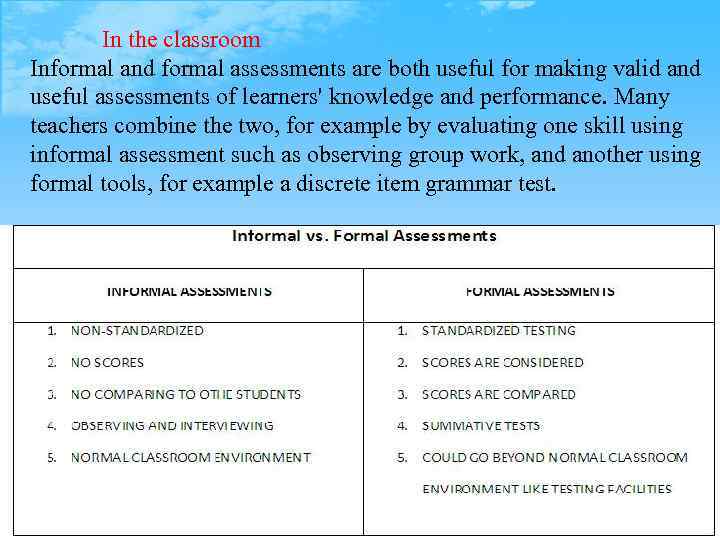 In the classroom Informal and formal assessments are both useful for making valid and useful assessments of learners' knowledge and performance. Many teachers combine the two, for example by evaluating one skill using informal assessment such as observing group work, and another using formal tools, for example a discrete item grammar test.
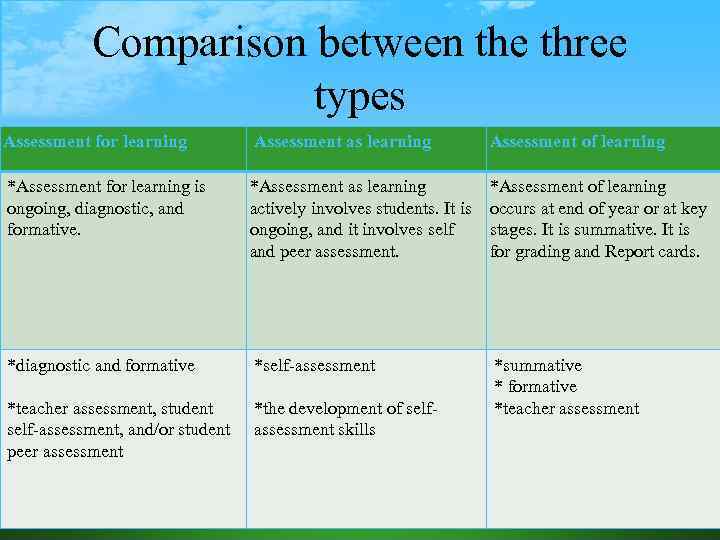 Comparison between the three types Assessment for learning Assessment as learning Assessment of learning *Assessment for learning is ongoing, diagnostic, and formative. *Assessment as learning actively involves students. It is ongoing, and it involves self and peer assessment. *Assessment of learning occurs at end of year or at key stages. It is summative. It is for grading and Report cards. *diagnostic and formative *self-assessment *teacher assessment, student self-assessment, and/or student peer assessment *the development of selfassessment skills *summative * formative *teacher assessment 16
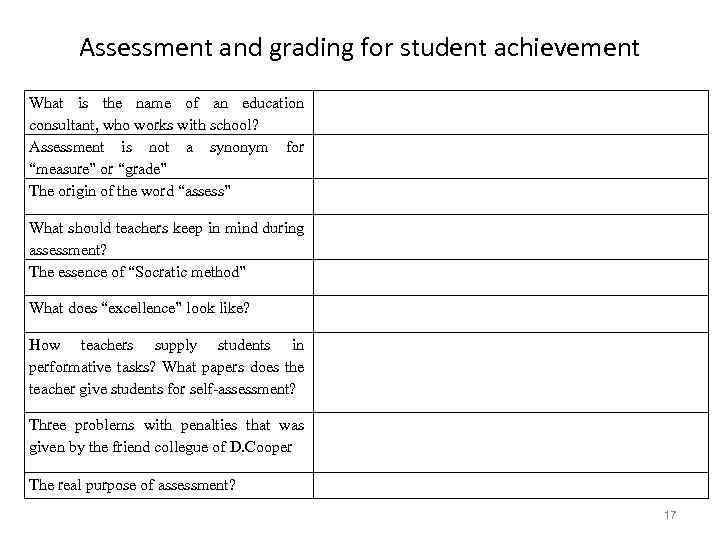 Assessment and grading for student achievement What is the name of an education consultant, who works with school? Assessment is not a synonym for “measure” or “grade” The origin of the word “assess” What should teachers keep in mind during assessment? The essence of “Socratic method” What does “excellence” look like? How teachers supply students in performative tasks? What papers does the teacher give students for self-assessment? Three problems with penalties that was given by the friend collegue of D. Cooper The real purpose of assessment? 17