


 Скачать презентацию Controlling Management EGN 5622 Enterprise Systems Integration Spring
f27a12868681b7d3ad3eb813dad9a059.ppt
- Количество слайдов: 63
 Controlling Management EGN 5622 Enterprise Systems Integration Spring, 2016
 Controlling Management Concepts & Theories
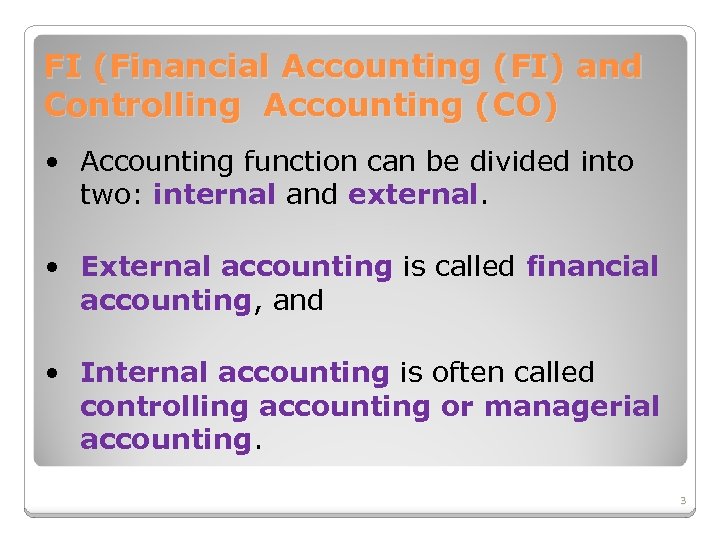 FI (Financial Accounting (FI) and Controlling Accounting (CO) • Accounting function can be divided into two: internal and external. • External accounting is called financial accounting, and • Internal accounting is often called controlling accounting or managerial accounting. 3
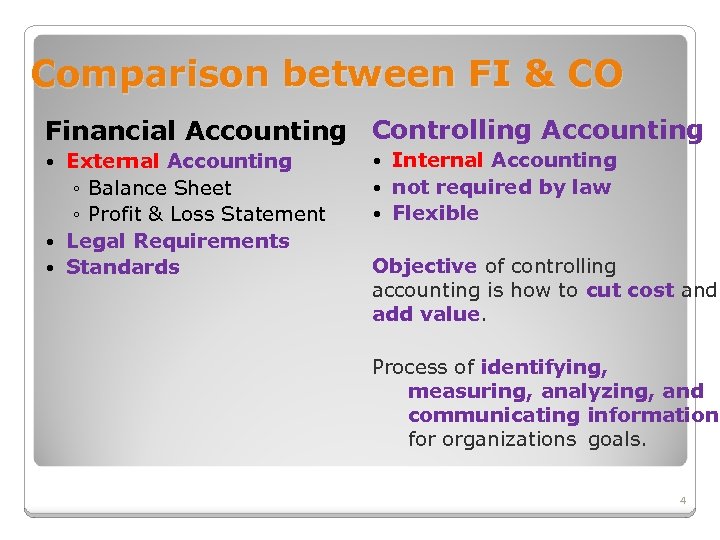 Comparison between FI & CO Financial Accounting Controlling Accounting External Accounting ◦ Balance Sheet ◦ Profit & Loss Statement Legal Requirements Standards Internal Accounting not required by law Flexible Objective of controlling accounting is how to cut cost and add value. Process of identifying, measuring, analyzing, and communicating information for organizations goals. 4
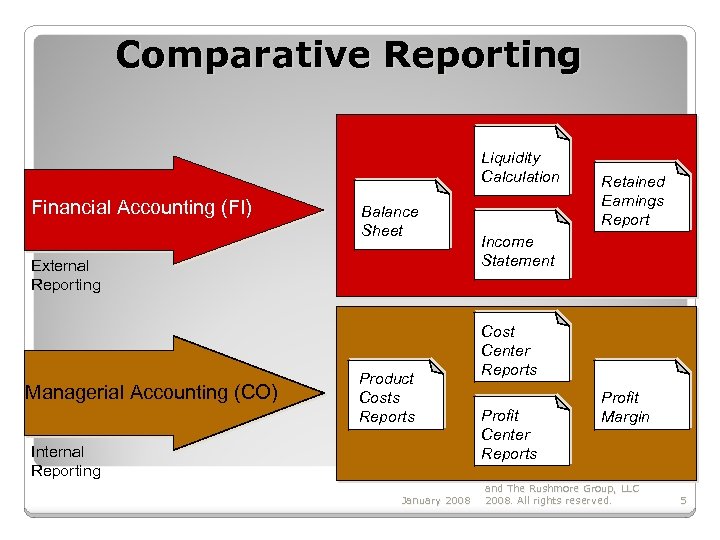 Comparative Reporting Liquidity Calculation Financial Accounting (FI) Balance Sheet External Reporting Managerial Accounting (CO) Product Costs Reports Internal Reporting January 2008 Retained Earnings Report Income Statement Cost Center Reports Profit Margin © SAP AG - University Alliances and The Rushmore Group, LLC 2008. All rights reserved. 5
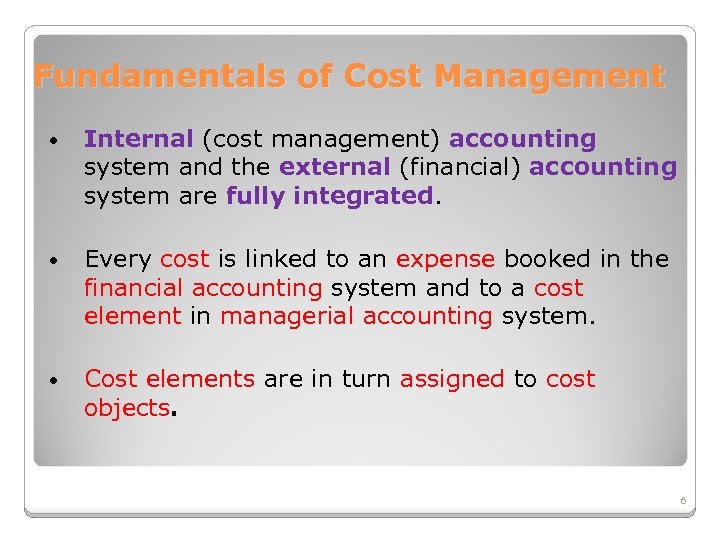 Fundamentals of Cost Management • Internal (cost management) accounting system and the external (financial) accounting system are fully integrated. • Every cost is linked to an expense booked in the financial accounting system and to a cost element in managerial accounting system. • Cost elements are in turn assigned to cost objects. 6
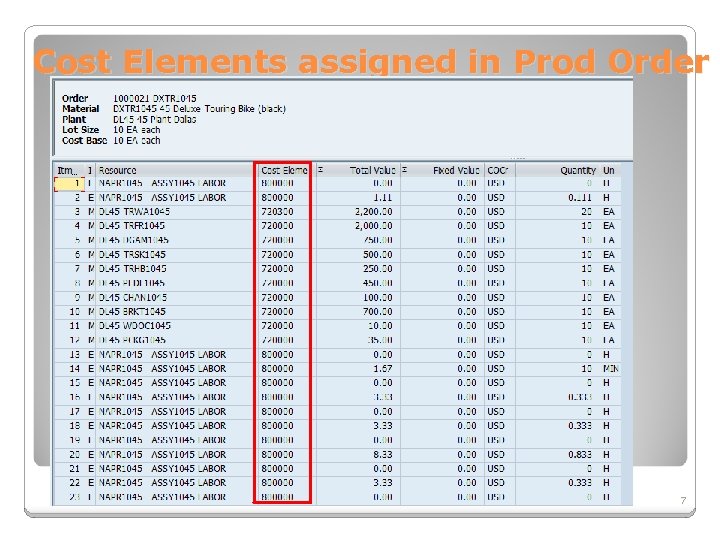 Cost Elements assigned in Prod Order 7
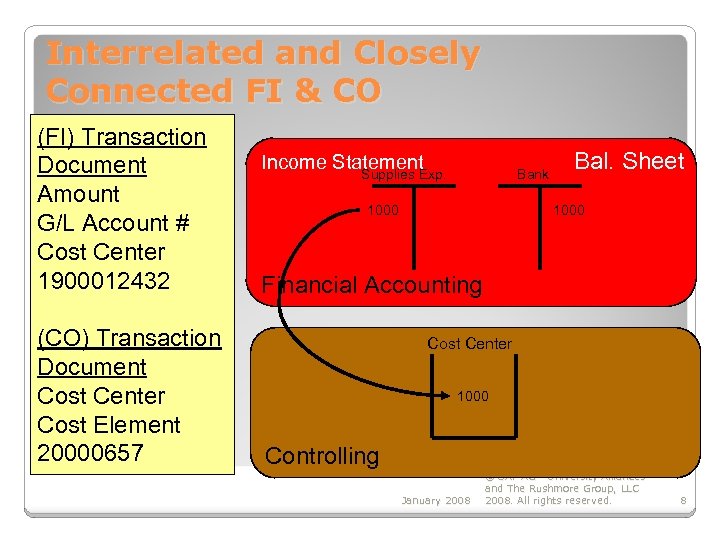 Interrelated and Closely Connected FI & CO (FI) Transaction Document Amount G/L Account # Cost Center 1900012432 (CO) Transaction Document Cost Center Cost Element 20000657 Income Statement Supplies Exp. Bank 1000 Bal. Sheet 1000 Financial Accounting Cost Center 1000 Controlling January 2008 © SAP AG - University Alliances and The Rushmore Group, LLC 2008. All rights reserved. 8
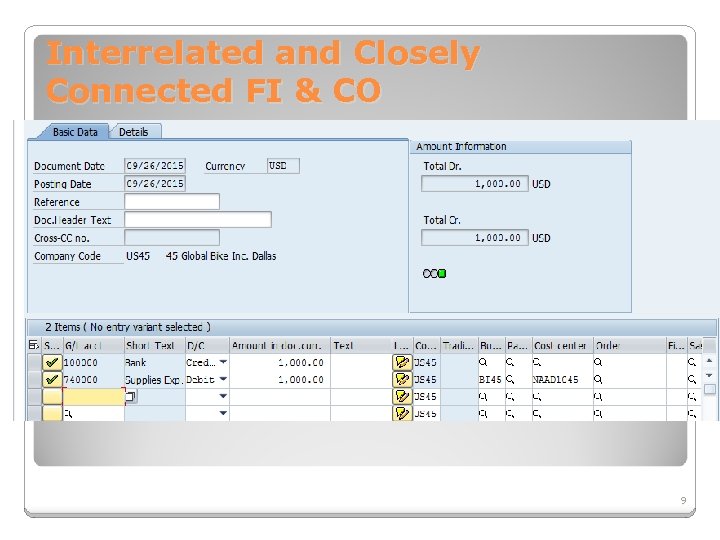 Interrelated and Closely Connected FI & CO Cost Center 9
 Fundamentals of Cost Management • Cost object is a classification of costs desired by the user. It could be a cost center (a department where the cost is incurred), a production order (costs to produce unit 10004232), or a special project (installation of an ERP system), etc. • Cost object is used to aggregate costs for some decision purpose at a later time. For instance, sales/marketing, finance/accounting, and general administration could be three cost centers (objects) in the headquarters under the direction of three different VPs or EVPs. • A cost element can be assigned to multiple cost objects. For example, travel as a cost © SAP AG - University Alliances element may and The Rushmore Group, LLC appear in all cost centers. January 2008. All rights reserved. 10
 Target Audience 1. 2. 3. 4. 5. Executives Senior Management Department Managers Controllers Cost Accountants 11
 Controlling Accounting Terminology Controlling Area 1. 2. 3. 4. 5. 6. A self-contained, organizational element for managerial accounting and reporting system. A controlling area is the highest level organizational entity within the Control module A controlling area may include one or more company codes; therefore, an enterprise can perform management accounting analyses and reports across several companies Each company code can be assigned to one and only one controlling area A way to identify and track where revenues and costs are incurred for evaluation purposes A controlling area is also broken down into two different “standard” hierarchical structures: 1) standard cost center hierarchy; and 2) standard profit center hierarchy 12
 Subcomponents of Controlling Accounting Cost Element Accounting 2. Cost Center accounting 3. Internal Orders, and 4. Profit Center Accounting 1. 13
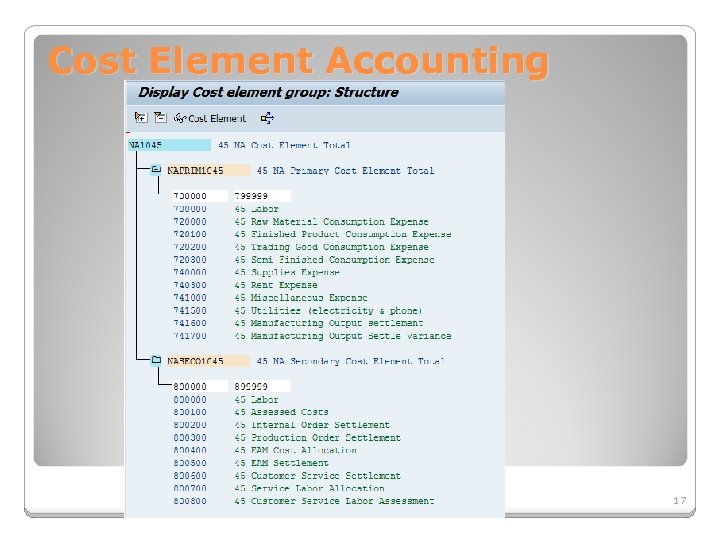
 1. Cost Element Accounting 1. 1 Cost Elements Cost and revenue accounts within a chart of accounts but involved in cost accounting are referred to as “elements, ” which are further divided into • primary cost elements, • primary revenue elements, and • secondary cost elements 14
 Cost Element Accounting 1. 2 Primary Cost and Revenue Element • Primary cost and revenue accounts are created in the FI module first, then the primary cost and revenue accounts created in CO module with the same numbers. The primary cost and revenue accounts/elements are used in the FI and CO modules to account for cost and revenue flows with parties external to the organization. 15
 Cost Element Accounting 1. 3 Secondary Cost Element • Secondary cost elements are created in the CO module only and are used exclusively within the CO to account for internal cost flows among cost objects within a controlling area (e. g. , cost allocations among cost centers). • There are no secondary revenue elements. 16
 Cost Element Accounting 17
 2. Cost Center Accounting (CCA) 1) Cost center accounting (CCA) module is used to assign planned costs and actual costs incurred to areas of cost responsibility within an organization. For example, if a manager wants to know how much it costs to run his department for the month of April, this module can be used to provide the answer. 2) CCA module contains a variety of methods for allocating costs among cost centers and from cost centers to other cost objects (e. g. , internal orders, production orders, profitability segments, etc. ). 18
 2. Cost Center Accounting 2. 1 Cost Centers • Cost center is created for internal controlling purposes and provides a tool for collecting costs. It may be a unit distinguished, for example, by area of responsibility, location, or type of activity, such as • Copy center, Security department, Maintenance department • Can be permanent or temporary (e. g. , internal order) • Operates as a collector and assignor of responsibility for expenditures • Responsible for cost containment, not responsible for revenue generation January 2008 © SAP AG - University Alliances and The Rushmore Group, LLC 2007. All rights reserved. 19
 Cost Center (- continued) • A cost center is the basic organizational responsibility component of a controlling area. • • There is one and only one standard cost center hierarchy for a controlling area. Cost centers may also be linked to a specific business area, company code, and profit center (i. e. , business areas, company codes, profit centers and controlling areas may all be viewed as collections of cost centers). 20
 2. Cost Center Accounting 2. 2 Activity • Any event, action, or transaction that causes a cost to be incurred in the production of a product or the providing of a service. 21
 2. Cost Center Accounting 2. 3 Activity types • Activity types are production or service activities rendered to a work center or cost center that are used to allocate costs. • Activity types generally include different types of labor (e. g. , setup, production labor, machine labor, etc. ) that are performed by personnel within a work center or cost center. • Measure of activity type quantity (e. g. , hours worked), which may be used to allocate all or a portion of the costs of a cost center to other cost objects (e. g. , other cost centers, production orders, profitability segments, etc. ). 22
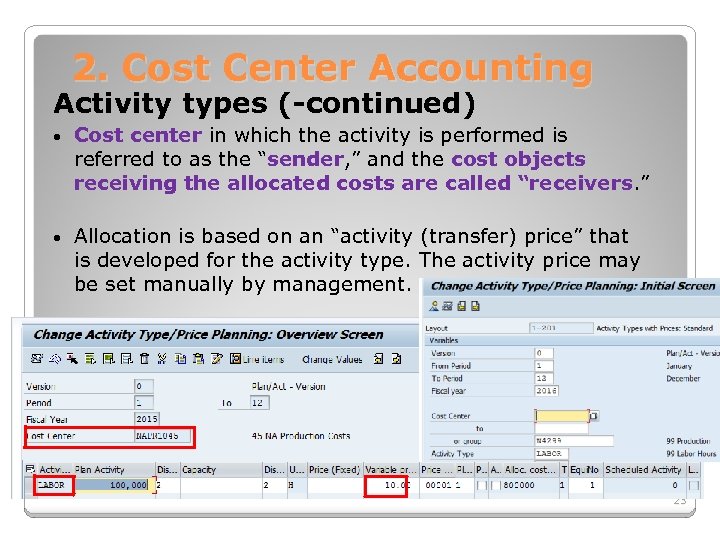 2. Cost Center Accounting Activity types (-continued) • Cost center in which the activity is performed is referred to as the “sender, ” and the cost objects receiving the allocated costs are called “receivers. ” • Allocation is based on an “activity (transfer) price” that is developed for the activity type. The activity price may be set manually by management. 23
 2. Cost Center Accounting 2. 4 Cost Drivers • A cost driver is a factor, such as machine hours, beds occupied, computer usage time, flight hours, or any other factor that causes overhead costs. • Typical cost driver types: activity types and statistical key figures, such square feet or head count. 24
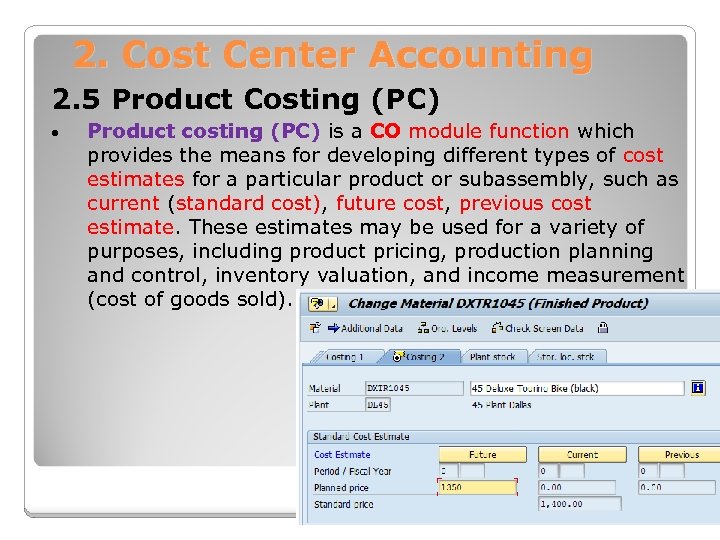 2. Cost Center Accounting 2. 5 Product Costing (PC) • Product costing (PC) is a CO module function which provides the means for developing different types of cost estimates for a particular product or subassembly, such as current (standard cost), future cost, previous cost estimate. These estimates may be used for a variety of purposes, including product pricing, production planning and control, inventory valuation, and income measurement (cost of goods sold). 25
 2. Cost Center Accounting 2. 6 Activity Based Costing (ABC) • Activity based costing (ABC) module provides the means for assigning planned costs and actual costs incurred at the cost center level to business processes. The costs assigned to a business process can in turn be allocated to those cost objects (products, services, customers, etc. ) that utilize the business process. • Cost center resources can allocate to business processes based on their true utilization of activities. 26
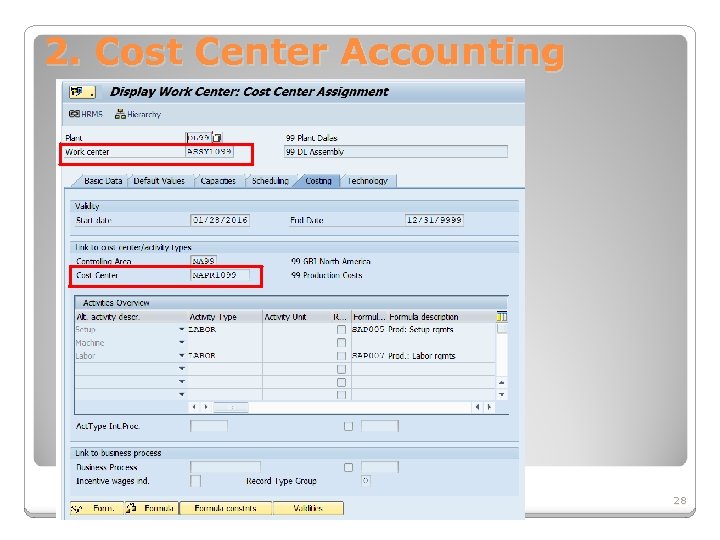
 2. Cost Center Accounting 2. 7 Work Center Work centers are organizational units that perform operation functions within a plant. • A work center might include a production line, quality checkpoint, packaging line, and warehouse. For each operation created in a routing, a work center must be identified. All manufacturing processes are routed through work centers. • Each work center is connected to only one cost center as defined in Work Center Master Records. This way allows costing, scheduling, and capacity planning to be done for each functional production area individually. 27
 2. Cost Center Accounting 28
 3. Internal Order • A method of internal cost allocation by which valuated activities from cost centers can be assigned to cost receivers in accordance with the cause of the cost. • The activities or allocation bases represent the output of a cost center (such as production hours or machine hours). • In internal activity allocation, the activity produced by the cost center is multiplied by the activity price. The result is the cost to be allocated. • Sender cost center is credited with this amount and the receiver object is debited. • Internal orders support task-oriented planning, monitoring, and allocation of costs. 29
 4. Profit Center Accounting (PCA) Profit center accounting is used to analyze income and expenditure for profit centers that represent an independent subunit within an organization. • Profit centers are linked to cost centers with one-to-one or one-to-many relationship. Responsible for revenue generation and cost containment • There is one and only one standard profit center hierarchy for a controlling area. • 30
 4. Profit Center Accounting 4. 2 Profitability Analysis (PA) • Profitability analysis (PA) module provides the means for assigning planned and actual revenues and costs to a variety of profitability segments, including customers, sales territories, sales employee groups, product groups, etc. 31
 Controlling Management SAP Implementation
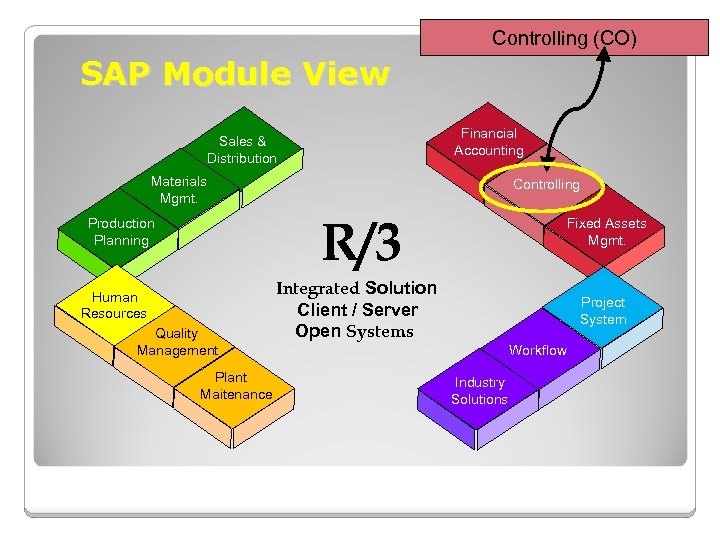 Controlling (CO) SAP Module View Financial Accounting Sales & Distribution Materials Mgmt. Controlling R/3 Production Planning Human Resources Quality Management Plant Maitenance Fixed Assets Mgmt. Integrated Solution Client / Server Open Systems Project System Workflow Industry Solutions
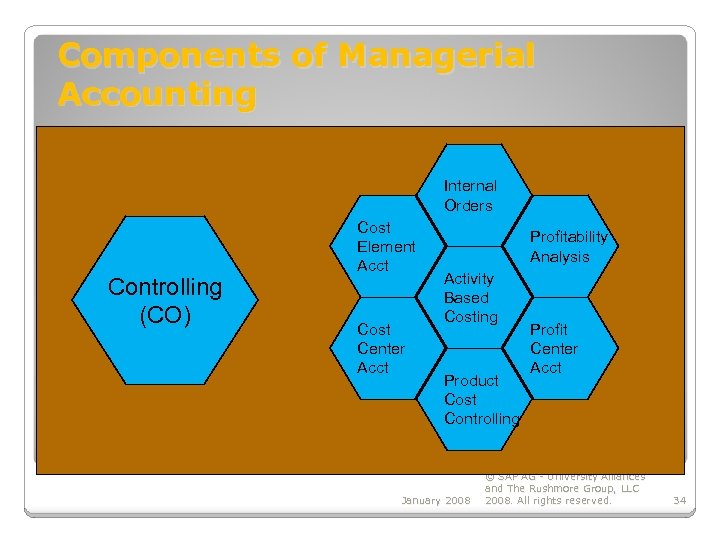 Components of Managerial Accounting Internal Orders Controlling (CO) Cost Element Acct Cost Center Acct Profitability Analysis Activity Based Costing Product Cost Controlling January 2008 Profit Center Acct © SAP AG - University Alliances and The Rushmore Group, LLC 2008. All rights reserved. 34
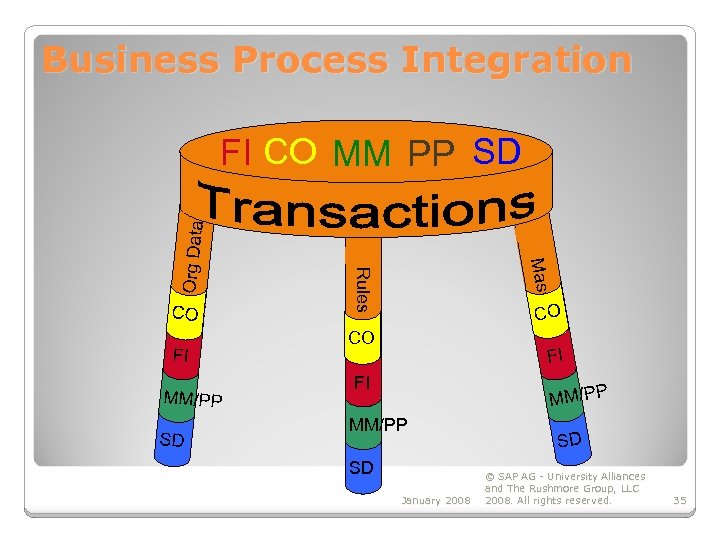 Business Process Integration MM/ P P SD CO Data FI Master CO Rules Org Data FI CO MM PP SD CO FI FI MM/ P P MM/PP SD January 2008 SD © SAP AG - University Alliances and The Rushmore Group, LLC 2008. All rights reserved. 35
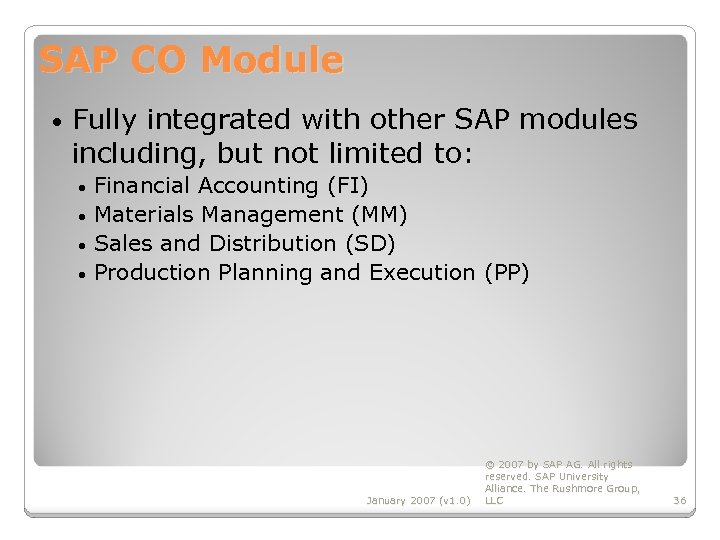 SAP CO Module • Fully integrated with other SAP modules including, but not limited to: • • Financial Accounting (FI) Materials Management (MM) Sales and Distribution (SD) Production Planning and Execution (PP) January 2007 (v 1. 0) © 2007 by SAP AG. All rights reserved. SAP University Alliance. The Rushmore Group, LLC 36
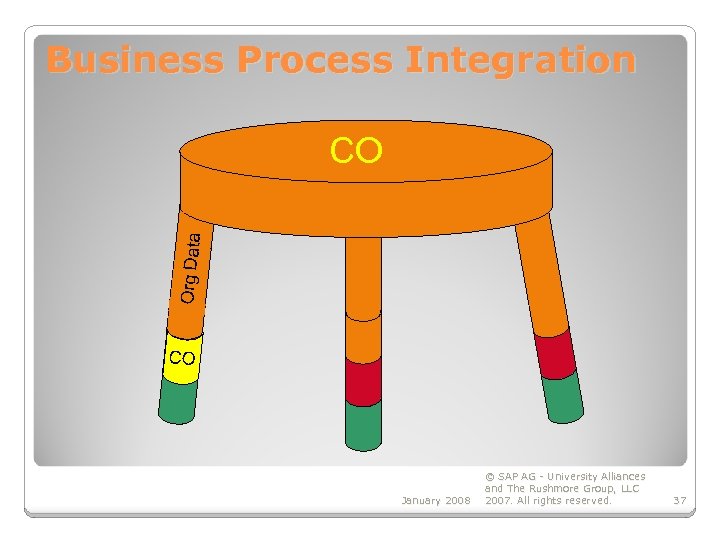 Business Process Integration Org Data CO CO January 2008 © SAP AG - University Alliances and The Rushmore Group, LLC 2007. All rights reserved. 37
 SAP CO Organizational Objects • These objects represent the legal and/or organizational views of an enterprise • They form a framework that supports business activities in the manner desired by management • They permit the accurate and organized collection of business information • They support the development and presentation of relevant information in order to enable and support business decisions 38
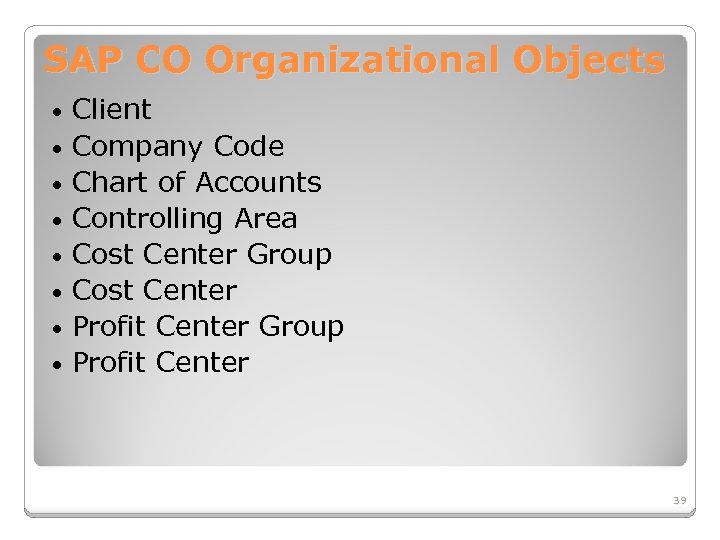 SAP CO Organizational Objects Client • Company Code • Chart of Accounts • Controlling Area • Cost Center Group • Cost Center • Profit Center Group • Profit Center • 39
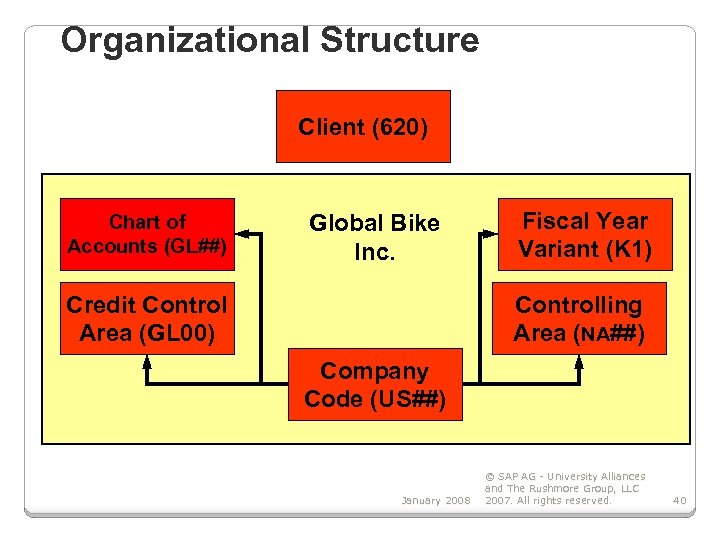 Organizational Structure Client (620) Chart of Accounts (GL##) Global Bike Inc. Credit Control Area (GL 00) Fiscal Year Variant (K 1) Controlling Area (NA##) Company Code (US##) January 2008 © SAP AG - University Alliances and The Rushmore Group, LLC 2007. All rights reserved. 40
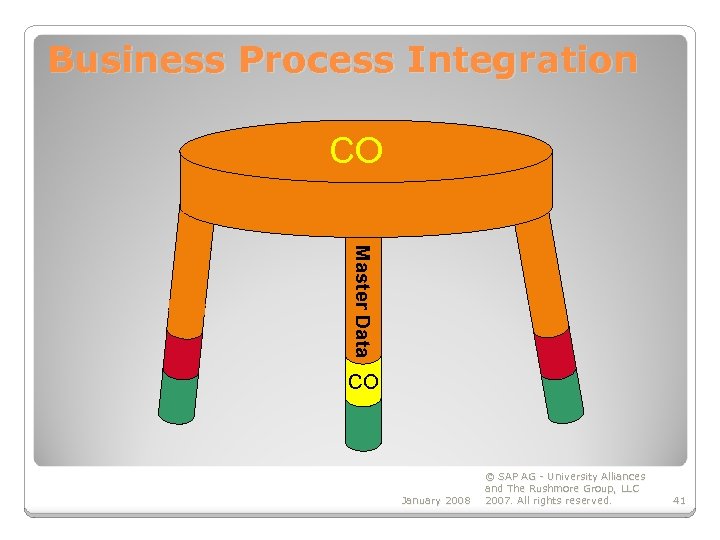 Business Process Integration CO Master Data CO January 2008 © SAP AG - University Alliances and The Rushmore Group, LLC 2007. All rights reserved. 41
 Cost Element Overview Cost Element Groups • Cost Elements • Primary Cost Elements • Secondary Cost Elements • Statistical Key Figures • January 2008 © SAP AG - University Alliances and The Rushmore Group, LLC 2007. All rights reserved. 42
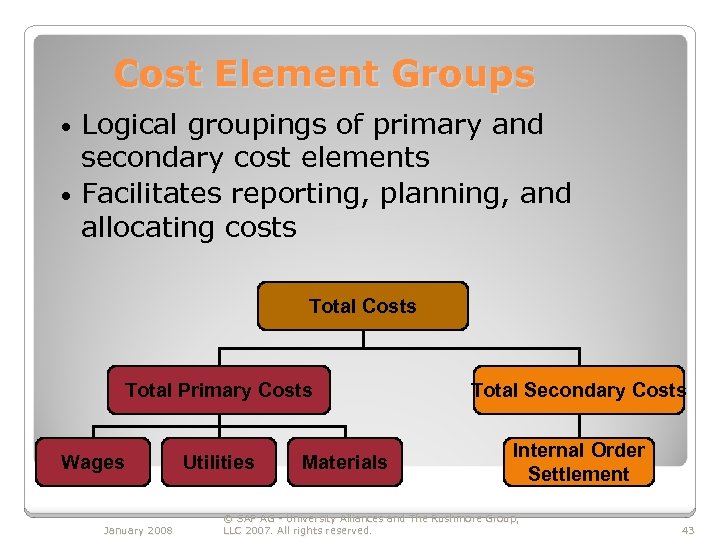 Cost Element Groups Logical groupings of primary and secondary cost elements • Facilitates reporting, planning, and allocating costs • Total Costs Total Primary Costs Wages January 2008 Utilities Materials Total Secondary Costs Internal Order Settlement © SAP AG - University Alliances and The Rushmore Group, LLC 2007. All rights reserved. 43
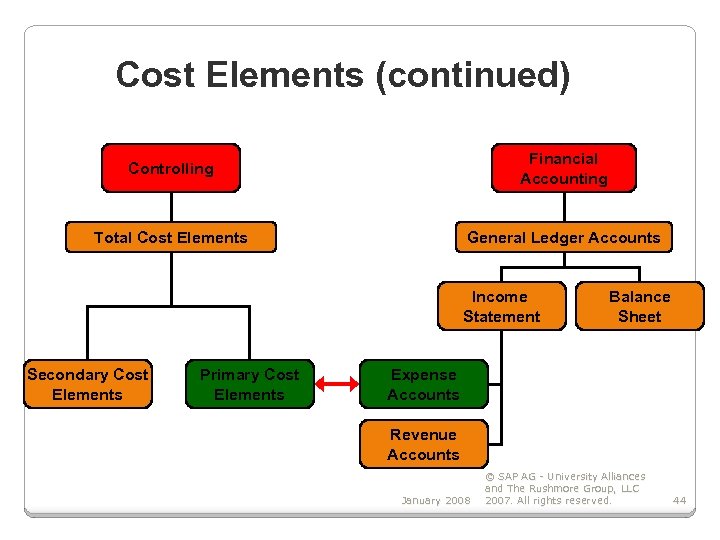 Cost Elements (continued) Controlling Financial Accounting Total Cost Elements General Ledger Accounts Income Statement Secondary Cost Elements Primary Cost Elements Balance Sheet Expense Accounts Revenue Accounts January 2008 © SAP AG - University Alliances and The Rushmore Group, LLC 2007. All rights reserved. 44
 Statistical Key Figures • Provide the foundation for accurate and effective cost allocations between cost objects • Utilized to support internal cost allocations involving allocations, assessments, and distributions • Examples: number of employees, square footage, minutes of computer usage January 2008 © SAP AG - University Alliances and The Rushmore Group, LLC 2007. All rights reserved. 45
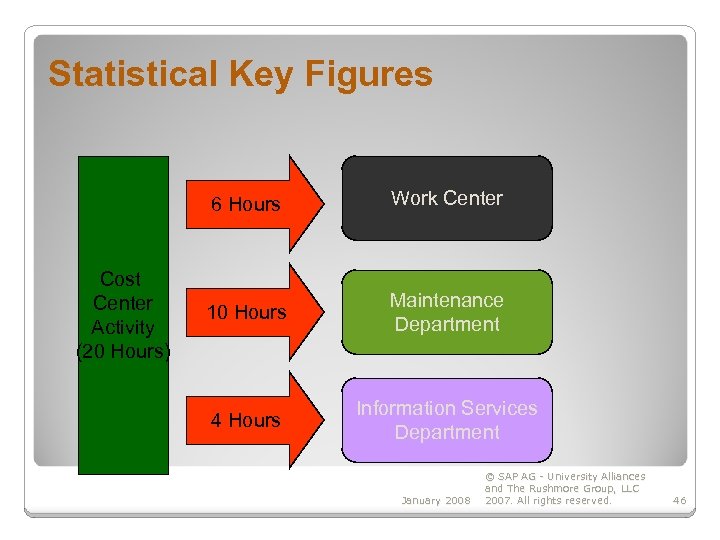 Statistical Key Figures 6 Hours Cost Center Activity (20 Hours) Work Center 10 Hours Maintenance Department 4 Hours Information Services Department January 2008 © SAP AG - University Alliances and The Rushmore Group, LLC 2007. All rights reserved. 46
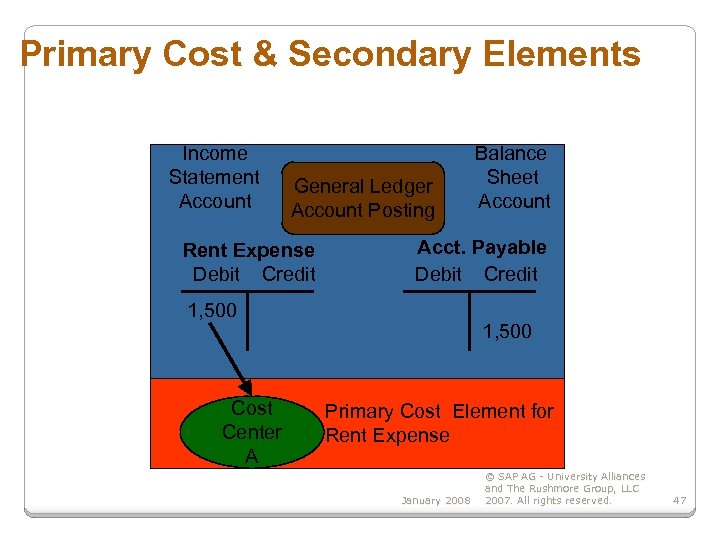 Primary Cost & Secondary Elements Income Statement Account General Ledger Account Posting Rent Expense Debit Credit Acct. Payable Debit Credit 1, 500 Cost Center A Balance Sheet Account 1, 500 Primary Cost Element for Rent Expense January 2008 © SAP AG - University Alliances and The Rushmore Group, LLC 2007. All rights reserved. 47
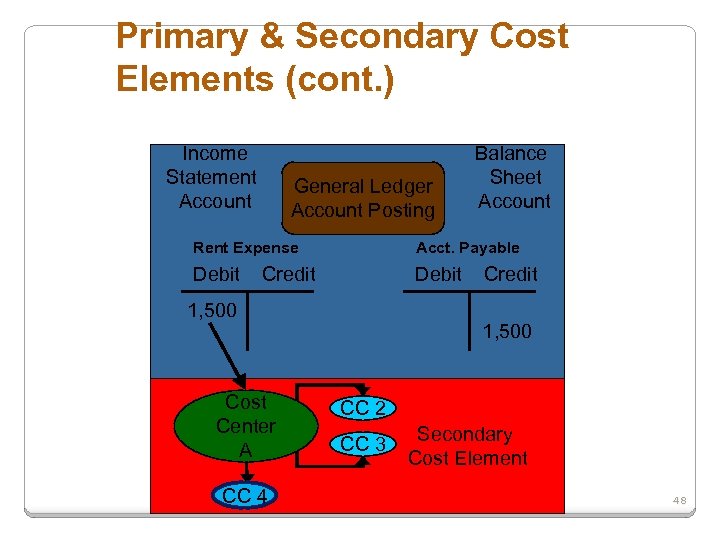 Primary & Secondary Cost Elements (cont. ) Income Statement Account General Ledger Account Posting Balance Sheet Account Rent Expense Acct. Payable Debit Credit 1, 500 Cost Center A CC 4 Credit 1, 500 CC 2 CC 3 Secondary Cost Element January 2008 48
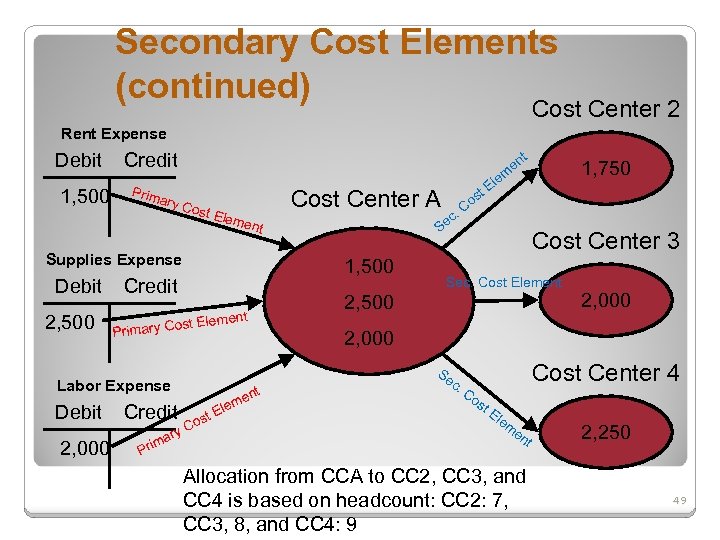 Secondary Cost Elements (continued) Cost Center 2 Rent Expense Debit 1, 500 t en Credit Prim ary C ost E leme nt Supplies Expense Debit 2, 500 Credit t Element 2, 000 r ma Pri st Cost Center 3 Sec. Cost Element 2, 000 nt o y. C . s Co 2, 500 os Primary C Credit t c Se 1, 500 Labor Expense Debit Cost Center A 1, 750 em El e lem E Se c. Co st E Cost Center 4 lem en t Allocation from CCA to CC 2, CC 3, and CC 4 is based on headcount: CC 2: 7, CC 3, 8, and CC 4: 9 2, 250 49
 Business Process Integration CO January 2008 © SAP AG - University Alliances and The Rushmore Group, LLC 2007. All rights reserved. 50
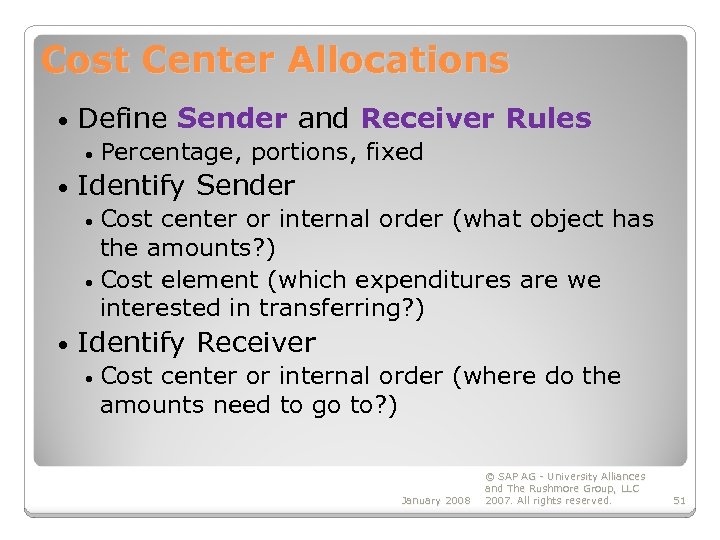 Cost Center Allocations • Define Sender and Receiver Rules • • Percentage, portions, fixed Identify Sender Cost center or internal order (what object has the amounts? ) • Cost element (which expenditures are we interested in transferring? ) • • Identify Receiver • Cost center or internal order (where do the amounts need to go to? ) January 2008 © SAP AG - University Alliances and The Rushmore Group, LLC 2007. All rights reserved. 51
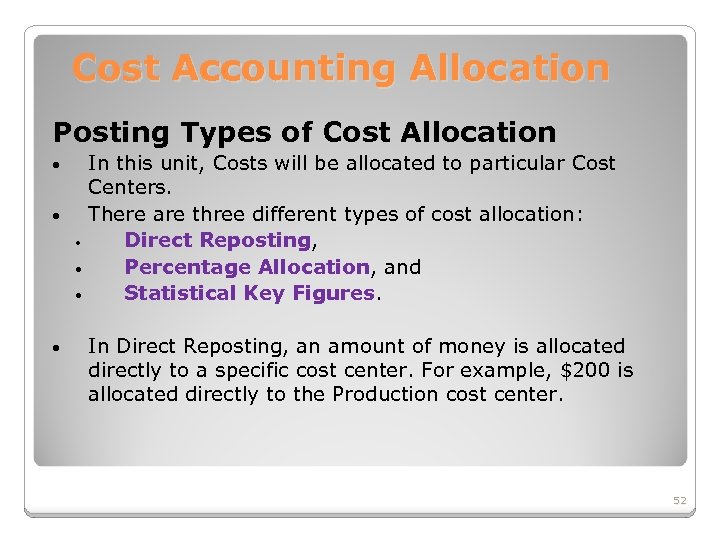 Cost Accounting Allocation Posting Types of Cost Allocation In this unit, Costs will be allocated to particular Cost Centers. • There are three different types of cost allocation: • Direct Reposting, • Percentage Allocation, and • Statistical Key Figures. • • In Direct Reposting, an amount of money is allocated directly to a specific cost center. For example, $200 is allocated directly to the Production cost center. 52
 Cost Accounting Allocation Posting Types of Cost Allocation (continued) • In Percentage Allocation, the amount that is to be allocated is split up among multiple cost centers based on a predetermined percentage. • For instance, assume that there are two services, and 70% of the cost is to be assigned to one service, while 30% is assigned to the other. In addition, the total costs to be allocated equal $2, 500. Because the first service is to be allocated 70% of the cost, it will be allocated $1750. Likewise, the second service which is to be allocated 30% of the cost will be allocated for the remaining $750. . 53
 Cost Accounting Allocation Posting Types of Cost Allocation (continued) • Statistical Key Figures (SKFs) are used in the ERP system to allocate costs from a service department to a user department at the closing of a period. These cost drivers, which are often referred to as tracing factors, are used in allocation methods that do not involve the explicit development of activity (transfer) prices. 54
 Types of Allocations Cycles Distributions – primary cost elements Assessments – combination of primary and/or secondary cost elements January 2007 (v 1. 0) © 2007 by SAP AG. All rights reserved. SAP University Alliance. The Rushmore Group, LLC 55
 Distribution Cycle Method for periodically allocating primary cost elements Primary cost elements maintain their identities in both the sending and receiving objects Sender and receiver cost centers are fully documented in a unique Controlling (CO) document 56
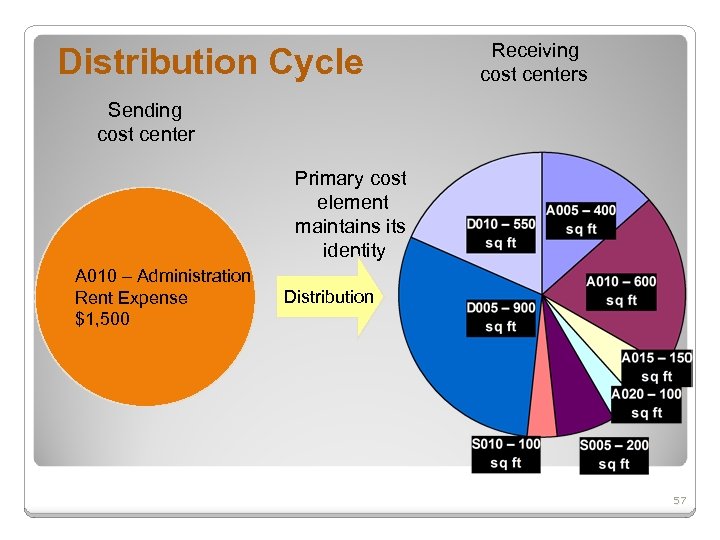 Distribution Cycle Receiving cost centers Sending cost center Primary cost element maintains its identity A 010 – Administration Rent Expense $1, 500 Distribution 57
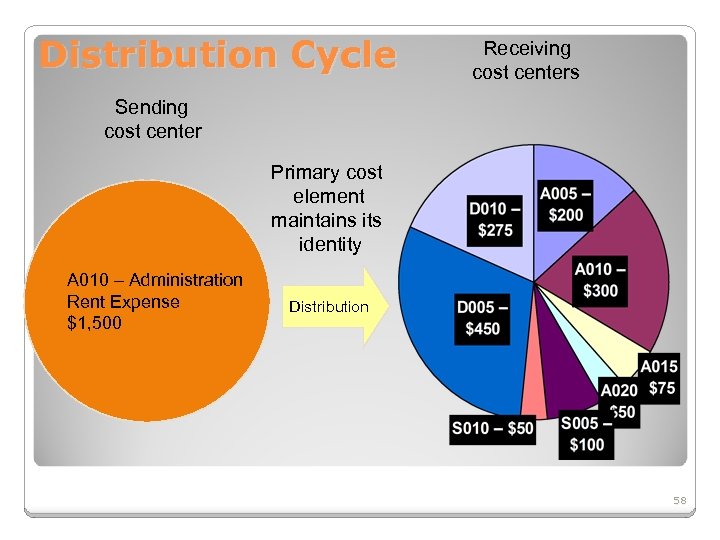 Distribution Cycle Receiving cost centers Sending cost center Primary cost element maintains its identity A 010 – Administration Rent Expense $1, 500 Distribution 58
 Assessment Cycle A method of allocating both primary and secondary cost elements Primary and/or secondary cost elements are grouped together and transferred to receiver cost centers through use of a secondary cost element Sender and receiver cost centers are fully documented in a unique Controlling (CO) document January 2007 (v 1. 0) © 2007 by SAP AG. All rights reserved. SAP University Alliance. The Rushmore Group, LLC 59
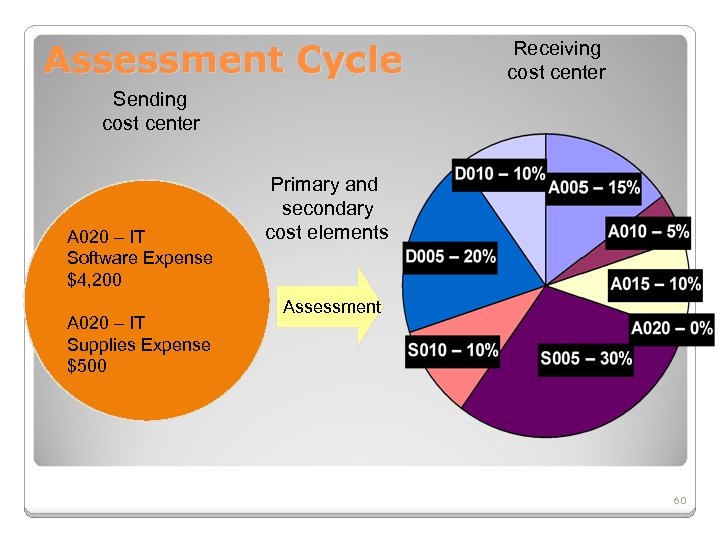 Assessment Cycle Receiving cost center Sending cost center A 020 – IT Software Expense $4, 200 A 020 – IT Supplies Expense $500 Primary and secondary cost elements Assessment 60
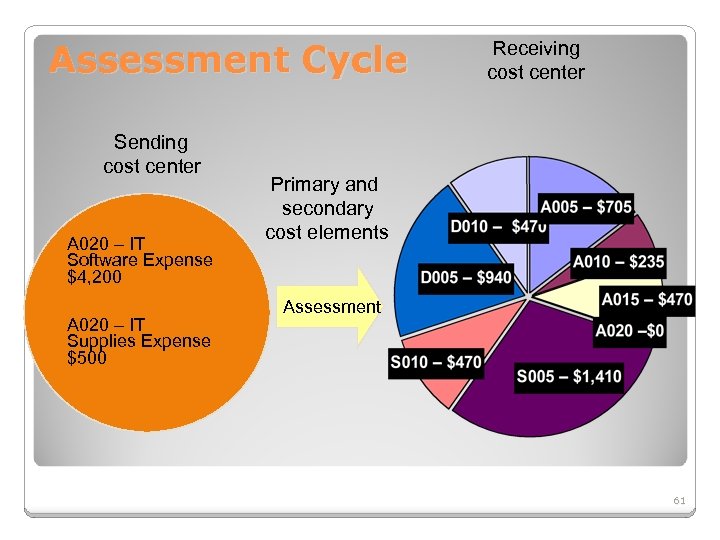 Assessment Cycle Sending cost center A 020 – IT Software Expense $4, 200 A 020 – IT Supplies Expense $500 Receiving cost center Primary and secondary cost elements Assessment 61
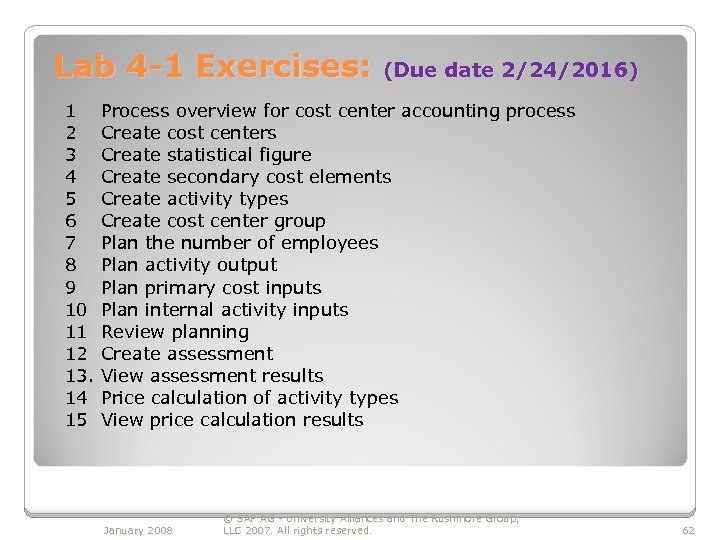 Lab 4 -1 Exercises: (Due date 2/24/2016) 1 Process overview for cost center accounting process 2 Create cost centers 3 Create statistical figure 4 Create secondary cost elements 5 Create activity types 6 Create cost center group 7 Plan the number of employees 8 Plan activity output 9 Plan primary cost inputs 10 Plan internal activity inputs 11 Review planning 12 Create assessment 13. View assessment results 14 Price calculation of activity types 15 View price calculation results January 2008 © SAP AG - University Alliances and The Rushmore Group, LLC 2007. All rights reserved. 62
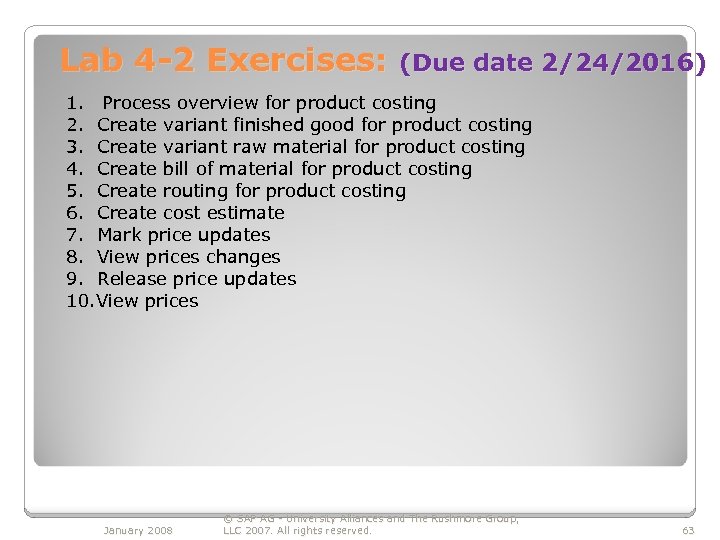 Lab 4 -2 Exercises: (Due date 2/24/2016) 1. Process overview for product costing 2. Create variant finished good for product costing 3. Create variant raw material for product costing 4. Create bill of material for product costing 5. Create routing for product costing 6. Create cost estimate 7. Mark price updates 8. View prices changes 9. Release price updates 10. View prices January 2008 © SAP AG - University Alliances and The Rushmore Group, LLC 2007. All rights reserved. 63