 Скачать презентацию Controlling Climate Change and Fostering sustainable Development in
3b0e144e6753f912d5f2b45e001c7462.ppt
- Количество слайдов: 35



Controlling Climate Change and Fostering (sustainable) Development in an Economic Crisis – Can we have it all? Diana Ürge-Vorsatz Climate Change and Higher Education, Feb 26, 2009, CEU
Outline v CC science: CC is here and can be attributed to humans v Stabilisation is a Herculean task, but doable v Choice of stabilisation pathway determines SD implications v The free lunch you are paid to eat v Your potential role in helping the world to eat the free lunches 3 CSEP
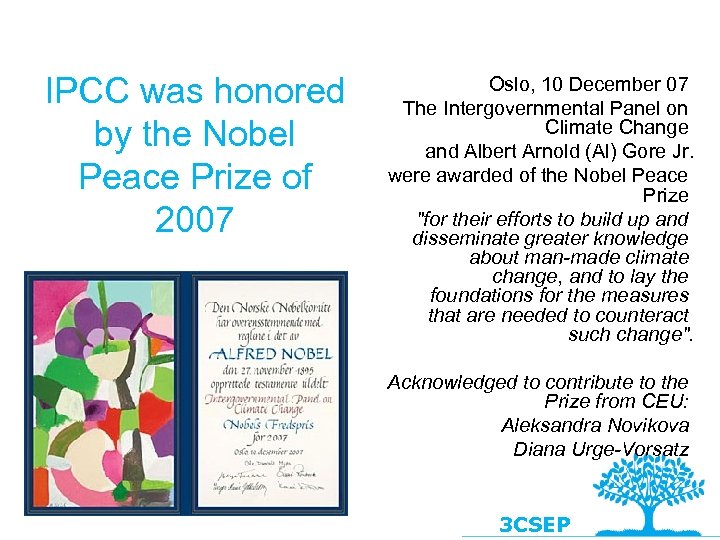
IPCC was honored by the Nobel Peace Prize of 2007 Oslo, 10 December 07 The Intergovernmental Panel on Climate Change and Albert Arnold (Al) Gore Jr. were awarded of the Nobel Peace Prize "for their efforts to build up and disseminate greater knowledge about man-made climate change, and to lay the foundations for the measures that are needed to counteract such change". Acknowledged to contribute to the Prize from CEU: Aleksandra Novikova Diana Urge-Vorsatz 3 CSEP
Climate change: background from the IPCC AR 4
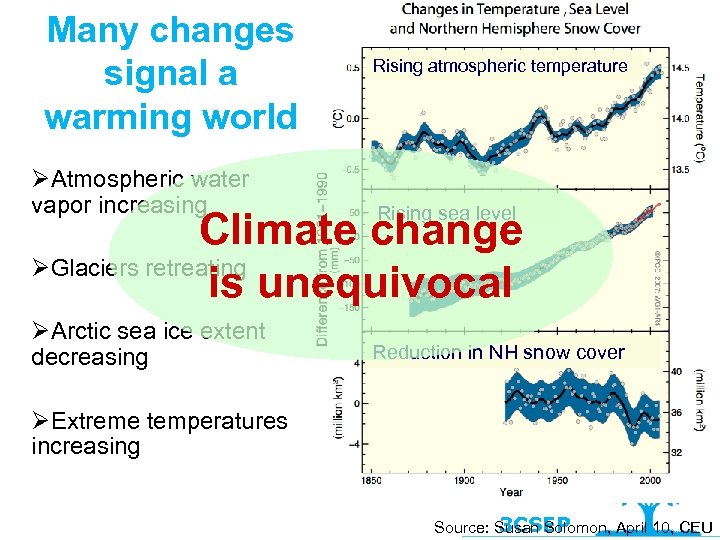
Many changes signal a warming world Rising atmospheric temperature ØAtmospheric water vapor increasing Rising sea level ØArctic sea ice extent decreasing Reduction in NH snow cover Climate change ØGlaciers retreating is unequivocal ØExtreme temperatures increasing 3 CSEP Source: Susan Solomon, April 10, CEU
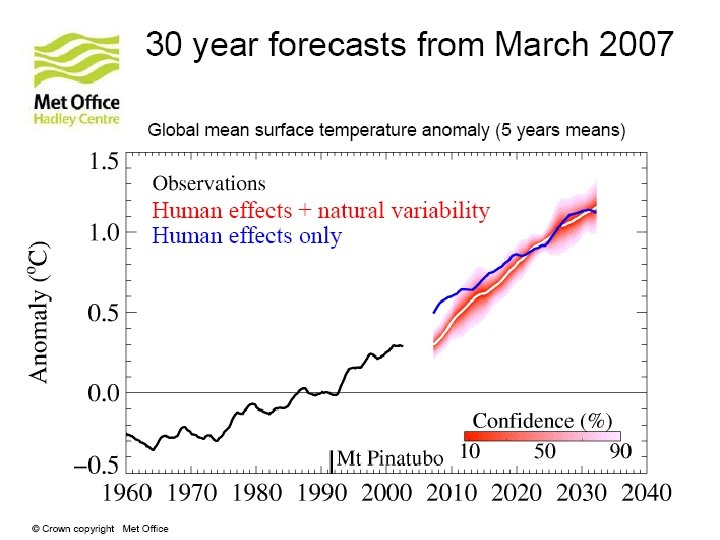
3 CSEP
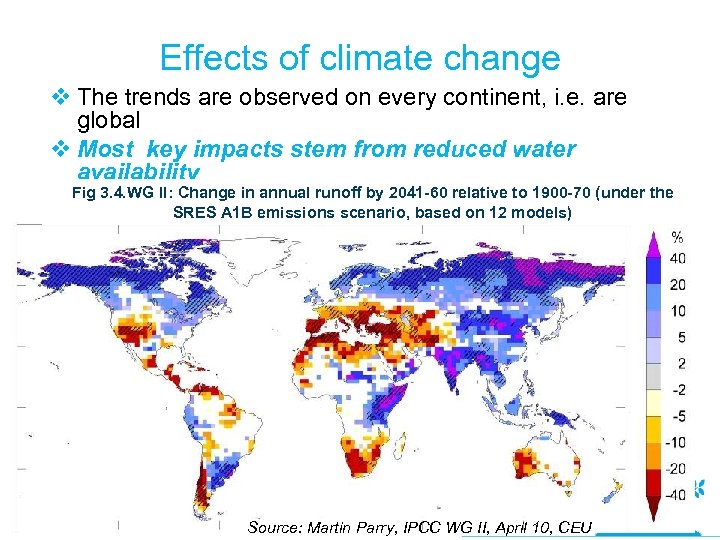
Effects of climate change v The trends are observed on every continent, i. e. are global v Most key impacts stem from reduced water availability Fig 3. 4. WG II: Change in annual runoff by 2041 -60 relative to 1900 -70 (under the SRES A 1 B emissions scenario, based on 12 models) 3 CSEP Source: Martin Parry, IPCC WG II, April 10, CEU
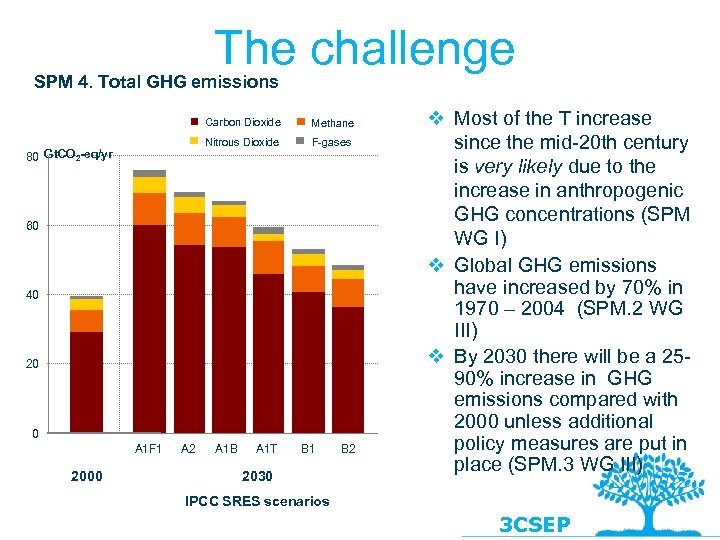
The challenge SPM 4. Total GHG emissions Carbon Dioxide Nitrous Dioxide 80 Gt. CO 2 -eq/yr Methane F-gases 60 40 20 0 A 1 F 1 2000 A 2 A 1 B A 1 T B 1 2030 B 2 v Most of the T increase since the mid-20 th century is very likely due to the increase in anthropogenic GHG concentrations (SPM WG I) v Global GHG emissions have increased by 70% in 1970 – 2004 (SPM. 2 WG III) v By 2030 there will be a 2590% increase in GHG emissions compared with 2000 unless additional policy measures are put in place (SPM. 3 WG III) IPCC SRES scenarios 3 CSEP
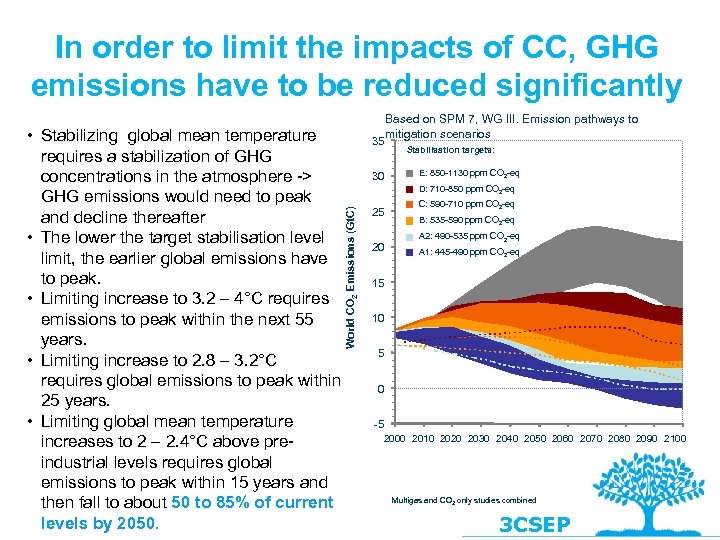
In order to limit the impacts of CC, GHG emissions have to be reduced significantly 35 30 Stabilisation targets: E: 850 -1130 ppm CO 2 -eq D: 710 -850 ppm CO 2 -eq World CO 2 Emissions (Gt. C) • Stabilizing global mean temperature requires a stabilization of GHG concentrations in the atmosphere -> GHG emissions would need to peak and decline thereafter • The lower the target stabilisation level limit, the earlier global emissions have to peak. • Limiting increase to 3. 2 – 4°C requires emissions to peak within the next 55 years. • Limiting increase to 2. 8 – 3. 2°C requires global emissions to peak within 25 years. • Limiting global mean temperature increases to 2 – 2. 4°C above preindustrial levels requires global emissions to peak within 15 years and then fall to about 50 to 85% of current levels by 2050. Based on SPM 7, WG III. Emission pathways to mitigation scenarios 25 20 C: 590 -710 ppm CO 2 -eq B: 535 -590 ppm CO 2 -eq A 2: 490 -535 ppm CO 2 -eq A 1: 445 -490 ppm CO 2 -eq 15 10 5 0 -5 2000 2010 2020 2030 2040 2050 2060 2070 2080 2090 2100 Multigas and CO 2 only studies combined 3 CSEP
Stabilising climate change in a period of economic crisis? v Stabilising climate change at a low T increase (such as 2 C) is a Herculean challenge v However, the IPCC has stated that it is feasible q “The range of stabilization levels assessed can be achieved by deployment of a portfolio of technologies that are currently available and those that are expected to be commercialised in coming decades. ” v The stabilisation path we choose determines the impact of mitigation efforts on (sustainable) development v Some options are more challenging to implement in a financial/economic crisis than others v There are important synergistic opportunities among CC mitigation, SD and mitigating the impact of the global economic crisis – energy efficiency is a key climate lever 3 CSEP
Having it all: (sustainable) development, CC mitigation and crisis impact alleviation The role and benefits of improved energy efficiency
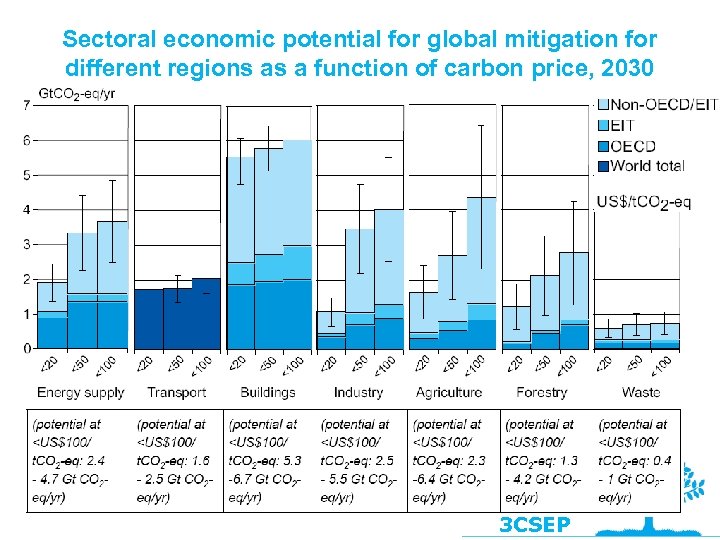
Sectoral economic potential for global mitigation for different regions as a function of carbon price, 2030 3 CSEP
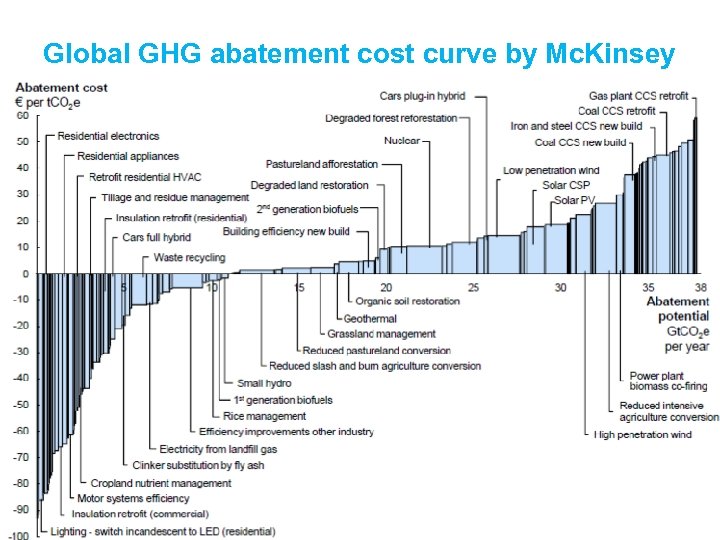
Global GHG abatement cost curve by Mc. Kinsey 3 CSEP
Mitigation through improved efficiency: global importance v Capturing only the cost-effective potential in buildings can supply app. 38% of total reduction needed in 2030 to keep us on a trajectory capping warming at 3˚C v As much as 80% of the operational emissions of standard new and existing buildings can be saved through integrated design principles and renovation q Often at no or little extra cost 3 CSEP
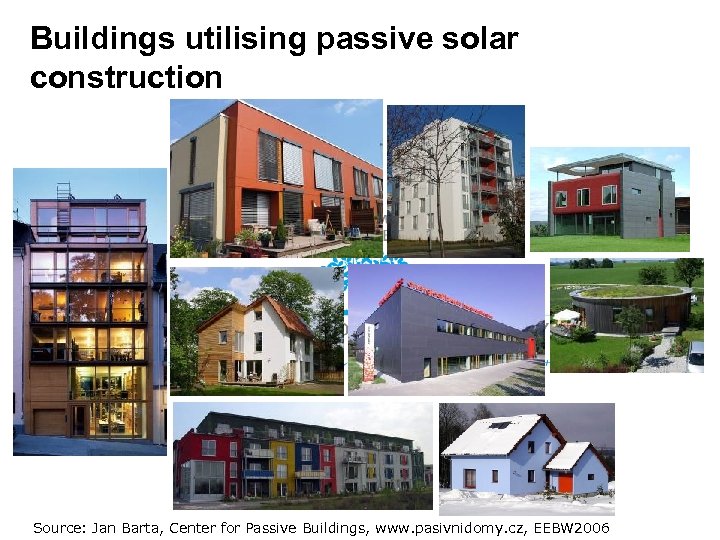
Buildings utilising passive solar construction Source: Jan Barta, Center for Passive Buildings, www. pasivnidomy. cz, EEBW 2006
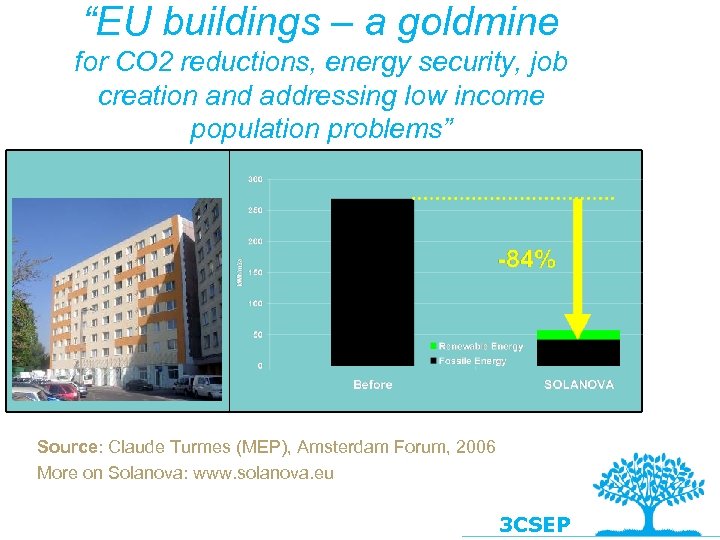
“EU buildings – a goldmine for CO 2 reductions, energy security, job creation and addressing low income population problems” Source: Claude Turmes (MEP), Amsterdam Forum, 2006 More on Solanova: www. solanova. eu 3 CSEP
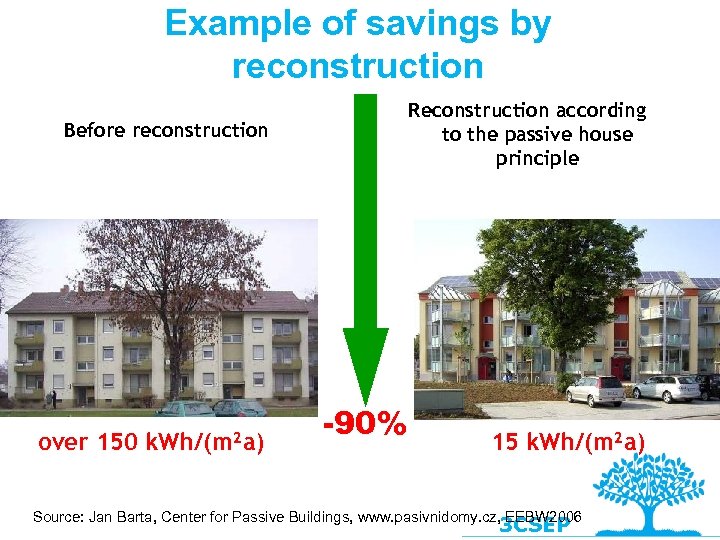
Example of savings by reconstruction Reconstruction according to the passive house principle Before reconstruction over 150 k. Wh/(m²a) -90% 15 k. Wh/(m²a) Source: Jan Barta, Center for Passive Buildings, www. pasivnidomy. cz, EEBW 2006 3 CSEP
Mitigation in the buildings sector: global importance v Capturing only the cost-effective potential in buildings can supply app. 38% of total reduction needed in 2030 to keep us on a trajectory capping warming at 3˚C v As much as 80% of the operational emissions of standard new and existing buildings can be saved through integrated design principles and renovation q Often at no or little extra cost v Net zero energy/emission, or even negative energy buildings are dynamically growing 3 CSEP
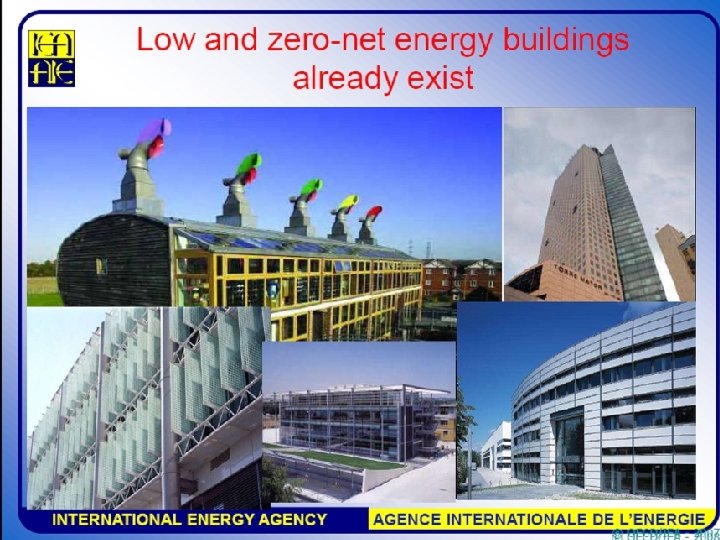
Applicability of energy efficiency technologies in different regions 2. Selected illustrative technologies, emphasis on advanced systems, the rating of which is different between countries 3 CSEP
Mitigation in the buildings sector: global importance v Capturing only the cost-effective potential in buildings can supply app. 38% of total reduction needed in 2030 to keep us on a trajectory capping warming at 3˚C v As much as 80% of the operational emissions of standard new and existing buildings can be saved through integrated design principles and renovation q Often at no or little extra cost v Net zero energy/emission, or even negative energy buildings are dynamically growing v A large share of these options have “negative costs” – i. e. represent profitable investment opportunities 3 CSEP
The free lunch you are paid to eat: the co-benefits of mitigation through EE 1. v Co-benefits are often not quantified, monetized, or identified v Overall value of co-benefits may be higher than value of energy savings v A wide range of co-benefits, including: v Reduced morbidity and mortality q App. 2. 2 million deaths attributable to indoor air pollution each year from biomass (wood, charcoal, crop residues and dung) and coal burning for household cooking and heating, in addition to acute respiratory infections in young children and chronic pulmonary disease in adults q Gender benefits: women and children also collect biomass fuel, they can work or go to school instead 3 CSEP
The free lunch you are paid to eat: the co-benefits of mitigation through EE 1. v Poverty alleviation and Improved social welfare q Fuel poverty: In the UK, about 20% of all households live in fuel poverty. The number of annual excess winter deaths is estimated at around 30 thousand annually in the UK alone. q Energy-efficient household equipment and low-energy building design helps alleviate poverty and households cope with increasing energy tariffs v Employment creation q “producing” energy through energy efficiency or renewables is more employment intensive than through traditional ways q a 20% reduction in EU energy consumption by 2020 can potentially create 1 mil new jobs in Europe v new business opportunities q a market opportunity of € 5– 10 billion in energy service markets in Europe v Reduced energy costs will make businesses more competitive v Others: q Improved energy security, reduced burden of constrained generation capacities, Increased value for real estate, Improved energy services (lighting, thermal comfort, etc) can improve productivity, Improved outdoor air quality, improved comfort, etc. 3 CSEP
So why isn’t everyone eating free lunches? v There are significant market barriers that prevent markets to capture the energy-efficient solutions q. Including agent/principal barriers and misplaced incentives, distorted energy tariffs and subsidies, lack of knowledge and awareness, lack of experts, etc. v For an ambitious stabilisation pathway embarking on efficiency a complete rethink is needed how we conceptualise energy q. Provide energy services rather than energy per se v How will YOU catalise the world to have access to these free lunches…? 3 CSEP
Conclusions v Climate change is unequivocal and can largely be attributed to human activities v Stabilising CC is a Herculean task but doable v Improving energy efficiency is a key mitigation lever that also has strong synergies with (sust) development agendas and economic crisis impact alleviation… v …due to the strong and numerous co-benefits v However, strong and concerted efforts are needed to unlock these potentials v There is a wide variety of cutting-edge opportunities and needs in leveraging these potentials: your career…? q Business (ESCO), academia, NGO, industry, government 3 CSEP
Thank you for your attention Diana Ürge-Vorsatz Center for Climate Change and Sustainable Energy Policy (3 CSEP) Web: 3 csep. ceu. hu Email: vorsatzd@ceu. hu For more information on the AR 4: www. ipcc. ch If you are interested in contributing to the Global Energy Assessment, visit Globalenergyassessment. org or write to me
Supplementary slides
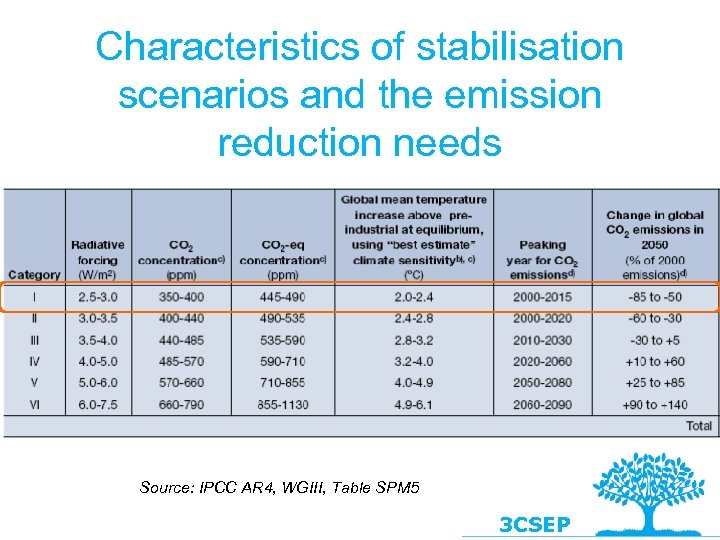
Characteristics of stabilisation scenarios and the emission reduction needs Source: IPCC AR 4, WGIII, Table SPM 5 3 CSEP

Acknowledgements: authors of Chapter 6 v Coordinating Lead Authors: q Mark Levine (USA), Diana Ürge-Vorsatz (Hungary) v Lead Authors: q Kornelis Blok (The Netherlands), Luis Geng (Peru), Danny Harvey (Canada), Siwei Lang (China), Geoffrey Levermore (UK), Anthony Mongameli Mehlwana (South Africa), Sevastian Mirasgedis (Greece), Aleksandra Novikova (Russia), Jacques Rilling (France), Hiroshi Yoshino (Japan) v Contributing Authors: q Paolo Bertoldi (Italy), Brenda Boardman (UK), Marilyn Brown (USA), Suzanne Joosen (The Netherlands), Phillipe Haves (USA), Jeff Harris (USA), Mithra Moezzi (USA) v Review Editors: q Eberhard Jochem (Germany), Huaqing Xu (PR China) 3 CSEP
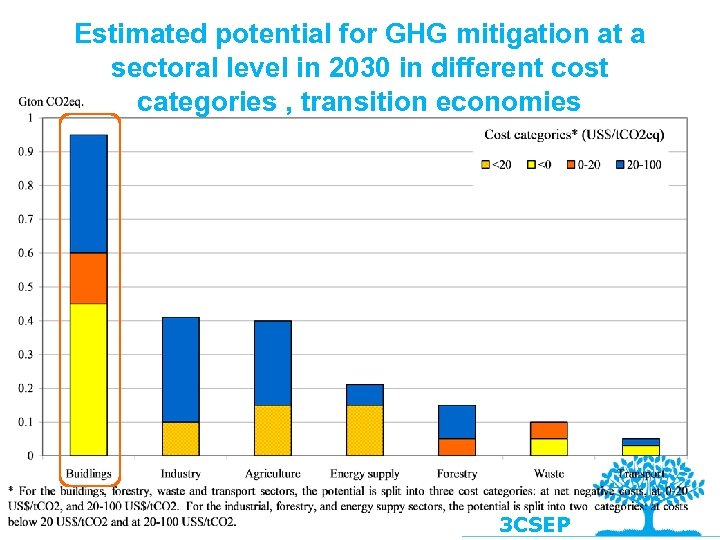
Estimated potential for GHG mitigation at a sectoral level in 2030 in different cost categories , transition economies 3 CSEP
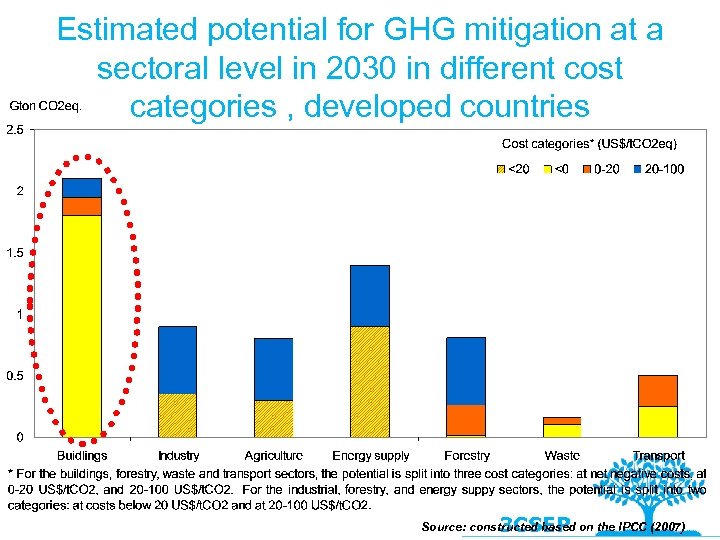
Estimated potential for GHG mitigation at a sectoral level in 2030 in different cost categories , developed countries 3 CSEP Source: constructed based on the IPCC (2007)
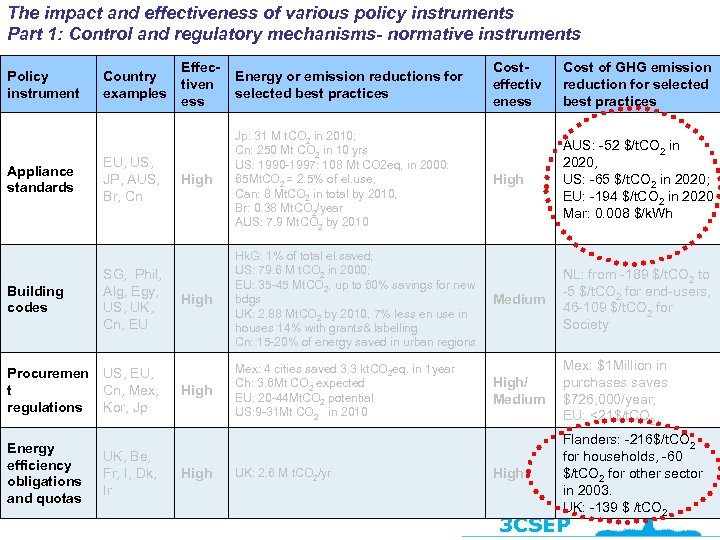
The impact and effectiveness of various policy instruments Part 1: Control and regulatory mechanisms- normative instruments Policy instrument Appliance standards Country examples EU, US, JP, AUS, Br, Cn Building codes SG, Phil, Alg, Egy, US, UK, Cn, EU Procuremen t regulations US, EU, Cn, Mex, Kor, Jp Energy efficiency obligations and quotas UK, Be, Fr, I, Dk, Ir Effectiven ess Energy or emission reductions for selected best practices High Jp: 31 M t. CO 2 in 2010; Cn: 250 Mt CO 2 in 10 yrs US: 1990 -1997: 108 Mt CO 2 eq, in 2000: 65 Mt. CO 2 = 2. 5% of el. use, Can: 8 Mt. CO 2 in total by 2010, Br: 0. 38 Mt. CO 2/year AUS: 7. 9 Mt. CO 2 by 2010 High Hk. G: 1% of total el. saved; US: 79. 6 M t. CO 2 in 2000; EU: 35 -45 Mt. CO 2, up to 60% savings for new bdgs UK: 2. 88 Mt. CO 2 by 2010, 7% less en use in houses 14% with grants& labelling Cn: 15 -20% of energy saved in urban regions High Mex: 4 cities saved 3. 3 kt. CO 2 eq. in 1 year Ch: 3. 6 Mt CO 2 expected EU: 20 -44 Mt. CO 2 potential US: 9 -31 Mt CO 2 in 2010 High UK: 2. 6 M t. CO 2/yr Costeffectiv eness Cost of GHG emission reduction for selected best practices High AUS: -52 $/t. CO 2 in 2020, US: -65 $/t. CO 2 in 2020; EU: -194 $/t. CO 2 in 2020 Mar: 0. 008 $/k. Wh Medium NL: from -189 $/t. CO 2 to -5 $/t. CO 2 for end-users, 46 -109 $/t. CO 2 for Society High/ Medium Mex: $1 Million in purchases saves $726, 000/year; EU: <21$/t. CO 2 High Flanders: -216$/t. CO 2 for households, -60 $/t. CO 2 for other sector in 2003. UK: -139 $ /t. CO 2 3 CSEP
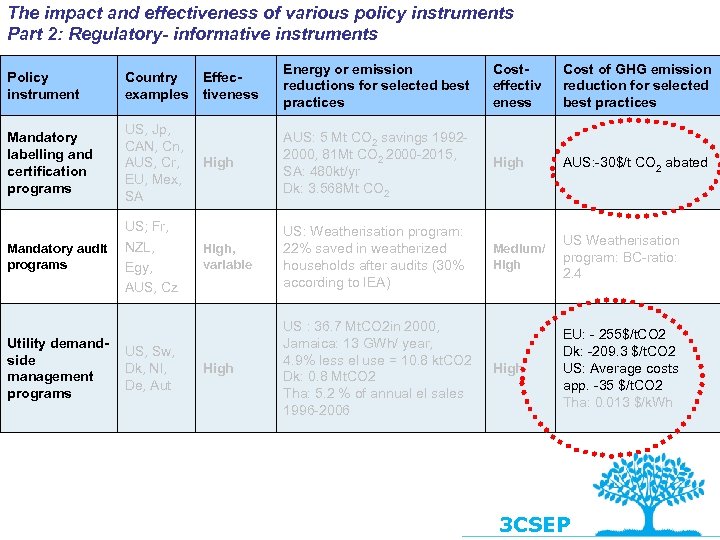
The impact and effectiveness of various policy instruments Part 2: Regulatory- informative instruments Policy instrument Country examples Mandatory labelling and certification programs US, Jp, CAN, Cn, AUS, Cr, EU, Mex, SA Mandatory audit programs US; Fr, NZL, Egy, AUS, Cz Utility demandside management programs US, Sw, Dk, Nl, De, Aut Effectiveness Energy or emission reductions for selected best practices Costeffectiv eness Cost of GHG emission reduction for selected best practices High AUS: 5 Mt CO 2 savings 19922000, 81 Mt CO 2 2000 -2015, SA: 480 kt/yr Dk: 3. 568 Mt CO 2 High AUS: -30$/t CO 2 abated High, variable US: Weatherisation program: 22% saved in weatherized households after audits (30% according to IEA) Medium/ High US Weatherisation program: BC-ratio: 2. 4 High US : 36. 7 Mt. CO 2 in 2000, Jamaica: 13 GWh/ year, 4. 9% less el use = 10. 8 kt. CO 2 Dk: 0. 8 Mt. CO 2 Tha: 5. 2 % of annual el sales 1996 -2006 High EU: - 255$/t. CO 2 Dk: -209. 3 $/t. CO 2 US: Average costs app. -35 $/t. CO 2 Tha: 0. 013 $/k. Wh 3 CSEP
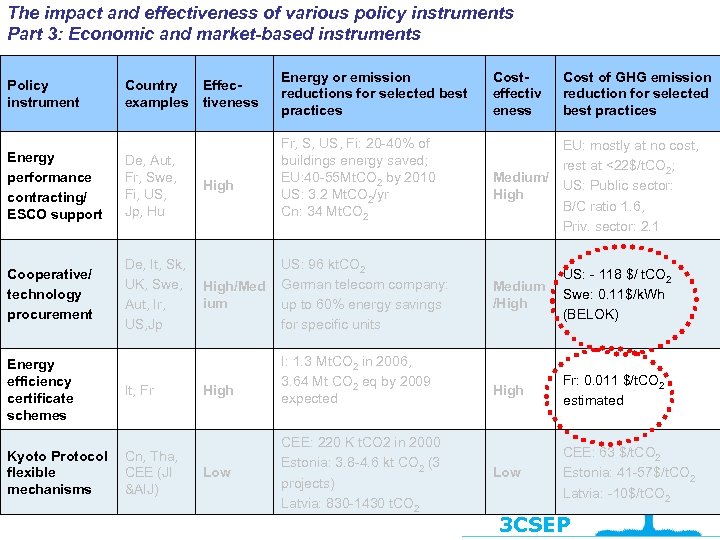
The impact and effectiveness of various policy instruments Part 3: Economic and market-based instruments Policy instrument Country examples Energy performance contracting/ ESCO support De, Aut, Fr, Swe, Fi, US, Jp, Hu Cooperative/ technology procurement De, It, Sk, UK, Swe, Aut, Ir, US, Jp Energy efficiency certificate schemes Kyoto Protocol flexible mechanisms It, Fr Cn, Tha, CEE (JI &AIJ) Effectiveness Energy or emission reductions for selected best practices Costeffectiv eness High Fr, S, US, Fi: 20 -40% of buildings energy saved; EU: 40 -55 Mt. CO 2 by 2010 US: 3. 2 Mt. CO 2/yr Cn: 34 Mt. CO 2 EU: mostly at no cost, rest at <22$/t. CO 2; Medium/ US: Public sector: High B/C ratio 1. 6, Priv. sector: 2. 1 High/Med ium US: 96 kt. CO 2 German telecom company: up to 60% energy savings for specific units Medium /High US: - 118 $/ t. CO 2 Swe: 0. 11$/k. Wh (BELOK) High Fr: 0. 011 $/t. CO 2 estimated Low CEE: 63 $/t. CO 2 Estonia: 41 -57$/t. CO 2 Latvia: -10$/t. CO 2 High Low I: 1. 3 Mt. CO 2 in 2006, 3. 64 Mt CO 2 eq by 2009 expected CEE: 220 K t. CO 2 in 2000 Estonia: 3. 8 -4. 6 kt CO 2 (3 projects) Latvia: 830 -1430 t. CO 2 Cost of GHG emission reduction for selected best practices 3 CSEP
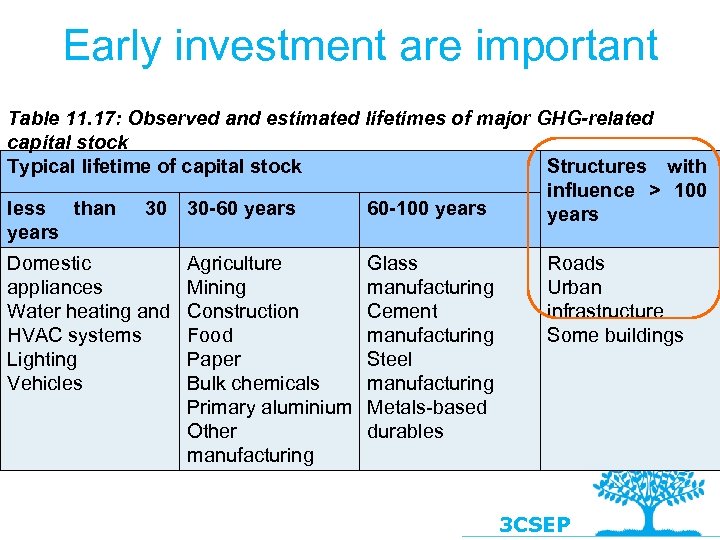
Early investment are important Table 11. 17: Observed and estimated lifetimes of major GHG-related capital stock Typical lifetime of capital stock Structures with influence > 100 less than 30 30 -60 years 60 -100 years Domestic appliances Water heating and HVAC systems Lighting Vehicles Agriculture Mining Construction Food Paper Bulk chemicals Primary aluminium Other manufacturing Glass manufacturing Cement manufacturing Steel manufacturing Metals-based durables Roads Urban infrastructure Some buildings 3 CSEP
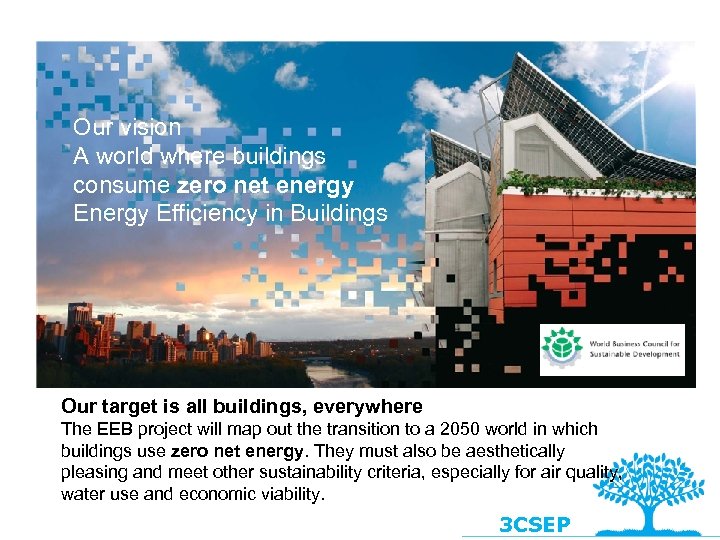
Our vision A world where buildings consume zero net energy Efficiency in Buildings Our target is all buildings, everywhere The EEB project will map out the transition to a 2050 world in which buildings use zero net energy. They must also be aesthetically pleasing and meet other sustainability criteria, especially for air quality, water use and economic viability. 3 CSEP
Скачать презентацию Controlling Climate Change and Fostering sustainable Development in
3b0e144e6753f912d5f2b45e001c7462.ppt